
Category: 11th Notes

  • Errors of measurement

    Errors of measurement

    Errors of measurement-

    generally it is seen the measured value of a quantity is different from its actual value . this difference in the measured value and and the true value of a quantity is called error of measurement. 

    Errors of measurement can be divided into following types-

    Systematic errors -Those errors whose causes are known and it can be corrected ( or ,  can be minimised). Like Instrumental errors, personal errors ,Error due to imperfection and errors due to external causes.

    Random errors-These errors may arise due to large variety of factors . some time it is also called ‘ chance error’ . random errors can be minimised by repeating the observation.

    Gross errors– These errors arises due to carelessness of the observer during the measurement of the values.

    Absolute errors– Absolute errors in the measurement is the difference between true value and measured value of the quantities . The absolute errors sometime may be positive and sometime negative .

    Mean absolute error-It is the arithmetic mean of magnitudes of absolute errors.

    Relative errors /Fractional errors-It is the ratio of mean absolute errors to the mean value or true value of the quantities measured.

    Permissible errors-It is the errors which arises due to limitations on the measuring abilities of various instruments use in the experiment.

    Accuracy– It is the extent to which a measurement approaches the true value of the quantities measured.

    Precision– It describes the limitations of the measuring instruments . It is the degree of correctness of a measurement.

    To  download important questions  on Errors  click here


  • Significant figure

    Significant figure

    Significant figure

    In this topic we will discuss what is a significant figure ?  how can we find the significant figure in the given values and what are the rules for counting significant figure ?

    Significant figure – It is the measured value of a physical quantity tell the number of digit in which we are confident . (  Larger the value of significant figure greater will be the accuracy and vice versa ).

    Number of significant figure in a physical quantity depends upon the least count of the instrument used for its measurement.

    Rules for counting significant figure –

    1. All non zero digits are significant figure , and all zeros occurring between the two non zero digits  are significant.
    2. In a number less than 1 , all zeros to the right of decimal point and to the left of a nonzero digit are not significant . But all the zeros on the right of the last non zero digit in the decimal part are significant.
    3. All zeros on the right of non zero digits are not significant . but all zeros on the right of the last non zero becomes significant when they come from a measurement.


    (Note- change in the unit of measurement of a quantity does not change the number of significant figures .)


  • PARALLAX METHOD

    PARALLAX METHOD –

    – Parallax method has been used for measuring distance of stars which are less than 100 light years away.(parallax is the name given to change in the position  of an object with respect to the back ground , when the object is seen from the two different positions .)

    PARALLAX METHOD
    PARALLAX METHOD FIGURE

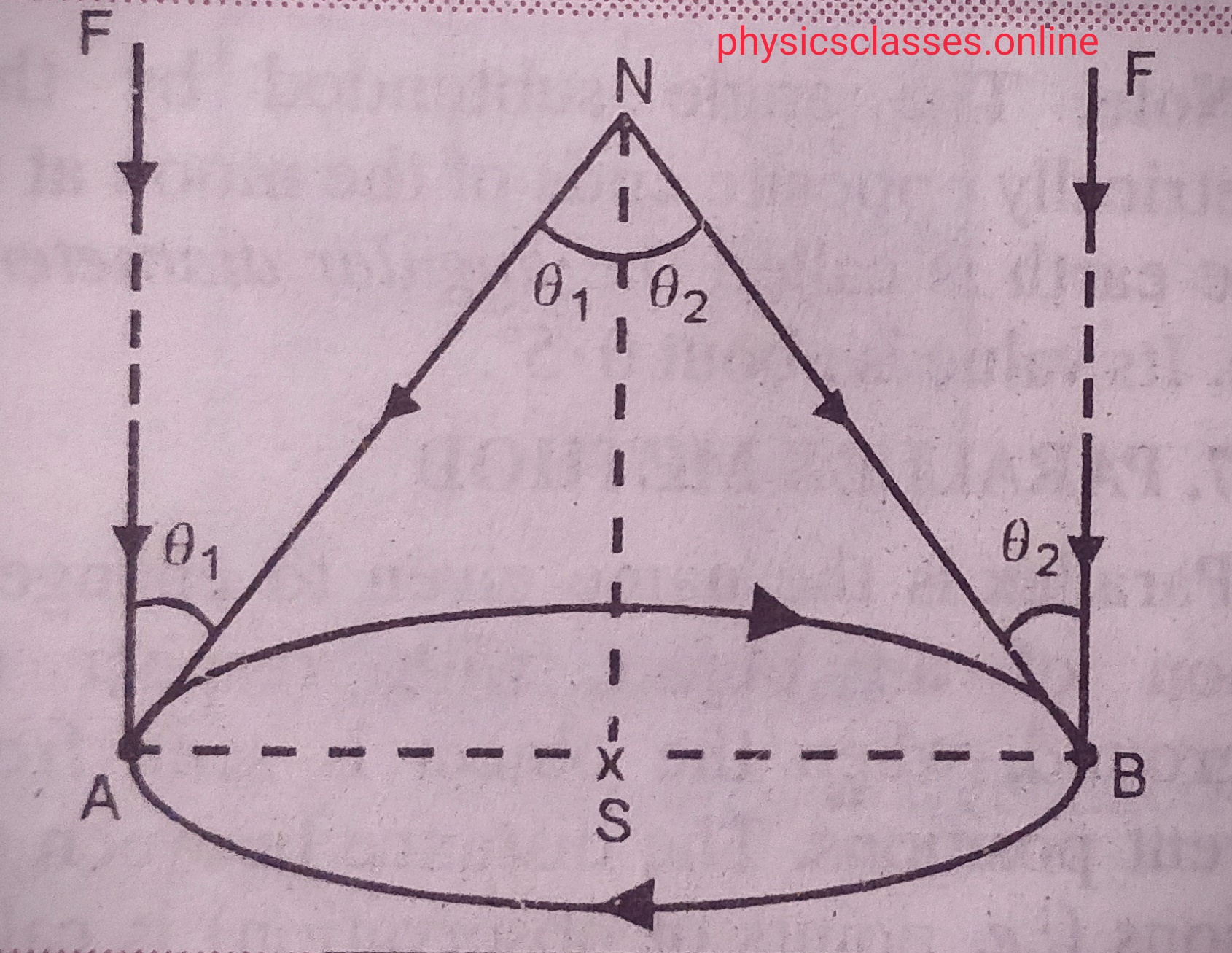
    The diameter AB  of earth’s orbit around the sun is chosen as the base line as shown in the fig. . N is the nearby star whose distance (d) from the earth is to be measured . F is a far off star whose direction is taken practically the same at all position of earth in its orbital motion .

    Suppose A is the position of earth in its orbital motion at any time . using an astronomical telescope we measure <FAN = θ1 , between the directions of light from distant star F and nearby star N . As it clear from the figure  <FAN = <ANS =θ1 .

    After six months earth is at B which is directly opposite to the point A , let < FBN =θ2, between the direction of light from distant star F and nearby star N is measured again   <FBN = <BNS = θ2

    Clearly , <ANB = <ANS +<BNS = θ1 + θ2 .

    As we know , angle = arc/ radius

    Therefore ,  θ1 + θ2  = AB/AN

    Or AN = AB / θ1 + θ2 .

    Clearly AB= 2AS = 2AU

    If θ1 and   θ2 is known then AN can be calculated.

    ( Note – the parallax method is used for measuring distance of nearby stars only. And parallax method is also used for determining distance of moon from earth ).