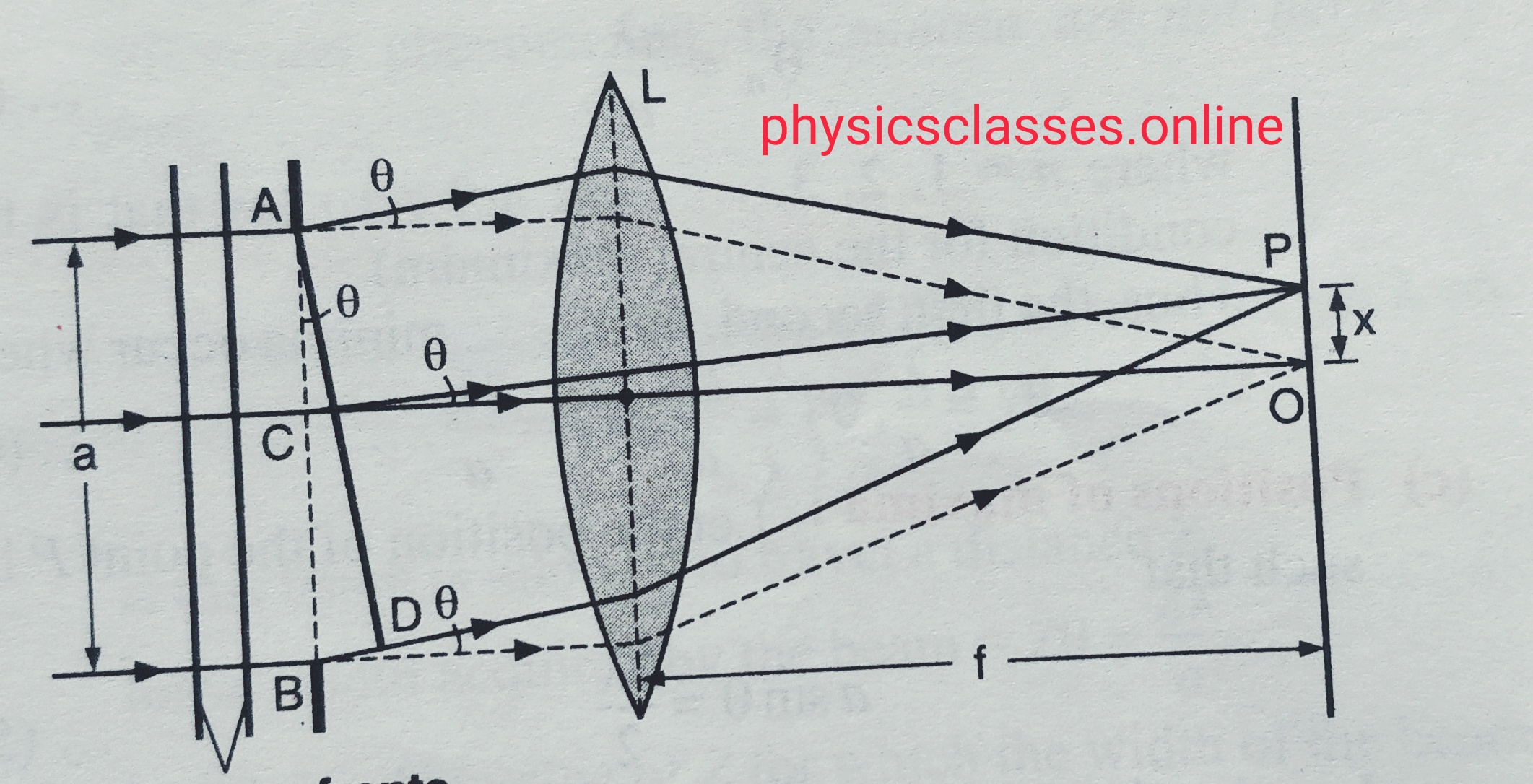
In this topic we will discuss what is diffraction of light , using single slit experiment formation of central max , position of secondary maxima and minima.
Diffraction of Light – Single Slit Experiment
diffraction single slit
1. What is diffraction of light?
Diffraction of light is the phenomenon of bending and spreading of light waves when they pass through a narrow slit or around the edge of an obstacle.
Diffraction is clearly observed when the size of the slit or obstacle is comparable to the wavelength of light.
In this topic we will explain the photoelectric effect and also will explain hertz’s observation and Hallwach’s and Lenard’s observation.
Photoelectric Effect: Hertz, Hallwachs and Lenard’s Observations
1. What is the Photoelectric Effect?
The photoelectric effect is the phenomenon in which electrons are emitted from the surface of a metal when electromagnetic radiation of a suitable frequency falls on it.
The emitted electrons are called photoelectrons, and the current produced by their motion is called photoelectric current.
Example: When ultraviolet light falls on a clean zinc plate, electrons may be emitted from its surface.
Important terms
Photoelectrons: Electrons emitted from a metal surface due to incident light.
Work function (ϕ): The minimum energy required to remove an electron from a metal surface.
Threshold frequency (): The minimum frequency of light required to produce photoelectric emission.
Stopping potential (): The minimum reverse potential required to stop even the fastest photoelectrons.
Einstein’s photoelectric equation is
where:
= Planck’s constant
= frequency of incident light
= work function of the metal
= maximum kinetic energy of emitted electrons
Since
This equation explains the main features of the photoelectric effect.
2. Hertz’s Observation (1887)
Heinrich Hertz
Heinrich Hertz was conducting experiments to demonstrate electromagnetic waves. During his experiments, he observed that ultraviolet radiation helped an electric spark pass between two metal electrodes.
Experimental observation
Hertz produced an electric spark between two metal electrodes.
He observed that ultraviolet light falling on the electrodes made the spark easier to produce.
When the ultraviolet radiation was blocked, the spark became more difficult to produce.
Conclusion
Hertz’s observation indicated that ultraviolet radiation could help release electrons from a metal surface, facilitating the discharge.
Importance: His observation was an early discovery of the photoelectric effect.
3. Hallwachs’s Observation (1888)
Wilhelm Hallwachs
Wilhelm Hallwachs studied the effect of ultraviolet light on electrically charged metal plates, especially a clean zinc plate.
Experiment
A clean zinc plate was connected to a negatively charged gold-leaf electroscope.
The electroscope’s gold leaf diverged because the plate and electroscope carried negative charge.
Ultraviolet light was allowed to fall on the zinc plate.
The gold leaf gradually collapsed, indicating that the electroscope was losing its negative charge.
Observation and conclusion
Negatively charged zinc plate: It loses negative charge when exposed to suitable ultraviolet light.
Positively charged zinc plate: It does not readily discharge through photoelectric emission because the emitted electrons are attracted back to the positively charged plate.
Uncharged zinc plate: It can become positively charged after photoelectrons escape.
Conclusion: Ultraviolet light causes electrons to leave the zinc surface.
This provided clear evidence that light can cause the emission of electrons from a metal.
4. Lenard’s Observation (1902)
Philipp Lenard
Philipp Lenard investigated photoelectric emission using a metal surface and an apparatus in which emitted electrons could be collected and measured.
Experimental setup
In a typical arrangement:
Light falls on a metal cathode.
Photoelectrons are emitted from the cathode.
A collector electrode (anode) collects the electrons.
The resulting photoelectric current is measured using an external circuit.
Main observations of Lenard
1. Photoelectric current depends on light intensity.
For light of frequency above the threshold frequency, increasing the intensity generally increases the number of emitted electrons per second. Therefore, the photoelectric current increases.
2. Maximum kinetic energy depends on frequency.
Increasing the frequency of incident light increases the maximum kinetic energy of photoelectrons, provided the frequency is above the threshold.
3. Existence of stopping potential.
A reverse potential can be applied to oppose the motion of photoelectrons. At a particular reverse potential, even the fastest electrons cannot reach the collector, and the current becomes zero.
Kmax=eVs
Here, e is the magnitude of the electron’s charge and Vs is the stopping potential.
4. Threshold frequency exists.
Below a certain minimum frequency, no photoelectrons are emitted, even if the intensity of light is increased.
Conclusion: Lenard’s experiments established important properties of photoelectric emission and showed that the energy of photoelectrons is related to the frequency of incident light.
5. Comparison of Hertz, Hallwachs and Lenard
Scientist
Main observation
Significance
Hertz (1887)
UV light made an electric spark easier to produce.
Early discovery of photoelectric emission.
Hallwachs (1888)
UV light discharged a negatively charged zinc plate.
Demonstrated that electrons leave the metal surface.
Lenard (1902)
Studied emitted electrons, their current, kinetic energy and stopping potential.
Established important experimental laws of the photoelectric effect.
6. Key results to remember for exams
Intensity of light
Increasing intensity increases photoelectric current, provided the frequency is above the threshold.
Frequency of light
Increasing frequency increases the maximum kinetic energy of photoelectrons.
Threshold frequency
Below the threshold frequency, photoelectric emission does not occur, regardless of intensity in the ordinary one-photon photoelectric effect.
Stopping potential
The stopping potential depends on the maximum kinetic energy, and therefore on the frequency of light for a given metal.
Introduction to Objective Physics for Class 12 “Objective Physics” by Nayan Jha meets the demand for objective questions in Class 12 Physics exams. Key Features of This Book: Comprehensive Question Types: Multiple Choice Questions (MCQs) with answers, Assertion–Reason Questions with answers, Case Study Based Questions with answers, Focus on Conceptual Understanding: Each question enhances students’ conceptual understanding of Physics. Problem-Solving Skill Development: The book strengthens students’ ability to solve various Physics problems. Detailed Solutions: Every question includes a detailed solution. Solutions explain the correct answer and underlying Physics principles. Target Audience and Benefits: This book is for: Class 12th Board Examination Preparation: It offers effective preparation for board exams. NEET and JEE Aspirants: Concept-based questions benefit students preparing for NEET and JEE. How This Book Helps Students: Chapter-wise Practice: Chapter-organized questions allow students to assess preparation and identify improvement areas. Beyond Memorization: The aim is to foster deeper understanding, helping students understand concepts, learn applications, and build confidence in solving objective questions. Author’s Philosophy: “Concepts + Practice = Success — Your Success is My Mission.” — Nayan Jha Physics by Nayan Jha
In this blog physics classes by Nayan jha providing objective questions and answers , which contain multiple choice , assertion reason and case study based questions with explanation( complete solution.
For question numbers 86-100, two statements are given-one labelled Assertion (A) and the other labelled Reason (R). Select the correct answer to these questions from the codes (a), (b), (c) and (d) as given below. (a) Both A and R are true and R is the correct explanation of A (b) Both A and R are true but R is NOT the correct explanation of A (c) A is true but R is false (d) A is false and R is also false
Assertion (A) : Long distance transmission of A.C. is carried out at extremely high voltage. Reason (R): For large distance, voltage has to be large….
Assertion (A) : An electric lamp connected in series with a variable capacitor and A.C. source, its brightness increases with increase in capacitance. Reason (R): Capacitive reactance decreases with increase in capacitance of capacitor.
Assertion (A) : A transformer cannot work on D.C. supply. Reason (R): D.C. changes neither in magnitude nor in direction.
Assertion (A) : Step-down transformer increases the current. Reason (R): Transformer obeys the law of conservation of energy.
There are 20 questions in the question paper , in which 14 are objective, (1 marker) and other 6 are subjective which carry 2 marks each .
This question paper covers the chapter magnetism and electromagnetic induction . It is just for the practice the questions of the chapters magnetism and electromagnetic induction.
1. Define the term magnetic moment of a current loop . Write the expression for the magnetic moment when an electron revolve at speed v around the orbit of radius r in hydrogen atom .
2 . Define magnetic susceptibility of the materials . Name two elements , one having positive and other having negative susceptibility . what does negative susceptibility signify ?
3. A bar magnet of magnetic moment M is aligned parallel to the direction of a uniform magnetic field B. What is the work done to turn the magnet, so as the align its magnetic moment (i) Opposite to the field direction (ii) Normal to the field direction?
4. Two circular coils one of small radius r and other of very large radius R are placed coaxially with center coinciding. Obtain the mutual inductance of the arrangement.
To download the complete question paperclick here –
There are 20 questions in this question paper. Students have to solve it in 25 minutes only .
Test NEET/JEE (ch-1,2,3,4)
1. A new system of units is proposed in which unit of mass is A kg . unit of length is B kg and unit of time is C s , What will be the value of 5 j in new system?
2. If linear momentum P , area A and time t is taken as fundamental units then the dimensional formula of energy is (a) P1 A-1 t-1 (b) P2 A1 t1 (c) P1 A-1/2 t1 (d) P1 A1/2 t-1.
3. If E , m,L and G denotes energy , mass , length and gravitational constant then the ( EL2 /m5G2) has the dimension of (a) mass (b) length (c) time (d) angle.
4. The period of oscillation of time period T is 2π(l/g)1/2 measured value of l is 10 cm is known as 1mm accuracy ant time for 100 0scillations of the pendulum is found to be 50 s using a wrist watch of 1s resolution . What is the accuracy in the measurement of g ?
(a)2% (b) 3% (c) 4% (d) 5% .
5. Two resistors of resistance R1=100+-3 Ohm R2=200+-4 Ohm then the equivalent resistance of parallel combination is (a) 66.7 +-1.8 (b) 66.7+- 4 (c) 66.7+-3 (d)66.7+-7 Ohm.
6. A cube has a side of length 1.2 x 10⁻² its volume upto correct significant figure is (a) 1.7×10 -6 (b) 1.73×10 -6 (c) 1.78×10 -6(d) 1.732×10 -6.
7. T he position of the object moving along x-axis is given by x= a+bt2, where a=8.5 b=2.5 and t is measured in seconds. The average velocity of the object between t=2s to t=4 s in m/s is (a) 5 (b) 10 (c) 15 (d) 20 .
8. A player throw a ball vertically upwards with velocity u at highest pint , (a) both velocity and acceleration are zero (b) The velocity of the ball is u and acceleration is zero (c)The velocity of the ball is 0 but acceleration is g (d) the velocity of the ball is u and acceleration is g .
9. If a lift is moving upward with velocity 5m/s a girl throw a ball upward with speed 50m/s the ball will returns on her hand in time (a)5s (b)10s (c) 15s (d) 20s.
10. A boy sliding on the smooth inclined plane requires 4 s to reach on the ground starting from rest from the top . How much time will it take to cover one fourth the distance starting from rest at the top?
(a) 1s (b) 4s (c)2s (d)16s .
11. A particle is released from rest from a tower of height 3h . the ratio of the intervals of time to cover three equal heights h is (a) t1:t2: t3 = 3:2:1 (b) t1:t2: t3 =1: (√2-1)(:√3-2) (c) t1:t2: t3 =√3:√2:1 (d) t1:t2: t3 = 1:√2-1): (√3-√2).
12. A ball A is thrown upward with velocity u at the same time another ball B is released from rest at height H, at time t the speed of A relative to B is (a) u (b) u-2gt (c) (u2-2gh)1/2 (d)u-gt.
13. A vehicle travel half the distance L with speed V1 and other half with speed V2 then its average speed is , (a) (V1 + V2)/2 (B) (2V1+V2)/V1+ V2 (C) 2V1V2/V1+V2 (D) L(V1+ V2)/V1V2 .
14. Two vectors and A+B = C then A and B are (a) parallel (b) perpendicular (c) anti-parallel (d) null vector.
15. If resultant of two equal vectors is equal to the either forces Then the angle between these two vectors is ,(a) 900 (b) 1200 (c) 600 (d) 300
16. if dot product of two vectors is null vector then the angle between these two vectors is (a) 0 (b) 1200 (c) 900 (d) 450 .
17. If then then which of the following statement is correct ( a) vector A is perpendicular to vector B (b) vector A is parallel to vector C (c) vector b is parallel to vector C (D) vector A is perpendicular to vector C .
18.Two vectors magnitude of A,B and C are 3,5,4 respectively then (a)the angle between A and B is 900 . angle between A and C is 900. (c) angle between B and C is 900(d) angle between A and B is 00.
19. If unit vector of a vector is represented as 0.5 – 0. 8 +c then the value of c is (a) √0.01 (b) √0.11 (c) √0.39 (d) 1.
20. The component of a vector A is along X-axis will have maximum value if (a)vector A is along positive Y axis (b)vector A along positive x-axis (c) vector A makes angle 450 with the x-axis (d) A is along negative X aixis.
Physics classes by Nayan jha provoding information ,How to select coaching centre for NEET and JEE
Students/parents as you know these days most of the parent or students are looking to settle their child as quick as possible. And IIT (Indian institute of technology) and medical colleges like AIIMS play the great role to do so.
As we know every student who appears for the 10th class exams has one big question about his life that which stream to select for further education. Once the decision for the stream is made, which is Science. Then next question is medicine or engineering? The answer to this question marks the beginning of a dream career. Students can decide this based on what subject interests them. If students scores good in NEET leads to admission to a good medical college, whereas a good score in IIT JEE will help students get admission to a reputed engineering college.
Both the exams are national-level entrance exams and hold a lot of importance concerning students’ higher education. One more doubt that arises when deciding between the two is which exam is easier to crack. Now, and for this selection of good coaching center is required to score good marks to take the admission in reputed colleges, every student who appears for the 10th class exams has one question about which stream to select for further education. Once the decision for the stream is made, the stream is Science. The question that comes next is medicine or engineering? The answer to this question marks the beginning of a dream career. Students can decide this based on what subject interests them. A good score in NEET leads to admission to a good medical college, whereas a good score in IIT JEE will help students get admission to a reputed engineering college.
Both the exams are national-level entrance exams and hold a lot of importance concerning students’ higher education. One more doubt that arises when and where should we join the coaching center or tuitions . Here is the answer – You just watch the video given below-
This assignment contains some important questions based on the surface tension, in which there are some objective and some numericals based questions.
these questions are for the practice of the topic surface tension and surface energy, excess pressure inside the liquid drop, soap bubble , ascent formula etc.
Multiple choice questions. (Only one option is correct)
1. The angle of contact doesn’t depend upon, (a) Temperature (b)Surface impurity (c) Cohesive force (d) The inclination of surface in contact. Ans -d
2. When a capillary tube is immersed in a liquid , then the liquid of mass m rises in the capillary tube .If capillary tube of double radius is taken then the mass f same liquid rising in the tube is , , (a) M/2 (b) 2M (c) M/4 (d) 4M . Ans- b
3. What will be the work done to increasing the radius of the soap bubble from r/2 to 2r . If surface tension of soap solution is T ? , (a) 3πr2T (b) 30πr2T (c) 9πr2T (d) 12πr2T . Ans-b
4. pressure inside soap bubble are 1.02 atm and 1.05 atm respectively . then the ratio of their surface area is (a) 125/8 (b) 25/4 (c)5/2 (d)2/5. Ans-b
Dou you want to know the harmful effect of Online classes click here–
5.The property utilized in the manufacture of lead shots is (a)specific gravity of lead (b)specific weight of the liquid lead (c) compressibility of the liquid lead (d) surface tension of the liquid lead. Ans-d
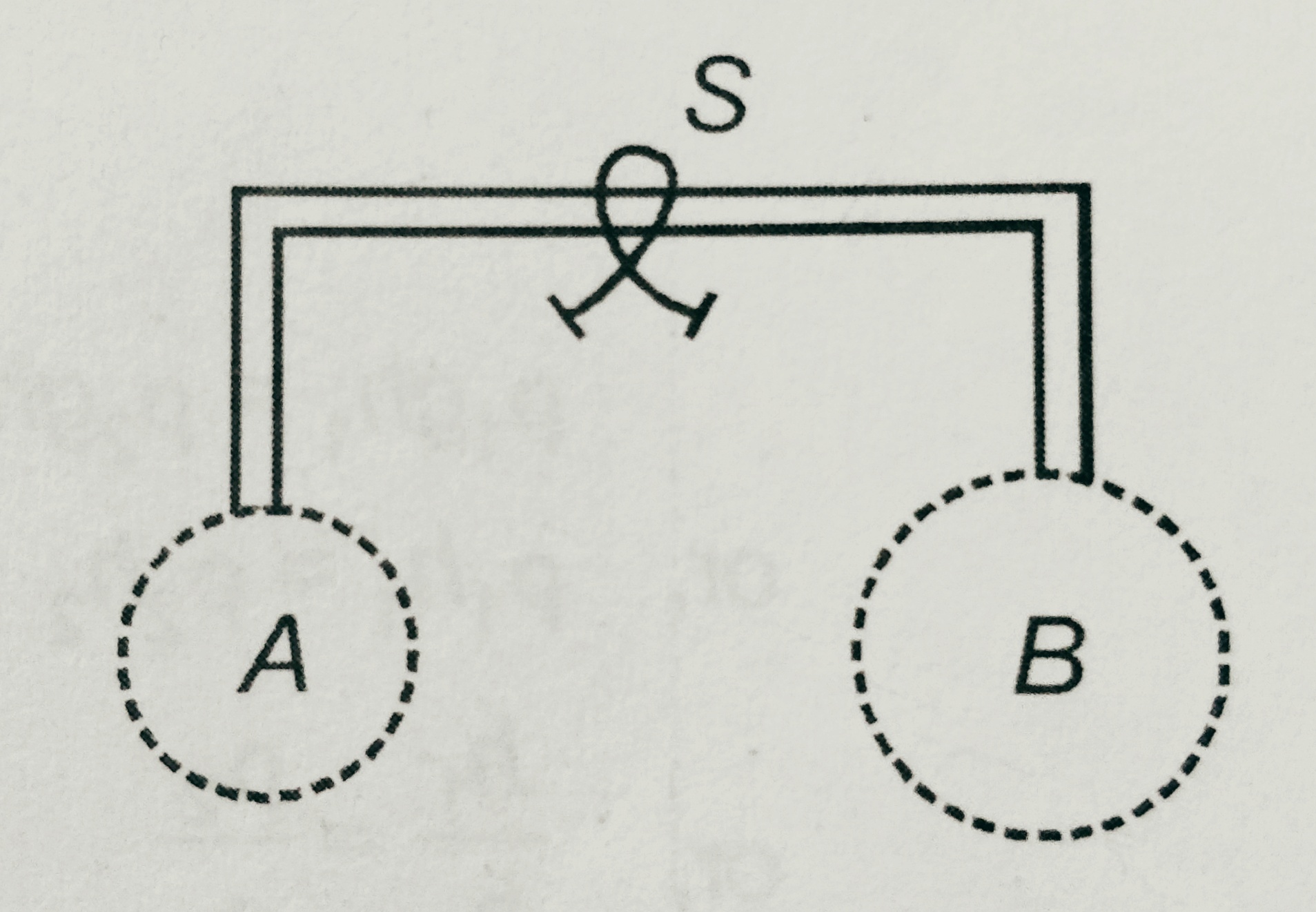
6. Two soap bubbles are connected by a tube as shown in figure , what happens when stopper s is removed ?
(a)size of A increase (b) size of B is decreased (c) both takes the same size (d) size of bubble A decreases and size of bubble B increases. Ans-d
7. Two soap bubble of radii 2cm and 4 cm are join to form a double bubble in air , then the radius of curvature of the interface is , (a)2√5 cm (b)2cm (c)4 cm (d) 2√3cm . Ans-c
8. A square wire frame of side l is floating on the surface of the liquid of surface tension T . The force required to pull out the frame from the liquid is (a) Tl (b) 2Tl (c) 4Tl (d) 8Tl . Ans-d
9. Two drops of liquid coalesce to form a single drop . In this process energy is (a) Absorbed (b) Evolved (c) Either absorbed or evolved (d) Neither absorbed nor evolved. Ans-b
10. Surface tension of a liquid , at critical temperature is (a)Maximum (b)Unchanged (c) Zero (d) none of these. Ans-c
Important numericals based on this topic –
TO WATCH THE VERY IMPORTANT TOPIC OF SURFACE TENSION WHICH IS EXCESS PRESUURE INSIDE THE SOAP BUBBLE AND LIQUD DROP CLICK ON THE VIDEO LINK GIVEN BELOW-
1.The surface tension of the soap solution is 30 x 10-3N/m .How much work is done to increase the radius of the soap bubble from 1.5 cm to 3 cm . Ans- 5.091 x 10⁻⁴ j.
2. A square glass plate of length 10cm and thickness 0.4cm, weighs 40 g in air . It is held vertically such that its lower edge rests on water surface. What is the apparent weight of glass plate now? (S.T. of water is 0.073 N/m). Ans-0.407N.
3. The radii of two air bubbles are in the ratio 4:5 .Find the ratio of excess pressure inside them . Also compare the works done in Blowing these bubbles. Ans-5/4 ; 16/25 . .
4. A circular plate of radius 4cm and weight W is made to rest on the surface of water if a minimum pull of W+F is required to clear the plate off the water surface then find F , given surface tension of water is 0.072N/M. Ans-0.018N .
5. Water rises up in a glass capillary upto a height of 10cm , while mercury falls down by 3.5 cm in the same tube. If the angle of contact for water – glass and mercury-glass are is taken as 00 and 1350 respectively . compare the surface tension of water and mercury. [ density of water and mercury are 103 and 13.6×10³kg/m3.].
6. A canister has a small hole at its bottom .What penetrates into the canister when its base is at a depth of 40cm from the surface of water. If surface tension of water is 73.5 dyne/cm, find the radius of the hole . Ans- 0.0375mm.
To get the solution of all numerical questions given above click here–
Are you looking to prepare JEE/NEET and looking for the best coaching center , then you must watch this video how to select coaching centre for JEE/NEET.
This assignment contains Important objective questions of mechanical properties of fluid , based on pressure atmospheric pressure , Pascal’s law , buoyancy etc.
It will be beneficial for the students preparing for 11th , NEET / JEE and other examination.
Mechanical properties of fluids
Questions based on fluid pressure , atmospheric pressure, Pascal’s law
1 . Dimension formula of pressure head is – (a) [M0 L0 T0 ] (b) [M L-1 T-2 ] (c) [M0 L1 T-2 ] (d) [M0 L1 T0 ].
Ans-d
2.The two thigh bones each of cross-sectional area 10cm2 supports the upper part of the person of a mass 50 kg . The average pressure sustained by the bones is , (a) 2.5 x 10⁵ N/m2 (b) 4 x 10⁵ N/m2 (c) 5 x 10⁵N/m2 (d) 106 N/m2 .
Ans-a
3.What is the pressure on the swimmer 20m below the surface of water? (a)1atm (b) 2atm (c) 3 atm (d) 4 atm .
Ans-c
4. Water is filled to a height H behind the dame of width w . The resultant force on the dame is ( if d is the density of water), (a) dgwH2 (b) 1/2 dgwH2 (c)2 dgwH2 (d)4 dgwH2.
Ans-b
5. A tank is filled by density d of liquid upto height H . The average pressure on the wall of the container is (a) dgH (b) ½ dgH (c) ¼ dgH (d) 1/8 dgH .
Ans-b
6. Increase in pressure at one point of the enclosed liquid in equilibrium of rest is transmitted equally to all other point of the liquid . This is as per (a) Buoyancy (b) Pascals law (c) conservation of momentum (d) Impulse .
Ans-b
7. By sucking through a straw , a boy can reduce the pressure in his lungs to 750mm of Hg ( density of Hg is 13.6 g/cm3). Using a straw he can drink water from a maximum depth of (a) 13.6 cm (b) 1.36 cm (d) 0.136 cm (d) 10 cm .
Ans-a
8. An open U-tube contains mercury , when 13.6 cm of water is poured into one of the arms of the tube , then the mercury rise in the other arm from its initial level is (a) 1cm (b) 0.5 cm (c) 10cm (d) 5 cm .
Ans-2
9. A cylinder of radius R full of liquid of density d Is rotated about its axis at w rad/sec. The increase in pressure at the centre of the cylinder will be (a) d w2 R2 /2 (b) d w2 R /2 (c) d2 w R /2 (d) d2 w2 R2 /2 .
Ans-a
10. A barometer kept in an elevator reads 76 cm when the accelerator is accelerating upward . The most likely pressure inside the elevator is ( in cm of Hg ) (a) 74 (b) 75 (c) 76 (d) 77 . Ans-d
Questions based on Archimedes principle , Buoyancy (up-thrust )
11. A body floating in water has 1/5th of its volume immersed in water . What fraction of its volume will be immersed , if it floats in liquid of specific gravity 1.2 ? ans- 1/6
12. A cylinder of height 30 cm and radius 7cm is immersed completely in a fluid of density 1.3 x 10³ kg/m3 . What is the buoyant force acting on it? G =10m/s2 . ans-60N.
13. A metallic spheres weighs 35g in air and 28.5 g in water. Find its relative density and also find its weight in a liquid of relative density 0.9 . ans- r.d – 5.4 and app-wt-29.15g .
14. A piece of gold weighs 50 g in air and 45g in water. If there is cavity inside the piece of gold , then find its volume ( density of gold is – 19.3 gm/cc) Ans-2.4
15.An alloy of Zn and Cu weighs 16.8 g in air and 14.7 g in water. If relative density of Cu and Zn are 8.9 and 7.1 respectively then determine the amount of Zn and Cu in alloy. Ans- Cu-9.34 Zn-7.45g.
16.An object of mass m is floating in a liquid of density x . if the object is made up of density y , then the apparent weight of the object in the liquid is (a) mg (b) mg(1-x/y) (c) mg (1-y/x) (d) zero. Ans-d
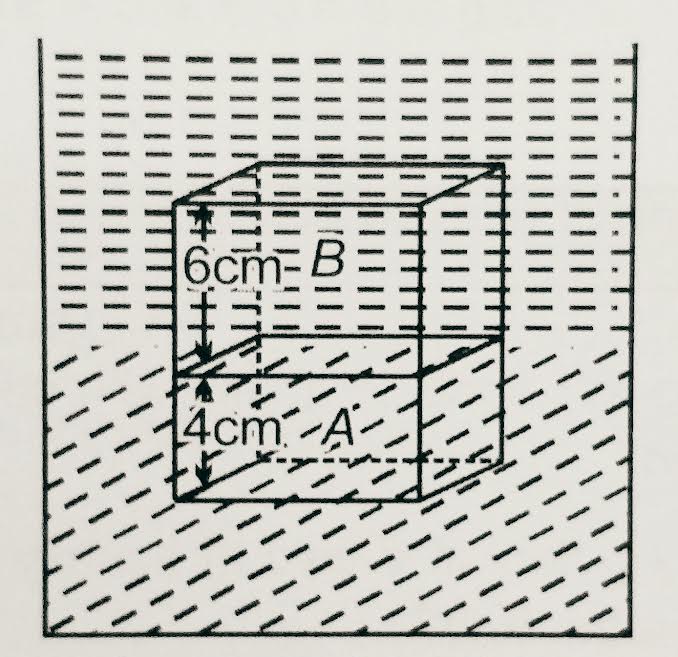
17. A cube of edge length 10 cm is just balanced at the interface of two liquids A and B as shown in fig. if A and B has specific gravity of 0.6 and 0.4 respectively then the mass of the cube is .
(a) 240g (b) 360g (c) 480g (d) 540g . ans-c
18.A boat having some iron pieces is floating in the pond , if iron pieces are thrown in the pond then level of the liquid (a) increases (b) Decreases (c) may increase or decrease (d) remain the same. Ans-b
19.When two liquid of same mass and different densities d1 and d2 mixed together, then the density of the mixture is (a) d1 +d2 (b) d1 +d2 /2 (c) 2d1 d2 / d1 +d2 (d) 2d1 +2d2 . Ans-c
20. When two liquid of same volume and different densities d1 and d2 mixed together, then the density of the mixture is (a) d1 +d2 (b) d1 +d2 /2 (c) 2 d1 d2 / d1 +d2 (d) 2d1 +2d2 . Ans-a
21. if there were no gravity, then which of the following will not be there for the fluid ? (a) viscosity (b)surface tension (c) pressure (d) upward thrust . ans-d
22. An ice cube contains a large air bubble . The cube is floating on the horizontal surface of water contained in a trough. What will happen to the water level when the cube is melts? (a) remain unchanged (b) it will fall (c) it will rise ( d) first it will fall and then rise . ans-a
23. The density of ice is 0.9gm/cm3.What percentage by volume by volume of the block of ice will float outside the water. (a) 10% (b)45% (c)75% (d)90% . ans-a
24. The reading of a spring balance when it is suspended in the air is 6oN . This reading is changed to 40N when it is submersed in water. The specific gravity of the block must be (a) 3 (b) 2 (c) 6 (d)1.5. ans-a
25. The weight of a body in water is one third of its weight in air. The density of the body in gm/cm3 is (a) 0.5 (b) 1.5 (c) 2.5 (d) 3.5 . ans-b
This is the assignment for the practice of objective questions of mechanical properties of solids. Students can consider it as a test paper of the chapter mechanical properties of solids.
1. Breaking stress depends on (a) length of wire (b) Area of cross-section of wire (c) both a and b (d) independent of length and area of cross-section.
2.Which of the following is perfectly plastic? (a) plasticine (b) Quartz fibre (c) steel (d) Rubber.
3. the length of an elastic string is X meter when the tension is 8N and Y m when tension is 10N , what will be the length when tension is 18N . (a) 4X-5Y (b) 5Y-4X (c) 9X-4Y (d) 4Y-9X.
4. When a load of 10kg is hung in the wire, then extension of 2m is produced. Then work done by the restoring force is (a)200J (b) 100J (c) 50J (d) 25J .
5.Substance which can be elastically stretched to large value of strain is called (a) isomers (b) isodiapheres (c) Plastomers (d) Elastomers .
6. A force F doubles the length of the wire of cross-section a . Then the Young’s modulus of the wire is (a) F/a (b) F/3a (c) F/2a (d) F/4a .
7. Breaking stress of a material is 2×10⁸ N/m2, what maximum length of the wire of this material can be taken so that the wire doesn’t break by own weight? ( density of material is 5×10³kg/m3) (a) 1km (b)2km (c) 3km (d) 4km.
8.Young modulus of elasticity for a gas is (a) 1 (b) infinity (c) zero (d) none of these .
9. If we added an impurity in the material then its elasticity (a) may change (b) never change (c) remain the same (d) change by a factor of 5 .
10. A structural steel rod has a radius r = 10mm when a force 100 kN is applied . it stretches along its length Y for steel is 2x 10¹¹ N/m2 . aswer the following questions-
(i) what is the stress produced ?
(ii)what is the elongation produced ?
(iii) what is the elastic energy density of the steel rod ?
(iv) elastic potential energy stored in the rod is what?
11.Elasticity of a rigid body is ………..
12. If Young’s modulus is three times of modulus of rigidity. Then the Poisson’s ratio is equal to …………
13. In case of bending of a beam , depression depends on the Young’s modulus Y as proportional to …….
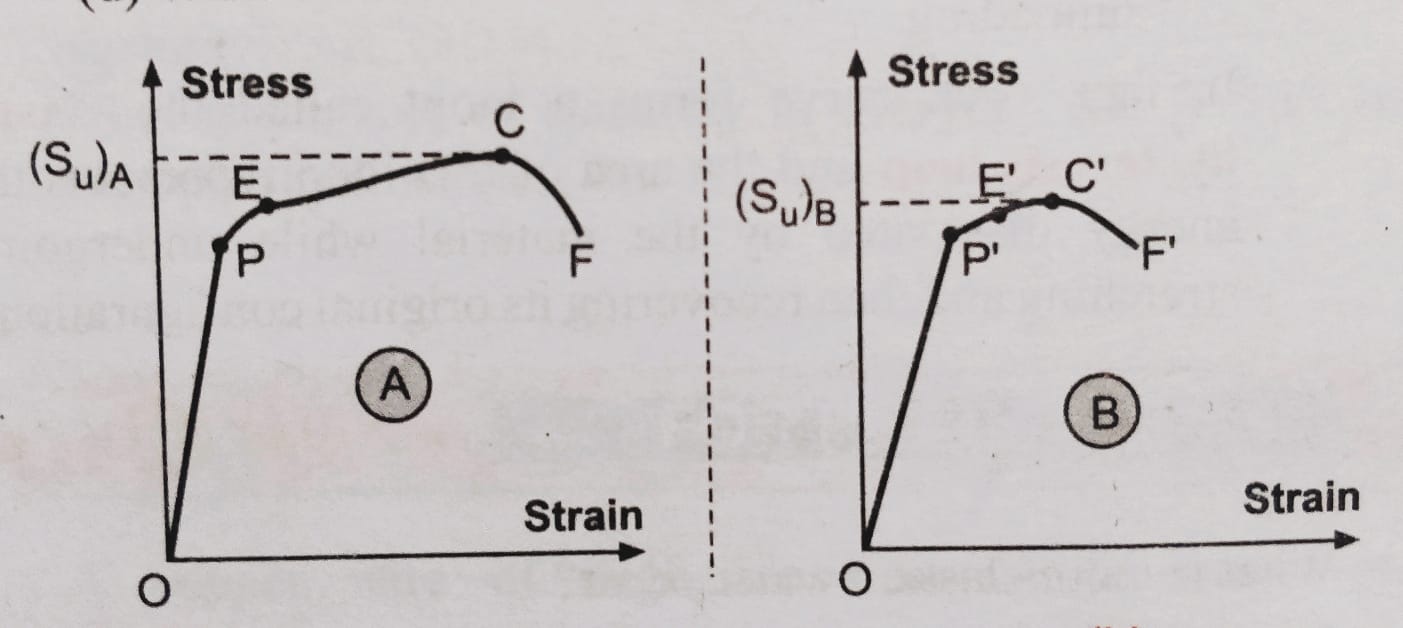
14.The stress strain graph for two materials A and B are shown in fig. (a) Which one has greater Young’s modulus ?(b) which one is strongest material?(c) which is more ductile?(d) which is more brittle?