Category: 10th Physics Notes

  • Life process

    This assignment belongs to the class 10th science chapter-6 , Life process.

    All important question belongs to this chapter is given here. After solving this question , students can improve the chapter Life process , and can prepare for board examination.

    To get the Important questions of METALS AND NON METALS CLICK HERE-

                            Life process ( ch-6) (biology)

    Multiple choice questions-:

    1.Select the incorrect pair.

    (a)Respiration-oxidation to food to obtain energy. (b)Nutrition-obtaining and utilising nutrients. (c)Transportation-response to stimuli (d)Excretion-removed to waste by products

    2.Which one of the following juice secreted in the human body does not contain any enzyme?

    a)Salivary Juice.                       b)Bile Juice.

    c)Gastric Juice.                         d)Pancreatic Juice.

    3.Rings of cartilage present in the throat ensures that,

    a)the air passage collapses                 b)the air passage does not collapse

    c)the air is filtered entering the nostrils d)None of these

    4.The function  of the lymph fluid is to, a) drains excess fluid from extracellular space back into the blood. b) carries digested and absorbed fat from intestine. c) circulates around the body and help in clotting of blood. d )Both (a) and (b).

    5.Which of the following are energy foods? (a)Carbohydrates and fats. (b)Proteins and minerals salts. (c)Vitamins and minerals. (d)Water and roughage.

    6.In which mode of nutrition an organisms derives its food from the body of another living organisms without killing it? (a) Saprotrophic nutrition. (b)Parasitic nutrition. (c)Holozoic nutrition. (d)Autotrophic nutrition.

    7.Roots of the plants absorb water from the soil through the process of,(a)Diffusion. (b)Transpiration. (c)Osmosis. (d)None of these.

    8.The site of photosynthesis in the cells of a leaf is, (a)Chloroplast. (b)Mitochondria. (c)Cytoplasm. (d)Protoplasm.

    9.In amoeba food digested in the: (a)Food vacuole. (b)Mitochondria. (c)Pseudopodia. (d)Chloroplast.

    10.Which region of the alimentary canal absorbs the digested food (a)Stomach. (b)Small intestine. (c)Large intestine. (d)Liver.

    11.The exit of unabsorbed food material is regulated by,

    (a)Liver.

    (b)Anus.

    (c)Small intestine.

    (d)Anal sphincter.

    12.Name the substance whose build up in the muscle during vigorous physical exercises may cause cramps?

    (a)Ethanol + carbon dioxide +energy.

    (b)Lactic acid +energy.

    (c)Carbon dioxide+ water+ energy.

    (d)Pyruvate.

    13.The movement of food in phloem is called:

    (a)Transpiration.

    (b)Translocation.

    (c)Respiration.

    (d)Evaporation.

    14.The procedure used cleaning the blood of a person by seprating urea from it is called.

    (a)Osmosis.

    (b)Filtration.

    (c)Dialysis.

    (d)Double circulation.

    Answers.

    (1).C

    (2).B

    (3).B

    (4).C

    (5).A

    (6).B

    (7).C

    (8).A

    (9).A

    (10).B

    (11).B

    (12).C

    (13).B

    (14).C

    To get the Important questions of ACIDS BASES AND SALTS, CLICK HERE-

    How to select coaching centre for JEE/NEET Watch the video given below-

    Two marks question.–

    15.(a)Does the transport of food in plants require living tissue and energy?

    (b)Name the components of food that are transported by the living tissues.Our body produces various waste products through different processes. List the waste products with the organs involved in their removal.

    16.Differentiate between single and  double circulation found in veterbrates.

    17.What are the two stages in photosynthesis.Differentiate between aerobic and anaerobic respiration.

    18.What is the role of glomerulus in kidney?

    Three marks question

    19.why is it necessary to separate oxygenated and deoxygenated blood in mammals and birds?

    20.Chloroplast are called energy convertors. Explain.

    21.What are the functions of lymph in our body.

    22.How is haemoglobin associated with respiration explained?

    23.How is transpiration pull responsible for upward movement of water?

    Five marks questions.

    24.(a). In which form are oxygen and carbon dioxide transported in the blood?

    (b). What happens to the muscles of the diaphragm, the external intercostal muscles and the position of diaphragm during inspiration and expiration?

    (c). Why do the walls of trachea not collapse, when there is less air in it?

    25.Shanu told his father that plants exude out a lot of water in the form  of vapour through leaves. Define this  process .what is its importance ? How do stomata help in this process?

    Very important topic for class 10th – lens formula of ray optics watch the video given below-

  • Metals and Non-metals

    Metals and Non-metals

    This assignment provide the important question of class 10 chapter -3 ( Metals and Non-metals)

    Before to solve the assignment of this chapter student may solve the assignment of first chapter CLICK HERE-

    To solve the assignment of chapter -2, (acids bases and salts ) – CLICK HERE-


    Multiple choice Questions

    1. Select odd one from the following elements.
      a. Bismuth
      b. Copper
      c. Zinc
      d. Arsenic
    2. Which element is present at the top of the reactivity series and is stored in kerosene oil?
      a. Potassium
      b. Tin
      c. Lead
      d. Gold
    3. The least reactive metal among the following :
      a. Sodium
      b. Silver
      c. Copper
      d. Lead
    4. A metal less reactive and another metal more reactive than hydrogen are:
      a. Aluminium and lead
      b. Iron and magnesium
      c. Copper and tin
      d. Copper and mercury
    5. Which of the following metal exists in the liquid state?
      a. Na
      b. Ag
      c. Cr
      d. Hg
    6. Which of the following non metal is a liquid?
      a. Carbon
      b. Sulphur
      c. Bromine
      d. Iodine
    7. Which of the following represent the correct order of decreasing reactivity?
      a. Mg> Al> Zn> Fe
      b. Mg>Zn> Al> Fe
      c. Al>Zn> Fe >Mg
      d. Mg> Fe>Zn>Al
    8. An element reacts with oxygen to give a compound with a high melting point. This compound is also soluble in water . The element is likely to be
      a. Ca
      b. C
      c. Si
      d. Fe
    9. Which of the following pairs of reactants will go undergo a displacement reaction?
      a. Cuso4 +Fe
      b. ZnSO4+Fe
      c. MgSO4+Fe
      d. Ca(SO4)+Fe
    10. Due to its semiconductor properties the non metal used in computer, t.v etc is
      a. Carbon
      b. Silicon
      c. Bromine
      d. Fluorine
    11. Which of the following metal exists in their native state in nature?
      I. Cu
      II. Au
      III. Zn
      IV. Ag
      a. (i) and (ii)
      b. (ii)and(iii)
      c. (ii) and (iv)
      d. (iii) and (iv)
    12. An element A is soft and can be cut with a knife.this is very reactive to air and cannot be kept in open. It reacts vigorously with water. Identify the element from the following
      a. Mg
      b. Na
      c. P
      d. Ca
    13. Generally non-metal are not conductors of electricity. Which of the following is a good conductor of electricity?
      a. Diamond
      b. Graphite
      c. Sulphur
      d. Fullerene
    14. What happens when a pellet of sodium is dropped in water?
      a. It Catches fire and forms oxide.
      b. It absorbs heat and forms oxide.
      c. It catches fire and forms hydroxide.
      d. It absorbs heat and forms and hydroxide.
    15. When calcium oxide is added to water, it completely dissolves in water without forming bubbles. What products are formed in the reaction?
      a. Ca and H2
      b. Ca and H2O2
      c. Ca(OH)2
      d. CaH2
      Two marks questions
    16. Write chemical equations for reaction taking place when
      a. Potassium with water.
      b. Steam is passed over hot iron.
      c. Magnesium is treated with dil.HNO3
    17. Give reason for the following:
      a. Metals are regarded as electropositive elements.
      b. When a piece of copper metal is added to a solution of zinc sulphate ,no change takes place but the blue colour sulphates fades away when a piece of zinc is placed in its solution.
      c. Reaction of Ca with water is less violent .
    18. A student was given Mg , Zn , Fe and Cu metals. He puts each of them in dil. HCL contained in different test tubes . Identify which of them
      a. Will not displace H2 from dil .HCL.
      b. Will give H2 with 5% HNO3.
      c. Will be displaced from its salt solution by all other metals.
    19. Mention the names of the metals for the following:
      a. Two metals which are alloyed with iron to make stainless steel.
      b. Two metals which are used to make jewellary .
    20. Give reason of the following:
      a. School bells are made up of metals.
      b. Electric wires are made up of copper.
      Three marks questions
    21. Write three differences between metal and non- metal.
    22. Write two uses of metal and non-metal
    23. Name the following:
      a. A metal, which is preserved in kerosene.
      b. A lustrous coloured non metal
      c. A metal, which can melt while kept on palm .
      d. A metal, which is poor conductor of heat.
    24. (a) explain the formation of ionic compound CaO with electron dot structure. Atomic number of calcium and oxygen are 20 and 8 respectively.
      (b) Name the constituent metals of bronze.
      25.(a) show the formation of Na2O by the transfer of electrons between the combining atoms
      (b) Why are ionic compound usually hard.
      (c) How is it that ionic compounds in the solid state do not conduct electricity but they do so when in molten state?
      5 marks Questions
    25. Show on a diagram the transfer of electrons between the atoms in the formation of MgO. Write symbols of cation and anion present in MgO.
      (b) Name the solvent in which ionic compounds are generally soluble.
      (c) Why are aqueous solutions of ionic compounds able to conduct electricity?
    26. In what forms metals found in nature? With the help of examples how metal react with oxygen , Water , and dilute acids . Also, write chemical equation for the reactions.
    27. Give reason for the following:
      a. Ionic compounds have high melting and boiling point.
      b. Non- metals in general do not displace hydrogen from dilute acids.
      c. Hydrogen gas is not evolved, when zinc metal reacts with dil. HNO3.
      d. School bells are made up of metals.
      e. Sodium hydroxide solution cannot be kept in aluminium containers.

    Do you know the harmful effect of Online classes, to see the video click here-

  • Acids bases and salts

    Acids bases and salts

    Before to solve these questions of chapter 2 science ‘Acids Bases and Salts’ students have to solve first chapter questions. To get the questions of chapter-1 CLICK HERE-

                                            Chemistry Class Xth

                                        Ch-2 Acids, Bases and Salts

    Multiple Choice Questions

    1. What is the common name of CaOCl2?(a)Bleaching powder(b)Baking soda(c)Washing soda(d)Lime water
    2. Which one will turn red litmus blue?(a)Vinegar(b)Lemon juice(c)Soft drinks(d)Baking soda solution
    3. 10 ml of a solution of NaOH is found to be completely neutralised by 8ml of a given solution of HCL. If we take 20ml of the same solution of NaOH ,the amount of HCL solution required to neutralise it will be:(a)4ml(b)8ml(c)12ml(d)16ml
    4. A solution reacts with zinc granules to give a gas which burns with a pop sound .The solution contains:(a)Mg(OH)2(b)Na2CO3(c)NaCl(d)HCL
    5. The indicator which produces a pink colour in an alkaline solution is:(a)Methyl orange(b)Turmeric paper(c)Phenolphthalein(d)Litmus paper
    6. The discomfort caused by indigestion due to overeating can be cured by taking:(a)Vinegar(b)Lemon juice(c)Baking soda(d)Caustic soda
    7. One of the following is not an organic acid.  This is :(a)Ethanoic acid(b)Formic acid(c)Citric acid(d)Carbonic acid
    8. One of the following is a medicine for indigestion. This is:(a)Sodium hydroxide(b)Manganese hydroxide(c)Magnesium hydroxide(d)Potassium hydroxide
    9. Bee sting contains:(a)An acidic liquid(b)A salt solution(c)An alkaline liquid(d)An alcohol
    10. Fresh milk has a PH of 6. When milk changes into curd ,the PH value will :(a)Become 7(b)Become less than 7(c)Become more than 7(d)Remain unchanged
    11. The salt which will give an acidic solution on dissolving in water is:(a)KCL(b)NH4CL(c)Na2CO3(d)CH3COONA
    12. The number of molecules of water of crystallization present in washing soda crystals is:(a)Five(b)Two(c)Ten(d)Seven
    13. Plaster of paris is prepared by heating one of the following to a temperature of 1000C. this is:(a)CaSO3.2H2O(b)CaCl2.2H2O(c)CaCO3.2H2O(d)CaSo4.2H2O
    14. A solution turns red litmus blue, its PH is likely to be(a)1(b)4(c)5(d)10
    15. A solution reacts with crushed eggs-shells to give gas that turns lime -water milky. The solution contains(a)NaCl(b)HCL(c)LiCl(d)KCl

    Objective Answer

    1. A
    2. D
    3. D
    4. D
    5. C
    6. C
    7. D
    8. C
    9. A
    10. B
    11. B
    12. C
    13. D
    14. D
    15. D
    Derivation of lens formula

    Two marks questions

    1. why should curd and sour substances not be kept in brass and copper vessels?
    2. Why do HCl , HNO3 etc. show acidic characters in aqueous solutions while solutions of compounds like alcohol and glucose do not show acidic character?
    3. Why does an aqueous solution of an acid conduct electricity?
    4. Why does dry HCl gas not change the colour of the dry litmus paper?
    5. While diluting an acid, why it is recommended that the acid should be added to water and not water to the acid?
    6. How is the concentration of hydronium ions affected when a solution of an acid is diluted?
    7. How is the concentration of hydroxide ions affected when excess base is dissolved in a solution of sodium hydroxide?
    8. What will happen if a solution of sodium carbonate is heated? Give the equation of the reaction involved?
    9. Write an equation to show the reaction between plaster of paris and water.
    10. Why does distilled water not conduct electricity , whereas rain water does?
    11. Why do acid not show acidic behaviour in the absence of water?
    12. Plaster of Paris should be stored in a moisture-proof container .explain why ?
    13. What is a neurtralisation reaction ? Give two examples.
    14. Give two important uses of washing soda and baking soda.
    15. A milk adds a very small amount of baking soda to fresh milk.(i)Why does he shift the PH of the fresh milk  from 6 to slightly alkaline?(ii)Why does this milk take a long time to set as curd?

    3 marks questions

    1. Metal compound A reacts with dilute hydrochloric acid to produce effervescence. The gas evolved extinguishes a burning candle .  write a balanced chemical equation for the reaction if one of the compounds formed is calcium chloride.
    2. What will you observe when a small amount of copper oxide is added in a beaker containing dilute hydrochloric acid?
    3. To an aqueous solution of sodium hydroxide a few drops of phenolphthalein were added .What do you observe, to this solution when small amount of dil. HCl was added ? explain your answer.
    4. What is rock salt? Why is it brown in colour?
    5. Why is washing soda also called basic salt? what are its uses?
    6. How do metal carbonates and metal hydrogen carbonate react with acids? Give their chemical equations.
    7. Write chemical name, chemical formula of bleaching powder. Write its chemical reaction and also write its two uses.
    8. Write chemical name, chemical formula of caustic soda. write its chemical reaction and two uses.
    9. Five solutions A, B, C, D and E when tested with universal indicator showed pH as,(a)Neutral (b)Strongly alkaline (c)Strongly acidic (d)Weakly acidic(e)Weakly alkaline. Arrange the pH in increasing order of hydrogen ion concentration.
    10. What are olfactory indicators? Write an example, also Write the name of two natural indicator.

    5 marks questions

    1. What is plaster of Paris? Write its chemical name and chemical formula. Also write the chemical reaction and its two uses.
    2. Write balanced chemical equations for the following: (a)Chlorine gas is passed through dry slaked lime. (b)Bleaching powder is kept in open air.(c)Sodium bicarbonate is reacts with dilute hydrochloric acid.(d)Electricity is passed through brine.(e)Formation of baking soda from sodium chloride.
  • Science class-10th,Assignment-  1

    Science class-10th,Assignment- 1

                                                  Chemistry Class Xth

                                        Ch-1 Chemical Reaction and Equations

    These questions are provided by Vaishnavi jha (A scince student in delhi university)


    How to select coaching centre for JEE and NEET click here-

    Multiple Choice Questions

    1. Which of the following does not involve in a chemical reaction?(a)Digestion of food in our body. (b)Process of respiration.(c)Burning of candle wax when heated.(d)Melting of candle wax when heated.
    2. What happens when dilute Hydrochloric acid is added to iron fillings?(a)Hydrogen gas and iron chloride are produced.(b)Chlorine gas and iron hydroxide are produced.(c)No reaction takes place.(d)Iron salt and water are produced.
    3. Which of the following reaction is an endothermic reaction?(a)Burning of coal.(b)Decomposition of vegetable matter into compost.(c)Process of respiration.(d)Decomposition of calcium carbonate to form quick lime and carbon dioxide.
    4. A dilute ferrous sulphate solution was gradually added to the beaker containing acidified permanganate solution. The light purple colour of the solution fades and finally disappears. Which of the following is the correct explanation of the observation?(a)KMnO4 is an oxidizing agent, it oxidizes FeSo4.(b)FeSO4 acts as an oxidizing agent and oxidizes KMnO4.(c)The colour disappears due to dilution; no reaction is involved.(d)Kmo4 is an unstable compound and decompose in presence of FeSO4 to a colourless compound.
    5. The chemical reaction between quick lime and water is characterised by:(a)Evolution of hydrogen gas.(b)Formation of slaked lime precipitate.(c)Change in temperature of mixture.(d)Change in colour of the product.
    6. One of the following is an exothermic reaction, this is: (a)Electrolysis of water.(b)Conversion of limestone into quicklime.(c)Process of respiration.(d)Process if photosynthesis.
    7. The chemical equations are balanced to satisfy one of the following laws in a chemical reactions. This law is known as:(a)Law of conservation of momentum.(b)Law of conservation of mass.(c)Law of conservation of motion.(d)Law of conservation of magnetism.
    8. The removal of oxygen from a substance is called:(a)Oxidation.(b)Corrosion(c)Reduction(d)Rancidity.
    9. The chemical reaction involved in the corrosion of iron metal is that of :(a)Oxidation as well as displacement.(b)Reduction as well as combination.(c)Oxidation as well as combination.(d)Reduction as well as displacement.
    10. In order to prevent the spoilage of potato chips, they are packed in plastic bags in an atmosphere of :(a)Cl2(b)N2 (c)H2(d)O2
    11. Which if the following can be decomposed by the decomposition of light?(a)Nacl (b) Kcl (c)Agcl (d)Cucl
    12. A white precipitate can be obtained by adding dilute sulphuric acid to:(a)CuSO4 solution(b)NaCl solution(c)BaCl2 solution(d)Na2SO4 solution
    13. The term used to indicate the development of unpleasant smell and taste in fat and oil containing foods due to aerial oxidation is :(a)Acidity(b)Radioactivity(c)Rabidity(d)Rancidity
    14. When ferrous sulphate is heated strongly it undergoes decomposition to form ferric oxide as a main product accompanied by a change in colour form:(a)Blue to green(b)Green to blue(c)Green to brown(d)Green to yellow
    15. When carbon dioxide is passed through lime water.(a)Calcium hydroxide is formed(b)White precipitate of CaO is formed(c)Lime water turns milky(d)Colour of lime water disappears

    OBJECTIVE ANSWER

    1. A
    2. A
    3. D
    4. A
    5. B
    6. C
    7. B
    8. C
    9. C
    10. B
    11. C
    12. C
    13. D
    14. D
    15. C

    If you are scared of physics, want to learn physics easily. How to learn physics ? How to make physics interesting? Ho to increase your studing strength in physics ? To know click here-

    2 marks question

    1. Why magnesium ribbon is cleaned before burning in air?
    2. Write two characteristics of chemical reaction?
    3. What is a balanced chemical reaction .why a chemical reaction should be balanced?
    4. Why is respiration considered as an exothermic process?
    5. What is a rusting of iron? Write an example.
    6. What is a redox reaction?
    7. Define combination reaction with an example?

    3 Marks questions

    • 1. In a container, solid calcium oxide was taken and water was added slowly to it.
    • 2. State the two observations made in the experiment.
    • 3. Write the name and the chemical formula of the product formed.
    • 4. Why are decomposition reaction called the opposite of combination reactions?
    • 5. Write one equation each for decomposition reactions where energy is supplied in the form of heat, light or electricity.
    • 6. A shiny brown coloured element X on heating in air becomes black in colour. Name the element X and the black coloured compound formed.

    5 marks questions

    • 1. Consider the chemical equation given below and answer the questions that follow: ZnO + C = Zn + CO . (a) Name the substance which is getting oxidized. (b)Name the substance which is getting reduced. (c)Name the oxidising agent. (d)Name the reducing agent. (e)What type of reaction does this equation represents.

    To get the important questions of Acids bases and salts ( Chapter-2 ) Click here –

    Do you know the harmful effect of online classes ? Watch the video given below-

  • Combination of resistances

    Combination of resistances

    Combination of resistances

    In this topic we will discuss about combination of resistances , i.e series and parallel combination of resistances .

    Combination of resistances –

    Series combination –  In series combination resistors are connected end to end with one another . resistors are said to be connected in series , when same current passes through the resistors  when potential difference applied across the connected  resistors .

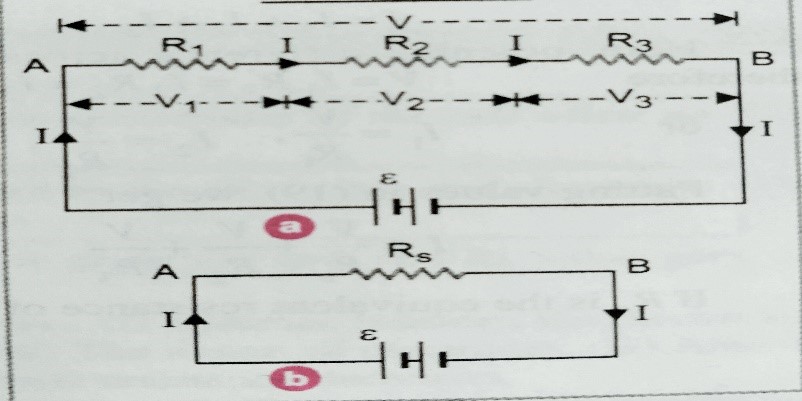
    Let , three resistors  of resistance R1, R2,and R3 are connected in series with external source E as shown in figure (a) . Let  I be the current flowing through the each resistors , their respective potential differences are V1, V2 and  V3 .

    According to Ohm’s law  here,  V1 = I R1  ,    V2 = I R2   ,  and   V3 = I R3

    Let, RS is the equivalent resistance of the combination as shown in figure (b) ,

    then , V = I RS

    But net potential V = V1+ V2 +V3

    Then  IRS  = I R1 + I R2 + I R3

    So ,  RS  =  R1 +  R2 +  R3  ……………………This the equation of equivalent resistance .

     Parallel combination –  Two or more resistors are said to be in parallel if potential difference across each resistors are same but currents are different . In parallel combination one end of each resistors are connected at one point and other ends at another point .

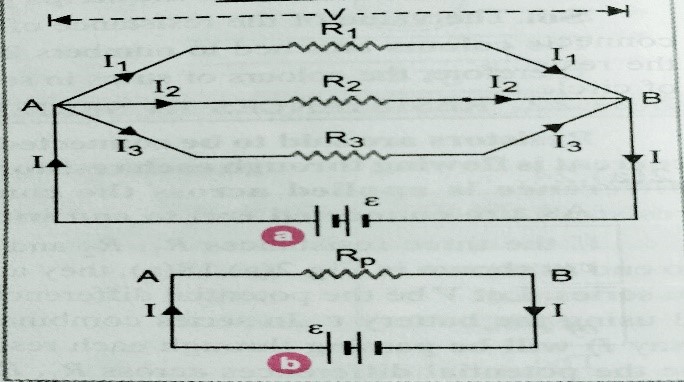
    Let three resistors of resistance R1 , R2 and R3 are connected in parallel as shown in figure (a) with external source . let V be the potential difference of the end A and B . I1, I2 and  I3 are the currents flowing through the resistors .


    According to Ohm’s law  I=V/R .

    SO, I1=V/R1 , I2=V/R2 and I3=V/R3

    Let, Rp is the equivalent resistance of the combination as shown in figure (b)

    Then I=V/Rp

    But I = I1+ I2 + I3

    V/Rp = V/R1 + V/R2 + V/R3

    SO, 1/Rp = 1/R1 + 1/R2 + 1/R3 …………………….. equation for equivalent resistance .


  • GRAPH

    GRAPH

    GRAPH

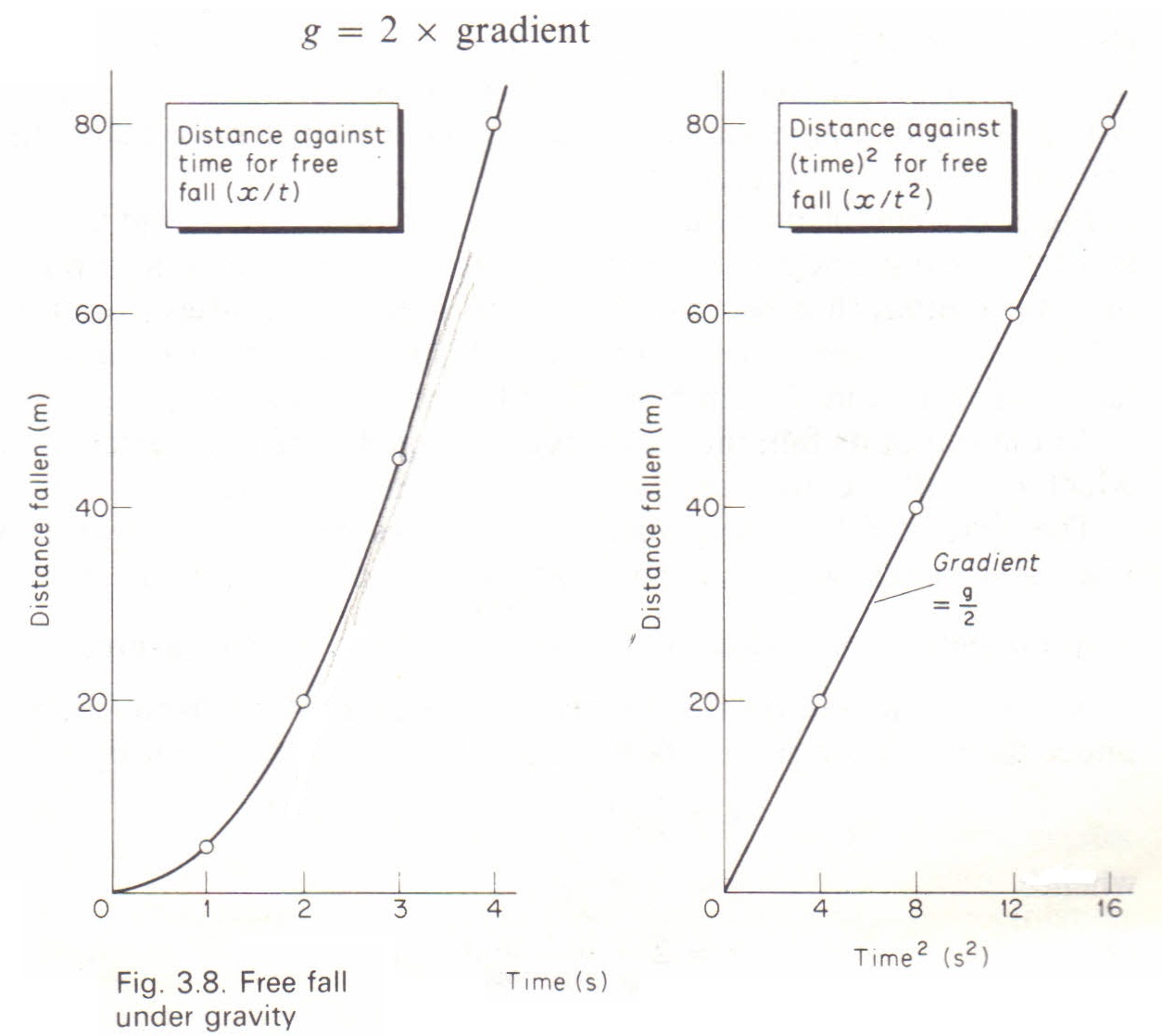
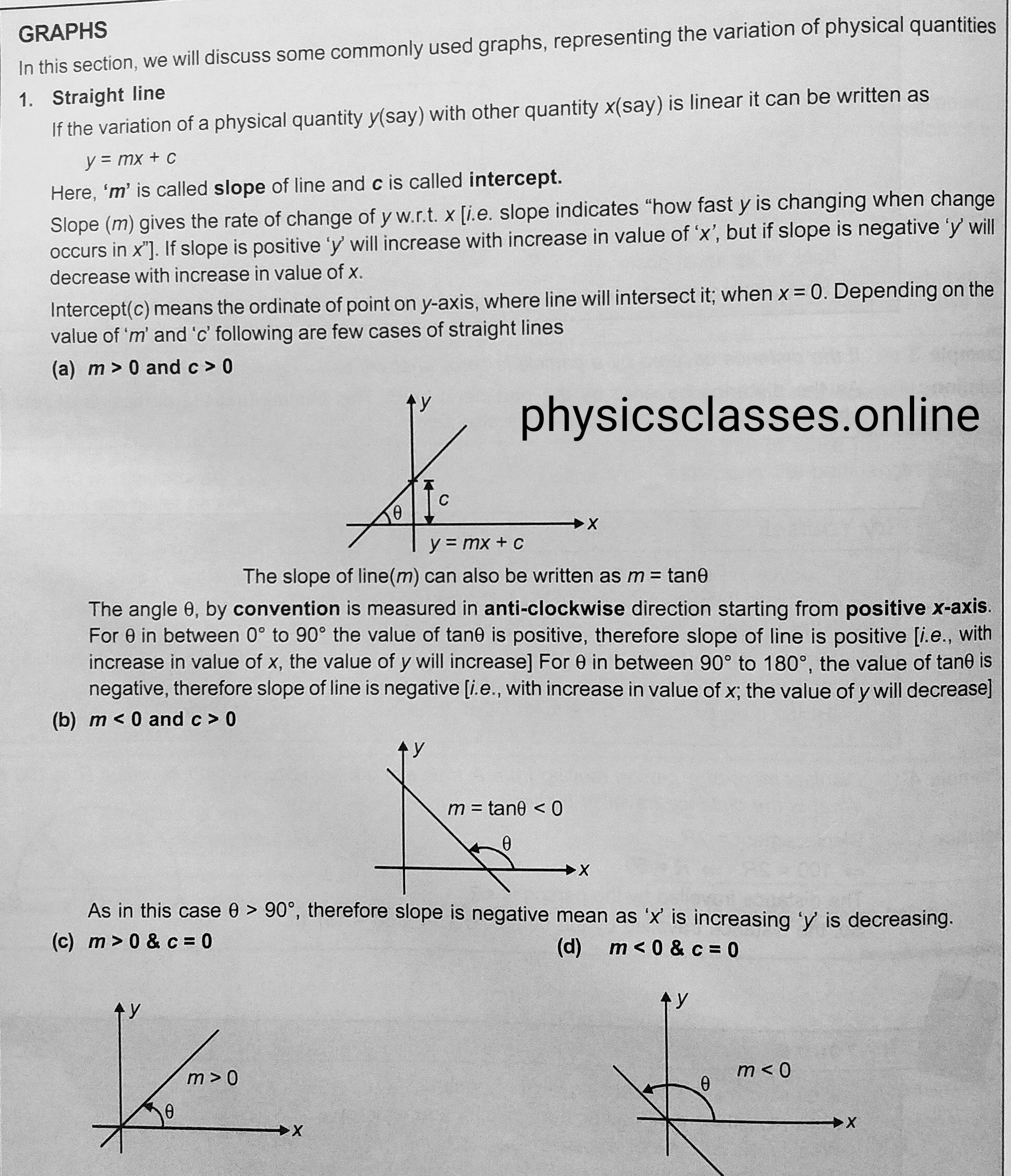
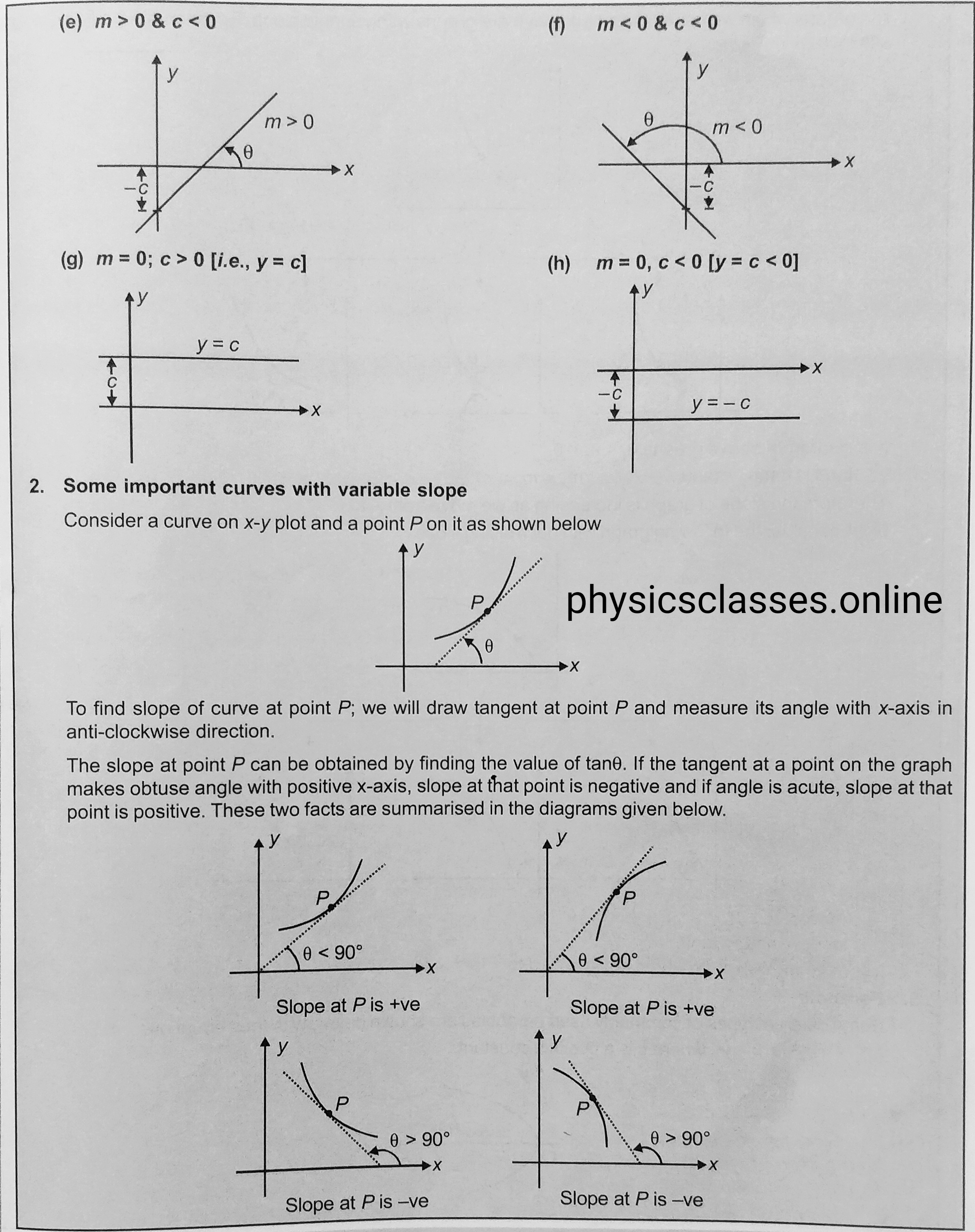
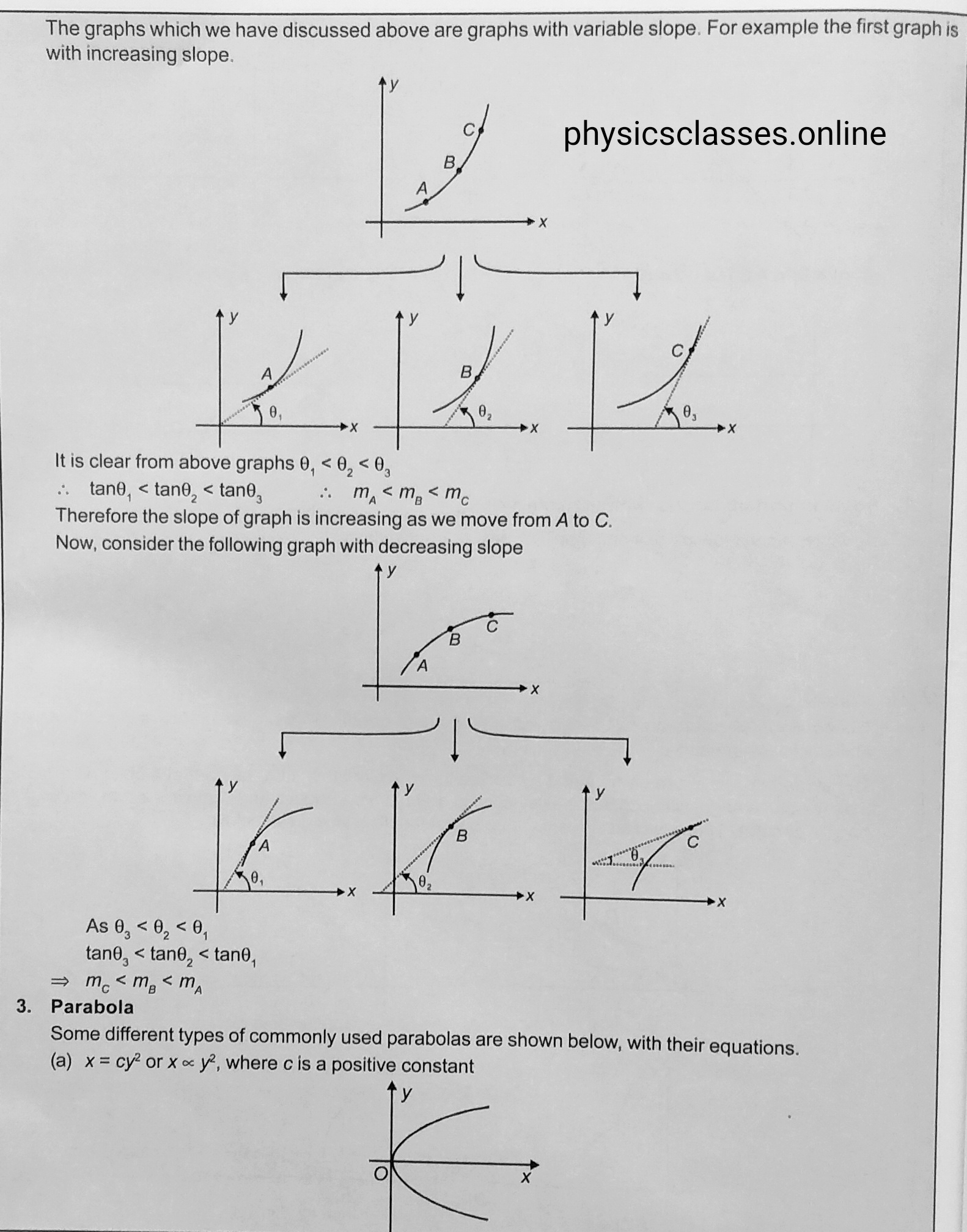
    In this post we will discuss about the graph , and how graphs makes to understand  the physics easily ?

    Graph-

    As we know it is not easy to study or understand the physics. Students who is taking interest in physics and want to understand the physics, it is necessary to improve your mathematics and most importantly graph, students who can’t solve the graphical questions will face lot of difficulties. So I am trying to provide some information/ knowledge for the students, so that students can understand the graphical questions easily. Now these days questions based on graph is important for every topics of physics specially the students who is appearing in the JEE/ NEET examination. Graph makes the calculation easier and it makes the topic to understand more easy. So every students must have to understand the graph and solve the questions based on it.

    Pg. -1

    peg 1 graph
    peg 1 graph

    Pg. -2

    peg 2
    peg 2

    Pg. – 3

    peg 3
    peg 3

    Pg. – 4

    peg 4
    peg 4


    Pg.-5

    peg 5
    peg 5


  • Definition of Ampere

    Definition of Ampere

    Define 1 Ampere

    electric current
    electric current

    This topic only explain the term definition of Ampere ( which is explain in different-different  type . Students can learn it according to there needs.  )

    Ampere is the basic unit of electric current . It is named after Andre-Marie -Ampere a French scientist  born in 1775  . He also known as the father of electrodynamics .

    Definition of Ampere –  1 Ampere  is the current flowing through a conductor when 1 Coulomb  of charge flows through a conductors in unit time.

    From Ohm’s law – potential difference across the conductor is directly proportional to the current flowing through the conductor , if V  is the  potential difference across the conductor and I be the current flowing through the conductor then according to Ohm’s law V α I or V= RI , where R is the resistance of the conductor . ( resistance of a conductor is the property of the conductor to restrict the flow of current through it) i.e. current  I =V/R,

    So we can say, 1 Ampere current flows through a conductor when unit potential difference setup across a conductor of resistance 1 Ohm .


    Another definition of current can be determined using the property of force between two parallel current carrying conductor according to it force between two parallel current carrying conductor can be given as force per unit length (f/l) F= µ0I1 I2 /2Πd ( Here I1 and  I2 are the current through the wires and , d is the separation between them . according to given relation we can define, 1 Ampere is the electric current which when flowing in each of parallel conductors placed at separation  1 m in vacuum exert a force of 2x 10⁻⁷N on 1 meter length of either wire. 


  • ELECTRIC CURRENT

    ELECTRIC CURRENT

     ELECTRIC CURRENT or CURRENT ELECTRICITY


    electric- current
    electric- current

     electric current –

    Electric current –

    When electric charges is in motion , they constitute what is called an electric current . electric current is defined as the rate of flow of charge through an area of the conductor . if  Q is the charge flows through a conductor in time T then  electric current I = Q/T

    Or  I= dQ /dt . unit of current is Ampere .

    We can define 1 Ampere  is the current flowing through a conductor when 1 Coulomb  of charge flows through a conductors in unit time.

    In the terms of drift velocity current I = n e A Vd  where n is the charge density , A  is the area of cross-section of the conductor , e is the charge on electron and Vd is the drift velocity.

    In terms of Ohm’s law – current  I = V/R  V is the potential difference across the conductor and R is the resistance of the conductor .

    So we can say 1 Ampere current flows through a conductor when unit potential difference setup across a conductor of resistance 1 Ohm .

    Ampere is the basic unit of electric current . It is named after Andre-Marie -Ampere a French scientist  born in 1775  . He also known as the father of electrodynamics .

    Definition of Ampere –  1 Ampere  is the current flowing through a conductor when 1 Coulomb  of charge flows through a conductors in unit time.

    From Ohm’s law – potential difference across the conductor is directly proportional to the current flowing through the conductor , if V  is the  potential difference across the conductor and I be the current flowing through the conductor then according to Ohm’s law V α I or V= RI , where R is the resistance of the conductor . ( resistance of a conductor is the property of the conductor to restrict the flow of current through it) i.e. current  I =V/R,

    So we can say, 1 Ampere current flows through a conductor when unit potential difference setup across a conductor of resistance 1 Ohm .


    Another definition of current can be determined using the property of force between two parallel current carrying conductor according to it force between two parallel current carrying conductor can be given as force per unit length (f/l) F= µ0I1 I2 /2Πd ( Here I1 and  I2 are the current through the wires and , d is the separation between them . according to given relation we can define, 1 Ampere is the current which when flowing in each of parallel conductors placed at separation  1 m in vacuum exert a force of 2 x 10⁻⁷ N on 1 meter length of either wire. 

    To solve or download important objective questions of current electricity click here- Current electricity and Ohm law  objective


  • SELF-INDUCTION

    SELF-INDUCTION

    Explain the term self-induction of a coil

    Self – Induction –

    It is the property of an electric circuit or coil by virtue of which it opposes any change of flux or current in it by inducing a current in itself is called self- induction. In another words we can say “self-induction is the inertia of electricity “. Due to self -induction an electric circuit resist any change of current through it .

    As we know magnetic flux linked with a coil is directly proportional to the current flowing through the circuit

    i.e.    ɸ α I ( ɸ= flux linked with the coil, and I is the current in the circuit )

    ɸ = LI ( L is the constant called coefficient of self- induction or self-inductance  or only inductance . )

    If current I =  1 ampere, then flux ɸ= L  . so we can define self-induction is the flux linked with the coil when unit current passes through the coil.

    as we know,

    emf  e= – dɸ/dt

    e= -d (LI)/ dt

    e= -L ( dI/dt)

    L= –  e/(dI/dt)

    So we can define self-inductance of a circuit is numerically equal to the induced emf setup in it when the rate of change of current through it is unity.

    Unit of self-inductance is Henry (H) .  We can define self-inductance of a coil is one Henry if 1 volt emf induced in the coil when rate of change of current through the coil is unity.

    To find the expression for self-inductance of long solenoid click here

  • What is electric current

    What is electric current

    What is electric currentelectric current

    What is electric current ? what is its unit ? define Ampere.

    Electric current-When electric charges is in motion , they constitute what is called an electric current . electric current is defined as the rate of flow of charge through an area of the conductor . if  Q is the charge flows through a conductor in time T then  electric current I = Q/T

    Or  I= dQ /dt . unit of current is Ampere .

    We can define 1 Ampere  is the current flowing through a conductor when 1 Coulomb  of charge flows through a conductors in unit time.

    In the terms of drift velocity current I = n e A Vd  where n is the charge density , A  is the area of cross-section of the conductor , e is the charge on electron and Vd is the drift velocity.

    • Subscribe to Video Tutorial ( Nayan Jha Sir )

    In terms of Ohm’s law – current  I = V/R  V is the potential difference across the conductor and R is the resistance of the conductor .

    So we can say 1 Ampere current flows through a conductor when unit potential difference setup across a conductor of resistance 1 Ohm .