Tag: electromagnetic wave

  • Important questions of electromagnetic wave

    Important questions of electromagnetic wave

    Important questions of electromagnetic wave-

    All the question given below is very Important questions of electromagnetic wave.

    Students of class 12th and who is preparing for   ,JEE/ NEET must have to solve the questions given below .These are very Important questions of electromagnetic wave.

    before to solve all questions given below, student must have to read all the topic of electromagnetic wave; to read the entire chapter : click here-Electromagnetic wave:-

    em wave

    Important questions for electromagnetic wave-

    1. How are electromagnetic wave produced ? what is the source of energy of these wave ? write mathematical expression for electric and magnetic fields of an electromagnetic wave propagating along the Z-axis . also write the important properties of electromagnetic wave.
    2. Why does a galvanometer when connected in series with a capacitor shows momentary deflection , when it is being charged or discharge ? how does this observation lead the modifying the Ampere’s circuital law ? hence write the generalised expression for Ampere circuital law .
    3. A capacitor , made of two parallel plates each of plate area A and separation d , is being charged by an external AC source . show that the displacement current inside the capacitor is same as the current charging the capacitor .
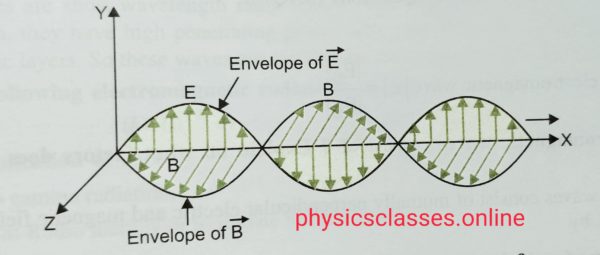
    4. What is meant by transverse nature of electromagnetic waves? Draw the diagram showing the propagation of an electromagnetic wave along X direction , indicating clearly the directions of oscillating electric and magnetic field associated with it .
    5. (a) which of the following electromagnetic radiations has least frequency: UV-RAY,X-RAY,MICROWAVES ?(b)How do you show that electromagnetic wave carry energy and momentum ? (c) write the expression for the energy density of an electromagnetic wave propagating in free space.
    6. An em wave is travelling in a medium with velocity v along x- axis , draw a sketch showing the propagation of the em wave , indicting the direction of oscillating electric and magnetic field . how are the magnitude of magnetic and electric field related to the velocity of em wave ?
    7. Give two characteristics of em waves . write the expression for the velocity of em wave in terms of permittivity and permeability of the medium .
    8. How are electromagnetic wave produced by oscillating charges ? state clearly how a microwave oven works to heat up a food item containing water molecule . why are microwave found useful for the radar systems in aircraft navigation?
    9. (a) name the em wave which are used for the treatment for certain form of cancer    . write their frequency range . (b) thin ozone layer on the top of stratosphere is crucial for human survival . why? (c) why is amount of momentum transferred by the em wave incident on the surface so small?
    10. (a)Which segment of em wave is higher frequency ? how are these wave produced / give one use of these wave .(b)which em wave lie near the high frequency end of visible part of em spectrum / give its one use . in what way this component of light has harmful effect on humen?
    11. Find the wavelength of em wave of frequency (i)5×10¹⁹Hz (ii) 6x 10¹²Hz (iii) 4x 10⁹ Write its two application, and how it is prepared? when an ideal capacitor is charged by a dc battery , no current flows . however , when an ac source used , the current flows continuously . how does one explain this , based on the concept of displacement current?
    12. Suppose that the electric field amplitude of an electromagnetic wave is E0=120N/C and that is frequency f =50.0MHz (i) determine B0,ω,k and λ (ii) find expression for electric and magnetic field .
    13. In a plane em wave , the electric field oscillate sinusoidally at a frequency of 2.0 x 10¹⁰Hz and amplitude 48V/m (i) what is the wavelength of the wave?(ii) what is the amplitude of oscillating magnetic field ?(iii) show that the average energy density of electric fields equal the average energy density of the magnetic field.
    14. A capacitor made of two circular plates each of radius r= 12cm and separation d = 5.0mm. the capacitor is being charged by an external source . the charging current is constant having value I = 0.15 A. (i) calculate the rate of change of electric field between the plates .(ii) find the displacement current across the plates .(iii)is Kirchhoff’s first rule is valid for each plate of capacitor ? Explain.
    15. A capacitor made of two circular plates each of radius r= 6cm and capacitance c=100pF. the capacitor is connected to an ac source of 230v with angular frequency 300rad/sec . (i) what is the rms value of the conduction current ?(ii)is conduction current equal to displacement current ?(iii)determine the amplitude of magnetic field induction at any point 3.0 cm away from the axis between the plates.                                          To read the complete chapter of em wave click here
  • Electromagnetic wave

    Electromagnetic wave

     Chapter:   ELECTROMAGNETIC WAVE

    What is em wave ? how it is produced ?and all kind of feature are explained here.

    The propagating in space through electric and magnetic field varying in space and time simultaneously are called electromagnetic wave .

    Origin – The electro magnetic wave are produced by an accelerated and deaccelerated charge or LC circuit . T he frequency of the electromagnetic wave is  ѵ = 1/2Π √LC .

    Characteristics of em wave –

    1. The electro magnetic waves is produced in free space with speed of light
    2. em waves are neutral , so they are not deflected by electric and magnetic field .
    • The em waves shows the properties of reflection, refraction , diffraction and polarisation.
    1. In em wave the electric and magnetic field are always in the same phase .
    2. The ratio of electric field and magnetic field in free space is constant which is equal to velocity of light ( c ) i.e. E0/B0 =1/√µ0ϵ0 =C=3 X 10⁸ m/s .
    3. In an em wave the energy is propagated by means of electric and magnetic field vectors in the direction of propagation of wave .

    Maxwell’s modification of Ampere’s law and displacement current –

    According to Ampere’s the line integral of magnetic field for a closed path is µ0 times the total current passes through the closed loop. i.e. ∫B. dl = µ0 I but Maxwell modified the law and, dc according to him ∫B. dl = µ0 (I + ID) Where Id is the displacement current.

    displacement current

     Displacement current – It is the current which come in the existence due to the rate of change of electric flux with respect to time

    As we know I = dQ/dt but between the plates of the capacitor  ,

    Electric field E = Q/ A ϵ0 and hence Q = E A ϵ0 = ɸ0 ϵ0 (WHERE ɸ0 = electric flux)

    But, I = dɸ0 /dt = ϵ0 dɸ0 /dt.

    So we can write improved form of Ampere’s law ∫ B. dl = µ0 ( I + ϵ0 dɸ0 /dt ) .

    Consequences of displacement current –

    (a)with the discovery of displacement current the law of electricity and magnetism become more symmetrical then before .

    (b) since the displacement current is produced by time varying electric field , an important link between electric field and magnetic field established .

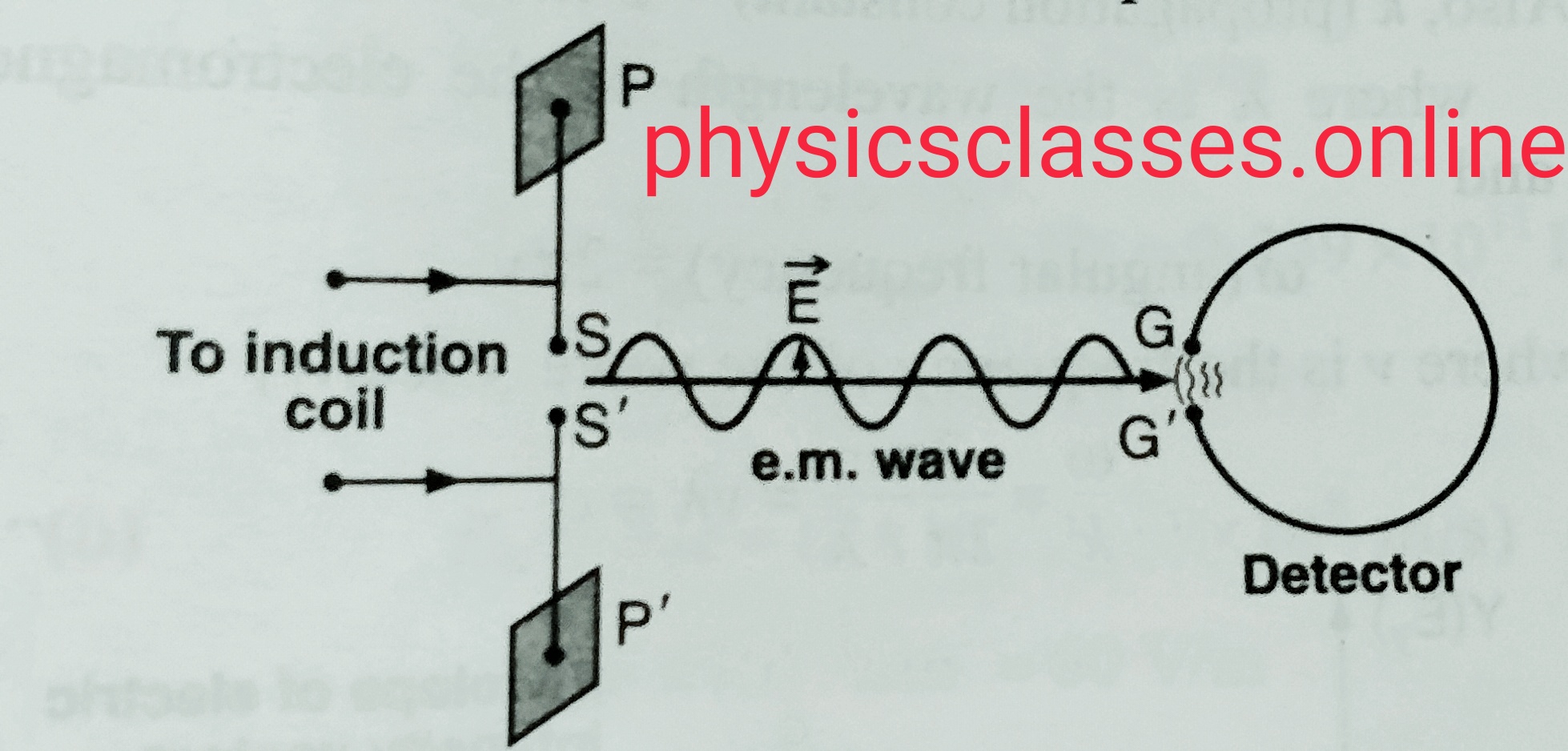
    Hertz’s experiment – Hertz demonstrated the production and detection of electromagnetic wave by electrical means . Experimental arrangement used by Hertz shown in figure :-   S and S’ are the two spheres connected by two large metal plates P and P’ , the spheres are connected to an induction coil . By causing a discharge between the spheres , the current distribution between the plates is such that an electromagnetic wave is generated parallel to the gap SS’ . the radiation thus produced is detected by Hertz by using an open wire loop . the em wave reaches at the gap GG’ of the detector has an electric field is enough the establish a high potential difference between this gap and cause a spark .

    Hertz experiment

    When the detector gap GG’ is at right angles to the right gap SS’ , no electromagnetic radiation detected  ,  the sensitivity is maximum  when the gap GG’  is parallel to SS’ . this property explain the transverse nature of the em wave , and em wave propagate perpendicular to the direction of propagation of electric field .

    Speed of electromagnetic wave in vacuum –

    According to faradays law of electromagnetic induction

    ∫E. dl = – dɸB /dt  ………..eq.1

    And according to Ampere-Maxwell’s law , ∫B. dl =µ0 I + µ0 ϵ0 dɸE /dt …………………..eq.2

    [ ɸB Flux for magnetic flux and ɸe is the electric flux .]

    For a plane polarised em wave travelling in the X- axis eq 1 and 2 gives

    dEy /dx = -dBZ/dt .

    or , dE/dx = – dB/dt ………………………eq. 3

    and ,    dBZ/dx = -µ0ϵ0 dEy/dt .

    or ,     dBx /dx = – µ0ϵ0 dE/dt ………………………eq. 4

    taking the partial differentiation of eq 3 we get

    d(dE/dx)/dx = – d(dB/dt)/dx = – d(dB/dx)/dt .

    or d2E/dx2 = -d(-µ0ϵ0 dE/dt)= µ0ϵ0 d2 E/dt2……………..eq. 5

    similarly ,

    d2B/dx2 = µ0ϵ0 d2 B/dt2 ………………………………..eq. 5

    on comparing eq 5 and 6 we get with the general equation of wave

    d2y/dx2 = (1/v2) ( d2y/dt2)     where  v is the speed of wave  .

    we get 1/v2 = µ0ϵ0 and hence ,

    we can write , v = 1/√ µ0ϵ0 or velocity of light in vacuum c = 1/√ µ0ϵ0 .

    Relation between electric and magnetic field with the speed of electromagnetic wave -the varying electric and magnetic field of a plane electromagnetic wave travelling along X- axis is given as ,

    Ey = E0 sin (kx-ωt) ………………………………………eq. 1

    Bz= B0(kx-ωt) ………………………………………………..eq.2

    Here , k = 2Π/λ

    ω =2Πѵ ,

    Clearly , ω/k = 2Πѵ/ (2Π/λ) = ѵλ = c .

    dE/dx = kE0 cos(kx-ωt)

    dB/dt = – ωB0 cos (kx-ωt)

    dE/dx = -dB/dt

    kE0 cos(kx-ωt) = ωB0 cos(kx-ωt)

    KE0 = ω B0 .

    E0/B0 = ω/K = c     ……………….this is the req. relation

    Intensity of electromagnetic wave – it is the amount of energy crossing per unit time per unit area perpendicular to the direction of propagation of electromagnetic wave .

    Let us consider there is a cylindrical region through which electromagnetic wave passing as wave is perpendicular to its area of cross-action , A is the area of cross-action and l is the length of the cylinder  , then volume of cylinder V = Al

    Total energy of the cylinder ; E= U.x Volume = U Al

    Intensity  I = total energy / (time x area) = U Al/ [(l/c) x A]= U X c

    Since U = ½ ϵ0E02 , therefore  intensity I = ½ ϵ0E02 c = ½ ϵ0Erms2 (√2)2 c = I = ϵ0 Erms2 c .

    For very important questions of electromagnetic wave click here

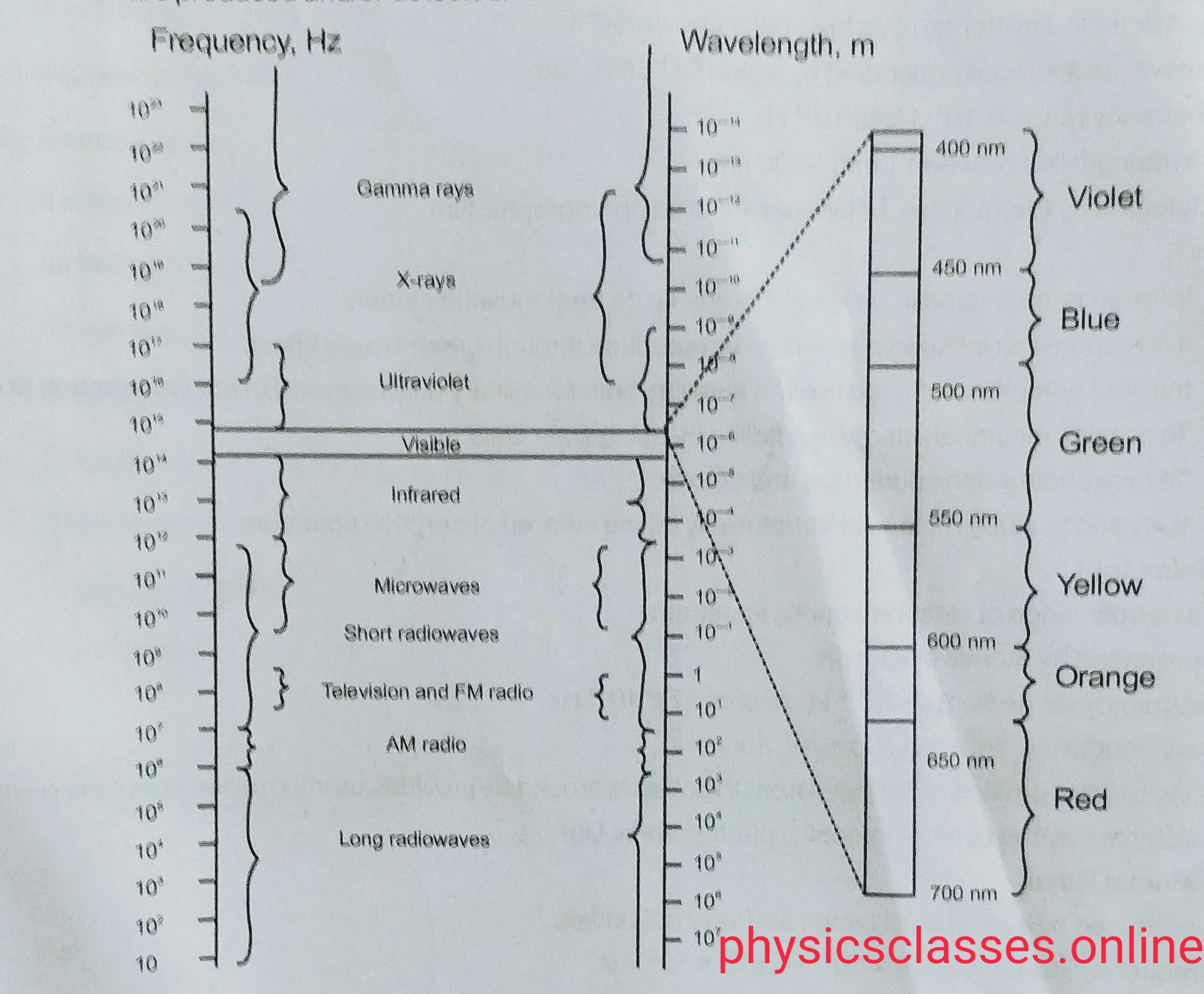
    Electromagnetic spectrum –

    Maxwell predicted the existence of em wave  .

    “ The orderly distribution of electromagnetic  radiation according to there frequency / wavelength is called electromagnetic spectrum .”

    em wave spectrum
    • Radio wave – It is produced by the accelerated motion of charges in conducting wire or we can say by oscillating electric circuit .

    Its frequency range is 500kHz – 1000MHz , wavelength range is 10-2m – 104m. it reflects , refract and diffract . it is used in radio and t.v. communication.

    • Microwave – It is produced by special vacuum tube known as klystrons ,magnetrons . its frequency range is 1GHz – 300GHz . It is used as radar system for aircraft navigation , detect the speed of cricket ball, automobile etc. its another use is in microwave oven .
    • Infrared waves – it is produced by hot bodies i.e. vibration of atoms and molecules . Human eye can’t detect it but snake can detect it . These wave is absorbed by water , co2 and NH3 . Its frequency range is 1011Hz-1014Hz and its wavelength is                      between ,  1mm-700nm   . It  can be detected by infrared photographic film . it is used to treat muscle strain  (physical therapy), green house effect, satellite for military purpose and to observe growth of crops, to provide electrical energy in the satellite by using solar cell , to take the photograph during fog and smoke and it is used to study molecular structure.
    • Visible light – It is produced by atomic excitation . Its frequency range is 4x 10¹⁴Hz -7x 10¹⁴Hz. , its wavelength lies between 700 nm – 400 nm . It makes the thing visible .
    • Ultraviolet ray – It produced by sun , special lamp and very hot bodies . Its frequency lies between 8 x 10¹⁴ Hz – 5 x 10¹⁶ Hz. Its wavelength lies between 400 nm – 0.6 nm . it is detected by photocell and photographic film . It causes the harmful effect on human being. It is used in eye surgery , kill germs in water purifier , to kill the bacteria , in finger print technology.
    • X- ray – It is produced in a tube called modern X-ray tube . its frequency range is between 1016 Hz – 1021Hz . its wavelength lies between 10nm – 10-4nm. It is used as a diagnostic tool in medicine and treatment of certain forms of cancer , in engineering it is used to detect cracks and holes , defect in rubber tyre and gold .
    • Gamma rays – it is produced in nuclear reaction they are emitted by radioactive nuclei , its frequency range is 1018-1022Hz . its wavelength is less than 10-3nm. It is detected by photographic film , Geiger tube , ionisation chamber. They shows phosphorescence , fluorescence ,polarisation , diffraction. It has very high penetrating power . it is used for cancer therapy, and it provide important information regarding nuclear structure.
    • chart frequency range

      To read or solve very important questions of electromagnetic wave click here