Tag: Mechanical properties of solids

  • Test mechanical properties of solids

    Test mechanical properties of solids

               Test solids            

                           Class 11 Physics – Mechanical Properties of Solids

    Multiple Choice Questions

    Q1. Stress is defined as:

    A) Force × Area    B) Force per unit area     C) Change in length per unit length D) Force per unit volume

    Q2. The SI unit of Young’s modulus is:

    A) N   B) N/m   C) N/m²    D) J

    Q3. Strain is a:

      A) Scalar quantity with unit metre   B) Vector quantity

    C) Dimensionless quantity   D) Quantity measured in pascal

    Q4. Hooke’s law is valid up to the:

    A) Breaking point       B) Elastic limit (approximately, within the proportional limit)

    C) Plastic region       D) Fracture point

    Q5. Young’s modulus is given by:

    A) Stress × Strain             B) Strain / Stress

    C) Stress / Strain              D) Force × Area

    Q6. If the length of a wire is doubled while its area and applied force remain constant, its extension becomes:

    A) Half   B) Double    C) Four times    D) Unchanged

    Q7. Which material generally has the highest Young’s modulus?

    A) Rubber    B) Steel   C) Sponge   D) Soft plastic

    Q8. The reciprocal of bulk modulus is called:

    A) Rigidity   B) Compressibility   C) Young’s modulus    D) Stress

    Q9. Poisson’s ratio is the ratio of:

    A) Longitudinal strain to lateral strain   B) Lateral strain to longitudinal strain, with a negative sign      C) Stress to strain     D) Pressure to volume

    Q10. The elastic potential energy stored per unit volume in a linearly elastic material is:

    A) Stress × Strain    B) 1/2xStress x Strain   C) Stress/Strain   D) 1/2xStress x (Strain)2

    How and when students should use Artificial intelligence? To know click here-

    Q11. Define stress and strain. Explain their different types with SI units. Also explain steel is more elastic then rubber.

    Q12. State and explain Hooke’s law. Draw and explain the stress–strain curve for a typical metallic wire,.also explain . proportional limit, elastic limit, yield point, ultimate tensile strength, and fracture point.on the curve.

    Q13. Define Young’s modulus, bulk modulus, and shear modulus. Derive the expression for the extension of a wire under a longitudinal force. The length of a wire is l1 when tension is T1 and length is l1 tension is T2. Find the actual length of the wire.

    Q14. What is Poisson’s ratio? Define elastic potential energy and derive the expression for energy stored per unit volume in a stretched wire, if stress and strain of the wire is given.

    Q15. A wire of length 2m and cross-sectional area 1x 10⁻⁶m2 is stretched by a force of  100 N. If Young’s modulus of the material is 2 x 10 11N/m2 calculate the extension produced in the wire. Also explain how knowledge of elasticity is useful to select the wire used in crane to lift the heavy load.

    Top 10 important questions for the class 11th students (first term and final examinations), CLICK HERE-

  • Objective questions of mechanical properties of solids

    Objective questions of mechanical properties of solids

    This is the assignment for the practice of objective questions of mechanical properties of solids. Students can consider it as a test paper of the chapter mechanical properties of solids.

    1. Breaking stress depends on  (a) length of wire (b) Area of cross-section of wire (c) both a and b (d) independent of length and area of cross-section.

    2.Which of the following is perfectly plastic? (a) plasticine (b) Quartz fibre (c) steel (d) Rubber.

    3. the length of an elastic string is X meter when the tension is 8N and Y m when tension is 10N , what will be the length when tension is 18N .  (a) 4X-5Y    (b) 5Y-4X  (c)  9X-4Y (d)    4Y-9X.

    4. When a load of 10kg is hung in the wire, then extension of 2m is produced. Then work done by the restoring force is (a)200J (b) 100J (c) 50J (d) 25J  .

    5.Substance which can be elastically stretched to large value of strain is called (a) isomers (b) isodiapheres (c) Plastomers  (d) Elastomers .

    6. A force F doubles the length of the wire of cross-section a . Then the Young’s modulus of the wire is (a) F/a (b) F/3a (c) F/2a  (d) F/4a .

    7. Breaking stress of a material is 2×10⁸ N/m2, what maximum length of the wire of this material can be taken so that the wire doesn’t break by own weight? ( density of material is 5×10³kg/m3) (a) 1km (b)2km (c) 3km (d) 4km.

    8.Young modulus of elasticity for a gas is (a) 1 (b) infinity (c) zero (d) none of these .

    9. If we added an impurity in the material then its elasticity (a) may change (b) never change (c) remain the same (d) change by a factor of 5 .

    10. A structural steel rod has a  radius r = 10mm when a force 100 kN is applied . it stretches along its length Y for steel is 2x 10¹¹ N/m2 . aswer the following questions-

     (i) what is the stress produced ?

     (ii)what is the elongation produced ?

    (iii) what is the elastic energy density of the steel rod ?

     (iv) elastic potential energy stored in the rod is what?

    11.Elasticity of a rigid body is ………..

    12. If Young’s modulus is three times of modulus of rigidity. Then the Poisson’s  ratio is equal to …………

    13. In case of bending of a beam , depression depends on the Young’s modulus  Y as proportional to …….

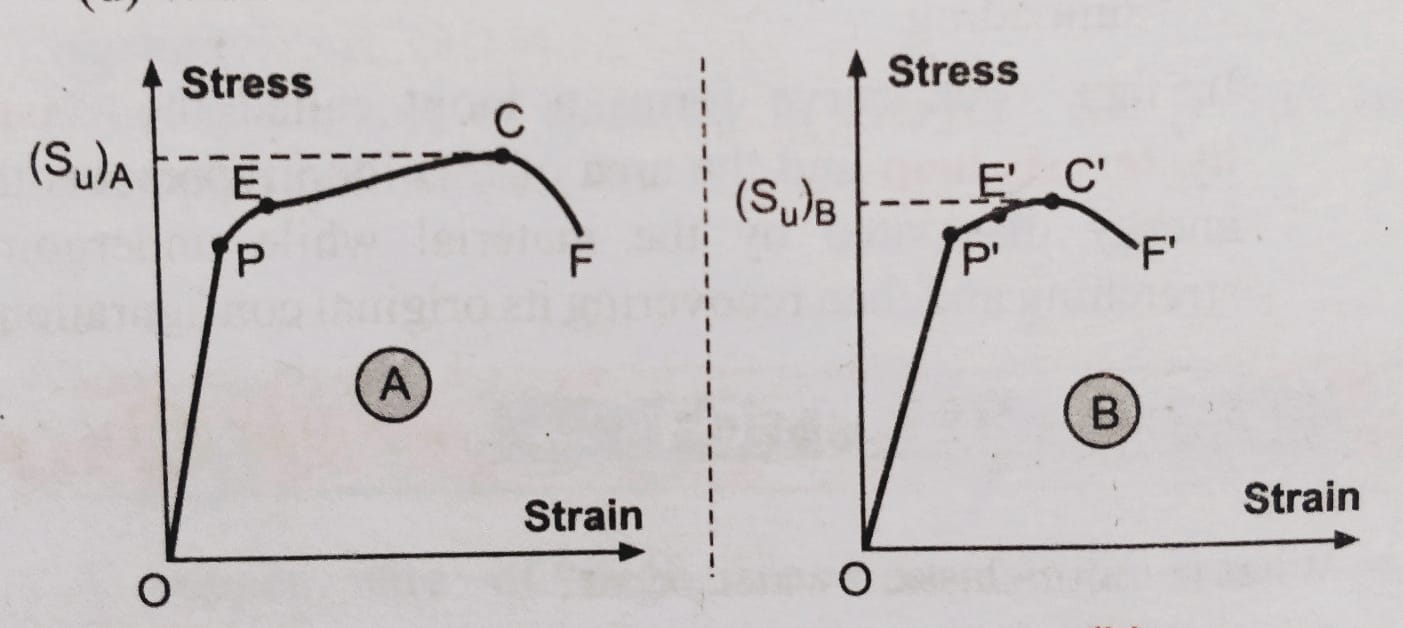
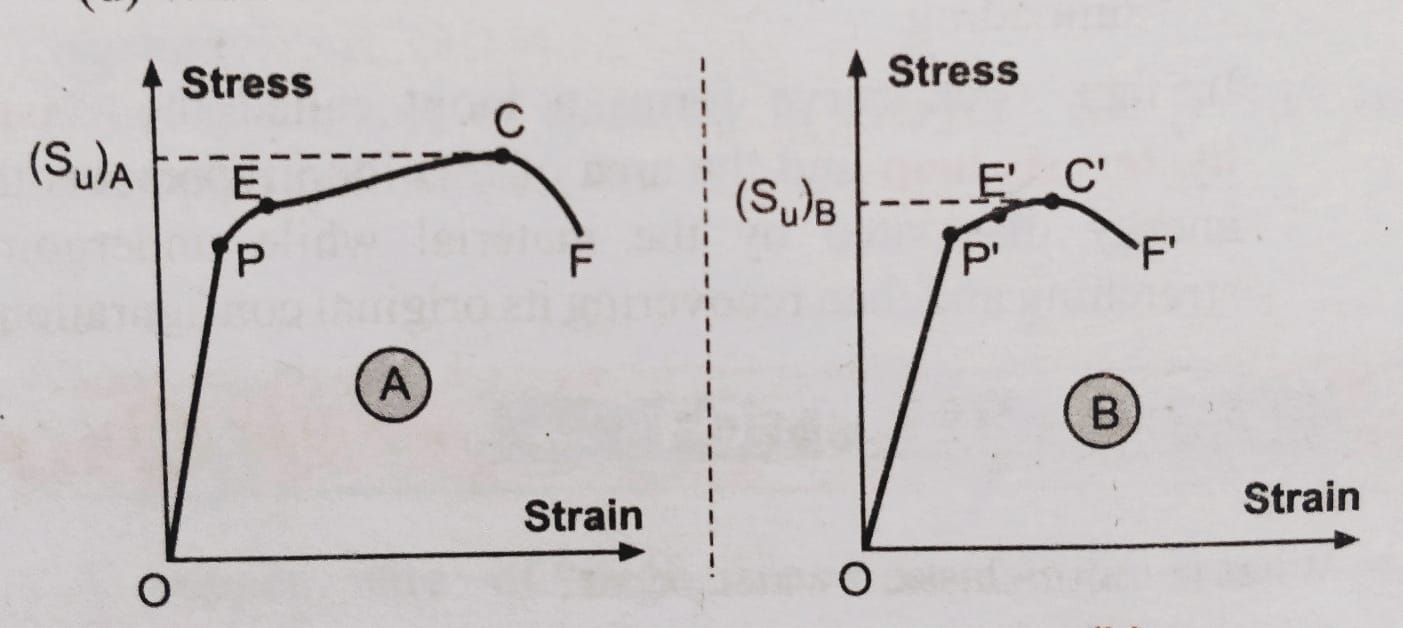
    14.The stress strain graph for two materials A and B are shown in fig. (a) Which one has greater Young’s modulus ?(b) which one is strongest material?(c) which is more ductile?(d) which is more brittle?

    Answers-

    1.-d      2.-a   3.-b    4.-b    5.-d     6.-a     7.-d     8.-c     9.-a    10.- (a) 3.18X10⁸Pa  (b)1.59mm (c) 2.5×10⁵j/m3  (d)7.92 J . 11.- infinity  12.- 0.5   13.-  Y-1 .

  • Important questions of elasticity

    This assignment contain Important questions of elasticity

    ( Mechanical properties of solids)

    1. what is more elastic water or air?

    2. Write copper,steel,rubber and glass in the increasing order of their elasticity.

    3.How do modulus of elasticity of a material changes with temperature?

    4. The breaking force for a wire is F, what will be the breaking force (i) two parallel wire of same size? (ii) for a single wire of double of thickness?  Ans- 2F and 4F

    5.What is the modulus of rigidity of a fluid ?    Ans-0

    6.Define Young’s modulus and modulus of rigidity. Give their expression and units.

    7. What is the meant by elastic limit and angle of share?

    8. Define Poisson’s ratio, what is its value for perfectly incompressible substance?                               Ans-0.5

    9. Derive an expression for the elastic potential energy of a wire under stress.

    10. What is the role of elasticity in everyday life? Give two example.

    11. A 4m long aluminium wire whose diameter is 3 mm is used to support a mass of 50 kg. What will be the elongation of the wire? Y for aluminium is 7 x 10¹¹N/m2  ans-3.9mm

    12-Calculate the percentage increase in the length of a wire of diameter 2.5mm stretched by a force of 100kg-wt Young’s modulus of the wire is 12.5 x 10¹⁰ N/m2.ans-0.16

    13.Acable is replaced by anther cable of same length and material but twice the diameter (a) How will this effect the elongation under given load? (b)How does this effect the maximum load it can support without exceeding the elastic limit? Ans-1/4th and D 2 .

    14. A material has poisson’s ratio 0.5. If a uniform rod of it suffers a longitudinal strain of 2 x 10⁻³ . What is the percentage increase in its volume? Ans-0%

    15.Two wires of different materials are suspended from a rigid support. They have the same length and diameter carrying the same load  at their free ends . (a) Will the stress and strain in each wire be the same? (b) will the extension in both wire will be same?   Ans- (a) stress same strain different (b) different.

    16.The stress strain graph for two materials A and B are shown in fig.

    (a) Which one has greater Young’s modulus ?(b) which one is strongest material?(c) which is more ductile?(d) which is more brittle?

    17. A wire stretches a certain amount under a load. If the load and diameter are both increased to three times, find the stretch cause in the wire.

    Ans. [3/4l]

    18.A metal bar of length L and area of the cross-section A is rigidly clamped between two walls. The young’s modulus of its material is Y and the coefficient of linear expansion is. α. The bar is heated so that its temperature is increased by C. find the force exerted at the ends of. the bar.

    Ans. [YA α]

    19.A metallic wire is suspended by attaching some weight to it. If  is the longitudinal strain and Y is young’s modulus, find the ratio between elastic potential energy and the energy density.

    Ans. [volume]

    20.A spherical ball contracts in volume by 0.01 when subjected to a normal pressure of 100 atmospheres. What is the bulk modulus of its material in cgs units?

    Ans. [1010 dynes /cm2]