Category: NEET/PMT

  • ELECTRIC CURRENT

    ELECTRIC CURRENT

     ELECTRIC CURRENT or CURRENT ELECTRICITY


    electric- current
    electric- current

     electric current –

    Electric current –

    When electric charges is in motion , they constitute what is called an electric current . electric current is defined as the rate of flow of charge through an area of the conductor . if  Q is the charge flows through a conductor in time T then  electric current I = Q/T

    Or  I= dQ /dt . unit of current is Ampere .

    We can define 1 Ampere  is the current flowing through a conductor when 1 Coulomb  of charge flows through a conductors in unit time.

    In the terms of drift velocity current I = n e A Vd  where n is the charge density , A  is the area of cross-section of the conductor , e is the charge on electron and Vd is the drift velocity.

    In terms of Ohm’s law – current  I = V/R  V is the potential difference across the conductor and R is the resistance of the conductor .

    So we can say 1 Ampere current flows through a conductor when unit potential difference setup across a conductor of resistance 1 Ohm .

    Ampere is the basic unit of electric current . It is named after Andre-Marie -Ampere a French scientist  born in 1775  . He also known as the father of electrodynamics .

    Definition of Ampere –  1 Ampere  is the current flowing through a conductor when 1 Coulomb  of charge flows through a conductors in unit time.

    From Ohm’s law – potential difference across the conductor is directly proportional to the current flowing through the conductor , if V  is the  potential difference across the conductor and I be the current flowing through the conductor then according to Ohm’s law V α I or V= RI , where R is the resistance of the conductor . ( resistance of a conductor is the property of the conductor to restrict the flow of current through it) i.e. current  I =V/R,

    So we can say, 1 Ampere current flows through a conductor when unit potential difference setup across a conductor of resistance 1 Ohm .


    Another definition of current can be determined using the property of force between two parallel current carrying conductor according to it force between two parallel current carrying conductor can be given as force per unit length (f/l) F= µ0I1 I2 /2Πd ( Here I1 and  I2 are the current through the wires and , d is the separation between them . according to given relation we can define, 1 Ampere is the current which when flowing in each of parallel conductors placed at separation  1 m in vacuum exert a force of 2 x 10⁻⁷ N on 1 meter length of either wire. 

    To solve or download important objective questions of current electricity click here- Current electricity and Ohm law  objective


  • SELF-INDUCTION OF LONG SOLENOID

    SELF-INDUCTION OF LONG SOLENOID

    SELF-INDUCTION OF LONG SOLENOID

    self- induction
    self- induction of long solenoid

    SELF-INDUCTION OF LONG SOLENOID this topic is important for the class 12th board examination

    Self-inductance of long air-cored solenoid question may asked as –

    what do you mean by the term self-induction ? Find expression for the self-inductance of long air cored solenoid .

    Self-inductance of long air-cored solenoid –

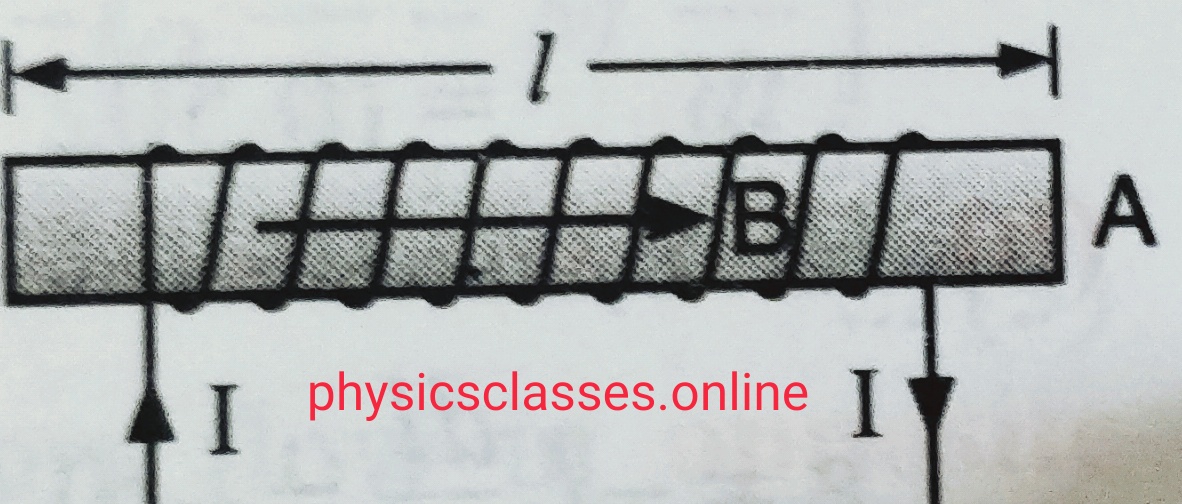
    Suppose a long air cored solenoid having ‘n’ number of turns per unit length . If current in the solenoid is ‘I’  the magnetic field within the solenoid B= µ0nI . If A is the area of cross-section of the solenoid , the effective flux linked with the solenoid of length ‘l’ ; ɸ=NBA……………………………….(i)

    where N is the total no. of turns of the solenoid . so ɸ= n l B A …………………………………….(ii) . substituting the value of B in this equation

    we get,

    ɸ =n l(µ0nI ) A  = µ0n2A l I .

    so , self-inductance  of solenoid L=ɸ/ I.=   µ0n2A l I / I  = µ0 n2 Al

    but n= N/l

    so self- inductance L= µ0 N2A/ l .

    If solenoid contains a core of ferromagnetic material , having relative permeability µr then self-inductance  L=   µ0µr N2A/ l .

    necessary picture of this topic  is shown above**.

  • SELF-INDUCTION

    SELF-INDUCTION

    Explain the term self-induction of a coil

    Self – Induction –

    It is the property of an electric circuit or coil by virtue of which it opposes any change of flux or current in it by inducing a current in itself is called self- induction. In another words we can say “self-induction is the inertia of electricity “. Due to self -induction an electric circuit resist any change of current through it .

    As we know magnetic flux linked with a coil is directly proportional to the current flowing through the circuit

    i.e.    ɸ α I ( ɸ= flux linked with the coil, and I is the current in the circuit )

    ɸ = LI ( L is the constant called coefficient of self- induction or self-inductance  or only inductance . )

    If current I =  1 ampere, then flux ɸ= L  . so we can define self-induction is the flux linked with the coil when unit current passes through the coil.

    as we know,

    emf  e= – dɸ/dt

    e= -d (LI)/ dt

    e= -L ( dI/dt)

    L= –  e/(dI/dt)

    So we can define self-inductance of a circuit is numerically equal to the induced emf setup in it when the rate of change of current through it is unity.

    Unit of self-inductance is Henry (H) .  We can define self-inductance of a coil is one Henry if 1 volt emf induced in the coil when rate of change of current through the coil is unity.

    To find the expression for self-inductance of long solenoid click here

  • What is electric current

    What is electric current

    What is electric currentelectric current

    What is electric current ? what is its unit ? define Ampere.

    Electric current-When electric charges is in motion , they constitute what is called an electric current . electric current is defined as the rate of flow of charge through an area of the conductor . if  Q is the charge flows through a conductor in time T then  electric current I = Q/T

    Or  I= dQ /dt . unit of current is Ampere .

    We can define 1 Ampere  is the current flowing through a conductor when 1 Coulomb  of charge flows through a conductors in unit time.

    In the terms of drift velocity current I = n e A Vd  where n is the charge density , A  is the area of cross-section of the conductor , e is the charge on electron and Vd is the drift velocity.

    • Subscribe to Video Tutorial ( Nayan Jha Sir )

    In terms of Ohm’s law – current  I = V/R  V is the potential difference across the conductor and R is the resistance of the conductor .

    So we can say 1 Ampere current flows through a conductor when unit potential difference setup across a conductor of resistance 1 Ohm .


  • Faraday’s law of electromagnetic induction

    Faraday’s law of electromagnetic induction

    Faraday’s law of electromagnetic induction

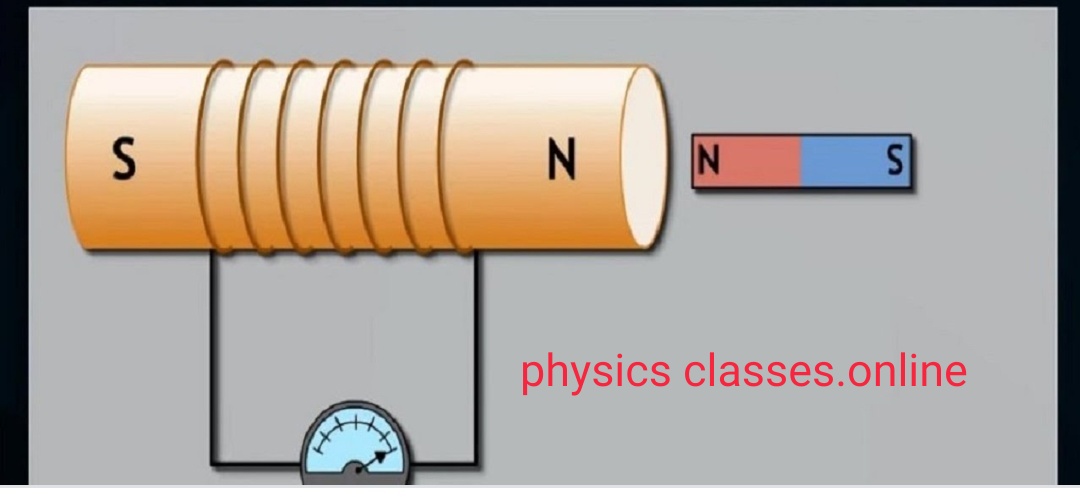
    Electromagnetic induction – As we know when electric current passes through a conductor then magnetic field developed across the conductor , first discovered by Oersted . But Michael Faraday found its converse is also possible i.e. Whenever magnetic field changes around a coil ( and hence magnetic flux linked  across the coil changes  ) electric current induced in the coil , such phenomena is called electromagnetic induction (E.M.I.) . And the current induced in the coil  is known as induced current and emf developed is known as induced emf .

    Faraday's law of EMI
    Faraday’s law of EMI

    Faraday’s laws of electromagnetic induction – On the basis of experiments Faraday’s gave the two laws –

    (i) Whenever electric flux linked with the coil changes then emf induced in the coil . The emf lasts only for the time for which flux is changing .

    (ii)  The magnitude of induced emf is directly proportional to rate of change of magnetic flux linked with the coil.   I.e.  emf   e  α ɸ2 – ɸ1 / t (time taken).

    Or  e =  – k dɸ/ dt . ( Here negative sign shows the  induced emf oppose any change in the magnetic flux through the coil.

    After combining these two equations Faraday’s law states “ An induced emf is produced in any closed circuit if there is a varying magnetic flux . the magnitude of induced emf  is equal to the negative of the time rate change of magnetic flux through the circuit .”


  • OBJECTIVE QUESTIONS OF KINEMATICS

    OBJECTIVE QUESTIONS OF KINEMATICS

    KINEMATICS  ( OBJECTIVE QUESTIONS)

    KINEMATICS
    KINEMATICS


    THIS ASSIGNMENT IS USEFUL FOR THE STUDENTS FOR CLASS XI ,NEET/ AIIMS AND JEE( MAIN / ADVANCE)OBJECTIVE QUESTIONS OF KINEMATICS IS DESIGNED FOR THE MULTI EXAMINATIONS PAPER  FOR THE STUDENTS . THIS QUESTION PAPER CONTAINS ALL KIND OF QUESTIONS LIKE ACCELERATED MOTION , PROJECTILE ETC….SINCE NUMBER OF QUESTIONS ARE VERY LESS SO STUDENTS CAN USE THIS ASSIGNMENT FOR QUICK REVISION.

    TO DOWNLOAD COMPLETE ASSIGNMENT KINEMATICS ( OBJECTIVE QUESTIONS ) CLICK HERE

    Here is practice paper for NEET/ JEE and class 12th which is selected from Akash study package .

     TO DOWNLOAD COMPLETE ASSIGNMENT OF motion in st. line Akash CLICK HERE-


  • OBJECTIVE QUESTIONS OF ELECTROSTATICS

    OBJECTIVE QUESTIONS OF ELECTROSTATICS

    ELECTROSTATICS

    OBJECTIVE TYPE QUESTIONS OF ELECTROSTATICS FOR THE STUDENTS PREPARING FOR JEE/ NEET/AIIMS.

    OBJECTIVE TYPE QUESTIONS OF ELECTROSTATICS questions will help the students to practice the entire chapter of ELECTROSTATICS …..Having solved these question students will be able to solve all questions in all competitive examinations based on this chapter . Section A is for NEET and XII(board), section B is for JEE students.


    ELECTROSTATICS


    TO DOWNLOAD ENTIRE QUESTION PAPER


    OBJECTIVE TYPE QUESTIONS -1-electrostatics

    Here is another set of important objective questions for class 12th which contain all important questions of electric field and potential only, it will help the students to practice this chapter well , for board examination  point of view .

    To dawnload important objective questions for class 12th-click here -Electric Field and Potential.objective 2


  • OBJECTIVE  QUESTIONS FOR UNITS AND DIMENSIONS

    OBJECTIVE QUESTIONS FOR UNITS AND DIMENSIONS

    Assignment of UNITS AND DIMENSIONS

                    UNITS AND DIMENSIONS

    Q1. the correct order in which the dimensions of length increases in the following quantities is :

    (i)permittivity  (ii) resistance  (iii) magnetic permeability  (iv)stress

    (a)(i),(ii),(iii),(iv)   (b) (iv),(iii),(ii),(i)    (c) (i),(iv),(iii),(ii)       (d) (iii),(ii),(iv),(i)

    Q2. the ratio of the dimensions of Plank’s constant and that of moment of inertia is the dimension of :

    (a)time    (b)frequency   (c)angular momentum   (d)velocity

    Q3. consider the following equation of Bernoulli’s theorem

                       P+ pv2 +pgh =K (constant )

    The dimension of K/P are :

    (a)thrust         (b)pressure    (c)angle   (d)viscosity

    Q3. Dimensions of electric resistance is :

    (a)[ML2T-3A-1]         (b) [ML2T-3A-2]    

     (c) [ML3T-3A-2]         (d) [ML-1T3A2]

    Q4. In a system of unit, if force (F), acceleration (A) and time (T) are taken as fundamental units then the dimensional formula for energy is :

    (a) [FA2T]        (b) [FAT2]      

     (c)[FA2T]         (d)[FAT]

    Q5. which of the following is not a unit of young’s modulus ?

    (a) Nm-1           (b) Nm-2     (c)dyne cm-2   (d)megapascal

    Q6. Out of the following four dimensional quantities, which one qualifies to be called a dimensional constant?

    (a)Acceleration due to gravity                   (b)Surface tension of water  

     (c)Weight of a standard kilogram mass   (d)The velocity of light on vacuum

    Q7. SI unit of magnetic flux is :

    (a)tesla      (b)oersted    (c)weber      (d)gauss

    Q8.Which of the following group have different dimension?

    (a)Potential difference, emf, voltage       (b)pressure, stress,  Young’s modulu (c)Heat, energy, work done   (d)Dipole moment, electric flux, electric field

    Q10. The unit of electric field is not equivalent to :

    (a)J/C     (b)J/cm     (c)V/m    (d)N/C

    Q11. If E and B respectively represent electric field and magnetic field, then the ratio E/B has the dimension of:

    (a) displacement  (b)velocity    (c)acceleration    (d)angle

    Q12. The dimension of  E0E2 , where E0 is permittivity of free space and E electric field, is

    (a)[ML2T-2] (b) )[ML-1T-2]  (c) )[ML2T-1]  (d) )[MLT-1]

    Q13. The mass and volume of a body are found to be 5.00 ±0.05kg and 1.00±0.05m3 respectively. Then the maximum possible percentage error in its density is :

    (a)6%      (b)3%     (c)10%      (d)5%      (e)7%

    Q14. In an experiment four quantities a,b,c and d are measured with percentage error 1%, 2%, 3% and 4% respectively. Quantity P is calculated as follows:

            P= a3b2/cd

    Percentage error in P is

    (a)10%      (b)7%       (c)4%     (d)14%

    Q15. the dimesion of the quantity E x B, where E  represents the electric field and B the magnetic field may be given as:

    (a)[MT-3]     (b)[M2LT-5A-2]                                                                         (c) [M2LT-3A-1]     (d) [MLT-2A-2]

    Q16. If force (F), velocity (V) and time (T) are taken as fundamental units, then the dimensions of mass are

    (a)[FVT-1]     (b)[FVT-2]                                                                                  (c)[FV-1T-1]     (d)[FV-1T]

    Q17. the dimensions of mobility of charge carriers are: 

    (a) [M-2T2A] (b) [M-1T2A]                                                                                (c) [M-2T3A] (d) [M-1T3A] (e) [M-1T2A-1]

    Q18. If energy (E), velocity (V) and time (T) are chosen as the fundamental quantities, the dimensional formulae of surface tension will be :

    (a)[EV-1T-2] (b) [EV-2T-2]                                                                                   (c) [E2V-1T-2] (d) [EV-2T-1]

    Q19. Plank’s constant (h), speed of light in volume (c) and Newton’s gravitational constant (G) are three fundamental constants. What is the dimension of length

    Q20. Which of the following unit denotes the dimension [ML2/Q2]. Where Q denotes the electric charge.

    (a)weber (Wb)         (b)Wb/m2      (c)henry (H)        (d)H/m2

    Q21. The magnetic moment has dimension of

    (a)[LA]         (b)[L2A]          (c) [LT-1A]           (d)[L2T-1A]

    Q22. Surface tension has the same dimension as of :

    (a)Coefficient of viscosity      (b)impulse      (c)momentum   (d)spring constant    (e) frequency

    Q23. which of the following sets of quantities have same dimensional formulae?

    (a) Frequency, angular frequency and angular momentum    

    (b)surface tension, stress and spring constant

     (c)acceleration, momentum and retardation 

     (d)Thermal capacity, specific heat and entropy

     (e) Work, energy and torque

    Q24. A physical quantity P=  / d3e1/3 is determined by measuring a, b, c,d  and separately with the percentage error of 2%, 3%, 2%, 1% and 6% respectively. Minimum amount of error is contributed by the measure of :

    (a)b        (b)a      (c)d       (d)e   (e)c

    Q25. Two forces 5N and 12N simultaneously  act on a particle. The net force on particle is

    (a) 17N     (b) 12N     (c) 13N      (d) 7N

    Q26. A physical quantity Y= a4b4 / (cd4)1/3 has four observables a, b, c, and d. the percentage error in a, b, c and d are 2%, 3%, 4% and 5% respectively. The error in y will be :

    (a) 6%    (b)11%     (c)12%     (d)22%

    Q27. which of the following quantities measured from different inertial reference frames are same ?

    (a)force     (b)velocity   (c)displace  (d)kinetic energy

    Q28. If the unit of mass, length and time are doubled, unit of angular momentum will be :

    (a)doubled   (b)tripled    (c)quadrupled  (d) 8 times the original value

    Q29. If E= energy , G gravitational constant,  I = impulse and M = mass, the dimension of GIM2/E2 are same that of

    (a)time   (b)mass      (c)length  (d)force

    Q30. A new system of unit is evolved in which the values of µ0 and E0 are 2 and 8 respectively. Then the speed of light in this system will be

    (a)0.25         (b) 0.5      (c)0.75     (d)1.0

    Q31.The velocity of a particle (v) at an instant t is given by ; v=at+bt2 the dimension of b is :

    (a)[L]                          (b) [LT-1]

    (c)[LT-2]                      (d)[LT-3]

    Q32. If the dimensions of a physical quantity are given by MaLbTc,then the physical quantity will be :

    (a)velocity if a=1,b=0,c=-1

    (b)acceleration if a=1,b=1,c=-2

    (c) force if a=0,b=-1,c=–2

    (d) pressure if a=1,b=-1,c= -2

    Q33.Given that the displacement of an oscillating particle is given by y=Asin (Bx=a+D).The displacement formula for (ABCD)is:

    (a)[M0L-1T0]         (b)[M0L0T-1]                                                                      (c)[M0L-1T-1]       (d)[M0LOT0]

    Q34. If force (F), work(w) and velocity (v) are taken as fundamental quantities ,then the dimensional formula of time (T)is:

    (a)[WFv]                 (b)[WFv-1]                                                                         (c)[W-1F-1v-1]       (d)[WF-1V-1]

    Q.35.The potential energy of a particle varies with distance x from a fixed origin as V=(A√x /(x+B)) where A and Bare constant ,The dimensions of AB are:

    (a) [ML5/2T-2]         (b)[ML2T-2]                                                                      (c)[ M3/2L3/2T-2]    (d)[ML7/2T-2]

    Q36.If force is proportional to square of velocity ,then the dimensions of proportionality constant is:

    (a)[ML-1T]                  (b)[ML-1T0]                                                                       (c)[MLT0]                 (d)[M0LT-1]

    Q37.The speed (v) of ripples on the surface of water depends on surface tension (σ) ,density density (p) and wavelength (λ) The square of speed (v) is proportional to :

    (a) σ/pλ    (b)p/σ λ       (c) λ/ pσ      (d)pσλ

    Q38. The modulus of electricity is dimensionally equivalent to :

    (a)strain                                      (b)force                  (c)stress                                      (d)coefficient of viscosity

  • Physics Post 2

    Physics Post 2

    What is Lorem Ipsum?

    Lorem Ipsum is simply dummy text of the printing and typesetting industry. Lorem Ipsum has been the industry’s standard dummy text ever since the 1500s, when an unknown printer took a galley of type and scrambled it to make a type specimen book. It has survived not only five centuries, but also the leap into electronic typesetting, remaining essentially unchanged. It was popularised in the 1960s with the release of Letraset sheets containing Lorem Ipsum passages, and more recently with desktop publishing software like Aldus PageMaker including versions of Lorem Ipsum.

    Why do we use it?

    It is a long established fact that a reader will be distracted by the readable content of a page when looking at its layout. The point of using Lorem Ipsum is that it has a more-or-less normal distribution of letters, as opposed to using ‘Content here, content here’, making it look like readable English. Many desktop publishing packages and web page editors now use Lorem Ipsum as their default model text, and a search for ‘lorem ipsum’ will uncover many web sites still in their infancy. Various versions have evolved over the years, sometimes by accident, sometimes on purpose (injected humour and the like).

    Where does it come from?

    Contrary to popular belief, Lorem Ipsum is not simply random text. It has roots in a piece of classical Latin literature from 45 BC, making it over 2000 years old. Richard McClintock, a Latin professor at Hampden-Sydney College in Virginia, looked up one of the more obscure Latin words, consectetur, from a Lorem Ipsum passage, and going through the cites of the word in classical literature, discovered the undoubtable source. Lorem Ipsum comes from sections 1.10.32 and 1.10.33 of “de Finibus Bonorum et Malorum” (The Extremes of Good and Evil) by Cicero, written in 45 BC. This book is a treatise on the theory of ethics, very popular during the Renaissance. The first line of Lorem Ipsum, “Lorem ipsum dolor sit amet..”, comes from a line in section 1.10.32.