test paper for class 11th
this test paper specially design for the students of class 11th( physics) . this question paper covers questions from chapter 1st to chapter 6th . student can check there preparation using this test paper . this question paper also contain very important questions , so students must try to solve these question test paper for class 11th.
Test -11th
M.M.-30 TIME-1:00
All questions are compulsory , section- A contains 5 questions each carry 1 mark, section- B contains 7 questions each carry 2 marks ,section- C contains 12 questions each carry 3 marks , section-D contains 3 questions each carry 5 marks.
SECTION (A )
- The volume of an object as a function of time is calculated by where t is time in seconds and v is in cubic meter. Determine the dimensions of constants A and B.
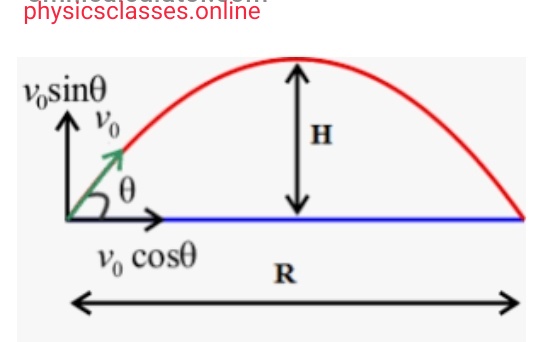
- A stone is thrown such that its horizontal range is 4 times the maximum height. Find the angle of projection.
- A cricket ball of mass 150 g has an initial velocity m/s and final velocity m/s after being hit. Calculate the change in momentum.
- What happens to coefficient of friction when the weight of a body is doubled ?
- If a man in an elevator drops his briefcase but it does not fall to the floor, what can you conclude about the elevator’s motion?
SECTION-B
- When a particle rotates in a circle, a central force acts on it directed towards the center of rotation. Why does this force does no work on the particle?
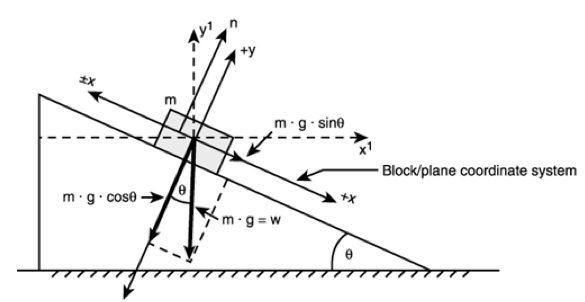
- A cubical block rests on a plane of coefficient of friction √3. The angle through which the plane be inclined to the horizontal so that the block just slides down will be what? Also define angle of repose.
- Show that the path followed by the particle given angular projection is parabolic.
- If a projectile is projected with same initial velocity at two different angles α and β with the horizontal , if horizontal distance covered in both the cases are same thin find the ratio of there maximum height attained in both cases.
- The block of mass M moving on the frictionless horizontal surface collides with the spring of spring constant k and compress it by length L. Calculate the maximum momentum of the block after collision.
- Explain impulse-momentum theorem. Give some practical applications of impulse.
- State and explain work energy principle using calculus method.
SECTION-C
- The displacement of a body is proportional to t3, where t is time elapsed , then what will be the nature of velocity-time and acceleration – time graph. Also plot the position time graph for the uniform motion of an object along a straight line , if (i) x0=positive , v=negative and magnitude of velocity is constant (ii) both x0 and v are negative and magnitude of velocity is constant.
- Explain Parallax method, how it is used to find the radius of the planet ?
- The escape velocity v of a body depends on the (i) acceleration due to gravity,(ii)the radius R of the planet. Establish dimensionally the relation for the escape velocity. Also write the dimension of gravitational constant G.
- Define acceleration due to gravity. Obtain relations to show how the value of ’g’ changes with (i) altitude , (ii) depth .
15. state and derive Kepler’s laws of area and periods for circular orbits.
- A man can jump 1.5 m on earth . calculate the height he may be abled to jump on a planet whose density is one quarter that of earth and whose radius is one third that of earth.
19.A uniform circular disc of radius R is rolling on a horizontal surface . Determine the tangential velocity (i) at the upper most point ,(ii)at the center of mass and (iii) at the point of contact.
- A body is moving with uniform acceleration , its velocity after 5 sec is 25m/s and after 8 sec is 34m/s. calculate distance it cover in 15th sec .
- A pump on the ground floor of a building can pump up water to fill a tank of volume 30 m3 in 15 min. If the tank is 40 m above the ground , how much electric power is consumed by the pump , the efficiency of the pump is 30%.
22.Define spring constant , write the characteristics of the force during the elongation of the spring . Derive the relation for the potential energy stored when it is elongated by the distance X .
- (i) A light and heavy body have same kinetic energy , which of the two have more momentum and why? (ii) If kinetic energy of a body is increased by 300% , find the % increase in its momentum.
- Two blocks of mass 2kg and 5kg are connected by a light and inextensible string passing over a frictionless pulley . the block of mass 2 kg is free to slide on a surface inclined at an angle of 300 with the horizontal whereas 5 kg block hangs freely . find the acceleration and tension in the string.
SECTION-D
- What do you mean by Banking of roads. What is the need of banking a circular road. Discuss the motion of car on banked circular road(with friction).
A vehicle running with speed 72 km/hr applies brakes producing a retardation of 3 m/s2 while taking a turn of radius 100 m. Find the acceleration.
- State and prove the theorem of (i) parallel axis and , (ii) perpendicular axis . Also find the moment of inertia of a circular disc about the axis perpendicular to the plane and passing through the center .
- How does a perfectly elastic collision is different from perfectly inelastic collision ? Two particles of mass m and M having velocities u1 and u2 respectively make an head on collision .Derive the relation for their final velocities . discuss the following special cases (i)m=M (ii) m>M and u2=0