Tag: dual nature

  • What is photo electric effect?

    What is photo electric effect?

    In this topic we will explain the photoelectric effect and also will explain hertz’s observation and Hallwach’s and Lenard’s observation.

    Photoelectric Effect: Hertz, Hallwachs and Lenard’s Observations

    1. What is the Photoelectric Effect?

    The photoelectric effect is the phenomenon in which electrons are emitted from the surface of a metal when electromagnetic radiation of a suitable frequency falls on it.

    The emitted electrons are called photoelectrons, and the current produced by their motion is called photoelectric current.

    Turning Points in Physics Notes — AQA A-Level

    Example: When ultraviolet light falls on a clean zinc plate, electrons may be emitted from its surface.

    Important terms

    • Photoelectrons: Electrons emitted from a metal surface due to incident light.
    • Work function (ϕ): The minimum energy required to remove an electron from a metal surface.
    • Threshold frequency (ν0): The minimum frequency of light required to produce photoelectric emission.
    • Stopping potential (Vs): The minimum reverse potential required to stop even the fastest photoelectrons.

    Einstein’s photoelectric equation is

    hν=ϕ+Kmax⁡

    where:

    • h= Planck’s constant
    • ν = frequency of incident light
    • ϕ = work function of the metal
    • Kmax⁡ = maximum kinetic energy of emitted electrons

    Since ϕ=hν0

    Kmax⁡=h(ν−ν0)

    This equation explains the main features of the photoelectric effect.

    2. Hertz’s Observation (1887)

    Radio — Whiting-Robertsdale Historical Society

    Heinrich Hertz

    Heinrich Hertz was conducting experiments to demonstrate electromagnetic waves. During his experiments, he observed that ultraviolet radiation helped an electric spark pass between two metal electrodes.

    Experimental observation

    1. Hertz produced an electric spark between two metal electrodes.
    2. He observed that ultraviolet light falling on the electrodes made the spark easier to produce.
    3. When the ultraviolet radiation was blocked, the spark became more difficult to produce.

    Conclusion

    Hertz’s observation indicated that ultraviolet radiation could help release electrons from a metal surface, facilitating the discharge.

    Importance: His observation was an early discovery of the photoelectric effect.

    3. Hallwachs’s Observation (1888)

    Wilhelm Hallwachs

    Wilhelm Hallwachs studied the effect of ultraviolet light on electrically charged metal plates, especially a clean zinc plate.

    Experiment

    Photoelectric Effect
    1. A clean zinc plate was connected to a negatively charged gold-leaf electroscope.
    2. The electroscope’s gold leaf diverged because the plate and electroscope carried negative charge.
    3. Ultraviolet light was allowed to fall on the zinc plate.
    4. The gold leaf gradually collapsed, indicating that the electroscope was losing its negative charge.

    Observation and conclusion

    • Negatively charged zinc plate: It loses negative charge when exposed to suitable ultraviolet light.
    • Positively charged zinc plate: It does not readily discharge through photoelectric emission because the emitted electrons are attracted back to the positively charged plate.
    • Uncharged zinc plate: It can become positively charged after photoelectrons escape.

    Conclusion: Ultraviolet light causes electrons to leave the zinc surface.

    This provided clear evidence that light can cause the emission of electrons from a metal.

    4. Lenard’s Observation (1902)

    Nobel Fisica 1905 > Philipp Eduard Anton von Lenard | Russian history, Historical illustration, Giclee print

    Philipp Lenard

    Philipp Lenard investigated photoelectric emission using a metal surface and an apparatus in which emitted electrons could be collected and measured.

    Experimental setup

    Doodlingo - Learn AI, Computer Science, Physics & Startups Through Doodles

    In a typical arrangement:

    • Light falls on a metal cathode.
    • Photoelectrons are emitted from the cathode.
    • A collector electrode (anode) collects the electrons.
    • The resulting photoelectric current is measured using an external circuit.

    Main observations of Lenard

    1. Photoelectric current depends on light intensity.

    For light of frequency above the threshold frequency, increasing the intensity generally increases the number of emitted electrons per second. Therefore, the photoelectric current increases.

    2. Maximum kinetic energy depends on frequency.

    Increasing the frequency of incident light increases the maximum kinetic energy of photoelectrons, provided the frequency is above the threshold.

    3. Existence of stopping potential.

    A reverse potential can be applied to oppose the motion of photoelectrons. At a particular reverse potential, even the fastest electrons cannot reach the collector, and the current becomes zero.

    Kmax⁡=eVsKmax​=eVs​​

    Here, ee is the magnitude of the electron’s charge and VsVs​ is the stopping potential.

    4. Threshold frequency exists.

    Below a certain minimum frequency, no photoelectrons are emitted, even if the intensity of light is increased.

    Conclusion: Lenard’s experiments established important properties of photoelectric emission and showed that the energy of photoelectrons is related to the frequency of incident light.

    5. Comparison of Hertz, Hallwachs and Lenard

    ScientistMain observationSignificance
    Hertz (1887)UV light made an electric spark easier to produce.Early discovery of photoelectric emission.
    Hallwachs (1888)UV light discharged a negatively charged zinc plate.Demonstrated that electrons leave the metal surface.
    Lenard (1902)Studied emitted electrons, their current, kinetic energy and stopping potential.Established important experimental laws of the photoelectric effect.

    6. Key results to remember for exams

    Intensity of light

    Increasing intensity increases photoelectric current, provided the frequency is above the threshold.

    Frequency of light

    Increasing frequency increases the maximum kinetic energy of photoelectrons.

    Threshold frequency

    Below the threshold frequency, photoelectric emission does not occur, regardless of intensity in the ordinary one-photon photoelectric effect.

    Stopping potential

    The stopping potential depends on the maximum kinetic energy, and therefore on the frequency of light for a given metal.

  • Case study based questions on Photoelectric effect

    Photoelectric effect

    Photoelectric effect is the phenomenon of emission of electrons from a metal surface , when radiation of suitable frequency fall on them . The emitted electrons are called photoelectrons and the current so produced is called photoelectric current.

    i. With the increase of intensity of incident radiation on photoelectrons emitted by a photo tube , the number of photoelectrons emitted pre unit time is (a) increases (b) decreases (c) remain the same  (d) none of these .

    ii. It is Observed that photoelectrons emission stops at a certain time t after the light source is switched on . The stopping potential can be represented as (a) 2(K.E.)max/e (b) (K.E.)max/e  (c) (K.E.)max/3e (c) (K.E.)max/2e .

    iii. A point source of light of power 3.2×10⁻³ W mono energetic photons of energy 5.0eV and work function 3.0eV . The efficiency of photoelectrons emission is 1 for every 106 incident photons . Assume that the photoelectrons are instantaneously swept away after emission . The max kinetic energy of photon is (a) 4eV (b) 5eV (c) 2eV (d) Zero .

    iv. Which of the following is the application of photoelectric effect ?   (a)L.E.D  (b)Diode (c) Photocell     (d) Transistor .

    v. If the frequency of incident light falling on the photosensitive metal is doubled , the kinetic energy of the emitted photoelectrons is (a) Unchanged (b) halved (c) doubled (d) more than twice its initial value.

    To solve the test based on the chapter Dual nature of matter . Atoms and nuclei, and Semiconductor devices click here-

    Test Dual nature, Atoms Nuclei and semiconductor

  • Important questions of dual nature of radiation and matter

    Important questions of dual nature of radiation and matter

    Important questions of dual nature of radiation and matter

    Dual nature

    In this assignment, important questions of dual nature of radiation and matter , i am trying to provide some important questions based on the chapter dual nature of radiation and matter, student preparing for 12th board exam must solve all the questions , this chapter is little bit easier than other previous chapter of physics class 12th.Numerical based on this chapter is bit  easier than other chapters, so prepare this chapter nicely , and solve all the questions , i am sure that students will get benefit from this assignment of important questions of dual nature of radiation and matter.

    Dual nature of matter and radiation

    1. List important observations made by Lenard which lead to quantum theory of radiations .
    2. State De-Broglie hypothesis . Derive an expression for the De-Broglie wavelength associated with an electron accelerated through a potential V . draw the schematic diagram  of a localized-wave describe the wave nature of the moving electron .
    3. Define the term threshold frequency and stopping potential in relation to the phenomenon of photoelectric effect . how is photoelectric current affected on increasing the (I) frequency (II) intensity of the incident radiations and why?
    4. Sketch the graphs showing the variation of stopping potential with frequency of incident radiations for two photosensitive radiations for two photosensitive materials A and B having threshold frequencies ѵ0 > ѵ0’ respectively . (I) which of the two metals ,A and B has higher work function ? (II) what information do you get from the slope of the  graphs ? (III) what does the value of the intercept of graph  A on the potential axis represent ?                                                                                                                 FOR IMPORTANT QUESTIONS OF RAY OPTICS -CLICK HERE
    5. Draw the graphs showing the variation of photoelectric current with anode potential of a photocell for (I) the same frequencies  but different intensities I1 >I2 >  I3 incident radiation, (II) the same intensities but different frequencies  ѵ1> ѵ2 >ѵ3 of incident radiation . Explain  why the saturation current is independent of the anode potential.
    6. What is the photoelectric current ? Write Einstein’s photoelectric equation and use it to explain (I) independence of photoelectrons from intensity , of incident light , (II) Existence of threshold frequency for emission of photoelectrons.                                                                                                 FOR IMPORTANT QUESTIONS OF WAVE OPTICS AND OPTICAL INSTRUMENT CLICK HERE
    7. An electron of mass m  and charge q is accelerated from rest through a potential difference V  , obtain the expression for the de-Broglie  wavelength  associated with it . if electron and proton are moving with the same K.E. , which one of them will have a large De-Broglie wavelength associated with it ? give reason .
    8. State the dependence of the work function on the K.E. of electrons emitted in a photocell . (a) if the intensity of the incident radiation increases to double of its initial intensity what change occur in the (I) stopping potential and (II)photoelectric current.(b) if the frequency of the incident radiation is doubled what change occur in the (I) stopping potential (II)photoelectric current(III) K.E. of the photo electron emitted
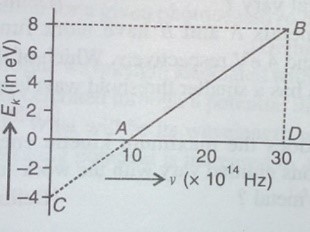
    9. Given below in the graph between frequency of the incident light and maximum kinetic energy of the emitted photoelectron find the value of (I) threshold frequency and (II) work function from the graph.

      dual pic-1
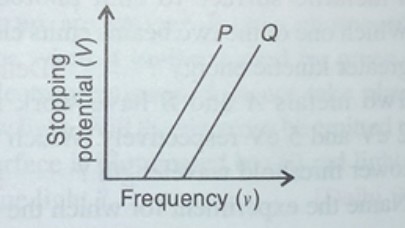
    10. In a photoelectric effect experiment , the graph between the stopping potential V and frequency v of the incident radiation on two different metal plate P and Q  in the fig. (I) which of the two metal plates , P and Q has greater value of work function ?(II)what does the  slope of the lines depict ?

      dual pic-2
    11. Ultraviolet light of wavelength 2271 A from a 100W mercury source is incident on a photocell made of molybdenum metal , if the stopping potential is 1.3 V , estimate the work function of the metal.

    For latest cbse class-12th  physics sample paper click here-

    WHAT IS DIFFRACTION OF LIGHT ? TO KNOW COMPLETE ASSIGNMENT. CLICK HERE-