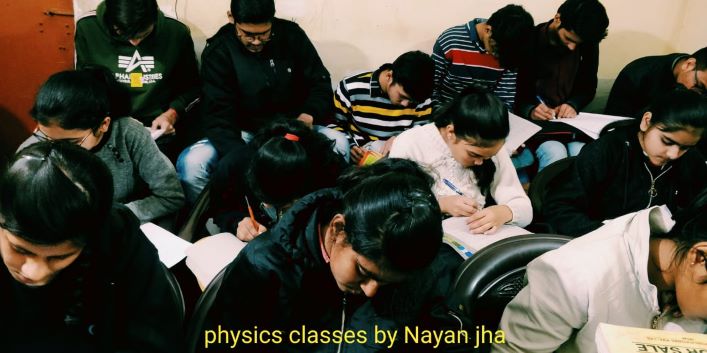
Tag: physics

  • How to score better marks in physics class 12 physics

    How to score better marks in physics class 12 physics

    How to score better marks in physics class 12 physics

    To download latest physics sample paper click here-

    CBSE Class 12 Physics Board Exam: Smart Strategy to Score Better Marks in physics.

    In this blog Physics by Nayan Jha going to tell you, about the smart strategy to score better in  physics class 12th board examination.

    Class 12th Physics Board Examination is not only about studying for long hours; it is about studying with the right strategy, proper revision and consistent practice. Many students understand the concepts but lose marks because of incomplete preparation, calculation mistakes, poor time management and lack of practice in objective-type questions.

    With the right approach, Physics can become one of the scoring subjects in the CBSE Board Examination.

    1. Make a Realistic Study Schedule

    Students should focus on quality study hours rather than simply counting the number of hours.Try to study Physics for around 2–3 focused hours every day, depending on your overall timetable and preparation level.A simple daily routine can be:

    – 45–60 minutes: Concept revision

    – 45–60 minutes: Numerical and derivations

    – 30–45 minutes: Objective questions

    – 15–20 minutes: Quick revision of formulas

    Consistency is more important than studying for 8–10 hours on one day and then taking a long break.

    2. Give Special Attention to Objective Questions

    To download the important objective class12th click here-

    The pattern of board examinations has increasingly placed importance on conceptual and application-based questions. Therefore, students should not prepare Physics only by solving long-answer questions.

    Practice regularly:

    – MCQs

    – Assertion-Reason questions

    – Case Study-based questions

    – Competency-based questions

    – Numerical-based MCQs

    – Statement-based questions

    Physics by Nayan Jha Suggestion:

    Don’t wait until the last few days to start objective preparation. Solve a small set of objective questions every day.

    3. Understand the Concept Before Memorising the Formula

    Physics is not a subject where memorising formulas alone is enough.

    Before using a formula, understand:

    What does the formula represent?

    When can it be used?

    What are the units of each quantity?

    What happens when one variable changes?

    This approach is particularly useful for MCQs, Assertion-Reason and application-based questions.

    4. Make a Chapter-wise Formula Sheet

    Prepare a separate formula sheet for every chapter.

    For example, revise:

    – Important formulas

    – SI units

    – Dimensions

    – Graphs

    – Important laws

    – Important definitions

    – Special cases

    – Frequently used relations

    Revise these sheets regularly instead of opening the entire textbook every time.

    5. Don’t Ignore NCERT

    For CBSE Board preparation, NCERT should remain one of the most important resources.

    Students should thoroughly study:

    – NCERT theory

    – Important definitions

    – Diagrams

    – Examples

    – Derivations

    – Numerical problems

    – Tables and graphs

    After completing NCERT, move towards sample papers and additional practice questions.

    6. Practice Numericals Every Day

    Many students understand the theory but lose marks in numerical questions because they do not practice enough.

    While solving a numerical, follow this sequence:

    Given → Formula → Substitution → Calculation → Final Answer with Unit

    Also pay attention to:

    – Sign conventions

    – SI units

    – Powers of 10

    – Significant figures where applicable

    – Direction of vectors

    Regular numerical practice improves both speed and accuracy.

    7. Prepare Important Derivations

    Do not leave derivations for the last week.

    Prepare the important derivations chapter-wise and practise writing them without looking at the book.

    While writing a derivation:

    1. Start with the relevant law or principle.

    2. Write the required equation.

    3. Show the mathematical steps clearly.

    4. Draw the diagram wherever required.

    5. Highlight the final result.

    A neat and logically arranged answer makes your solution easier to evaluate.

    8. Solve Sample Papers and Previous Questions

    Once you have completed the syllabus, start solving full-length papers under examination conditions.

    Try to complete the paper within the prescribed time.

    After every paper, analyze :

    – Which questions were wrong?

    – Which concepts were weak?

    – Where did you lose time?

    – Were there calculation mistakes?

    – Did you leave any question incomplete?

  • Objective class 12th Book part-1

    Objective class 12th Book part-1

    Introduction to Objective Physics for Class 12
    “Objective Physics” by Nayan Jha meets the demand for objective questions in Class 12 Physics exams.
    Key Features of This Book:
    Comprehensive Question Types:
    Multiple Choice Questions (MCQs) with answers,
    Assertion–Reason Questions with answers,
    Case Study Based Questions with answers,

    Focus on Conceptual Understanding: Each question enhances students’ conceptual understanding of Physics.
    Problem-Solving Skill Development: The book strengthens students’ ability to solve various Physics problems.
    Detailed Solutions:
    Every question includes a detailed solution.
    Solutions explain the correct answer and underlying Physics principles.
    Target Audience and Benefits:
    This book is for:
    Class 12th Board Examination Preparation: It offers effective preparation for board exams.
    NEET and JEE Aspirants: Concept-based questions benefit students preparing for NEET and JEE.
    How This Book Helps Students:
    Chapter-wise Practice: Chapter-organized questions allow students to assess preparation and identify improvement areas.
    Beyond Memorization: The aim is to foster deeper understanding, helping students understand concepts, learn applications, and build confidence in solving objective questions.
    Author’s Philosophy:
    “Concepts + Practice = Success — Your Success is My Mission.”
    — Nayan Jha
    Physics by Nayan Jha

    To download the complete book (pdf) click here-

  • Alternating current objective questions with answers

    In this blog physics classes by Nayan jha providing objective questions and answers , which contain multiple choice , assertion reason and case study based questions with explanation( complete solution.

    To download the pdf all questions and its answer click here-

    For question numbers 86-100, two statements are given-one labelled Assertion (A) and the other labelled Reason (R).
    Select the correct answer to these questions from the codes (a), (b), (c) and (d) as given below.
    (a) Both A and R are true and R is the correct explanation of A
    (b) Both A and R are true but R is NOT the correct explanation of A
    (c) A is true but R is false
    (d) A is false and R is also false

    1. Assertion (A) : Long distance transmission
      of A.C. is carried out at extremely high voltage.
      Reason (R): For large distance, voltage has
      to be large….
    2. Assertion (A) : An electric lamp connected
      in series with a variable capacitor and A.C.
      source, its brightness increases with increase
      in capacitance.
      Reason (R): Capacitive reactance decreases
      with increase in capacitance of capacitor.
    3. Assertion (A) : A transformer cannot work
      on D.C. supply.
      Reason (R): D.C. changes neither in magnitude
      nor in direction.
    4. Assertion (A) : Step-down transformer
      increases the current.
      Reason (R): Transformer obeys the law of
      conservation of energy.

    To download complete assignment of these questions and answer (PDF)click here-

  • How forces affects motion

    class 9 Chapter-6 (physics)

    In Chapter 4, you learnt to describe the motion of an object in terms
    of its position, velocity and acceleration. But you did not consider
    what causes motion. Is there an underlying cause for a change in
    position and velocity of an object? What is the nature of this cause?
    Do all motions require a cause? In this chapter, we will investigate
    what causes changes in the motion of objects. We will also discuss
    Newton’s three laws of motion and learn how to apply them.
    6.1 The Concept of Force
    Grade 8
    Curiosity
    Chapter 5
    You may recall learning earlier that a force can make an
    object move from rest, change the speed and direction
    of motion of a moving object, and can even change the
    shape of an object. For example, a ball at rest starts moving when
    you apply a force, a force applied by a cricket bat on a cricket ball
    changes its direction, and a lemon can be squeezed by the force
    applied by your fingers.

    To download the entire chapter click here-

  • What is String theory?

    What is String theory?

    What is string theory? Simple explanation of string theory in physics

    Now these days as the need of science increasing , the students are excited to know about the  universe, , related to the atomic and sub atomic particles. String theory is one of them .

    Now in this block we will discuss about the one of the most excited and fundamental concept of physics, known as the string theory.

    String theory is a theory in modern physics that tries to explain what the smallest building blocks of the universe really are.

    Questions may be asked on the basis of string theory which are –

    (i) How does a string produces particles?

    (ii)What are the purpose of string theory?

    (iii) Why extra dimensions involved ?

    (iv) Is the string theory proven ?

    String theory is a proposed framework in physics that tries to explain the fundamental particles and forces of nature—including gravity—within one mathematical theory.

    The central idea is surprisingly simple: instead of treating fundamental particles as infinitely small points, string theory proposes that they are tiny, one-dimensional vibrating strings.

    Normally we think of particles such as electron ,quarks as point like particles. But according to string theory ,at most fundamental level these particle may actually be made of extremely small , one dimensional objects called ‘string’.

    Different ways a string vibrates would appear to us as different particles. You can think of it somewhat like a guitar string: one string can produce different notes depending on how it vibrates. In string theory, one vibration might behave like an electron, another like a photon, and another like a different particle.

    One reason physicists are interested in string theory is that it naturally produces a particle with the properties expected of the graviton, the hypothetical quantum particle associated with gravity. This makes string theory a candidate for reconciling quantum mechanics with general relativity, two extremely successful theories that are difficult to combine under extreme conditions such as the interiors of black holes or the very early universe.

    There are some unusual consequences. Most versions require more dimensions than the four we experience (three dimensions of space plus time). Superstring theories generally require 10 space time dimensions, with the additional dimensions thought to be curled up at extremely small scales. A broader framework called M-theory involves 11 dimensions and also includes higher-dimensional objects called branes.

    The major problem is that string theory has not been experimentally confirmed. The characteristic scales involved are thought to be far beyond what current particle accelerators can directly probe, and the theory allows many possible ways for the extra dimensions to be arranged. Consequently, string theory remains an active but speculative area of theoretical physics rather than an experimentally established description of nature.

    In one sentence: string theory proposes that everything—from electrons to the particles associated with forces—ultimately arises from different vibrations of extraordinarily tiny strings.