Tag: Laws of motion

  • Newton’s second law of motion is the real law of motion

    Newton’s second law of motion is the real law of motion

    Newton’s second law of motion is the real law of motion

    Before to know Newton’s second law of motion is the real law of motion we must know all three equations of motion.

    To know, Newton’s first law of motion click here–

    To know, Newton’s second law of motion click here-

    To know, Newton’s third law of motion click here-


    Second law of motion  is the real law of motion –

    The question may be asked as , show that second law of motion is the real law of motion . 

    ***This question is very important for the class 11th examination point of view .

    To show it we must prove two things (i) First law contained in the second law and (ii) Third law contained in second law.

    (i) ) First law contained in the second law –  As we know according to Newtons second law of motion

    Force F = Ma ,

    If there is no external force

    then F = 0

    Or, Ma =0    then we can say    M=0 or a=o , but mass of the body can’t be zero.

    Therefore only possible thing is that only acceleration is zero .

    But , we know acceleration a= v-u/t ( where , v- final velocity and  u- initial velocity) .

    So we can write , v-u/t = 0  i.e v-u=0 or v=u

    Since V (final velocity) = u ( initial velocity).

    So we can say if body initially is in rest will be in rest and if it is moving with some velocity it will remain in the motion with the same velocity( which is the statement of first law ) . So we can say first law contained in the second law .

    To watch the video of this topic Newton’s second law is the real law of motion , click on the link given below-

    (ii) Third law contained in the second law –  suppose an isolated system of two objects A and B , they interact mutually with one another . Then obviously they will apply force on each other .

    Let,  FAB – Force on A due to B ,

    And  FBA – Force on B due to A .

    Let dpa and dpb is the change in momentum in A and B respectively in small time dt .

    Then from Newton’s second law –

    FAB = dpA/dt   ………………………(i)

    and, FBA= dpB/dt …………………..(ii)

    FAB+ FBA= dpB/dt + dpA/dt   ……….(iii)

    In the absence of external force , the rate in change in momentum of the system will be zero .

    i.e. dpB/dt + dpA/dt  = 0

    Therefore , FAB+ FBA=0 ;

    Or, FAB= -FBA ( which is third law )

    So we can say Newtons third law contained in the second law .

    Therefore we can say Newton’s second law of of motion is the real law of motion.

    What is the syllabus removed in class 12th physics (CBSE) for 2021 board examination , click on the link given below-


  • Apparent weight of a man in a lift

    Apparent weight of a man in a lift

    Apparent weight of a man in a lift

    In this topic we will discuss about , a man of mass m standing in a lift . What will be its apparent weight of a man in a lift when lift has some motion with uniform acceleration or velocity?

    But before to know about this topic students must know Newton’s third law of motion. To get the notes on Newton’s third law of motion click here-

    Apparent weight of a man in a lift  (elevator)  –

    Suppose a man of mass ‘m’ is standing on a weighing machine placed inside a lift . initially when the lift is in rest weight of the man acts vertically downward direction which acts on the   weighing machine and machine offers a resistance ‘R’ against its weight shows the actual weight which is mg .

    Case i – When the lift is in rest or moving with uniform velocity (fig-c)- In that case there is no acceleration in the lift and man , and hence reaction force is equal to the weight of the man.

    In that case , R  = mg

    i.e  Apparent weight = Actual weight

    Case ii – When lift moves upward with acceleration ‘a’ fig (a).

    Since there is upward motion then  ;

    So  R-mg =ma

    Or , R = mg+ma = m(g+a)

    i.e. R ( apparent weight) > mg(actual weight) ;

    i.e  Weighing machine shows more weight the actual .

    Case iii – When lift moves downward with acceleration ‘a’ fig (b).

    Since there is downward motion then  ;

    So  mg-R =ma

    Or , R = mg-ma = m(g-a)

    i.e. R ( Apparent weight) < mg(Actual weight) ;

    i.e  Weighing machine shows less weight the actual .

    case iv– When the lift falls freely –  In that case lift accelerates downward with acceleration ‘a=g’

    So we can write , R= mg-ma = mg-mg ( since a=g) = o

    Show apparent weight of the man will be zero . So person feel’s weightlessness.


  • Horse and cart problem

    Horse and cart problem

    Horse and cart problem

    This is the topic  Horse and cart problem which explain the one of the important illustration of Newton’s third law of motion.

    But before to learn the topic Horse and cart problem students must know, Newton’s third law of motion. To get the notes on Newton’s third law of motion click here-

    To get the Notes on Newton’s first law and inertia click here-

    To get the Notes on Newton’s second law and impulse click here-

    Horse and cart problems –

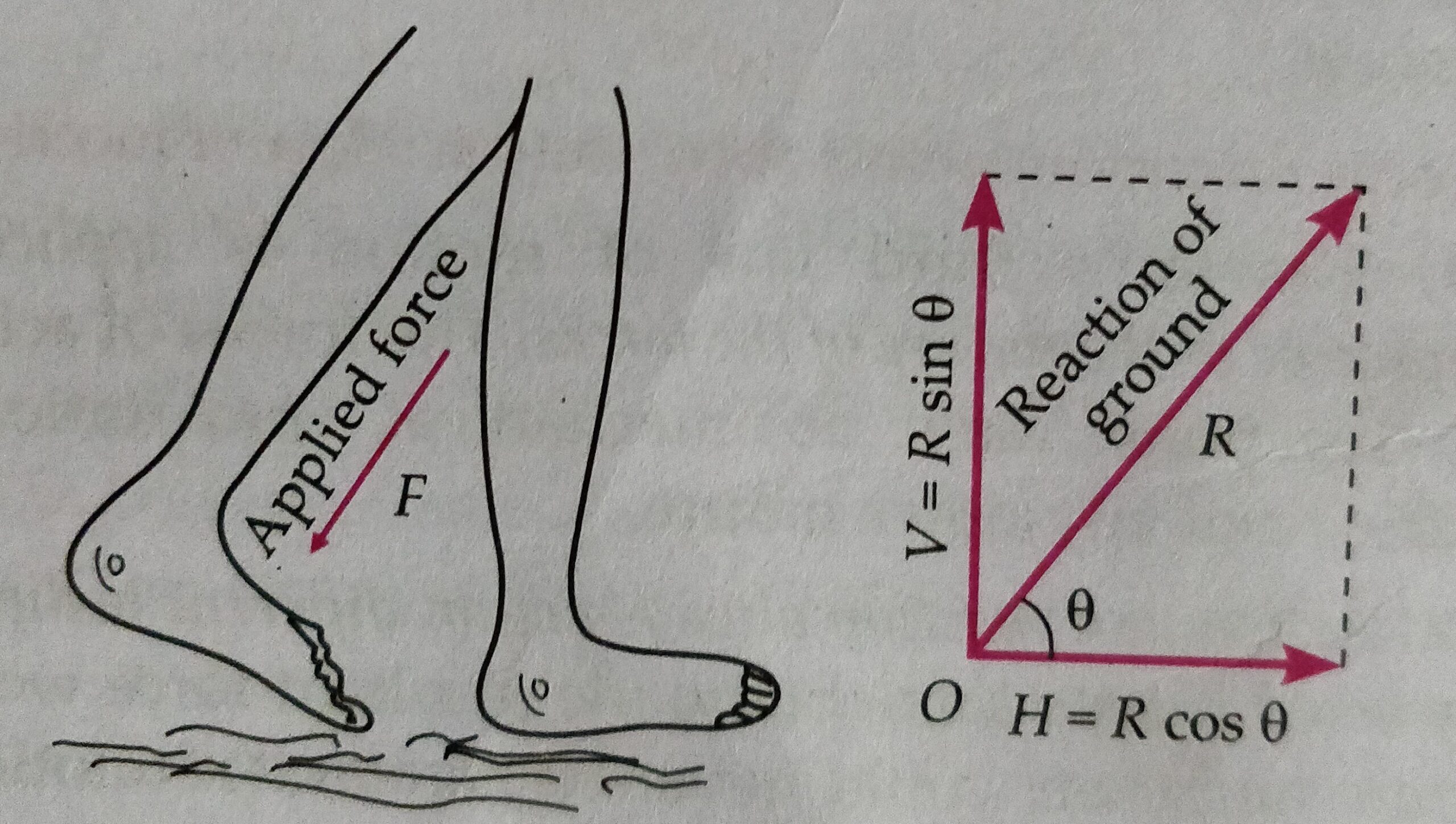
    Suppose a cart is connected  with a  horse by a light inextensible string. When horse start to walk horse press the ground F ( action ) with their feet in the slightly backward direction and ground  exert an equal reaction R , as shown in figure . then R has two component H = R cosϴ in horizontal direction  and V= R sinϴ in vertical direction . V balance the weight of the horse and H makes the horse to move in forward direction . While pulling the cart produces a tension T in the string .


    If H > T then cart starts moving in the forward direction with acceleration ‘a’ .

    Net force acting on the horse = H-T= ma.( where m is the mass of the horse)……………..(i)

    If f is the frictional force between tyre of cart and ground then for cart we can write

    T-F= Ma  ( M is the mass of the cart ) …………………………(ii)

    From equations (i) and (ii) we get ,

    H-f = ( M+m ) a ;

    So, acceleration   a  =  H-f/ (M+m ) ;

    The whole system will move if H>f ;


  • Newton’s third law of motion

    Newton’s third law of motion

    Newton’s third law of motion

    In this topic we will discuss about Newton’s third law of motion and some important illustrations of Newton’s third law of motion .

    Before to go with this topic students must know Newton’s first and second law .

    For Newton’s first law and inertia click here-

    For Newton’s second law and impulse click here-


    Newton’s third law of motion-

    According to this law every action has equal and opposite reaction.

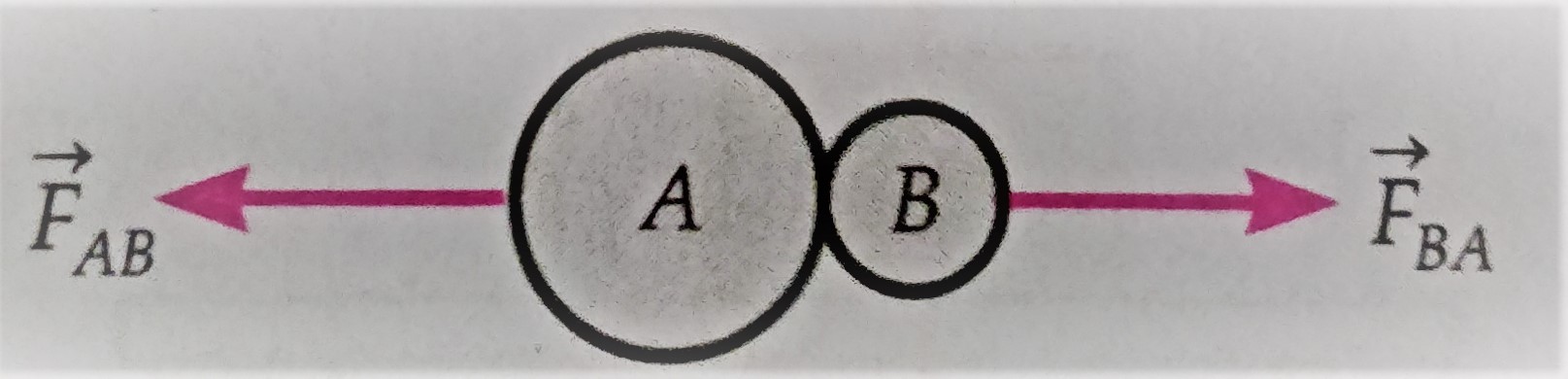
    Forces in nature always occur between pairs of bodies. Let two objects A and B colliding as shown in figure.

    FAB force on A due to B ,and FBA force on B due to A .

    Then according to Newton’s third law of motion FAB = -FBA .

    For example- When a man walk on the ground then man push the road backward and road push the man in forward direction. This example shows , single force never exist and force always exist in pair.

    Important point of Newton’s third law we must know –

    (i) Action and reaction always acts on different bodies.

    (ii) No action occur without reaction.

    (iii) Action and reaction can’t cancel each other.

    (iv) action and reaction may be mechanical, gravitational, electrical or of any other nature.

    Some important illustration of Newton’s third law of motion.-

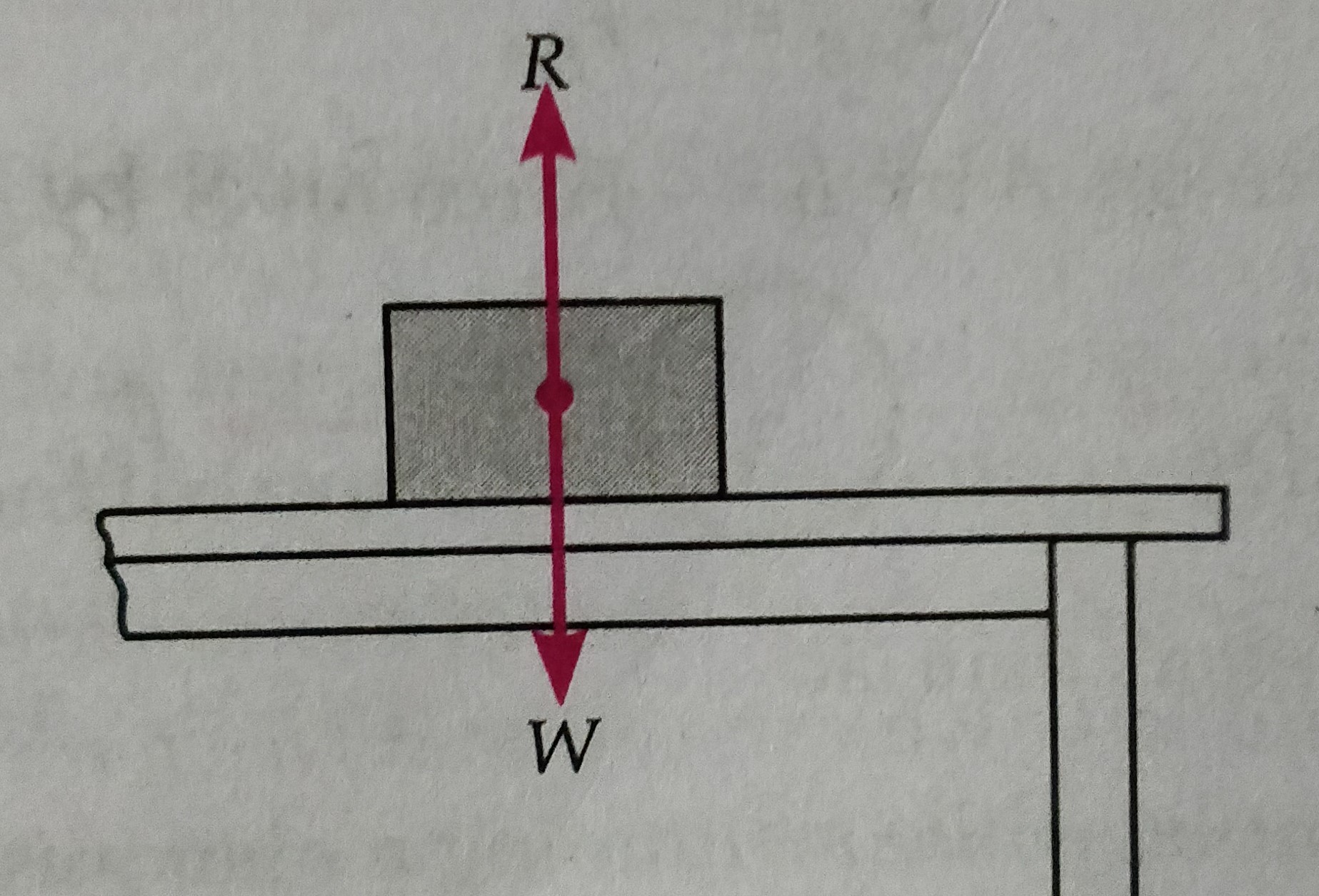
    1. Object kept on the table – suppose an object of mass ‘m’ placed on the table , then the weight ‘W’ applying a force equal ti its weight W = mg,  on the surface of table , and table applying a reaction R on the book , In this condition W = -R.

    1. 2. Walking of a man on the ground –

    While walking we press the ground F ( action ) with our feet in the slightly backward direction and ground  exert an equal reaction R , as shown in figure . then R has two component H = R cosϴ in horizontal direction  and V= R sinϴ in vertical direction . V balance the weight of the man and H makes the man to move in forward direction .

    1. It is difficult to walk on the slippery ground or sand-  It is because we are unable to push such a ground sufficiently hard . As a result force of reaction is not sufficient to help a person move in forward direction.
    2. While swimming , a person pushes water with his hand in the backward direction and water in turns reacts and pushes the swimmer in forward direction.
  • Newton’s second law of motion and Impulse

    Newton’s second law of motion and Impulse

    Newton’s second law of motion and Impulse

    In this topic Newton’s second law of motion and Impulse  , we will explain Newton’s second law of motion , expression for force, Impulse and application of concept of impulse . The reasoning questions of this topic and numericals ( specially based on Impulse) is very important for class examination and also for other competitive examination like JEE/NEET .

    But before to know this topic, it is necessary the students must  have the concept of Newtons first law of motion and inertia .                                                                                                    For  the notes on Newton’s first law and inertia click here- 

    Newtons second law of motion and impulse –

    As we know from Newton’s first law of motion ‘every body remain in its position of rest or of uniform motion in a straight line , till no external force acts on it’ . Just think what will happen when external force acts on the body . This effect of  acting a force on the body is described by Newton’s second law of motion .

    To watch the video on Newton’s second law – click on the link given below-


    Newtons second law of motion ( Force law)-

    Newton’s second law of motion states that , when an external force applied on a body , then rate in change in momentum is directly proportional to the applied force , and change takes place in the direction of applied force . this law is also known as the law of force.

    We have to take care of its two parts (i) rate of change of momentum is directly proportional to the applied force and , (ii) change in momentum occurs in the direction of applied force .

    Expression of force from newtons second law of motion –

    Let a body of mass ‘m’ moving with velocity ‘v’ .

    Then , its linear momentum will be  p = mv ;

    As newton’s second law states  force F α dp/dt   ;  or  F= k dp/dt  ……………..(i)

    But here ,  p=mv .

    So putting this value of p in equation (i) we get

    F=k d(mv)/dt =k m (dv/dt) = k ma; [where dv/dt=a( acceleration) ],

    Experimentally it is found k=1

    So we can say,  F =ma ;

    Unit of force is  kg-m/s2  or kg-ms-2 OR Newton (N)

    Its dimension is  [ M L T-2] ;


    IMPULSE-

    To know the impulse we must know . What is impulsive force?

    Impulsive force – It a large force acts on a body for short time which is the cause of change in momentum . example-  Blow a hammer on a nail, force exerted by a bat when it hits a ball, etc.

    Impulse – When a large force acts on a body for short time which is the cause of change in momentum, then the product of force and time for which it acts on the body is called impulse or Impulse of force which is equal to the change in linear momentum of the body.

    So we can write impulse I = Fav. x  t   = Pf – Pi = Δp

    Proof–   From Newton’s second law we know ;

    Force F = dp /dt  ;

    But momentum P = mv ( m- mass of the body and v is its velocity);

    So we can write  F dt = dp ;

    Integrating both sides with appropriate limits we get ,

    ∫ Fdt =∫dp = p2-p1 

    Or ,  Fav.t = p2-p1  = I

    So we can say if the force varying with time ( or force is the function of time ) then we can write

    Impulse I = ∫F dt .

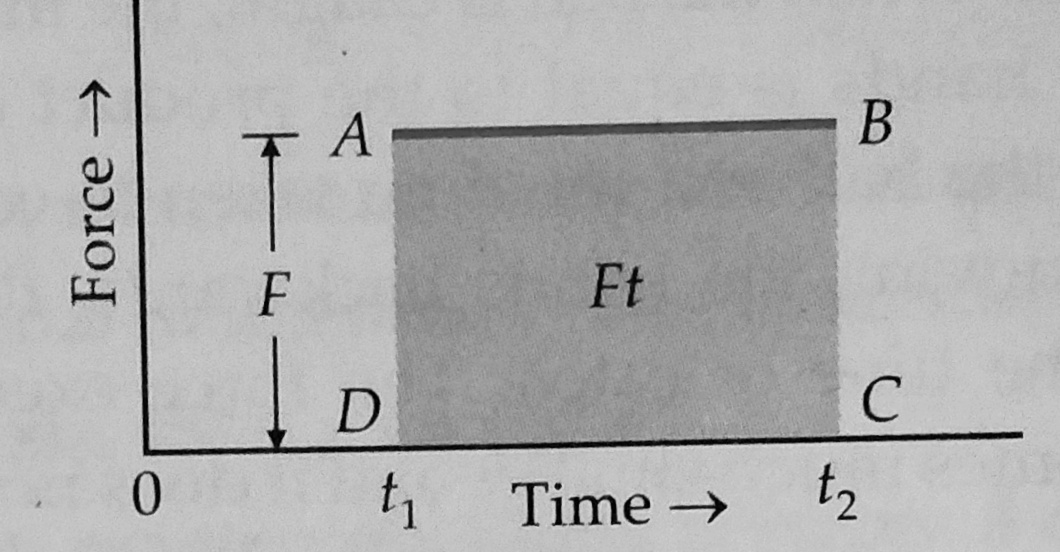
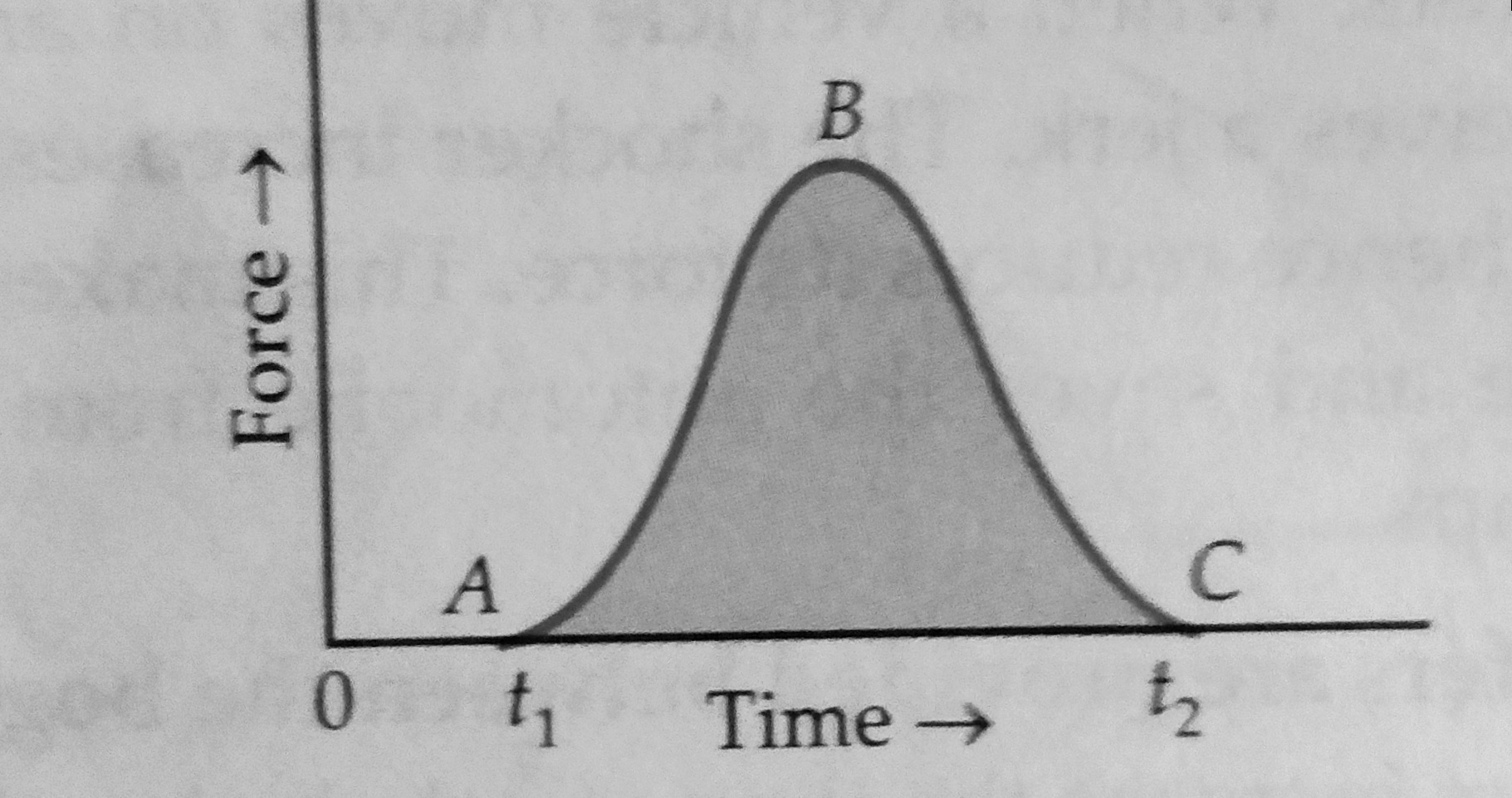
    If we plot the force v/s time curve , then the area under the curve gives the impulse .

    A. When a constant force acts on a body then force v/s time graph is given below . the area under the line AB gives the impulse .

    B. When a variable force acts on a body then force v/s time graph is given below . the area under the line ABC gives the impulse ;

    The unit and dimension of the impulse is same as linear momentum .

    Application of concept of impulse – ( It also work as reasoning questions in your class examinations)

    (a) Automobiles are provided with shockers.

    (b) China wares are packed under straw paper.

    (c) A cricket players lower his hand while catching a ball.

    (d) A person falling from a certain height gets more injuries when he falls on a cemented or tough floor than when he falls from a heap of sand.

    If we goes to the reason of all the points mentioned above then answers of all the questions will be same .

    As we know,  impulse = F x t = change in momentum

    For the same impulse force F = impulse / time . i.e. F α 1/t

    when time of impact increases due to some processes then force acts on the body decreases .

    To watch of the video of this topic click here-

  • Newton’s first law of motion and inertia

    Newton’s first law of motion and inertia

    Newton’s first law of motion and inertia

    In this topic we will discuss about Newton’s first law of motion and inertia .  Force , linear momentum and some example of inertia (all type).

    Newton’s first law of motion  ( law of inertia )-

    Before to know the Newton’s first law of motion and inertia we must know –

    FORCE– Force is a physical quantity which when applied on a body it actually changes or try to change , shape, size and, position of rest or motion.

    INERTIA –  It is the property of a body by virtue of which it can’t change itself its state of rest or uniform motion in a straight line . Or we can say ‘inertia is the resistance of change’. this term inertia is first used by Galileo .

    Different types of inertia –

    1. Inertia of rest – It is the tendency of a body to remain in its position of rest .

    Example- A person standing in a bus fall backward when the bus suddenly start moving forward. Dust is removed from a hanging carpet by beating it with a stick,  etc.

    1. Inertia of motion– It is the tendency of a body to remain in its state of uniform motion in a straight line .

    Example-When a running bus stop suddenly the passengers in the bus fall in forward direction. It is dangerous to jump out from a running bus, etc.

    1. Inertia of direction– It is the property of the body to restrict the change of direction of motion.

    Example- When a bus takes a sharp turn the person sitting in the bus experiences a force acting away from the centre of the curved path .

    Linear momentum (momentum) –  momentum of a body is the quantity of motion possessed by the body . Mathematically it is equal to the product of mass and velocity of the body .

    If ‘m’ is the mass of the body and its velocity is’v’ then it is given momentum P = m v .

    It is a vector quantity .

    Its unit is kg m/s or Ns.

    And its dimension is [M L T-1] .


    Newton’s  first law of motion   – It is also known as law of inertia. According to Newton’s first law of motion ‘every body remain in its position of rest or of uniform motion in a straight line , till no external force acts on it’ .

    This law consist of three parts ;

    (i) firs part say  a body is in rest continues in the states of rest( inertia of rest).

    (ii) second part say that body is in motion continue moves in the same path with same speed (inertia of motion)

    (iii)third part say that if a body moving with wit uniform velocity in a st. line then it cant change its direction of motion it self ( inertia of direction ) .

    From the above three parts given above explain that how Newton’s first law  explain the law of inertia.

    Illustration of Newton’s first law of motion –

    1. Based on inertia of rest-

    (i) When we shake a branch of tree its fruit and dry leaves fall down – It is because when we shake the tree its branches comes in motion but due to inertia of rest fruit or leaves wants to be in rest due to which it separated from the branches of tree and fall down.

    (ii) When a horse suddenly start running then the riders on it fall back -It is because initially the rider and horse are in rest , when horse starts running suddenly the  part of the rider in contact with the horse comes into the motion but upper part of the body due to inertia in rest remain in rest and the rider falls back.

    (iii) A person standing in a bus fall backward when the bus suddenly start moving suddenly forward- -It is because initially the person and bus are in rest , when bus starts moving suddenly the  part of the person in contact with the bus comes into the motion but upper part of the body due to inertia in rest remain in rest and the person falls back.

    (iv) Dust is removed from a hanging carpet by beating it with a stick- it is because when we hit the carpet it comes in motion but due to inertia of rest dust wants to be in rest due to which it separated from the carpet and fall down.

    2.Based on inertia of motion–

    (i) When a running bus stop suddenly the passengers in the bus fall in forward direction.- It is because when the bus is in motion then the passenger on it also is in motion , but when bus stop suddenly then the portion of the passenger is in contact with the bus also comes in rest but due to inertia of motion upper part of the passenger remain in motion and hence passengers fall in forward direction or in the direction of the moving bus .

    (ii) It is dangerous to jump out from a running bus – .- It is because when the bus is in motion then the passenger on it also is in motion , but when the person jumps out then the lower part of the body comes in contact with the ground and it comes in rest but due to inertia of motion upper portion of the body remain in motion and person fall down in the direction of motion of bus and it becomes the cause of accident.

    NEXT TOPIC -Newton’s second law of motion and Impulse.            To get the notes on Newton’s second law of motion and Impulse click here-