Tag: wave optics

  • What are the coherent sources of light?

    What are the coherent sources of light?

    In this topic we will discuss about ,what are the coherent sources of light? What are the necessary conditions to obtain coherent sources of light?why to independent sources of light can’t be coherent?

    1. What are coherent sources of light?

    Definition: Two sources of light are said to be coherent if they emit light waves of the same frequency (or wavelength) and maintain a constant phase difference with time.

    Examples:

    • Two slits illuminated by the same monochromatic light source in Young’s double-slit experiment.
    • Two secondary sources derived from a single source of light.

    2. Conditions to obtain coherent sources of light

    The following conditions are necessary to obtain coherent sources:

    1. Same frequency: Both sources must emit light waves of the same frequency or wavelength.

    2. Constant phase difference: The phase difference between the two waves must remain constant with time.

    3. Same state of polarization: For effective interference, the waves should have the same polarization.

    4. Same source of origin: The sources should preferably be derived from a single source of light, because independent sources emit light with randomly changing phase differences.

    5. Comparable amplitudes: For clearly visible interference fringes, the amplitudes of the two waves should be equal or nearly equal.

    3. How are coherent sources produced?
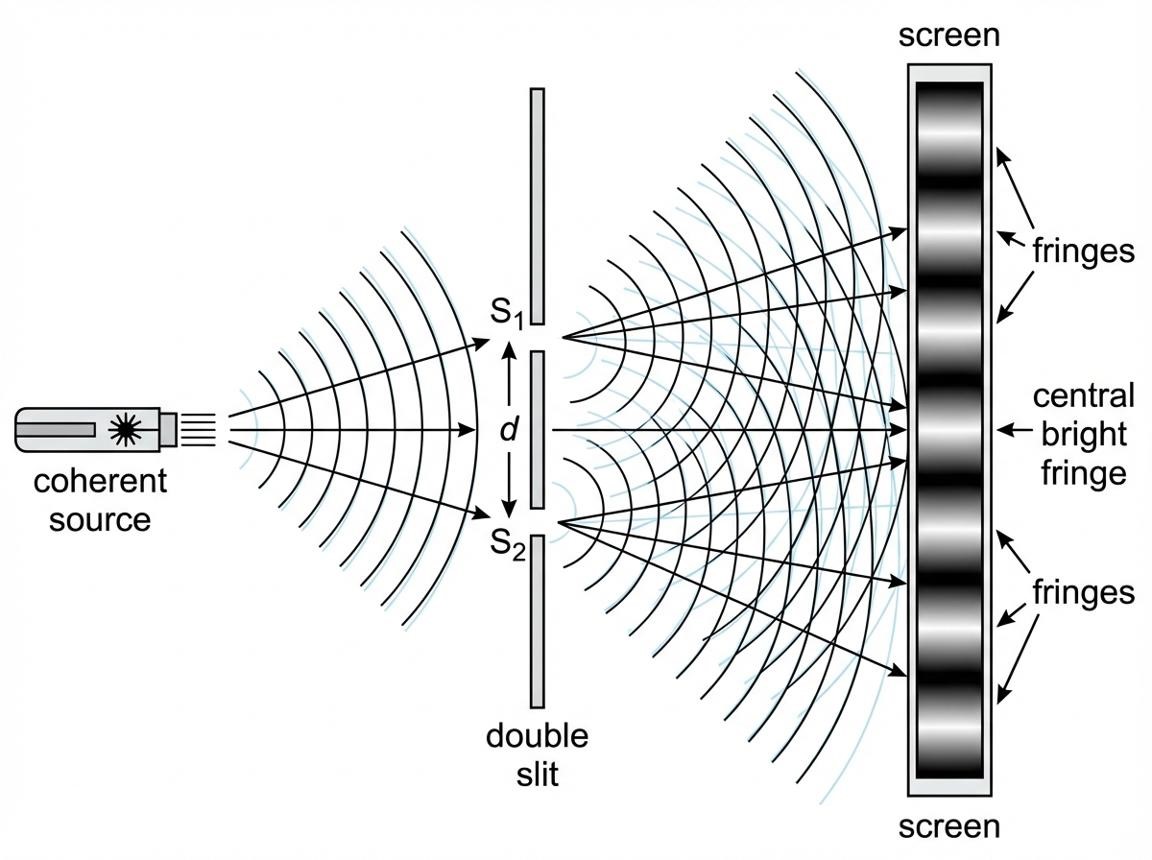
    In Young’s double-slit experiment, monochromatic light from a single source first illuminates two narrow slits, \(S_1\) and \(S_2\). Since both slits receive light from the same source, they act as coherent sources and produce a stable interference pattern on the screen.

    Important exam point: Two independent light sources cannot generally be coherent because their phase difference changes randomly with time.

    4. Why can’t two independent light sources be coherent?

    Two independent light sources cannot generally produce sustained, stable interference because: 

    • They emit light independently.
    • The phase difference between their waves changes randomly with time.
    • Their emissions arise from independent atomic processes.
    • As a result, the interference pattern averages out over time.

    Conclusion: To obtain a stable interference pattern, coherent sources are required. In Young’s double-slit experiment, both slits are illuminated by the same source, making them coherent.

    Remember for exams: Coherent sources have the same frequency and a constant phase difference.
  • Diffraction of light

    Diffraction of light

    What is diffraction of light?

    In this topic we will discuss what is diffraction of light , using single slit experiment formation of central max , position of secondary maxima and minima.

    Diffraction of Light – Single Slit Experiment

    diffraction single slit

    1. What is diffraction of light?

    Diffraction of light is the phenomenon of bending and spreading of light waves when they pass through a narrow slit or around the edge of an obstacle.

    Diffraction is clearly observed when the size of the slit or obstacle is comparable to the wavelength of light.

    To read the complete topic click here-

  • Huygen’s principle

    Huygen’s principle

    Explain Huygen’s principle. In this topic we will discuss what is Huygen’s principle and its applications.

    Huygens’ Principle

    Huygens’ principle states that every point on a wavefront acts as a source of secondary wavelets that spread out in all directions at the speed of the wave. The new wavefront is the forward envelope of these secondary wavelets.

    Explanation of Huygens’ Principle

    According to Huygens’ principle:

    1. Every point on an existing wavefront acts as a source of secondary wavelets.
    2. These secondary wavelets spread in all directions through the medium at the speed of the wave.
    3. After a certain time, a common tangent surface touching the forward edges of all these wavelets forms the new wavefront.

    To know about the wavefront click here-

    https://youtu.be/2Fhm5mJMKNY

    Applications of Huygens’ Principle

    Huygens’ principle helps explain:

    • Reflection of light: Why light changes direction when it reflects from a surface.
      • Refraction of light: Why light bends when it passes from one medium into another.
      • Diffraction of light: How waves spread around obstacles and through narrow openings.

    Mathematical Relation

    If a secondary wavelet travels with speed v for time t, its radius is

    r=vt

    where: v is the velocity of wave ant t is the time taken.

  • What is wavefront ?

    What is wavefront ?

    In this blog we will discuss what is the wavefront and what are its types?

    What is wavefront?

    It is the continuous  locus of all such particles of the medium which are vibrating in the same phase at any instant . So we can say wavefront is the surface of constant phase.( An arrow drown perpendicular to the wavefront in the direction of propagation of wave is called ray.)

    We can also states

    A wavefront is a surface joining all the points of a wave that are vibrating in the same phase.

    For example, the circular ripples produced when you drop a stone into water form circular wavefronts.

    There are three types of wavefront-

     (i) spherical wavefront- When light rays coming out from a point source then the wavefront drawn is spherical wavefront.

    (ii) Cylindrical wavefront- When light rays coming out from a linear source then the wavefront drawn is cylendrical wavefront.

    (iii)Plane wavefront – A small portion of the wavefront acoming from the large distat source gives plane wavefront.

    Next topic –Huygen’s principle click here-.

  • Diffraction of light

    Diffraction of light

    Diffraction of light

    What is diffraction of light ? conditions for maximum and minimum using single slit experiment, and intensity curve .

    Diffraction of light  –

    When a beam of monochromatic light passes through an aperture or an obstacle comes into the way of light then light is bent at the corners of the aperture or obstacle , this phenomena of light is called diffraction of light

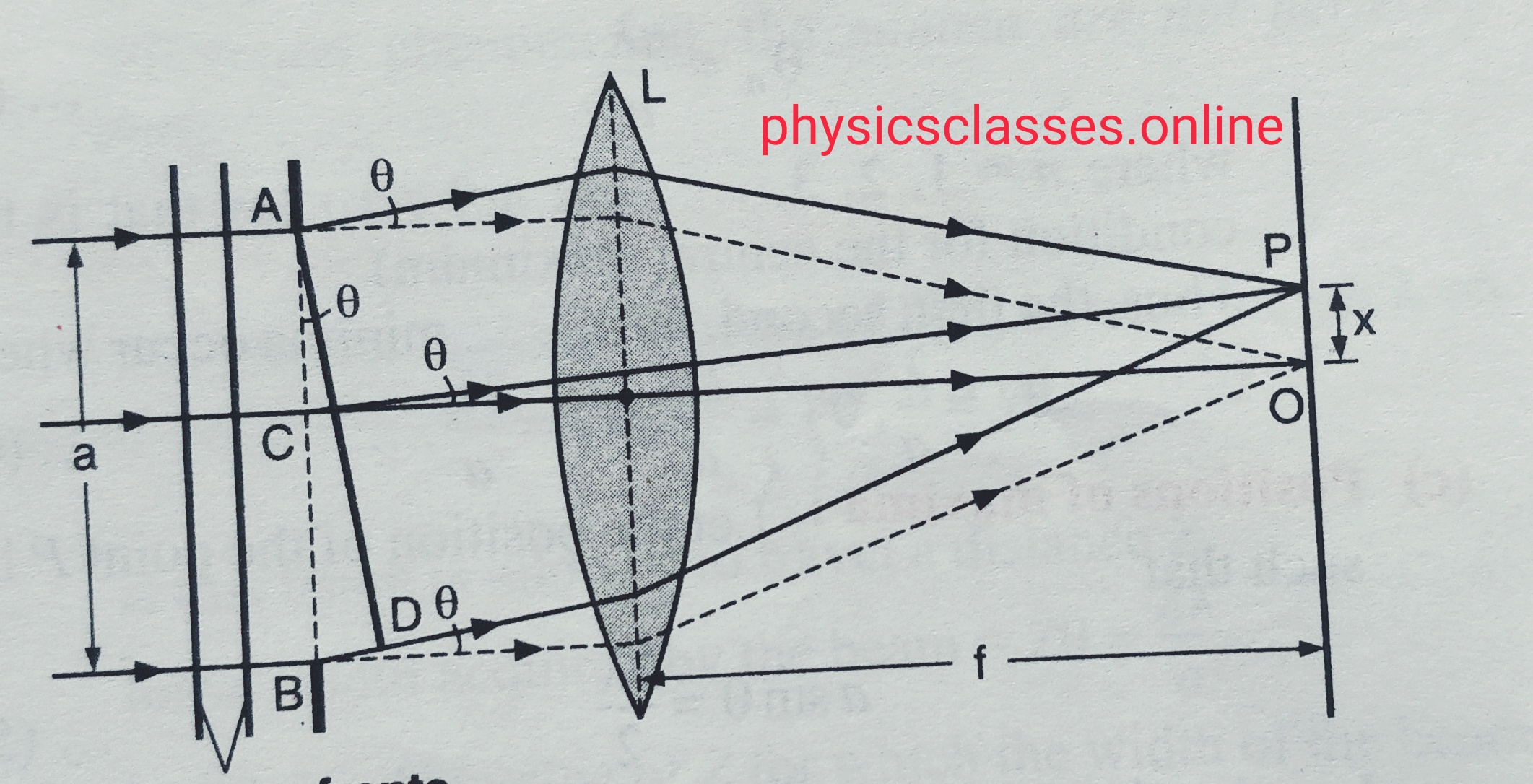
    Diffraction of light at a single slit – when a beam of monochromatic light is made incident on single slit , then we get  diffraction pattern on the screen , which contain bright (maximum) and dark (minimum) band .

    diffraction single slit


    Let, AB be a slit of width ‘a’ and parallel beam of a monochromatic light incident on it . All the primary ray incident converges at the center and form a bright fringe, and all the secondary wave gets superimposed and form secondary dark and bright fringes on the screen .

    Let θ be the angle of diffraction  for waves reaching at point P of screen , and AD is the perpendicular drown from ‘A’

    The path difference   between the rays AP and BP

    So path difference , p =   BP – AP = BD

    But from geometry <ANB = θ

    Sinθ= BD/AB ,

    Or,   BD = AB sinθ

    width of the slit AB = a

    Hence path difference ;  p = a sinθ  ……………………………(i)

    Position of central maximum  – the wavelets fall on the lens L along parallel direction of the axis reaches at o in the same phase and form central maximum .

    Position of secondary minimum  –   if we imagine the slits is divided in two equal halves  AC and CB then every point on the upper half the path difference is λ/2  and same as in lower half . they will reach at the point p in opposite phase and form destructive  interference cause of minimum or dark band , for dark band   a sinθ =  nλ  , where  n= 1,2,3,4………..

    , if θ is very small then , aθ = nλ

    So , θ = nλ/a  .

    Position of secondary maximum  –   we imagine slits is divided in three equal parts so the path difference between these two upper parts will be λ/2 , which will cancelled each other effect , so only third part will be the cause of the diffraction pattern obtained on the screen .

    So ,    a sinθ    = ( 2n+1) λ/2

    If     θ is very small then ,      a θ  =    ( 2n+1) λ/2

    So ,            θ =( 2n+1) λ/2  / a


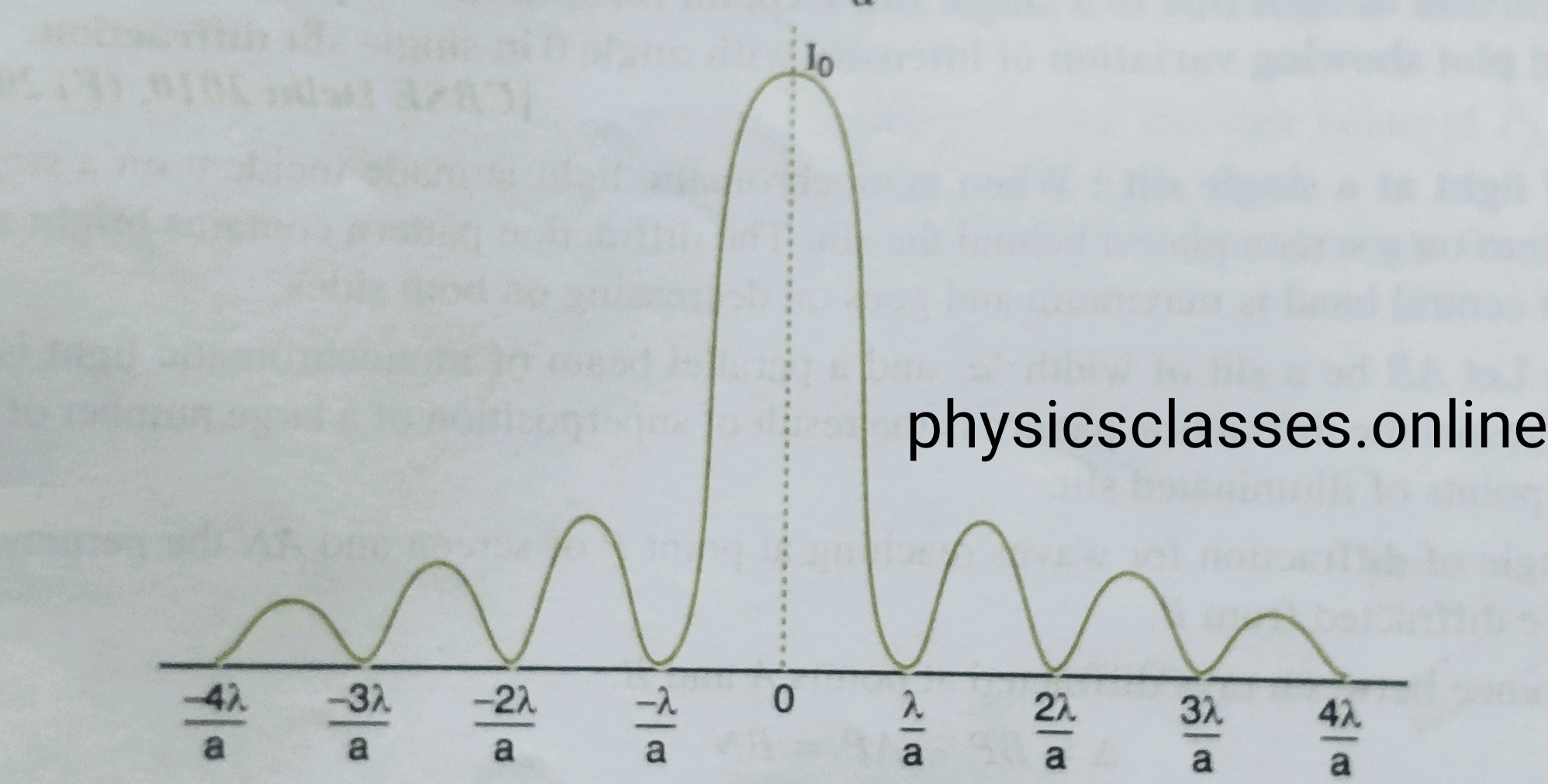
    Intensity- position curve for diffraction of light

    intensity curve

    FOR IMPORTANT QUESTIONS OF RAY OPTICS– CLICK HERE


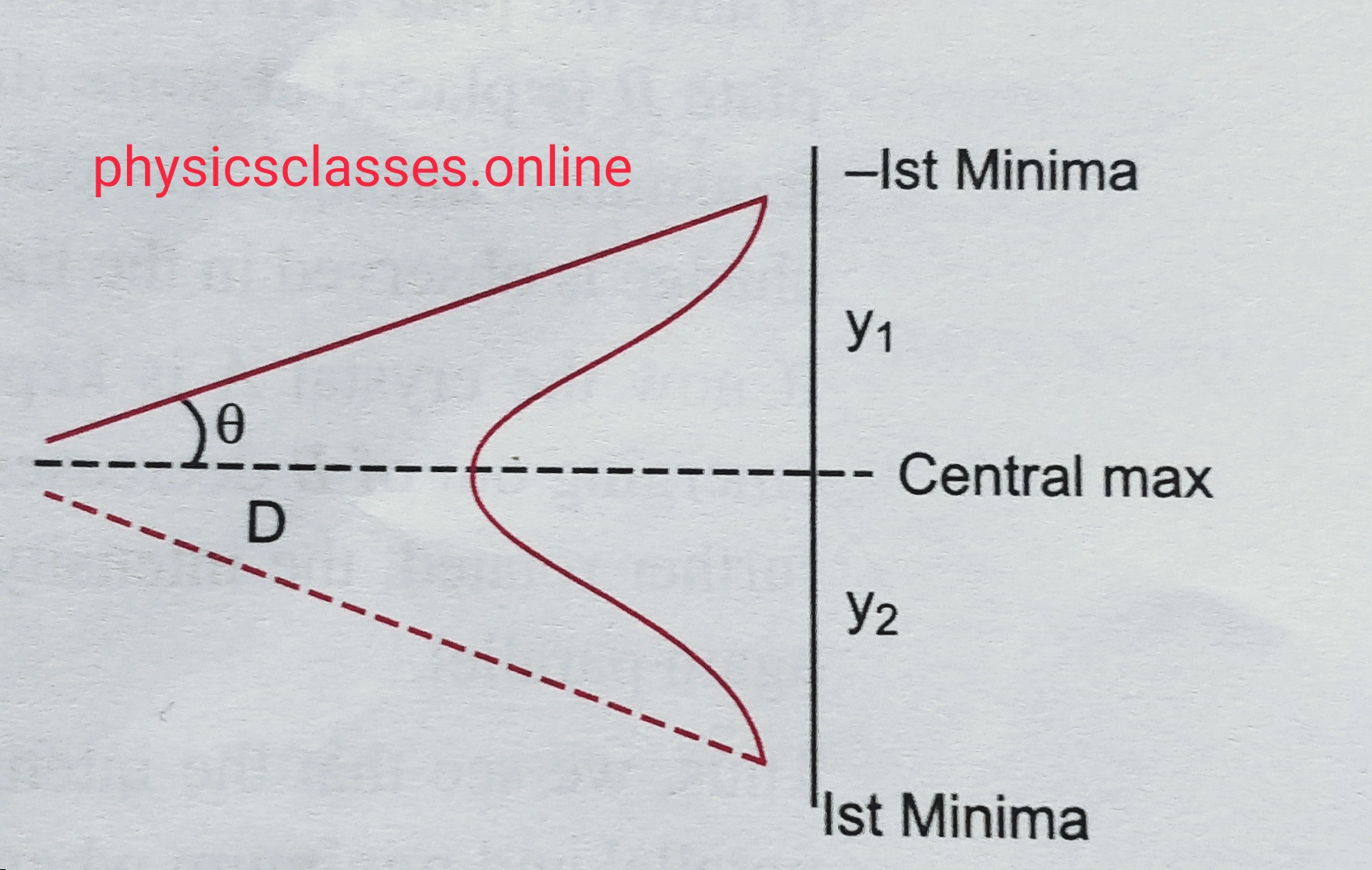
    Central maximum is twice the width of any other secondary maximum –


    diffraction central maximum

    For first minimum , from the relation of secondary minimum     θ = nλ/a

    Here value of n=1 ( for first minimum ) , so,  θ = 1λ/a  .

    But  , according to the geometry  θ = y1 / D ( where D is the separation between the slit and screen ) .

    Angular width of the central maximum           2θ = y1 + y2  /D ,

    Or,          2λ/a =  y1+ y2 /D,

    Or ,     Y1 + y2 = 2λD/a

    Therefore , width of the slits = 2( λD/a) = 2  x (width of other secondary maximum).

    Questions based on diffraction of light  – What do you mean by the term diffraction of light ? using single slit show the conditions of central maximum, secondary minimum, secondary maximum and hence draw the intensity curve with position ‘x’ . Using single slit experiment show that (i) the intensity of diffraction fringes increases as order (n) increases .(ii) angular width of the central maximum is twice of first order secondary maximum .

    For important questions based on the chapter wave optics– click here


    FOR IMPORTANT QUESTIONS OF DUAL NATURE OF RADIATION AND MATTER- CLICK HERE