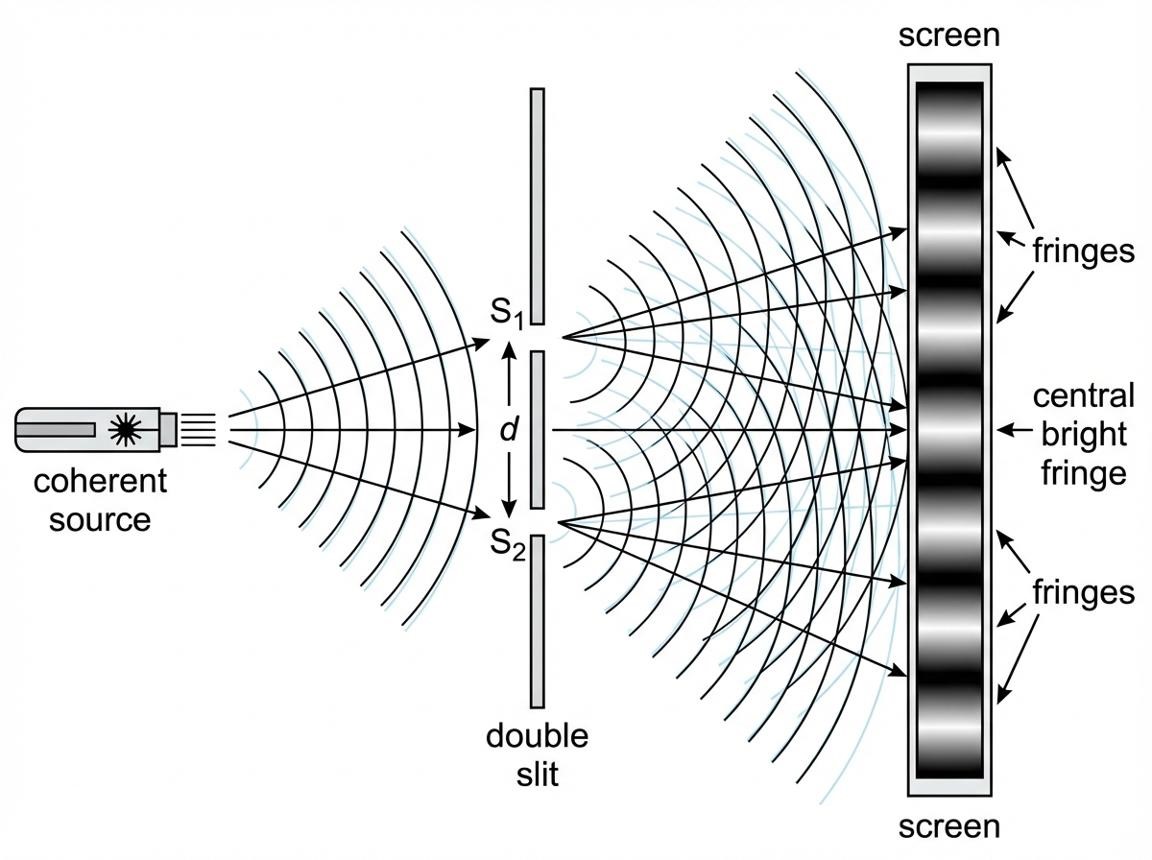
In this topic we will discuss about ,what are the coherent sources of light? What are the necessary conditions to obtain coherent sources of light?why to independent sources of light can’t be coherent?
1. What are coherent sources of light?
Definition: Two sources of light are said to be coherent if they emit light waves of the same frequency (or wavelength) and maintain a constant phase difference with time.
Examples:
- Two slits illuminated by the same monochromatic light source in Young’s double-slit experiment.
- Two secondary sources derived from a single source of light.
2. Conditions to obtain coherent sources of light
The following conditions are necessary to obtain coherent sources:
1. Same frequency: Both sources must emit light waves of the same frequency or wavelength.
2. Constant phase difference: The phase difference between the two waves must remain constant with time.
3. Same state of polarization: For effective interference, the waves should have the same polarization.
4. Same source of origin: The sources should preferably be derived from a single source of light, because independent sources emit light with randomly changing phase differences.
5. Comparable amplitudes: For clearly visible interference fringes, the amplitudes of the two waves should be equal or nearly equal.
3. How are coherent sources produced?
In Young’s double-slit experiment, monochromatic light from a single source first illuminates two narrow slits, \(S_1\) and \(S_2\). Since both slits receive light from the same source, they act as coherent sources and produce a stable interference pattern on the screen.
Important exam point: Two independent light sources cannot generally be coherent because their phase difference changes randomly with time.
4. Why can’t two independent light sources be coherent?
Two independent light sources cannot generally produce sustained, stable interference because:
- They emit light independently.
- The phase difference between their waves changes randomly with time.
- Their emissions arise from independent atomic processes.
- As a result, the interference pattern averages out over time.
Conclusion: To obtain a stable interference pattern, coherent sources are required. In Young’s double-slit experiment, both slits are illuminated by the same source, making them coherent.
Remember for exams: Coherent sources have the same frequency and a constant phase difference.