Tag: ELECTRIC CURRENT

  • What is electric current

    What is electric current

    What is electric currentelectric current

    What is electric current ? what is its unit ? define Ampere.

    Electric current-When electric charges is in motion , they constitute what is called an electric current . electric current is defined as the rate of flow of charge through an area of the conductor . if  Q is the charge flows through a conductor in time T then  electric current I = Q/T

    Or  I= dQ /dt . unit of current is Ampere .

    We can define 1 Ampere  is the current flowing through a conductor when 1 Coulomb  of charge flows through a conductors in unit time.

    In the terms of drift velocity current I = n e A Vd  where n is the charge density , A  is the area of cross-section of the conductor , e is the charge on electron and Vd is the drift velocity.

    • Subscribe to Video Tutorial ( Nayan Jha Sir )

    In terms of Ohm’s law – current  I = V/R  V is the potential difference across the conductor and R is the resistance of the conductor .

    So we can say 1 Ampere current flows through a conductor when unit potential difference setup across a conductor of resistance 1 Ohm .


  • POTENTIOMETER

    POTENTIOMETER

    POTENTIOMETER

    THIS TOPIC EXPLAIN ABOUT THE POTENTIOMETER

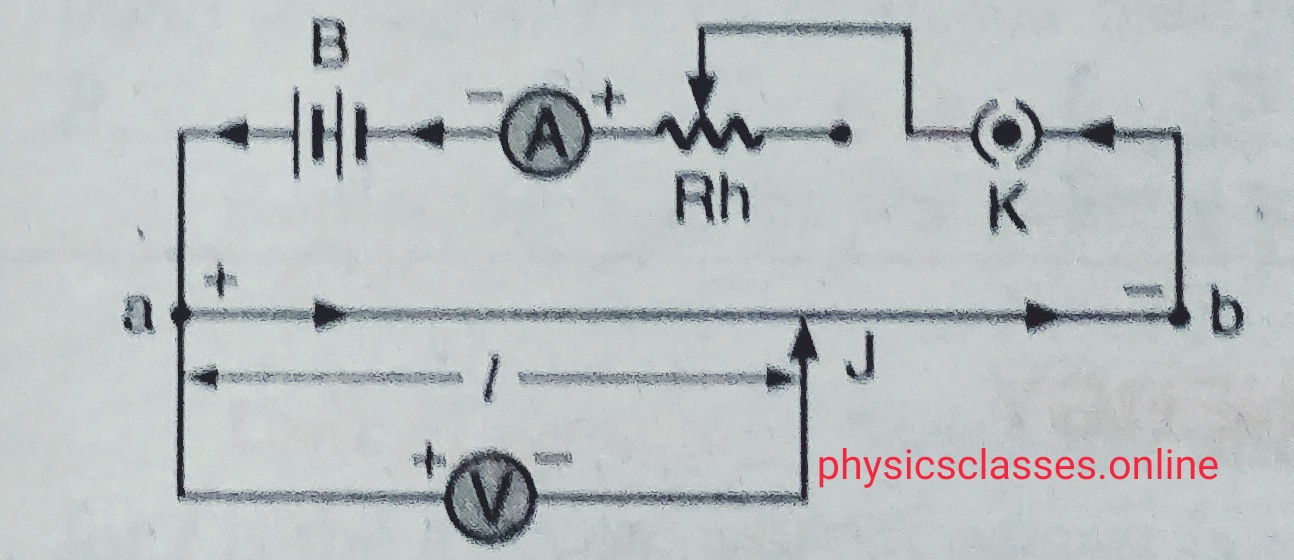
     Potentiometer – An instrument used to measure accurately the EMF or potential difference is called potentiometer.

    Principle– Its working based on the principle that the potential drop across a conductor is directly proportional to the length of the conductor , if constant current passes through the conductor having uniform area of cross-section .

    Construction –

    POTENTIOMETER
    POTENTIOMETER


    As we know ,

    potential V=IR

    V = (ρl/A) I

    Since current is constant and area of cross-section is uniform  so V α l

    Or V = K l

    K = V/l ( K is a constant called potential gradient)

    [ calculation of potential gradient ( students don’t have to derive it in case of potentiometer it is useful for the numerical questions) – if Rh = r and resistance of the wire is r and E is the emf of  driver cell  then ,  current through the circuit is , i = E/ (R+r)

    There fore potential difference at the end  the wire is v= i r

    V= {E/ (R+r) } r . so potential gradient  K = V/l = {E/ (R+r) } r/l. ]

    Potantiometer is preferred over the galvenometer to measure  potential difference across a conductor

  • IMPORTANT QUESTIONS OF CURRENT ELECTRICITY

    IMPORTANT QUESTIONS OF CURRENT ELECTRICITY

    CURRENT ELECTRICITYCURRENT ELECTRICITY

    IMPORTANT QUESTION OF CURRENT ELECTRICITY

    THIS ASSIGNMENT PROVIDE  ALL IMPORTANT QUESTIONS OF CURRENT ELECTRICITY CHAPTER .

    This question paper is designed for quick revision for the students of class 12th appearing in the class test or board examination , if students have to practice the question of current electricity in broad level click on  complete assignment of electric current 

    1 (i)State the working principle of a potentiometer. With the help of the circuit diagram, explain how a potentiometer is used to compare the emf’s of two primary cells. Obtain the required expression used for comparing the emf’s.

    (ii) write two possible causes for one sided deflection in a potentiometer experiment.

    (iii)Which material is used for potentiometer wire and why?

    (iv)how can the sensitivity of a potentiometer be increased?

    2. Answer the following

    (i) Why are the connections between the resistor in a meter bridge made of thick copper strips?

    (ii)Why is it generally preferred to obtain the balance point in the middle of the meter bridge wire?

    (iii)which material is used for the meter bridge wire and why?

    3. (i)State with the help of a circuit diagram, the working principle of a meter bridge. Obtain the expression used for determining the unknown resistance.

    (ii) what happens if the galvanometer and cell are interchanged at the balance point of the bridge?

    (iii) why is it considered important to obtain the balance point near the mid- point of the wire?

    4. (a) A cell of emf E and internal resistance r is connected across a variable resistor R. Plot a graph showing the variation of terminal potential V with resistance R.

    (b) Plot a graph showing the variation of terminal potential difference across a cell of emf E and internal resistance r with current drawn from it. Using this graph how does one determine the emf of the cell?

    5. Two conducting wires X and Y of same diameter but different materials are joined in series across a battery. If the number of density of electrons in X is twice than that in Y, then find the ratio of drift velocity of electrons in the two wires.


     If students wants to quick revision in short time practice these question-  IMPORTANT QUESTIONS OF ELECTRIC CURRENT-