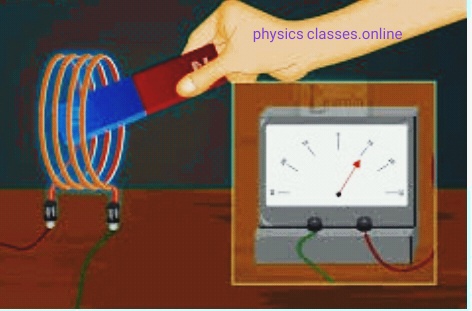
In moving coil galvanometer we will learn about the working theory of a galvanometer and its conversion from galvanometer to ammeter and voltmeter
To read the complete topic click here- Moving Coil Galvanometer

To read the complete topic click here- Moving Coil Galvanometer

In this topic we will, discuss about working of cyclotron , its principle, construction and its limitations. (** this topic is removed from the syllabus of class 12th, board examination).To know the complete syllabus click on the given link-
Before to know about the cyclotron students must know Force Acting on a Charge Particle Moving in a Uniform Magnetic Field; To get the notes on this topic click here-
Cyclotron-
It is a device used to accelerate positive charged particles like proton, deutron , alpha particles etc . with desired velocity.
Principle– Its working based on the principle that a positive charge particle can be accelerated to a sufficient high energy with the help of oscillating electric field with the help of perpendicular strong magnetic field .
Construction– It consist two D-shaped chamber ( Dees) D1 and D2 , which are placed slightly separated with each other between two poles of the magnet N- pole and S–pole ( as shown in figure. ) Dees are connected with an high frequency oscillator ( cause of variable electric field).
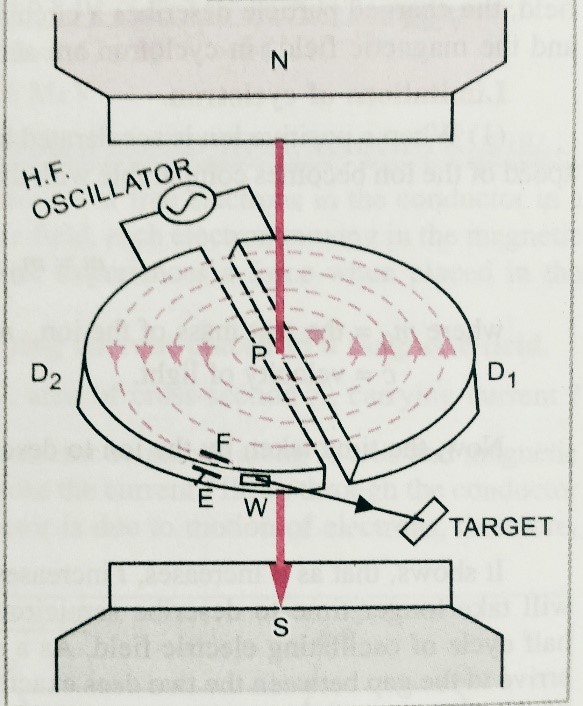
Working and theory – suppose initially the D1 is negative and D2 is positively charged , then the positive charged particle at point P starts to move towards D1 , but due to perpendicular magnetic field it starts moving on a circular path. If r is the radius of the circular path then ,
mv2/r = qvB
So r = mv/qB ;
Time taken by the charged particle to complete half cycle t= ∏r/v = ∏m/qB ;
When particle reaches to D1 at the same time D1 becomes positively charge and D2 negatively then again charge particle starts to move towards D2 with the circular path with greater radius . similarly charge particle remain describing the circular path with greater radius and greater speed and at an instant it ejected through the window with high kinetic energy .
Maximum energy of charged particle– suppose v0 , r0 is the is the maximum velocity and maximum radius of the circular path followed by the charged particle ,
Then ,m v0 2/ r0 = B q v0 or , v0 = Bq r0/m ,
Therefore maximum kinetic energy k = ½ mv02 = B2 q2 r02 / 2m ;
Cyclotron frequency –
Angular velocity ω= Bqr/mr = Bq/m ……………..(3)
here frequency f=ω/2∏ = Bq/2∏m ( here frequency is independent of velocity)………….(4)
limitations of cyclotron-
To watch the video on motion of a charged particle in magnetic field click here-
IN THIS CHAPTER BODY TRAVELS IN ONE, TWO AND THREE DIMENSIONAL DIRECTION.
IN THIS CHAPTER BODY COVERS BOTH UNIFORM AND NON UNIFORM MOTION.
. A particle starts form origin at t=0 with a velocity 5 m/s and moves in X Y-plane under the action of a force, which produces a constant acceleration of 3i+2j m/s2.
(a) what is the y-coordinate of the particle at the instant its x coordinate is 84 m?
(b) what is speed of the particle at this time?
TO DOWNLOAD THE COMPLETE ASSIGNMENT CLICK BELOW…..

A PHYSICAL QUANTITY HAVING BOTH MAGNITUDE AND DIRECTION KNOWN AS A VECTOR QUANTITY.
TO DOWNLOAD THE COMPLETE ASSIGNMENT OF VECTOR CLICK BELOW
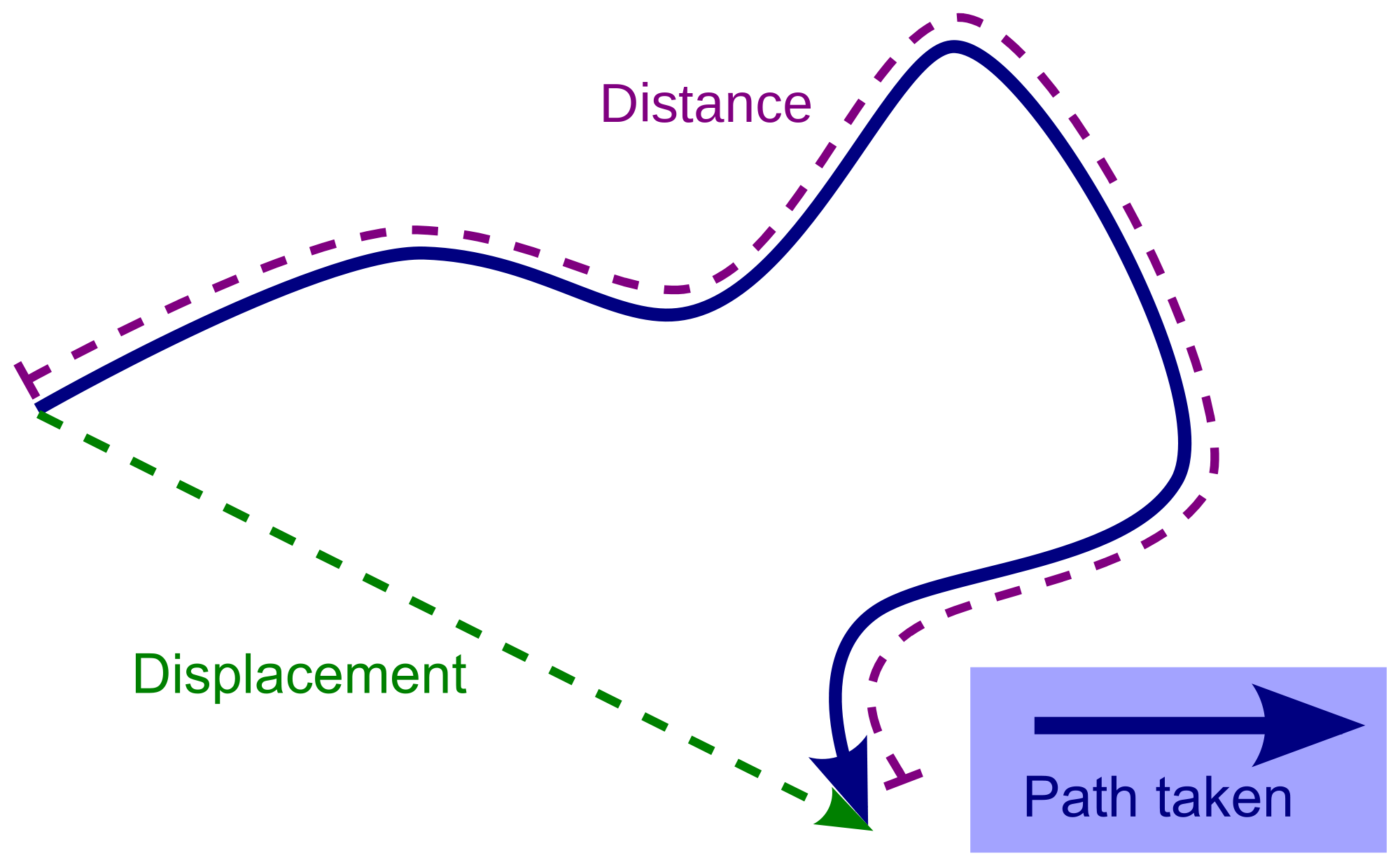
When a body changes its position with respect to its surroundings in a single direction , then the motion is said to be in one dimension. read more about MOTION IN ONE DIMENSION

Assignment of UNITS AND DIMENSIONS will help the students practice the chapter well , and improve their numerical skills in this chapter .
Q 1. Calculate the dimensions of (i) force (f) and (it) impulse (i) in terms of velocity(v) , density (p) and frequency (v) as the fundamental units .
Q 2. If the velocity of light c, gravitational constant G and Plank’s constant h be chosen as fundamental units, find the dimension of (i) mass, length and time in new system.
Q 3. Find the dimensions of a/b in the equations, where P is pressure ,t- time & x distance
P= (a-t2 ) / bx
To download the full assignment click below…
UNITS AND DIMENSIONS
ASSIGNMENT
CLASS-11
UNITS AND MEASUREMENTS
Very short answer type questions
1> Find the area of circle of radius 3.458cm up to correct significant figures.
2> Name the physical quantities whose dimensions are same.
3> State the no. of significant fig. in the following (a)0.007 cm (b)2.64 x 1024kg (c)0.2370 cm
4> Which of the following measurement is more accurate and why? (1)5000.0 cm(2)0.0005cm (3) 6.00cm.
5> Are all dimensionally correct equations numerically correct? Give one example.
6> If x=a+bt+ct2 where x is in meters and t is in second, what is the dimensional formula of ‘a’ , and ‘c’.
7> Write the dimensions formula of (1) Planck’s constant and(2) Rydberg’s constant
Short answer type questions
1>The wavelength ‘λ’ depends mass M of the moving particle its velocity v and planks constant ‘h’ . Show dimensionally the relationship between them.
2>In an experiment the refractive index of the glass was observed to be 1.45, 1.56,1.54,1.44,1.54 and 1.53 . Calculate (1) mean value of the refractive index ;(2) Absolute error ;(3)Fractional error ; (4)Percentage error . Express the result in terms of absolute error and percentage error.
3> If (P+a/V2) (V-b)=RT where the symbols has their usual meanings, then what is the dimension of a/b .
4. If F= a/ b+√d , where f=force ,d= density , then find the dimension of a and b.
5> The factors effecting the time period (T) of the simple pendulum depends on mass , length and acceleration due to gravity . Deduce the relation for time period of the simple pendulum.
6> To determine acceleration due to gravity ,the time of 20 oscillations of a simple pendulum of length 100 cm was observed to be 40 s . calculate the value of ‘g’ and maximum percentage error in the measured value of ‘g’ .
7> If power P=a-x2/b where x represents displacement find the dimension of a and b.
8> A physical quantity Qis given by Q= . A.B3/2/C4D1/2 percentage error in A,B,C,D are 1%, 2%,4%,2% respectively . Find the percentage error in Q.
9>The measured value of length , breadth and height of a block is given as l=12.08+-0.01 cm , b=10.12+-0.01cm . h=5.62+-0.01 cm . Calculate the percentage error in the volume of the block.
10>(a) convert 10 J into ergs . (b) convert 10 N into dyne .
11> A planet moves around the sun , the period of revolution ‘T’ depends upon radius of the orbit ‘R’, mass of the sun ‘M’ and gravitational constant ‘G’, show that T2αR3 .
12>If the length and time period of an oscillating pendulum have errors of 1% and 2% respectively , what is the error in the estimate of ‘g’.

In this topic we will discuss about Biot-savart’s law and magnetic field at a point due to finite current carrying wire or conductor.
Biot- Savart law – Biot-Savart’s law explain the magnetic field due to small current carrying element
As we know , whenever the current passes through a conductor magnetic field setup around it . To find the magnetic field at any point first given by Jean Biot and Felix savart . according to Biot- Savart , magnetic field intensity at any point due to small current carrying element is given as dB=µ0idl sinθ/r2 .
EXPLANATION- Let us consider a small element of length ‘dl’ carrying a current I through it . If dB is the magnetic field at a point r distance away from the element , then according to this law
after combining these equations ,we get
dB α I dl sinθ/r2
so , dB= k I dl sinθ/r2
(Where K= µ0/4Π = 10-7 Wb/ (A m ))
Magnetic field due to straight current carrying wire of finite length –****( derivation is not in syllabus for 12th board examination, but we must know the result )
Suppose current ‘I’ is flowing through a wire XY , and we have to find the magnetic field at point ‘P’.as shown in figure .
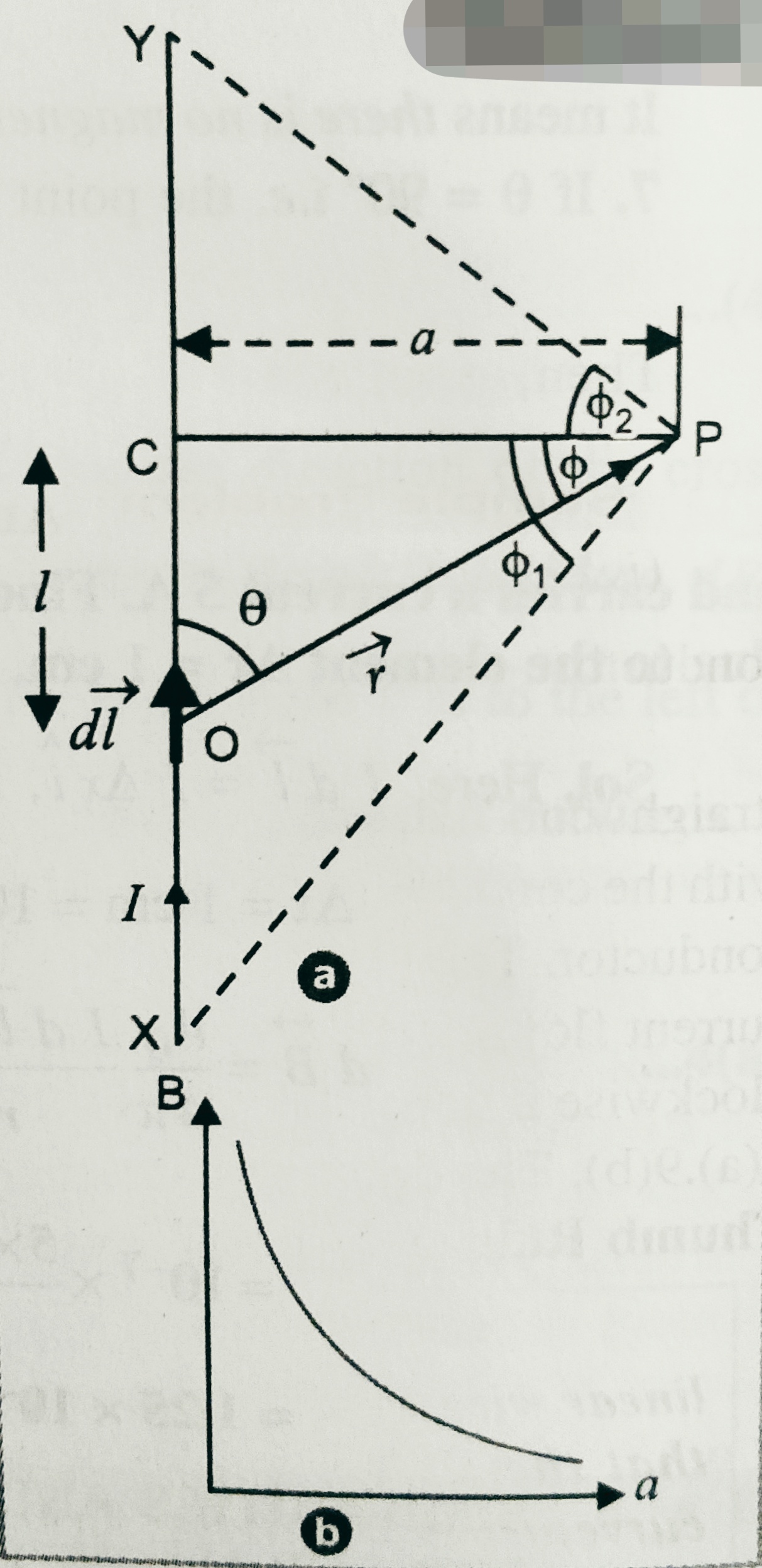
B = (µ0I/4Πa)(sinɸ1 + sinɸ2) ,
Special cases – Case-(1) — When the wire is of infinite length and point P is near the wire in that case ɸ1=900 , ɸ2=900 ;
So magnetic field at that point P , B = (µ0I/4Πa)(sin90 + sin90) = µ0I/2Πa
Case-(2)– When the wire is of infinite length and point P is near the one end of the wire in that case ɸ1=900 , ɸ2=00 ;
So magnetic field at the point P , B = (µ0I/4Πa)(sin90 + sin0) = µ0I/2Πa ;
Case-(3)—If length of the conductor is finite (L) and point P lies on right bisector of conductor , then ɸ1=ɸ2= ɸ ; and sinɸ=L/( 4a2+L2)1/2 .
Then magnetic field B= (µ0I/4Πa)(sinɸ + sinɸ)= (µ0I/4Πa)2sinɸ=(µ0I/4Πa)[ L/( 4a2+L2)1/2];
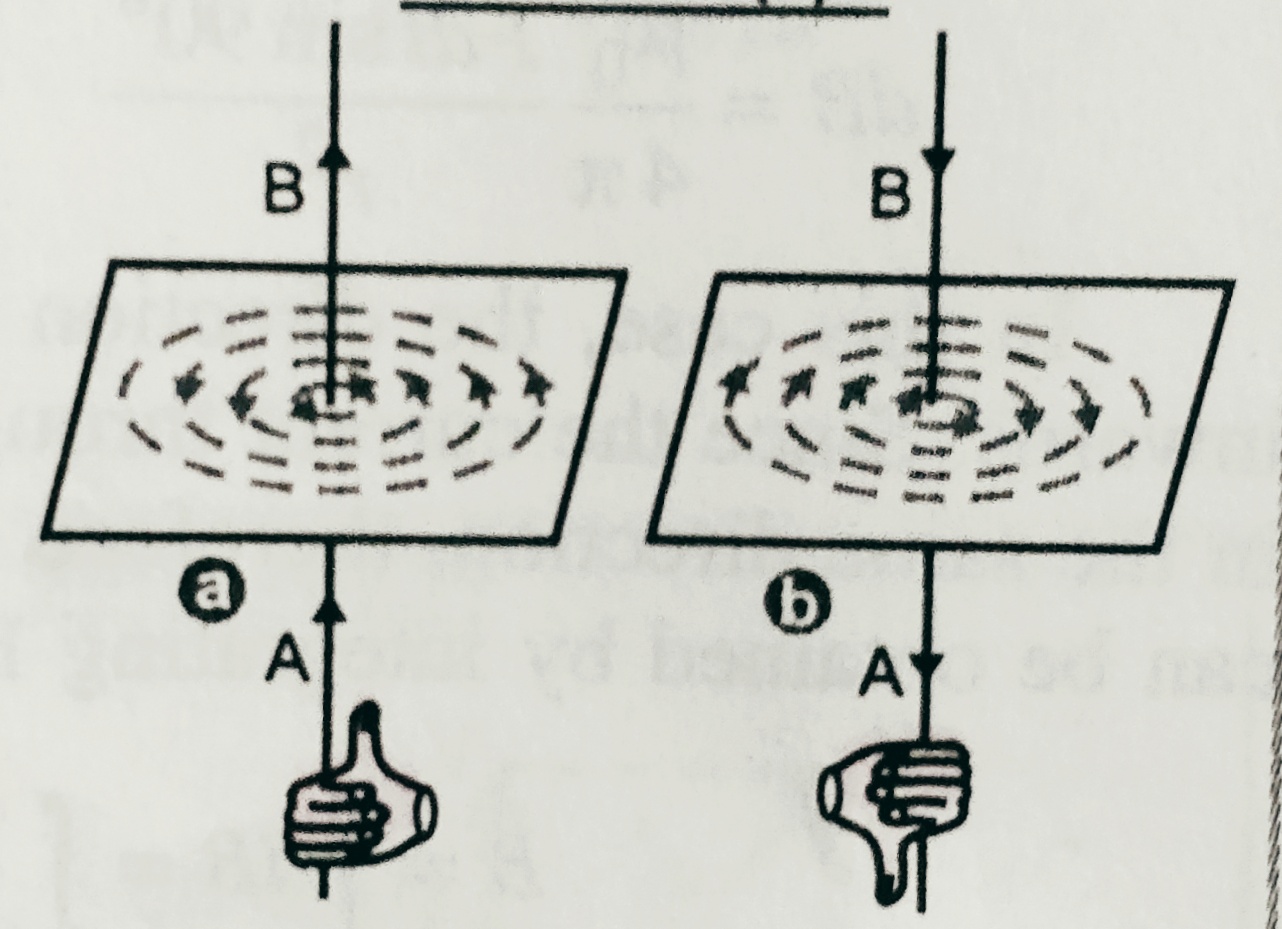
Direction of magnetic field – The direction of magnetic field through a current carrying wire can be found using right hand thumb rule .
Right hand thumb rule – According to this rule we held the current carrying straight wire in our hand grip of our right hand so that thumbs directed towards the direction of flow of current then the curled finger gives the direction of magnetic field around the conducting wire . As shown in figure.
to see the video on Biot-Savart’s law click on the link given below-
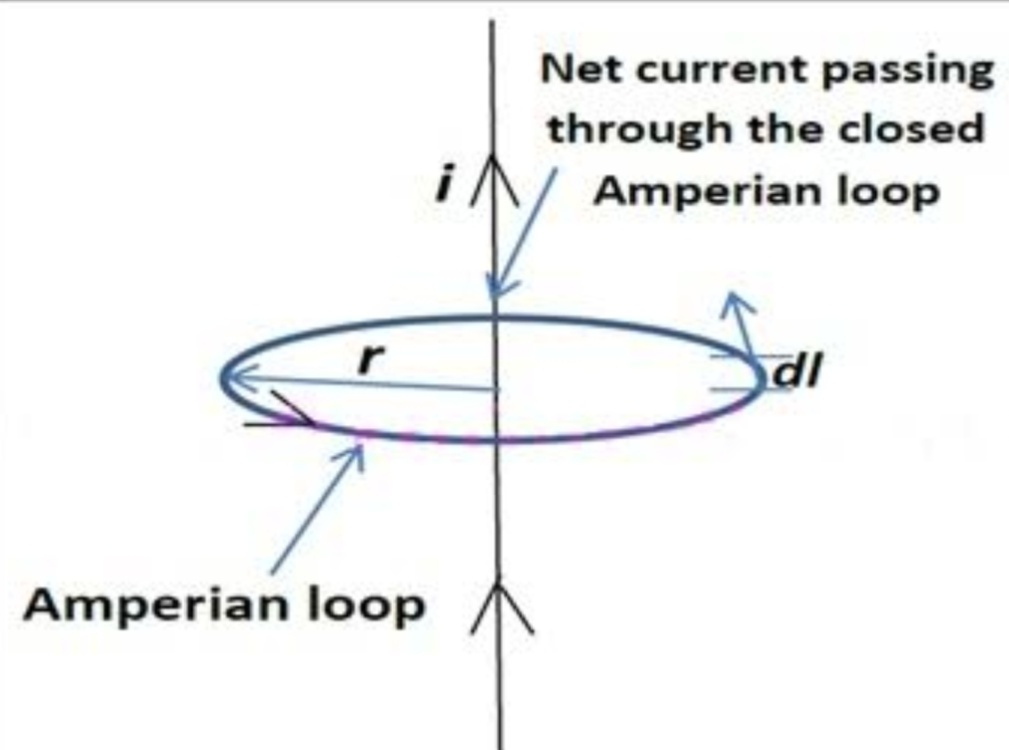
Ampere circuital law – After the discovery of Oersted and Biot-Savart, Ampere found a useful relation between magnetic field and electric current. [ In the case of all basic laws of physics , Ampere’s law can’t be derived , its validity is based on the correctness of the result.] . According to Ampere circuital law that the linear integral of magnetic field (B) along a imaginary closed path is equal to the product of current enclosed by the path and permeability of the medium µ0 . for a long straight current carrying conductor , magnetic field
B= µ0 I/2ΠR
So,
∫B.dl = ( µ0 I/2Πr) ∫dl ( integrate with limit 0 to 2Πr ) = ( µ0 I/2ΠR) × 2Πr = µ0I

Magnetic effect of current– If current flows through a conductor setup magnetic field around it is first observed by Oersted in 1820 . After that Biot-savart established a formula for magnetic field due to small current carrying conductor. Direction of magnetic field can be found using right hand thumb rule . If current is flowing through st. line and thumb shows the direction of current flowing through it then curled finger gives the direction of magnetic field. If current flowing through a circular coil ,and curled finger shows the direction of current then thumbs gives the direction of magnetic field.