Author: Nayan Jha

  • Syllabus class12th physics (Term-2) (2021-2022)

    Important questions of ray optics

    Physics classes by Nayan jha providing the syllabus for term -2 CBSE (physics)Examination ; guided by CBSE( Distribution of marks may change in some circumstances)

    CBSE Class 12 Physics Syllabus Term – 2 (2021-22)

    Time: 2hrs 

    Max Marks: 35

    SI. No.Chapter Namemarks
    Unit–VElectromagnetic Waves2-3
    Chapter–8: Electromagnetic Waves
    Unit–VIOptics14-15
    Chapter–9: Ray Optics and Optical Instruments
    Chapter–10: Wave Optics 
    Unit–VIIDual Nature of Radiation and Matter4-5
    Chapter–11: Dual Nature of Radiation and Matter 
    Unit–VIIIAtoms and Nuclei6-7
    Chapter–12: Atoms
    Chapter–13: Nuclei
    Unit–IXElectronic Devices7
    Chapter–14: Semiconductor -Electronics: Materials, Devices and Simple Circuits
    Total35

     Unit (i – iv is provided for term-1 examination)

    Unit V: Electromagnetic waves   

    Chapter–8: Electromagnetic Waves 

    Electromagnetic waves, their characteristics, their Transverse nature (qualitative ideas only). Electromagnetic spectrum (radio waves, microwaves, infrared, visible, ultraviolet, X-rays, gamma rays) including elementary facts about their uses. 

    Unit VI: Optics   

    Chapter–9: Ray Optics and Optical Instruments 

    Ray Optics: Refraction of light, total internal reflection and its applications, optical fibers, refraction at spherical surfaces, lenses, thin lens formula, lensmaker’s formula, magnification, power of a lens, combination of thin lenses in contact, refraction of light through a prism. 

    Optical instruments: Microscopes and astronomical telescopes (reflecting and refracting) and their magnifying powers. 

    Chapter–10: Wave Optics 

    Wave optics: Wavefront and Huygens principle, reflection and refraction of plane waves at a plane surface using wave fronts. Proof of laws of reflection and refraction using Huygens principle. Interference, Young’s double slit experiment and expression for fringe width, coherent sources and sustained interference of light, diffraction due to a single slit, width of central maximum. 

    Unit VII: Dual Nature of Radiation and Matter  

    Chapter–11: Dual Nature of Radiation and Matter 

    Dual nature of radiation, Photoelectric effect, Hertz and Lenard’s observations; Einstein’s photoelectric equation-particle nature of light. Experimental study of photoelectric effect Matter waves-wave nature of particles, de-Broglie relation 

    Unit VIII: Atoms and Nuclei           

    Chapter–12: Atoms 

    Alpha-particle scattering experiment; Rutherford’s model of atom; Bohr model, energy levels, hydrogen spectrum. 

    Chapter–13: Nuclei 

    Composition and size of nucleus Nuclear force Mass-energy relation, mass defect, nuclear fission, nuclear fusion. 

    Unit IX: Electronic Devices  

    Chapter–14: Semiconductor Electronics: Materials, Devices and Simple Circuits 

    Energy bands in conductors, semiconductors and insulators (qualitative ideas only) Semiconductor diode – I-V characteristics in forward and reverse bias, diode as a rectifier; Special purpose p-n junction diodes: LED, photodiode, solar cell. 

  • Important questions of oscillations

    Important questions of oscillations-

    1. What is meant by periodic and oscillatory motion? Distinguish between them.

    2. What is meant by SHM . Find the expressions for displacement , velocity and acceleration. Also find the phase difference between them.

    3. Find the potential energy and kinetic energy of a SHM and hence show that total energy is conserved . In what position of the oscillation is the energy wholly kinetic and wholly potential?

    4. Prove that for an harmonic motion time period T = 1/2π(spring factor/inertial factor)1/2.

    5. What is simple pendulum? Derive expression for the time period or frequency of the oscillating simple pendulum. Also explain the second pendulum and find the length of the second pendulum on the surface of earth.

    TO GET THE IMPORTANT QUESTIONS OF MECHANICAL PROPERTIES OF FLUID CLICK HERE-

    6. Show that vibration of the liquid in the U-Tube is simple harmonic and also find the expression for the time period and frequency .

    7. Explain the term (i) Free vibration (ii) Forced vibration (c) Resonant vibration (d) Damped oscillation.

    8. A cylinder floating in water is temporarily pushed down . Derive an expression for its frequency.

    9. Obtain an expression for the time period of a loaded and massless spring (i) Oscillating horizontally (ii) oscillating vertically . Show that is the same as the simple pendulum of length equal to the extension of the spring?

    Numericals-

    1. A body describe S.H.M. with am amplitude of 5cm . and a period of 0.2sec . Find the acceleration and velocity  of the body when the displacement is (a) 5cm (b)3cm (c)0cm.

    2.  Simple pendulum of length l and having a bob of mass m is suspended in a car . The car is moving on a circular path of radius R with a uniform speed v . If the pendulum makes small oscillation in a redial direction about its equilibrium position . What will be its time period?  

    3. A spring balance has a scale that reads from 0 to 50 kg . the length of the scale is 20cm. A body suspended from this balance when displaced and released , oscillation with a period of 0.60 sec. What is the weight of the body?                                            Ans-219N

    4. The acceleration due to gravity on the surface of the moon is 1.7m/s2. What is the time period of the simple pendulum on the moon if its time period on the surface of the earth is 3.5sec?     Ans-8.4 sec

    5. A spring with spring constant 1200N /m is mounted on the horizontal frictionless table , a mass of three kg it attached to the free end of the spring . The mass is then pulled sideway to a distance of 2cm and released . Determine (a) the frequency of oscillation (b)the maximum acceleration of the mass (c) The maximum speed of the mass.          Ans- 3.2 ; 8.1 ; 0.4

    To get the very important questions of Thermodynamics click here-

  • Important questions of mechanical properties of fluid in rest

    Important questions of mechanical properties of fluid in rest (Hydrostatics);

    This assignment contain all important questions based on the topic , liquid pressure, Pascal’s law, surface tension etc. It will help the students to prepare for the schools examination for class 11th.

    1. Define thrust  and derive an expression for the pressure at depth in a liquid at rest under gravity.

    2. State and prove Pascal’s law . Describe the principle and working of hydraulic press, or hydraulic lift.

    3. What do you mean by up-thrust force? explain.  Obtain the conditions for floating and equilibrium of a floating body.

    4. Describe briefly Torricelli’s experiment. What do you understand by the statement that the atmospheric pressure in 76cm of Hg column.

    5. Define surface tension and surface energy show that surface energy is equivalent to surface tension.

    6. Define angle of contact . How can it be determined  in case of mercury and glass?

    7. Derive an expression for the excess pressure inside (i) a liquid drop and (ii) a soap bubble (iii) an air bubble in liquid .

    To watch the video on the topic excess pressure inside liquid drop and soap bubble click here-

    8. What is capillarity? Explain the capillary rise in liquid , deduce an expression for the rise .

    9. Explain why

    (a) The angle of contact of mercury with glass is obtuse , while that of water with glass is acute.

    (b) Water on a clean glass surface tends to spread out while mercury on the same surface tends to form drops .

    (c) Surface tension of a liquid is independent of the area of the surface .

    (d)Water with detergent is dissolved in it should have small angles of contact .

    (e) A drop of liquid under no external force is always spherical in shape .

    (f) To keep a piece of paper horizontal. You should blow over not under it.

    (g)A spinning cricket ball in air doesn’t follow a parabolic trajectory.

    Numericals-

    1. A 50 kg girls wearing high heel shoes balance on a single heel . The heel is circular with a diameter 1.0cm . What is the pressure exerted by the heel on the horizontal floor?    Ans-6.2x 10⁶N/m2.

    2. What is the pressure inside the drop of mercury of radius 3mm at room temperature? T for mercury is 4.56×10⁻¹n/m also give the excess pressure inside the drop. Ans-310pa,1,01×105N/m2.

    3. A U-shaped wire is dipped in the soap solution, and removed . The thin soap film formed between the wire and the light slider support a weight of 1.5×10⁻²N . The length of the slider is 30cm. What is the surface tension of the film?     Ans-2.5×10⁻²N/m.

  • Case study question on Compound microscope

    Compound microscope-

    A compound microscope is an optical instrument used for observing high magnified image of tiny objects. Magnifying power of compound microscope is defined as the ratio of the angle subtended at the eye by the final image to the angle subtended by the object , when both the final image and object at the least distance of distinct vision from the eye . It can be given that:m=mexm0, where me is the magnifying power of eyepiece and m0 is the magnifying power of objective lens. Suppose a lens of focal length 2.0cm and another of 6.25 cm separated by distance 15 cm .

    (i) The object distance of eye piece , so that final image is formed at the least distance of distinct vision will be (a) 3.45cm  (b)5cm (c)1.29cm (d) 2.59cm.

    (ii)How far from the objective should an object be placed in order to obtain the condition given in (i). (a)4.5cm (b)2.5cm (c) 1.5cm (d) 3.0cm .

    (iii) What  is the magnifying power of the microscope in case of list distinct of vision? (a)20 (b)30 (c)40 (d)10 .

    (iv) The intermediate image formed by the objective of a compound microscope is (a) real, inverted and magnified (b) real erect and magnified (c) virtual , erect and magnified (d) virtual, inverted and magnified .

    (v) The magnifying power of compound microscope is increases with .(a) f0 increases and fe decreased (b)fe increased and f0 decreased (c) both increased (d) both decreased .

  • Case study question on astronomical telescope

    Astronomical telescope-

    An astronomical telescope is an optical instrument which is used for observing distinct images of heavenly bodies libe stars, planets etc. It consists of two lenses . In normal adjustment of telescope , the final image is formed at infinity . Magnifying power of astronomical telescope in normal adjustment is defined as the ratio of the angle subtended at the eye by the angle subtended at the eye by the final image to the angle subtended at the eye , by the object directly , when the final image and the object both lie at the infinite distance from the eye . It is given by m = f0/fe. To increase magnifying power of an astronomical telescope in normal adjustment , focal length of objective lens should be small.

    (i)An astronomical telescope of magnifying power 7 consists of two thin lenses 40cm apart , in normal adjustment . The focal length of the lenses are (a) 5cm,35cm   (b) 7cm , 35cm (c)17cm , 35cm (d)5cm, 30cm.

    (ii)  An astronomical telescope has a magnifying power of 10. In normal adjustment , distance between the objective and eye piece is 22cm . the focal length of the objective lens is ,(a)25cm (b)10cm(c)15cm (d)20cm.

    (iii) In astronomical telescope compare to eye piece , objective lens has (a)negative focal length (b)zero focal length (c)small focal length (d)large focal length .

    (iv)To see stars use (a)simple microscope (b)compound microscope (c)endoscope (d)astronomical telescope.

    (v)For large magnifying power of astronomical telescope (a) f0<<fe (b)f0=fe (c)f0>>fe (d)none of these  .

  • Very important questions of thermodynamics

    Important questions of thermodynamics-

    1. What is the zeroth law of thermodynamics ? How does it lead us to the concept of temperature?

    2. Define isothermal and adiabatic process . What are the conditions necessary for such process to occur?

    3. State and explain the first law of thermodynamics. Also write its limitations.

    4. Define two principle specific heat of gas . Why is Cp greater then Cv ?

    5. Define two specific heat of a gas and show that the difference between them is constant . (or, Derive Mayer’s formula).

    6. Describe melting and boiling process on the basis of first law of thermodynamics.

    7. Show that for an adiabatic change in a perfect gas PVƳ=constant, where P is pressure and V is the volume and Ƴ is the ratio of two specific heat of the gas.

    8. Define isothermal change . Calculate the amount of work done when perfect gas expand isothermally.

    9. Define adiabatic change . Calculate the amount of work done when perfect expands adiabatically.

    10.  Derive a relation between the slopes of an isothermal and adiabatic curve.

    11. State second law of thermodynamics in the two usual forms. Show that both these forms are equivalent to each other. Also write the limitations of second law of thermodynamics.

    12. What is the heat engine ? Explain the basic principle with the help of a flow diagram. Also explain its efficiency .

    13. What is a Carnot cycle? Find its efficiency. Does this efficiency depends on the working fluid ?Does any actual engine reach to the efficiency of Carnot engine ? Give reason  .

    Numericals-

    1. A cylinder with a movable piston contains 3 mole of hydrogen at standard temperature and pressure. The wall of the cylinder is made of insulating . By what factor does the pressure of the gas increase if the gas is compressed to half of its initial value?    Ans-21.4

    2. In changing the states of a gas adiabatically from an equilibrium states A to another Equilibrium state B , an amount of work equal to 22.3J is done on the system . If the gas is taken from state A to B via process in which the net heat absorbed by the system is 9.35 cal, how much is the net work done by the system in latter case ?               Ans-16.9 J

    3. A steam engine delivers 5.4×10⁸J of work per minute. What is the efficiency of the engine ? How much heat is wasted per minute?                        Ans- 15%, 3.06x10J .

    4. An electric heater supplies heat to a system at a rate of 100W . The system prefer work at the rate of 75J/sec. At what rate the internal energy increasing?                  Ans-25 watt.

    5. A thermodynamic system is taken from an original states D to an intermediate state E by the liner process shown in fig,

    Its volume is then reduced to the original value From E to F by an isobaric process . Calculate the total work done by the gas from D to E to F.

  • Case study questions on ray optics

    Before to solve case study based questions of ray optics , students must complete these questions , which are basic questions based on ray optics , To get the questions click on the link given below-

    Case study based questions-

    1. Total internal reflection –

    Total internal reflection is the phenomenon of reflection of light into denser medium at the interface of denser medium with rarer medium . For this phenomenon to occur necessary condition is that light must move from denser to rarer and angle of incidence in denser medium must be greater than critical angle for the pair of media in contact. Critical angle depends on nature of medium and wavelength of light . We can show that µ=1/sinC (where C is the critical angle).

    (i) critical angle for glass air interface , where µ for glass is 3/2 , is (a)41.80 (b) 600 (c)300 (d)150 .

    (ii)Critical angle for water air interface is 48.60 , then what is the refractive index of water/(a)1 (b)3/2 (c)4/3 (d)3/4

    (iii) critical angle for air water interface for violet colour is 490 its value for red colour will be (a)490(b)500 (c)480 (d)can’t say.

    (iv) Which of the following is not due to total internal reflection?(a) working of optical fibre (b)difference between real depth and apparent depth of a pound.(c)mirage on hot summer day (d) brilliance of diamond.

    (v) critical angle of glass is θ1 and that of the water is θ2 critical angle for water and glass surface would be (µg > µw) (a) less than θ2 (b) between θ1 and θ2 (c)greater then θ2 (d)less than θ1 .

    2. Power of a lens-

    Power (P) of a lens is given as the reciprocal of focal length (P=1/f)where f should be in meter and P is in Diopter . for convex power is positive and concave power is –ve. When two or more lenses are kept in contact then power of the combined lens is given as P= P1 + P2+P3 …….

    (I) A convex and a concave lens is separated by distance d are then put in contact then the focal length of the combination  (a) becomes 0 (b) remain the same (iii) decreases (iv)increases.

    (ii)The two lenses of power +1.5D and +1.0D are placed in contact then the effective power of the combination will be (a)2.5D (b)1.5 D (c) 0.5D (d)3.25D .

    (iii) If the power of the lens is 5D then what is the focal length of the lens?(a)10cm (b) 20cm (c)15cm (d) 5cm

    (iv)Two thin lens of focal length +10cm and -5cm are kept in contact , the power of the combination is ? (a)-10D (b)-20D (c)10D (d)15D .

    (v)A convex lens of focal length 25cm is placed coaxially in contact with a concave lens of focal length 20cm the system will be ; (a) converging in nature (ii) diverging in nature (c) can be converging or diverging (d) None of the above.

    3.

    4. Refraction through a prism

    A prism is a portion of a transparent medium bounded by two planes face inclined to each other at a suitable angle . A ray of light suffers two refraction on passing through a prism and hence deviates through a certain angle from its original path . The angle of deviation of a prism is ɗ = (µ-1 )A , through which a ray deviates on passing through a thin prism  of small refracting angle A . If µ is the refractive index of the material of the prism then the prism formula is µ = sin(A+ɗm/2)/sin(A/2).

    (i) For which colour , angle of deviation is minimum ?(a) Red (b)yellow (c) violet (d) blue.

    (ii) When white light moves through vacuum (a) all colours have same speed (b)different colours have different speed (c) violet has more speed then red (d)red has more speed then violet.

    (iii)The deviation through a prism is maximum when angle of incidence is (a)450 (b) 700 (c)900(d)600 .

    (iv)What is the deviation produced by a prism of angle 60 ? (µ=1.644) (a)3.840 (b)4.595(c)7.259(d)1.252.

    (v) A ray of light falling at an angle of 500 is refracted through a prism and suffers minimum deviation . If the angle of prism is 600, then the angle of minimum deviation is (a) 450 (b) 750 (c)500 (d)400 .

    5.

    6.

  • Very important Short answer type questions of ray optics

    Short answer type questions- (2 marks),

    Before to solve this assignment students have to solve these questions given in the link below-

    This assignment provides Very important short answer type questions of ray optics which is very important for the class 12th board examinations.

    1.What are the necessary conditions for the phenomenon of total internal reflection to occur . Also write the relation between refractive index and critical angle for a given pair of optical media.

    2. State the principle on which the working of an optical fiber is based. What are the necessary conditions of  phenomenon to occur?

    3. Define critical angle . Obtain a relation between refractive index and critical angle for a pair of media . Does critical angle depends on the colour of light ? Explain.

    4. Draw ray diagrams to show how specially designed prism make use of total internal reflection to obtain the inverted image of the object by deviating rays (i) through 900 (ii) through 1800.

    5. Find the relation between real depth and apparent depth with the refractive index , when light moves from denser medium to rarer medium.

    6. A fish in the water tank sees the outside world as if fish at the vertex of cone such that the circular base of the cone coincide with the surface of water . Given the depth of water were fish is located being h and critical angle for water-air interface being ic , find out by drawing the ray diagram the relationship between the radius of the cone and height h.

    7. Draw the ray diagram showing the path of a ray of light entering through a triangular glass prism . Deduce the expression for the refractive index of glass prism in terms of the angle of minimum deviation and angle of the prism.

    8. A convex lens of focal length f1 is kept in contact with another lens of focal length f2 . Find an expression for the focal length of the combination.

    Watch the video of related topic combination of lenses click here-

    9. Why does the sun appear reddish at sunset or sunrise? For which colour the refractive index of prism material is maximum and minimum?

    10. Draw the ray diagram showing formation of image by a magnifying glass when the image is formed at infinity also find the angular magnification of image.

    11. Define the magnifying power of compound microscope when the final image is formed at infinity. Why does objective and the eyepiece of a compound microscope has short focal lengths ? explain.

    12. Draw  a schematic diagram of reflecting telescope (Cassegrain). Write its two advantages .or, Modern telescope prefer using suitable mirrors over using suitable lens , give two reasons for this preferences.

    13. Use a lens formula and show that (i) Object placed at the focal length of the convex lens for image at infinity.(ii) Object is placed between O(optical center) and F (focus) the image will be virtual.

    14. Draw a plot showing the variation of power of a lens with the wavelength of the incident light.

    15 A double convex lens made from a material of refractive index µ1 is immersed in liquid of refractive index µ2 where µ2>µ1 . What change if any, would occur in the nature of the lens?

  • Important questions of thermal properties of matter

    Important questions of thermal properties of matter

    This assignment provides all important questions of this chapter , which will be important for examinations point of view.

    1. Briefly describe the various scale of temperature and give the relation between them.

    2.Define coefficient of linear ,area and volume expansion , also find the relation between them.

    3.Show with the help of potential energy diagram that thermal expansion in solid is due to increase in interatomic distance.

    4. What do you mean by the term thermal stress? Derive an expression for the same in case of a road fixed at both ends.

    5. Define heat capacity, molar heat capacity and specific heat capacity also give their units and dimensions.

    6. What do you mean by the term latent heat of fusion and latent heat of vaporization ?

    7.Using P-T diagram of water , discuss the behavior of water when both pressure and temperature are (i) above the triple point (ii) at triple point (iii)below the triple point.

    8. What is thermal conduction ? Discuss the variable and steady state of a rod being heated at one of its ends.

    9. Define the coefficient of thermal conductivity and explain the formula used . Why do metals have higher conductivity then insulator?

    10. Write the expression for the rate of flow of heat energy through a conductor maintained at different temperature at its two ends . Explain the symbols used . Given that heat is measured in joule , derive the units of thermal conductivity.

    11.What is Newton’s law of cooling / how can it be experimentally verified? Plot the graph of log (T-T0) V/S time ‘t’.

    12.Discuss energy distribution in the spectrum of perfectly black body. What conclusion do you derive from this distribution? Also explain the Wine’s displacement law of radiation.

    13. State and explain Stefan’s law . How will you deduce  Newton’s law of cooling from this law?

    14. State and prove Kirchhoff’s law of heat radiation . Explain how Kirchhoff’s law leads to the conclusion that good absorber are good emitters.

    Numericals-

    1. A surveyor uses a steel measuring tape that is exactly 50m long at a temperature of 200C . What is the length on the hot summer day when the temperature is 350C?                                                              coefficient of linear expansion is  1.2 x 10⁻⁵K-1. .   [ans-50.009m]

    2. A glass flask with volume 200cm3 is filled to the brim with mercury at 200C . How much mercury overflows when temperature of the system is raised to 1000C ?[α for glass is 0.40x 10⁻⁵K-1.and cubical exp. For mercury is 1.2x 10⁻⁵K] . Ans-2.7cm3].

    3. A pendulum clock consist of an iron rod connected to a small heavy bob. If it is designed to keep correct time at 200C, how fast or slow will it go in 24 hours at 400C. ( α for iron is 1.2×10⁻⁵K-1).                Ans-10.4 sec

    4.At what temperature is the Fahrenheit scale reading equal to(I) half that on the Celsius scale (II)Equal to the reading on Celsius scale?

    5.A faulty thermometer reads 50C in melting ice and 990C in steam . Find the correct temperature in 0F when this faulty thermometer reads 520C.

    6.

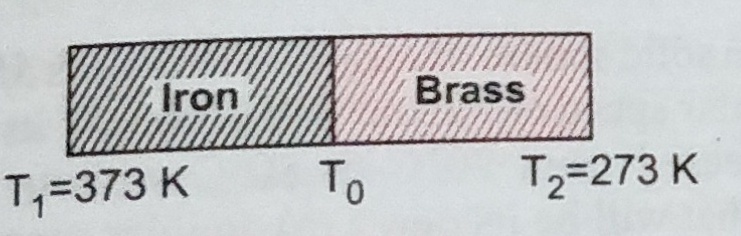
    An iron bar of length l1=0.1m, A1=0.02m2, k1= 79w/mK and a brass bar of length l2=0.1m area 0.02m2 and K2=109 W/mK are soldered end to end as shown in fig. the free ends of the iron ball and brass bar maintained at 373K and 273K respectively . Obtain expression for and hence compute (a) the temperature of the junction(b) the equivalent thermal conductivity of the compound bar and (c)the heat current through the compound bar.   Ans-315K ,91.6W/mK, 916W.

    7. A body cools from 700c to 500C in 6 minutes and to 400C in 12 minutes . Find the temperature of the surroundings if cooling occur according to Newton’s law of cooling.        Ans-300C.

    8. A pan filled with hot food cools from 940C to 860C in 2 minutes when the room temperature is 200C . How long will it take to cool from 710C to 690c .    Ans- 42sec.

    9. The energy emitted per second by a black body at 12270C is E . If the temperature of the black body is increased to 27270C , calculate the energy emitted per second in terms of E in the second case. Ans-16E

    10. Calculate the temperature in kelvin scale at which a perfectly black body radiates at the rate of 5.67 W/cm2. Given σ=5.67×10⁻⁸W/m2K4.                                  Ans-1000K.

  • Thermal stress

    Thermal stress-

    If we clamp the ends of a rod rigidly to prevent its expansion or contraction and then change the temperature, tensile or compressive stress developed is called thermal stress. The rod like to expand or contract but clamps won’t allow it. As shown in fig.

    To calculate the thermal stress in a clamped rod , we have to find how much the rod would expand if not held rigidly and then find the stress needed to compress it back to its original length. Suppose that the rod with length L0 and cross-sectional area A is held at constant length while the temperature is reduced  causing tensile stress. The fractional change in length if the rod were free to contract would be

     (ΔL/L0 )thermal= αΔT………….(i)

    Both ΔL and ΔT are negative . the tension must increase by an amount F that is just enough to produce an equal and opposite fractional change in length (ΔL/L0 )thermal from the definition of Young’s modulus (Y),

    Therefore Y =( F/A)/(ΔL/L);

    So  (ΔL/L0 )thermal= F/AY …………(II)

    If the length is to be constant , the total fractional change in length must be zero. This means that

    (ΔL/L0 )thermal +  (ΔL/L0 )thermal = 0

    αΔT + F/AY = 0

    F/A = – YαΔT…………………….(III)

    For a decrease in temperature , ΔT is negative , so F and F/A are positive . This means that a tensile force and stress are needed to maintain the length. If ΔT is positive , F and F/A is negative , and the required stress and force are compressive.

    If there are temperature difference within a body , non uniform expansion or contraction will result and thermal stress can be induced .

    You can break a glass bowl by pouring hot water into it . The thermal stress between the hot and cold parts of the bowl exceeds the breaking stress of the glass, causing cracks . The same phenomenon make ice cube crack when dropped into warm water.