CYCLOTRON
In this topic we will, discuss about working of cyclotron , its principle, construction and its limitations. (** this topic is removed from the syllabus of class 12th, board examination).To know the complete syllabus click on the given link-
Before to know about the cyclotron students must know Force Acting on a Charge Particle Moving in a Uniform Magnetic Field; To get the notes on this topic click here-
Cyclotron-
It is a device used to accelerate positive charged particles like proton, deutron , alpha particles etc . with desired velocity.
Principle– Its working based on the principle that a positive charge particle can be accelerated to a sufficient high energy with the help of oscillating electric field with the help of perpendicular strong magnetic field .
Construction– It consist two D-shaped chamber ( Dees) D1 and D2 , which are placed slightly separated with each other between two poles of the magnet N- pole and S–pole ( as shown in figure. ) Dees are connected with an high frequency oscillator ( cause of variable electric field).
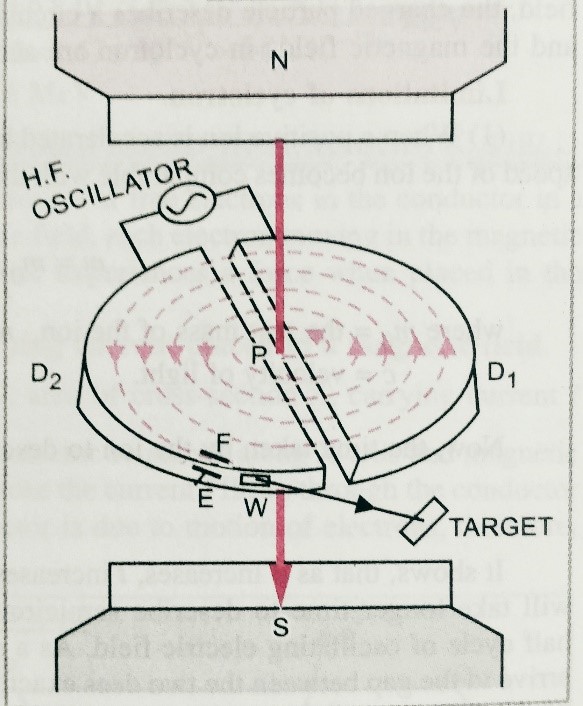
Working and theory – suppose initially the D1 is negative and D2 is positively charged , then the positive charged particle at point P starts to move towards D1 , but due to perpendicular magnetic field it starts moving on a circular path. If r is the radius of the circular path then ,
mv2/r = qvB
So r = mv/qB ;
Time taken by the charged particle to complete half cycle t= ∏r/v = ∏m/qB ;
When particle reaches to D1 at the same time D1 becomes positively charge and D2 negatively then again charge particle starts to move towards D2 with the circular path with greater radius . similarly charge particle remain describing the circular path with greater radius and greater speed and at an instant it ejected through the window with high kinetic energy .
Maximum energy of charged particle– suppose v0 , r0 is the is the maximum velocity and maximum radius of the circular path followed by the charged particle ,
Then ,m v0 2/ r0 = B q v0 or , v0 = Bq r0/m ,
Therefore maximum kinetic energy k = ½ mv02 = B2 q2 r02 / 2m ;
Cyclotron frequency –
Angular velocity ω= Bqr/mr = Bq/m ……………..(3)
here frequency f=ω/2∏ = Bq/2∏m ( here frequency is independent of velocity)………….(4)
limitations of cyclotron-
- When a positive ion is accelerated by the cyclotron , it moves with greater speed when it becomes closer to speed of light or comparable with speed of light , then mass of the particle increases according to the given relation m= m0 /√(1-v2/c2) where m0 is the mass of the charged particle , v is the speed of charged particle , c is the speed of light . But cyclotron doesn’t discuss about variable masses .
- Cyclotron is suitable for accelerating heavy particles only . i.e electron can not be accelerated through cyclotron .
- The uncharged particle can not be accelerated by the cyclotron.
To watch the video on motion of a charged particle in magnetic field click here-