Category: 11th Notes

  • Beats

    BEATS
    If two tuning fork whose frequency is slightly different are sounded together , the sound we hear periodically fluctuates in intensity , i.e intensity increases and decreases suddenly . This periodic variations in intensity of sound are called beats.

    So we can define “ Beats are periodic vibration in the intensity of sound when two sound wave of nearly same frequency travel in the same direction. One loud sound followed by a faint sound from one beat and the number of beats formed per second is called beat frequency”.

    Graphical method for the formation of beats-
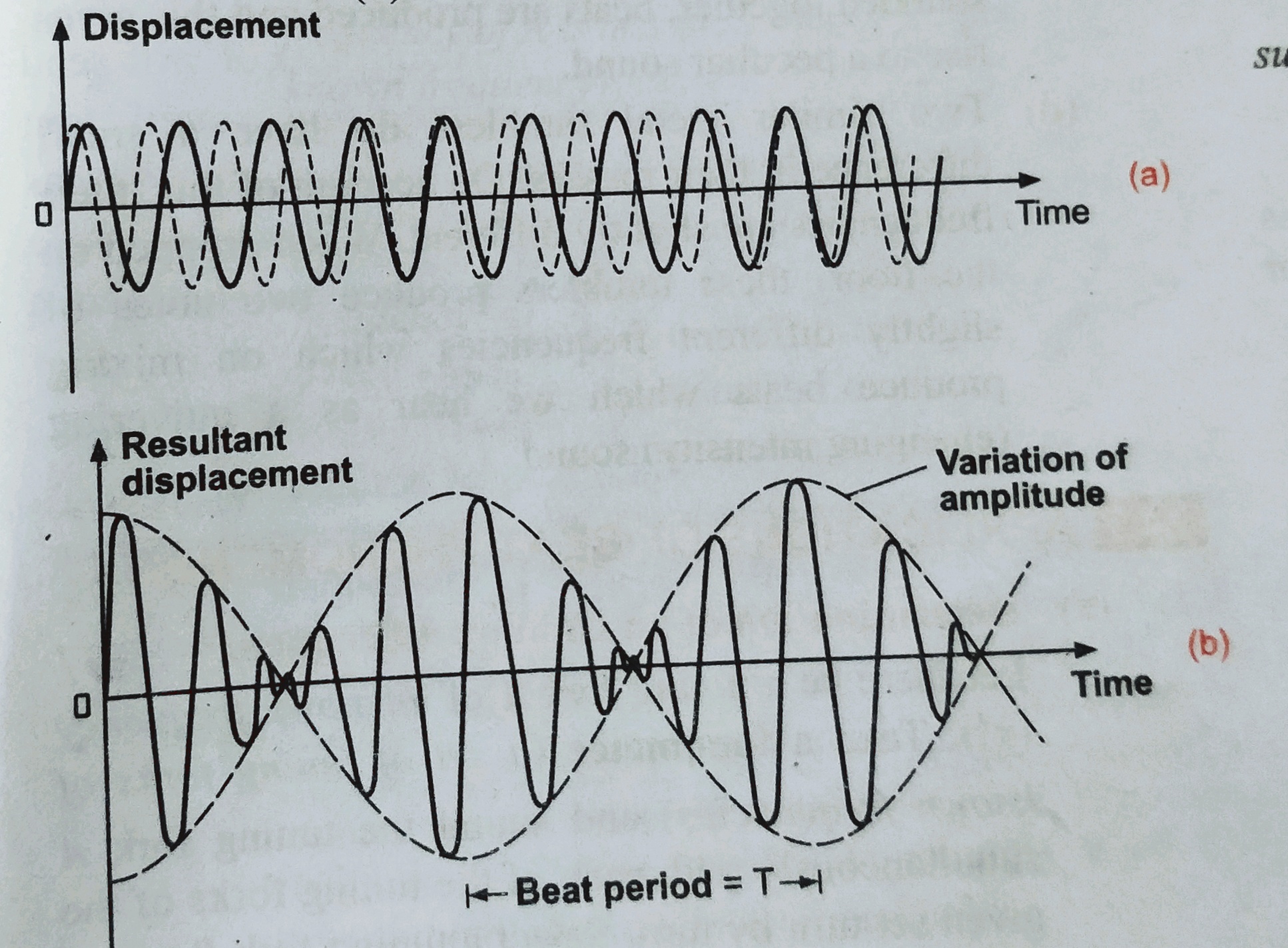
    As shown in fig (a) Two waves ( One in dotted and other in dark line). When they superimpose then due to the superposition principle , at T=0 the intensity becomes max and at T= T/2 Intensity becomes minimum which is ‘0’ . This process happening again and again.

    And number of beats per second or beats frequency is equal to difference in frequency between these two waves.

    Suppose the beat period is T and that during this time one wave of frequency n1 , makes one cycle more than the other wave of frequency n2 . The number of cycle of frequency n1 in time T = n1T. And number of cycle of frequency n2 in time T = n2T.

    According to the given condition, n1T-n2T = 1

    Or   

    n1-n2 = 1/T = n0 (resultant frequency).

    Analysis of graph shown in figure-

    (1)The resultant wave oscillates with the average of the frequencies of the individual waves .

    (2) The resultant amplitude oscillates with a beat frequency that is equal to the difference between the two frequencies.

    Application of beat phenomenon

    (i) Determination of unknown frequency

    (ii) By loading tuning fork with wax.

    (iii) By loading the tuning fork

    (iv) Tuning musical instrument

    (v) In electronics.
  • Thermal stress

    Thermal stress-

    If we clamp the ends of a rod rigidly to prevent its expansion or contraction and then change the temperature, tensile or compressive stress developed is called thermal stress. The rod like to expand or contract but clamps won’t allow it. As shown in fig.

    To calculate the thermal stress in a clamped rod , we have to find how much the rod would expand if not held rigidly and then find the stress needed to compress it back to its original length. Suppose that the rod with length L0 and cross-sectional area A is held at constant length while the temperature is reduced  causing tensile stress. The fractional change in length if the rod were free to contract would be

     (ΔL/L0 )thermal= αΔT………….(i)

    Both ΔL and ΔT are negative . the tension must increase by an amount F that is just enough to produce an equal and opposite fractional change in length (ΔL/L0 )thermal from the definition of Young’s modulus (Y),

    Therefore Y =( F/A)/(ΔL/L);

    So  (ΔL/L0 )thermal= F/AY …………(II)

    If the length is to be constant , the total fractional change in length must be zero. This means that

    (ΔL/L0 )thermal +  (ΔL/L0 )thermal = 0

    αΔT + F/AY = 0

    F/A = – YαΔT…………………….(III)

    For a decrease in temperature , ΔT is negative , so F and F/A are positive . This means that a tensile force and stress are needed to maintain the length. If ΔT is positive , F and F/A is negative , and the required stress and force are compressive.

    If there are temperature difference within a body , non uniform expansion or contraction will result and thermal stress can be induced .

    You can break a glass bowl by pouring hot water into it . The thermal stress between the hot and cold parts of the bowl exceeds the breaking stress of the glass, causing cracks . The same phenomenon make ice cube crack when dropped into warm water.

  • Change of density with temperature

    Before to go with tis topic students must know the topic thermal expansion of matter, which is one of the most important topic for thermal properties of matter. To learn the topic Thermal expansion of matter CLICK HERE-

    After Completing the topic thermal expansion   students must solve some important questions of thermal expansion of matter, To get (solve)the question  based on this topic CLICK HERE-      

        Change of density with temperature

    The density of a substance is defined as its mass per unit volume of a given mass of a substance changes with temperature while its mass remain the same , the density undergoes a change with the temperature .

    Consider a body of mass m . Let v1 and ƍ1 be its volume and density respectively at temperature t1 and v1and ƍ2 the corresponding values at t2.

    Clearly , mass m= v2ƍ2=v1(1+ƳΔT)ƍ2, where ΔT=t2-t1 ,

    Thus ƍ2 = ƍ1/(1+ƳΔT) = ƍ1(1+ƳΔT)-1. = ƍ1(1-ƳΔT)[ Using Binomial theorem]

    i.e.  ƍ2= ƍ1(1-ƳΔT) [so we can say the density of the material decreases with the rise in temperature].

    Some numericals  for practice based on change of density with temperature are given below .

    1. Coefficient of volume expansion of mercury is 0.18 x 10⁻³/0C . If the density of mercury at 00C is 13.6g/cc, then its density at 2000C is (a) 13.11g/cc (b)52.11g/cc (c)16.11g/cc (d) 26.11g/cc.

    2. The coefficient of volume expansion of glycerin is 49×10-5/K. The fractional change in density on a 300C rise in temperature is (a)1.47 x 10⁻² (b) 1.47 x 10⁻³ (c) 1.47 x 10⁻¹ (d) 1.47 x 10⁻⁴.

  • Thermal expansion

    Thermal expansion

    Most of the material expand when their temperature increases. Then the phenomenon of expansion of material when it is heated is known as thermal expansion.

    1. Linear expansion– When a rod heated then the temperature of the body increases due to which length of the rod increases , this phenomenon is known as the linear expansion .

    Suppose a rod is of length l0 at the initial temperature T0, when its temperature is rises by temperatureT , then the length changes by l. Then the change in length is proportional to original length and rise in temperature,

    i.e.   l α T……………(i)

    And l α l0 ……………..(ii)

    From eq. (i) and (ii)

    l α l0T,

    Or, l = α l0T , where α is the coefficient of linear expansion its unit is K-1 or  ( C0)-1.

    Then the final length l = l0+ l  

    Or, l = l0 + α l0T

    L = l0 ( 1+ α T)………….(iii)

    Area expansion or superficial expansion – When a surface heated then the temperature of the body increases due to which area of the rod increases , this phenomenon is known as the Area expansion .

    Suppose a rod is of length A0 at the initial temperature T0, when its temperature is rises by temperatureT , then the length changes by A. Then the change in area is proportional to original area and rise in temperature,

    i.e.   A α T……………(i)

    And A α l0 ……………..(ii)

    From eq. (i) and (ii)

    A α A0T,

    Or, A = β A0T , where β is the coefficient of Superficial expansion its unit is K-1 or  ( C0)-1.

    Then the final area A = A0+ A  

    Or, A = A0 + β A0T

    A = A0 ( 1+ β T)………….(iii)

    Volume expansion-  When a rod heated then the temperature of the body increases due to which volume of the rod increases , this phenomenon is known as the volume expansion .

    Suppose a rod is of length V0 at the initial temperature T0, when its temperature is rises by temperatureT , then the length changes by V. Then the change in length is proportional to original length and rise in temperature,

    i.e.   V α T……………(i)

    And V α V0 ……………..(ii)

    From eq. (i) and (ii)

    V α V0T,

    Or, V = Ÿ V0T , where Ÿ is the coefficient of linear expansion its unit is K-1 or  ( C0)-1.

    Then the final length V = V0+ V  

    Or, V = V0 + Ÿ V0T

    V = V0 ( 1+ Ÿ T)………….(iii)

    Relation between linear, area and volume expansion (α,β and Ÿ )

    2α=β; and 3α=Ÿ

    Or , α = β/2=Ÿ/3 .

    To solve the important questions based on this topic CLICK HERE-

    To solve the important questions based on the topic Temperature and thermometers CLICK HERE-

  • Magnus effect and dynamic lift

    Magnus effect and dynamic lift-

    The upward force experience by a body when it moves through a fluid is called dynamic lift . Such a lift is felt by airfoil , aircraft win etc. Couse behind it can be explained by Bernoulli’s theorem . It also explain why a spinning ball is deviated from its parabolic path .This deviation is usually observed in many games like cricket, football golf, tennis etc.

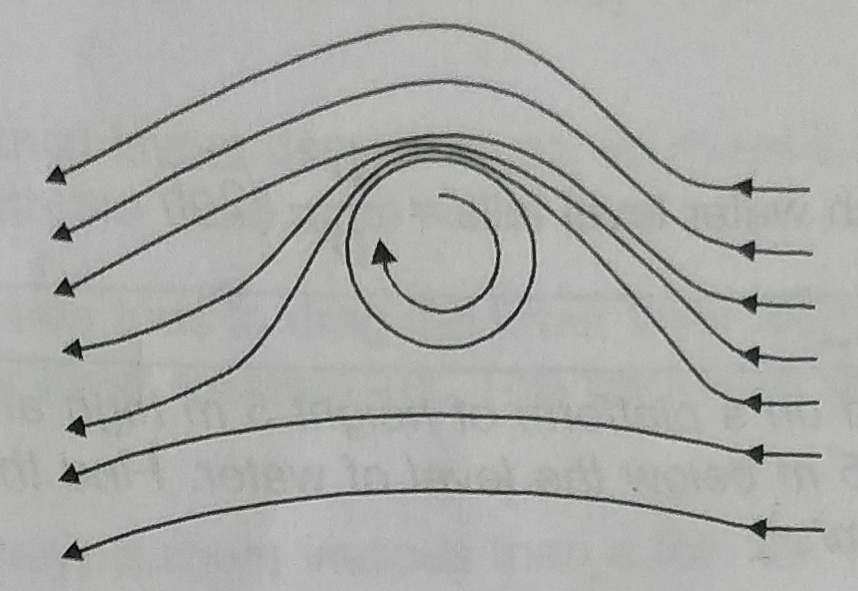
    As a ball moves through air without spinning , it divides the streamline  above and below it symmetrically . Thus there is no pressure difference on the two sides of the ball.

    But when a ball spins as it moves through air , it drags along a layer of air with itself. When the ball moves forward , the air ahead of the ball rushes backward to fill the space left vacant by the ball. Thus the streamlines of air around this ball is shown in the fig. given below.

    The velocity of air above the ball opposite to the direction of spin and it is in the direction below the ball. Thus the relative velocity of air  with respect to the ball is larger at the upper part than that is in the region below  the ball . The streamline thus gets crowded above and rarified below .This cause the pressure above the to be smaller and that below it to be greater . This pressure difference causes an upward force on the ball. Hence the ball experiences a dynamic lift and is deviated from its path . This effect arising due to spinning of the ball is called ‘Magnus effect’.

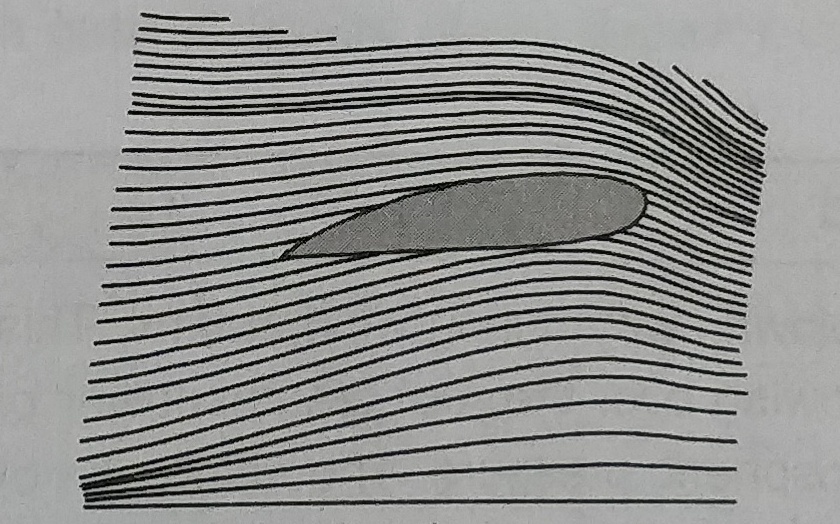
    Airfoil and lift on aircraft wing:-  An airfoil is streamlined shaped , Solid body that is capable of generating a dynamic lift as it moves through a fluid .  streamline shape is special shape given to bodies moving in fluids, So as to produce minimum drag .

    The cross-section of air wings is also shaped like that  .Its upper portion is more curved then the lower surface .Its front edge is broader and the rear edge is narrow . When the airfoil moves through air , streamlines of air moves backward . The air above the foil has to travel a longer distance then that  below in the same time . Thus the flow speed on top becomes greater then that below it . The higher speed on reduces air pressure there. This pressure difference causes to lift the foil. Such dynamic lift also acts on the wings of an air craft and balances the weight of the plane.     

  • Surface energy

    Before to learn or to know surface energy students must know surface tension. To know about the surface tension click here-

    Surface energy-

    It is given as the work done to increase the unit area of a liquid .Or, It is the energy required to remove a molecule completely from a liquid. Or,  The molecules at the surface have extra energy as compared to the molecule in the interior we call this energy as surface energy.

    Mathematically it is equal to the surface tension(T) of the liquid.

    surface energy

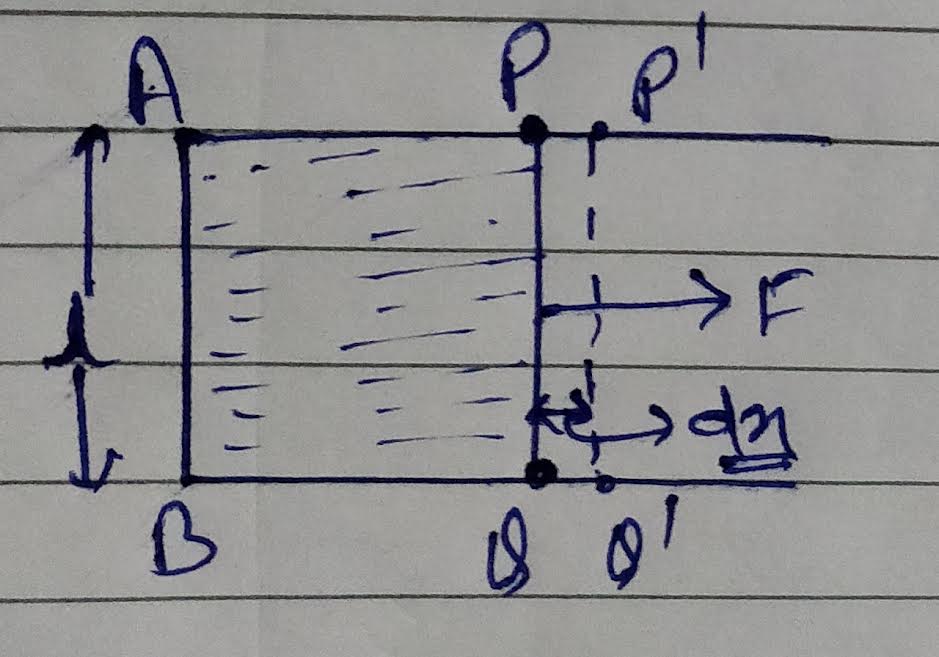
    Let we have a liquid surface (film) ABPQ , is of surface tension T .

    A force F is applied to the surface so that PQ moves to P’Q’ , by dx

    Then work done is given as W= F.dx

    As we know Force F= T/2l ( where T is the surface tension ).

    Then work done,  W= F.dx = (T/2l).dx

    As we have defined above surface energy is the work done per unit area  ,

    So surface energy E = Work done/ change in area  = (T/2l).dx/( change in area )

    Here change in area  = 2l.dx ;

    So surface energy E= [(T/2l).dx]/[2l dx]   = T ……..eq.

    So we can say surface energy of a liquid is equivalent to the surface tension.

    ( Here questions may be asked as show that surface energy is equivalent to the surface tension.)

    [ Note – when a bigger spherical drop of a liquid is broken to form small spherical droplets, the total surface area of the liquid increases . Due to this the surface enegy of the system increases this increase in energy  is taken from the system and hence temperature of the system will fall. We can also think it inversely.]

  • Surface tension

    Surface tension–  It is the property of a free surface of liquid to get minimum surface area .

    The property of a liquid at rest by virtue of which its free surface behaves like a stretched elastic membrane and tries to occupy as small an area as possible called surface tension.

    As we know in a liquid , the molecules are not as close to each other as they are in solid . The result in a liquid not having a strong enough  cohesive force to have a rigid structure as a solid . But these intermolecular forces are strong enough to give the liquid a definite shape. These molecular force is effective upto certain distance called molecular range . The uppermost layer of the liquid which thickness is equal to the molecular range is called surface film.

    To watch the most important derivation of surface tension click on the video link given below-

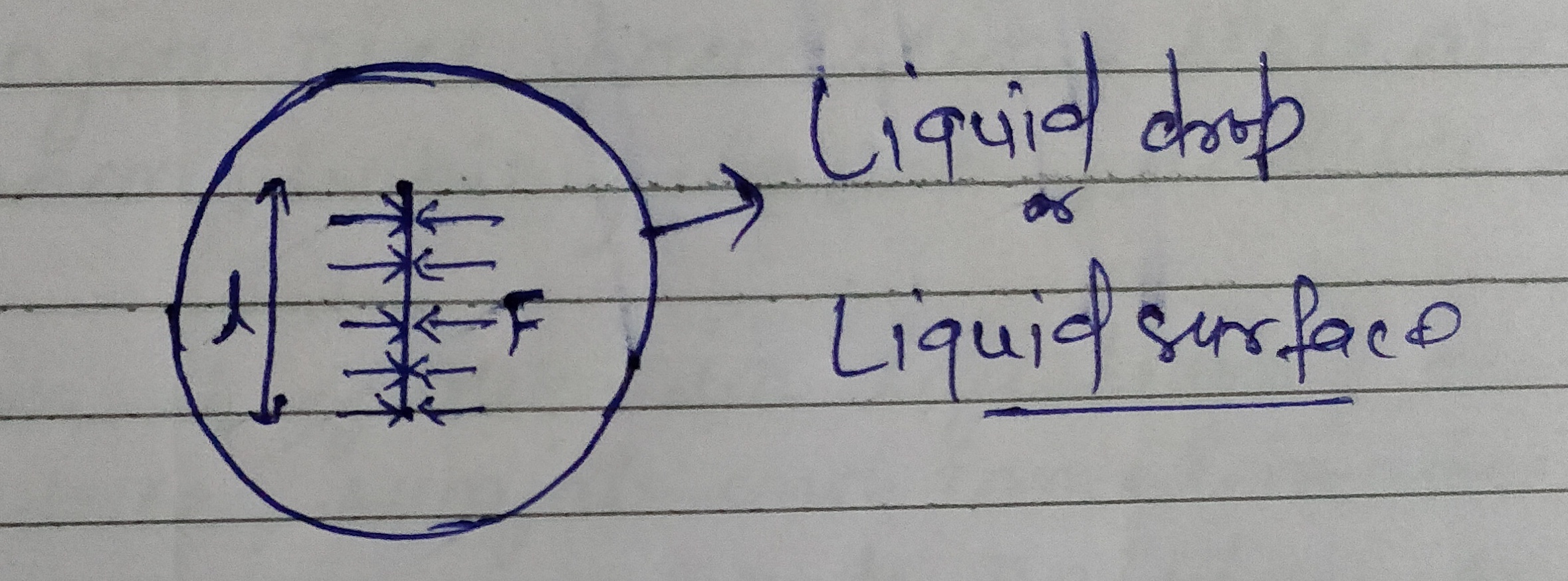
    We can define the surface tension in another way mathematically  the surface tension of a liquid is the force of tension acting across a unit length of an imaginary line drawn on the free surface of a liquid at rest . The direction of this force is perpendicular to the line and tangential to the surface.

    Surface tension on liquid surface

    If F is the force and l is the length of an imaginary line on the surface of liquid then surface tension T is given as

     T = F/ l    .

    But, for a surface film it is given as the

     Surface tension  ;  T = F/2l  ;

    Unit of surface tension is , Newton/meter or , kgs-2

    Dimension of surface tension is ; [ MT-2] or [M L0 T-2]

    Note- 1. Temperature of the liquid increases surface tension decreases .

    2. The surface tension arises due to the intermolecular cohesive forces .

    3. The surface tension doesn’t depend on the area of the surface.

    4. Soap or hot water helps in better cleaning of cloths because it reduces the surface tension of water.

    After completing the surface tension students must know surface energy.

    to get the notes on Surface energy click here

  • Newton’s second law of motion is the real law of motion

    Newton’s second law of motion is the real law of motion

    Newton’s second law of motion is the real law of motion

    Before to know Newton’s second law of motion is the real law of motion we must know all three equations of motion.

    To know, Newton’s first law of motion click here–

    To know, Newton’s second law of motion click here-

    To know, Newton’s third law of motion click here-


    Second law of motion  is the real law of motion –

    The question may be asked as , show that second law of motion is the real law of motion . 

    ***This question is very important for the class 11th examination point of view .

    To show it we must prove two things (i) First law contained in the second law and (ii) Third law contained in second law.

    (i) ) First law contained in the second law –  As we know according to Newtons second law of motion

    Force F = Ma ,

    If there is no external force

    then F = 0

    Or, Ma =0    then we can say    M=0 or a=o , but mass of the body can’t be zero.

    Therefore only possible thing is that only acceleration is zero .

    But , we know acceleration a= v-u/t ( where , v- final velocity and  u- initial velocity) .

    So we can write , v-u/t = 0  i.e v-u=0 or v=u

    Since V (final velocity) = u ( initial velocity).

    So we can say if body initially is in rest will be in rest and if it is moving with some velocity it will remain in the motion with the same velocity( which is the statement of first law ) . So we can say first law contained in the second law .

    To watch the video of this topic Newton’s second law is the real law of motion , click on the link given below-

    (ii) Third law contained in the second law –  suppose an isolated system of two objects A and B , they interact mutually with one another . Then obviously they will apply force on each other .

    Let,  FAB – Force on A due to B ,

    And  FBA – Force on B due to A .

    Let dpa and dpb is the change in momentum in A and B respectively in small time dt .

    Then from Newton’s second law –

    FAB = dpA/dt   ………………………(i)

    and, FBA= dpB/dt …………………..(ii)

    FAB+ FBA= dpB/dt + dpA/dt   ……….(iii)

    In the absence of external force , the rate in change in momentum of the system will be zero .

    i.e. dpB/dt + dpA/dt  = 0

    Therefore , FAB+ FBA=0 ;

    Or, FAB= -FBA ( which is third law )

    So we can say Newtons third law contained in the second law .

    Therefore we can say Newton’s second law of of motion is the real law of motion.

    What is the syllabus removed in class 12th physics (CBSE) for 2021 board examination , click on the link given below-


  • Apparent weight of a man in a lift

    Apparent weight of a man in a lift

    Apparent weight of a man in a lift

    In this topic we will discuss about , a man of mass m standing in a lift . What will be its apparent weight of a man in a lift when lift has some motion with uniform acceleration or velocity?

    But before to know about this topic students must know Newton’s third law of motion. To get the notes on Newton’s third law of motion click here-

    Apparent weight of a man in a lift  (elevator)  –

    Suppose a man of mass ‘m’ is standing on a weighing machine placed inside a lift . initially when the lift is in rest weight of the man acts vertically downward direction which acts on the   weighing machine and machine offers a resistance ‘R’ against its weight shows the actual weight which is mg .

    Case i – When the lift is in rest or moving with uniform velocity (fig-c)- In that case there is no acceleration in the lift and man , and hence reaction force is equal to the weight of the man.

    In that case , R  = mg

    i.e  Apparent weight = Actual weight

    Case ii – When lift moves upward with acceleration ‘a’ fig (a).

    Since there is upward motion then  ;

    So  R-mg =ma

    Or , R = mg+ma = m(g+a)

    i.e. R ( apparent weight) > mg(actual weight) ;

    i.e  Weighing machine shows more weight the actual .

    Case iii – When lift moves downward with acceleration ‘a’ fig (b).

    Since there is downward motion then  ;

    So  mg-R =ma

    Or , R = mg-ma = m(g-a)

    i.e. R ( Apparent weight) < mg(Actual weight) ;

    i.e  Weighing machine shows less weight the actual .

    case iv– When the lift falls freely –  In that case lift accelerates downward with acceleration ‘a=g’

    So we can write , R= mg-ma = mg-mg ( since a=g) = o

    Show apparent weight of the man will be zero . So person feel’s weightlessness.


  • Horse and cart problem

    Horse and cart problem

    Horse and cart problem

    This is the topic  Horse and cart problem which explain the one of the important illustration of Newton’s third law of motion.

    But before to learn the topic Horse and cart problem students must know, Newton’s third law of motion. To get the notes on Newton’s third law of motion click here-

    To get the Notes on Newton’s first law and inertia click here-

    To get the Notes on Newton’s second law and impulse click here-

    Horse and cart problems –

    Suppose a cart is connected  with a  horse by a light inextensible string. When horse start to walk horse press the ground F ( action ) with their feet in the slightly backward direction and ground  exert an equal reaction R , as shown in figure . then R has two component H = R cosϴ in horizontal direction  and V= R sinϴ in vertical direction . V balance the weight of the horse and H makes the horse to move in forward direction . While pulling the cart produces a tension T in the string .


    If H > T then cart starts moving in the forward direction with acceleration ‘a’ .

    Net force acting on the horse = H-T= ma.( where m is the mass of the horse)……………..(i)

    If f is the frictional force between tyre of cart and ground then for cart we can write

    T-F= Ma  ( M is the mass of the cart ) …………………………(ii)

    From equations (i) and (ii) we get ,

    H-f = ( M+m ) a ;

    So, acceleration   a  =  H-f/ (M+m ) ;

    The whole system will move if H>f ;