There are 20 questions in this question paper. Students have to solve it in 25 minutes only .
Test NEET/JEE (ch-1,2,3,4)
1. A new system of units is proposed in which unit of mass is A kg . unit of length is B kg and unit of time is C s , What will be the value of 5 j in new system?
2. If linear momentum P , area A and time t is taken as fundamental units then the dimensional formula of energy is (a) P1 A-1 t-1 (b) P2 A1 t1 (c) P1 A-1/2 t1 (d) P1 A1/2 t-1.
3. If E , m,L and G denotes energy , mass , length and gravitational constant then the ( EL2 /m5G2) has the dimension of (a) mass (b) length (c) time (d) angle.
4. The period of oscillation of time period T is 2π(l/g)1/2 measured value of l is 10 cm is known as 1mm accuracy ant time for 100 0scillations of the pendulum is found to be 50 s using a wrist watch of 1s resolution . What is the accuracy in the measurement of g ?
(a)2% (b) 3% (c) 4% (d) 5% .
5. Two resistors of resistance R1=100+-3 Ohm R2=200+-4 Ohm then the equivalent resistance of parallel combination is (a) 66.7 +-1.8 (b) 66.7+- 4 (c) 66.7+-3 (d)66.7+-7 Ohm.
6. A cube has a side of length 1.2 x 10⁻² its volume upto correct significant figure is (a) 1.7×10 -6 (b) 1.73×10 -6 (c) 1.78×10 -6(d) 1.732×10 -6.
7. T he position of the object moving along x-axis is given by x= a+bt2, where a=8.5 b=2.5 and t is measured in seconds. The average velocity of the object between t=2s to t=4 s in m/s is (a) 5 (b) 10 (c) 15 (d) 20 .
8. A player throw a ball vertically upwards with velocity u at highest pint , (a) both velocity and acceleration are zero (b) The velocity of the ball is u and acceleration is zero (c)The velocity of the ball is 0 but acceleration is g (d) the velocity of the ball is u and acceleration is g .
9. If a lift is moving upward with velocity 5m/s a girl throw a ball upward with speed 50m/s the ball will returns on her hand in time (a)5s (b)10s (c) 15s (d) 20s.
10. A boy sliding on the smooth inclined plane requires 4 s to reach on the ground starting from rest from the top . How much time will it take to cover one fourth the distance starting from rest at the top?
(a) 1s (b) 4s (c)2s (d)16s .
11. A particle is released from rest from a tower of height 3h . the ratio of the intervals of time to cover three equal heights h is (a) t1:t2: t3 = 3:2:1 (b) t1:t2: t3 =1: (√2-1)(:√3-2) (c) t1:t2: t3 =√3:√2:1 (d) t1:t2: t3 = 1:√2-1): (√3-√2).
12. A ball A is thrown upward with velocity u at the same time another ball B is released from rest at height H, at time t the speed of A relative to B is (a) u (b) u-2gt (c) (u2-2gh)1/2 (d)u-gt.
13. A vehicle travel half the distance L with speed V1 and other half with speed V2 then its average speed is , (a) (V1 + V2)/2 (B) (2V1+V2)/V1+ V2 (C) 2V1V2/V1+V2 (D) L(V1+ V2)/V1V2 .
14. Two vectors and A+B = C then A and B are (a) parallel (b) perpendicular (c) anti-parallel (d) null vector.
15. If resultant of two equal vectors is equal to the either forces Then the angle between these two vectors is ,(a) 900 (b) 1200 (c) 600 (d) 300
16. if dot product of two vectors is null vector then the angle between these two vectors is (a) 0 (b) 1200 (c) 900 (d) 450 .
17. If then then which of the following statement is correct ( a) vector A is perpendicular to vector B (b) vector A is parallel to vector C (c) vector b is parallel to vector C (D) vector A is perpendicular to vector C .
18.Two vectors magnitude of A,B and C are 3,5,4 respectively then (a)the angle between A and B is 900 . angle between A and C is 900. (c) angle between B and C is 900(d) angle between A and B is 00.
19. If unit vector of a vector is represented as 0.5 – 0. 8 +c then the value of c is (a) √0.01 (b) √0.11 (c) √0.39 (d) 1.
20. The component of a vector A is along X-axis will have maximum value if (a)vector A is along positive Y axis (b)vector A along positive x-axis (c) vector A makes angle 450 with the x-axis (d) A is along negative X aixis.
Physics classes by Nayan jha provoding information ,How to select coaching centre for NEET and JEE
Students/parents as you know these days most of the parent or students are looking to settle their child as quick as possible. And IIT (Indian institute of technology) and medical colleges like AIIMS play the great role to do so.
As we know every student who appears for the 10th class exams has one big question about his life that which stream to select for further education. Once the decision for the stream is made, which is Science. Then next question is medicine or engineering? The answer to this question marks the beginning of a dream career. Students can decide this based on what subject interests them. If students scores good in NEET leads to admission to a good medical college, whereas a good score in IIT JEE will help students get admission to a reputed engineering college.
Both the exams are national-level entrance exams and hold a lot of importance concerning students’ higher education. One more doubt that arises when deciding between the two is which exam is easier to crack. Now, and for this selection of good coaching center is required to score good marks to take the admission in reputed colleges, every student who appears for the 10th class exams has one question about which stream to select for further education. Once the decision for the stream is made, the stream is Science. The question that comes next is medicine or engineering? The answer to this question marks the beginning of a dream career. Students can decide this based on what subject interests them. A good score in NEET leads to admission to a good medical college, whereas a good score in IIT JEE will help students get admission to a reputed engineering college.
Both the exams are national-level entrance exams and hold a lot of importance concerning students’ higher education. One more doubt that arises when and where should we join the coaching center or tuitions . Here is the answer – You just watch the video given below-
Physics classes by Nayan jha providing the syllabus for term -2 CBSE (physics)Examination ; guided by CBSE( Distribution of marks may change in some circumstances)
CBSE Class 12 Physics Syllabus Term – 2 (2021-22)
Time: 2hrs
Max Marks: 35
SI. No.
Chapter Name
marks
Unit–V
Electromagnetic Waves
2-3
Chapter–8: Electromagnetic Waves
Unit–VI
Optics
14-15
Chapter–9: Ray Optics and Optical Instruments
Chapter–10: Wave Optics
Unit–VII
Dual Nature of Radiation and Matter
4-5
Chapter–11: Dual Nature of Radiation and Matter
Unit–VIII
Atoms and Nuclei
6-7
Chapter–12: Atoms
Chapter–13: Nuclei
Unit–IX
Electronic Devices
7
Chapter–14: Semiconductor -Electronics: Materials, Devices and Simple Circuits
Total
35
Unit (i – iv is provided for term-1 examination)
Unit V: Electromagnetic waves
Chapter–8: Electromagnetic Waves
Electromagnetic waves, their characteristics, their Transverse nature (qualitative ideas only). Electromagnetic spectrum (radio waves, microwaves, infrared, visible, ultraviolet, X-rays, gamma rays) including elementary facts about their uses.
Unit VI: Optics
Chapter–9: Ray Optics and Optical Instruments
Ray Optics: Refraction of light, total internal reflection and its applications, optical fibers, refraction at spherical surfaces, lenses, thin lens formula, lensmaker’s formula, magnification, power of a lens, combination of thin lenses in contact, refraction of light through a prism.
Optical instruments: Microscopes and astronomical telescopes (reflecting and refracting) and their magnifying powers.
Chapter–10: Wave Optics
Wave optics: Wavefront and Huygens principle, reflection and refraction of plane waves at a plane surface using wave fronts. Proof of laws of reflection and refraction using Huygens principle. Interference, Young’s double slit experiment and expression for fringe width, coherent sources and sustained interference of light, diffraction due to a single slit, width of central maximum.
Unit VII: Dual Nature of Radiation and Matter
Chapter–11: Dual Nature of Radiation and Matter
Dual nature of radiation, Photoelectric effect, Hertz and Lenard’s observations; Einstein’s photoelectric equation-particle nature of light. Experimental study of photoelectric effect Matter waves-wave nature of particles, de-Broglie relation
Unit VIII: Atoms and Nuclei
Chapter–12: Atoms
Alpha-particle scattering experiment; Rutherford’s model of atom; Bohr model, energy levels, hydrogen spectrum.
Chapter–13: Nuclei
Composition and size of nucleus Nuclear force Mass-energy relation, mass defect, nuclear fission, nuclear fusion.
Unit IX: Electronic Devices
Chapter–14: Semiconductor Electronics: Materials, Devices and Simple Circuits
Energy bands in conductors, semiconductors and insulators (qualitative ideas only) Semiconductor diode – I-V characteristics in forward and reverse bias, diode as a rectifier; Special purpose p-n junction diodes: LED, photodiode, solar cell.
Here physics classes by Nayan jha provide Practical chemistry for class 8/9/10th whish is prepared by Rahul jha [Currently working with the St. Joseph School , Bhagalpur ( Bihar) , He is also the co-founder of QT classes bhagalpur ] .
These practical is totally based on ICSE/CBSE/ALL STATES BOARD .
With the help of these notes, Practical chemistry for class 8/9/10th students can prepare the notes for their chemistry practical for their class examinations .
The Syllabus class 12 (physics) providing here is totally based on 2019-2020 pattern , if there will be any change in the syllabus , it will be improved and informed to the students through the website – www.physicsclasses.online , to get any improved information remain in contact with this site .
Topic removed from cbse class 12th physics. What are the benefits for the students or what are the drawbacks see in the video given below-
electrostatics –
Chapter 1: electric charges and fields –
Electric charges , properties of charges (Conservation of charge , quantisation of charge etc. ), coulombs law ( between two point charges and due to multiple charges also known as superposition of force due to multiple charges ) , permittivity of a medium , continuous charge distribution ( linear ,surface ,volume charge density) .
Electric field , electric field due to a point charge , electric field lines ( electric lines of force ) , electric dipole , electric field due to a dipole ( axial and equatorial) , torque on a dipole placed in uniform electric field . Electric flux , Gauss’s theorem and its applications (i.e. electric field at a point due to long straight charged conductor, charged infinite plane sheet , charged spherical shell) .
Chapter 2: Electrostatic potential and capacitance –
Electric potential and potential difference , electric potential due to a point charge and system of charges also due to electric dipole ( axial, equatorial and at any point) , equipotential surfaces , electric potential energy of a system of two point charges and of a dipole in an electric field . Conductors and insulators , electric polarization and dielectric constant ( relative permittivity ) , capacitor and its capacitance ; combination of capacitor ( series and parallel ) , capacitance of parallel plate capacitor with dielectric slab /conducting slab , energy stored in capacitor , common potential , lass in energy when two charged capacitors connected with each other .
current electricity-
Chapter 3: current electricity-
Electric current, drift velocity , mobility , relation between drift velocity and current , proof of Ohm’s law on the basis of drift velocity , current density , resistance , conductance , resistivity, conductivity , relation between current density and drift velocity, effect of temperature on resistance and resistivity , graph of resistance(resistivity) Vs temperature for conductors/alloy /semiconductors , Ohmic and non ohmic conductors ( graph) , carbon resister , combination of resistors ( series and parallel ) . Internal resistance (r) , terminal potential (V) and emf (E) of the cell and relation between them . also graph between ( V,E, r and R) . Combination of cells (series, parallel ,and mixed grouping) , Kirchhoff’s law (junction and loop rules) , wheat -stone bridge , meter bridge , potentiometer and its applications ( effects on null points on different -different conditions ). Electrical energy and power .
Magnetic effect of current and magnetism-
Chapter 4: Moving charges and magnetism-
Oersted’s experiment , concepts of magnetic field, Biot-Savart’s law and its application ( magnetic field at a point using Biot -savart’s law due to current carrying wire finite( only formulae ) and infinite , at the centre and on the axis of a circular current carrying coil . Ampere circuital law and its application to infinite long straight current carrying conducting wire ( thin and thick ) , magnetic field inside solenoid / toroid . Force on a moving charge in a magnetic field and direction of force . force on a current carrying wire placed in uniform magnetic field. Force between two parallel current carrying wire and definition of one Ampere . Torque acting on a current carrying coil , and expression for potential energy stored in the coil placed in uniform magnetic field . Moving coil galvanometer its current sensitivity and conversion of galvanometer into ammeter and voltmeter .
Chapter 5: Magnetism and matter-
Earth behaves like magnet , pole strength, magnetic dipole and magnetic moment . Expression for torque and potential energy when a magnetic dipole( short magnet) placed in uniform magnetic field . Current loop as magnetic dipole and its magnetic moment , current carrying solenoid behave as short bar magnet , magnetic field intensity at a point due to magnetic dipole (short bar magnet) at axial, equatorial and any point . Magnetic field lines and its properties . magnetic moment due to revolving electrons in an atom Bohr magneton . magnetic elements of earth and relation between them . Di- para-ferro magnetic substance ( with examples) and its properties . Electro magnet, permanent magnets and factor effecting its strength and material suitable for making them .
Electromagnetic induction and alternating current-
Chapter 6: Electromagnetic induction-
Electromagnetic induction, Faraday’s law , induced emf and current , Lenz’s law , Eddy current . self and mutual induction , expression for self- induction of current carrying solenoid , expression for mutual induction due to coaxial solenoids , units and dimensions of self and mutual induction . grouping of inductors (series and parallel ) .
Chapter 7: Alternating current-
Alternating current. Peak, mean and rms( root mean square ) current/emf . Phasor diagram . phase relation and its phasor diagram when an AC source connected to only resistance, only inductor, only capacitor, resistance and inductor connected in series, resistance and capacitor connected in series , and resistance , capacitor and inductor ( LCR) connected in series , also discussion of reactance and impedance . resonance circuit of LCR and discussion of Quality factor ( sharpness of resonance ) .power in AC circuits . power factor . Watt-less current . Ac generator and transformer .
Electromagnetic wave ( EMW)-
Chapter 8: Electromagnetic wave-
Production of Electromagnetic wave their characteristics their transverse nature ( qualitative idea only ) , displacement current, Maxwell’s improvement of Ampere’s law . Electromagnetic spectrum their production ,properties and uses ( elementary facts )
6.Optics-
Chapter 9: Ray optics and optical instruments –
Reflection of light , spherical mirror , mirror formula , refraction of light , total internal reflection and its application , optical fibres , refraction at spherical surface , lenses thin lens formula , lens maker’s formula , magnification , power of a lens , combination of lens , refraction and dispersion of light through the prism . Scattering of light . Optical instruments ( microscope , telescope ( refracting and reflecting)) and expression for magnifying power .
Chapter 10: Wave optics-
Wave-front , Huygen’s principle , reflection and refraction on the basis of wave theory using Huygen’s principle , interference of light , conditions of constructive and destructive interference using YDSE also expression for fringe width . Diffraction of light using single slit experiment . Width of the central maximum , difference between diffraction and interference. Resolving power of microscope and limit of resolution . polarization , plane polarized light, law of malus , Brewster’s law uses of plane polarised light and polaroids .
Dual nature of radiation and matter –
Chapter 11: Dual nature of radiation and matter –
Emission of electron , photoelectric effect, Hertz’s and Lenard’s observation , effect of intensity and frequency on photoelectric current, stopping potential and threshold frequency , Einstein’s photoelectric equation also the possible graph using these equation . Particle nature of light . Matter waves . Wave nature of particles . De-Broglie relation . Davisson- Germer experiment( only conclusion).
Atoms and nuclei –
Chapter 12: Atoms –
Alpha particle scattering experiment , Rutherford’s model of atom , Bohr’s model, expressions for radius , velocity , total energy and time period ( frequency ) , energy levels , hydrogen spectrum .
Chapter 13: Nuclei –
Atomic mass unit . Composition and size of nucleus , Radioactivity, alpha-beta and gamma emission and their properties . radioactive decay law . half life and mean life . Activity of a radioactive substance . mass defect , binding energy , binding energy per nucleon and its variation with mass number . nuclear fission and fusion .
Electronic devices –
Chapter 14: semiconductor devices and simple circuit-
Energy band in conductors, semiconductors and insulators . Semiconductor diode ( both p-type and n-type) . formation of deplation layer , potential barrier . biasing of diode . forward and reverse characteristics . Diode as rectifier ( full wave and half wave ) . application of diode ( Zener , photo,light emitting diode and solar cell )
CBSE (CENTRAL BOARD OF SECONDARY EDUCATION) decided to follow new marking pattern for class 12th physics , students has to know it and prepare himself according to the new marking scheme.
Important information for all the students of class 12th (science ) should have to know that marking scheme and questions pattern is changed academic year 2019-2020 by CBSE……Here physics classes by nayan jha trying to help the students to know the marking scheme on the chapter basis .
Distribution of marks chapters basis -Total marks -70
(1)-
Chapter -1 ,Electric charges and fields +
chapter-2 , Electrostatic potential and capacitance +
chapter -3 , Current electricity
THESE THREE CHAPTERS CONTAINS 18 MARKS
(2)-
Chapter -4 , Moving charges and magnetism+
Chapter-5 , Magnetism and matter
chapter-6 Electromagnetic induction +
Chapter- 7 Alternating current
THESE FOUR CHAPTERS CONTAINS 17 MARKS
(3)—
chapter-8 Electromagnetic wave+
Chapter- 9 Ray optics and optical instruments +
Chapter-10 Wave optics
THESE THREE CHAPTERS CONTAINS 18 MARKS
(4)—
chapter -11 Dual nature of radiation and matter +
Chapter-12 Atoms +
Chapter-13 Nuclei
THESE THREE CHAPTERS CONTAINS 10MARKS
(5)–
chapter- 14 Semiconductor materials ,electronic devices and simple circuits
THIS CHAPTER CONTAINS 7 MARKS
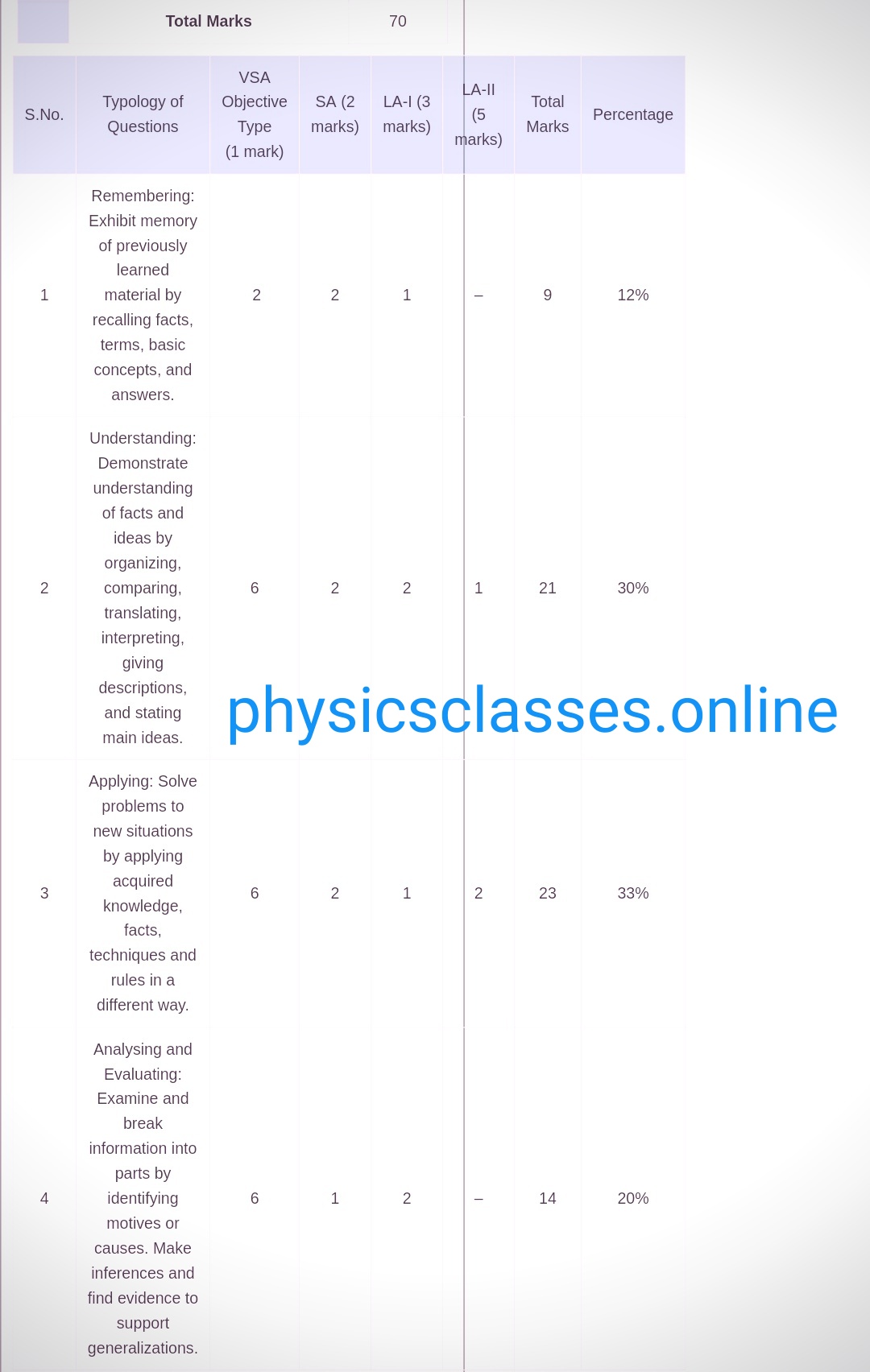
Now it is predicted that question paper style may be like that as it is mentioned below (NOTE-Since this information is on the basis of some sites information ,it may change in the question paper provided by CBSE in the board exam )