Important questions of mechanical properties of fluid in rest (Hydrostatics);
This assignment contain all important questions based on the topic , liquid pressure, Pascal’s law, surface tension etc. It will help the students to prepare for the schools examination for class 11th.
1. Define thrust and derive an expression for the pressure at depth in a liquid at rest under gravity.
2. State and prove Pascal’s law . Describe the principle and working of hydraulic press, or hydraulic lift.
3. What do you mean by up-thrust force? explain. Obtain the conditions for floating and equilibrium of a floating body.
4. Describe briefly Torricelli’s experiment. What do you understand by the statement that the atmospheric pressure in 76cm of Hg column.
5. Define surface tension and surface energy show that surface energy is equivalent to surface tension.
6. Define angle of contact . How can it be determined in case of mercury and glass?
7. Derive an expression for the excess pressure inside (i) a liquid drop and (ii) a soap bubble (iii) an air bubble in liquid .
8. What is capillarity? Explain the capillary rise in liquid , deduce an expression for the rise .
9. Explain why
(a) The angle of contact of mercury with glass is obtuse , while that of water with glass is acute.
(b) Water on a clean glass surface tends to spread out while mercury on the same surface tends to form drops .
(c) Surface tension of a liquid is independent of the area of the surface .
(d)Water with detergent is dissolved in it should have small angles of contact .
(e) A drop of liquid under no external force is always spherical in shape .
(f) To keep a piece of paper horizontal. You should blow over not under it.
(g)A spinning cricket ball in air doesn’t follow a parabolic trajectory.
Numericals-
1. A 50 kg girls wearing high heel shoes balance on a single heel . The heel is circular with a diameter 1.0cm . What is the pressure exerted by the heel on the horizontal floor? Ans-6.2x 10⁶N/m2.
2. What is the pressure inside the drop of mercury of radius 3mm at room temperature? T for mercury is 4.56×10⁻¹n/m also give the excess pressure inside the drop. Ans-310pa,1,01×105N/m2.
3. A U-shaped wire is dipped in the soap solution, and removed . The thin soap film formed between the wire and the light slider support a weight of 1.5×10⁻²N . The length of the slider is 30cm. What is the surface tension of the film? Ans-2.5×10⁻²N/m.
The upward force experience by a body when it moves through a fluid is called dynamic lift . Such a lift is felt by airfoil , aircraft win etc. Couse behind it can be explained by Bernoulli’s theorem . It also explain why a spinning ball is deviated from its parabolic path .This deviation is usually observed in many games like cricket, football golf, tennis etc.
As a ball moves through air without spinning , it divides the streamline above and below it symmetrically . Thus there is no pressure difference on the two sides of the ball.
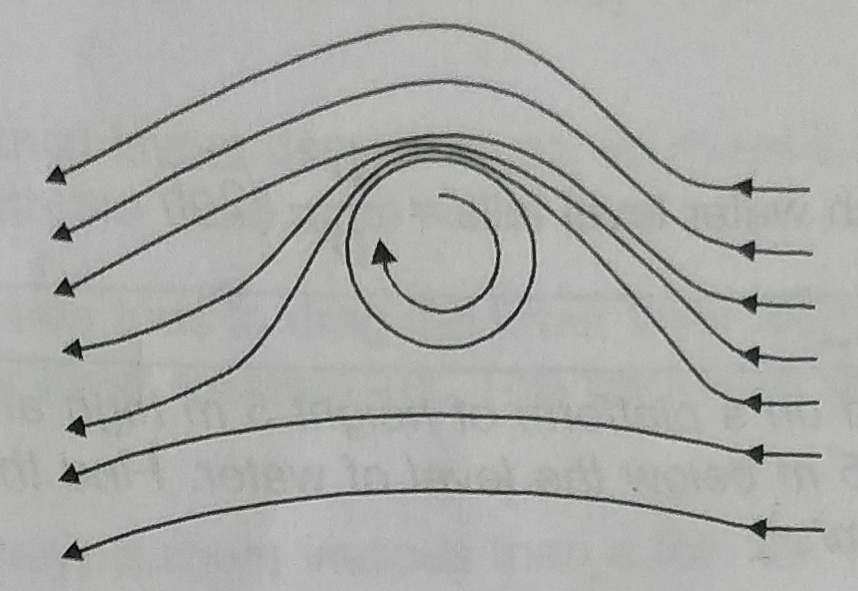
But when a ball spins as it moves through air , it drags along a layer of air with itself. When the ball moves forward , the air ahead of the ball rushes backward to fill the space left vacant by the ball. Thus the streamlines of air around this ball is shown in the fig. given below.
The velocity of air above the ball opposite to the direction of spin and it is in the direction below the ball. Thus the relative velocity of air with respect to the ball is larger at the upper part than that is in the region below the ball . The streamline thus gets crowded above and rarified below .This cause the pressure above the to be smaller and that below it to be greater . This pressure difference causes an upward force on the ball. Hence the ball experiences a dynamic lift and is deviated from its path . This effect arising due to spinning of the ball is called ‘Magnus effect’.
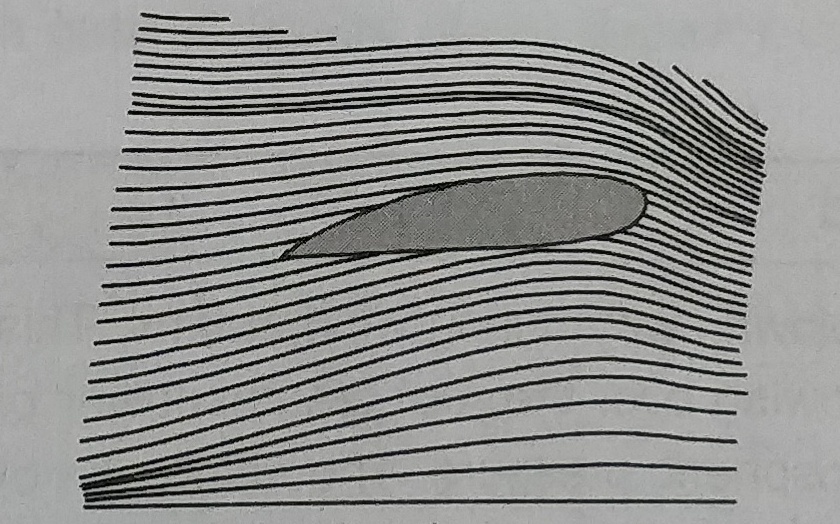
Airfoil and lift on aircraft wing:- An airfoil is streamlined shaped , Solid body that is capable of generating a dynamic lift as it moves through a fluid . streamline shape is special shape given to bodies moving in fluids, So as to produce minimum drag .
The cross-section of air wings is also shaped like that .Its upper portion is more curved then the lower surface .Its front edge is broader and the rear edge is narrow . When the airfoil moves through air , streamlines of air moves backward . The air above the foil has to travel a longer distance then that below in the same time . Thus the flow speed on top becomes greater then that below it . The higher speed on reduces air pressure there. This pressure difference causes to lift the foil. Such dynamic lift also acts on the wings of an air craft and balances the weight of the plane.
This assignment contains Important numericals of surface tension which is solved . solution is given just below the questions.
1.The surface tension of the soap solution is 30 x 10-3N/m .How much work is done to increase the radius of the soap bubble from 1.5 cm to 3 cm . Ans- 5.091 x 10⁻⁴ j.
solution-
2. A square glass plate of length 10cm and thickness 0.4cm, weighs 40 g in air . It is held vertically such that its lower edge rests on water surface. What is the apparent weight of glass plate now? (S.T. of water is 0.073 N/m). Ans-0.407N.
3. The radii of two air bubbles are in the ratio 4:5 .Find the ratio of excess pressure inside them . Also compare the works done in Blowing these bubbles. Ans-5/4 ; 16/25 .
.
4. A circular plate of radius 4cm and weight W is made to rest on the surface of water if a minimum pull of W+F is required to clear the plate off the water surface then find F , given surface tension of water is 0.072N/M. Ans-0.018N .
5. Water rises up in a glass capillary upto a height of 10cm , while mercury falls down by 3.5 cm in the same tube. If the angle of contact for water – glass and mercury-glass are is taken as 00 and 1350 respectively . compare the surface tension of water and mercury. [ density of water and mercury are 103 and 13.6×10³kg/m3.].
6. A canister has a small hole at its bottom .What penetrates into the canister when its base is at a depth of 40cm from the surface of water. If surface tension of water is 73.5 dyne/cm, find the radius of the hole . Ans- 0.0375mm.
To get the Important objective questions based on this topic click here–
This assignment contains some important questions based on the surface tension, in which there are some objective and some numericals based questions.
these questions are for the practice of the topic surface tension and surface energy, excess pressure inside the liquid drop, soap bubble , ascent formula etc.
Multiple choice questions. (Only one option is correct)
1. The angle of contact doesn’t depend upon, (a) Temperature (b)Surface impurity (c) Cohesive force (d) The inclination of surface in contact. Ans -d
2. When a capillary tube is immersed in a liquid , then the liquid of mass m rises in the capillary tube .If capillary tube of double radius is taken then the mass f same liquid rising in the tube is , , (a) M/2 (b) 2M (c) M/4 (d) 4M . Ans- b
3. What will be the work done to increasing the radius of the soap bubble from r/2 to 2r . If surface tension of soap solution is T ? , (a) 3πr2T (b) 30πr2T (c) 9πr2T (d) 12πr2T . Ans-b
4. pressure inside soap bubble are 1.02 atm and 1.05 atm respectively . then the ratio of their surface area is (a) 125/8 (b) 25/4 (c)5/2 (d)2/5. Ans-b
Dou you want to know the harmful effect of Online classes click here–
5.The property utilized in the manufacture of lead shots is (a)specific gravity of lead (b)specific weight of the liquid lead (c) compressibility of the liquid lead (d) surface tension of the liquid lead. Ans-d
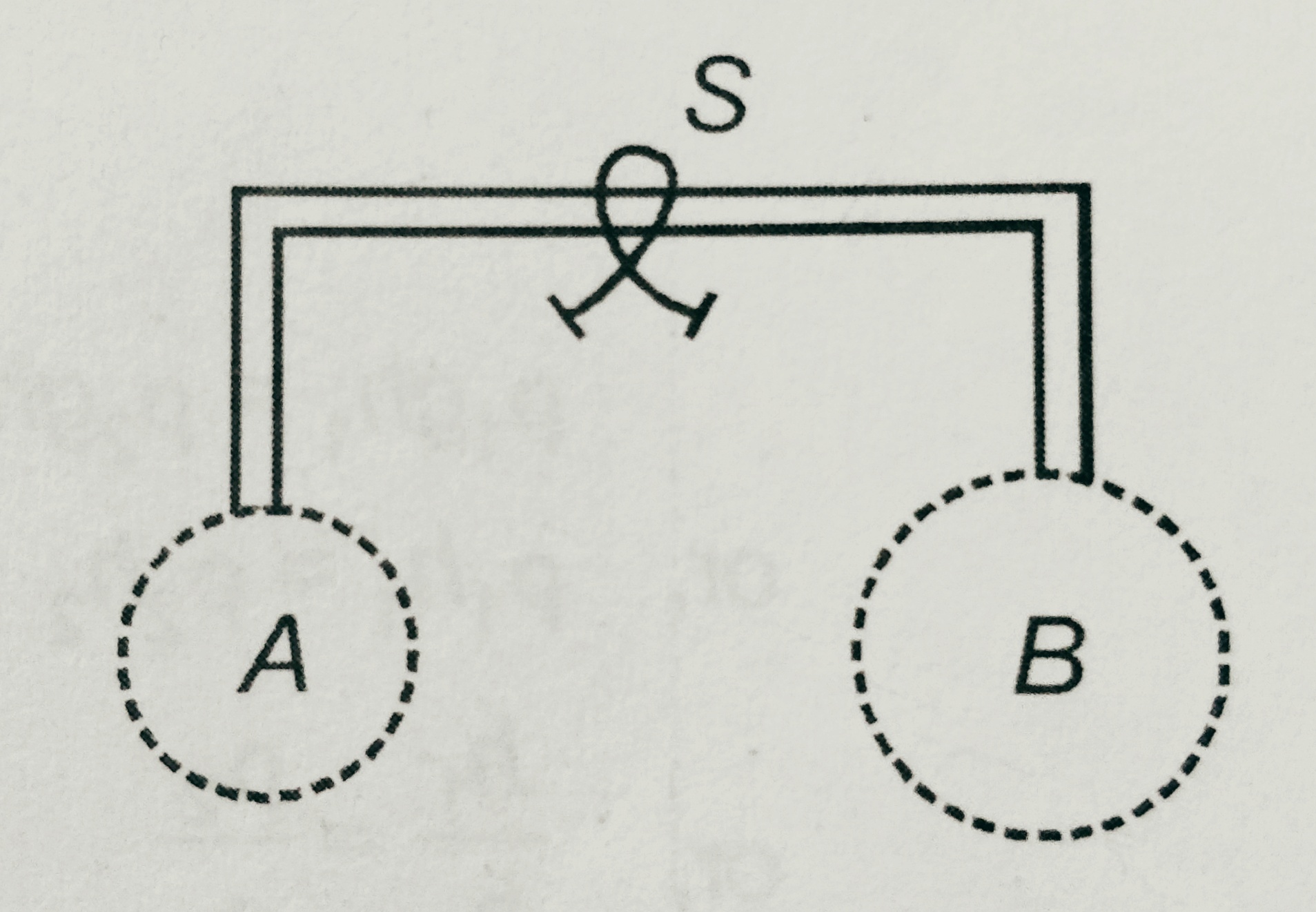
6. Two soap bubbles are connected by a tube as shown in figure , what happens when stopper s is removed ?
(a)size of A increase (b) size of B is decreased (c) both takes the same size (d) size of bubble A decreases and size of bubble B increases. Ans-d
7. Two soap bubble of radii 2cm and 4 cm are join to form a double bubble in air , then the radius of curvature of the interface is , (a)2√5 cm (b)2cm (c)4 cm (d) 2√3cm . Ans-c
8. A square wire frame of side l is floating on the surface of the liquid of surface tension T . The force required to pull out the frame from the liquid is (a) Tl (b) 2Tl (c) 4Tl (d) 8Tl . Ans-d
9. Two drops of liquid coalesce to form a single drop . In this process energy is (a) Absorbed (b) Evolved (c) Either absorbed or evolved (d) Neither absorbed nor evolved. Ans-b
10. Surface tension of a liquid , at critical temperature is (a)Maximum (b)Unchanged (c) Zero (d) none of these. Ans-c
Important numericals based on this topic –
TO WATCH THE VERY IMPORTANT TOPIC OF SURFACE TENSION WHICH IS EXCESS PRESUURE INSIDE THE SOAP BUBBLE AND LIQUD DROP CLICK ON THE VIDEO LINK GIVEN BELOW-
1.The surface tension of the soap solution is 30 x 10-3N/m .How much work is done to increase the radius of the soap bubble from 1.5 cm to 3 cm . Ans- 5.091 x 10⁻⁴ j.
2. A square glass plate of length 10cm and thickness 0.4cm, weighs 40 g in air . It is held vertically such that its lower edge rests on water surface. What is the apparent weight of glass plate now? (S.T. of water is 0.073 N/m). Ans-0.407N.
3. The radii of two air bubbles are in the ratio 4:5 .Find the ratio of excess pressure inside them . Also compare the works done in Blowing these bubbles. Ans-5/4 ; 16/25 . .
4. A circular plate of radius 4cm and weight W is made to rest on the surface of water if a minimum pull of W+F is required to clear the plate off the water surface then find F , given surface tension of water is 0.072N/M. Ans-0.018N .
5. Water rises up in a glass capillary upto a height of 10cm , while mercury falls down by 3.5 cm in the same tube. If the angle of contact for water – glass and mercury-glass are is taken as 00 and 1350 respectively . compare the surface tension of water and mercury. [ density of water and mercury are 103 and 13.6×10³kg/m3.].
6. A canister has a small hole at its bottom .What penetrates into the canister when its base is at a depth of 40cm from the surface of water. If surface tension of water is 73.5 dyne/cm, find the radius of the hole . Ans- 0.0375mm.
To get the solution of all numerical questions given above click here–
Are you looking to prepare JEE/NEET and looking for the best coaching center , then you must watch this video how to select coaching centre for JEE/NEET.
Before to learn or to know surface energy students must know surface tension. To know about the surface tension click here-
Surface energy-
It is given as the work done to increase the unit area of a liquid .Or, It is the energy required to remove a molecule completely from a liquid.Or, The molecules at the surface have extra energy as compared to the molecule in the interior we call this energy as surface energy.
Mathematically it is equal to the surface tension(T) of the liquid.
surface energy
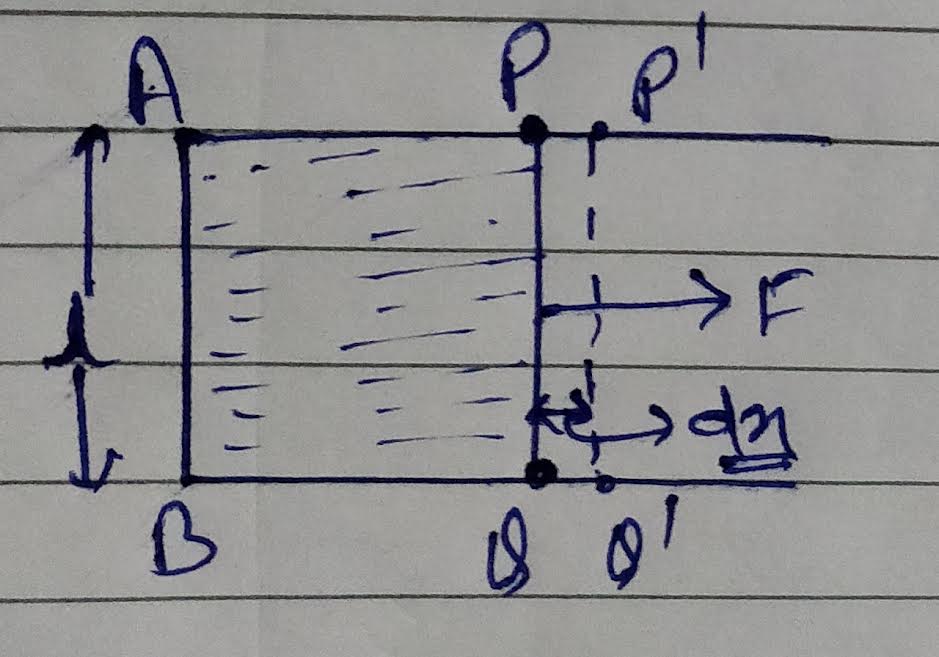
Let we have a liquid surface (film) ABPQ , is of surface tension T .
A force F is applied to the surface so that PQ moves to P’Q’ , by dx
Then work done is given as W= F.dx
As we know Force F= T/2l ( where T is the surface tension ).
Then work done, W= F.dx = (T/2l).dx
As we have defined above surface energy is the work done per unit area ,
So surface energy E = Work done/ change in area = (T/2l).dx/( change in area )
Here change in area = 2l.dx ;
So surface energy E= [(T/2l).dx]/[2l dx] = T ……..eq.
So we can say surface energy of a liquid is equivalent to the surface tension.
( Here questions may be asked as show that surface energy is equivalent to the surface tension.)
[ Note – when a bigger spherical drop of a liquid is broken to form small spherical droplets, the total surface area of the liquid increases . Due to this the surface enegy of the system increases this increase in energy is taken from the system and hence temperature of the system will fall. We can also think it inversely.]
Surface tension– It is the property of a free surface of liquid to get minimum surface area .
The property of a liquid at rest by virtue of which its free surface behaves like a stretched elastic membrane and tries to occupy as small an area as possible called surface tension.
As we know in a liquid , the molecules are not as close to each other as they are in solid . The result in a liquid not having a strong enough cohesive force to have a rigid structure as a solid . But these intermolecular forces are strong enough to give the liquid a definite shape. These molecular force is effective upto certain distance called molecular range . The uppermost layer of the liquid which thickness is equal to the molecular range is called surface film.
To watch the most important derivation of surface tension click on the video link given below-
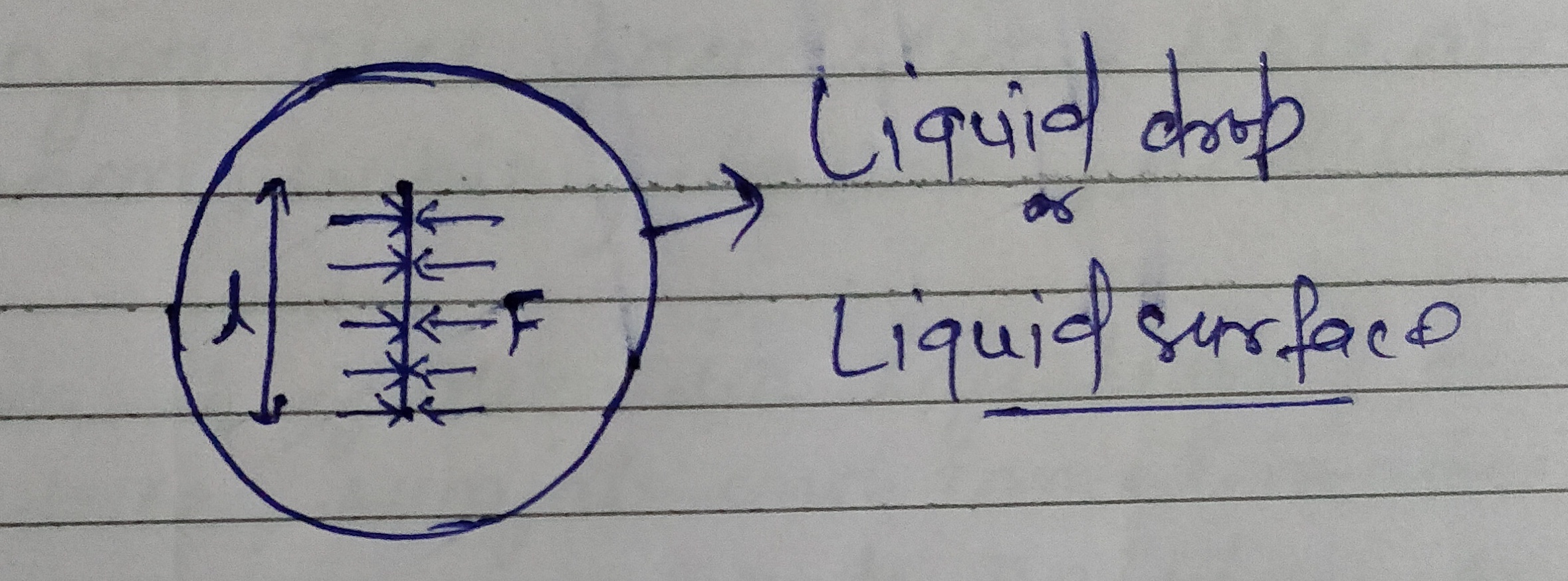
We can define the surface tension in another way mathematically the surface tension of a liquid is the force of tension acting across a unit length of an imaginary line drawn on the free surface of a liquid at rest . The direction of this force is perpendicular to the line and tangential to the surface.
Surface tension on liquid surface
If F is the force and l is the length of an imaginary line on the surface of liquid then surface tension T is given as
T = F/ l .
But, for a surface film it is given as the
Surface tension ; T = F/2l ;
Unit of surface tension is , Newton/meter or , kgs-2
Dimension of surface tension is ; [ MT-2] or [M L0 T-2]
Note- 1. Temperature of the liquid increases surface tension decreases .
2. The surface tension arises due to the intermolecular cohesive forces .
3. The surface tension doesn’t depend on the area of the surface.
4. Soap or hot water helps in better cleaning of cloths because it reduces the surface tension of water.
After completing the surface tension students must know surface energy.
This assignment contains Important objective questions of mechanical properties of fluid , based on pressure atmospheric pressure , Pascal’s law , buoyancy etc.
It will be beneficial for the students preparing for 11th , NEET / JEE and other examination.
Mechanical properties of fluids
Questions based on fluid pressure , atmospheric pressure, Pascal’s law
1 . Dimension formula of pressure head is – (a) [M0 L0 T0 ] (b) [M L-1 T-2 ] (c) [M0 L1 T-2 ] (d) [M0 L1 T0 ].
Ans-d
2.The two thigh bones each of cross-sectional area 10cm2 supports the upper part of the person of a mass 50 kg . The average pressure sustained by the bones is , (a) 2.5 x 10⁵ N/m2 (b) 4 x 10⁵ N/m2 (c) 5 x 10⁵N/m2 (d) 106 N/m2 .
Ans-a
3.What is the pressure on the swimmer 20m below the surface of water? (a)1atm (b) 2atm (c) 3 atm (d) 4 atm .
Ans-c
4. Water is filled to a height H behind the dame of width w . The resultant force on the dame is ( if d is the density of water), (a) dgwH2 (b) 1/2 dgwH2 (c)2 dgwH2 (d)4 dgwH2.
Ans-b
5. A tank is filled by density d of liquid upto height H . The average pressure on the wall of the container is (a) dgH (b) ½ dgH (c) ¼ dgH (d) 1/8 dgH .
Ans-b
6. Increase in pressure at one point of the enclosed liquid in equilibrium of rest is transmitted equally to all other point of the liquid . This is as per (a) Buoyancy (b) Pascals law (c) conservation of momentum (d) Impulse .
Ans-b
7. By sucking through a straw , a boy can reduce the pressure in his lungs to 750mm of Hg ( density of Hg is 13.6 g/cm3). Using a straw he can drink water from a maximum depth of (a) 13.6 cm (b) 1.36 cm (d) 0.136 cm (d) 10 cm .
Ans-a
8. An open U-tube contains mercury , when 13.6 cm of water is poured into one of the arms of the tube , then the mercury rise in the other arm from its initial level is (a) 1cm (b) 0.5 cm (c) 10cm (d) 5 cm .
Ans-2
9. A cylinder of radius R full of liquid of density d Is rotated about its axis at w rad/sec. The increase in pressure at the centre of the cylinder will be (a) d w2 R2 /2 (b) d w2 R /2 (c) d2 w R /2 (d) d2 w2 R2 /2 .
Ans-a
10. A barometer kept in an elevator reads 76 cm when the accelerator is accelerating upward . The most likely pressure inside the elevator is ( in cm of Hg ) (a) 74 (b) 75 (c) 76 (d) 77 . Ans-d
Questions based on Archimedes principle , Buoyancy (up-thrust )
11. A body floating in water has 1/5th of its volume immersed in water . What fraction of its volume will be immersed , if it floats in liquid of specific gravity 1.2 ? ans- 1/6
12. A cylinder of height 30 cm and radius 7cm is immersed completely in a fluid of density 1.3 x 10³ kg/m3 . What is the buoyant force acting on it? G =10m/s2 . ans-60N.
13. A metallic spheres weighs 35g in air and 28.5 g in water. Find its relative density and also find its weight in a liquid of relative density 0.9 . ans- r.d – 5.4 and app-wt-29.15g .
14. A piece of gold weighs 50 g in air and 45g in water. If there is cavity inside the piece of gold , then find its volume ( density of gold is – 19.3 gm/cc) Ans-2.4
15.An alloy of Zn and Cu weighs 16.8 g in air and 14.7 g in water. If relative density of Cu and Zn are 8.9 and 7.1 respectively then determine the amount of Zn and Cu in alloy. Ans- Cu-9.34 Zn-7.45g.
16.An object of mass m is floating in a liquid of density x . if the object is made up of density y , then the apparent weight of the object in the liquid is (a) mg (b) mg(1-x/y) (c) mg (1-y/x) (d) zero. Ans-d
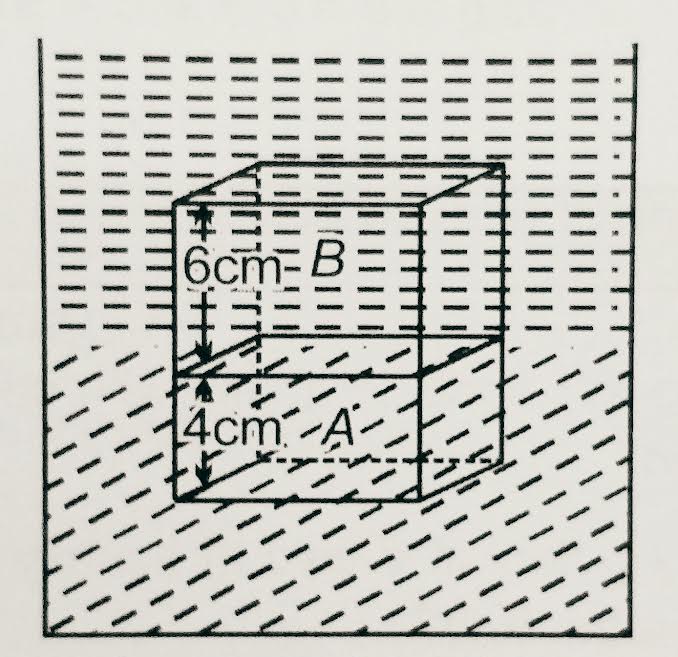
17. A cube of edge length 10 cm is just balanced at the interface of two liquids A and B as shown in fig. if A and B has specific gravity of 0.6 and 0.4 respectively then the mass of the cube is .
(a) 240g (b) 360g (c) 480g (d) 540g . ans-c
18.A boat having some iron pieces is floating in the pond , if iron pieces are thrown in the pond then level of the liquid (a) increases (b) Decreases (c) may increase or decrease (d) remain the same. Ans-b
19.When two liquid of same mass and different densities d1 and d2 mixed together, then the density of the mixture is (a) d1 +d2 (b) d1 +d2 /2 (c) 2d1 d2 / d1 +d2 (d) 2d1 +2d2 . Ans-c
20. When two liquid of same volume and different densities d1 and d2 mixed together, then the density of the mixture is (a) d1 +d2 (b) d1 +d2 /2 (c) 2 d1 d2 / d1 +d2 (d) 2d1 +2d2 . Ans-a
21. if there were no gravity, then which of the following will not be there for the fluid ? (a) viscosity (b)surface tension (c) pressure (d) upward thrust . ans-d
22. An ice cube contains a large air bubble . The cube is floating on the horizontal surface of water contained in a trough. What will happen to the water level when the cube is melts? (a) remain unchanged (b) it will fall (c) it will rise ( d) first it will fall and then rise . ans-a
23. The density of ice is 0.9gm/cm3.What percentage by volume by volume of the block of ice will float outside the water. (a) 10% (b)45% (c)75% (d)90% . ans-a
24. The reading of a spring balance when it is suspended in the air is 6oN . This reading is changed to 40N when it is submersed in water. The specific gravity of the block must be (a) 3 (b) 2 (c) 6 (d)1.5. ans-a
25. The weight of a body in water is one third of its weight in air. The density of the body in gm/cm3 is (a) 0.5 (b) 1.5 (c) 2.5 (d) 3.5 . ans-b