Interference of light-
Definition: The phenomenon of redistribution of light energy due to the superposition of two coherent light waves of the same frequency (or wavelength), producing alternate bright and dark fringes, is called interference of light.
Explanation
When two coherent light waves travelling through the same medium superimpose on each other, the resultant intensity at different points changes due to constructive and destructive interference.
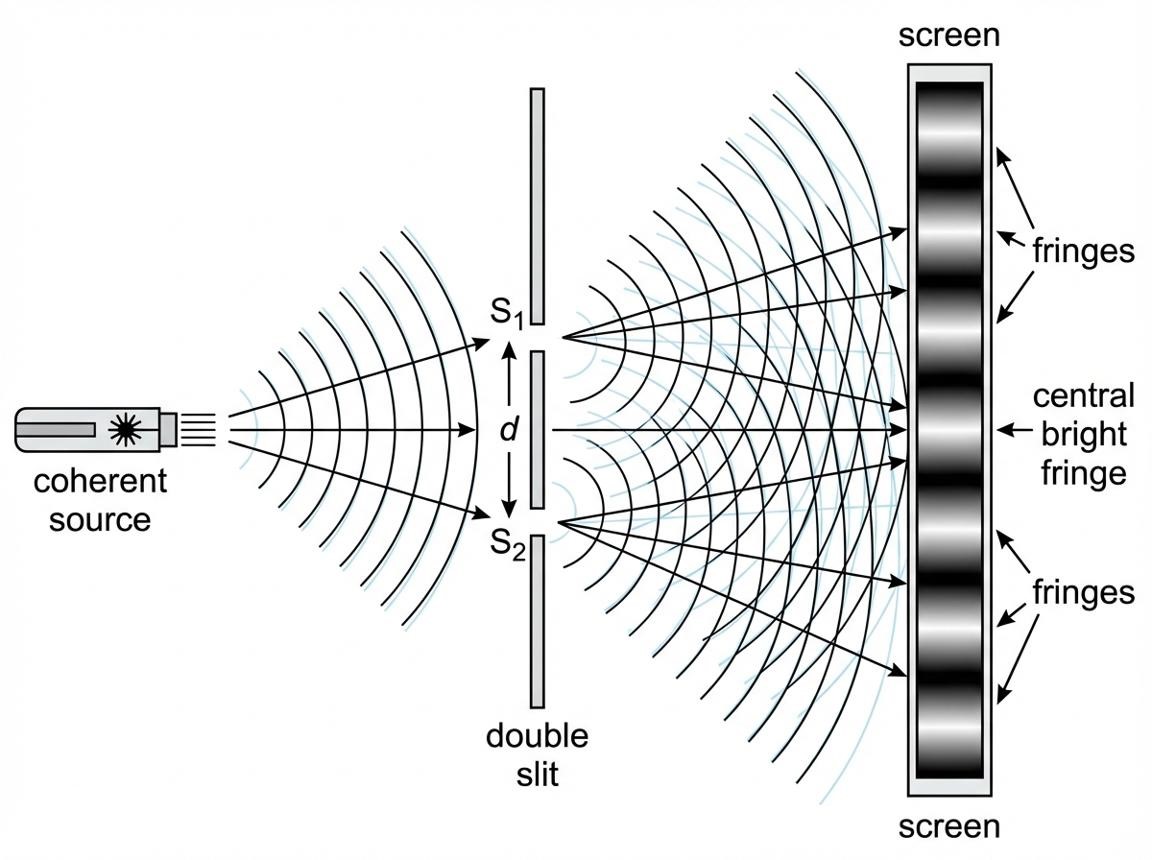
Expression for the Conditions of Constructive and Destructive Interference
When two coherent light waves superimpose, the resultant intensity depends on the path difference or phase difference between them.
Let the two wave
Y1=A1 sin (ωt )
Y2=A2 sin (ωt +Φ)
After superimposition
Y = Y1 + Y2
Y = A1 sin (ωt )+ A2 sin (ωt +Φ)
After solving it we get ,
Y = R A2 sin (ωt +θ)
Where R is the resultant amplitude of the resulting wave
R2 = A1 2 + A22 +2 A1A2 cos (ωt )
But Intensity of light, I α (amplitude )2
So we can write ,
I = I1 + I2 +2√I1I2 cos ωt ,
1. Constructive Interference (Bright Fringe)
When two waves meet in the same phase, their amplitudes add up and maximum intensity is obtained.
For Maximum intensity cos Φ = +1
cos Φ = 2nπ
Therefore path difference p = nʎ [ whwre n= 0,1,2,3…],
For maximum intensity Imax = I1 + I2 +2√I1I2.
Or, Imax = A12+ A2 2 + 2A1 A2 = (A1 +A2)2
2. Destructive Interference (Dark Fringe)
When two waves meet in opposite phases, their amplitudes cancel each other and minimum intensity is obtained.
Condition: intensity should be minimum i.e. cos Φ = -1
Phase difference , Φ = (2n-1)π
Path difference p = (2n-1 )ʎ/2
For minimum intensity Imin = I1 + I2 – 2√I1I2,
OR, Im = A12+ A2 2 – 2A1 A2 = (A1 -A2)2
For the practice of objective questions of wave optics click on the link given below