Category: 11th Notes

  • KINETIC THEORY OF GASES – COMPLETE NOTES

    KINETIC THEORY OF GASES – COMPLETE NOTES

    complete notes of kinetic theory of gases for class 11th

    These notes  provided by physics classes by nayan jha. whichcover the complete chapter Kinetic Theory of Gases,  according to the Class 11 CBSE syllabus, including definitions, assumptions,  important derivations, formulas, diagrams and important examination questions.

    After completing your notes , to get the important questions based on this topic click here-


    INTRODUCTION TO KINETIC THEORY OF GASES

    The kinetic theory of gases explains the macroscopic  properties of gases, such as pressure, temperature and volume,  on the basis of the microscopic motion of gas molecules.

    Important characteristics of gases

    1. Gases have no fixed shape or volume.
    2. Gases occupy the entire volume of the container.
    3. Gases are highly compressible.
    4. Gases exert pressure on the walls of the container.
    5. Gas molecules are in continuous random motion.

    MOLECULAR NATURE OF  MATTER

    According to the molecular theory of matter:

    1. All substances are made up of tiny particles called molecules.
    2. Molecules are separated by intermolecular spaces.
    3. Molecules attract each other through intermolecular forces.
    4. Molecules are in continuous motion.
    5. The average kinetic energy of molecules depends on the absolute temperature.

     IDEAL GAS

    An ideal gas is a hypothetical gas that obeys all gas laws at all temperatures and pressures.

    Characteristics of an ideal gas

    1. The molecules are treated as point masses.
    2. The volume of molecules is negligible compared to the volume of the container.
    3. There are no intermolecular forces between molecules except during collisions.
    4. Collisions between molecules and with the walls are perfectly elastic.
    5. Molecules move randomly in all directions.

    Note: No real gas is perfectly ideal, but many gases behave approximately as ideal gases at low pressure and high temperature.


    ASSUMPTIONS OF KINETIC THEORY OF GASES

    The important assumptions are:

    1. A gas consists of a very large number of identical molecules.
    2. The size of each molecule is very small compared to the distance between molecules.
    3. Molecules are in continuous random motion.
    4. Molecules move in straight lines between successive collisions.
    5. Collisions between molecules and container walls are perfectly elastic.
    6. The time spent during a collision is negligible compared to the time between two successive collisions.
    7. There is no intermolecular force except during collisions.
    8. The molecules obey Newton’s laws of motion.

     PRESSURE EXERTED BY AN  IDEAL GAS
    Pressure is defined as the force exerted per unit area.P=FAP=AF​

    Where:

    • P = Pressure
    • F = Force
    • A = Area

    Derivation of pressure exerted by an ideal gas

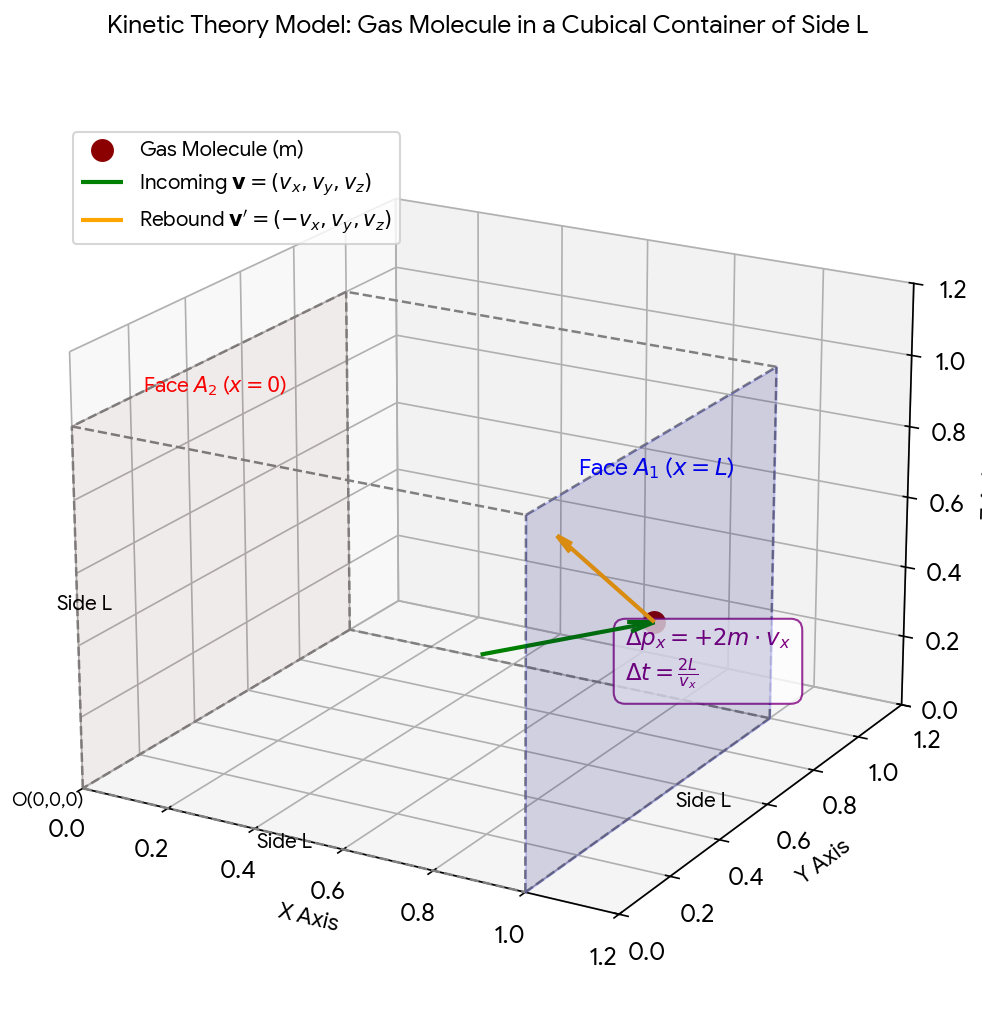
    Consider a cubical container of side length LL, containing gas molecules moving randomly.

    Let:

    • m = Mass of each molecule
    • N= Total number of molecules
    • vx= Velocity component along the x-direction
    • L= Length of the container

    Step 1: Change in momentum

    When a molecule collides elastically with the wall:

    Initial momentum:pi=mvx​

    Final momentum:pf=−mvx​

    Change in momentum:Δp=pf−pi​

    Magnitude of change in momentum:Δp=2mvx​​

     Time between two successive collisions

    Distance travelled between two successive collisions with the same wall:d=2L

    Time taken:Δt=2Lvx​

     Force exerted by one molecule

    According to Newton’s second law:F=Change in momentumTimeF=2mvx2L/vx​​F=mvx2L

     Total force exerted by N moleculesF=mL∑i=1Nvxi2

    Pressure

    P=FAP=NmVvx2‾

    For random motion of molecules:vx2‾=vy2‾=vz2‾

    Also,v2‾=vx2‾+vy2‾+vz2‾​​

    Therefore,vx2‾=13v2‾

    Putting this value:P=Nm3Vv2‾

    Hence,P=13NmVvrms2

    Since density,ρ=NmV​

    We get:P=13ρvrms2

    This is the fundamental equation of kinetic theory of gases.


     ROOT MEAN SQUARE (RMS) SPEED

    The root mean square speed is defined as the  square root of the mean of the squares of the  speeds of all gas molecules.

    Mathematically,vrms=v12+v22+⋯+vN2N

    Relation between pressure and RMS speed

    From kinetic theory:P=13ρvrms2

    Therefore,vrms=3Pρ​​​

    Important: RMS speed is always greater than or equal to the average speed of the molecules.


     KINETIC INTERPRETATION OF TEMPERATURE

    According to kinetic theory, the absolute temperature  of a gas is directly proportional to the average  translational kinetic energy of its molecules.

    From the ideal gas equation:PV=NkBT

    Where:

    • kB = Boltzmann constant
    • T = Absolute temperature
    • N = Number of molecules

    From the fundamental equation:PV=13Nmvrms2​

    Equating both equations:NkBT=13Nmvrms2kBT=13mvrms2

    Multiplying by 3/2:12mvrms2=32kBT​

    Therefore,Average translational KE per molecule=32kBT​

    This is an important result of kinetic theory.

    Important conclusions

    1. The average kinetic energy depends only on absolute temperature.
    2. At the same temperature, all ideal gases have the same average translational kinetic energy.
    3. If temperature increases, average kinetic energy increases.
    4. At absolute zero, the classical model predicts zero translational kinetic energy.

    DIFFERENT TYPES OF MOLECULAR SPEEDS

    There are three important types of molecular speeds.

    (A) Most Probable Speed

    It is the speed possessed by the maximum number of molecules.vmp=2RTM​​​

    (B) Average Speed

    It is the arithmetic mean of the speeds of all gas molecules.vavg=8RTπM​​​

    (C) RMS Speed

    It is the square root of the mean of the squares of the speeds of all molecules.vrms=3RTM​​​

    Where:

    • R = Universal gas constant
    • T = Absolute temperature
    • M = Molar mass in kg/mol

    Relationship between three speeds

    vmp:vavg:vrms=2:8π:3

    Therefore,vmp<vavg<vrms​​


     IDEAL GAS EQUATION

    The ideal gas equation combines Boyle’s law, Charles’ law and Avogadro’s law.PV=nRT​

    Where:

    • P = Pressure
    • V = Volume
    • n = Number of moles
    • R = Universal gas constant
    • T = Absolute temperature

    The value of universal gas constant is:R=8.314 J mol−1K−1

    Another form of ideal gas equation:PV=NkBT​

    Where,kB=RNA​

    Boltzmann constant:kB=1.38×10⁻²³ J/K​

    Avogadro number:NA=6.022×10²³ mol−1


    LAW OF EQUIPARTITION OF ENERGY

    According to the law of equipartition of energy:

    For a system in thermal equilibrium, energy is equally  distributed among all independent quadratic degrees  of freedom, with each degree of freedom  contributing an average energy of 12kBT21​kB​T per molecule.

    Mathematically,E=12kBT​

    per degree of freedom per molecule.

    What is Degree of Freedom?

    The number of independent coordinates required to specify the position and configuration of a molecule is called its degree of freedom.

    It is generally represented by f.

    Types of degrees of freedom

    1. Translational degrees of freedom

    A molecule can move along three mutually perpendicular directions:

    • X-axis
    • Y-axis
    • Z-axis

    Therefore,f=3

    Average translational energy:E=32kBT

    2. Rotational degrees of freedom

    A molecule can rotate about different axes.

    For a diatomic molecule at ordinary temperatures, there are generally two active rotational degrees of freedom.Erotational=2×12kBTErotational=kBT​

    3. Vibrational degrees of freedom

    Molecules can vibrate about their equilibrium positions.

    Each active vibrational mode contributes:kBT

    because it has two quadratic energy terms: kinetic and potential.


     SPECIFIC HEAT CAPACITY OF GASES

    The amount of heat required to raise the temperature of unit mass of a substance by 1 K is called specific heat capacity.

    For gases, specific heat capacities are generally studied under two conditions.

    (A) Specific heat at constant volume (Cv)

    It is the amount of heat required to raise the temperature of one mole of gas by 1 K at constant volume.CV=(dQdT)V​​

    (B) Specific heat at constant pressure (Cp)

    It is the amount of heat required to raise the temperature of one mole of gas by 1 K at constant pressure.CP=(dQdT)P​​

    Mayer’s relation

    For one mole of an ideal gas:CP−CV=R​

    This is known as Mayer’s relation.

    Ratio of specific heats

    The ratio of specific heat at constant pressure to specific heat at constant volume is called the adiabatic index.γ=CPCV​​​


     SPECIFIC HEAT CAPACITY AND DEGREES OF FREEDOM

    According to the law of equipartition of energy, if a molecule has f active degrees of freedom:

    Average energy per molecule:E=f2kBT

    For one mole:U=f2RT

    At constant volume:CV=dUdT​

    Therefore,CV=f2R​

    Using Mayer’s relation:CP=CV+RCP=f2R+RCP=f+22R​

    Hence,γ=CPCV​​γ=f+2f

    Important table for examination

    Type of gasDegrees of freedom (f)CvCpγ
    Monoatomic33R/25R/25/3
    Diatomic55R/27R/27/5
    Non-linear polyatomic (classical model)63R4R4/3

    Note: These values assume the listed degrees of freedom are active. Vibrational modes become important at higher temperatures.


     MEAN FREE PATH

    The average distance travelled by a gas molecule between two successive collisions is called mean free path.

    It is represented by:λ​

    Expression for mean free path

    λ=12πd2n

    Where:

    • d = Diameter of a molecule
    • n = Number of molecules per unit volume

    Since,n=PkBT​

    Therefore,λ=kBT2πd2P​​

    Factors affecting mean free path

    1. Mean free path increases with temperature at constant pressure.
    2. Mean free path decreases with increase in pressure at constant temperature.
    3. Mean free path decreases with increase in molecular diameter.

     AVOGADRO’S LAW

    According to Avogadro’s law:

    Equal volumes of all gases at the same temperature and pressure contain equal numbers of molecules.

    Mathematically,V∝n​

    At constant temperature and pressure.


    BOYLE’S LAW

    At constant temperature, the pressure of a fixed mass of gas is inversely proportional to its volume.P∝1VPV=Constant​

    Graph

    • P versus V: Rectangular hyperbola.
    • P versus 1/V: Straight line through the origin.

     CHARLES’ LAW

    At constant pressure, the volume of a fixed mass of gas is directly proportional to its absolute temperature.V∝TVT=Constant

    Graph

    V versus T (in Kelvin) is a straight line passing through the origin.


    PRESSURE LAW (GAY-LUSSAC’S LAW)

    At constant volume, the pressure of a fixed mass of gas is directly proportional to its absolute temperature.P∝TPT=Constant


    IMPORTANT FORMULA  SHEET

    Physical quantityFormula
    Ideal gas equationPV=nRTPV=nRT
    Molecular gas equationPV=NkBTPV=NkB​T
    Fundamental equationP=13ρvrms2P=31​ρvrms2​
    RMS speedvrms=3RTMvrms​=M3RT​​
    Average speedvavg=8RTπMvavg​=πM8RT​​
    Most probable speedvmp=2RTMvmp​=M2RT​​
    Average KE per molecule32kBT23​kB​T
    Total translational KE32NkBT23​NkB​T
    Mean free pathλ=12πd2nλ=2​πd2n1​
    Boltzmann constant1.38×10−23 J/K1.38×10−23 J/K
    Universal gas constant8.314 J/mol K8.314 J/molK
    Mayer’s relationCP−CV=RCP​−CV​=R
    Adiabatic indexγ=CP/CVγ=CP​/CV​
    CvCV=f2RCV​=2f​R
    CpCP=f+22RCP​=2f+2​R
    Adiabatic index in terms of fγ=1+2fγ=1+f2​

     IMPORTANT CBSE BOARD  EXAMINATION QUESTIONS

    To get the another important questions of this chapter click here

    A. Very Short Answer Questions (1 Mark)

    1. What is an ideal gas?
    2. Define RMS speed.
    3. What is the SI unit of Boltzmann constant?
    4. What is the average translational kinetic energy of a gas molecule?
    5. What is the value of degrees of freedom for a monoatomic gas?
    6. Define mean free path.
    7. What is the relation between Cp and Cv?
    8. Why does the pressure of a gas increase when its temperature increases at constant volume?
    9. What is the value of the universal gas constant?
    10. What is the value of the ratio Cp/Cv for a monoatomic ideal gas?

    B. Short Answer Questions (2–3 Marks)

    1. State the assumptions of the kinetic theory of gases.
    2. Explain the kinetic interpretation of temperature.
    3. Differentiate between average speed and RMS speed.
    4. State and explain the law of equipartition of energy.
    5. Explain why the pressure of a gas is caused by molecular collisions.
    6. Why is the average kinetic energy of all ideal gases equal at the same temperature?
    7. Explain the physical significance of mean free path.
    8. Derive the relation between RMS speed and pressure.
    9. State Mayer’s relation and explain its significance.
    10. Explain why Cp is greater than Cv.

    C. Long Answer Questions (3–5 Marks)

    1. Derive the fundamental equation of kinetic theory of gases:

    P=13ρvrms2

    1. Derive the expression for RMS speed of gas molecules.
    2. Explain the law of equipartition of energy and derive the expressions for Cp and Cv.
    3. Derive the relationship between the average kinetic energy of gas molecules and absolute temperature.
    4. Explain the concept of mean free path and derive its expression.
    5. Derive the relation:

    γ=f+2f


     IMPORTANT NUMERICAL 

    Numerical 1: RMS Speed

    Solution:

    Formula:vrms=3RTM​​

    Numerical 2: Average Kinetic Energy

    Calculate the average translational kinetic energy of a gas molecule at 300 K.

    Given:kB=1.38×10⁻²³J/K

    Solution:E=32kBTNumerical 3: Pressure of Gas

    A gas has a density of 1.2 kg/m31.2kg/m3 and RMS speed of 500 m/s500m/s. Calculate its pressure.

    Numerical 4: Specific Heat Ratio

    Calculate the ratio of specific heats for a diatomic gas having five degrees of freedom.

    To get the questions of kinetic theory of gases click here-

  • What is  Black Body?

    What is Black Body?

    What is black body ? and some important questions based on this topic which are important for class 11th examination provided in this blog –

    To download the complete notes and questions based on this topic click on the link given here-

    http://physicsclasses.online/wp-content/uploads/2026/11/Black-Body.pdf

    Black Body – Class 11 Physics (CBSE)

    1. What is a Black Body?

    A black body is an ideal body that absorbs all the radiations incident on its surface, irrespective of their wavelength, frequency and direction.

    It neither reflects nor transmits any radiation falling on it.

    A black body is also called a perfect absorber of radiation.

    Definition for CBSE examination:

    A black body is an ideal body that absorbs completely all the radiations incident upon it, without reflecting or transmitting any part of them.

    2. Important Characteristics of a Black Body

    1. It absorbs 100% of the radiation falling on it.
    2. It is a perfect absorber and a perfect emitter of radiation.
    3. It does not reflect or transmit any incident radiation.
    4. The radiation emitted by a black body depends only on its temperature.
    5. At a given temperature, it emits the maximum possible thermal radiation.

    3. Practical Example of a Black Body

    A hollow enclosure with a small hole is considered a good practical approximation of a black body.

    Working:

    • When radiation enters through the small hole, it undergoes multiple reflections inside the cavity.
    • At each reflection, some energy is absorbed by the inner walls.
    • After several reflections, almost all the radiation gets absorbed.
    • Therefore, the small hole behaves approximately like a perfect black body.

    Important: A small hole in a hollow cavity is considered a practical example of a black body.

    4. Black Body Radiation

    The radiation emitted by a black body due to its temperature is called black body radiation.

    When a black body is heated, it emits electromagnetic radiation.

    For example:

    • At a lower temperature, it emits mainly infrared radiation.
    • At a higher temperature, it may appear red.
    • At a still higher temperature, it may appear yellow or white.

    Thus, the colour and intensity of radiation emitted by a black body depend upon its temperature.

    5. Important Laws Related to Black Body Radiation

    These laws are useful for understanding thermal radiation and are important for higher-level study.

    (a) Stefan-Boltzmann Law

    The total energy radiated per unit area per second by a black body is directly proportional to the fourth power of its absolute temperature.

    E=σT4

    Where:

    • E = Energy radiated per unit area per second.
    • σ = Stefan’s constant.
    • T = Absolute temperature in Kelvin.

    (b) Wien’s Displacement Law

    The wavelength corresponding to maximum intensity of radiation is inversely proportional to the absolute temperature.

    λm​T=b

    Where:

    λm​ = Wavelength of maximum intensity.

    • T = Absolute temperature.
    • b = Wien’s displacement constant.

    Important CBSE-Based Questions on Black Body

    The following questions are useful for Class 11 Physics revision and conceptual understanding.

    A. Very Short Answer Questions (1 Mark)

    1. What is a black body?
    2. Why is a black body called a perfect absorber?
    3. Does a black body reflect any incident radiation?
    4. What is black body radiation?
    5. Give one practical example of a black body.
    6. What is the nature of radiation emitted by a black body?
    7. Does the radiation emitted by a black body depend on its material or temperature?

    B. Short Answer Questions (2 Marks)

    1. Define a black body. Write any two characteristics of a black body.
    2. Why is a small hole in a hollow cavity considered a good approximation of a black body?
    3. What happens to the radiation emitted by a black body when its temperature increases?
    4. Why is a black body considered both a perfect absorber and a perfect emitter?
    5. Differentiate between a perfect reflector and a perfect absorber.

    C. Long Answer Questions (3–5 Marks)

    1. Explain the concept of a black body with the help of a suitable diagram.
    2. Explain the construction and working of a cavity radiator as a practical approximation of a black body.
    3. What is black body radiation? Explain how the nature of emitted radiation changes with temperature.
    4. State and explain Stefan-Boltzmann law.
    5. State Wien’s displacement law and explain the relationship between temperature and wavelength of maximum intensity.

    D. Important Numerical Questions

    Q1. The temperature of a black body is doubled. How many times will its energy radiated per unit area per second increase?

    Solution:

    According to Stefan-Boltzmann law,

    E= σT 4

    If temperature becomes 2T,

    E= σ(2T) 4

    E= 16σT 4

    E′=16E​

    Answer: The energy radiated increases 16 times.

    Q2. The wavelength of maximum intensity of a black body is 500 nm500nm. Calculate its temperature using Wien’s displacement law.

    Given:

    λm​=500×10-9 m

    b=2.898×10⁻³mK

    Using,

    λm​T=b

    T=2.898×10−3500×10−9T=500×10-9  2.898×10⁻³ ​

    T=5796K​

    E. Important MCQs (CBSE Pattern)

    Test your understanding

    5 MCQs

    Q1. A black body is a body which:

    A. Reflects all radiation

    B. Absorbs all incident radiation

    C. Transmits all radiation

    D. Emits no radiation

    Q2. A small hole in a hollow cavity behaves approximately as:

    A. Perfect reflector

    B. Perfect absorber

    C. Perfect transmitter

    D. Perfect insulator

    Q3. The energy radiated per unit area per second by a black body is proportional to:

    A. T

    B. T²

    C. T³

    D. T⁴

    Q4. Wien’s displacement law is:

    A. λm/T = constant

    B. λmT = constant

    C. λmT² = constant

    D. λm = constant

    Q5. The colour of radiation emitted by a heated body changes with:

    A. Its shape only

    B. Its temperature

    C. Its volume only

    D. Its mass only

    Top of Form

    Bottom of Form

    To download the complete notes in PDF form click here-

  • Pascal’s law || class-11th||physics || Fluid mechanics .

    Statement of Pascal’s Law

    Pascal’s Law states that any pressure applied to a confined, incompressible fluid is transmitted undiminished throughout the fluid in all directions and acts with equal force on equal areas.

    Alternatively, in the absence of gravity, the pressure at any point in a fluid at rest is the same in all directions.


    Mathematical Proof of Pascal’s law

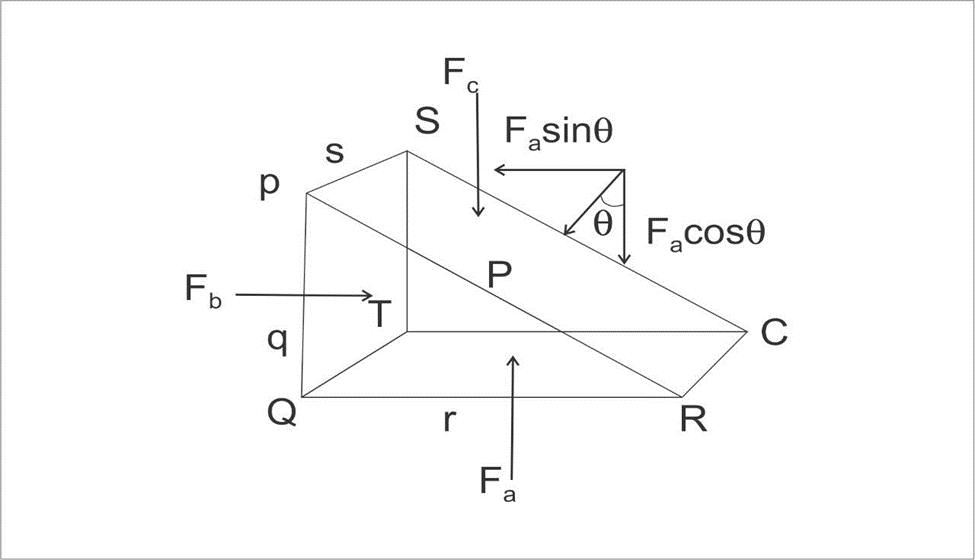
    To prove that pressure is isotropic (equal in all directions) inside a stationary fluid, let us isolate a microscopic, right-angled prismatic fluid element inside a larger mass of fluid.

    Because the element is extremely small, the effect of gravity on it is negligible.

    Expand image

    The diagram below maps out the dimensions, normal pressures, and vector components required to resolve the forces acting along the \x and y axes.

    Let the areas of the faces are

    Ar(PRCS) = p

    Ar(PQTS) = q = psinθ

    Ar(QRCT) = r = pcos θ

    There respective forces are Fa, Fb and Fc are the forces as shown in the diagram.

    Fb= Fa cosθ

    Fc=Fa sinθ

    Pressure at surface p Pa= Fa/p

    Pressure at surface q Pb= Fb/r = Fa cosθ/pcos θ = Fa/p

    Pressure at surface r Pc= Fc/q = Fa sinθ/ psinθ= Fa/p

    Pa=Pb = Pc  Hence proved Pascal’s law.


    Practical Applications of Pascal’s law

    Pascal’s law forms the foundation of hydraulic machinery, which serves as a powerful “force multiplier”.

    ApplicationWorking Principle
    Hydraulic LiftA small force applied to a smaller piston creates a massive upward force on a larger piston, easily lifting vehicles.
    Hydraulic BrakesWhen a driver steps on the brake pedal, the pressure is transmitted through the brake fluid to all wheels simultaneously, squeezing the brake pads against the discs.
    Hydraulic PressUsed in manufacturing to crush items or mold heavy sheets of metal by driving a large piston down with massive multiplied force.
  • A liquid at rest exerts force perpendicular to the surface of the container at every point.

    A liquid at rest exerts force perpendicular to the surface of the container at every point.

    Show that a liquid at rest exerts force perpendicular to the surface of the container at every point.

    Proof:

    Suppose the force exerted by the liquid on the container’s surface acts at an angle to the perpendicular (normal) to the surface.

    We can resolve this force into two components:

    1. Normal component: Acts perpendicular to the surface.
    2. Tangential component: Acts parallel to the surface.

    The tangential component would cause the liquid layers near the surface to move, which contradicts the condition that the liquid is at rest.

    Therefore, the tangential component must be zero, and the force acts only perpendicular to the surface.

    Hence, a liquid at rest exerts force perpendicular to the surface of the container at every point.


  • streamline, turbulent and laminar flow.

    streamline, turbulent and laminar flow.

    What is streamline flow ?

    Streamline flow—

    When liquid flows such that each particle of the liquid passing a given point moves along the such path and has the same velocity as its predecessor, the flow is called streamline flow or steady flow.

    1. What is Streamline Flow?

    Streamline flow, also called laminar flow, is a type of fluid flow in which fluid particles move along smooth, fixed paths called streamlines without mixing irregularly with one another.

    Example: The slow flow of water through a narrow pipe.

    Properties of Streamline Flow

    1. Smooth motion: Fluid particles move smoothly along definite paths.
    2. No crossing of streamlines: Two streamlines can never intersect each other.
    3. No irregular mixing: Fluid layers move smoothly without significant mixing between them.
    4. Constant velocity at a point: In steady streamline flow, the velocity of the fluid at any fixed point remains constant with time.
    5. Low velocity: It generally occurs when the fluid velocity is low.
    6. Viscosity: The viscosity of the fluid helps maintain smooth flow.

    Q.-Why two streamlines cannot cross each other?

    Ans- Two streamlines can’t cross each other , If they will do so , then the fluit particle at the point of intersection will have two different directions of motion. i.e. it cam go one way or the other destroying the steady nature of the liquid flow.   

    2. What is Turbulent Flow?

    Turbulent flow is a type of fluid flow in which fluid particles move irregularly, forming eddies and causing mixing between different layers of the fluid.

    Example: Water flowing rapidly in a river or a stream.

    Properties of Turbulent Flow

    1. Irregular motion: Fluid particles move in random and unpredictable directions.
    2. Mixing of layers: Different layers of the fluid mix with one another.
    3. Formation of eddies: Small swirling regions called eddies are formed.
    4. Fluctuating velocity: The velocity at a fixed point changes irregularly with time.
    5. High velocity: It generally occurs when the fluid velocity is high.
    6. Greater energy loss: Turbulent flow usually produces greater frictional energy losses than laminar flow.

    3. Difference Between Streamline Flow and Turbulent Flow

    Streamline FlowTurbulent Flow
    Fluid particles move smoothly along definite paths.Fluid particles move irregularly.
    There is little mixing between fluid layers.There is considerable mixing between fluid layers.
    Eddies are generally absent.Eddies are present.
    Velocity at a fixed point remains constant in steady flow.Velocity at a fixed point fluctuates with time.
    Usually occurs at low flow velocities.Usually occurs at high flow velocities.
    Energy loss is generally lower.Energy loss is generally higher.
    Example: Slow water flow through a narrow pipe.Example: Rapid water flow in a river.

    Important Note: Reynolds Number

    The type of flow in a pipe can be predicted using the Reynolds number (Re):

    Re=ρvD/η

    Where:

    • ρ = Density of the fluid
    • v= Average velocity of the fluid
    • D = Diameter of the pipe
    • η = Dynamic viscosity of the fluid

    For flow in a circular pipe:

    • Re < 2000: Generally laminar flow.
    • Re = 2000–4000: Transition region.
    • Re > 4000: Generally turbulent flow.

    In short: Streamline flow is smooth and orderly, whereas turbulent flow is irregular and involves mixing and eddies.

    Laminar flow-

    What is Laminar Flow?

    Laminar flow is a type of fluid flow in which fluid particles move smoothly in parallel layers without mixing irregularly with one another.

    Properties of Laminar Flow

    1. Fluid particles move in smooth and regular paths.
    2. Different layers of fluid slide over one another.
    3. There is no significant mixing between the layers.
    4. The velocity at any fixed point remains constant with time in steady laminar flow.
    5. It generally occurs at low fluid velocities.
    6. It usually occurs when the Reynolds number is less than 2000 in a circular pipe.

    Example: Water flowing slowly through a narrow pipe.

    Remember: Laminar flow is also known as streamline flow when the flow is smooth and orderly.

    To read another important notes of class 11th click here-

  • Beats

    BEATS
    If two tuning fork whose frequency is slightly different are sounded together , the sound we hear periodically fluctuates in intensity , i.e intensity increases and decreases suddenly . This periodic variations in intensity of sound are called beats.

    So we can define “ Beats are periodic vibration in the intensity of sound when two sound wave of nearly same frequency travel in the same direction. One loud sound followed by a faint sound from one beat and the number of beats formed per second is called beat frequency”.

    Graphical method for the formation of beats-

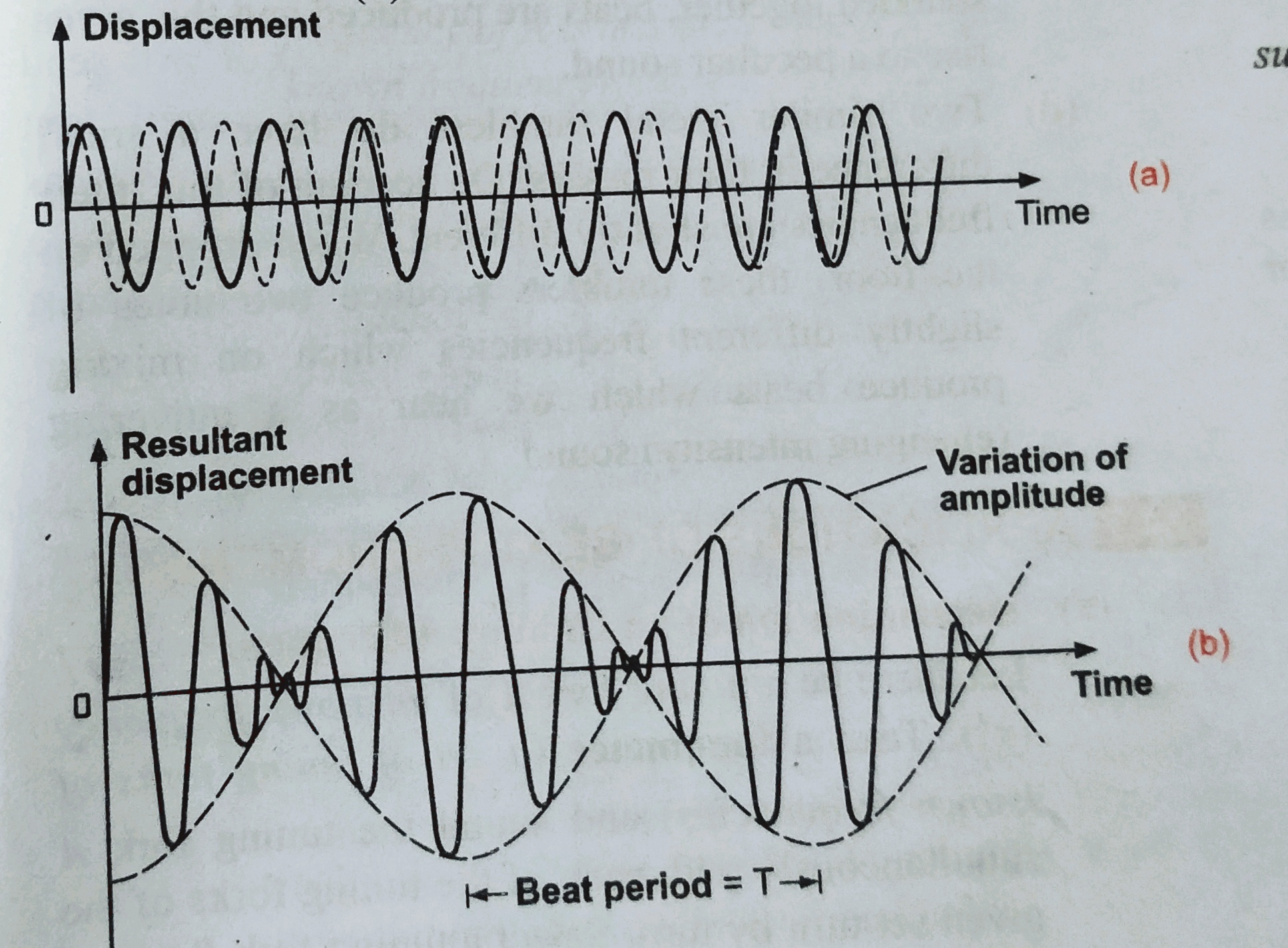
    As shown in fig (a) Two waves ( One in dotted and other in dark line). When they superimpose then due to the superposition principle , at T=0 the intensity becomes max and at T= T/2 Intensity becomes minimum which is ‘0’ . This process happening again and again.

    And number of beats per second or beats frequency is equal to difference in frequency between these two waves.

    Suppose the beat period is T and that during this time one wave of frequency n1 , makes one cycle more than the other wave of frequency n2 . The number of cycle of frequency n1 in time T = n1T. And number of cycle of frequency n2 in time T = n2T.

    According to the given condition, n1T-n2T = 1

    Or   

    n1-n2 = 1/T = n0 (resultant frequency).

    Analysis of graph shown in figure-

    (1)The resultant wave oscillates with the average of the frequencies of the individual waves .

    (2) The resultant amplitude oscillates with a beat frequency that is equal to the difference between the two frequencies.

    Application of beat phenomenon

    (i) Determination of unknown frequency

    (ii) By loading tuning fork with wax.

    (iii) By loading the tuning fork

    (iv) Tuning musical instrument

    (v) In electronics.

  • Thermal stress

    Thermal stress-

    If we clamp the ends of a rod rigidly to prevent its expansion or contraction and then change the temperature, tensile or compressive stress developed is called thermal stress. The rod like to expand or contract but clamps won’t allow it. As shown in fig.

    To calculate the thermal stress in a clamped rod , we have to find how much the rod would expand if not held rigidly and then find the stress needed to compress it back to its original length. Suppose that the rod with length L0 and cross-sectional area A is held at constant length while the temperature is reduced  causing tensile stress. The fractional change in length if the rod were free to contract would be

     (ΔL/L0 )thermal= αΔT………….(i)

    Both ΔL and ΔT are negative . the tension must increase by an amount F that is just enough to produce an equal and opposite fractional change in length (ΔL/L0 )thermal from the definition of Young’s modulus (Y),

    Therefore Y =( F/A)/(ΔL/L);

    So  (ΔL/L0 )thermal= F/AY …………(II)

    If the length is to be constant , the total fractional change in length must be zero. This means that

    (ΔL/L0 )thermal +  (ΔL/L0 )thermal = 0

    αΔT + F/AY = 0

    F/A = – YαΔT…………………….(III)

    For a decrease in temperature , ΔT is negative , so F and F/A are positive . This means that a tensile force and stress are needed to maintain the length. If ΔT is positive , F and F/A is negative , and the required stress and force are compressive.

    If there are temperature difference within a body , non uniform expansion or contraction will result and thermal stress can be induced .

    You can break a glass bowl by pouring hot water into it . The thermal stress between the hot and cold parts of the bowl exceeds the breaking stress of the glass, causing cracks . The same phenomenon make ice cube crack when dropped into warm water.

  • Change of density with temperature

    Before to go with tis topic students must know the topic thermal expansion of matter, which is one of the most important topic for thermal properties of matter. To learn the topic Thermal expansion of matter CLICK HERE-

    After Completing the topic thermal expansion   students must solve some important questions of thermal expansion of matter, To get (solve)the question  based on this topic CLICK HERE-      

        Change of density with temperature

    The density of a substance is defined as its mass per unit volume of a given mass of a substance changes with temperature while its mass remain the same , the density undergoes a change with the temperature .

    Consider a body of mass m . Let v1 and ƍ1 be its volume and density respectively at temperature t1 and v1and ƍ2 the corresponding values at t2.

    Clearly , mass m= v2ƍ2=v1(1+ƳΔT)ƍ2, where ΔT=t2-t1 ,

    Thus ƍ2 = ƍ1/(1+ƳΔT) = ƍ1(1+ƳΔT)-1. = ƍ1(1-ƳΔT)[ Using Binomial theorem]

    i.e.  ƍ2= ƍ1(1-ƳΔT) [so we can say the density of the material decreases with the rise in temperature].

    Some numericals  for practice based on change of density with temperature are given below .

    1. Coefficient of volume expansion of mercury is 0.18 x 10⁻³/0C . If the density of mercury at 00C is 13.6g/cc, then its density at 2000C is (a) 13.11g/cc (b)52.11g/cc (c)16.11g/cc (d) 26.11g/cc.

    2. The coefficient of volume expansion of glycerin is 49×10-5/K. The fractional change in density on a 300C rise in temperature is (a)1.47 x 10⁻² (b) 1.47 x 10⁻³ (c) 1.47 x 10⁻¹ (d) 1.47 x 10⁻⁴.

  • Thermal expansion

    Thermal expansion

    Most of the material expand when their temperature increases. Then the phenomenon of expansion of material when it is heated is known as thermal expansion.

    1. Linear expansion– When a rod heated then the temperature of the body increases due to which length of the rod increases , this phenomenon is known as the linear expansion .

    Suppose a rod is of length l0 at the initial temperature T0, when its temperature is rises by temperatureT , then the length changes by l. Then the change in length is proportional to original length and rise in temperature,

    i.e.   l α T……………(i)

    And l α l0 ……………..(ii)

    From eq. (i) and (ii)

    l α l0T,

    Or, l = α l0T , where α is the coefficient of linear expansion its unit is K-1 or  ( C0)-1.

    Then the final length l = l0+ l  

    Or, l = l0 + α l0T

    L = l0 ( 1+ α T)………….(iii)

    Area expansion or superficial expansion – When a surface heated then the temperature of the body increases due to which area of the rod increases , this phenomenon is known as the Area expansion .

    Suppose a rod is of length A0 at the initial temperature T0, when its temperature is rises by temperatureT , then the length changes by A. Then the change in area is proportional to original area and rise in temperature,

    i.e.   A α T……………(i)

    And A α l0 ……………..(ii)

    From eq. (i) and (ii)

    A α A0T,

    Or, A = β A0T , where β is the coefficient of Superficial expansion its unit is K-1 or  ( C0)-1.

    Then the final area A = A0+ A  

    Or, A = A0 + β A0T

    A = A0 ( 1+ β T)………….(iii)

    Volume expansion-  When a rod heated then the temperature of the body increases due to which volume of the rod increases , this phenomenon is known as the volume expansion .

    Suppose a rod is of length V0 at the initial temperature T0, when its temperature is rises by temperatureT , then the length changes by V. Then the change in length is proportional to original length and rise in temperature,

    i.e.   V α T……………(i)

    And V α V0 ……………..(ii)

    From eq. (i) and (ii)

    V α V0T,

    Or, V = Ÿ V0T , where Ÿ is the coefficient of linear expansion its unit is K-1 or  ( C0)-1.

    Then the final length V = V0+ V  

    Or, V = V0 + Ÿ V0T

    V = V0 ( 1+ Ÿ T)………….(iii)

    Relation between linear, area and volume expansion (α,β and Ÿ )

    2α=β; and 3α=Ÿ

    Or , α = β/2=Ÿ/3 .

    To solve the important questions based on this topic CLICK HERE-

    To solve the important questions based on the topic Temperature and thermometers CLICK HERE-

  • Magnus effect and dynamic lift

    Magnus effect and dynamic lift-

    The upward force experience by a body when it moves through a fluid is called dynamic lift . Such a lift is felt by airfoil , aircraft win etc. Couse behind it can be explained by Bernoulli’s theorem . It also explain why a spinning ball is deviated from its parabolic path .This deviation is usually observed in many games like cricket, football golf, tennis etc.

    As a ball moves through air without spinning , it divides the streamline  above and below it symmetrically . Thus there is no pressure difference on the two sides of the ball.

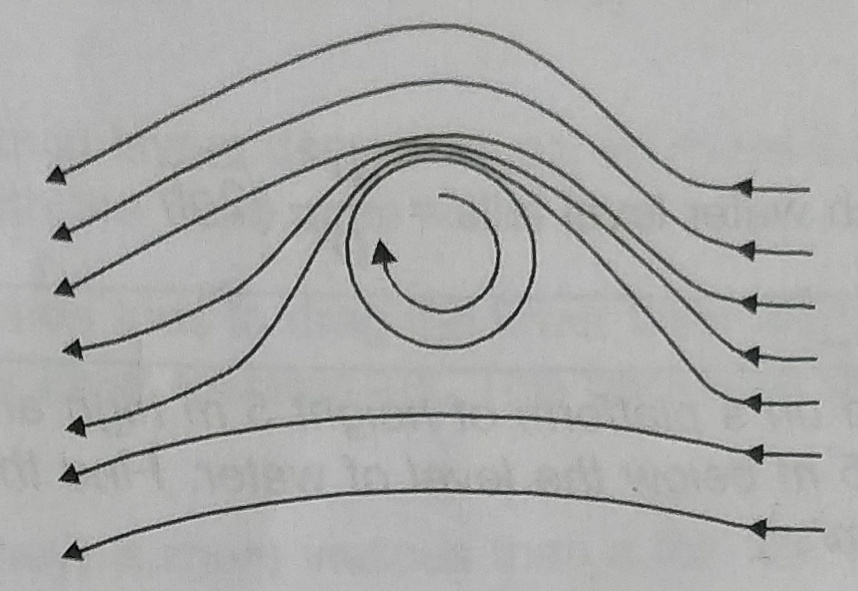
    But when a ball spins as it moves through air , it drags along a layer of air with itself. When the ball moves forward , the air ahead of the ball rushes backward to fill the space left vacant by the ball. Thus the streamlines of air around this ball is shown in the fig. given below.

    The velocity of air above the ball opposite to the direction of spin and it is in the direction below the ball. Thus the relative velocity of air  with respect to the ball is larger at the upper part than that is in the region below  the ball . The streamline thus gets crowded above and rarified below .This cause the pressure above the to be smaller and that below it to be greater . This pressure difference causes an upward force on the ball. Hence the ball experiences a dynamic lift and is deviated from its path . This effect arising due to spinning of the ball is called ‘Magnus effect’.

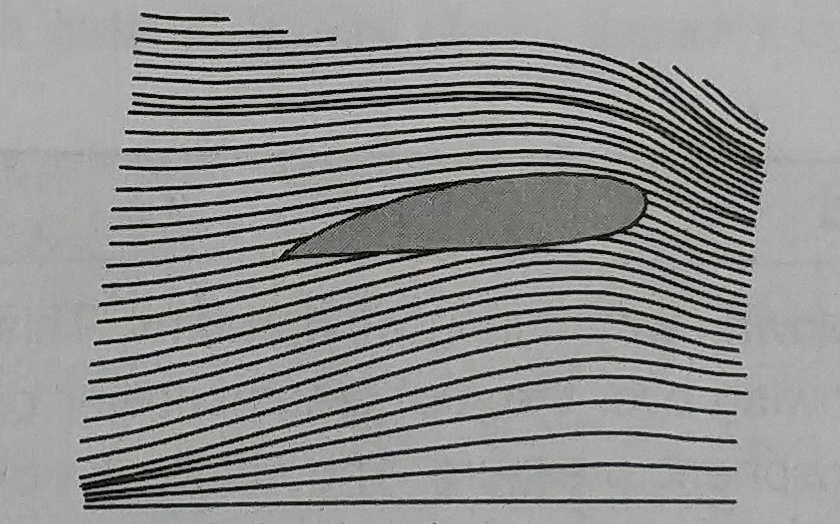
    Airfoil and lift on aircraft wing:-  An airfoil is streamlined shaped , Solid body that is capable of generating a dynamic lift as it moves through a fluid .  streamline shape is special shape given to bodies moving in fluids, So as to produce minimum drag .

    The cross-section of air wings is also shaped like that  .Its upper portion is more curved then the lower surface .Its front edge is broader and the rear edge is narrow . When the airfoil moves through air , streamlines of air moves backward . The air above the foil has to travel a longer distance then that  below in the same time . Thus the flow speed on top becomes greater then that below it . The higher speed on reduces air pressure there. This pressure difference causes to lift the foil. Such dynamic lift also acts on the wings of an air craft and balances the weight of the plane.