Statement of Pascal’s Law
Pascal’s Law states that any pressure applied to a confined, incompressible fluid is transmitted undiminished throughout the fluid in all directions and acts with equal force on equal areas.
Alternatively, in the absence of gravity, the pressure at any point in a fluid at rest is the same in all directions.
Mathematical Proof of Pascal’s law
To prove that pressure is isotropic (equal in all directions) inside a stationary fluid, let us isolate a microscopic, right-angled prismatic fluid element inside a larger mass of fluid.
Because the element is extremely small, the effect of gravity on it is negligible.
Expand image
The diagram below maps out the dimensions, normal pressures, and vector components required to resolve the forces acting along the \x and y axes.
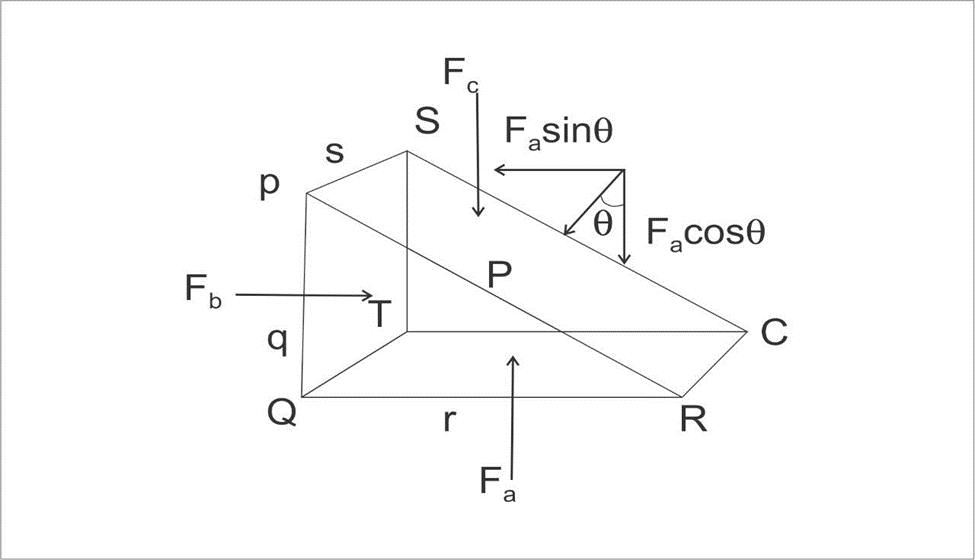
Let the areas of the faces are
Ar(PRCS) = p
Ar(PQTS) = q = psinθ
Ar(QRCT) = r = pcos θ
There respective forces are Fa, Fb and Fc are the forces as shown in the diagram.
Fb= Fa cosθ
Fc=Fa sinθ
Pressure at surface p Pa= Fa/p
Pressure at surface q Pb= Fb/r = Fa cosθ/pcos θ = Fa/p
Pressure at surface r Pc= Fc/q = Fa sinθ/ psinθ= Fa/p
Pa=Pb = Pc Hence proved Pascal’s law.
Practical Applications of Pascal’s law
Pascal’s law forms the foundation of hydraulic machinery, which serves as a powerful “force multiplier”.
| Application | Working Principle |
| Hydraulic Lift | A small force applied to a smaller piston creates a massive upward force on a larger piston, easily lifting vehicles. |
| Hydraulic Brakes | When a driver steps on the brake pedal, the pressure is transmitted through the brake fluid to all wheels simultaneously, squeezing the brake pads against the discs. |
| Hydraulic Press | Used in manufacturing to crush items or mold heavy sheets of metal by driving a large piston down with massive multiplied force. |