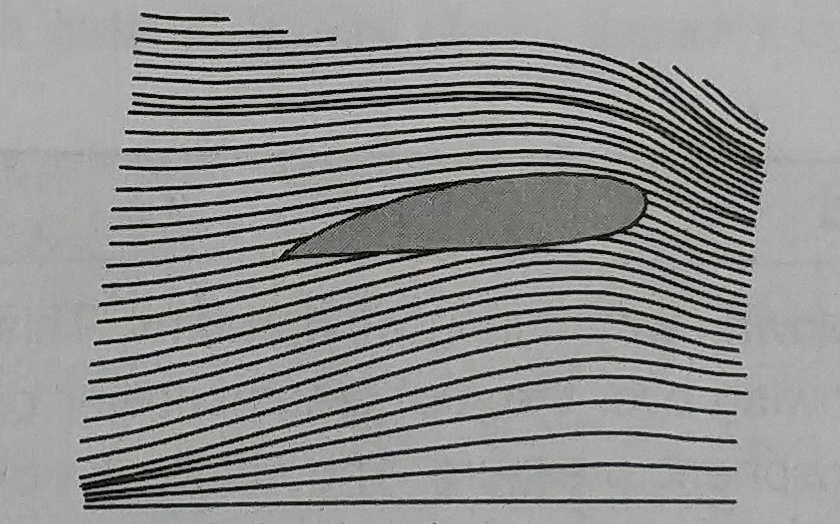
What is streamline flow ?
Streamline flow—
When liquid flows such that each particle of the liquid passing a given point moves along the such path and has the same velocity as its predecessor, the flow is called streamline flow or steady flow.
1. What is Streamline Flow?
Streamline flow, also called laminar flow, is a type of fluid flow in which fluid particles move along smooth, fixed paths called streamlines without mixing irregularly with one another.
Example: The slow flow of water through a narrow pipe.
Properties of Streamline Flow
- Smooth motion: Fluid particles move smoothly along definite paths.
- No crossing of streamlines: Two streamlines can never intersect each other.
- No irregular mixing: Fluid layers move smoothly without significant mixing between them.
- Constant velocity at a point: In steady streamline flow, the velocity of the fluid at any fixed point remains constant with time.
- Low velocity: It generally occurs when the fluid velocity is low.
- Viscosity: The viscosity of the fluid helps maintain smooth flow.
Q.-Why two streamlines cannot cross each other?
Ans- Two streamlines can’t cross each other , If they will do so , then the fluit particle at the point of intersection will have two different directions of motion. i.e. it cam go one way or the other destroying the steady nature of the liquid flow.
2. What is Turbulent Flow?
Turbulent flow is a type of fluid flow in which fluid particles move irregularly, forming eddies and causing mixing between different layers of the fluid.
Example: Water flowing rapidly in a river or a stream.
Properties of Turbulent Flow
- Irregular motion: Fluid particles move in random and unpredictable directions.
- Mixing of layers: Different layers of the fluid mix with one another.
- Formation of eddies: Small swirling regions called eddies are formed.
- Fluctuating velocity: The velocity at a fixed point changes irregularly with time.
- High velocity: It generally occurs when the fluid velocity is high.
- Greater energy loss: Turbulent flow usually produces greater frictional energy losses than laminar flow.
3. Difference Between Streamline Flow and Turbulent Flow
| Streamline Flow | Turbulent Flow |
| Fluid particles move smoothly along definite paths. | Fluid particles move irregularly. |
| There is little mixing between fluid layers. | There is considerable mixing between fluid layers. |
| Eddies are generally absent. | Eddies are present. |
| Velocity at a fixed point remains constant in steady flow. | Velocity at a fixed point fluctuates with time. |
| Usually occurs at low flow velocities. | Usually occurs at high flow velocities. |
| Energy loss is generally lower. | Energy loss is generally higher. |
| Example: Slow water flow through a narrow pipe. | Example: Rapid water flow in a river. |
Important Note: Reynolds Number
The type of flow in a pipe can be predicted using the Reynolds number (Re):
Re=ρvD/η
Where:
- ρ = Density of the fluid
- v= Average velocity of the fluid
- D = Diameter of the pipe
- η = Dynamic viscosity of the fluid
For flow in a circular pipe:
- Re < 2000: Generally laminar flow.
- Re = 2000–4000: Transition region.
- Re > 4000: Generally turbulent flow.
In short: Streamline flow is smooth and orderly, whereas turbulent flow is irregular and involves mixing and eddies.
Laminar flow-
What is Laminar Flow?
Laminar flow is a type of fluid flow in which fluid particles move smoothly in parallel layers without mixing irregularly with one another.
Properties of Laminar Flow
- Fluid particles move in smooth and regular paths.
- Different layers of fluid slide over one another.
- There is no significant mixing between the layers.
- The velocity at any fixed point remains constant with time in steady laminar flow.
- It generally occurs at low fluid velocities.
- It usually occurs when the Reynolds number is less than 2000 in a circular pipe.
Example: Water flowing slowly through a narrow pipe.
Remember: Laminar flow is also known as streamline flow when the flow is smooth and orderly.
To read another important notes of class 11th click here-