This is the assignment for the practice of objective questions of mechanical properties of solids. Students can consider it as a test paper of the chapter mechanical properties of solids.
1. Breaking stress depends on (a) length of wire (b) Area of cross-section of wire (c) both a and b (d) independent of length and area of cross-section.
2.Which of the following is perfectly plastic? (a) plasticine (b) Quartz fibre (c) steel (d) Rubber.
3. the length of an elastic string is X meter when the tension is 8N and Y m when tension is 10N , what will be the length when tension is 18N . (a) 4X-5Y (b) 5Y-4X (c) 9X-4Y (d) 4Y-9X.
4. When a load of 10kg is hung in the wire, then extension of 2m is produced. Then work done by the restoring force is (a)200J (b) 100J (c) 50J (d) 25J .
5.Substance which can be elastically stretched to large value of strain is called (a) isomers (b) isodiapheres (c) Plastomers (d) Elastomers .
6. A force F doubles the length of the wire of cross-section a . Then the Young’s modulus of the wire is (a) F/a (b) F/3a (c) F/2a (d) F/4a .
7. Breaking stress of a material is 2×10⁸ N/m2, what maximum length of the wire of this material can be taken so that the wire doesn’t break by own weight? ( density of material is 5×10³kg/m3) (a) 1km (b)2km (c) 3km (d) 4km.
8.Young modulus of elasticity for a gas is (a) 1 (b) infinity (c) zero (d) none of these .
9. If we added an impurity in the material then its elasticity (a) may change (b) never change (c) remain the same (d) change by a factor of 5 .
10. A structural steel rod has a radius r = 10mm when a force 100 kN is applied . it stretches along its length Y for steel is 2x 10¹¹ N/m2 . aswer the following questions-
(i) what is the stress produced ?
(ii)what is the elongation produced ?
(iii) what is the elastic energy density of the steel rod ?
(iv) elastic potential energy stored in the rod is what?
11.Elasticity of a rigid body is ………..
12. If Young’s modulus is three times of modulus of rigidity. Then the Poisson’s ratio is equal to …………
13. In case of bending of a beam , depression depends on the Young’s modulus Y as proportional to …….
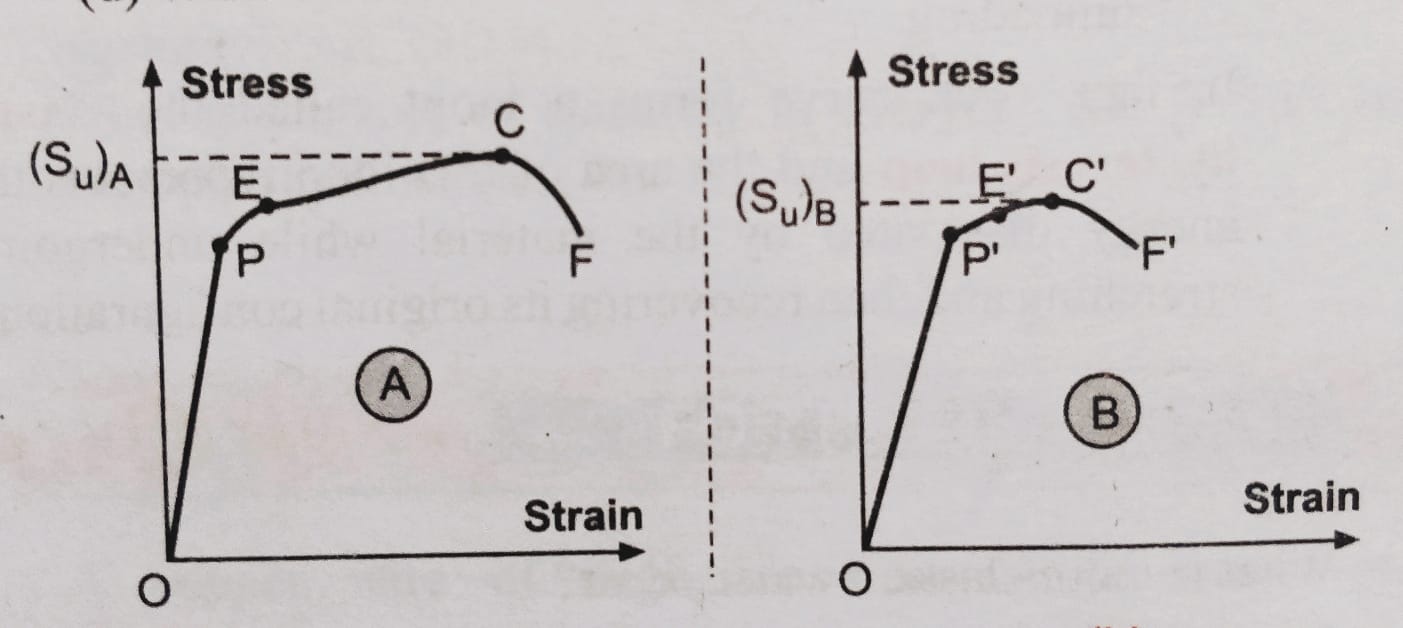
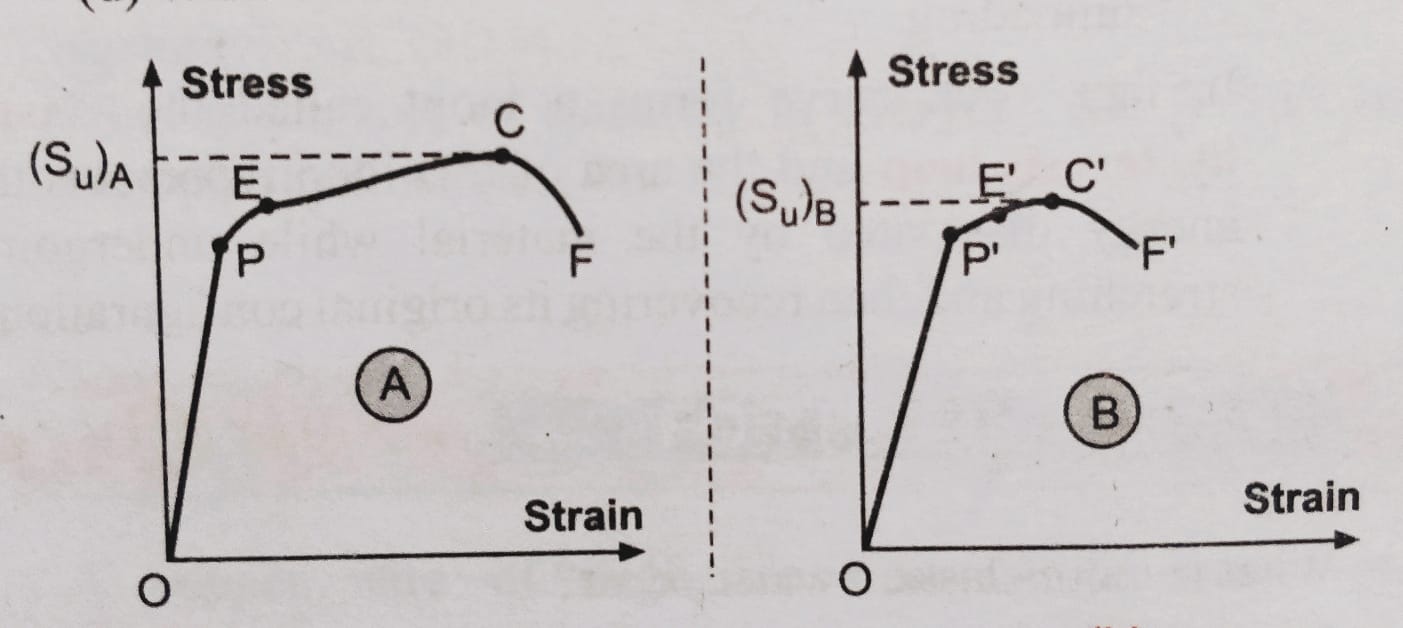
14.The stress strain graph for two materials A and B are shown in fig. (a) Which one has greater Young’s modulus ?(b) which one is strongest material?(c) which is more ductile?(d) which is more brittle?
This assignment contain Important questions of elasticity
( Mechanical properties of solids)
1. what is more elastic water or air?
2. Write copper,steel,rubber and glass in the increasing order of their elasticity.
3.How do modulus of elasticity of a material changes with temperature?
4. The breaking force for a wire is F, what will be the breaking force (i) two parallel wire of same size? (ii) for a single wire of double of thickness? Ans- 2F and 4F
5.What is the modulus of rigidity of a fluid ? Ans-0
6.Define Young’s modulus and modulus of rigidity. Give their expression and units.
7. What is the meant by elastic limit and angle of share?
8. Define Poisson’s ratio, what is its value for perfectly incompressible substance? Ans-0.5
9. Derive an expression for the elastic potential energy of a wire under stress.
10. What is the role of elasticity in everyday life? Give two example.
11. A 4m long aluminium wire whose diameter is 3 mm is used to support a mass of 50 kg. What will be the elongation of the wire? Y for aluminium is 7 x 10¹¹N/m2 ans-3.9mm
12-Calculate the percentage increase in the length of a wire of diameter 2.5mm stretched by a force of 100kg-wt Young’s modulus of the wire is 12.5 x 10¹⁰ N/m2.ans-0.16
13.Acable is replaced by anther cable of same length and material but twice the diameter (a) How will this effect the elongation under given load? (b)How does this effect the maximum load it can support without exceeding the elastic limit? Ans-1/4th and D 2 .
14. A material has poisson’s ratio 0.5. If a uniform rod of it suffers a longitudinal strain of 2 x 10⁻³ . What is the percentage increase in its volume? Ans-0%
15.Two wires of different materials are suspended from a rigid support. They have the same length and diameter carrying the same load at their free ends . (a) Will the stress and strain in each wire be the same? (b) will the extension in both wire will be same? Ans- (a) stress same strain different (b) different.
16.The stress strain graph for two materials A and B are shown in fig.
(a) Which one has greater Young’s modulus ?(b) which one is strongest material?(c) which is more ductile?(d) which is more brittle?
17. A wire stretches a certain amount under a load. If the load and diameter are both increased to three times, find the stretch cause in the wire.
Ans. [3/4l]
18.A metal bar of length L and area of the cross-section A is rigidly clamped between two walls. The young’s modulus of its material is Y and the coefficient of linear expansion is. α. The bar is heated so that its temperature is increased by C. find the force exerted at the ends of. the bar.
Ans. [YA α]
19.A metallic wire is suspended by attaching some weight to it. If is the longitudinal strain and Y is young’s modulus, find the ratio between elastic potential energy and the energy density.
Ans. [volume]
20.A spherical ball contracts in volume by 0.01 when subjected to a normal pressure of 100 atmospheres. What is the bulk modulus of its material in cgs units?
This assignment contains all important questions for class 11th physics.It will help the students to revise all questions in a short period of time .
If (p+ a/V2) (V-b)=RT where the symbols has their usual meanings, then what is the dimension of a/b .
If F= a/ b+√d , where f=force ,d= density , then find the dimension of a and b.
The factors effecting the time period (T) of the simple pendulum depends on mass , length and acceleration due to gravity . Deduce the relation for time period of the simple pendulum.
To determine acceleration due to gravity ,the time of 20 oscillations of a simple pendulum of length 100 cm was observed to be 40 s . calculate the value of ‘g’ and maximum percentage error in the measured value of ‘g’ .
If power P=a-x2/b where x represents displacement find the dimension of a and b.
A physical quantity Qis given by Q= A2.B3/2/C4D1/2 percentage error in A,B,C,D are 1%, 2%,4%,2% respectively . Find the percentage error in Q.
Write the expression for distance covered in nth second by uniformly accelerated body.
A ball is thrown vertically upwards. Draw its:
Velocity-time curve
Acceleration-time curve.
Draw velocity -time graph of uniformly accelerated motion in one dimension .From the velocity time graph of uniform Accelerated motion ,deduce the equation of motion in distance and time.
The displacement (in metre) of a particle moving along x-axis is given by
x=18 t + 5 t2.Calculate :
The instantaneous velocity at t=2s,
Average velocity between t=2s and t=3s, and
Instantaneous acceleration.
Derive an equation for the distance covered by a uniformly accelerated body in nth second of its motion. A body travels half its total path in the last second of its fall from rest . Calculate the time of its fall.
12.A body moving with a uniform acceleration describes 12 m in 3rd second of its motion and 20 m in the 5th second . find the velocity after 10 seconds.
A car travels first half of a length S with velocity u1. The second half is covered with velocities u2 and u3 for equal time intervals .Find the average velocity of the motion.
A body start from rest and accelerates uniformly .find the ratio of the displacement in, (1)one, two and three seconds, (2) first ,seconds and third second.
This assignment contains all important questions of the chapter kinetic theory of gases
KINETIC THEORY OF GASES
What are the basic assumptions of kinetic theory of gases ? on their basis, derive an expression for the pressure exerted by an ideal gas.
What is meant by degrees of freedom? State the law of equipartition of energy. Hence calculate the values of molar specific heats at constant volume and pressure for monoatomic , diatomic and triatomic gases.
Calculate the kinetic energy of one mole of argon at 127⁰ given that N =6.02×10²³ mol and k=1.381 x10⁻²³ mol-1K-1
Calculate the number of degrees of freedom for one mole of diatomic gas at N.T.P
Calculate the number of degrees of freedom of 1 cm3 of helium gas at N.T.P.
A vessel contains argon gas at 127⁰ find the average kinetic energy of argon molecule, if Boltzmann’s constant, k=1.38 x 10⁻²³ j mol -1 K-1
Calculate the total kinetic energy of 1g of helium at 27⁰C Given that R =8.31 mole -1 K-1.
At what temperature is the r.m.s velocity of a hydrogen molecule equal to that of a oxygen molecule at 47⁰C ?
Give the kinetic interpretation of temperature and define absolute temperature.
10. If three molecules have velocities 0.5,1 and 2km s-1 respectively, calculate the relation between the root mean square speed and average speed.
11. Calculate the temperature at which the r.m.s velocity of a hydrogen will be equal to 8km/hr. given that R =8.31 j mole -1.
12.Calculate the r.m.s velocity of CO2 molecules at N.T.P. given, R=8.31 j mol -1 K-1 .
13. Calculate the r.m.s velocity of hydrogen at N.T.P. given that density of the gas is 9×10⁻⁵ g cm -3.
14. Find the temperature at which the root mean square velocity of a gas is double than that its value at 0 ⁰C , pressure remaining constant.
15. The molar gas volume at S.T.P. is 22.4 litre and Avogadro number is 6.023×10²³. (a) calculate the number of gas molecules per unit volume,
16. Draw a graph to show the variation of V2rms with absolute temperature .
17. When an ideal gas undergoes an isothermal expansion, the pressure of the gas in the encloser falls. Why?
18. Two identical cylinders contains helium at 2.5 atmosphere and organ at 1 atmosphere. Find pressure if both the gases are filled in one of the cylinders?
19. The temperature of argon, kept in vessel, is raised by 1⁰C at constant volume. The total heat supplied to the gas is a combination of translational energies. Find their respective shares.
20. A gas mixture consist of 2 moles of oxygen and 4 moles of argon at temperature T. find total internal energy of the system, when vibrational modes are rejected.
This assignment contains all important questions of oscillations and waves , it will help the students preparing for the final class examination and prepare entire chapters in short time .
What do you mean by SHM ? Find expression for its displacement, velocity and acceleration , also write their phase difference .
What is meant by symmetric & Doppler effect?
How does the frequency of a tuning fork change, when the temperature is increase?
Tube a has both ends open, whole tube B has one end closed otherwise the two tubes are identical. what is the ratio of fundamental frequency of the tubes A and B?
When we start an empty bucket with water, the pitch of the sound produced foes on changing. Why?
A sine wave is travelling in a medium. What is the minimum distance between two particles always have same speed?
Two waves of the same frequency and amplitude superpose to produce a resultant disturbance of the same frequency. What is the phase difference between the waves?
A spring balance has a scale that reads from 0 to 50 kg. the length of the scale is 20cm. a body suspended from this spring, when displaced and released, oscillates with a period of 0.60 s. what is the weight of the body?
A spring of mass 2.50 kg is under a tension of 200 N. the length of the stretched string is 20.0 m. if a transverse jerk is struck at one end of the string, how long does the disturbance take to reach the other end.
A policeman on duty detects a drop of 15in the pitch of the horn of a motor car as it crosses him, if the velocity of sound is 330m/s, calculate the speed of the car.
This assignment contains all important questions of thermodynamics. It will help the students of class 11th to practice the entire chapter of thermodynamics for the final examination of class 11th , in cbse/icsc and all state board examinations.
IMPORTANT QUESTIONS OF THERMODYNAMICS
During an adiabatic process, the pressure of a gas is found to be proportional to cube of its absolute temperature what is the ratio of Cp/Cv ?
Can a room be cooled by opening the door of a refrigerator in a closed room?
Which molecules ice at 0⁰C or water at 0⁰C have greater potential energy and why?
(a) can the temperature of system be increases without heating it? (b) can heat be added to a system without increasing its temperature?
A refrigerator, whose coefficient of performance β is 5 extract heat from the cooling compartment at the rate of 250 j per cycle.
(a)How much work per cycle is required to operate the refrigerator cycle? (b) how much heat per cycle is discharged to the room which acts as high temperature reservoir?
A piston divides a closed gas cylinder gas into two parts. Initially the piston is kept pressed such that one part has a pressure p and volume 5V and the other part has pressure 8p and volume v; the piston is now left free. Find the new pressure and volume for the isothermal and adiabatic prosses.
Two car not engine A and B ate operated in series. The first one A receive heat at 800k and rejects to a reservoir at TK. The second engine B receives the heat rejected by the first engine and in turn
A mass of diatomic gas (=1.4) at a pressure of 2 atmosphere is compressed adiabatically, so that its temperature rises from 27⁰C to 927⁰. What is the pressure of the gas in the final state.
State and explain the isothermal process, derive the expression for work done in isothermal process.
State and explain the adiabatic process, derive the expression for work done in adiabatic process.
Important questions of system of particles and rotational motion
In this assignment we are providing for the students, Important questions of system of particles and rotational motion . Students who is already completed the theory and derivation of entire chapter should solve all the questions given in this assignment ” Important questions of system of particles and rotational motion”. Since numbers of questions in this assignment is very less, so it can be revised or solved in very short time .
System of particle and rotational motion
assignment
Is it possible to open a pen cap with one finger? Why?
When a sphere, ring, disc and spherical shell are coming down on an inclined plane, rolling without slipping, which will reach the ground first?
How will you distinguish between a hard-boiled egg and a raw egg by spinning each on a table top?
Find the torque of a force 7î-3jˆ-5kˆ about the origin which acts on a particle whose position vector is iˆ+jˆ-kˆ.
What is torque? Write its formula in vector form. Handle, to open the door, is always provided at the free edge of a door. Why?
Establish the relation between angular momentum and rotational kinetic energy?
If earth were to shrink suddenly, what would happen to the length of the day?
Derive the relations
L = I ω (ii) Ʈ = Iα
If angular momentum is covered in a system whose moment of inertia is decreased, will its rotational kinetic energy to be also conserved? Explain.
Can a body in translatory motion have angular momentum? Explain.
A ring, a dice and a sphere all of the same radius and same mass roll down on an inclined plane from the same height h. Which of the three reaches the bottom
(i)earliest (ii) latest ?
Write an expression for the moment of inertia of a circular disc of a mass M and radius R
(i)about an axis passing through its center, and a perpendicular to its plane.
(ii) about its diameter.
(iii)about a tangent to its own plane.
(iv) about a tangent perpendicular to the plane of the disc.
How much fraction of the K.E. of rolling is purely (i) translational (ii) rotational ?
Obtain an expression for position vector of center of mass of a two particle system.
What is the difference between rotational kinetic energy and rolling kinetic energy?
Show that rolling kinetic energy of a rolling body is given by 1/2mv2(( K2/r2)+1) , where r is the radius of the body and K is the radius of gyration of the body.
(i) Define moment of inertia. Write the parallel and perpendicular axis theorem.
Derive an expression for moment of inertia of a disc of radius r, mass m
Prove that the rate of a change of the angular momentum of particle is equal the torque of acting on it.
Define moment inertia. Write any two factors which it depends. When the diver leaves the diving board, why does he bring his hand and feet closer together in order to make a some result ?
Derive an expression for moment of inertia of a thin circular ring passing through the centerrotational motionr and perpendicular to the plane of the ring.
(I)Define moment of inertia .write the parallel and perpendicular axis theorem .(II)derive an expression for moment of inertia of a disc of radius r , mass m about the axis along its diameter.
A rope of negligible mass is wound round a hollow cylinder of mass 3kg and radius 40cm . what is the angular acceleration of the cylinder if the rope is pulled by a force of 30N?what is the linear acceleration of the rope?
From a uniform circular disc of diameter d , a circular hole of diameter d/6 and having its center at a distance of d/4 from the center of the disc is scooped out , find the center of mass of the remaining portion .
A uniform ring of mass 10kg and diameter 0.40m rotate with the uniform speed of 2100 rpm, find the moment of inertia and angular momentum of the ring about its geometric axis
A cylinder of mass 5kg and radius 30cm and free to rotate about its axis , receive an angular impulse of 3kg m2/s followed by a similar impulse after every 4 sec . what is the angular speed of the cylinder 30 sec. after the initial impulse ? the cylinder is at rest initially.
Two particles of mass 2kg and 1kg are moving along the same line with speeds 2m/s and 5m/s respectively . what is the speed of the center of mass of the system if both the particles are moving (a) in the same direction (b) in opposite direction ?
In this topic important questions of gravitation is given which will be very important for students studying in class 11th .
This topic covers all important questions of gravitation
Important question
Gravitation
*****Derivation /define/relations based questions
1.State Newtons law of gravitation in vector form .(I)Haw can you find the mass of earth ,starting from the law of gravitation?)II) What are the factors affecting the value of G ? (III) If mass of two bodies are doubled and distance is halved , how will the gravitational force change ?
2. Define gravitational acceleration , find the expression for it, also find its value on the surface of earth .Haw the value of g changes (I) With altitude (II)with the depth .A planet reduces its radius by 1% with its mass remaining same , haw acceleration due to gravity changes ?
3. Define gravitational field and gravitational field intensity at a point , also find the expression for field intensity at a point.
4. Define gravitational potential, and gravitational potential energy at a point ,derive the expression for gravitational potential at a point also find the relation with potential energy.
5. Write the differences between (I) Inertial and gravitational mass, (II) G and g (III)escape velocity and orbital velocity on earth.
6.What is escape velocity ? obtain the expression for the escape velocity on earth . why there is no atmosphere on moon? Explain.
7.state and prove Kepler’s laws of planetary motion.
8. what is geostationary satellite ? calculate the height of the orbit above the surface of the earth in which a satellite is placed , will appear stationary, and also write the conditions for the launching of geo stationary satellite.
9.define the term orbital velocity , find the expression for (a) orbital velocity(b) time period and(c) total energy of the satellite . obtain the relation for orbital speed and escape velocity of the satellite from earth surface.
***numericals***
10. A 10 kg mass is divided into two parts , such that the force of attraction between them is maximum , what is the mass of each portions?
11. two stationary particles of masses M and m are separated by distance d apart . a third particle of mass m1 is placed on the line joining the two particles , experience no resultant gravitational force , what is the distance of the particle from m ?
12. haw far above the earth’s surface does the value of g becomes 20% of its value on the surface of earth ?
13. find the relation between height h above the earth surface with the depth from the earth surface where the value of g will be same.
14. what is the percentage increase in velocity for moon to escape from the gravitational pull of the earth ?
15.Two masses each of mass 100 kg are separated by distance 1m , find the gravitational (a) field and (b) potential at the mid point of the line joining them.
16.A satellite of mass 2000kg is raised from a circular orbit of radius 2R to a circular orbit of radius 3R . what is the approximate work done ?
17. If the earth supposed to be a uniform sphere , suddenly contract and its radius becomes half of its original value , what will be the duration of day (or what will be time of rotation of earth on its own axis/ what will be the %change in duration of day)?
18. The weight of a body on the surface of earth is 250 N . calculate its weight at the distance equal to half of radius of earth below the surface of earth ( radius of earth =6400 km)
19. A rocket is launched from the surface of earth vertically with an initial speed of 10 m/s . haw far above the surface of earth would it go ? radius of the earth is 6400 km.
20. A satellite of mass 200 kg is rotating in an orbit at a height of 400 km from the surface of earth , haw much energy must be given to the rocket to take the satellite out of the earth ‘s gravitational influence? Mass of earth=6.0 x 10^24 kg; radius of earth=6400 km.
21. Three particles each of mass m are placed at the vertices of an equilateral triangle of side l . Find the work which should be done on this system to increase the sides of triangle 2l.
22. At what rate should the earth rotate so that the apparent g on the equator becomes zero? What will be the length of day in this situation? Find the energy required to launch a satellite of mass 1000 kg from the surface of earth to the height 2000 km above the earth surface.
23. Find the potential energy of a system of four particles placed at the vertices of a square of side l . also obtain the gravitational potential and gravitational field intensity at the center of the square.
24. Why space craft usually launched from west to east ? why is it more advantageous to launch rockets in the equatorial plane?
Assignment for short answer type questions of electromagnetic induction and alternating current
this Assignment for short answer type questions of electromagnetic induction and alternating current contain all short type questions which is important for board examination of class 12th
SHORT ANSWER TYPE QUESTIONS.
Q1. In a series LCR circuit, obtain the conditions under which (i)the impedance of the circuit is minimum and (ii)wattles current flows in the circuit.
Q2. what is the power dissipated by an ideal inductor in AC circuit? Explain.
Q3. When an AC source is connected to an ideal capacitor, show that the average power supplied by the source over a complete cycle is zero.
Q4. Prove that the power dissipated in an ideal resistor connected to an AC source is Veff2 / R.
Q5. State the principle of working of a transformer. Can a transformer be used to step up or step down a d.c. voltage ? Justify your answer.
Q6. State the underlying principle of a transformer. How is the large scale transmission of electric energy over long distances done with the use of transformers?
Q7. Define power factor. State the conditions under which it is (i)maximum (ii) minimum.
Q8. Show that the current leads the voltage in phase by n/2 in an AC circuit containing an ideal capacitor.
Q9. State Lenz’s law.
A metallic rod held horizontally along east- west direction, is allowed to fall under gravity. Will there be an emf induced at its ends? Justify your answer.
Q10. show that Lenz’s law is in accordance with the law of conservation of energy.
Q11. In an experimental arrangement of two coils C1 and C2 placed coaxially parallel to each other, find out the expression for the emf induced in the coil C1 (of N1 turns) corresponding to the change of current I2 in the coil C2 (of N2 turns).
Q12. (a)How does the mutual inductance of a pair of coils change when
(i)distance between the coils increased and
(ii)number of turns in the coil increased
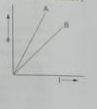
(b) A plot of magnetic flux (ɸ) versus current (I), is shown in the figure for two inductors A and B. which one the two has large value of self inductance?
(c)How is the mutual inductance of a pair of coils effected when
(i)separation between the coils increased
(ii)the number of turns in each coil is increased
(iii)a thin iron sheet is placed between the two coils, other factors remaining the same ?
Q13. Define self-inductance of a coil . show that magnetic energy required to build up the current I in a coil of a self inductance L. is given by½ LI2. .
OR
Define the term self- inductance of a solenoid. Obtain the expression for the magnetic energy stored in an inductor of self- inductance L. to build up a current I through it.
TO DOWNLOAD/READ LONG ANSWER TYPE QUESTIONS CLICK HERE
Assignment of electromagnetic induction and alternating current
This assignment of electromagnetic induction and alternating current contain long answer type questions ( derivation and reasoning type questions. )
electromagnetic induction
LONG ANSWER TYPE QUESTIONS OF ELECTROMAGNETIC INDUCTION AND ALTERNATING CURRENT
Q1. Explain with the help of a labelled diagram, the principle and working of an ac generator. Write the expression for the emf generated in the coil in terms of speed and rotation. Can the current produced by an ac generator be measured with a moving coil galvanometer ?
OR
Describe briefly , with the help of a labelled diagram, the basic elements of an ac generator. State its underlying principle. Show diagrammatically how an alternating emf is generated by a loop of wire rotating in a magnetic field. Write the expression for the instantaneous value of the emf induced in the rotating loop.
OR
State the working of ac generator with the help of a labelled diagram . the coil of an ac generator having N turns, each of area A, is rotated with a constant angular velocity ω. Deduce the expression for the alternating emf generated in the coil. What is the source of energy generation in this device?
Q2. derive an expression for impedance of an a.c. circuit consisting of an inductor and a resistor.
Q3. (a)State the condition for resonance to occur in series LCR a.c. circuit and derive an expression for resonant frequency.
(b) Draw a plot showing the variation of the peak current (im)with frequency of the a.c. source used. Define the quality factor Q of the circuit.
Q4. Define the term capacitive reactance. Show graphically the variation of capacitive reactance with frequency of applied alternating voltage.
An ac voltage V=V0 sin ωt is applied across a pure capacitor of capacitance C. Find an expression for current flowing through it. Show mathematically the current flowing through it leads the applied voltage by angle π/2.
Q5. Explain the term inductive reactance. Show graphically the variation of inductive reactance with frequency of the applied alternating voltage.
An ac voltage V=V0 sin ωt is applied across a pure inductor of inductance L. Find an expression for current i, flowing in the circuit . Show mathematically the current flowing through it lags behind the applied voltage by phase angle π/2. Also draw (i) phasor diagram (ii) graphs of V an I versus ωt for the circuit.
Q6. Derive an expression for (i)induced current when a conductor of length l is moved with a uniform velocity v. normal to a uniform magnetic field B. Assume the resistance of conductor to be R.
Q7. (a)What is induced emf ? write Faraday’s law of electromagnetic induction. Express it Mathematically.
(b) A conducting rod of length l with one end pivoted, is rotated with a uniform angular speed ω in a vertical plane, normal to a uniform magnetic field B. deduce an expression for the emf induced in this rod.
If resistance of rod is R, what is the current induced in it.
Q8. A coil of number of turns N, Area A is rotated at a constant angular speed ω in a uniform magnetic field B and conducted to a resistor R. Deduce the expression for
(i)Maximum emf induced in the coil.
(ii) Power dissipation in the coil .
Q9. (a)Describe briefly, with the help of a labeled diagram, the working of a step up transformer.
(b) Write any two source of energy loss in a transformer.
(c) A set up Transformer converts a low voltage into high voltage. Does it not violate the principle of conservation of energy? Explain.
OR
Draw a schematic Diagram of a set up transformer. Explain its working principle . Deduce the expression for the secondary to primary voltage in turms of number of turns in the two coils. In an ideal transformer, how is this ratio related to the current in the two coils?
How is the transformer used in large scale transmission and distribution of electrical energy over long distances?
Q10. An ac source of voltage V=Vm sin ωt is connected one by one, to three circuit elements X,Y and Z. It is observed that the current flowing in them.
(a) is in the phase with applied voltage for element X.
(b) lags the applied voltage, in phase, by angle π/2 for element Y.
(c) leads the applied voltage in phase by angle π/2.
Identify the three circuit elements.
Find an expression for for the current flowing in the circuit, when the same ac source is connected across a series combination of the elements X,Y and Z.
If the frequency of the applied voltage is varied, set up the condition of the frequency when the current amplitude in the circuit is maximum. Write expression for this current amplitude.
Q11. (a)What is impedance?
(b) A series LCR circuit is connected to an ac source having voltage V=V0 sin ωt. Derive an expression for the impedance, instantaneous current and its phase relationship to the applied voltage. Find the expression for the resonant frequency
OR
(a) ac source having voltage V=V0 sin ωt is connected to a series combination of L, C and R. Use the phasor diagram to obtain expression for impedance of the circuit and phase angle between voltage and current. Find the condition when the current will be in phase with the voltage. What is the circuit in this condition called?
(b)In a series LR circuit XL = R and power factor of the circuit is P1. When capacitor with capacitance C such that XL=XC is put in series, the power factor becomes P2 calculate P1/P2 .
Q12. Derive Expression for self inductance of a long air- cored solenoid of length l, cross- sectional area A and having number of turns N.
Q13. What do mean by mutual inductance of two nearby coils ? Find an expression for mutual inductance of two co-axial solenoid.
OR
(a)Define mutual inductance and write its SI units.
(b)Derive an expression for the mutual inductance of two long co – axial solenoid of same length wound one over the other.
(c)In an experiment, two coils C1 an C2 are placed close to each other. Find out the expression for the emf induced in the coil C1 due to change in the current through coil C2.