Blog

  • Very important short answer type questions of wave optics

    Very important short answer type questions of wave optics

    Very important Short answer type questions of wave optics

    Short answer type questions (2 marks )-

    1. Define the term wave-front . Use Huygen’s principle to show diagrammatically the propagation of a wave-front from the instant t1 =0 to a later time t2=t .

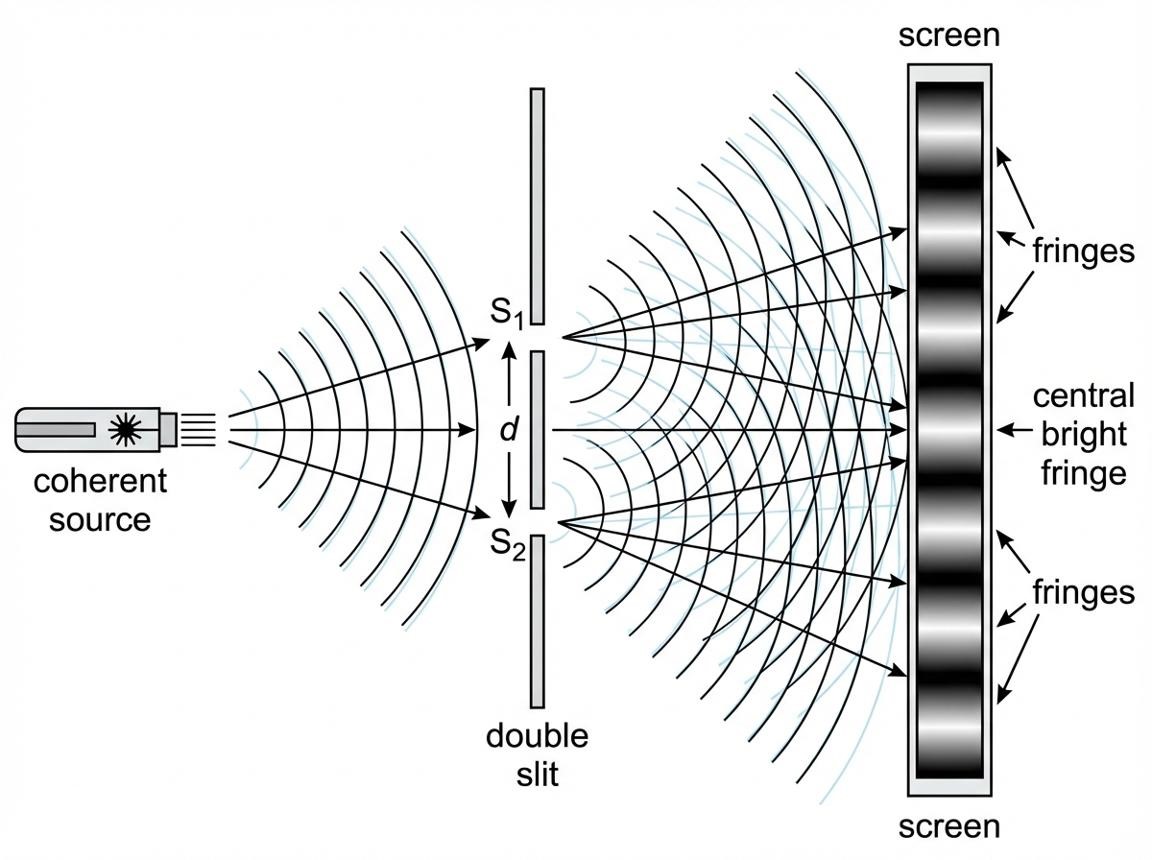
    2. Write the conditions under which light rays said to be coherent . also state why it is necessary to have coherent sources in order to produce an interference pattern ?

    3. Based on Huygen’s  principle , draw the shape of a plane wave-front as it gets refracted on passing through (i) thin lenses (ii) concave and convex mirror and (iii) prism .

    4. What is the effect on the interference fringes in a young’s double slit experiment if a monochromatic light replaced by white light . explain why?

    5. In a single-slit  diffraction experiment , a monochromatic source of light of wavelength  ‘λ’ illuminates a  narrow slit  of width ‘a’ . shows , Giving appropriate reasoning  , that the half angular width of the central maxima in the observed pattern is equal to λ/a .

    6. Draw the intensity pattern for single slit diffraction and double slit interference . Hence state two difference between interference and diffraction pattern .

    7.    Does the appearance of dark fringes in the interference pattern violate , in any way  the law of   conservation of energy ?

    8. Define the term resolving power and limit of resolution . writes its expressions for (i) Telescope (ii) Microscope and (iii) Human eye .

    9. Using wave theory of light derive law of reflection or law of refraction ( Snell’s law).

    10. How the fringe-width obtained using YDSE changes when (i) separation between slits increases or decreases .(ii) separation between slits and screen changes (iii) entire apparatus is immersed in the liquid having some refractive index.
  • Expression for the Conditions of Constructive and Destructive Interference

    Expression for the Conditions of Constructive and Destructive Interference

    Interference of light-

    Definition: The phenomenon of redistribution of light energy due to the superposition of two coherent light waves of the same frequency (or wavelength), producing alternate bright and dark fringes, is called interference of light.

    Explanation

    When two coherent light waves travelling through the same medium superimpose on each other, the resultant intensity at different points changes due to constructive and destructive interference.

    Expression for the Conditions of Constructive and Destructive Interference

    When two coherent light waves superimpose, the resultant intensity depends on the path difference or phase difference between them.

    Let the two wave

    Y1=A1 sin (ωt )

    Y2=A2 sin (ωt +Φ)

    After superimposition

     Y = Y1 + Y2

    Y = A1 sin (ωt )+ A2 sin (ωt +Φ)

    After solving it we get ,

    Y = R A2 sin (ωt +θ)

    Where R is the resultant amplitude of the resulting wave

    R2 = A1 2 + A22 +2 A1A2 cos (ωt )

    But Intensity of light,  I α (amplitude )2

    So we can write ,

    I = I1 + I2 +2√I1I2 cos ωt ,

    1. Constructive Interference (Bright Fringe)

    When two waves meet in the same phase, their amplitudes add up and maximum intensity is obtained.

     For Maximum intensity cos Φ = +1

    cos Φ = 2nπ

     Therefore path difference  p = nʎ [ whwre n= 0,1,2,3…],

    For maximum intensity Imax = I1 + I2 +2√I1I2.

    Or, Imax = A12+ A2 2 + 2A1 A2 = (A1 +A2)2

    2. Destructive Interference (Dark Fringe)

    When two waves meet in opposite phases, their amplitudes cancel each other and minimum intensity is obtained.

    Condition: intensity should be minimum i.e. cos Φ = -1

     Phase difference , Φ = (2n-1)π

    Path difference p = (2n-1 )ʎ/2

    For minimum intensity Imin = I1 + I2 – 2√I1I2,

    OR, Im = A12+ A2 2 – 2A1 A2 = (A1 -A2)2

    For the practice of objective questions of wave optics click on the link given below

  • Very important topics for ray optics

    Very important topics for ray optics ( for primary practice  (topic wise ))

     These Are the basics questions . Students must have to complete all the questions given below .

    1. Reflection by Spherical Mirrors

    Q 1-Derive the mirror formula for a spherical mirror.

    Q 2-A concave mirror has a radius of curvature of 20 cm. Calculate the object distance required to obtain an image with magnification –2. Also find the image position.

    Q 3-For a concave mirror of focal length f, find the minimum distance between an object and its real image.

    Q 4-Draw ray diagrams showing image formation by a concave mirror for different object positions.

    Q 5-Explain why a concave mirror is used as a shaving mirror.

    2. Refraction of Light

    Q1-Derive the relation between real depth and apparent depth.

    Q2-A small object is placed at the bottom of a vessel filled with water of refractive index 4/3. Find its apparent depth.

    Q3-Derive the formula for refraction at a spherical surface.

    Q4-An object is placed in front of a convex spherical refracting surface. Explain how the image position changes as the object approaches the surface.

    Q5-Why does a pencil partially immersed in water appear bent?

    3. Total Internal Reflection (TIR)

    Q1- State the two necessary conditions for total internal reflection.

    Q2- Define critical angle and obtain its relation with refractive index.

    Q3- Explain the working principle of optical fibres.

    Q4- A light ray travels from glass to air. Calculate the critical angle for a given refractive index.

    Q5- Explain why a diamond sparkles.

    4. Refraction Through a Prism

    Q1- Derive the relation between the angle of deviation and the angle of incidence in a prism.

    Q2- Derive the expression for the refractive index of the prism material:

    μ=sin(A+δm)/2 / sin(A/2)

    Q3- What is the condition for minimum deviation?

    Q4- Draw the ray diagram of a light ray passing through a prism at minimum deviation.

    Q5-How does the angle of deviation change with the angle of incidence?

    5. Lenses and Lens Maker’s Formula

    https://www.youtube.com/watch?v=j9H1URgG8r8&t=749s

    Q1- Derive the lens maker’s formula using refraction at spherical surfaces.

    Q2- Derive the thin lens formula.

    Q3- A convex lens of focal length 20 cm is placed in a medium whose refractive index is greater than that of the lens. Explain the nature of the lens.

    Q4- Two thin lenses of focal lengths f₁ and f₂ are placed in contact. Derive the expression for their equivalent focal length.

    Q5- A concave lens is cut into two equal halves. Find the focal length of each half.

    Q6- Two concave lenses of focal length 8 cm each are placed 16 cm apart. Find the position and nature of the final image.

    6. Optical Instruments

    Q1 – Draw a labelled ray diagram of an astronomical telescope in normal adjustment.

    Q2- Derive the expression for the magnifying power of an astronomical telescope.

    Q3-Why is a reflecting telescope preferred over a refracting telescope?

    Q4-Draw a labelled ray diagram of a compound microscope.

    Q5- Derive the expression for the magnifying power of a compound microscope.


    To solve the short answer type questions of ray optics click here-

    To solve the case study questions of ray optics click here-

    To solve very important questions of ray optics click here-

    to solve important numerical of ray optics click here-

  • Pascal’s law || class-11th||physics || Fluid mechanics .

    Statement of Pascal’s Law

    Pascal’s Law states that any pressure applied to a confined, incompressible fluid is transmitted undiminished throughout the fluid in all directions and acts with equal force on equal areas.

    Alternatively, in the absence of gravity, the pressure at any point in a fluid at rest is the same in all directions.


    Mathematical Proof of Pascal’s law

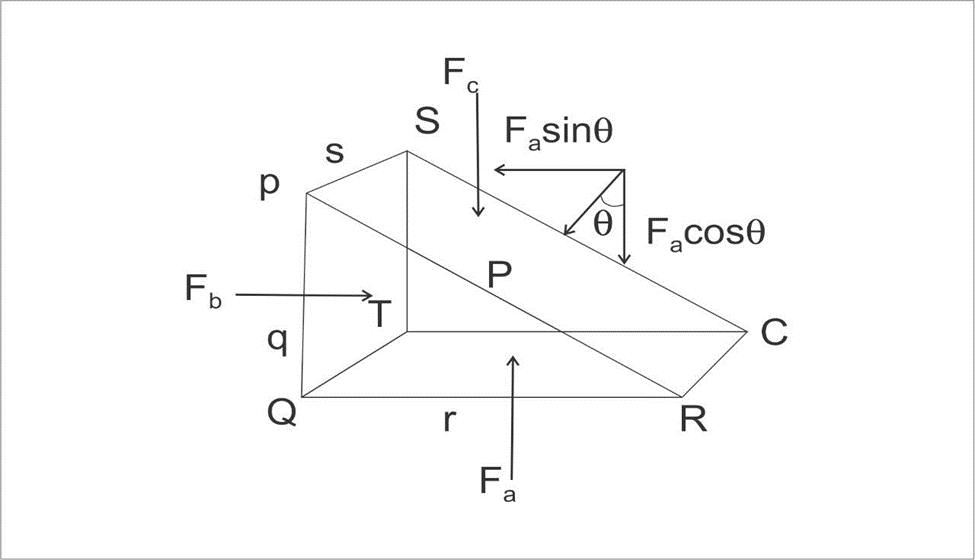
    To prove that pressure is isotropic (equal in all directions) inside a stationary fluid, let us isolate a microscopic, right-angled prismatic fluid element inside a larger mass of fluid.

    Because the element is extremely small, the effect of gravity on it is negligible.

    Expand image

    The diagram below maps out the dimensions, normal pressures, and vector components required to resolve the forces acting along the \x and y axes.

    Let the areas of the faces are

    Ar(PRCS) = p

    Ar(PQTS) = q = psinθ

    Ar(QRCT) = r = pcos θ

    There respective forces are Fa, Fb and Fc are the forces as shown in the diagram.

    Fb= Fa cosθ

    Fc=Fa sinθ

    Pressure at surface p Pa= Fa/p

    Pressure at surface q Pb= Fb/r = Fa cosθ/pcos θ = Fa/p

    Pressure at surface r Pc= Fc/q = Fa sinθ/ psinθ= Fa/p

    Pa=Pb = Pc  Hence proved Pascal’s law.


    Practical Applications of Pascal’s law

    Pascal’s law forms the foundation of hydraulic machinery, which serves as a powerful “force multiplier”.

    ApplicationWorking Principle
    Hydraulic LiftA small force applied to a smaller piston creates a massive upward force on a larger piston, easily lifting vehicles.
    Hydraulic BrakesWhen a driver steps on the brake pedal, the pressure is transmitted through the brake fluid to all wheels simultaneously, squeezing the brake pads against the discs.
    Hydraulic PressUsed in manufacturing to crush items or mold heavy sheets of metal by driving a large piston down with massive multiplied force.
  • A liquid at rest exerts force perpendicular to the surface of the container at every point.

    A liquid at rest exerts force perpendicular to the surface of the container at every point.

    Show that a liquid at rest exerts force perpendicular to the surface of the container at every point.

    Proof:

    Suppose the force exerted by the liquid on the container’s surface acts at an angle to the perpendicular (normal) to the surface.

    We can resolve this force into two components:

    1. Normal component: Acts perpendicular to the surface.
    2. Tangential component: Acts parallel to the surface.

    The tangential component would cause the liquid layers near the surface to move, which contradicts the condition that the liquid is at rest.

    Therefore, the tangential component must be zero, and the force acts only perpendicular to the surface.

    Hence, a liquid at rest exerts force perpendicular to the surface of the container at every point.


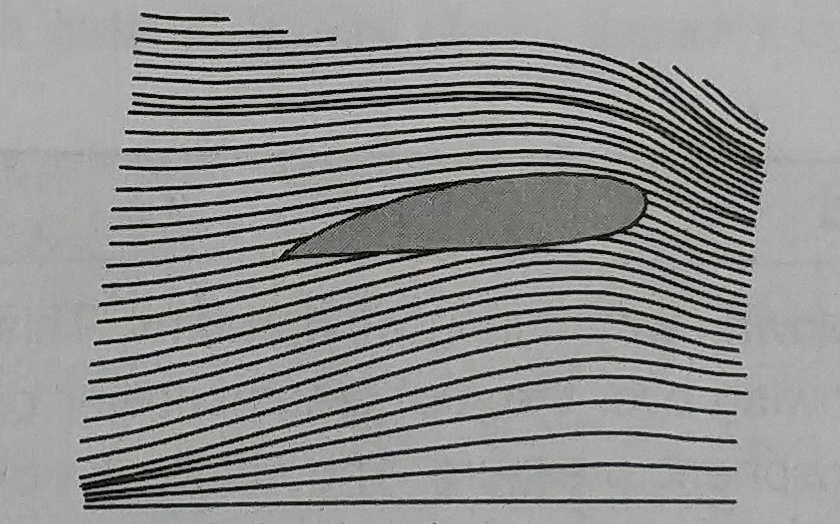
  • streamline, turbulent and laminar flow.

    streamline, turbulent and laminar flow.

    What is streamline flow ?

    Streamline flow—

    When liquid flows such that each particle of the liquid passing a given point moves along the such path and has the same velocity as its predecessor, the flow is called streamline flow or steady flow.

    1. What is Streamline Flow?

    Streamline flow, also called laminar flow, is a type of fluid flow in which fluid particles move along smooth, fixed paths called streamlines without mixing irregularly with one another.

    Example: The slow flow of water through a narrow pipe.

    Properties of Streamline Flow

    1. Smooth motion: Fluid particles move smoothly along definite paths.
    2. No crossing of streamlines: Two streamlines can never intersect each other.
    3. No irregular mixing: Fluid layers move smoothly without significant mixing between them.
    4. Constant velocity at a point: In steady streamline flow, the velocity of the fluid at any fixed point remains constant with time.
    5. Low velocity: It generally occurs when the fluid velocity is low.
    6. Viscosity: The viscosity of the fluid helps maintain smooth flow.

    Q.-Why two streamlines cannot cross each other?

    Ans- Two streamlines can’t cross each other , If they will do so , then the fluit particle at the point of intersection will have two different directions of motion. i.e. it cam go one way or the other destroying the steady nature of the liquid flow.   

    2. What is Turbulent Flow?

    Turbulent flow is a type of fluid flow in which fluid particles move irregularly, forming eddies and causing mixing between different layers of the fluid.

    Example: Water flowing rapidly in a river or a stream.

    Properties of Turbulent Flow

    1. Irregular motion: Fluid particles move in random and unpredictable directions.
    2. Mixing of layers: Different layers of the fluid mix with one another.
    3. Formation of eddies: Small swirling regions called eddies are formed.
    4. Fluctuating velocity: The velocity at a fixed point changes irregularly with time.
    5. High velocity: It generally occurs when the fluid velocity is high.
    6. Greater energy loss: Turbulent flow usually produces greater frictional energy losses than laminar flow.

    3. Difference Between Streamline Flow and Turbulent Flow

    Streamline FlowTurbulent Flow
    Fluid particles move smoothly along definite paths.Fluid particles move irregularly.
    There is little mixing between fluid layers.There is considerable mixing between fluid layers.
    Eddies are generally absent.Eddies are present.
    Velocity at a fixed point remains constant in steady flow.Velocity at a fixed point fluctuates with time.
    Usually occurs at low flow velocities.Usually occurs at high flow velocities.
    Energy loss is generally lower.Energy loss is generally higher.
    Example: Slow water flow through a narrow pipe.Example: Rapid water flow in a river.

    Important Note: Reynolds Number

    The type of flow in a pipe can be predicted using the Reynolds number (Re):

    Re=ρvD/η

    Where:

    • ρ = Density of the fluid
    • v= Average velocity of the fluid
    • D = Diameter of the pipe
    • η = Dynamic viscosity of the fluid

    For flow in a circular pipe:

    • Re < 2000: Generally laminar flow.
    • Re = 2000–4000: Transition region.
    • Re > 4000: Generally turbulent flow.

    In short: Streamline flow is smooth and orderly, whereas turbulent flow is irregular and involves mixing and eddies.

    Laminar flow-

    What is Laminar Flow?

    Laminar flow is a type of fluid flow in which fluid particles move smoothly in parallel layers without mixing irregularly with one another.

    Properties of Laminar Flow

    1. Fluid particles move in smooth and regular paths.
    2. Different layers of fluid slide over one another.
    3. There is no significant mixing between the layers.
    4. The velocity at any fixed point remains constant with time in steady laminar flow.
    5. It generally occurs at low fluid velocities.
    6. It usually occurs when the Reynolds number is less than 2000 in a circular pipe.

    Example: Water flowing slowly through a narrow pipe.

    Remember: Laminar flow is also known as streamline flow when the flow is smooth and orderly.

    To read another important notes of class 11th click here-

  • Huygens’ Principle – Class 12 Physics (CBSE)

    Huygens’ Principle

    1. Statement of Huygens’ Principle

    Statement 1: Every point on a wave-front acts as a source of secondary wavelets that spread out in all directions with the speed of light in that medium.

    Statement 2: The forward envelope (common tangent surface) of these secondary wavelets at any later instant gives the new wave-front at that instant.

    In another words we can state –

    Huygens’ principle states that every point on a wavefront acts as a source of secondary wavelets, which spread out in the forward direction with the speed of light in that medium. The new wavefront at any later time is the forward envelope of these secondary wavelets.

    2. Explanation of Huygens’ Principle

    Huygens Principle Explains Wave Behavior | Dr. Krishnakant Prasad posted on the topic | LinkedIn

    Consider a wavefront (AB) at a particular instant.

    1. Every point on the wavefront AB acts as a source of secondary wavelets.
    2. These secondary wavelets travel forward through the medium with the speed of light.
    3. After a time t, each wavelet travels a distance ct, where c is the speed of light in the medium.
    4. A common tangent surface drawn to these wavelets gives the new wavefront A’B’.

    Thus, Huygens’ principle helps us determine the position of a wavefront at any later instant.

    3. Uses of Huygens’ Principle in Wave Optics

    Huygens’ principle is used to explain and derive:

    1. Reflection of light: It helps derive the laws of reflection.
    2. Refraction of light: It helps derive Snell’s law of refraction.
    3. Wave propagation: It explains how a wavefront advances through a medium.
    4. Interference of light: The wave nature of light and the superposition of waves help explain interference.
    5. Diffraction of light: It helps explain the bending and spreading of light around obstacles and through narrow apertures.

    Important result for examinations

    Using Huygens’ principle, we can prove the laws of reflection:

    • Angle of incidence = Angle of reflection, i=r.
    • The incident ray, reflected ray and normal at the point of incidence lie in the same plane.

    We can also derive Snell’s law for refraction:

    sin i / sin r=v1/v2

    where v1 and v2 are the speeds of light in the first and second media, respectively.

    Conclusion: Huygens’ principle is a fundamental concept of wave optics used to understand the propagation of light and derive the laws of reflection and refraction.

    Why two independent sources of light can’t be coherent? To know the answer click here-

  • Why can’t two independent sources of light be coherent?

    Why can’t two independent sources of light be coherent?

    Why can’t two independent sources of light be coherent?

    Two independent sources of light cannot be coherent because they do not maintain a constant phase difference with time.

    To get the interference of light light should have coherent.

    To know about the coherent sources of light click here-

    Explanation

    Each independent source of light emits light waves due to the random and independent transitions of its atoms.( Even a small sources of light emits millions of atoms)These atomic transitions occur randomly, so the phase of the emitted waves changes irregularly. Therefore, the phase difference between the waves emitted by two independent sources changes continuously with time .Hence, they cannot produce a sustained and stable interference pattern.

    (Conclusion of this explanation explain that “Two sources are coherent only when they emit light waves of the same frequency and maintain a constant phase difference”.)

    Example: Two separate electric bulbs are independent sources and cannot produce a stable interference pattern.

    To get all information about the topic related to physics visit-

    www.physicsclasses.online

  • Objective test chapter 1 and 2 class 12th physics.

    Objective test chapter 1 and 2 class 12th physics.

    TEST CHAPTER-1 , 2

    SET-1 Electric charges and field

    1. Two small identical sphere having charges +10μC attract each other with a force of F newton. If they are kept in contact and then separated by the same distance, the new force between them is: (a)F/6                         (b) 16F                   (c) 16F/9                    (d) 9F                   
    2. A charge q is placed at the mid-point of the line joining two equal charges Q. The system of three charges will be in equilibrium when q has the value: (a)Q/4                         (b) Q/2                 (c) -Q/4                        (d) -Q/2           
    3. An electric dipole is placed in a non-uniform electric field. Then net:(a)force experienced is zero while torque is not zero(b)force experienced is zero and torque is also zero(c)both force and torque are not zero(d)force experienced is not zero while torque is zero                                    
    4. The total electric flux leaving spherical surface of radius 1cm and surrounding an electric dipole is: (a)q/ε0                       (b) zero                     (c) 2q/ε0                            (d) 8πr2q/ε0               
    5. Two particles of masses m and 2m with charge 2q and 2q are placed in a uniform electric field E and allowed to move for the same time. The ratio of their kinetic energies will be:(a)2 : 1                       (b) 8 : 1                     (c) 4 : 1                      (d) 1 : 4                
    6. Electric charges q , q, -2q are placed at the corners of an equilateral triangle ABC of side l. The magnitude of electric dipole moment of the system is: (a)ql                              (b) 2ql                      (c) √3ql                      (d) 4ql                
    7. A particle of mass m and charge q is placed at rest in a uniform electric field E and then released. The KE attained by the particle after moving a distance y is: (a)qEy2                          (b) qE2y                    (c) qEy                        (d) q2Ey           

    To download complete question paper click here-

  • Test mechanical properties of solids

    Test mechanical properties of solids

               Test solids            

                           Class 11 Physics – Mechanical Properties of Solids

    Multiple Choice Questions

    Q1. Stress is defined as:

    A) Force × Area    B) Force per unit area     C) Change in length per unit length D) Force per unit volume

    Q2. The SI unit of Young’s modulus is:

    A) N   B) N/m   C) N/m²    D) J

    Q3. Strain is a:

      A) Scalar quantity with unit metre   B) Vector quantity

    C) Dimensionless quantity   D) Quantity measured in pascal

    Q4. Hooke’s law is valid up to the:

    A) Breaking point       B) Elastic limit (approximately, within the proportional limit)

    C) Plastic region       D) Fracture point

    Q5. Young’s modulus is given by:

    A) Stress × Strain             B) Strain / Stress

    C) Stress / Strain              D) Force × Area

    Q6. If the length of a wire is doubled while its area and applied force remain constant, its extension becomes:

    A) Half   B) Double    C) Four times    D) Unchanged

    Q7. Which material generally has the highest Young’s modulus?

    A) Rubber    B) Steel   C) Sponge   D) Soft plastic

    Q8. The reciprocal of bulk modulus is called:

    A) Rigidity   B) Compressibility   C) Young’s modulus    D) Stress

    Q9. Poisson’s ratio is the ratio of:

    A) Longitudinal strain to lateral strain   B) Lateral strain to longitudinal strain, with a negative sign      C) Stress to strain     D) Pressure to volume

    Q10. The elastic potential energy stored per unit volume in a linearly elastic material is:

    A) Stress × Strain    B) 1/2xStress x Strain   C) Stress/Strain   D) 1/2xStress x (Strain)2

    How and when students should use Artificial intelligence? To know click here-

    Q11. Define stress and strain. Explain their different types with SI units. Also explain steel is more elastic then rubber.

    Q12. State and explain Hooke’s law. Draw and explain the stress–strain curve for a typical metallic wire,.also explain . proportional limit, elastic limit, yield point, ultimate tensile strength, and fracture point.on the curve.

    Q13. Define Young’s modulus, bulk modulus, and shear modulus. Derive the expression for the extension of a wire under a longitudinal force. The length of a wire is l1 when tension is T1 and length is l1 tension is T2. Find the actual length of the wire.

    Q14. What is Poisson’s ratio? Define elastic potential energy and derive the expression for energy stored per unit volume in a stretched wire, if stress and strain of the wire is given.

    Q15. A wire of length 2m and cross-sectional area 1x 10⁻⁶m2 is stretched by a force of  100 N. If Young’s modulus of the material is 2 x 10 11N/m2 calculate the extension produced in the wire. Also explain how knowledge of elasticity is useful to select the wire used in crane to lift the heavy load.

    Top 10 important questions for the class 11th students (first term and final examinations), CLICK HERE-