Author: Nayan Jha

  • MOTION

    MOTION

    MOTION

    MOTION , THERE DIFFERENT TYPES, AND EQUATIONS OF MOTION .
    MOTION OF AN OBJECT


    Motion –

    Rest and Motion -An object is said to be in rest , if body does not change its position with time , with respect to surroundings . An object is said to be in motion , if body  changes its position with time , with respect to surroundings .

    Motion of the body can be of following type –

    • Rectilinear / Translatory motion – In rectilinear motion a point mass body moves along a straight line . but in translator motion a body which is not a point mass moves in a straight line path.


    • Circular or rotatory motion – In circular motion a point mass object moves on a circular path. But in rotatory motion a body which is not a point mass moves on a circular path .


    • Oscillatory or vibratory motion– oscillatory motion is a type of motion in which a body moves to and fro or back and forth repeatedly about a fixed point. If in the oscillatory motion, amplitude is very small then the motion of the body is said to be in vibratory motion.


    Motion in one , two and three dimensions-

    • One dimensional motion– The motion of a body is said to be in one dimensional if only one co-ordinate specify the position of the object in the given time. In such a motion body moves along a straight line
    • Two dimensional motion– The motion of a body is said to be in two dimensional if any two coordinate specify the motion of the body.
    • Three dimensional motion – The motion of a body said to be in three dimensional if all three coordinates specify the motion of the body . in such kind of motion body may cover a specific motion or irregular motion.


    UNIFORM AND NON-UNIFORM MOTION- 

    Uniform motion – If a body covers equal distance in equal interval of time then it is said the motion of a body is uniform .

    Some important features of the uniform motion is following-

    (a) For a uniform motion  along a straight line in a given direction , the distance and magnitude of the displacement remain the same .

    (b) The velocity in uniform motion doesn’t depend upon the time interval .

    (c)There is no need of force for an object to be in uniform motion .

    (d) The velocity in uniform motion is in dependent of choice of origin.

    (e) The average and instantaneous velocities have value in uniform motion.


    If the motion of the object is uniform the following formula is used to find the

    different– different physical quantities .


    Distance = speed x time ;    speed = distance / time


    Displacement = velocity x time ;   Velocity = displacement / time ;

    Average speed = total distance covered / total time taken .


    Average velocity = total displacement covered / total time taken


    V =  X2-X1 / t2-t1 .


    Non-uniform motion- An object is said to be in non-uniform motion if it covers unequal distance in equal interval of time ,or equal distance in unequal interval of time. The velocity of a body changes with time it may increase ( accelerated ) or decrease (deaccelerate) with time .

    Following are the important equations of motion– for uniformly accelerated motion

    • 1st of motion ( it is also known as velocity – time relation)- v = u + at ( Where v=final velocity, u= initial velocity , a= acceleration, t = time taken .)
    • 2nd of motion (it also known as distance – time relation ) – S=ut+1/2 at2 (where s=displacement ;  u = initial velocity ; a= acceleration ; t = time taken .)
    • 3rd of motion (it is also known as the velocity- position relation) – V2-U2=2aS (where – S= displacement ; V= final velocity ; U= initial velocity ; a= acceleration .)

    TO SEE THE VIDEO FOR THE DERIVATION OF ALL THREE EQUATIONS OF MOTION CLICK HERE-

    • 4th of motion ( distance covered by the body in nth second ) Snth = u+ a(2n-1)/2 . (where Snth = distance covered in nth second ; a= acceleration ; n= given time ; u= initial velocity .)

    TO SEE THE VIDEO FOR THE DERIVATION OF 4th EQUATION OF MOTION CLICK HERE-


     To download  objective practice paper of motion in st line (akash)click here-

    the above assignment wiil be very helpful for the student preparing for NEET/ JEE and class 12-th board examination.


  • ADDITION OF VECTORS

    ADDITION OF VECTORS

    ADDITION OF VECTORS

    ADDITION OF VECTOR – Vectors can not be added by simple laws of algebra.

    Rules of geometric addition of vectors –

    • For the addition of two vectors – For the addition of two vectors represent these two vectors by arrowed lines using the same scale . Displace the second vector as its coincide with the head of first vector , then the single vector drawn from the tail of the first vector to the head of the second vector represent their resultant ( addition) vector.

    the addition of two vectors can be obtained using Triangle law or parallelogram law of vector addition

    • For the addition of three or more vectors – Represent these vectors by arrowed lines using the same scale . Displace these vectors such that the head of the first vector coincide with the tail of the second vector and head of second coincide with the tail of third vector and so on , then the single vector drawn from the tail of the first to the head of the last represent their resultant vector. The addition of three or more vectors can be found using polygon law of vector addition.

    Triangle law of vector addition-   It states that if two vectors acting on a particle represented by two sides of a triangle in same order , then the third side in opposite order gives the resultant vector.

    TO DOWNLOAD COMPLETE NOTES OF ADDITION OF VECTOR CLICK HERE-ADDITION OF VECTOR

  • What do you mean by the term vector quantity?

    What do you mean by the term vector quantity?

    What do you mean by the term vector quantity ?

    What do you mean by the term vector quantity? what are the uses of vector quantity? Explain different types of vector.

    VECTORS-

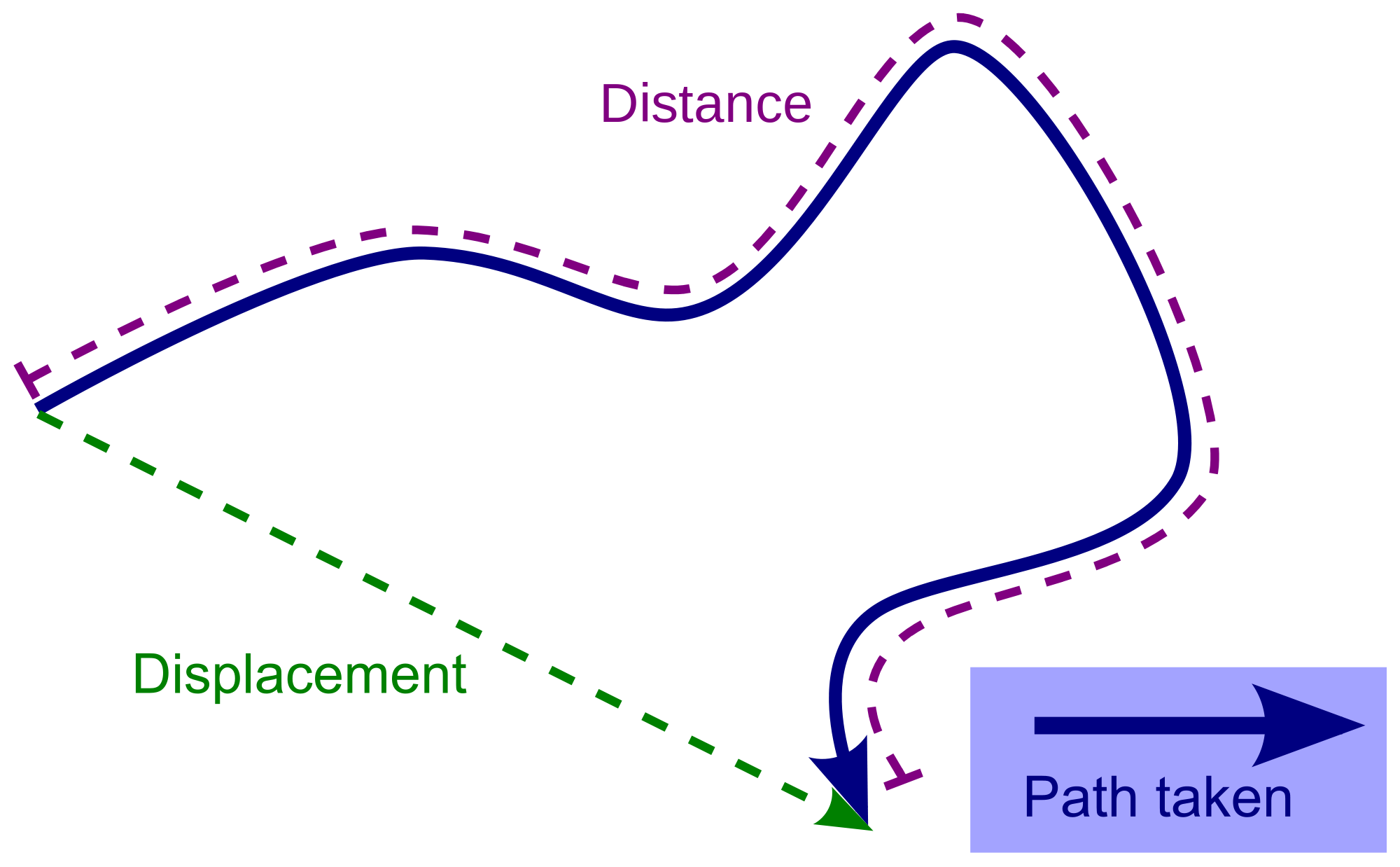
    Physical quantity having both magnitude and direction called vector quantity . And the physical quantity having magnitude only called scalar quantity . E.X.- suppose a man move 10 km , now in that case I am discussing about  its distance only i.e. it has magnitude only but there is no any information about its direction hence it is a scalar quantity, if we say man  is moving 10 km towards East(or any other direction ) so we can say we are discussing about its displacement i.e. it has both magnitude and direction. A vector quantity is represented as an arrow on its top ex;-  ? ⃗

    Vectors can be divided into two ways –

    • Polar vector- a vector which has a starting point or a point of application. E. X .- displacement , force etc.
    • (ii) Axial vector – Vectors which represent rotational effects and acts along the axis of rotation in accordance with right hand screw rule.

    TO DOWNLOAD VECTORS COMPLETE NOTES CLICK HERE.

     Addition of vectors (triangle law and parallelogram of vector addition)

  • DIMENSIONS

    DIMENSIONS

    DIMENSIONS

    What is dimensions of a physical quantity?What are the uses of dimensions ?

    DIMENSIONS– The dimension of a physical quantity as the power to which the fundamental units have to raised to represent a derived units of the quantity.

    To see the video of dimensions    click here

    As we know that derived units of the physical quantities can be obtained from fundamental units of mass , length and time . Fundamental unit of mass is represented as [M], length is represented as [L] , and time as [T] . If we have to derive the dimension of velocity , then it may be written as

    Velocity V = distance / time = [L] / [T] = [M0L1T-1] . Similarly we can find the dimensions of all physical quantities .

    The dimensions of the physical quantity is an expression which tells us : (i) The dimensional units on which the quantity depends and (ii) The nature of the dependence .

    The dimensional formula of a physical quantity can be obtained by defining there relation with other physical quantities , whose dimensions in mass, length and time are already known .

    When a physical quantity is equated to its dimensional formula , what we obtained is the dimensional equation of the physical quantity.

    Uses of dimensional equations : –

    • Checking the accuracy of formula ; Whether the given equations are correct or not can be checked on the basis of principle of homogeneity . according to this principle , the given formula is correct if dimension of left hand side of the equation is equal to the dimension of right hand side of a physical quantity.
    • To see the video of how to check the correctness of formula click here-
    • Conversion of one system of units into another ; – This is based on the fact that the magnitude of a physical quantity remains the same , whatever the system of its measurement. Q= n1u1 = n2u2. For to do that , we have to use the formula

    Which is given as , n2=n1 [M1/M2]a [L1/L2]b [T1/T2]c .

    To see the video on conversion of one system to another click here-

     Derivation of formula or to find the actual relationship between given physical quantities. Using the same principle of homogeneity of dimensions , we can derive the formula of physical quantity , provided we know the factors on which the physical quantity depends.

  • METER-BRIDGE

    METER-BRIDGE

    METER-BRIDGE


    METER-BRIDGE
    METER-BRIDGE

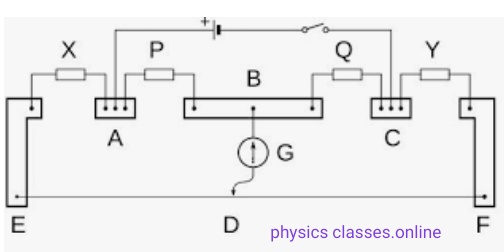
    Question based on meter-bridge may be asked as ; What is meter-bridge ? How does it work? find the expression to find the value of unknown resistance using meter bridge.

    Meter-bridge is a devise used to know the value of unknown resistance.

     Principle -its working based on the principle of wheat-stone-bridge .

    See  the  video of complete explanation of meter bridge HERE-

    expression for unknown resistance will be given as S/R = 100-l/ l

    where R=known resistance ; S= unknown resistance ; l is the length of the uniform wire.


  • MUTUAL INDUCTANCE OF TWO COAXIAL SOLENOID

    MUTUAL INDUCTANCE OF TWO COAXIAL SOLENOID

    MUTUAL INDUCTANCE OF TWO COAXIAL SOLENOID

    In this topic we will derive the expression for coefficient of mutual induction or mutual inductance of two coaxial solenoid

    MUTUAL INDUCTION OF TWO COAXIAL SOLENOID–

    mutual induction
    mutual induction fig.-

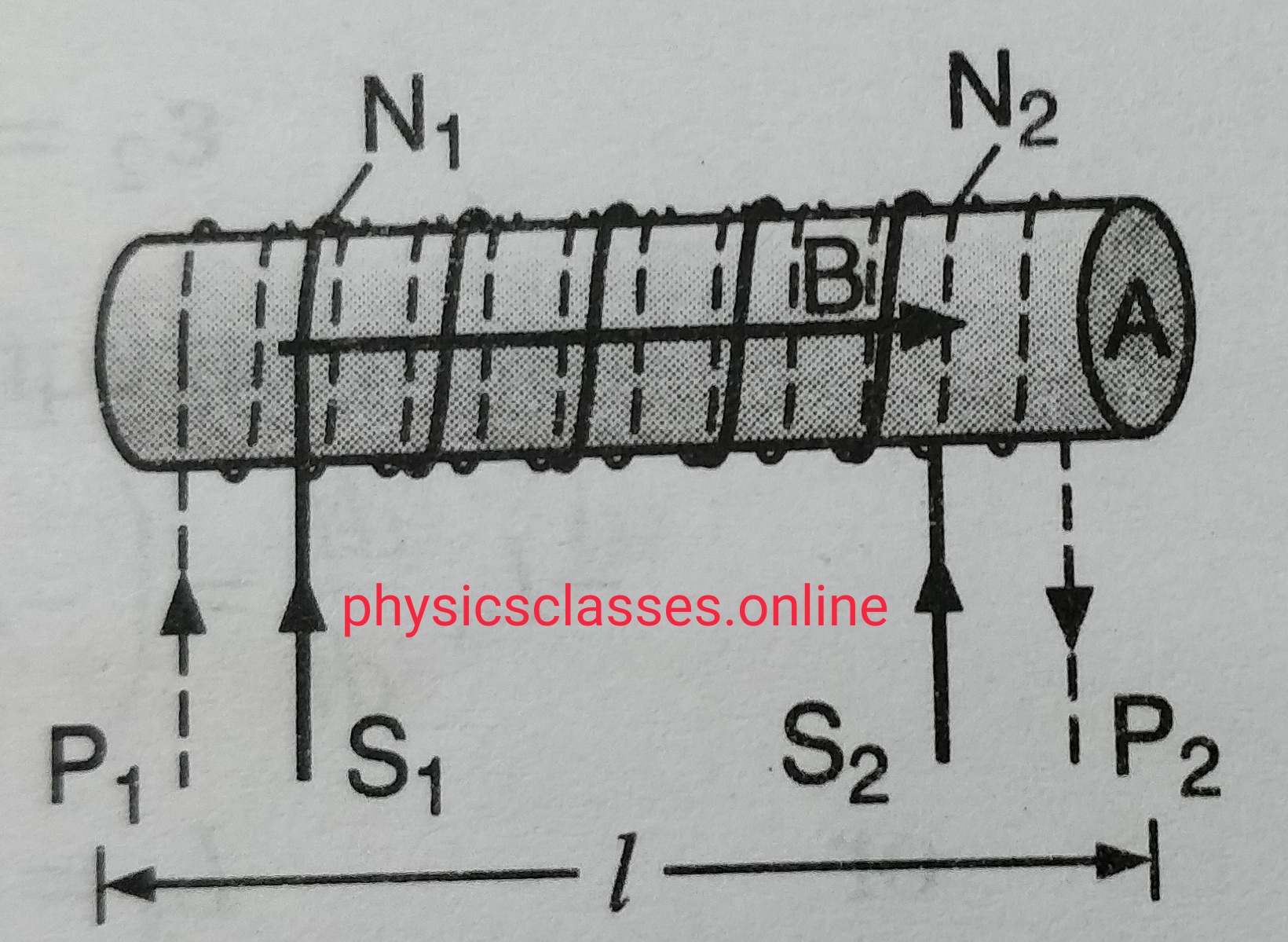
    Let us consider two coaxial solenoid P1P2 and S1S2 (as shown in figure).

    Let their common length is ‘l’ with cross-sectional area  A  and having N1 turns  but second coil has N2 turns .

    If I1 is the current flows through the coil P1P2 , the magnetic field at its centre ,  B = µ0 n1 I . so magnetic flux linked with the coil S1S2 = B A .

    Magnetic flux for entire coil S1S2 , ɸ = BAN2 = µ0n1n2 A I = µ0 N1N2 I A/ l …………(i)

    But as we know , ɸ= MI ……………….(ii) (Here M is the mutual induction of the coil)

    From eq. (i) and (ii)

    MI = µ0 N1N2 I A / l

    So  M= µ0 N1N2  A/l .


    Points to be remember-

    • If a medium of relative permeability µr fills the entire space in the inner solenoid then mutual induction M= µ0µr N1N2  A/l
    • If the cross-sectional area of both the the coils are different then we always consider the inner coil radius ( area of that coil having smaller area of cross-section)
    • The calculation of mutual induction is quite complicated even in the case of considerable symmetry.
  • MUTUAL INDUCTION

    MUTUAL INDUCTION

    Mutual induction-

    In this topic students will study what is mutual induction and coefficient of mutual induction / mutual inductance? And what is the unit of mutual inductance

    mutual induction
    mutual induction

    Mutual induction-

    Let us consider two coils placed near to each other closely . One of the coil carries the battery is the primary coil and the other one is secondary coil connected with a galvanometer. When current starting flows through the primary coil  then its value increases from zero value to a fixed value during this time we observe that there is some deflection in the galvanometer . as we know when current passes through a coil (solenoid ) magnetic field setup ,due to increasing value of current magnetic field through the coil also increases and hence magnetic flux linked with the secondary  coil also increases , and according to Faraday’s law  emf  setup across the secondary coil .

    So we can say , The phenomena of inducing current in a circuit by changing the current in a neighbouring circuit is called mutual induction. We can also define it the property of two circuits by virtue of which each circuit opposes any change in flux or strength of current flowing through other circuit.

    It is found that the flux ‘ɸ’ linked with the secondary coil is directly proportional to the current ‘I’ flowing through the primary coil ,

    i.e.      ɸ = I

    or         ɸ = MI ( M is a constant called coefficient of mutual induction , the value of M depends upon the characteristics of the circuit ant their orientations . )

    so,     M = ɸ/I   ; if  I =1 ampere then M=ɸ

    So we can define coefficient of mutual induction is equal to the flux linked with the coil when unit current passes through the another coil.

    We know that,  emf ‘e’ = -dɸ/dt =  – d(MI)/dt  =  -M dI/dt  ,

    If dI/dt = 1 then , m  = – e , so we can define coefficient of mutual induction is equal to emf induced in secondary coil when rate of change of secondary coil is unity.

    Unit of mutual inductance  is Henry (H) , Henry is also the unit of self inductance  , we can define that mutual induction of two circuit is said to be 1 Henry if a current changing at the rate of 1 ampere per second  in one circuit and induces 1 volt of emf in other circuit.

     To derive the expression for the mutual induction of two coaxial solenoid click here

    To derive the expression for  the coefficient of self induction click here

  • MARKS DISTRIBUTION CLASS 12th PHYSICS

    MARKS DISTRIBUTION CLASS 12th PHYSICS-

    physics Assignment
    physicsclasses.online

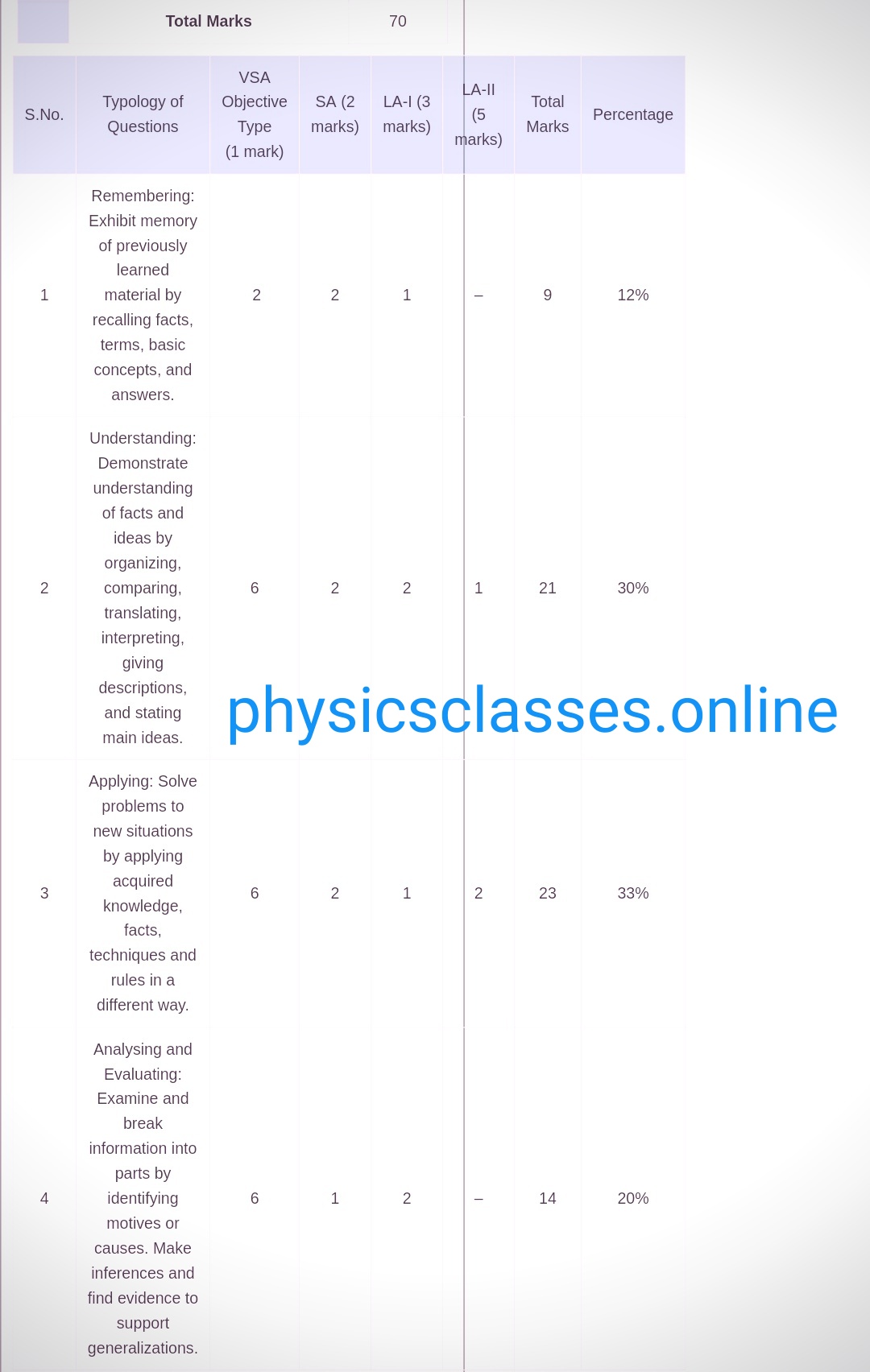
    CBSE (CENTRAL BOARD OF SECONDARY EDUCATION) decided  to follow new marking pattern for class 12th physics , students has to know it and prepare himself according to the new marking scheme.

    Important information for all the students of class 12th (science ) should have  to know that marking scheme and questions pattern is changed   academic year 2019-2020 by CBSE……Here physics classes by nayan jha trying to help the students to know the marking scheme on the chapter basis .

    Distribution of marks chapters basis -Total marks -70

    (1)-

             Chapter -1 ,Electric charges and fields +

    chapter-2 , Electrostatic potential and capacitance +

    chapter -3 , Current electricity


    THESE THREE CHAPTERS CONTAINS 18 MARKS


    (2)-

           Chapter -4 , Moving charges and magnetism+

    Chapter-5 , Magnetism and matter

    chapter-6 Electromagnetic induction +

    Chapter- 7 Alternating current


    THESE FOUR CHAPTERS CONTAINS 17 MARKS


    (3)—

             chapter-8 Electromagnetic wave+

    Chapter- 9 Ray optics and optical instruments +

    Chapter-10 Wave optics


    THESE THREE CHAPTERS CONTAINS 18 MARKS


    (4)—

             chapter -11 Dual nature of radiation and matter +

    Chapter-12 Atoms +

    Chapter-13 Nuclei


    THESE THREE CHAPTERS CONTAINS 10MARKS


    (5)–

             chapter- 14 Semiconductor materials ,electronic  devices and simple circuits


    THIS CHAPTER CONTAINS 7 MARKS


    Now it is predicted that question paper style may be like that as it is mentioned below (NOTE-Since this information is on the basis of some sites information ,it may  change in the question paper provided by CBSE in the board exam )


    marking scheme
    marking scheme
  • Errors of measurement

    Errors of measurement

    Errors of measurement-

    generally it is seen the measured value of a quantity is different from its actual value . this difference in the measured value and and the true value of a quantity is called error of measurement. 

    Errors of measurement can be divided into following types-

    Systematic errors -Those errors whose causes are known and it can be corrected ( or ,  can be minimised). Like Instrumental errors, personal errors ,Error due to imperfection and errors due to external causes.

    Random errors-These errors may arise due to large variety of factors . some time it is also called ‘ chance error’ . random errors can be minimised by repeating the observation.

    Gross errors– These errors arises due to carelessness of the observer during the measurement of the values.

    Absolute errors– Absolute errors in the measurement is the difference between true value and measured value of the quantities . The absolute errors sometime may be positive and sometime negative .

    Mean absolute error-It is the arithmetic mean of magnitudes of absolute errors.

    Relative errors /Fractional errors-It is the ratio of mean absolute errors to the mean value or true value of the quantities measured.

    Permissible errors-It is the errors which arises due to limitations on the measuring abilities of various instruments use in the experiment.

    Accuracy– It is the extent to which a measurement approaches the true value of the quantities measured.

    Precision– It describes the limitations of the measuring instruments . It is the degree of correctness of a measurement.

    To  download important questions  on Errors  click here


  • Significant figure

    Significant figure

    Significant figure

    In this topic we will discuss what is a significant figure ?  how can we find the significant figure in the given values and what are the rules for counting significant figure ?

    Significant figure – It is the measured value of a physical quantity tell the number of digit in which we are confident . (  Larger the value of significant figure greater will be the accuracy and vice versa ).

    Number of significant figure in a physical quantity depends upon the least count of the instrument used for its measurement.

    Rules for counting significant figure –

    1. All non zero digits are significant figure , and all zeros occurring between the two non zero digits  are significant.
    2. In a number less than 1 , all zeros to the right of decimal point and to the left of a nonzero digit are not significant . But all the zeros on the right of the last non zero digit in the decimal part are significant.
    3. All zeros on the right of non zero digits are not significant . but all zeros on the right of the last non zero becomes significant when they come from a measurement.


    (Note- change in the unit of measurement of a quantity does not change the number of significant figures .)