Author: Nayan Jha

  • Wave optics and optical instruments

    Wave optics and optical instruments

    Wave optics and optical instruments

    In this question paper we will practice the important questions of wave optics and optical instruments .
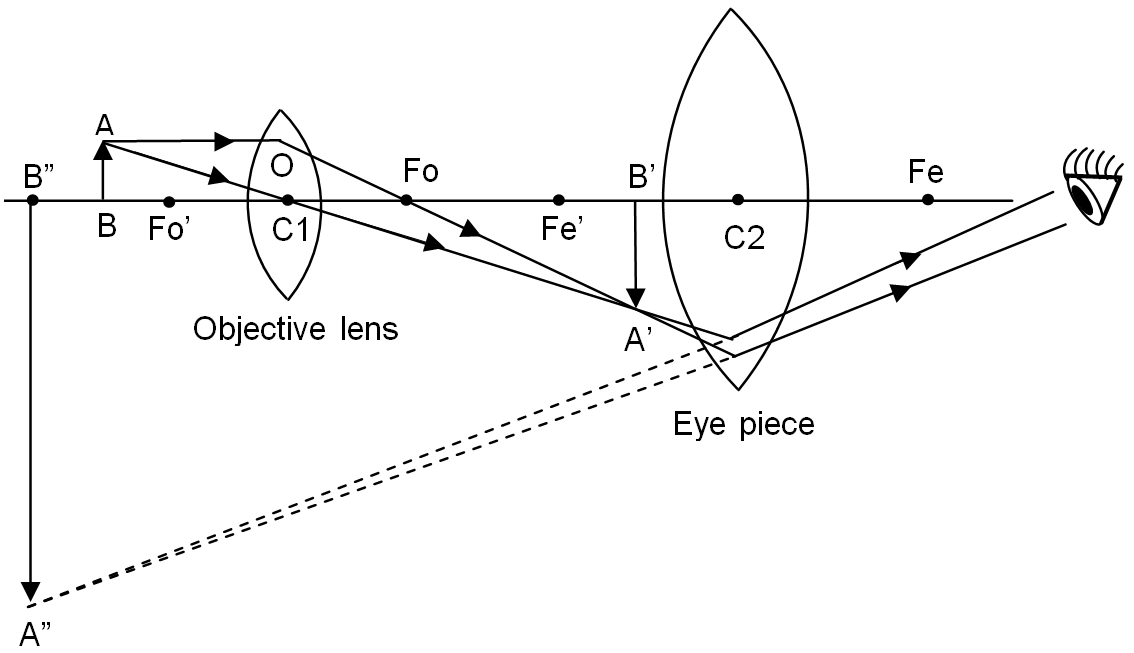
    RayDiagramOfCompoundMicroscope

    students preparing for class 12th must have to practice all questions given in the assignments “wave optics and optical instruments” , I  am sure that you will get sure benefits in your board examination .

    Students can also solve important questions of ray optics . for important questions of ray optics click here-

    Important questions on wave optics
    and optical instrument
    (***Derivations and reasoning type questions***)
    1. Draw a ray diagram showing the image formation of compound microscope, hence obtain the expression for magnifying power when (I) image is formed at infinity (II) image is formed at least distance of distinct vision. (a)Why must both the objective and eyepiece of a compound microscope have short wavelength? (b) while viewing through a compound microscope, why should our eyes be placed not on the eye piece but at short distance away from it for best viewing?
    2. Draw a labelled ray diagram of astronomical telescope, for(I) normal adjustment, (II) at least distance of distinct of vision. Also derive the expression for magnifying power
    3. Define resolving power and limit of resolution derive the expression for resolving power for (I) microscope, (II)telescope and (III)eye.
    4. Explain reflecting type telescope draw the ray diagram for (I) Newtonian and (II)Cassegrainian type telescope. Write advantages of reflecting type telescope over refracting type telescope.
    5. Define wavefront . What type of wave front will emerge from a point source and distance light source? Draw a wave front coming out from a (I)prism(II)concave and convex mirror(III)concave lens and(III)convex lens .
    6. State Huygens principle, using this principle draw the diagram to show how a plane wave front incident(I) At the interface of two media gets refracted when it propagates from a rarer to denser medium, and hence verified Snell’s law and (II) At a plane surface and gets reflected and hence derive law of reflection.
    7. What are coherent sources of light ? Why two independent sources can’t be coherent ?why coherent sources are necessary to observing a sustained interference pattern ? How are the coherent sources are obtained in the Young’s double slit experiment?
    8. What is interference of light? Write dawn the conditions to obtain the sustained interference fringe pattern. Show that the superposition of wave originating from two sources having displacement Y1 =a cosωt , Y2 =a cos(ωt+ɸ) at a point produces a resultant intensity , I=4a^2 cos^2(ɸ/2) hence write the conditions for the appearance of dark and bright fringes.(* this question may be asked as ,deduce the conditions for constructive and destructive interference and hence write the expression for the distance between two consecutive bright or dark interference)
    9. Using Young’s double slit experiment obtain the conditions for gating bright and dark fringes also derive the expression for the fringe width. Also write the effect on fringe width when(I)Distance between slits increases/decreases(II) Distance between slits and the screen increases/decreases(III) Monochromatic light replaced by white light,(IV) One of slit is closed and (V) entire experimental apparatus is immersed in a liquid
    10. In a single slit diffraction experiment , deduce the conditions for the central maximum and secondary maxima/minima observed in diffraction pattern . Also explain why the secondary maxima go on becoming weaker in intensity as the order increases.(I) Haw does the width of the slit affected the size of the central bright fringe?(II)When a tiny circular obstacle is placed in the path of the light from a distant source , why is a bright spot seen at the center of the shadow of the obstacle?(III) Show that the angular width of the central bright is two times the width of the first diffraction fringe (IV) If a mono chromatic source of light is replaced by white light , what change would you observe in the diffraction pattern?
    11. What is unpolarised and plane polarised light? How an unpolarised light gets polarised when it passes through a polaroid. Why is the phenomenon of polarisation not observed by sound wave?
    12. What are Polaroids ? how are the used to demonstrate that (a) A light wave is transverse in nature,(b) if an unpolarised light wave is incident, then light wave gets linearly polarised?
    13. State and prove law of malus and Brewster’s law .What is Brewster’s angle ? when an unpolarised light is incident on a plane glass surface , what should be the angle of incidence so that the reflected and refracted rays are perpendicular to each other?

    ******IMPORTANT NOTICE FOR THE STUDENTS OF CLASS 12TH-

    Students as we know , this year there are some changes in the pattern of  question paper  of physics for class 12th . It is informed by the cbse that there will be 20 marks objective type questions in the paper , but it is decleared    that what will be the  type question paper of physics . previously only 5 marks of questions was on the basis of objective question (one marks each) , and in the answer of these questions students has to write the answers , but this year question paper pattern is changed  , the sample paper provided by cbse is provided  here.

    To download the entire question paper click here
     

  • Important numerical of ray optics

    Important numerical of ray optics

    Important numerical of  ray optics

       All questions given below is very important numerical of ray optics . These questions are  good for quick practice at the time of examination.

    1. Suppose while sitting on a parked car , you noticed a jogger approaching towards you in the rear view mirror of R=2m . If the jogger is running towards you at the speed of 5m/s , how fast the image of the jogger moving when the jogger is (a)39m(b)29m(c)19m away.

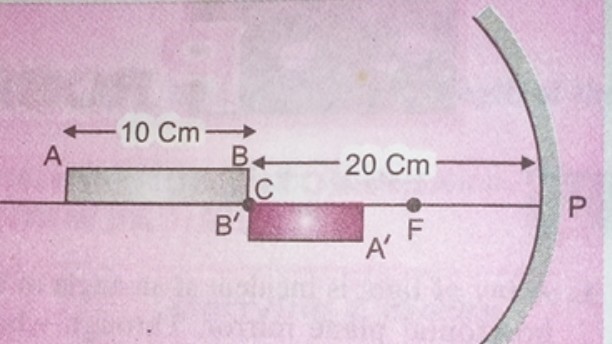
    2. A rod AB =10cm in length is placed along the principle axis of a concave              mirror having focal length equal to 10cm as shown in fig. the distance                  PB=20cm . what is the length of the image of the rod AB.

    image -1(ray optics)
    1. When an object is placed at a distance of 60 cm from a convex spherical mirror , the magnification produced is ½. Where should we place the object to get a magnification of 1/3?
    2. A ray of light travelling in water is incident on water glass interface at angle 300calculate the angle of refraction. Refractive index of water and glass is 4/3 and 3/2 respectively .
    3. What is apparent position of the object below a rectangular block of glass 6cm thick , if a layer of water 4cm thick is on the top of the glass ? Refractive index of glass and water with respect to air is 3/2 and 4/3 respectively.
    4. Calculate the critical angle for total internal reflection of light travelling from (a) water to air(b) glass into water. Refractive index for glass and water is 3/2 and 4/3 respectively with respect to air.
    5. Light from a point source in air falls on a spherical glass surface .If refractive index of glass is 1.5 and radius of curvature =20cm , the distance of light source from the glass surface is 100cm ; at what position image will formed?
    6. A biconvex lens has a focal length 2/3 times the radius of curvature of either surface . Calculate the refractive index of lens material .
    7. Find the radius of curvature of the convex surface of a plano-convex lens , whose focal length is 0.3m and the refractive index of the material of the lens is 1.5.
    8. A screen is placed 100cm from an object . The image of the object on the screen is formed by a convex lens at two different locations , separated by distance 20cm . calculate the focal length of the lens used.
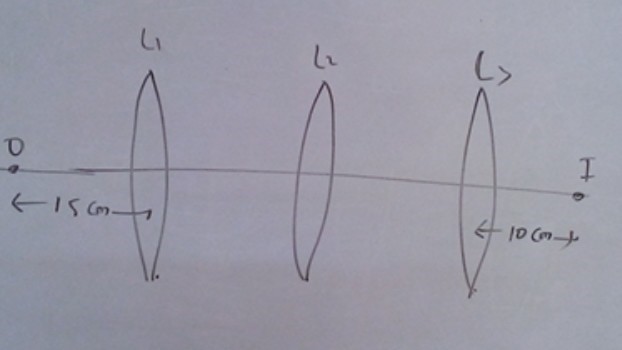
    9. You are given three lenses L1 , L2,L3 each of focal length 10cm . an object is kept at 15cm in front of L1  ,  as shown in fig. the final image is formed at the focus of L3 find the separation between the lenses.
    image -2 (ray optics)
    1. A convex lens made up of glass of refractive index 1.5 is dipped  , in turn ,in (a) a medium of refractive index 1.65 (b)   ) a medium of refractive index 1.33.Will it behave like converging or diverging lens in two cases, explain how focal length changes in two cases .
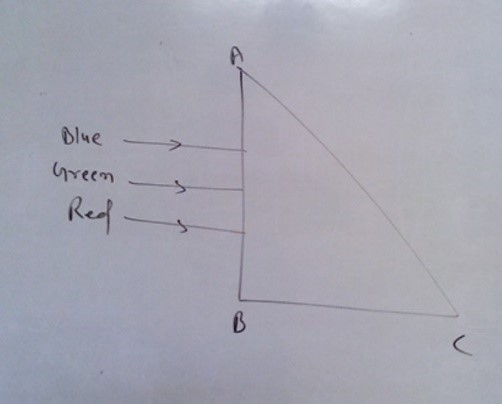
    2. Three rays red  , green and blue are incident on a right angled prism ABC at face AB the refractive indices of the material  of the prism for red, green ,and blue are 1.39,1.44, and 1.47 respectively . Out of the three which color of ray emerge out of face AC. Trace the path of the three rays after passing through AB.
    image-3 (ray optics)
    1. Draw ray diagram to show how specially designed prism make use of total internal reflection to obtain inverted image of the object by deviation of rays (a) through 900 (b) through 1800 and(c) through 00  .
    2. State the conditions under which total internal reflection occurs . one face of a prism with a refracting angle of 30 , is coated with silver . A ray incident on another face at an angle of 45 is refracted and reflected from the silver coated face and retrace its path. Find the refractive index of the material of the prism.
    3. A convex lens with the radii of curvature of magnitude 10 cm each , is put over a liquid layer is poured on the top of the plane mirror . A small needle with its tip on the principle axis of the lens , is moved along the axis until its inverted real image coincide with the needle  itself . The distance of the needle from the lens is measured to be 15 cm . on removing the liquid layer and repeating  the experiment  the new distance is measured to be 30cm ,what is the refractive index of the liquid?
    4. Find the position of the image formed by the lens combination given in figure


    image -4 (ray optics)


    1. A diverging lens of focal length f cut into two identical parts ,each forming a plano- convex lens what is the focal length of each part. How the focal length of the lens changes if it bisected axially?
    2. The image of a needle placed 45cm from a lens is formed on a screen placed 90 cm on the other side of lens. Find displacement of image if object is moved 5cm away from lens.
    3. A small bulb is placed at the bottom of a tank containing water to a depth of 80 cm . what is the area of the surface of water through which light of the bulb can emerge out ?Refractive index of water is 1.33 consider the bulb to be a point source.


  • Important questions of gravitation

    Important questions of gravitation

    Important questions of gravitation

    In this topic important questions of gravitation is given which will be very important for students studying in class 11th .

     This topic covers all important questions of gravitation

    Important question
    Gravitation
    *****Derivation /define/relations based questions
    1.State Newtons law of gravitation in vector form .(I)Haw can you find the mass of earth ,starting from the law of gravitation?)II) What are the factors affecting the value of G ? (III) If mass of two bodies are doubled and distance is halved , how will the gravitational force change ?
    2. Define gravitational acceleration , find the expression for it, also find its value on the surface of earth .Haw the value of g changes (I) With altitude (II)with the depth .A planet reduces its radius by 1% with its mass remaining same , haw acceleration due to gravity changes ?
    3. Define gravitational field and gravitational field intensity at a point , also find the expression for field intensity at a point.
    4. Define gravitational potential, and gravitational potential energy at a point ,derive the expression for gravitational potential at a point also find the relation with potential energy.
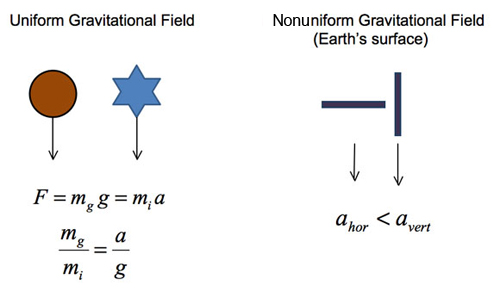
    5. Write the differences between                                                                                         (I) Inertial and gravitational mass,                                                                                 (II) G and g                                                                                                                           (III)escape velocity and orbital velocity on earth.
    6.What is escape velocity ? obtain the expression for the escape velocity on earth . why there is no atmosphere on moon? Explain.
    7.state and prove Kepler’s laws of planetary motion.
    8. what is geostationary satellite ? calculate the height of the orbit above the surface of the earth in which a satellite is placed , will appear stationary, and also write the conditions for the launching of geo stationary satellite.
    9.define the term orbital velocity , find the expression for (a) orbital velocity(b) time period and(c) total energy of the satellite . obtain the relation for orbital speed and escape velocity of the satellite from earth surface.
    ***numericals***
    10. A 10 kg mass is divided into two parts , such that the force of attraction between them is maximum , what is the mass of each portions?
    11. two stationary particles of masses M and m are separated by distance d apart . a third particle of mass m1 is placed on the line joining the two particles , experience no resultant gravitational force , what is the distance of the particle from m ?
    12. haw far above the earth’s surface does the value of g becomes 20% of its value on the surface of earth ?
    13. find the relation between height h above the earth surface with the depth from the earth surface where the value of g will be same.
    14. what is the percentage increase in velocity for moon to escape from the gravitational pull of the earth ?
    15.Two masses each of mass 100 kg are separated by distance 1m , find the gravitational (a) field and (b) potential at the mid point of the line joining them.
    16.A satellite of mass 2000kg is raised from a circular orbit of radius 2R to a circular orbit of radius 3R . what is the approximate work done ?
    17.  If the earth supposed to be a uniform sphere , suddenly contract and its radius becomes half of its original value , what will be the duration of day (or what will be time of rotation of earth on its own axis/ what will be the %change in duration of day)?
    18. The weight of a body on the surface of earth is 250 N . calculate its weight at the distance equal to half of radius of earth below the surface of earth ( radius of earth =6400 km)
    19. A rocket is launched from the surface of earth vertically with an initial speed of 10 m/s . haw far above the surface of earth would it go ? radius of the earth is 6400 km.
    20. A satellite of mass 200 kg is rotating in an orbit at a height of 400 km from the surface of earth , haw much energy must be given to the rocket to take the satellite out of the earth ‘s gravitational influence? Mass of earth=6.0 x 10^24 kg; radius of earth=6400 km.
    21. Three particles each of mass m are placed at the vertices of an equilateral triangle of side l . Find the work which should be done on this system to increase the sides of triangle 2l.
    22. At what rate should the earth rotate so that the apparent g on the equator becomes zero? What will be the length of day in this situation? Find the energy required to launch a satellite of mass 1000 kg from the surface of earth to the height 2000 km above the earth surface.
    23. Find the potential energy of a system of four particles placed at the vertices of a square of side l . also obtain the gravitational potential and gravitational field intensity at the center of the square.
    24. Why space craft usually launched from west to east ? why is it more advantageous to launch rockets in the equatorial plane?

    To solve important questions of system particles and rotational motion click here-

  • Important questions of electromagnetic wave

    Important questions of electromagnetic wave

    Important questions of electromagnetic wave-

    All the question given below is very Important questions of electromagnetic wave.

    Students of class 12th and who is preparing for   ,JEE/ NEET must have to solve the questions given below .These are very Important questions of electromagnetic wave.

    before to solve all questions given below, student must have to read all the topic of electromagnetic wave; to read the entire chapter : click here-Electromagnetic wave:-

    em wave

    Important questions for electromagnetic wave-

    1. How are electromagnetic wave produced ? what is the source of energy of these wave ? write mathematical expression for electric and magnetic fields of an electromagnetic wave propagating along the Z-axis . also write the important properties of electromagnetic wave.
    2. Why does a galvanometer when connected in series with a capacitor shows momentary deflection , when it is being charged or discharge ? how does this observation lead the modifying the Ampere’s circuital law ? hence write the generalised expression for Ampere circuital law .
    3. A capacitor , made of two parallel plates each of plate area A and separation d , is being charged by an external AC source . show that the displacement current inside the capacitor is same as the current charging the capacitor .
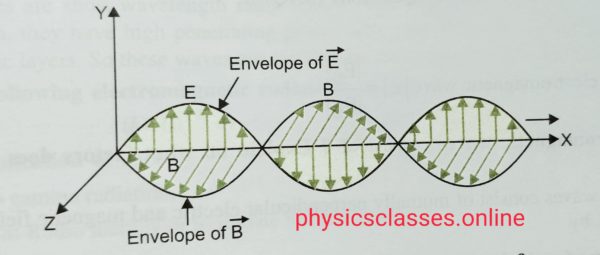
    4. What is meant by transverse nature of electromagnetic waves? Draw the diagram showing the propagation of an electromagnetic wave along X direction , indicating clearly the directions of oscillating electric and magnetic field associated with it .
    5. (a) which of the following electromagnetic radiations has least frequency: UV-RAY,X-RAY,MICROWAVES ?(b)How do you show that electromagnetic wave carry energy and momentum ? (c) write the expression for the energy density of an electromagnetic wave propagating in free space.
    6. An em wave is travelling in a medium with velocity v along x- axis , draw a sketch showing the propagation of the em wave , indicting the direction of oscillating electric and magnetic field . how are the magnitude of magnetic and electric field related to the velocity of em wave ?
    7. Give two characteristics of em waves . write the expression for the velocity of em wave in terms of permittivity and permeability of the medium .
    8. How are electromagnetic wave produced by oscillating charges ? state clearly how a microwave oven works to heat up a food item containing water molecule . why are microwave found useful for the radar systems in aircraft navigation?
    9. (a) name the em wave which are used for the treatment for certain form of cancer    . write their frequency range . (b) thin ozone layer on the top of stratosphere is crucial for human survival . why? (c) why is amount of momentum transferred by the em wave incident on the surface so small?
    10. (a)Which segment of em wave is higher frequency ? how are these wave produced / give one use of these wave .(b)which em wave lie near the high frequency end of visible part of em spectrum / give its one use . in what way this component of light has harmful effect on humen?
    11. Find the wavelength of em wave of frequency (i)5×10¹⁹Hz (ii) 6x 10¹²Hz (iii) 4x 10⁹ Write its two application, and how it is prepared? when an ideal capacitor is charged by a dc battery , no current flows . however , when an ac source used , the current flows continuously . how does one explain this , based on the concept of displacement current?
    12. Suppose that the electric field amplitude of an electromagnetic wave is E0=120N/C and that is frequency f =50.0MHz (i) determine B0,ω,k and λ (ii) find expression for electric and magnetic field .
    13. In a plane em wave , the electric field oscillate sinusoidally at a frequency of 2.0 x 10¹⁰Hz and amplitude 48V/m (i) what is the wavelength of the wave?(ii) what is the amplitude of oscillating magnetic field ?(iii) show that the average energy density of electric fields equal the average energy density of the magnetic field.
    14. A capacitor made of two circular plates each of radius r= 12cm and separation d = 5.0mm. the capacitor is being charged by an external source . the charging current is constant having value I = 0.15 A. (i) calculate the rate of change of electric field between the plates .(ii) find the displacement current across the plates .(iii)is Kirchhoff’s first rule is valid for each plate of capacitor ? Explain.
    15. A capacitor made of two circular plates each of radius r= 6cm and capacitance c=100pF. the capacitor is connected to an ac source of 230v with angular frequency 300rad/sec . (i) what is the rms value of the conduction current ?(ii)is conduction current equal to displacement current ?(iii)determine the amplitude of magnetic field induction at any point 3.0 cm away from the axis between the plates.                                          To read the complete chapter of em wave click here
  • Electromagnetic wave

    Electromagnetic wave

     Chapter:   ELECTROMAGNETIC WAVE

    What is em wave ? how it is produced ?and all kind of feature are explained here.

    The propagating in space through electric and magnetic field varying in space and time simultaneously are called electromagnetic wave .

    Origin – The electro magnetic wave are produced by an accelerated and deaccelerated charge or LC circuit . T he frequency of the electromagnetic wave is  ѵ = 1/2Π √LC .

    Characteristics of em wave –

    1. The electro magnetic waves is produced in free space with speed of light
    2. em waves are neutral , so they are not deflected by electric and magnetic field .
    • The em waves shows the properties of reflection, refraction , diffraction and polarisation.
    1. In em wave the electric and magnetic field are always in the same phase .
    2. The ratio of electric field and magnetic field in free space is constant which is equal to velocity of light ( c ) i.e. E0/B0 =1/√µ0ϵ0 =C=3 X 10⁸ m/s .
    3. In an em wave the energy is propagated by means of electric and magnetic field vectors in the direction of propagation of wave .

    Maxwell’s modification of Ampere’s law and displacement current –

    According to Ampere’s the line integral of magnetic field for a closed path is µ0 times the total current passes through the closed loop. i.e. ∫B. dl = µ0 I but Maxwell modified the law and, dc according to him ∫B. dl = µ0 (I + ID) Where Id is the displacement current.

    displacement current

     Displacement current – It is the current which come in the existence due to the rate of change of electric flux with respect to time

    As we know I = dQ/dt but between the plates of the capacitor  ,

    Electric field E = Q/ A ϵ0 and hence Q = E A ϵ0 = ɸ0 ϵ0 (WHERE ɸ0 = electric flux)

    But, I = dɸ0 /dt = ϵ0 dɸ0 /dt.

    So we can write improved form of Ampere’s law ∫ B. dl = µ0 ( I + ϵ0 dɸ0 /dt ) .

    Consequences of displacement current –

    (a)with the discovery of displacement current the law of electricity and magnetism become more symmetrical then before .

    (b) since the displacement current is produced by time varying electric field , an important link between electric field and magnetic field established .

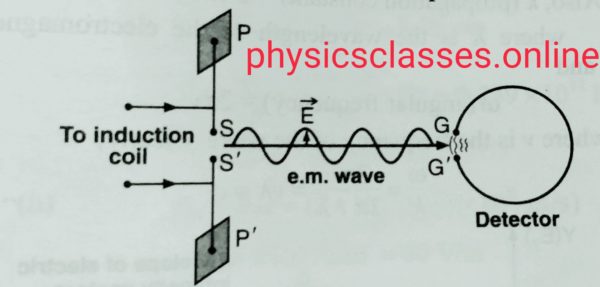
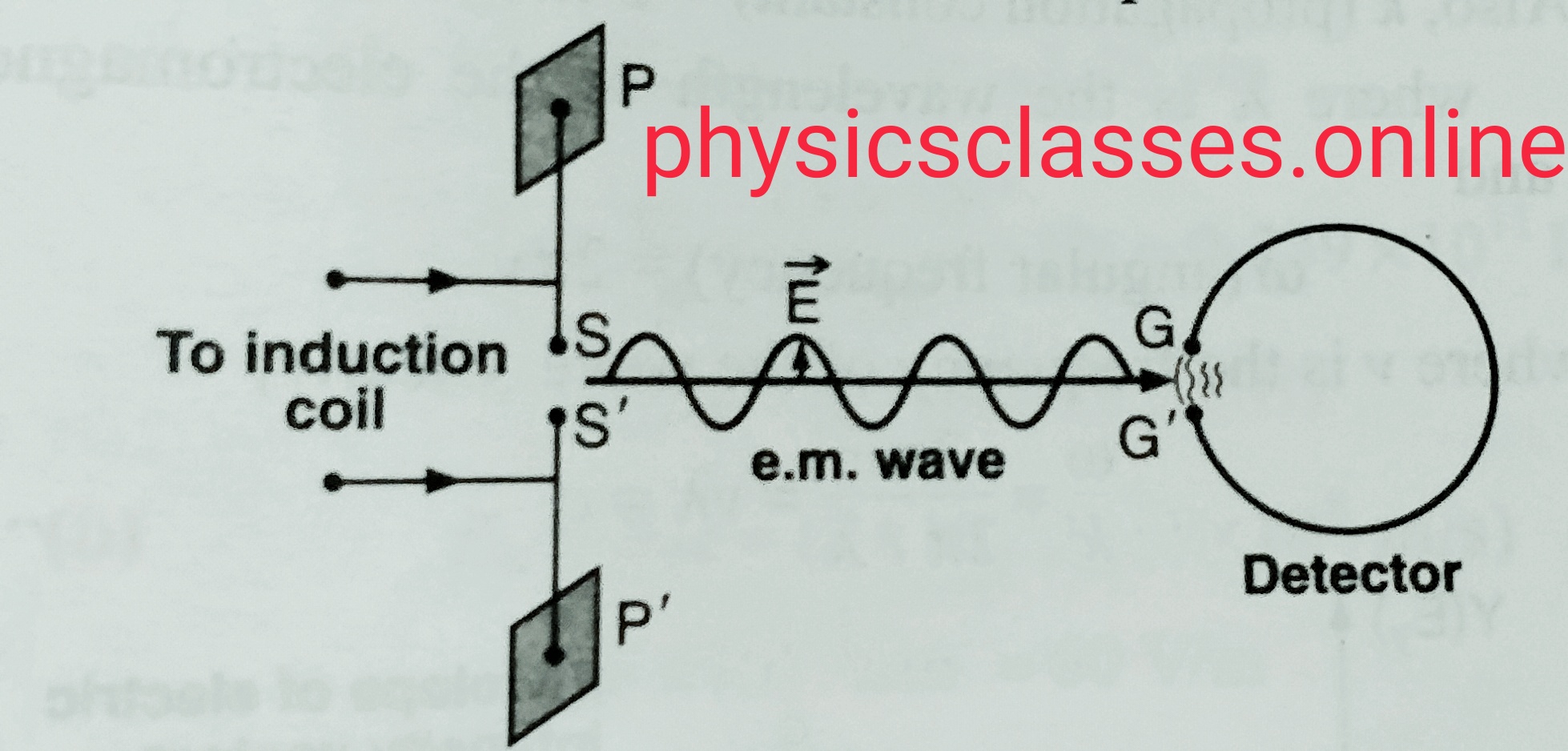
    Hertz’s experiment – Hertz demonstrated the production and detection of electromagnetic wave by electrical means . Experimental arrangement used by Hertz shown in figure :-   S and S’ are the two spheres connected by two large metal plates P and P’ , the spheres are connected to an induction coil . By causing a discharge between the spheres , the current distribution between the plates is such that an electromagnetic wave is generated parallel to the gap SS’ . the radiation thus produced is detected by Hertz by using an open wire loop . the em wave reaches at the gap GG’ of the detector has an electric field is enough the establish a high potential difference between this gap and cause a spark .

    Hertz experiment

    When the detector gap GG’ is at right angles to the right gap SS’ , no electromagnetic radiation detected  ,  the sensitivity is maximum  when the gap GG’  is parallel to SS’ . this property explain the transverse nature of the em wave , and em wave propagate perpendicular to the direction of propagation of electric field .

    Speed of electromagnetic wave in vacuum –

    According to faradays law of electromagnetic induction

    ∫E. dl = – dɸB /dt  ………..eq.1

    And according to Ampere-Maxwell’s law , ∫B. dl =µ0 I + µ0 ϵ0 dɸE /dt …………………..eq.2

    [ ɸB Flux for magnetic flux and ɸe is the electric flux .]

    For a plane polarised em wave travelling in the X- axis eq 1 and 2 gives

    dEy /dx = -dBZ/dt .

    or , dE/dx = – dB/dt ………………………eq. 3

    and ,    dBZ/dx = -µ0ϵ0 dEy/dt .

    or ,     dBx /dx = – µ0ϵ0 dE/dt ………………………eq. 4

    taking the partial differentiation of eq 3 we get

    d(dE/dx)/dx = – d(dB/dt)/dx = – d(dB/dx)/dt .

    or d2E/dx2 = -d(-µ0ϵ0 dE/dt)= µ0ϵ0 d2 E/dt2……………..eq. 5

    similarly ,

    d2B/dx2 = µ0ϵ0 d2 B/dt2 ………………………………..eq. 5

    on comparing eq 5 and 6 we get with the general equation of wave

    d2y/dx2 = (1/v2) ( d2y/dt2)     where  v is the speed of wave  .

    we get 1/v2 = µ0ϵ0 and hence ,

    we can write , v = 1/√ µ0ϵ0 or velocity of light in vacuum c = 1/√ µ0ϵ0 .

    Relation between electric and magnetic field with the speed of electromagnetic wave -the varying electric and magnetic field of a plane electromagnetic wave travelling along X- axis is given as ,

    Ey = E0 sin (kx-ωt) ………………………………………eq. 1

    Bz= B0(kx-ωt) ………………………………………………..eq.2

    Here , k = 2Π/λ

    ω =2Πѵ ,

    Clearly , ω/k = 2Πѵ/ (2Π/λ) = ѵλ = c .

    dE/dx = kE0 cos(kx-ωt)

    dB/dt = – ωB0 cos (kx-ωt)

    dE/dx = -dB/dt

    kE0 cos(kx-ωt) = ωB0 cos(kx-ωt)

    KE0 = ω B0 .

    E0/B0 = ω/K = c     ……………….this is the req. relation

    Intensity of electromagnetic wave – it is the amount of energy crossing per unit time per unit area perpendicular to the direction of propagation of electromagnetic wave .

    Let us consider there is a cylindrical region through which electromagnetic wave passing as wave is perpendicular to its area of cross-action , A is the area of cross-action and l is the length of the cylinder  , then volume of cylinder V = Al

    Total energy of the cylinder ; E= U.x Volume = U Al

    Intensity  I = total energy / (time x area) = U Al/ [(l/c) x A]= U X c

    Since U = ½ ϵ0E02 , therefore  intensity I = ½ ϵ0E02 c = ½ ϵ0Erms2 (√2)2 c = I = ϵ0 Erms2 c .

    For very important questions of electromagnetic wave click here
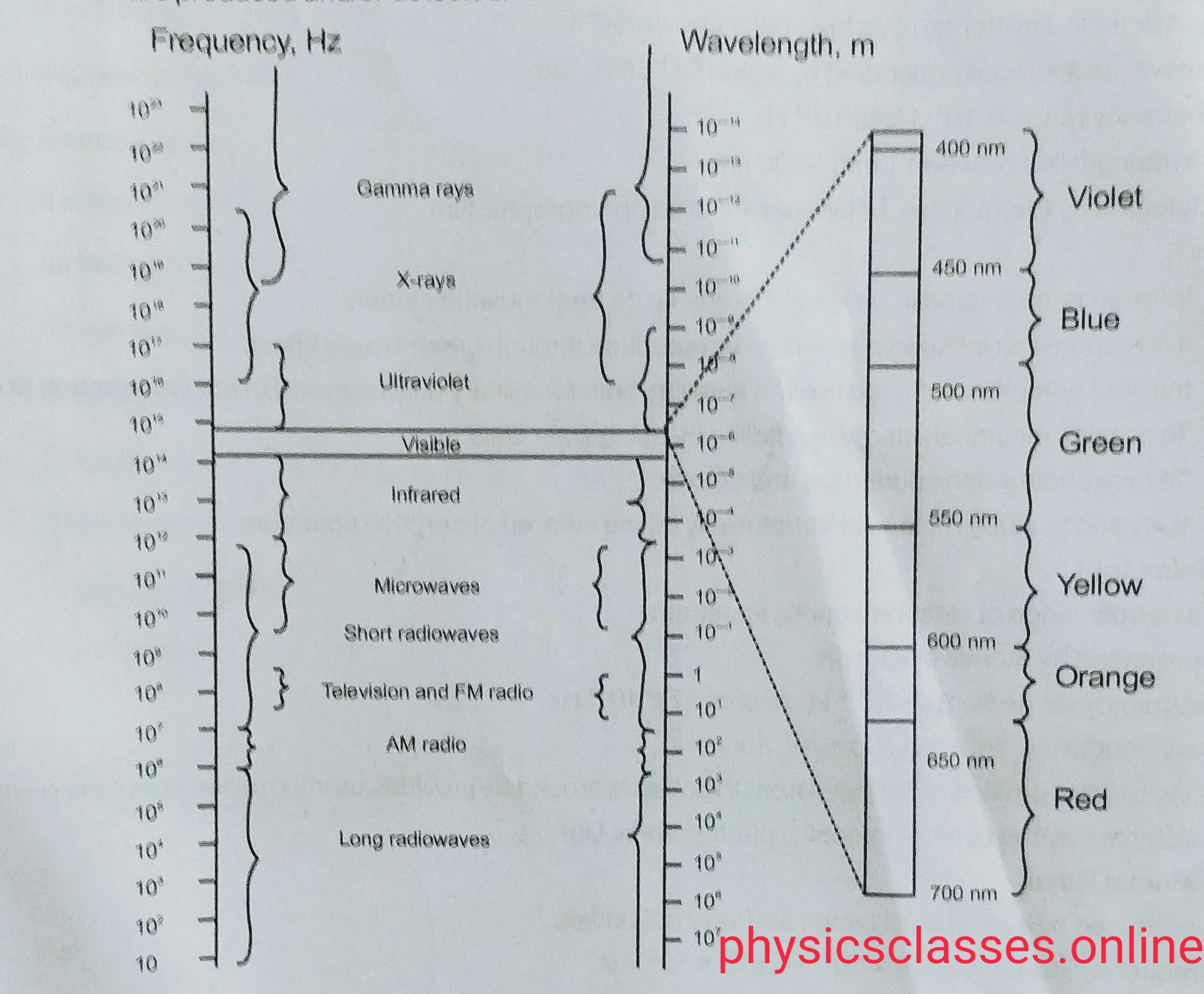
    Electromagnetic spectrum –

    Maxwell predicted the existence of em wave  .

    “ The orderly distribution of electromagnetic  radiation according to there frequency / wavelength is called electromagnetic spectrum .”

    em wave spectrum
    • Radio wave – It is produced by the accelerated motion of charges in conducting wire or we can say by oscillating electric circuit .

    Its frequency range is 500kHz – 1000MHz , wavelength range is 10-2m – 104m. it reflects , refract and diffract . it is used in radio and t.v. communication.

    • Microwave – It is produced by special vacuum tube known as klystrons ,magnetrons . its frequency range is 1GHz – 300GHz . It is used as radar system for aircraft navigation , detect the speed of cricket ball, automobile etc. its another use is in microwave oven .
    • Infrared waves – it is produced by hot bodies i.e. vibration of atoms and molecules . Human eye can’t detect it but snake can detect it . These wave is absorbed by water , co2 and NH3 . Its frequency range is 1011Hz-1014Hz and its wavelength is                      between ,  1mm-700nm   . It  can be detected by infrared photographic film . it is used to treat muscle strain  (physical therapy), green house effect, satellite for military purpose and to observe growth of crops, to provide electrical energy in the satellite by using solar cell , to take the photograph during fog and smoke and it is used to study molecular structure.
    • Visible light – It is produced by atomic excitation . Its frequency range is 4x 10¹⁴Hz -7x 10¹⁴Hz. , its wavelength lies between 700 nm – 400 nm . It makes the thing visible .
    • Ultraviolet ray – It produced by sun , special lamp and very hot bodies . Its frequency lies between 8 x 10¹⁴ Hz – 5 x 10¹⁶ Hz. Its wavelength lies between 400 nm – 0.6 nm . it is detected by photocell and photographic film . It causes the harmful effect on human being. It is used in eye surgery , kill germs in water purifier , to kill the bacteria , in finger print technology.
    • X- ray – It is produced in a tube called modern X-ray tube . its frequency range is between 1016 Hz – 1021Hz . its wavelength lies between 10nm – 10-4nm. It is used as a diagnostic tool in medicine and treatment of certain forms of cancer , in engineering it is used to detect cracks and holes , defect in rubber tyre and gold .
    • Gamma rays – it is produced in nuclear reaction they are emitted by radioactive nuclei , its frequency range is 1018-1022Hz . its wavelength is less than 10-3nm. It is detected by photographic film , Geiger tube , ionisation chamber. They shows phosphorescence , fluorescence ,polarisation , diffraction. It has very high penetrating power . it is used for cancer therapy, and it provide important information regarding nuclear structure.
    • chart frequency range

      To read or solve very important questions of electromagnetic wave click here
  • Projectile motion

    Projectile motion

    Projectile motion

    Projectile given horizontal projection and projectile given angular projection

    In this topic we will discuss about projectile given horizontal and projectile given angular projection. And we will derive the expressions for equation of trajectory, time of flight , vertical height , horizontal range and velocity of projectile at any time .

    Projectile motion-

    When a body has given some initial velocity , and body allowed to move in two dimensional motion under the action of gravitational force only ( i.e. there is no any external force acting on the body ) such kind of motion of the body is called projectile motion .

    • Important things to know about the projectile motion- projectile moves with constant horizontal velocity, there are no any external force it means there is no acceleration or retardation in horizontal motion.
    • The vertical velocity changes with time i.e. increases or decreases when moves downward or upward direction respectively under the gravitational acceleration.
    • There is no air resistance ( practically it is not possible in earth surrounding , but considered)
    • The magnitude of acceleration due to gravity remain constant at every point it doesn’t changes even at height or depth.
    • Projectile given horizontal projection-
    • HORIZONTAL PROJECTION
      HORIZONTAL PROJECTION

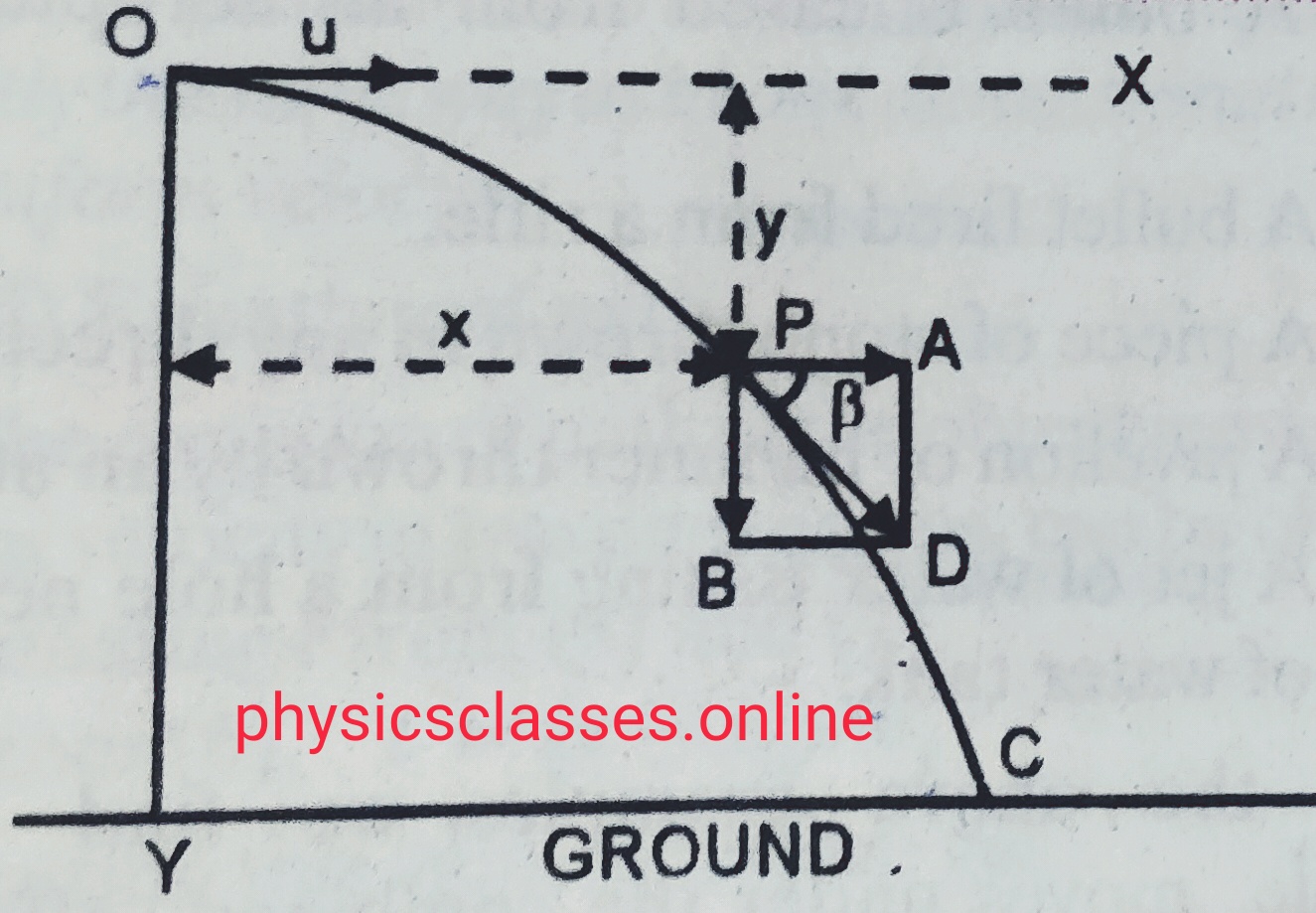
    Suppose OX a horizontal line is parallel to the ground and oy is vertical height. A body is projected with velocity  u in horizontal direction ,

    so, ux = u and uy = o

    Let t is the time taken by the body to reach from initial point O to final point C ( as shown in fig. ) then ,    horizontal distance X = ux x t  = u x t

    so  t= x /u

    Again for vertical motion  Y = uyt + ½ gt2 = 0 + ½ gt2

    y = ½ g (X/u)2

    or , Y = ½ g X2/u2……………………..(i) This the equation of trajectory which is equation of parabola , then we can say path followed the projectile is parabolic .


    Time of flight (T)  – It is the time taken by the projectile to reach from initial to final position , let T is the time of flight and H is the height ,

    Then,  from equation of motion  Y = uy + ½ gT2

    ( but uy =0)

    so, Y= ½ g T2

    or ,  T = √2H/g ………………(ii)

    Horizontal range (R)   – It is the horizontal distance covered by the projectile during its flight . Since there is no acceleration in horizontal direction.

    So , distance = speed x time

    X = R = u x T = u √2H/g .

    Velocity of the projectile at any time ‘t’ –  As shown in fig. at point p  , there are are two components of the velocity ,  vx and vy along horizontal and vertical direction respectively , then , v =  √(vx)2 + (vy)2

    Or , v = √ u2 +(gt)2 ( since , vx = u and vy = gt )

    Let v makes an angle β with the horizontal then , tanβ = vy/vx

    Or , tanβ = gt/u .

    Or , β = tan-1(gt/u) with the horizontal.

    TO SEE THE VIDEO ON PROJECTILE GIVEN HORIZONTAL PROJECTION CLICK HERE-

    Projectile given angular projection- 

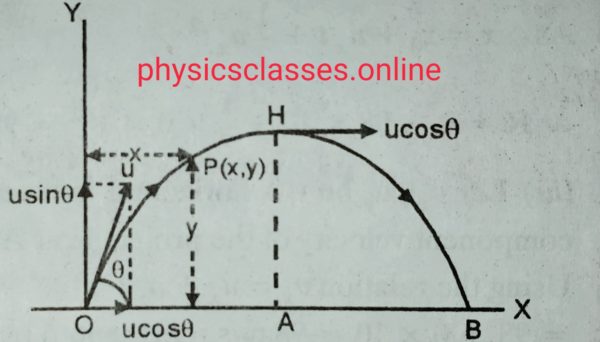
    ANGULAR PROJECTION
    ANGULAR PROJECTION

    Suppose a projectile is projected at an angle θ with horizontal , and velocity given to the projectile is ‘u’ . OX and OY are the horizontal and vertical axis respectively . Then the component of velocity along OX and OY are respectively u cosθ  and  u sinθ .


    Equation of trajectory-  let  ‘t’ is the time taken by the projectile to reach from point O to point B as shown in fig.

    Then horizontal distance X = u cosθ x t ,

    Or, t=x/ucosθ

    But for vertical motion ,  y= uyt + ½ g t2

    Putting the  value of time in the above equation we get ,

    Y = usinθ .( x/ucosθ)   + ½ g ( x2/ u2 cos2θ) .

    Or , y=  x tanθ + ½ g (x2/u2 cos2θ) …………………….this is the equation of trajectory , which is parabolic . Hence we can say path followed by the projectile is parabolic .


    Time of flight (T) –     It is the total time taken by the projectile to reach from initial position to the final position .   Total time of flight ( T) =  ta ( time of ascent) + td (time of descent ) .

    [       Time of ascent is the time taken by the projectile to reach to max. height by the projectile. And time of descent is the time taken by the projectile to reach from highest position to the point on the ground .]

    As we know , for ascending motion , v = uy – gta

    But at highest point v=0 , so , 0= u sinθ – g ta

    g ta = u sinθ

    ta = u sinθ/g ;

    Hence, Time of flight  , T = 2 ta = 2u sinθ/g ……………eq.


    maximum height(H) – It is the maximum vertical height attained by the projectile above the point of projection during its flight .

    from 3rd equation of motion v2 -u2 =2as ;

    0 – u2sin2θ = – 2gH

    H = u2sin2θ/2g ……………………eq.

    Horizontal range(H) –  It is the displacement of the projectile  between point of projection and point of hitting the ground .

    Since there is no acceleration in horizontal direction and hence

    X= R = u cosθ x T = u cosθ . 2u sinθ/g = u2 2sinθ cosθ/g  = u2 sin2θ /g ;

    Range R = u2 sin2θ /g ………………eq.

    TO SEE THE COMPLETE VIDEO ON PROJECTILE GIVEN HORIZONTAL PROJECTION CLICK HERE-

    Velocity of projectile at any time –

    VELOCITY OF PROJECTILE AT ANY INSTANT
    VELOCITY OF PROJECTILE AT ANY INSTANT

    At ant time the velocity has two components vx (velocity along x- axis) and vy (velocity along y-axis ). So at any time velocity v= √vx2 + vy2

                                                                                           v = √ [u2 cos2 θ + (u sinθ – gt)2 ].

    Or , v = √ (u2 + g2t2-2ugt sinθ ).

    Let β be the angle of resultant velocity with horizontal direction then ,

    Tanβ = (u sinθ-gt) / (ucosθ)

    [ ***** note- question based on the projectile may be asked to find the all equations but angle of projection is θ with the vertical instead of  horizontal in that case  , at the place of sinθ take cosθ and vice-versa .*******]

  • LC-oscillation

    LC-oscillation

    OSCILLATION IN AN LC – CIRCUIT

    LC- oscillation —-

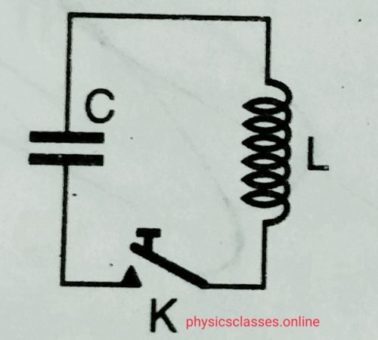
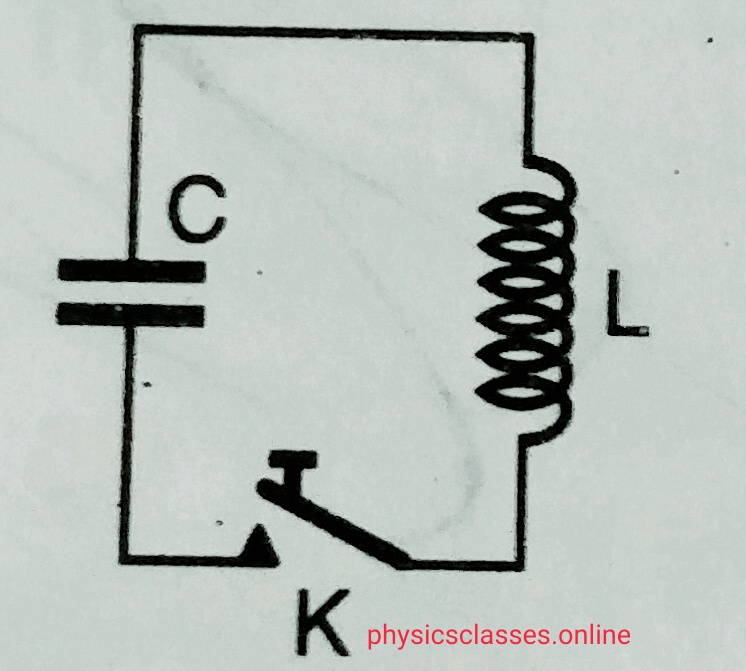
    An LC circuit consists  an inductor and a capacitor connected in parallel . Its another name is tank circuit.

    Working –

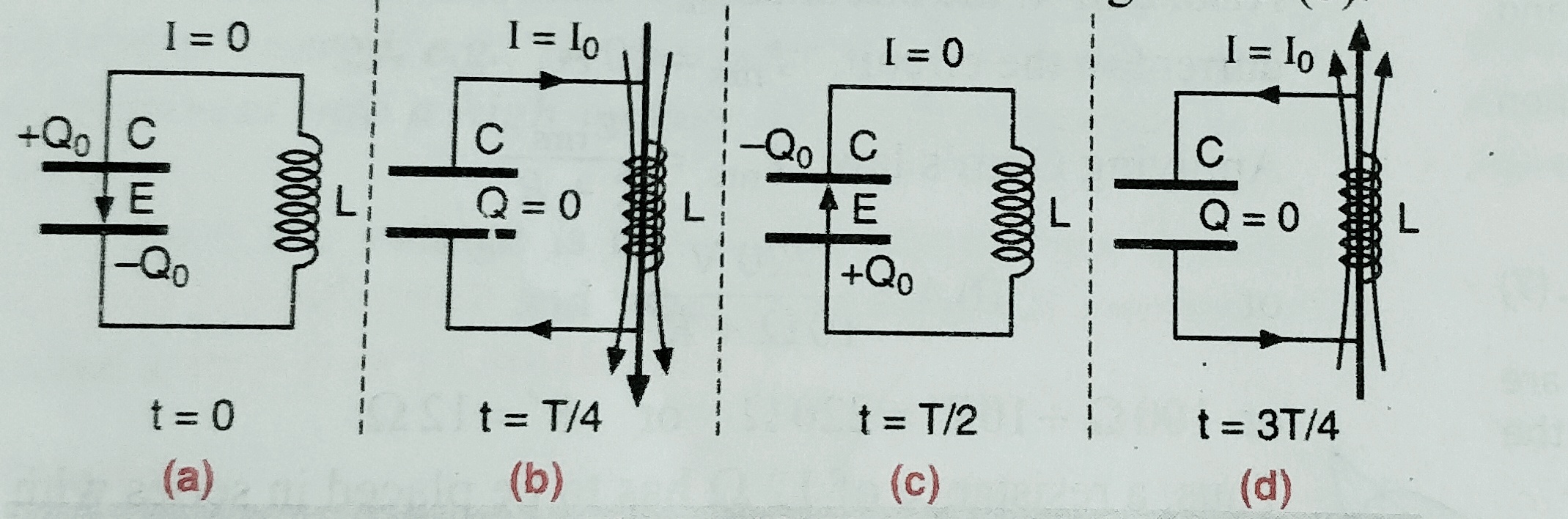
     At t= 0 – – capacitor is first charged . The whole energy is stored in the capacitor which is U= ½ CV2 , at that instant charge on the capacitor is Q , and there is no current through the circuit and energy in the inductor at that instant is zero .

     Watch Important Physics Videos 

    At t=T/4 (T= time period of oscillation ) –  –  the capacitor begins to discharge and a  growing current starts flowing through the inductor , which setup magnetic field around it which produces induced current in the inductor  in opposite direction  and hence there is delay in discharge . As the capacitor discharges its energy starts decreasing which converted as magnetic energy in the inductor , and at an instant total charge in capacitor is zero , and hence energy stored in the capacitor is zero and energy stored in the inductor at that time is ½ LI2‑.

    At t=T/2 – as soon as capacitor is completely discharged , the magnetic field around the inductor starts decreasing , it produced an induced emf in opposite direction  , due to which capacitor start charging it self in opposite direction and at an instant inductor discharged completely and capacitor charged completely again which is ½ CV2 .

    This process repeated again and again then energy obtained once keep on oscillating between capacitor and inductor and to and fro pulses of current are produced .

    LC-OSCILLATOR
    LC-OSCILLATOR
     WORKING OF LC-OSCILLATION AND DERIVATION OF ITS FREQUENCY – Watch Video Below

    Derivation for frequency of LC- oscillation

    – Suppose an electrical circuit having a capacitor of capacitance C and an inductor of inductance L connected as shown in fog. Below-

    LC OSCILLATION
    LC OSCILLATION

    . Let the capacitor is charged Q initially and when key is closed emf induced in the inductor is L (di / dt) and potential difference across the capacitor is Q/C . Then from Kirchhoff’s law    L (dI/dt) +Q/C =0 ………..(i)

    But I = dQ /dt

    And hence eq. (i) may be written as

    L(d2Q/dt2)+ Q/C =0

    Or , d2Q/dt2 + Q/LC = 0 ………………………..(ii)

    But as we know eq . of SHM.  May be written as  d2x/dt2+ ω2x = 0  ………..(iii)

    Comparing eq. (ii) and (iii) we get

    ω2 = 1/LC

    or,  ω= 1/√LC .

    but ,   ω=2Πѵ ( where ѵ=frequency)

    so ,  frequency ,  ѵ= 1/2Π√LC


  • PHASOR DIAGRAM

    PHASOR DIAGRAM

    PHASOR DIAGRAM-

    PHASORS AND PHASOR DIAGRAM-

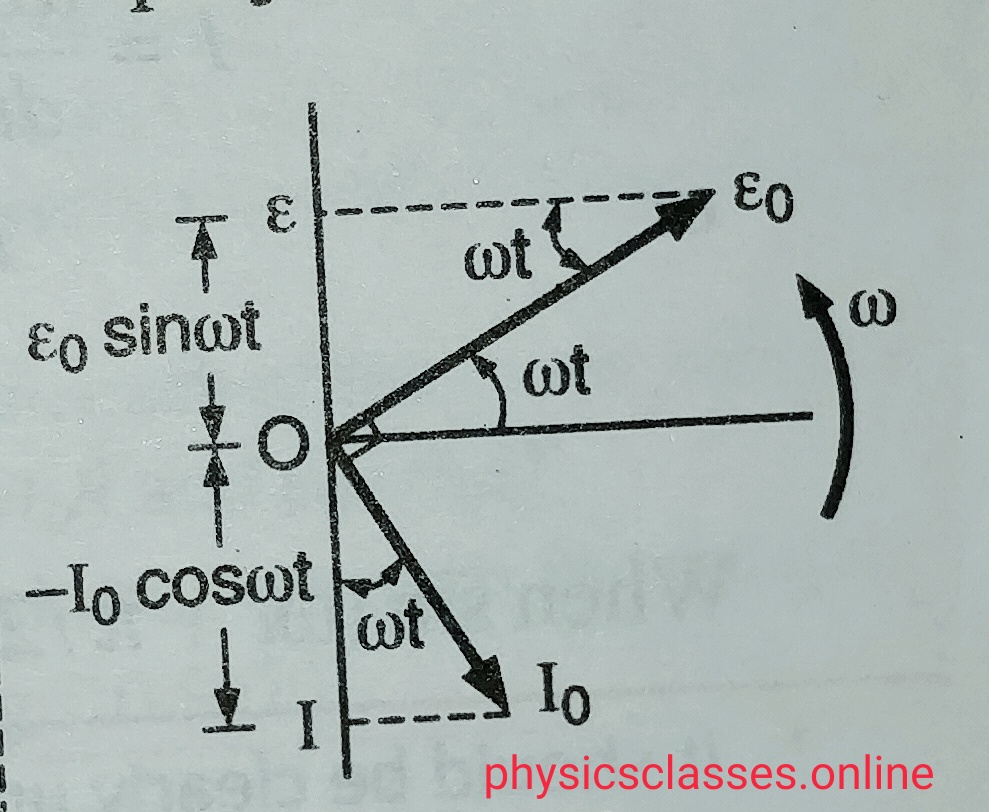
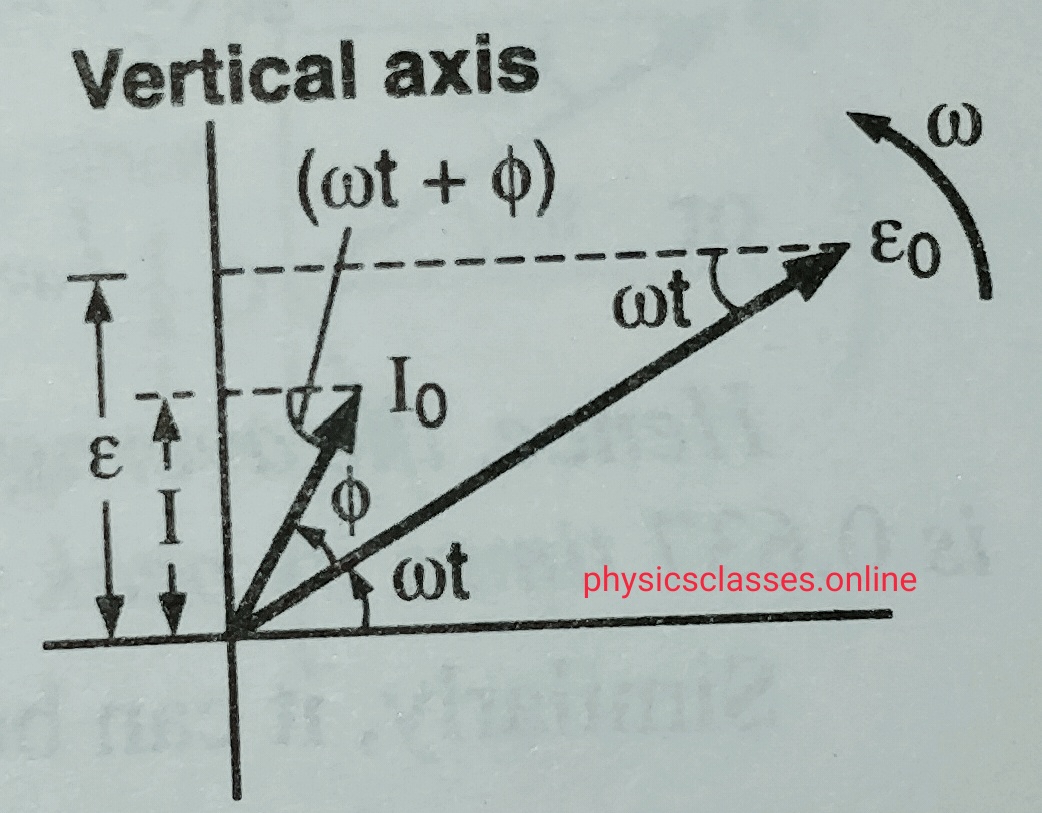
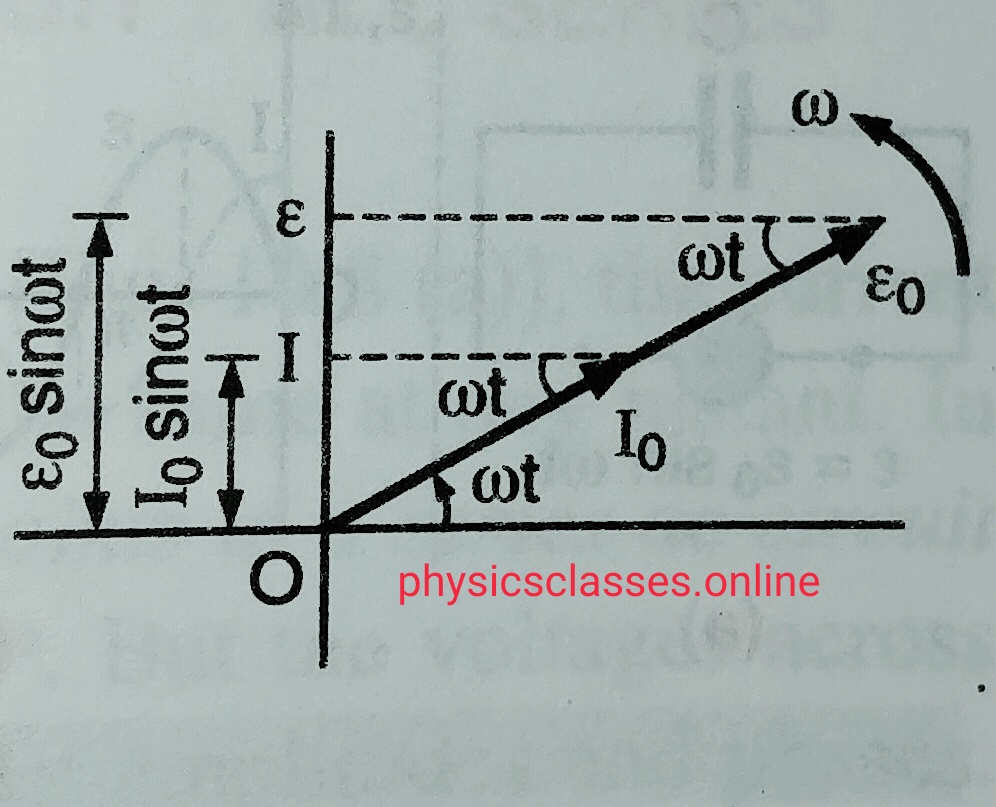
    The co-planar vectors which represents sinusoidal time varying quantities like alternating current or alternating voltage are known as phasor and the graphical representation of these quantities for the ac circuit is known as phasor diagram.

    In another words we can say when AC or alternating voltage  represented as rotating vectors in a graph is  known as phasor diagram .

    • Phasors are represented by the arrows rotating anticlockwise .
    • The length of the arrow represent the peak current or peak voltage.
    • Phasor diagram represents the phase relation between alternating current and voltage

    Representation of phasor diagram for an ac source-

    PHASOR DIAGRAM1
    PHASOR DIAGRAM-1


    Phasor diagram when ac circuit containing only resistance –

    PHASOR DIAGRAM -2
    PHASOR DIAGRAM -2

     Phasor diagram when ac circuit containing only capacitor-

    PHASOR DIAGRAM -3
    PHASOR DIAGRAM -3


    Phasor diagram when ac circuit containing only inductor-

    PHASOR DIAGRAM -4
    PHASOR DIAGRAM -4


  • What do you mean by Relative velocity ?

    What do you mean by Relative velocity ?

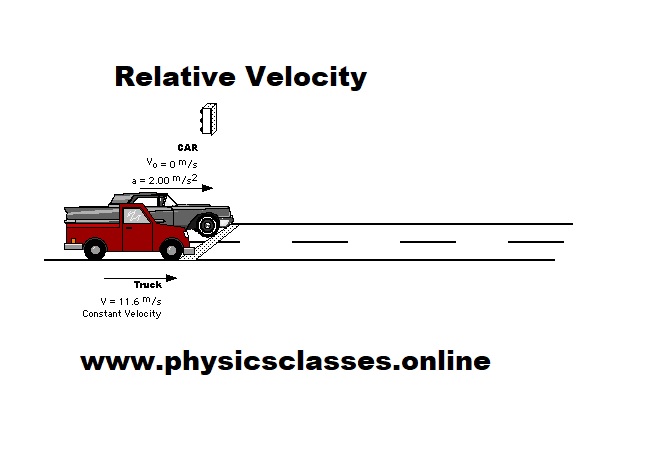
    This topic will discuss about the velocity of an object with respect to another object. In this article you will learn Relative Velocity Analysis  in both forms text and video as well.

     Relative velocity of one object with respect to another is the velocity with which one object moves with respect to another object .When two objects A and B are moving with different velocities , then the velocity of one object A with respect to another object B is called relative velocity of object A with respect to object B , hence relative velocity is defined as the time rate of change of relative position of one object with respect to another.

    • Watch Relative Velocity Analysis Video :

    Expression for the relative velocities – Suppose two objects A and B moving with uniform velocities VA and VB respectively along parallel straight line path in the

    (i) Same direction (I.e. angle between them is 00)  ;

    Relative velocity of A with respect to B = VA -(VB ) = VA -VB


    (ii) Opposite direction (I.e. angle between them is 1800)

    Relative velocity of A with respect to B = VA – (-VB ) = VA + VB

    To read or download complete topic of Relative velocity click here-


    Download QA for various chapters of Physics 


  • GRAPH

    GRAPH

    GRAPH

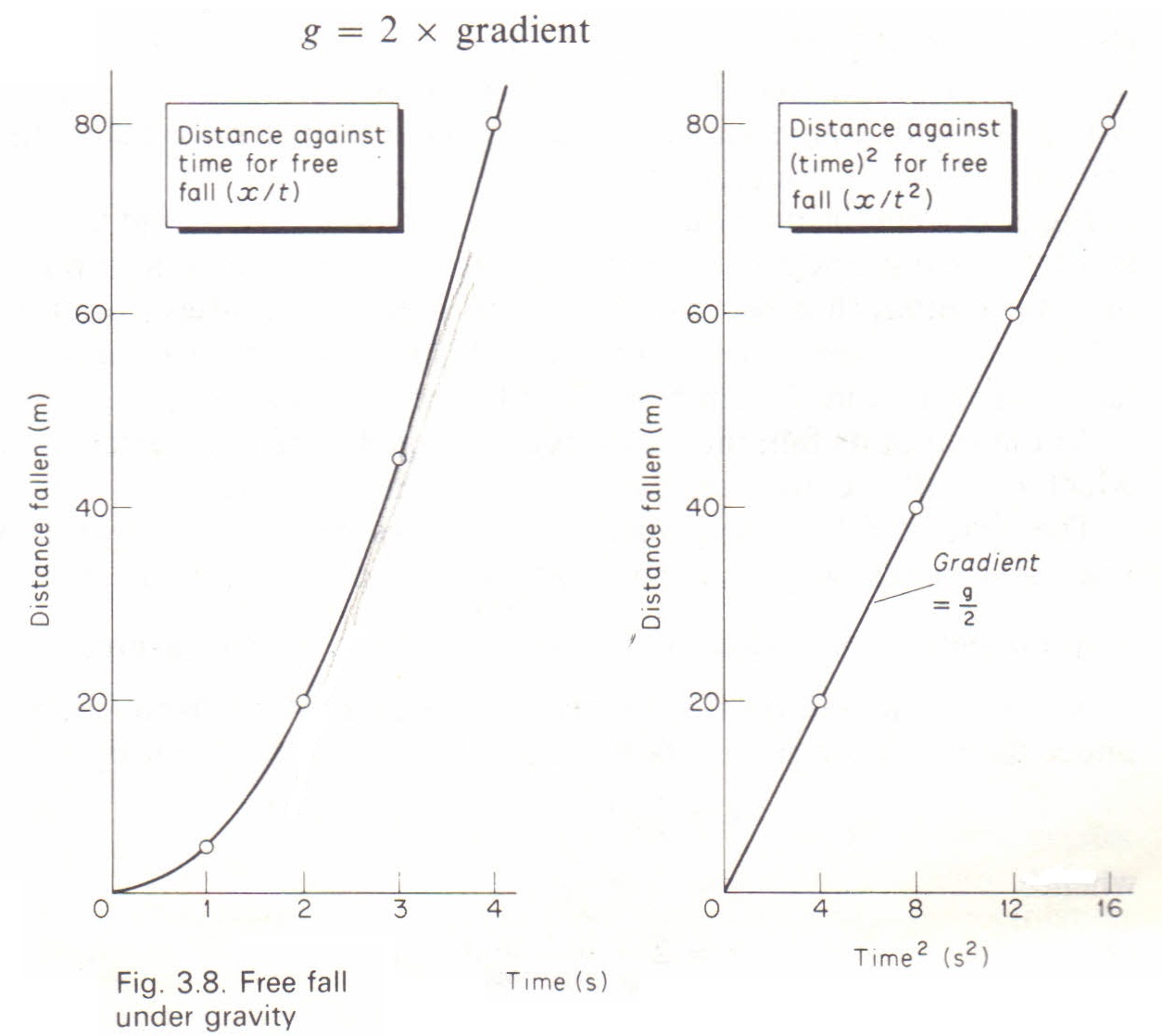
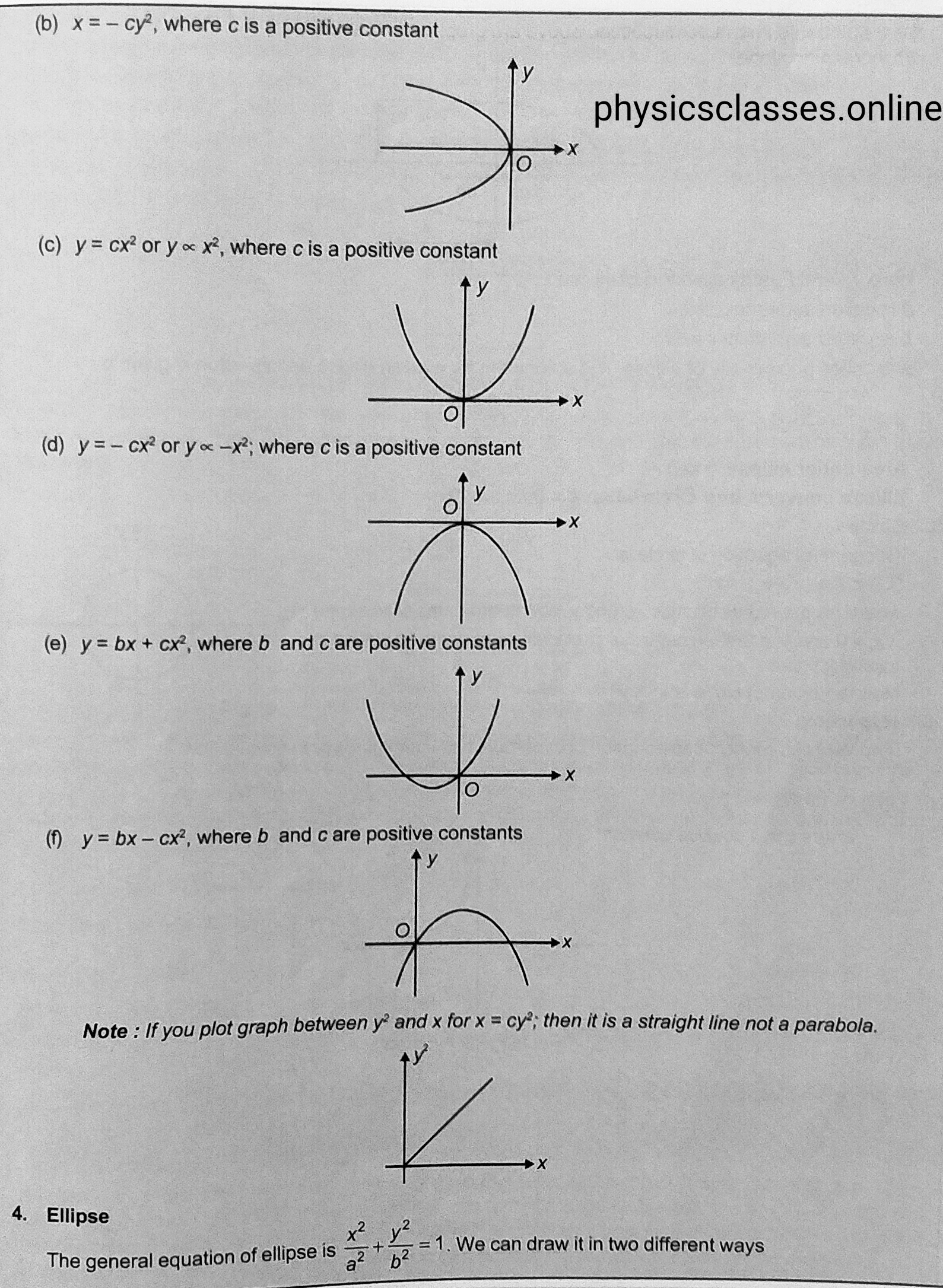
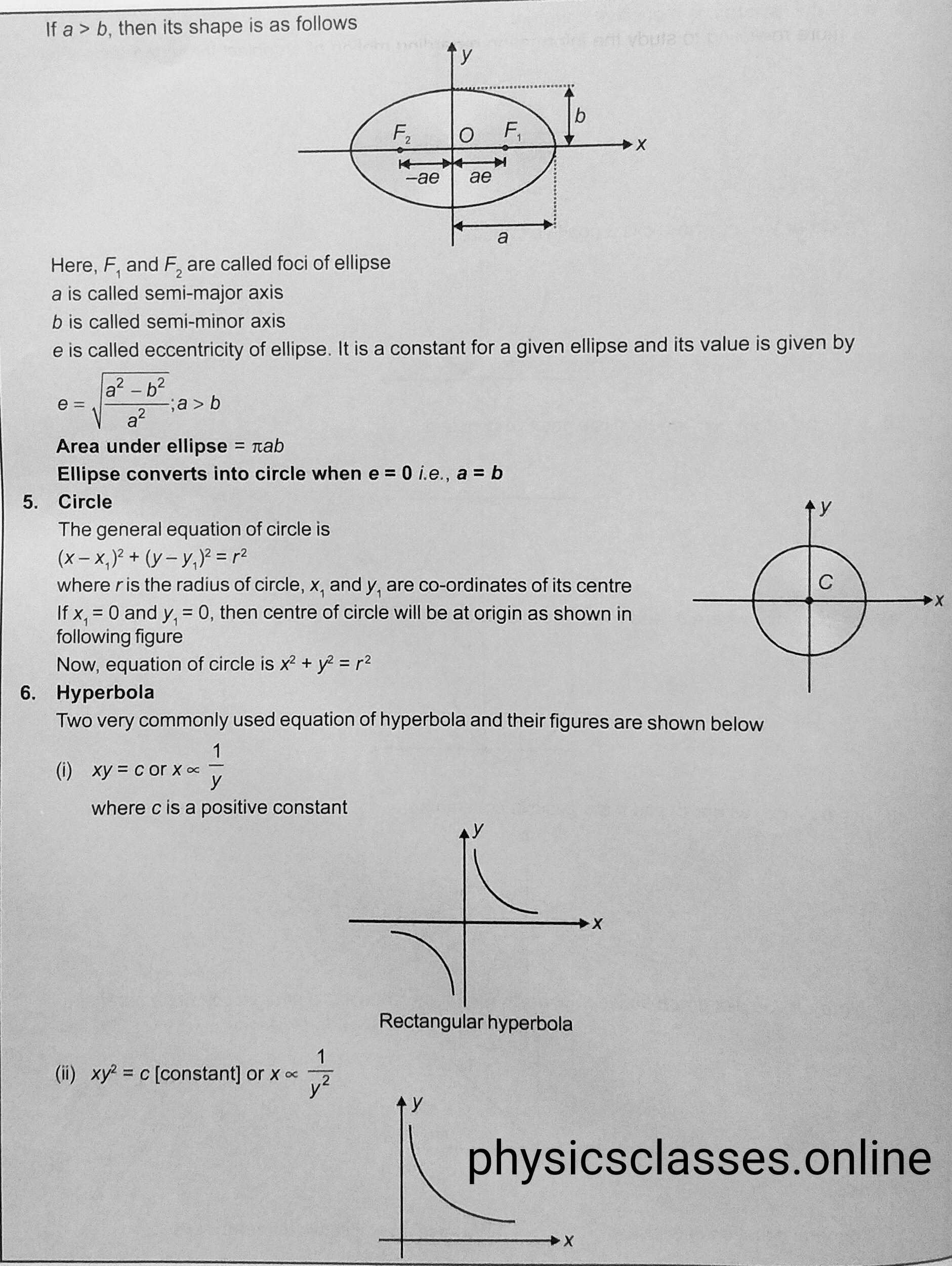
    In this post we will discuss about the graph , and how graphs makes to understand  the physics easily ?

    Graph-

    As we know it is not easy to study or understand the physics. Students who is taking interest in physics and want to understand the physics, it is necessary to improve your mathematics and most importantly graph, students who can’t solve the graphical questions will face lot of difficulties. So I am trying to provide some information/ knowledge for the students, so that students can understand the graphical questions easily. Now these days questions based on graph is important for every topics of physics specially the students who is appearing in the JEE/ NEET examination. Graph makes the calculation easier and it makes the topic to understand more easy. So every students must have to understand the graph and solve the questions based on it.

    Pg. -1

    peg 1 graph
    peg 1 graph

    Pg. -2

    peg 2
    peg 2

    Pg. – 3

    peg 3
    peg 3

    Pg. – 4

    peg 4
    peg 4


    Pg.-5

    peg 5
    peg 5