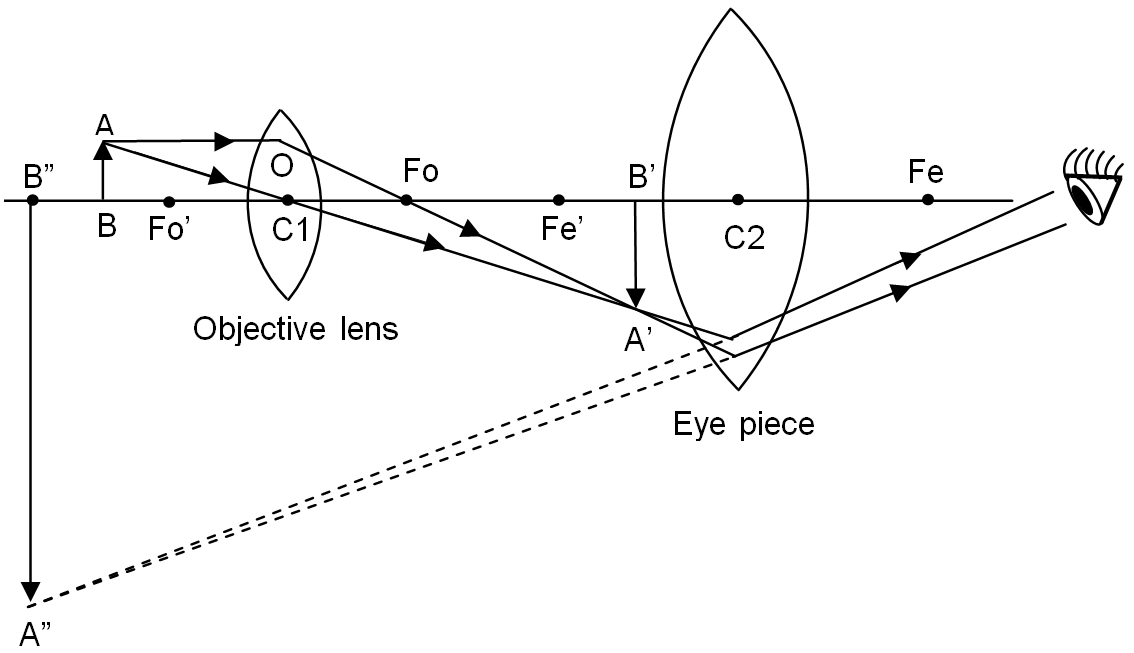
An astronomical telescope is an optical instrument which is used for observing distinct images of heavenly bodies libe stars, planets etc. It consists of two lenses . In normal adjustment of telescope , the final image is formed at infinity . Magnifying power of astronomical telescope in normal adjustment is defined as the ratio of the angle subtended at the eye by the angle subtended at the eye by the final image to the angle subtended at the eye , by the object directly , when the final image and the object both lie at the infinite distance from the eye . It is given by m = f0/fe. To increase magnifying power of an astronomical telescope in normal adjustment , focal length of objective lens should be small.
(i)An astronomical telescope of magnifying power 7 consists of two thin lenses 40cm apart , in normal adjustment . The focal length of the lenses are (a) 5cm,35cm (b) 7cm , 35cm (c)17cm , 35cm (d)5cm, 30cm.
(ii) An astronomical telescope has a magnifying power of 10. In normal adjustment , distance between the objective and eye piece is 22cm . the focal length of the objective lens is ,(a)25cm (b)10cm(c)15cm (d)20cm.
(iii) In astronomical telescope compare to eye piece , objective lens has (a)negative focal length (b)zero focal length (c)small focal length (d)large focal length .
(iv)To see stars use (a)simple microscope (b)compound microscope (c)endoscope (d)astronomical telescope.
(v)For large magnifying power of astronomical telescope (a) f0<<fe (b)f0=fe (c)f0>>fe (d)none of these .
Total internal reflection is the phenomenon of reflection of light into denser medium at the interface of denser medium with rarer medium . For this phenomenon to occur necessary condition is that light must move from denser to rarer and angle of incidence in denser medium must be greater than critical angle for the pair of media in contact. Critical angle depends on nature of medium and wavelength of light . We can show that µ=1/sinC (where C is the critical angle).
(i) critical angle for glass air interface , where µ for glass is 3/2 , is (a)41.80 (b) 600 (c)300 (d)150 .
(ii)Critical angle for water air interface is 48.60 , then what is the refractive index of water/(a)1 (b)3/2 (c)4/3 (d)3/4
(iii) critical angle for air water interface for violet colour is 490 its value for red colour will be (a)490(b)500 (c)480 (d)can’t say.
(iv) Which of the following is not due to total internal reflection?(a) working of optical fibre (b)difference between real depth and apparent depth of a pound.(c)mirage on hot summer day (d) brilliance of diamond.
(v) critical angle of glass is θ1 and that of the water is θ2 critical angle for water and glass surface would be (µg > µw) (a) less than θ2 (b) between θ1 and θ2 (c)greater then θ2 (d)less than θ1 .
2. Power of a lens-
Power (P) of a lens is given as the reciprocal of focal length (P=1/f)where f should be in meter and P is in Diopter . for convex power is positive and concave power is –ve. When two or more lenses are kept in contact then power of the combined lens is given as P= P1 + P2+P3 …….
(I) A convex and a concave lens is separated by distance d are then put in contact then the focal length of the combination (a) becomes 0 (b) remain the same (iii) decreases (iv)increases.
(ii)The two lenses of power +1.5D and +1.0D are placed in contact then the effective power of the combination will be (a)2.5D (b)1.5 D (c) 0.5D (d)3.25D .
(iii) If the power of the lens is 5D then what is the focal length of the lens?(a)10cm (b) 20cm (c)15cm (d) 5cm
(iv)Two thin lens of focal length +10cm and -5cm are kept in contact , the power of the combination is ? (a)-10D (b)-20D (c)10D (d)15D .
(v)A convex lens of focal length 25cm is placed coaxially in contact with a concave lens of focal length 20cm the system will be ; (a) converging in nature (ii) diverging in nature (c) can be converging or diverging (d) None of the above.
3.
4. Refraction through a prism
A prism is a portion of a transparent medium bounded by two planes face inclined to each other at a suitable angle . A ray of light suffers two refraction on passing through a prism and hence deviates through a certain angle from its original path . The angle of deviation of a prism is ɗ = (µ-1 )A , through which a ray deviates on passing through a thin prism of small refracting angle A . If µ is the refractive index of the material of the prism then the prism formula is µ = sin(A+ɗm/2)/sin(A/2).
(i) For which colour , angle of deviation is minimum ?(a) Red (b)yellow (c) violet (d) blue.
(ii) When white light moves through vacuum (a) all colours have same speed (b)different colours have different speed (c) violet has more speed then red (d)red has more speed then violet.
(iii)The deviation through a prism is maximum when angle of incidence is (a)450 (b) 700 (c)900(d)600 .
(iv)What is the deviation produced by a prism of angle 60 ? (µ=1.644) (a)3.840 (b)4.595(c)7.259(d)1.252.
(v) A ray of light falling at an angle of 500 is refracted through a prism and suffers minimum deviation . If the angle of prism is 600, then the angle of minimum deviation is (a) 450 (b) 750 (c)500 (d)400 .
This assignment provides Very important short answer type questions of ray optics which is very important for the class 12th board examinations.
1.What are the necessary conditions for the phenomenon of total internal reflection to occur . Also write the relation between refractive index and critical angle for a given pair of optical media.
2. State the principle on which the working of an optical fiber is based. What are the necessary conditions of phenomenon to occur?
3. Define critical angle . Obtain a relation between refractive index and critical angle for a pair of media . Does critical angle depends on the colour of light ? Explain.
4. Draw ray diagrams to show how specially designed prism make use of total internal reflection to obtain the inverted image of the object by deviating rays (i) through 900 (ii) through 1800.
5. Find the relation between real depth and apparent depth with the refractive index , when light moves from denser medium to rarer medium.
6. A fish in the water tank sees the outside world as if fish at the vertex of cone such that the circular base of the cone coincide with the surface of water . Given the depth of water were fish is located being h and critical angle for water-air interface being ic , find out by drawing the ray diagram the relationship between the radius of the cone and height h.
7. Draw the ray diagram showing the path of a ray of light entering through a triangular glass prism . Deduce the expression for the refractive index of glass prism in terms of the angle of minimum deviation and angle of the prism.
8. A convex lens of focal length f1 is kept in contact with another lens of focal length f2 . Find an expression for the focal length of the combination.
9. Why does the sun appear reddish at sunset or sunrise? For which colour the refractive index of prism material is maximum and minimum?
10. Draw the ray diagram showing formation of image by a magnifying glass when the image is formed at infinity also find the angular magnification of image.
11. Define the magnifying power of compound microscope when the final image is formed at infinity. Why does objective and the eyepiece of a compound microscope has short focal lengths ? explain.
12. Draw a schematic diagram of reflecting telescope (Cassegrain). Write its two advantages .or, Modern telescope prefer using suitable mirrors over using suitable lens , give two reasons for this preferences.
13. Use a lens formula and show that (i) Object placed at the focal length of the convex lens for image at infinity.(ii) Object is placed between O(optical center) and F (focus) the image will be virtual.
14. Draw a plot showing the variation of power of a lens with the wavelength of the incident light.
15 A double convex lens made from a material of refractive index µ1 is immersed in liquid of refractive index µ2 where µ2>µ1 . What change if any, would occur in the nature of the lens?
The upward force experience by a body when it moves through a fluid is called dynamic lift . Such a lift is felt by airfoil , aircraft win etc. Couse behind it can be explained by Bernoulli’s theorem . It also explain why a spinning ball is deviated from its parabolic path .This deviation is usually observed in many games like cricket, football golf, tennis etc.
As a ball moves through air without spinning , it divides the streamline above and below it symmetrically . Thus there is no pressure difference on the two sides of the ball.
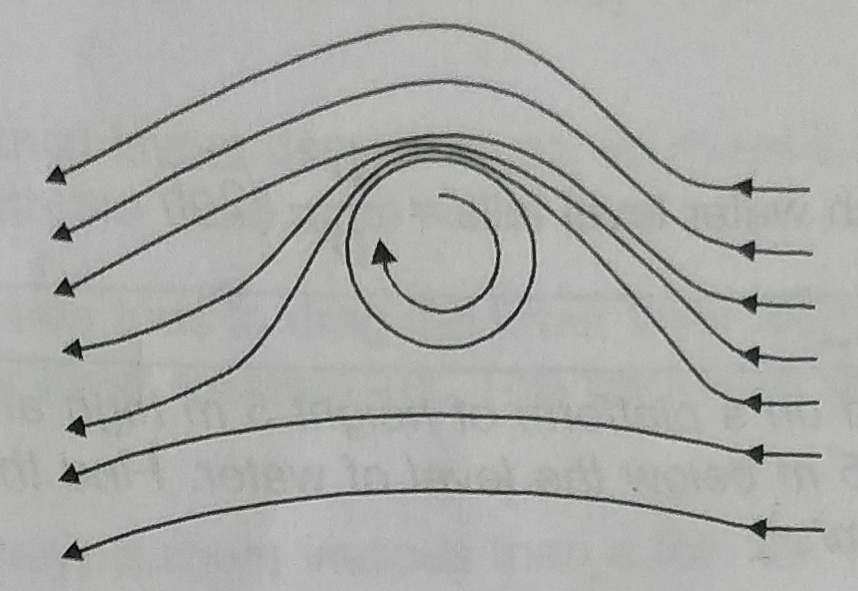
But when a ball spins as it moves through air , it drags along a layer of air with itself. When the ball moves forward , the air ahead of the ball rushes backward to fill the space left vacant by the ball. Thus the streamlines of air around this ball is shown in the fig. given below.
The velocity of air above the ball opposite to the direction of spin and it is in the direction below the ball. Thus the relative velocity of air with respect to the ball is larger at the upper part than that is in the region below the ball . The streamline thus gets crowded above and rarified below .This cause the pressure above the to be smaller and that below it to be greater . This pressure difference causes an upward force on the ball. Hence the ball experiences a dynamic lift and is deviated from its path . This effect arising due to spinning of the ball is called ‘Magnus effect’.
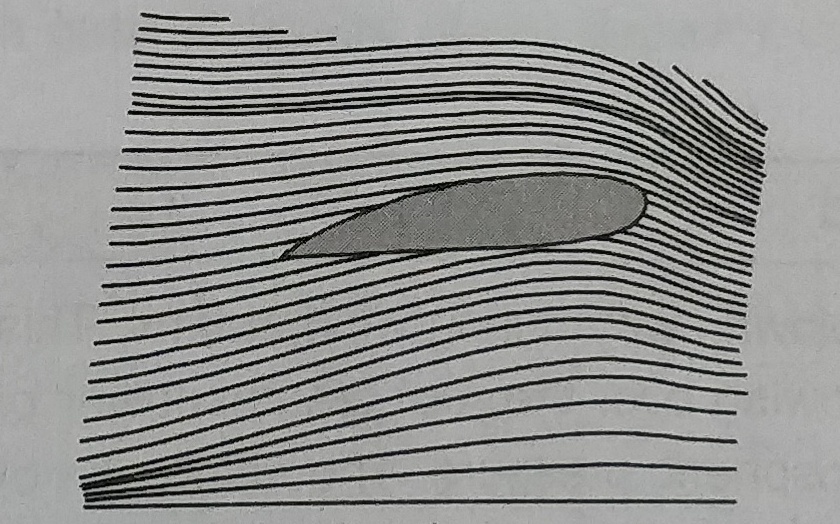
Airfoil and lift on aircraft wing:- An airfoil is streamlined shaped , Solid body that is capable of generating a dynamic lift as it moves through a fluid . streamline shape is special shape given to bodies moving in fluids, So as to produce minimum drag .
The cross-section of air wings is also shaped like that .Its upper portion is more curved then the lower surface .Its front edge is broader and the rear edge is narrow . When the airfoil moves through air , streamlines of air moves backward . The air above the foil has to travel a longer distance then that below in the same time . Thus the flow speed on top becomes greater then that below it . The higher speed on reduces air pressure there. This pressure difference causes to lift the foil. Such dynamic lift also acts on the wings of an air craft and balances the weight of the plane.
In this topic we will discuss , what do you mean by the term Total internal reflection, critical angle . And we will practice some questions based on these topics.
before to know this topic students must know Real depth and apparent depth. To know this topic click here-
Total internal reflection and critical angle.
Before to know about the total internal reflection we must know critical angle
Critical angle – It is the value of angle of incidence for which angle of refraction becomes 900, when light enters from denser to rarer medium .
As we know ,
1µ2 = sin i /sin r
Since light is moving from denser medium to rarer medium
So, 1µ2 = sin r /sin I;
i.e. µ = sin 900 / sin c [ here r= 900 then I is written by C (critical angle).
So, sin C = 1/µ
Then critical angle C = sin -1(1/µ).
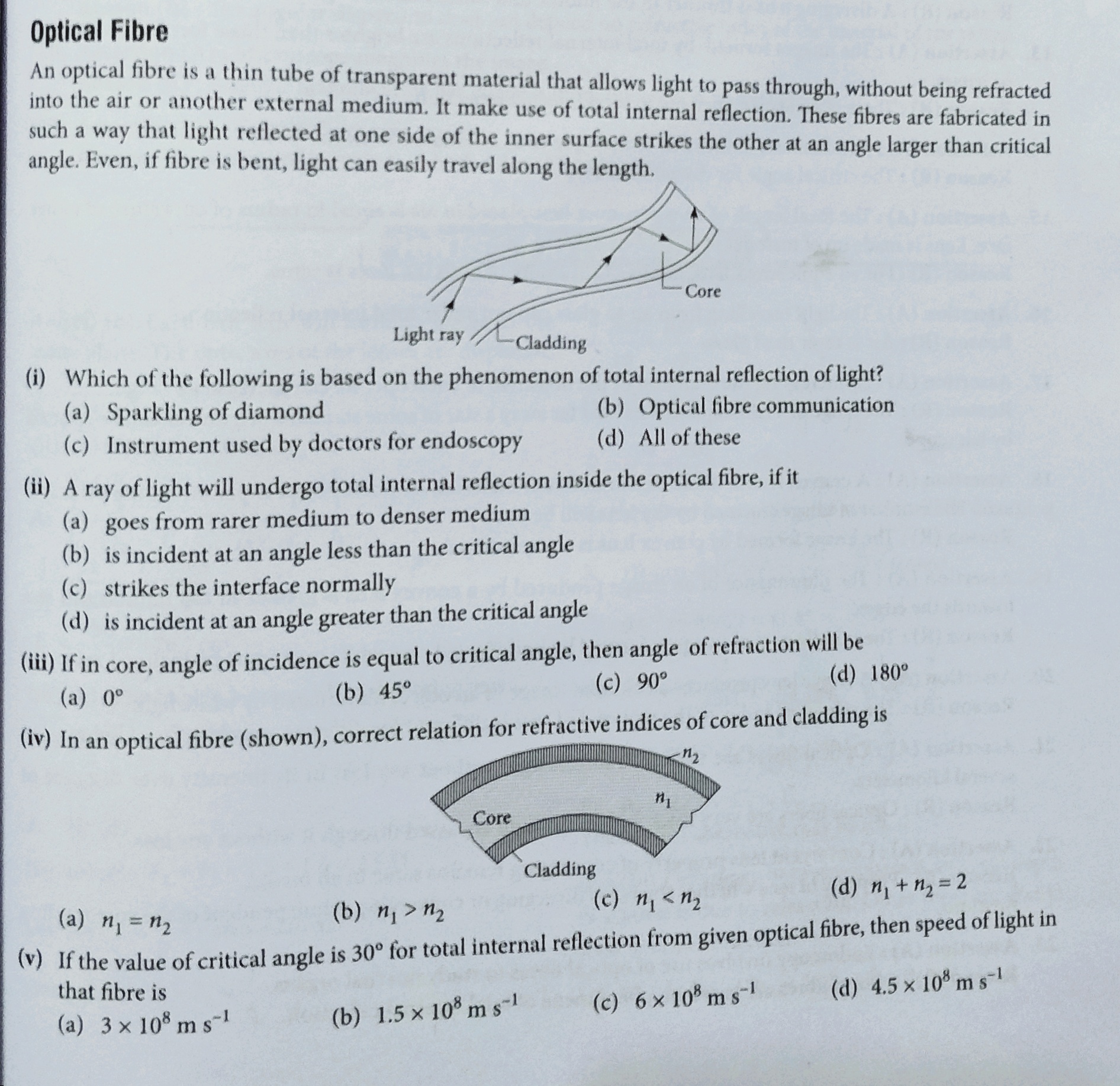
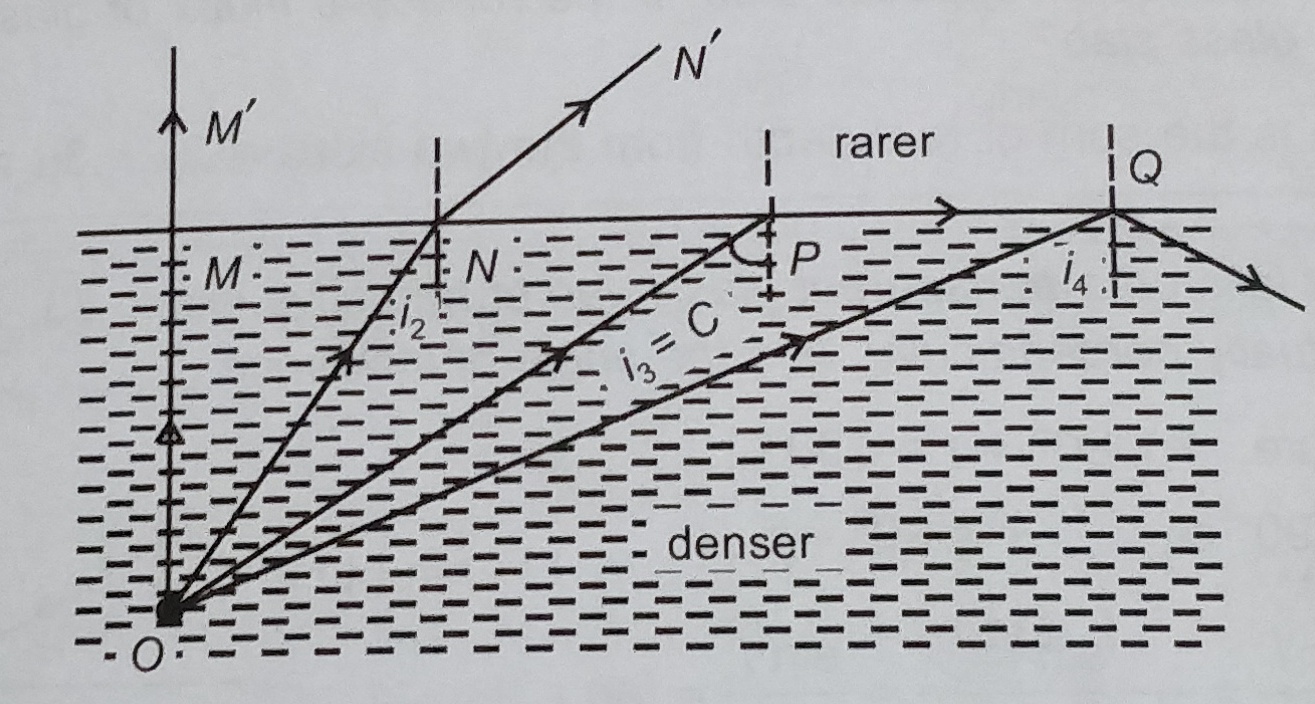
Total internal reflection- (TIR) When the light in the denser medium strikes an interface separating the denser medium and a rarer medium at an angle of incidence greater then critical angle total light is reflected without any refraction through the rarer medium . This phenomenon is called “total internal reflection”.
As shown in fig.
I2< C ( critical angle) in this case refraction of light occurs .
I1> C in this condition T.I.R. occurs.
Essential conditions for T.I.R is
(i) Light must move from denser to rarer and (ii) angle of incidence should be greater then critical angle.
Questions based on refraction of light ( apparent depth and real depth, total internal reflection and
Q1. A ray of light is incident on a glass plate as an angle of 600. What would be the refractive index of glass , if reflected and refracted rays are perpendicular to each other? (a)√3 . (b)3/2 (c) √3/2 (d) ½ . ans-a
Q2. A glass of thickness 12mm is placed on a table . The lower surface of the slab has a black spot .At what depth from the upper surface will the sport appear when viewed from above ? (µg=1.50) . (a) 2mm (b) 4mm (c) 6mm (d) 8mm. ans-d
Q3. Light enters at an angle of incidence in a transparent rod of refractive index of the material of the rod the light once entered into it will not leave it through its lateral surface whatsoever be the value of angle of incidence? (a) µ>√2 (b) µ = 1 (c) µ=1.1 (d) µ=1.3. ans-a
Q4. A transparent cube contains a small air bubble . Its apparent distance is 2cm when seen through one face and 5cm when seen through other face . If the refractive index of the of the material of the cube is 1.5 the real length of the edge of the cube must be (a) 7cm (b) 7.5 cm (c) 10.5 cm (d) 14/3 cm. ans-c
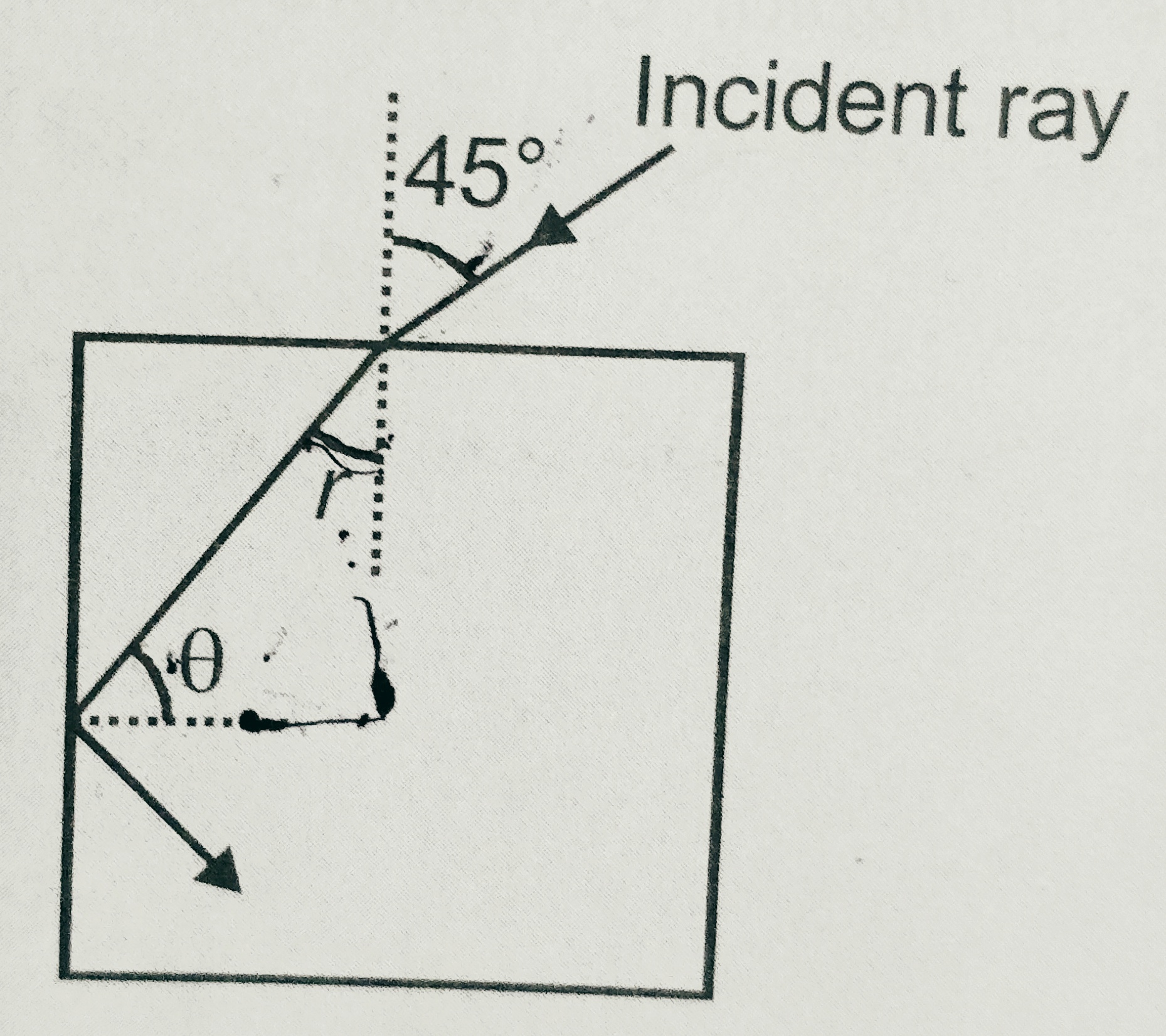
Q5. For the given incident ray as shown in figure , The condition of T.I.R of the ray will be satisfied , if the refractive index of the block will be ,
(a) (√3+1)/2 (b)(√2+1)/2 (c)√3/√2 (d)√7/√6. ans-c
Q6. A ray of light travels from optical denser medium to rarer medium. The critical angle for the two media is C . The maximum possible deviation of the ray will be (a)2C (b) π/2 – C (c) π-C (d) π-2C . ans-b
Q7. The apparent depth of water in the cylindrical water tank of diameter 2R cm is reducing at the rate of x cm/min. when water is being drained out at a constant rate . The amount of water drained in cc/minute is : (µ1 refractive index of air and µ2 refractive index of water) (a) xπR2µ1/µ2 (b) xπR2µ2/µ1 (c)2πRµ1/µ2 (d) xπR2. ans-b
Q8. Refractive index of glass with respect to medium is 4/3 .If the difference between the velocities of light in medium and glass is 6.25 x 10⁷m/sec , then velocity of light in medium is (a)2.5 x 10⁸m/s (b) 0.125 x10⁸m/s (c) 1.5 x 10⁷m/s (d) 3 x 10⁷m/s . ans-a
In Maths, integration is a method of adding or summing up the parts to find the whole. It is a reverse process of differentiation, where we reduce the functions into parts. This method is used to find the summation under a vast scale. Calculation of small addition problems is an easy task which we can do manually or by using calculators as well.
But for big addition problems, where the limits could reach to even infinity, integration methods are used. Integration and differentiation both are important parts of calculus. The concept level of these topics is very high. Hence, it is introduced to us at higher secondary classes and then in engineering or higher education.
Ho can you increase the studding strength of physics watch the video given below–
We can say, integration is the calculation of an integral. Integrals in mathematics are used to find many useful quantities such as areas, volumes, displacement, etc. When we speak about integrals, it is related to usually definite integrals. The indefinite integrals are used for anti-derivatives. Integration is one of the two major calculus topics in Mathematics, apart from differentiation(which measure the rate of change of any function with respect to its variables). It’s a vast topic which is discussed at higher level classes like in Class 11 and 12
To download the important questions of indefinite integration click below.
Answers of all the questions are given at the end of all questions of the assignment.
1. for which if the following depends of drift velocity v on electric field E is Ohm’s law obeyed ? (a) v α E (b) v= constant (c) v α E ½ (d) v α E 2 .
2. A potential difference is applied across the end of the metallic wire . If the potential difference is doubled , the drift velocity ; (a) will be doubled, (b) will be halved, (c) will be quadrupled, (d) no change .
3. The maximum current that flows in the fuse wire , before it blows out , varies with the radius r as :(a) r3/2 (b) r (c) r2/3 (d) r ½
4. The mass of three wires of copper are in the ratio of 1:3:5 and their length are in the ratio 5:3:1 . T he ratio of their electric resistance is ; (a) 1:3:5 (b) 5:3:1 (c) 1:15:125 (d) 125:15:1
5. The temperature (T) dependence of resistivity of a semiconductor represented by :
6. A wire of resistance R b= is stretched till its radius is half of its original value . Then the radius of the stretched wire is ; (a) 2R (b) 4R (c) 8R (d) 16R :
7. A wire till its length is doubled of its original length , then the resistance of the stretched wire is; (a) 2R (b) 4R (c) 8R (d) 16R :
8. If a copper wire is stretched to make it 0.1% longer, then the percentage change in its resistance is approximately (a) 0.1% (b) 0.2 % (c) 0.4% (d) 0.8% .
9. If a copper wire is stretched to make its radius decrease by 0.1% , then the % change in its resistance is approximately ; (a) 0.1% (b) 0.2 % (c) 0.4% (d) 0.8% .
10. A current of 5 amp exist in the 10 ohm resistance, for 4 minutes . How many coulombs pass through any cross-section of the resistor in this time ? (a) 12 (b) 120 (c) 1200 (d) 12000.
11. The temperature coefficient of resistance of a wire is 0.00125/0C at 300K is one Ohm. The resistance of the wire will be 2 ohm at (a)1154K (b) 1100k (c) 1400k (d) 1127k .
12. Drift speed of electrons is of the order of ; (a) zero (b) 10-2 (c) 105 (d) 100m/s ;
13. Which represents the negative dynamic resistance?
(a) AB (b) BC (c)CD (d) DA
14. When a current flows in a wire , there exist in electric field in the direction of ; (a) flow of current, (b) opposite to the flow of current (c) perpendicular to the flow of current (d)at the angle of 450 to the flow of current.
15. The drift velocity of free electron in a conductor is v when a current I is flow in it . If both the radius and current are doubled , then drift velocity will be; (a) v (b) v/2 (c) v/4 (d) v/8 .
16. The sides of rectangular block are 2,3 and 4cm . the ratio of maximum to minimum resistance between its parallel face is; (a) 4 (b)3 (c) 2 (d) 1 ;
17. The electric resistance of certain wire is R, if its length and radius both are doubled , then ; (a) resistance will be doubled and the specific resistance will be halved (b) resistance will be halved and the specific resistance will be remain same (c) resistance will be halved and the specific resistance will be doubled (d) resistance will be unchanged and also the specific resistance will be unchanged.
18. Total no. of electrons present in 4 amp current flowing for 1 sec is ; (a) 2.5 x 10⁹ (b)2.5x 10²⁰ (c) 1.25×10¹³ (d) 6x 10⁸ .
19. If the electric current through a bulb is 3.2 A, the no of electrons flowing through it in 1 sec is; (a) 2 x 10⁹ (b) 2 x 10¹⁹ (c) 3.2 x 10⁹ (d) 1.6 x 10¹⁸ .
20. The resistance of a wire is 5 ohm at 500c and 6 ohm at 1000c , the resistance of the wire at 00c will be; (a) 3 ohm (b) 2 ohm (c) 1 ohm (d) 4 ohm .
21. Two wires have length ,diameter and resistivity all are in the ratio 1:2 the resistance of the first wire is 10 ohm, the resistance of the second wire is ; (a) 5 (b) 10 (c) 20 (d) infinity.
22. Two copper wire have their masses in the ratio 2:3 and the length in the ratio 3:4 , the ratio of their resistance is ; (a) 4:9 (b) 27:32 (c) 16:9 (d) 27:128 (e) 1:2 ,
23.On increasing the temperature of the conductor its resistance increases because the ; (a) relaxation time increases (b) mass of electron increases (c) electron density decreases (d) relaxation time decreases .
24 .The resistance of a wire is R ohm . It is melted and stretched to n times its original length , the new resistance will be ; (a) R/n (b) n2R (c)R/ n2 (d) nR .
25. The current flowing through a wire depends on time as I = 3t2 +2t +5 . The charge flowing through the cross-section of the wire in time from t=0 to t=2 sec is; (a) 22c (b) 20c (c) 18c (d) 5c.
ans- Ans- 1-a ;2- a ; 3-a ;4- d ;5-b ;6-d ; 7-b ; 8-b ; 9-c ;10-c ; 11-d; 12- b ; 13 -c; 14-a ;15-b ;16- a; 17-b ; 18-a ; 19-b ; 20-d ; 21-b ; 22-b ; 23-d ;24-b ;25-a
In this topic we will get some, Very important questions of ray optics. Students preparing for board examination must solve all the questions given below.
Very important questions of ray optics
1. Derive the mathematical relation between refractive indices μ1 and μ2 of two radii and radius of curvature R for refraction at a convex spherical surfaces. Consider the object to be a point source on the principle axis in rarer medium of refractive index μ1 and a real image formed in the denser medium .
Light from a point source in air falls on a convex spherical glass surface of refractive index 1.5 and radius of curvature 20 cm . The distance of light source from the glass surface is 100cm . At what position the image will be formed?
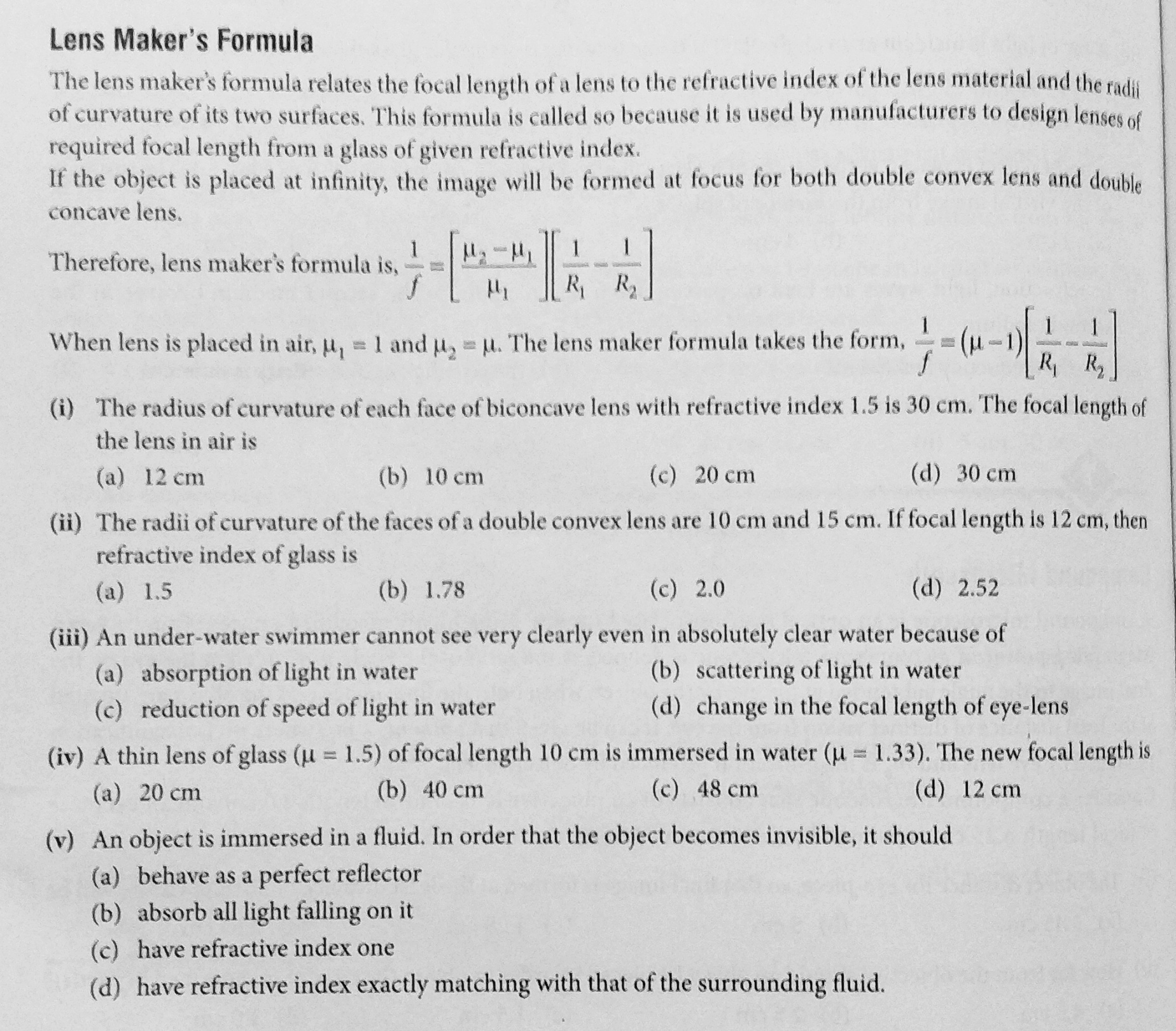
2. A point object is placed in front of a double convex lens with its spherical faces of radii of curvature R1 and R2 . Show the path of rays due to refraction at first and subsequently at the second surface to obtain the formation of the real image of the object. Hence obtain the lens maker’s formula for a thin lens.
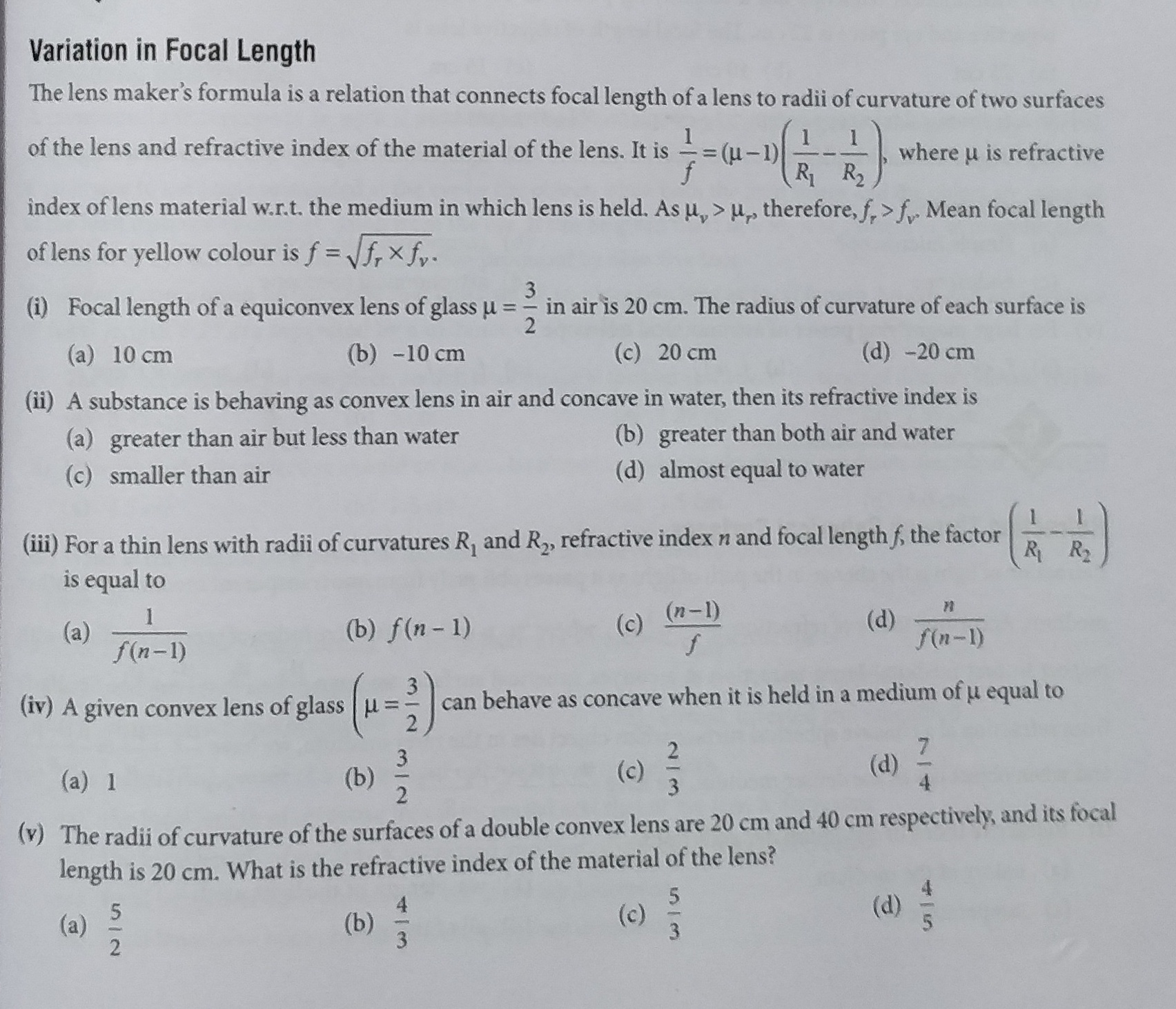
(i) A double convex lens having both faces of the same radius of curvature has refractive index 1.5. Find out the radius of curvature of the lens required to get the focal length of 20 cm . (ii) How the focal length of the above lens changes when it is placed in liquid of refractive index (a) 1.3 (b) 1.5 and (c)2.5 .
To solve this questions students must watch this video
3. Draw the ray diagram to show the refraction of a ray of monochromatic light passing through a glass prism. Deduce the expression for the refractive index of glass in terms of angle of prism and angle of minimum deviation.
A ray of light incident on face AB of an equilateral glass prism ABC , shows minimum deviation of 300 calculate the speed of light through the prism. Also find the angle of incidence at face AB so that the emergent ray along the face AC .
4.What do you mean by the term total internal reflection also write the conditions to get the total internal reflection, define the term critical angle for a pair of media , how the critical angle is related to the refractive index of the medium. A point source is kept at the bottom of the pond 2m deep ( μ= 4/3 )draw the ray diagram and calculate the area of water surface through which light emerges out of the pond.
5. Draw a ray diagram showing the image formation of compound microscope, hence obtain the expression for magnifying power when (I) image is formed at infinity (II) image is formed at least distance of distinct vision. (a)Why must both the objective and eyepiece of a compound microscope have short wavelength? (b) while viewing through a compound microscope, why should our eyes be placed not on the eye piece but at short distance away from it for best viewing?
TO WATCH THE COMPLETE VIDEO OF THIS TOPIC CLICK ON THE VIDEO GIVEN BELOW-
6. Draw a labelled ray diagram of astronomical telescope, for(I) normal adjustment, (II) at least distance of distinct of vision. Also derive the expression for magnifying power .You are given the three lance L1 , L2 , L3 having power 3D , 6D and 10D respectively with aperture 8cm,1cm and 1cm respectively, which two lances will you use as an eyepiece and objective to construct (a) compound microscope and (b) Astronomical telescope. Give reasons.
7.Explain reflecting type telescope draw the ray diagram for (I) Newtonian and (II)Cassegrainian type telescope. Write advantages of reflecting type telescope over refracting type telescope.
8.Derive lens formula in a convex lens using suitable ray diagram 1/v -1/u = 1/f . (a) A convex les is used to obtain the image of an object on the screen 10 cm from the lens . if the magnification is 19, find the focal length of the lens. (b) An illuminated object and a screen are placed 90 cm apart. Determine the focal length and nature of the lens required to produce a clear image on the screen , twice the size of the object.
TO WATCH THE COMPLETE VIDEO OF THIS TOPIC CLICK ON THE VIDEO GIVEN BELOW-
In this assignment Complete assignment of magnetic effect of current all kind of questions , objective , short answer type questions, long answer type questions and all kind of numericals with hots questions.
After solving these questions students will be able to solve the all kind of questions related to this chapter. Specially objective type question will help the students to solve the questions for all competitive examinations like JEE and NEET along with board examinations.
physics classes by Nayan jha already provided assignment of electric current . But this is the Complete assignment of electric current . In students can solve all kind of questions like objective,fill in the blanks,very short, short , long answer type , numericals and hots questions . This assignment will help the students to prepare for 12th board and all kind of competitive examination like JEE and NEET .Specially the objective questions are very helpful for board and competitive examinations.
Before to solve this assignment students must learn complete assignment of electric current .
For which of the following dependence of drift velocity ʋ on electric field E is ohm’s law obeyed? (a)ʋ ꭀ E (b) ʋ = constant (c) ʋ ꭀ E1/2 (d) ʋ ꭀ E2
Ans-a
in metals the time of relaxation of electrons:
(a)increases with increasing temperature
(b)decreases with increasing temperature
(c)does not depend on temperature
(d)changes suddenly at 400 K
Ans-b
Constantan wire is used for making standard resistance because it has:
(a)low specific resistance
(b)high specific resistance
(c)negligible temperature coefficient of resistance
(d)high melting point
Ans-c
A potential difference is applied across the ends of a metallic wire. If the potential difference is doubled, the drift velocity:
(a)will be doubled (c) will be quadrupled
(b)will be halved (d) will remain unchanged
Ans-a
The maximum current that flows in the fuse wire, before it blow out, varies with the radius r as:
(a)r3/2 (b) r (c) r2/3 (d) r1/2
Ans-a
A wire of resistance R is cut into n equal parts. These parts are then connected in parallel. The equivalent resistance of the combination will be:
(a)nR (b) R/n (c) n/R (d) R/n2
Ans-d
The masses of three wires of copper are in the ratio of 1 : 3 : 5 and their lengths are in the ratio 5 : 3 : 1. The ratio of their electrical resistances is:
Kirchhoff’s first law is based on the law of conservation of:
(a) charge (b) energy (c) momentum (d) sum of mass and energy
Ans-a
Kirchhoff’s second law is based on the law of conservation of:
(a)charge (b) energy (c) momentum (d) sum of mass and energy
Ans-b
A call of emf E is connected across a resistance r. The potential difference between the terminal of the cell is found to be V. The internal resistance of the cell must be:
(a) 2(E – V)V/r (b) 2(E – V)r/E (c) (E – V)r/V (d) (E – V)r
Ans-c
PDF of the Complete assignment of electric current is given below-