This topic provide important objective questions for electric current it will be very important for the students preparing for class 12th board examination or JEE/NEET
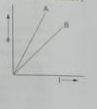
For which of the following dependence of drift velocity ʋ on electric field E is ohm’s law obeyed?
This assignment contain all important objective questions of atoms and nuclei , which is important for the students preparing for board examination and other competitive examinations .
Atomic Structure
According to Bohr’s atomic model:
(a)an atom has heavy, positively charged nucleus
(b)the electron radiates energy only when it jumps to another orbit
(c)the electron can move only in particular orbits
(d)all the above statements are correct
In an atom, two electrons move around the nucleus in circular orbit of radii R and 4R. The ratio of the time taken by them to complete one revolution is:
(a)1/4 (b) 4/1 (c) 8/1 (d) 1/8
According to Bohr’s quantum condition, an electron can revolve only in those orbits in which:
(a) its energy is an integral multiple of h/2π
(b) its linear momentum is an integral multiple of h/2π
(c) its angular momentum is an integral multiple of h/2π
(d) its angular momentum vector is perpendicular to magnetic dipole moment vector
According Bohr’s theory the radius of the electron in an orbit described by principal quantum number n and atomic number Z is proportional to:
(a)Z2n2 (b) Z2 /n2
(c) Z2 /n
(d) n2 /Z
When the electron jumps from a level n = 4 to n = 1, the momentum of the recoiled hydrogen atom will be:
(a)5 ₓ 10-27 kg – ms-1
(b) 13.6 ₓ 10-19 kg – ms-1 (c)75 ₓ 10-19 kg – ms-1
(d) zero
The radius of Bohr’s fast orbit is a0. The electron in nth orbit has a radius:
(a)na0
(b) a0/n
(c) n2a0
(d) a0/n2
The angular momentum of an electron in the nth orbit is given by:
(a)nh
(b) h/2πn
(c) nh/2π
(d) n2h/2π
When a hydrogen atom is raised from the ground state to fifth state:
(a)both KE and PE increase
(b) PE increases and KE decreases
(c)both KE and PE decrease
(d) PE decreases and KE increases
As the electron in Bohr orbit of hydrogen atom passes from state n = 2 to n = 1, the KE (K) and PE (U) change as: (a)K two-fold, U also two-fold
(c) K four-fold, U two-fold
(b)K four-fold, U also four-fold
(d) K two-fold U four-fold
An electron jumps from the 4th orbit to the 2nd orbit of a hydrogen atom. Given the Rydberg constant R = 105 cm-1, the frequency in Hz of the emitted radiation will be:
(a)3/16 ₓ 105
(b) 3/16 ₓ 1015
(c) 9/16 ₓ 1015
(d) 3/4 ₓ 1015
Nitrogen gas, cynogen gas and compounds of carbon give band spectra because:
(a)these are excited in molecular state
(b)these are in atomic state
(c)these are inorganic compounds
(d)these are in gaseous state
The hydrogen atom can give spectral lines in the series, Lyman, Balmer and Paschen. Which of the following statements is correct?
(a)Lyman series is in the infrared region
(b)Balmer series is in the visible region (partly)
(c)Balmer series is solely in the ultraviolet region
(d)Paschen series is in the visible region
.Which of the following statements is true regarding Bohr’s model of hydrogen atom?
(a)Orbiting speed of electron decreases as it falls to discrete orbits away from the nucleus.
(b)Radii of allowed orbits of electrons are proportional to the principal quantum number.
(c)Frequency with which electrons orbits around the nucleus in discrete orbits is inversely proportional the principal quantum number.
Binding force with which the electron is bound to the nucleus increases as it shifts to outer orbits.
(A)a and c
(B) b and d
(C) a, b and c
(D) b, c and d
An electron in the hydrogen atom jumps from excited state n to the ground state. The wavelength so emitted illuminates a photosensitive material having work function 2.75 eV. If the stopping potential of the photo-electron is 10 V, then the value of n is: (a)2 (b) 3 (c) 4 (d) 5
In Bohr’s model, the atomic radius of the fast orbit is r0;then the radius of the third orbit is: (a)r0/9 (b) r0 (c) 9r0 (d) 3r0
The ground state energy of H-atom is 13.6 eV. The energy needed to ionise H-atom from its second excited state is: (a)51 eV (b) 3.4 eV (c) 13.6 eV (d) 12.1 eV
Hydrogen atoms are excited from ground state to the state of principal quantum number 4. Then, the number of spectral lines observed will be:
(a) 3 (b) 6 (c) 5 (d) 2
If an electron in n = 3 orbit of hydrogen atom jumps down to n = 2 orbits, the amount of energy released and the wavelength of radiation emitted are: (a)85 eV, 6566 Å (b) 1.89eV, 1240 Å (c) 1.89 eV, 6566 Å (d) 1.5 eV,6566 Å
The longest wavelength that a single ionised helium atom in its ground state will absorb is:
(a)912 Å (b) 304 Å (c) 606 Å (d) 1216 Å
If the ionisation potential of hydrogen atom is 13.6 eV, the energy required to remove the electron from the third orbit of hydrogen atom is:
(a)5 V (b) 1.5 eV (c) 4.5 eV (d) 3.4 V
The ratio of the areas within the electron orbits for the first excited state the ground state for the ground state for the hydrogen atom is:(a)2 : 1 (b) 4 : 1 (c) 8 : 1 (d) 16 : 1
The first excitation potential of the hydrogen atom in the ground state is: (a)6 volt (b) 10.2 volt (c) 3.4 volt (d) 1.89 volt
The minimum energy in electron volt required to strip a ten times ionized sodium atom ( i.e., Z = 11) of its last electron is:
(a)6 eV (b) 13.6/11 eV (c) 13.6 ₓ 11 eV (d) 13.6 ₓ (11)2 eV
Of the following transitions in hydrogen atom, the one which gives emission line of minimum frequency is:(a)n = 1 to n = 2 (b) n = 3 to n = 10 (c) n = 10 to n = 3 (d) n = 2 to n = 1
The energy of an electron in the nth orbit of positronium is: (a) -13.6/n2 eV (b) -13.6 ₓ 2/n2 eV (c) -13.6 ₓ 4/n2 eV (d) -13.6/2n2 eV
The ratio (in SI units) of magnetic dipole moment to that of the angular momentum of electron of mass m kg and charge e coulomb in Bohr’s orbit of hydrogen atom is:
(a) e/2m (b) e/m (c) 2e/m (d) none of these
The Bohr model of atoms:
(a)assumes that the angular momentum of the electrons is quantized
(b)uses Einstein’s photoelectric equation
(c)predicts continuous emission spectra for atoms
(d)predicts the same emission spectra for all types of atoms
The angular momentum of an electron in a hydrogen atom is proportional to:
(a)1/√r (b) 1/r (c) √r (d) r2
What will be the angular momentum in fourth orbit, if L is the angular momentum of the electron in the second orbit of hydrogen atom?
(a)2 L (b) 3/2 L (c) 2/3 L (d) L/2
The required energy to detach one electron from Balmer series of hydrogen spectrum is:
(a)6 eV (b) 10.2 eV (c) 3.4 eV (d) -1.5 eV
Which of the following is quantised according to Bohr’s theory of hydrogen atom? (a)Linear momentum of electron
(b)Angular momentum of electron
(c)Angular velocity of electron
(d)Linear velocity of electron
The energy levels of a certain atom for 1st ,2nd and 3rd levels are E, 4E/3 and 2E respectively. A photon of wavelength λ is emitted for a transition 3 →1.What will be the wavelength of emission for transition 2 → 1?
(a) λ/3 (b) 4λ/3 (c) 3λ/4 (d) 3λ
The ratio of the frequencies of the long wavelength limits of the Lyman and Balmer series of hydrogen is:
(a)27 : 5 (b) 5 : 27 (c) 4 : 1 (d) 1 : 4
If electron in a hydrogen atom has moved from n = 1 to n = 10 orbit, the potential energy of the system has:
(a)Increased (b)Decreased (c) remains unchanged (d) become zero
The energy of hydrogen atom in nth orbit is En , then the energy in nth orbit of singly ionised helium atom will be:
(a)4En (b) En/4 (c) 2En (d) En/2
The energy of hydrogen atom is -13.6 eV in the first orbit, then calculate the energy of He atom in the same orbit:
(a)6 eV (b) -27.2 eV (c) -54.4 eV (d) +54.4 eV
In hydrogen spectrum, the shortest wavelength in Balmer series is λ. The shortest wavelength in Brackett series will be:(a)2λ (b) 4λ (c) 9λ (d) 16λ
The ratio of the largest to shortest wavelength in Lyman series of hydrogen spectra is:
(a) 25/9 (b) 17/6 (c) 9/5 (d) 4/3
The minimum orbital angular momentum of the electron in hydrogen atom is:
(a) h (b) h/π (c) h/2π (d) h/2
The total energy of an electron in the first excited state of hydrogen atom is about – 3.4 eV. Its KE in this state is:
(a)4 eV (b) 6.8 eV (c) -3.4 eV (d)-6.8 eV
The ground state energy of hydrogen atom is -13.6 eV. What is the potential energy of the electron in this state?
(a)0 eV (b) -27.2 eV (c) 1 eV (d) 2 eV
If λ1 and λ2 are the wavelengths of the first member of the Lyman and Paschen series respectively, then λ1 : λ2 is:
(a)1 : 3 (b) 1 : 30 (c) 7 : 50 (d) 7 : 108
Student’s as we know from this year , in CBSE 12th board examination ( physics ) there will be 20 , 1- mark questions . therefore we just posted some objective questions of wave optics , so that students can practice well all kind of objective questions of wave optics in short time .
Objective questions of wave optics
Newton has postulated his corpuscular theory on the basis of , (a) Newton’s ring (b) color due to thin film (c) dispersing of light (d) rectilinear propagation of light.
The wavefront is a surface in which ; (a) all points are on the same phase(b) there are pair of points in opposite phase (c) there are pairs of points with phase difference 900 (d)there are no relation between the phase.
The concepts of secondary wavelets from all points on a wave front was proposed by ; (a) Newton (b) Huygen (c) Faraday (d) Raman.
Huygen’s concepts of secondary waves ; (a) allow us to find the focal length of thin lens (b) gives the magnifying power of thin lens (c) is a geometrical method to find the wavelength (d)is used to find the velocity of light.
For constructive interference to take place between two monochromatic light waves of wavelength λ , the path difference should be ; (a) (2n-1)λ/4 (b) (2n-1)λ/2 (c) nλ (d)(2n+1)λ/2
Two light sources are coherent when ; (a) their amplitudes are equal (b) their frequency are equal (c) their wavelengths are equal (d)their frequencies are equal and their phase difference is constant.
Ratio of intensity of two waves is given by 4:1 , the ratio of amplitudes of their waves is ; (a) 2:1 (b)1:2 (c) 4:1 (d)1:4
If the ratio of intensities of two waves causing interference be 9:4 then the ratio of the resultant maximum and minimum intensity will be : ; (a) 9:4(b) 3:2 (c) 25:1 (d)5:1 .
In young’s double slit experiment , if monochromatic light used is replaced by white light , then ; (a) no fringes are observed (b) all bright fringes becomes white (c) all fringes have colour between violet and red (d)only central fringes is white and all other fringes are coloured .
Two coherent monochromatic light beams of intensity I and 4I are superposed , the max and min. possible intensities in the resulting beam are ; (a) 5I and I (b) 5I and 3I (c) 9I and I (d) 9I and 3I
If two waves , each of intensities I0 , having the same frequency but differing by constant phase angle of 600 , superpose at a certain point in space , then the intensity of resultant wave is ; (a) 2I0 (b) √3 I0 (c) 3I0 (d) 4I0
Two monochromatic waves each of intensity I , have constant phase difference of ɸ , if these waves superpose , then the intensity of resulting wave is ; (a) 4I (b) 4Icosɸ (c) 4Icos2ɸ (d) 4I cos2 (ɸ/2)
Two monochromatic waves of same amplitude ‘a’ ,have random phase difference between them . when these wave superpose , then the amplitude of resulting wave is given by ; (a) √2a (b) 2a (c) 4a (d)zero .
The contrast in the fringes in any interference pattern depends on ; (a) fringe width (b)wavelength (c) intensity ratio of the sources (d) distance between the sources
In young’s double slit experiment if the distance between the slits is made 3-folds, the fringe width becomes ; (a) 1/3 folds (b) 3 folds (c) 1/9 folds (d) 9 folds .
In Young’s double slit experiments the separation between the is halved and separation between the slits and screen is doubled , the fringe width is ; ; (a) unchanged (b) halved (c) doubled (d) quadrupled .
Yellow light emitted by sodium lamp in Young’s double slit experiment is replaced by blue light of the same intensity ; (a) fringe width will decrease (b) fringe width will increase (c) fringe width will remain unchanged (d) fringe will become less intense .
Two light waves are coherent if they are obtained from a single monochromatic source by ; ; (a) division of amplitude only (b) division of wavefront only (c) both of the above (d) none of the above.
In an interference experiment monochromatic light is replaced by white light , we will see , ; (a) uniform illumination on the screen (b) uniform darkness in the screen (c) equally spaced white and dark bands (d) a few coloured bands and then uniform illumination .
In Young’s double slit experiment the fringe width is found to be 0.4 mm . if the whole apparatus is immersed in water of refractive index 4/3 without disturbing the original geometric arrangement , then new fringe width will be ; (a) 0.3mm (b)0.40mm (c) 0.53mm (d )450 microns .
Two waves are said to be coherent if they have ; (a) same wave length (b) same amplitude (c) same amplitude and save wavelength (d) same wavelength and constant phase difference .
In a young’s double slit experiment fringe width is equal to 1mm , then the distance of the nearest bright fringe from the central fringe will be ; (a) 1mm (b) 0.5mm (c) 2mm (d) insufficient data ,
In young’s double slit experiment . if width of the slit s is increased keeping other parameters constant , then the interference fringes will be ; (a) remain unchanged (b) form closer (c) form further away (d) gradually disappear.
Interference of light waves from two coherent sources is possible for ; (a) unpolarised light waves only (b) polarised light waves only if their polarisation is in the same direction (c) both of the above (d) none of the above.
Two waves coming from two coherent sources , having different intensity interfere , their ratio of maximum intensity is 25 , then the intensities of the sources are in the ratio ; (a) 25:1 (b) 25:16 (c) 9:4 (d) 5:1 .
When petrol drop from a vehicle fall over rain water on the road , colors are seen because of ; (a) dispersion of light (b) scattering of light (c) interference of light (d) absorption of light.
In one of the two slits of young’s double slit experiment is painted over so that it transmits half the light intensity of the other , then ; (a) the fringe system will disappear (b) the bright fringe will be more bright (c) the dark fringe will be brighter and vice -versa (d) none of the above .
The phenomena of diffraction can be exhibited by ; (a) polarised wave only (b) unpolarised wave only (c) longitudinal wave only (d)all kind of wave
Diffraction effects are easily observed for ; (a) microwave (b) sound wave (c) radio waves (d) all of the these .
In case of diffraction at single slit if the wavelength of light becomes equal to the aperture of slit , on the screen we shall observe : ; (a) image of slit (b) diffraction band (c)uniform illumination (d) non-uniform illumination.
Light of wavelength 2 x 10⁻³ m falls on a slit of width 4 x 10⁻³ m . the angular dispersion of the central max will be ; (a) 300 (b) 600 (c) 900 (d) 1800 .
The width of the diffraction band varies as (a) inversely as the wavelength (b) directly as the width of the slit (c) directly as the distance between slit and the screen (d) inversely as the size of source from which the slit is illuminated .
The polarisation of light prove the ; (a) corpuscular nature of light (b) quantum nature of light (c) transverse wave nature of light (d) longitudinal wave nature of light .
A beam of light strikes a piece of glass at an angle of incidence of 600 and reflected beam is completely plane polarized , then the refractive index of glass is ; (a) 1.5 (b) √3 (c) √2 (d) 2/3.
A ray of light incident on the surface of a glass plate at an angle of incidence equal to Brewster’s angle ɸ. If µ is the refractive index of the glass then the angle between reflected and refracted rays is ; (a) (90+ɸ) (b) sin-1 (µ cosɸ) (c) 900 (d) sin-1( sinɸ/µ).
A Nicol prism is based on the principle of ; (a) refraction (b) scattering (c) dichroism (d) double refraction .
Which of these wave can be polarised ? (a)sound wave (b) longitudinal wave on a string (c) transverse wave on a string (d) light wave
Two Nicol prism are first crossed and ten one of them is rotated through 600 , the percentage of incident light transmitted is ; (a) 1.25 (b)25 (c)37.5 (d)50 .
Two polaroids are placed cross to each other , now one of them is rotated through an angle of 450 the percentage of incident light now transmitted through the system is (a)15% (b)25% (c) 50% (d) 60% ( e) 75%.
Waves can’t be polarised is ; (a) light wave (b) electromagnetic wave (c) transverse wave (d) longitudinal wave .
Young’s double slit experiment is made in a liquid . The tenth bright fringe in the liquid lies where the 6th bright fringe lies in the vacuum . The refractive index of the liquid is approximately ; (a) 1.8 (b) 1.54 (c) 1.67 (d) 2 .
If light is polarised by reflection , then the angle between reflected and refracted light is ; (a) Π (b) Π/2 (c) Π/3 (d) Π/4
A beam of light strikes a piece of glass at an angle of incidence of 600 and the reflected ray is completely polarised . Then the refractive index of the glass is ; (a) 1.5 (b) √3 (c) √2 (d)3/2
Important questions of dual nature of radiation and matter
Dual nature
In this assignment, important questions of dual nature of radiation and matter , i am trying to provide some important questions based on the chapter dual nature of radiation and matter, student preparing for 12th board exam must solve all the questions , this chapter is little bit easier than other previous chapter of physics class 12th.Numerical based on this chapter is bit easier than other chapters, so prepare this chapter nicely , and solve all the questions , i am sure that students will get benefit from this assignment of important questions of dual nature of radiation and matter.
Dual nature of matter and radiation
List important observations made by Lenard which lead to quantum theory of radiations .
State De-Broglie hypothesis . Derive an expression for the De-Broglie wavelength associated with an electron accelerated through a potential V . draw the schematic diagram of a localized-wave describe the wave nature of the moving electron .
Define the term threshold frequency and stopping potential in relation to the phenomenon of photoelectric effect . how is photoelectric current affected on increasing the (I) frequency (II) intensity of the incident radiations and why?
Sketch the graphs showing the variation of stopping potential with frequency of incident radiations for two photosensitive radiations for two photosensitive materials A and B having threshold frequencies ѵ0 > ѵ0’ respectively . (I) which of the two metals ,A and B has higher work function ? (II) what information do you get from the slope of the graphs ? (III) what does the value of the intercept of graph A on the potential axis represent ? FOR IMPORTANT QUESTIONS OF RAY OPTICS -CLICK HERE
Draw the graphs showing the variation of photoelectric current with anode potential of a photocell for (I) the same frequencies but different intensities I1 >I2 > I3 incident radiation, (II) the same intensities but different frequencies ѵ1> ѵ2 >ѵ3 of incident radiation . Explain why the saturation current is independent of the anode potential.
What is the photoelectric current ? Write Einstein’s photoelectric equation and use it to explain (I) independence of photoelectrons from intensity , of incident light , (II) Existence of threshold frequency for emission of photoelectrons. FOR IMPORTANT QUESTIONS OF WAVE OPTICS AND OPTICAL INSTRUMENT CLICK HERE
An electron of mass m and charge q is accelerated from rest through a potential difference V , obtain the expression for the de-Broglie wavelength associated with it . if electron and proton are moving with the same K.E. , which one of them will have a large De-Broglie wavelength associated with it ? give reason .
State the dependence of the work function on the K.E. of electrons emitted in a photocell . (a) if the intensity of the incident radiation increases to double of its initial intensity what change occur in the (I) stopping potential and (II)photoelectric current.(b) if the frequency of the incident radiation is doubled what change occur in the (I) stopping potential (II)photoelectric current(III) K.E. of the photo electron emitted
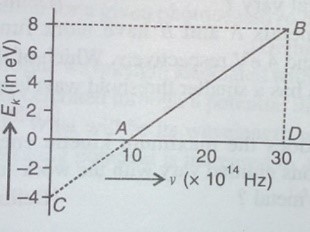
Given below in the graph between frequency of the incident light and maximum kinetic energy of the emitted photoelectron find the value of (I) threshold frequency and (II) work function from the graph.
dual pic-1
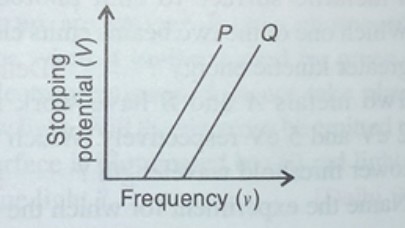
In a photoelectric effect experiment , the graph between the stopping potential V and frequency v of the incident radiation on two different metal plate P and Q in the fig. (I) which of the two metal plates , P and Q has greater value of work function ?(II)what does the slope of the lines depict ?
dual pic-2
Ultraviolet light of wavelength 2271 A from a 100W mercury source is incident on a photocell made of molybdenum metal , if the stopping potential is 1.3 V , estimate the work function of the metal.
This topic is important for class 12th student . it is considered this chapter is little bit easier than other previous chapter of physics for board examination point of view . One important reason is that student already studied this chapter in class 11th (chemistry) , so it is easy to learn this chapter . Through “important questions of atoms and nuclei” , I am going to provide some important questions based on this topic . Student preparing for board examination of all board should revise all these questions given in ” important questions of atoms and nuclei”.
ATOMS AND NUCLEI
Here is some important questions of atoms and nuclei-
Atoms- nuclei
Draw a labelled diagram of alpha particle scattering experiment. Give Rutherford observations and discuss the significance of this experiment .
Using postulates of Bohr energy of hydrogen atom ,show that (a) the radii of orbits increases as n2 and (b) the total energy of the electron increases as 1/n2 , where n is the principle quantum number of the atom .
Draw a schematic arrangement of the Gieger -Marsden experiment for studying alpha particle scattering by a thin foil of gold . describe briefly , by drawing trajectories of the scattered alpha particle . haw this studies can be used to estimate the size of the nucleus ?
State any two postulates of Bohr theory of hydrogen atom . what is the maximum possible no. of spectral lines observed when the hydrogen atom is in its second exited state ? justify your answer . calculate the ratio of the max. and min. wavelength of the radiation emitted in this process.
Using Bohr postulates for hydrogen atom , show that the total energy of the electron in the stationary states can be expressed as the sum of kinetic energy(K) and potential energy (U) , where K=-2U. hence , deduce the expression for the total energy in the nth energy level of hydrogen atom .
The energy of an electron in the ground state of hydrogen atom is -13.6 Ev. (i) what does the negative sign signify ? (ii)how much energy is required to take an electron in this atom from the ground state to the first exited state?
In Bohr theory of hydrogen atoms, calculate the energy of the photon emitted during a transition of the electron from first exited state to its ground state . write in which region of the electromagnetic spectrum this transition lies. Given R=1.03 * 107m-1.
The electron in a given Bohr orbit has a total energy of -1.5Ev. calculate its(i) kinetic energy(ii)potential energy (iii) wavelength of the radiation emitted , when this electron makes a transition to the ground state.
The energy level diagram of an element is given below . identify using necessary calculations , which transition corresponds to the emission of the spectral line of wavelength 102.7 nm . which transition corresponds to the emission of radiation of maximum wavelength?
.
atoms and nuclei
The ground state energy of hydrogen atom is -13.6 eV. ( I ) What is the potential energy of an electron in the third exited state? (ii) what will be the maximum and minimum wavelength of the emitted radiation of Lyman series of hydrogen spectrum.
State and explain the law of radioactive decay. Plot the graph of showing the number (N) of undecayed nuclei as a function of time (t) for a given radioactive sample having half life T1/2.depict in the plot the number of undecayed nuclei at (i) t=3T1/2 (ii) t=5T1/2.
How the size of nuclei is experimentally determined ? write the relation between the radius and mass number of the nucleus . show that the density of the nucleus is independent of its mass number. Two nuclei of mass number in the ratio 27:125. What is the ratio of their nuclear radius and , ratio of their densities.
(i)Define the activity of the radioactive material and write its SI unit. plot a graph showing the variation of activity with respect to time of a given radioactive sample.(ii) what is meant by half life time of a radioactive element ? the half life of a radioactive sample is 30s calculate (a) the decay constant and (b)time taken for the sample to decay by 3/4thof the initial value .explain alpha , beta and , gama decay with an example . if an element 238X 92 converted into another element 222Y90 find the no of alpha and beta particles emitted.
Draw the binding energy per nucleon curve . using the curve state clearly how the release in energy in the process of nuclear fission and nuclear fusion can be explained.
Draw a plot of potential energy of a pair of nucleons , as a function of their separation . write two important conclusions which you can draw regarding the nature of nuclear force. Also, explain the mass of a nucleus , in the ground state is always less than total mass of its constituents neutron and proton .
We are given the following atomic masses ; 238 U92 =238.05079u; 234 Th90=234.04363u ; 237Pa91=237.05121u; 1H1=1.00783u; 4He2=4.00260 u ;(a) calculate the energy released during alpha decay of uranium (b) calculate the kinetic energy of alpha particle ,and (c) show that ; 238 U92 cannot spontaneously emit a proton.
The activity of a radioactive sample drop to 1/16 th of its initial value in 32 years . find the mean life of the sample .
In this question paper we will practice the important questions of wave optics and optical instruments .
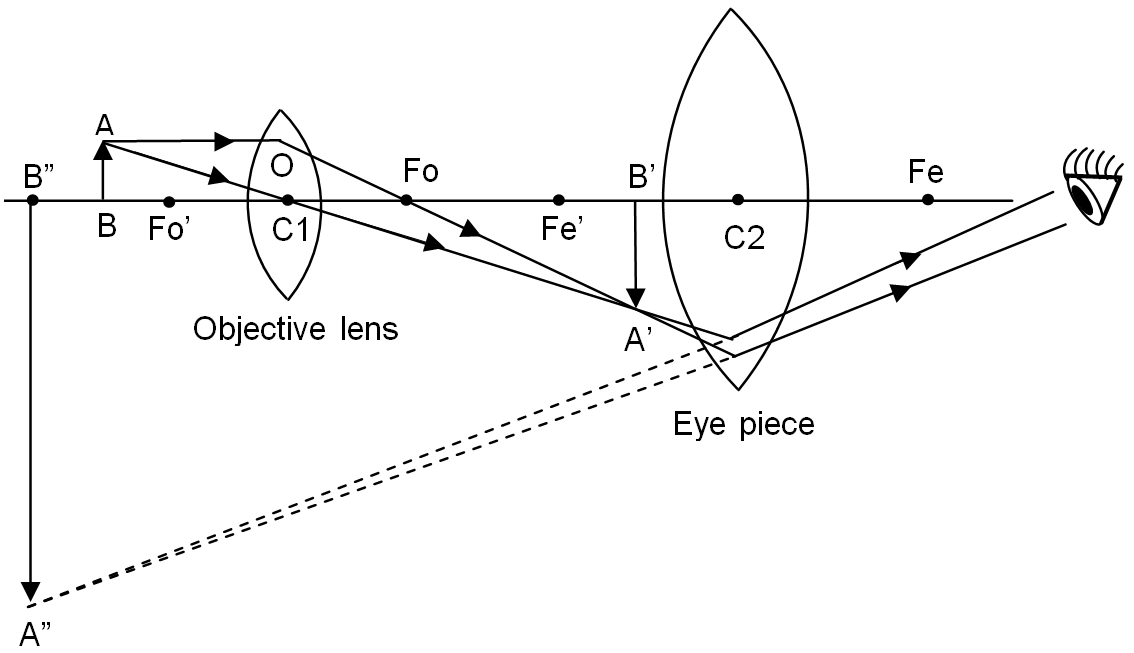
RayDiagramOfCompoundMicroscope
students preparing for class 12th must have to practice all questions given in the assignments “wave optics and optical instruments” , I am sure that you will get sure benefits in your board examination .
Important questions on wave optics
and optical instrument
(***Derivations and reasoning type questions***)
1. Draw a ray diagram showing the image formation of compound microscope, hence obtain the expression for magnifying power when (I) image is formed at infinity (II) image is formed at least distance of distinct vision. (a)Why must both the objective and eyepiece of a compound microscope have short wavelength? (b) while viewing through a compound microscope, why should our eyes be placed not on the eye piece but at short distance away from it for best viewing?
2. Draw a labelled ray diagram of astronomical telescope, for(I) normal adjustment, (II) at least distance of distinct of vision. Also derive the expression for magnifying power
3. Define resolving power and limit of resolution derive the expression for resolving power for (I) microscope, (II)telescope and (III)eye.
4. Explain reflecting type telescope draw the ray diagram for (I) Newtonian and (II)Cassegrainian type telescope. Write advantages of reflecting type telescope over refracting type telescope.
5. Define wavefront . What type of wave front will emerge from a point source and distance light source? Draw a wave front coming out from a (I)prism(II)concave and convex mirror(III)concave lens and(III)convex lens .
6. State Huygens principle, using this principle draw the diagram to show how a plane wave front incident(I) At the interface of two media gets refracted when it propagates from a rarer to denser medium, and hence verified Snell’s law and (II) At a plane surface and gets reflected and hence derive law of reflection.
7. What are coherent sources of light ? Why two independent sources can’t be coherent ?why coherent sources are necessary to observing a sustained interference pattern ? How are the coherent sources are obtained in the Young’s double slit experiment?
8. What is interference of light? Write dawn the conditions to obtain the sustained interference fringe pattern. Show that the superposition of wave originating from two sources having displacement Y1 =a cosωt , Y2 =a cos(ωt+ɸ) at a point produces a resultant intensity , I=4a^2 cos^2(ɸ/2) hence write the conditions for the appearance of dark and bright fringes.(* this question may be asked as ,deduce the conditions for constructive and destructive interference and hence write the expression for the distance between two consecutive bright or dark interference)
9. Using Young’s double slit experiment obtain the conditions for gating bright and dark fringes also derive the expression for the fringe width. Also write the effect on fringe width when(I)Distance between slits increases/decreases(II) Distance between slits and the screen increases/decreases(III) Monochromatic light replaced by white light,(IV) One of slit is closed and (V) entire experimental apparatus is immersed in a liquid
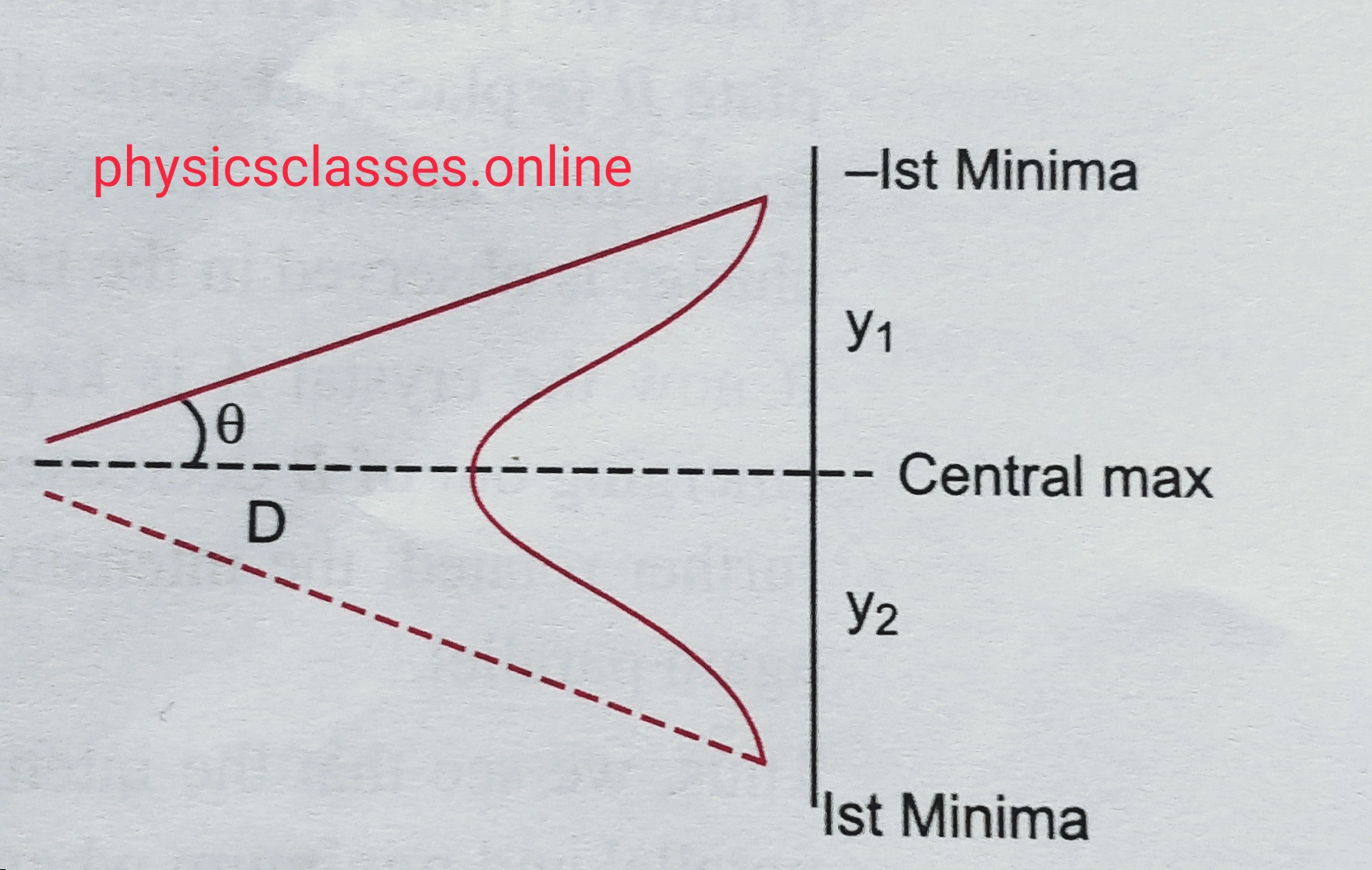
10. In a single slit diffraction experiment , deduce the conditions for the central maximum and secondary maxima/minima observed in diffraction pattern . Also explain why the secondary maxima go on becoming weaker in intensity as the order increases.(I) Haw does the width of the slit affected the size of the central bright fringe?(II)When a tiny circular obstacle is placed in the path of the light from a distant source , why is a bright spot seen at the center of the shadow of the obstacle?(III) Show that the angular width of the central bright is two times the width of the first diffraction fringe (IV) If a mono chromatic source of light is replaced by white light , what change would you observe in the diffraction pattern?
11. What is unpolarised and plane polarised light? How an unpolarised light gets polarised when it passes through a polaroid. Why is the phenomenon of polarisation not observed by sound wave?
12. What are Polaroids ? how are the used to demonstrate that (a) A light wave is transverse in nature,(b) if an unpolarised light wave is incident, then light wave gets linearly polarised?
13. State and prove law of malus and Brewster’s law .What is Brewster’s angle ? when an unpolarised light is incident on a plane glass surface , what should be the angle of incidence so that the reflected and refracted rays are perpendicular to each other?
******IMPORTANT NOTICE FOR THE STUDENTS OF CLASS 12TH-
Students as we know , this year there are some changes in the pattern of question paper of physics for class 12th . It is informed by the cbse that there will be 20 marks objective type questions in the paper , but it is decleared that what will be the type question paper of physics . previously only 5 marks of questions was on the basis of objective question (one marks each) , and in the answer of these questions students has to write the answers , but this year question paper pattern is changed , the sample paper provided by cbse is provided here.
All questions given below is very important numerical of ray optics . These questions are good for quick practice at the time of examination.
Suppose while sitting on a parked car , you noticed a jogger approaching towards you in the rear view mirror of R=2m . If the jogger is running towards you at the speed of 5m/s , how fast the image of the jogger moving when the jogger is (a)39m(b)29m(c)19m away.
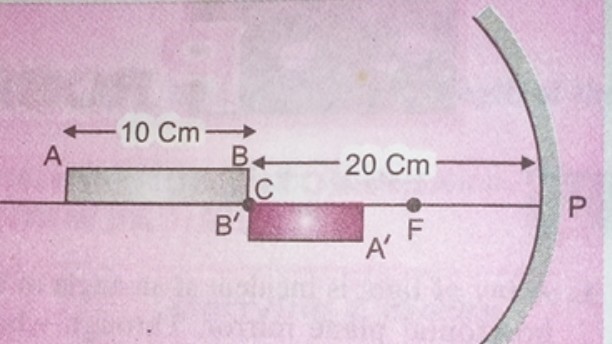
2. A rod AB =10cm in length is placed along the principle axis of a concave mirror having focal length equal to 10cm as shown in fig. the distance PB=20cm . what is the length of the image of the rod AB.
image -1(ray optics)
When an object is placed at a distance of 60 cm from a convex spherical mirror , the magnification produced is ½. Where should we place the object to get a magnification of 1/3?
A ray of light travelling in water is incident on water glass interface at angle 300calculate the angle of refraction. Refractive index of water and glass is 4/3 and 3/2 respectively .
What is apparent position of the object below a rectangular block of glass 6cm thick , if a layer of water 4cm thick is on the top of the glass ? Refractive index of glass and water with respect to air is 3/2 and 4/3 respectively.
Calculate the critical angle for total internal reflection of light travelling from (a) water to air(b) glass into water. Refractive index for glass and water is 3/2 and 4/3 respectively with respect to air.
Light from a point source in air falls on a spherical glass surface .If refractive index of glass is 1.5 and radius of curvature =20cm , the distance of light source from the glass surface is 100cm ; at what position image will formed?
A biconvex lens has a focal length 2/3 times the radius of curvature of either surface . Calculate the refractive index of lens material .
Find the radius of curvature of the convex surface of a plano-convex lens , whose focal length is 0.3m and the refractive index of the material of the lens is 1.5.
A screen is placed 100cm from an object . The image of the object on the screen is formed by a convex lens at two different locations , separated by distance 20cm . calculate the focal length of the lens used.
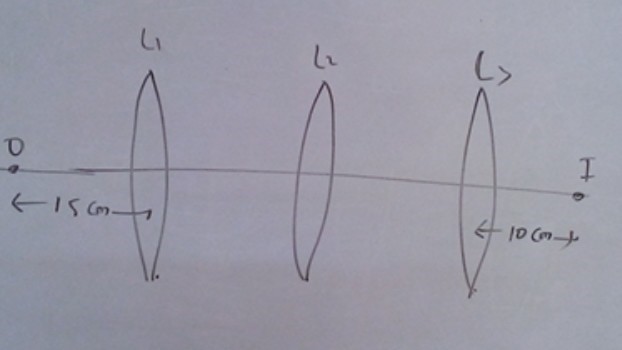
You are given three lenses L1 , L2,L3 each of focal length 10cm . an object is kept at 15cm in front of L1 , as shown in fig. the final image is formed at the focus of L3 find the separation between the lenses.
image -2 (ray optics)
A convex lens made up of glass of refractive index 1.5 is dipped , in turn ,in (a) a medium of refractive index 1.65 (b) ) a medium of refractive index 1.33.Will it behave like converging or diverging lens in two cases, explain how focal length changes in two cases .
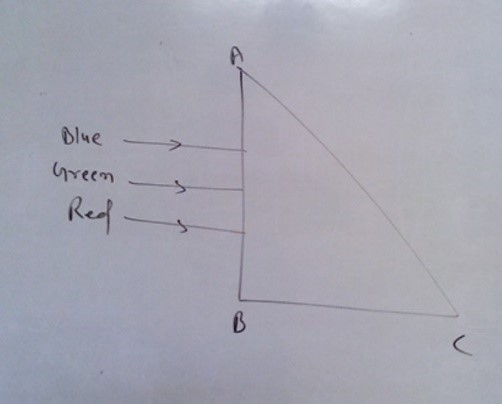
Three rays red , green and blue are incident on a right angled prism ABC at face AB the refractive indices of the material of the prism for red, green ,and blue are 1.39,1.44, and 1.47 respectively . Out of the three which color of ray emerge out of face AC. Trace the path of the three rays after passing through AB.
image-3 (ray optics)
Draw ray diagram to show how specially designed prism make use of total internal reflection to obtain inverted image of the object by deviation of rays (a) through 900 (b) through 1800 and(c) through 00 .
State the conditions under which total internal reflection occurs . one face of a prism with a refracting angle of 30 , is coated with silver . A ray incident on another face at an angle of 45 is refracted and reflected from the silver coated face and retrace its path. Find the refractive index of the material of the prism.
A convex lens with the radii of curvature of magnitude 10 cm each , is put over a liquid layer is poured on the top of the plane mirror . A small needle with its tip on the principle axis of the lens , is moved along the axis until its inverted real image coincide with the needle itself . The distance of the needle from the lens is measured to be 15 cm . on removing the liquid layer and repeating the experiment the new distance is measured to be 30cm ,what is the refractive index of the liquid?
Find the position of the image formed by the lens combination given in figure
image -4 (ray optics)
A diverging lens of focal length f cut into two identical parts ,each forming a plano- convex lens what is the focal length of each part. How the focal length of the lens changes if it bisected axially?
The image of a needle placed 45cm from a lens is formed on a screen placed 90 cm on the other side of lens. Find displacement of image if object is moved 5cm away from lens.
A small bulb is placed at the bottom of a tank containing water to a depth of 80 cm . what is the area of the surface of water through which light of the bulb can emerge out ?Refractive index of water is 1.33 consider the bulb to be a point source.
All the question given below is very Important questions of electromagnetic wave.
Students of class 12th and who is preparing for ,JEE/ NEET must have to solve the questions given below .These are very Important questions of electromagnetic wave.
before to solve all questions given below, student must have to read all the topic of electromagnetic wave; to read the entire chapter : click here-Electromagnetic wave:-
em wave
Important questions for electromagnetic wave-
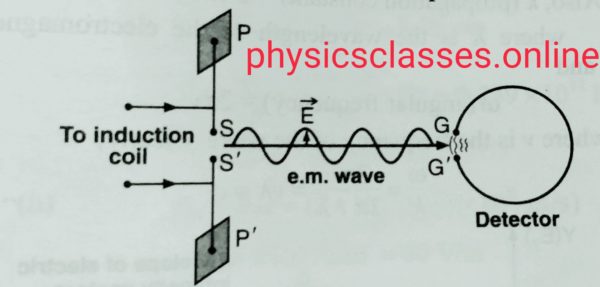
How are electromagnetic wave produced ? what is the source of energy of these wave ? write mathematical expression for electric and magnetic fields of an electromagnetic wave propagating along the Z-axis . also write the important properties of electromagnetic wave.
Why does a galvanometer when connected in series with a capacitor shows momentary deflection , when it is being charged or discharge ? how does this observation lead the modifying the Ampere’s circuital law ? hence write the generalised expression for Ampere circuital law .
A capacitor , made of two parallel plates each of plate area A and separation d , is being charged by an external AC source . show that the displacement current inside the capacitor is same as the current charging the capacitor .
What is meant by transverse nature of electromagnetic waves? Draw the diagram showing the propagation of an electromagnetic wave along X direction , indicating clearly the directions of oscillating electric and magnetic field associated with it .
(a) which of the following electromagnetic radiations has least frequency: UV-RAY,X-RAY,MICROWAVES ?(b)How do you show that electromagnetic wave carry energy and momentum ? (c) write the expression for the energy density of an electromagnetic wave propagating in free space.
An em wave is travelling in a medium with velocity v along x- axis , draw a sketch showing the propagation of the em wave , indicting the direction of oscillating electric and magnetic field . how are the magnitude of magnetic and electric field related to the velocity of em wave ?
Give two characteristics of em waves . write the expression for the velocity of em wave in terms of permittivity and permeability of the medium .
How are electromagnetic wave produced by oscillating charges ? state clearly how a microwave oven works to heat up a food item containing water molecule . why are microwave found useful for the radar systems in aircraft navigation?
(a) name the em wave which are used for the treatment for certain form of cancer . write their frequency range . (b) thin ozone layer on the top of stratosphere is crucial for human survival . why? (c) why is amount of momentum transferred by the em wave incident on the surface so small?
(a)Which segment of em wave is higher frequency ? how are these wave produced / give one use of these wave .(b)which em wave lie near the high frequency end of visible part of em spectrum / give its one use . in what way this component of light has harmful effect on humen?
Find the wavelength of em wave of frequency (i)5×10¹⁹Hz (ii) 6x 10¹²Hz (iii) 4x 10⁹ Write its two application, and how it is prepared? when an ideal capacitor is charged by a dc battery , no current flows . however , when an ac source used , the current flows continuously . how does one explain this , based on the concept of displacement current?
Suppose that the electric field amplitude of an electromagnetic wave is E0=120N/C and that is frequency f =50.0MHz (i) determine B0,ω,k and λ (ii) find expression for electric and magnetic field .
In a plane em wave , the electric field oscillate sinusoidally at a frequency of 2.0 x 10¹⁰Hz and amplitude 48V/m (i) what is the wavelength of the wave?(ii) what is the amplitude of oscillating magnetic field ?(iii) show that the average energy density of electric fields equal the average energy density of the magnetic field.
A capacitor made of two circular plates each of radius r= 12cm and separation d = 5.0mm. the capacitor is being charged by an external source . the charging current is constant having value I = 0.15 A. (i) calculate the rate of change of electric field between the plates .(ii) find the displacement current across the plates .(iii)is Kirchhoff’s first rule is valid for each plate of capacitor ? Explain.
A capacitor made of two circular plates each of radius r= 6cm and capacitance c=100pF. the capacitor is connected to an ac source of 230v with angular frequency 300rad/sec . (i) what is the rms value of the conduction current ?(ii)is conduction current equal to displacement current ?(iii)determine the amplitude of magnetic field induction at any point 3.0 cm away from the axis between the plates. To read the complete chapter of em wave click here
Assignment for short answer type questions of electromagnetic induction and alternating current
this Assignment for short answer type questions of electromagnetic induction and alternating current contain all short type questions which is important for board examination of class 12th
SHORT ANSWER TYPE QUESTIONS.
Q1. In a series LCR circuit, obtain the conditions under which (i)the impedance of the circuit is minimum and (ii)wattles current flows in the circuit.
Q2. what is the power dissipated by an ideal inductor in AC circuit? Explain.
Q3. When an AC source is connected to an ideal capacitor, show that the average power supplied by the source over a complete cycle is zero.
Q4. Prove that the power dissipated in an ideal resistor connected to an AC source is Veff2 / R.
Q5. State the principle of working of a transformer. Can a transformer be used to step up or step down a d.c. voltage ? Justify your answer.
Q6. State the underlying principle of a transformer. How is the large scale transmission of electric energy over long distances done with the use of transformers?
Q7. Define power factor. State the conditions under which it is (i)maximum (ii) minimum.
Q8. Show that the current leads the voltage in phase by n/2 in an AC circuit containing an ideal capacitor.
Q9. State Lenz’s law.
A metallic rod held horizontally along east- west direction, is allowed to fall under gravity. Will there be an emf induced at its ends? Justify your answer.
Q10. show that Lenz’s law is in accordance with the law of conservation of energy.
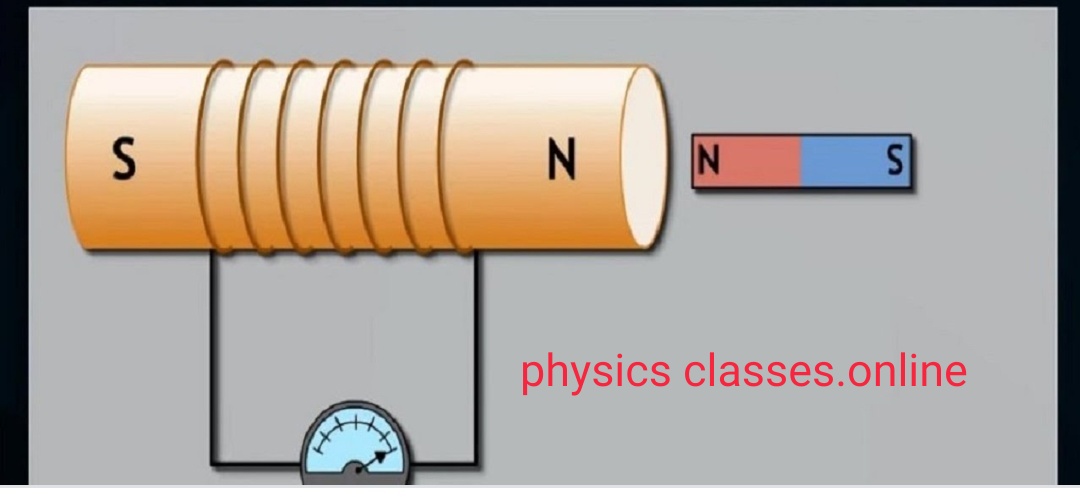
Q11. In an experimental arrangement of two coils C1 and C2 placed coaxially parallel to each other, find out the expression for the emf induced in the coil C1 (of N1 turns) corresponding to the change of current I2 in the coil C2 (of N2 turns).
Q12. (a)How does the mutual inductance of a pair of coils change when
(i)distance between the coils increased and
(ii)number of turns in the coil increased
(b) A plot of magnetic flux (ɸ) versus current (I), is shown in the figure for two inductors A and B. which one the two has large value of self inductance?
(c)How is the mutual inductance of a pair of coils effected when
(i)separation between the coils increased
(ii)the number of turns in each coil is increased
(iii)a thin iron sheet is placed between the two coils, other factors remaining the same ?
Q13. Define self-inductance of a coil . show that magnetic energy required to build up the current I in a coil of a self inductance L. is given by½ LI2. .
OR
Define the term self- inductance of a solenoid. Obtain the expression for the magnetic energy stored in an inductor of self- inductance L. to build up a current I through it.
TO DOWNLOAD/READ LONG ANSWER TYPE QUESTIONS CLICK HERE
Assignment of electromagnetic induction and alternating current
This assignment of electromagnetic induction and alternating current contain long answer type questions ( derivation and reasoning type questions. )
electromagnetic induction
LONG ANSWER TYPE QUESTIONS OF ELECTROMAGNETIC INDUCTION AND ALTERNATING CURRENT
Q1. Explain with the help of a labelled diagram, the principle and working of an ac generator. Write the expression for the emf generated in the coil in terms of speed and rotation. Can the current produced by an ac generator be measured with a moving coil galvanometer ?
OR
Describe briefly , with the help of a labelled diagram, the basic elements of an ac generator. State its underlying principle. Show diagrammatically how an alternating emf is generated by a loop of wire rotating in a magnetic field. Write the expression for the instantaneous value of the emf induced in the rotating loop.
OR
State the working of ac generator with the help of a labelled diagram . the coil of an ac generator having N turns, each of area A, is rotated with a constant angular velocity ω. Deduce the expression for the alternating emf generated in the coil. What is the source of energy generation in this device?
Q2. derive an expression for impedance of an a.c. circuit consisting of an inductor and a resistor.
Q3. (a)State the condition for resonance to occur in series LCR a.c. circuit and derive an expression for resonant frequency.
(b) Draw a plot showing the variation of the peak current (im)with frequency of the a.c. source used. Define the quality factor Q of the circuit.
Q4. Define the term capacitive reactance. Show graphically the variation of capacitive reactance with frequency of applied alternating voltage.
An ac voltage V=V0 sin ωt is applied across a pure capacitor of capacitance C. Find an expression for current flowing through it. Show mathematically the current flowing through it leads the applied voltage by angle π/2.
Q5. Explain the term inductive reactance. Show graphically the variation of inductive reactance with frequency of the applied alternating voltage.
An ac voltage V=V0 sin ωt is applied across a pure inductor of inductance L. Find an expression for current i, flowing in the circuit . Show mathematically the current flowing through it lags behind the applied voltage by phase angle π/2. Also draw (i) phasor diagram (ii) graphs of V an I versus ωt for the circuit.
Q6. Derive an expression for (i)induced current when a conductor of length l is moved with a uniform velocity v. normal to a uniform magnetic field B. Assume the resistance of conductor to be R.
Q7. (a)What is induced emf ? write Faraday’s law of electromagnetic induction. Express it Mathematically.
(b) A conducting rod of length l with one end pivoted, is rotated with a uniform angular speed ω in a vertical plane, normal to a uniform magnetic field B. deduce an expression for the emf induced in this rod.
If resistance of rod is R, what is the current induced in it.
Q8. A coil of number of turns N, Area A is rotated at a constant angular speed ω in a uniform magnetic field B and conducted to a resistor R. Deduce the expression for
(i)Maximum emf induced in the coil.
(ii) Power dissipation in the coil .
Q9. (a)Describe briefly, with the help of a labeled diagram, the working of a step up transformer.
(b) Write any two source of energy loss in a transformer.
(c) A set up Transformer converts a low voltage into high voltage. Does it not violate the principle of conservation of energy? Explain.
OR
Draw a schematic Diagram of a set up transformer. Explain its working principle . Deduce the expression for the secondary to primary voltage in turms of number of turns in the two coils. In an ideal transformer, how is this ratio related to the current in the two coils?
How is the transformer used in large scale transmission and distribution of electrical energy over long distances?
Q10. An ac source of voltage V=Vm sin ωt is connected one by one, to three circuit elements X,Y and Z. It is observed that the current flowing in them.
(a) is in the phase with applied voltage for element X.
(b) lags the applied voltage, in phase, by angle π/2 for element Y.
(c) leads the applied voltage in phase by angle π/2.
Identify the three circuit elements.
Find an expression for for the current flowing in the circuit, when the same ac source is connected across a series combination of the elements X,Y and Z.
If the frequency of the applied voltage is varied, set up the condition of the frequency when the current amplitude in the circuit is maximum. Write expression for this current amplitude.
Q11. (a)What is impedance?
(b) A series LCR circuit is connected to an ac source having voltage V=V0 sin ωt. Derive an expression for the impedance, instantaneous current and its phase relationship to the applied voltage. Find the expression for the resonant frequency
OR
(a) ac source having voltage V=V0 sin ωt is connected to a series combination of L, C and R. Use the phasor diagram to obtain expression for impedance of the circuit and phase angle between voltage and current. Find the condition when the current will be in phase with the voltage. What is the circuit in this condition called?
(b)In a series LR circuit XL = R and power factor of the circuit is P1. When capacitor with capacitance C such that XL=XC is put in series, the power factor becomes P2 calculate P1/P2 .
Q12. Derive Expression for self inductance of a long air- cored solenoid of length l, cross- sectional area A and having number of turns N.
Q13. What do mean by mutual inductance of two nearby coils ? Find an expression for mutual inductance of two co-axial solenoid.
OR
(a)Define mutual inductance and write its SI units.
(b)Derive an expression for the mutual inductance of two long co – axial solenoid of same length wound one over the other.
(c)In an experiment, two coils C1 an C2 are placed close to each other. Find out the expression for the emf induced in the coil C1 due to change in the current through coil C2.