Category: 12th Assignments

  • Important questions of electromagnetic wave

    Important questions of electromagnetic wave

    Important questions of electromagnetic wave-

    All the question given below is very Important questions of electromagnetic wave.

    Students of class 12th and who is preparing for   ,JEE/ NEET must have to solve the questions given below .These are very Important questions of electromagnetic wave.

    before to solve all questions given below, student must have to read all the topic of electromagnetic wave; to read the entire chapter : click here-Electromagnetic wave:-

    em wave

    Important questions for electromagnetic wave-

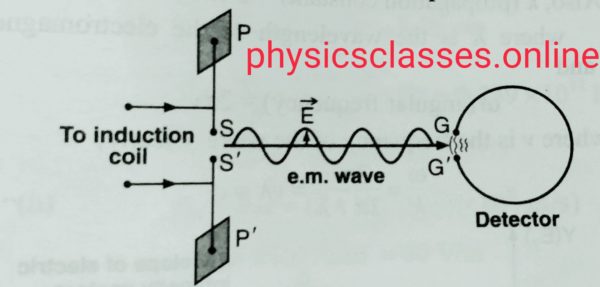
    1. How are electromagnetic wave produced ? what is the source of energy of these wave ? write mathematical expression for electric and magnetic fields of an electromagnetic wave propagating along the Z-axis . also write the important properties of electromagnetic wave.
    2. Why does a galvanometer when connected in series with a capacitor shows momentary deflection , when it is being charged or discharge ? how does this observation lead the modifying the Ampere’s circuital law ? hence write the generalised expression for Ampere circuital law .
    3. A capacitor , made of two parallel plates each of plate area A and separation d , is being charged by an external AC source . show that the displacement current inside the capacitor is same as the current charging the capacitor .
    4. What is meant by transverse nature of electromagnetic waves? Draw the diagram showing the propagation of an electromagnetic wave along X direction , indicating clearly the directions of oscillating electric and magnetic field associated with it .
    5. (a) which of the following electromagnetic radiations has least frequency: UV-RAY,X-RAY,MICROWAVES ?(b)How do you show that electromagnetic wave carry energy and momentum ? (c) write the expression for the energy density of an electromagnetic wave propagating in free space.
    6. An em wave is travelling in a medium with velocity v along x- axis , draw a sketch showing the propagation of the em wave , indicting the direction of oscillating electric and magnetic field . how are the magnitude of magnetic and electric field related to the velocity of em wave ?
    7. Give two characteristics of em waves . write the expression for the velocity of em wave in terms of permittivity and permeability of the medium .
    8. How are electromagnetic wave produced by oscillating charges ? state clearly how a microwave oven works to heat up a food item containing water molecule . why are microwave found useful for the radar systems in aircraft navigation?
    9. (a) name the em wave which are used for the treatment for certain form of cancer    . write their frequency range . (b) thin ozone layer on the top of stratosphere is crucial for human survival . why? (c) why is amount of momentum transferred by the em wave incident on the surface so small?
    10. (a)Which segment of em wave is higher frequency ? how are these wave produced / give one use of these wave .(b)which em wave lie near the high frequency end of visible part of em spectrum / give its one use . in what way this component of light has harmful effect on humen?
    11. Find the wavelength of em wave of frequency (i)5×10¹⁹Hz (ii) 6x 10¹²Hz (iii) 4x 10⁹ Write its two application, and how it is prepared? when an ideal capacitor is charged by a dc battery , no current flows . however , when an ac source used , the current flows continuously . how does one explain this , based on the concept of displacement current?
    12. Suppose that the electric field amplitude of an electromagnetic wave is E0=120N/C and that is frequency f =50.0MHz (i) determine B0,ω,k and λ (ii) find expression for electric and magnetic field .
    13. In a plane em wave , the electric field oscillate sinusoidally at a frequency of 2.0 x 10¹⁰Hz and amplitude 48V/m (i) what is the wavelength of the wave?(ii) what is the amplitude of oscillating magnetic field ?(iii) show that the average energy density of electric fields equal the average energy density of the magnetic field.
    14. A capacitor made of two circular plates each of radius r= 12cm and separation d = 5.0mm. the capacitor is being charged by an external source . the charging current is constant having value I = 0.15 A. (i) calculate the rate of change of electric field between the plates .(ii) find the displacement current across the plates .(iii)is Kirchhoff’s first rule is valid for each plate of capacitor ? Explain.
    15. A capacitor made of two circular plates each of radius r= 6cm and capacitance c=100pF. the capacitor is connected to an ac source of 230v with angular frequency 300rad/sec . (i) what is the rms value of the conduction current ?(ii)is conduction current equal to displacement current ?(iii)determine the amplitude of magnetic field induction at any point 3.0 cm away from the axis between the plates.                                          To read the complete chapter of em wave click here
  • Assignment for short answer type questions of electromagnetic induction and alternating current

    Assignment for short answer type questions of electromagnetic induction and alternating current

    Assignment for short answer type questions of electromagnetic induction and alternating current

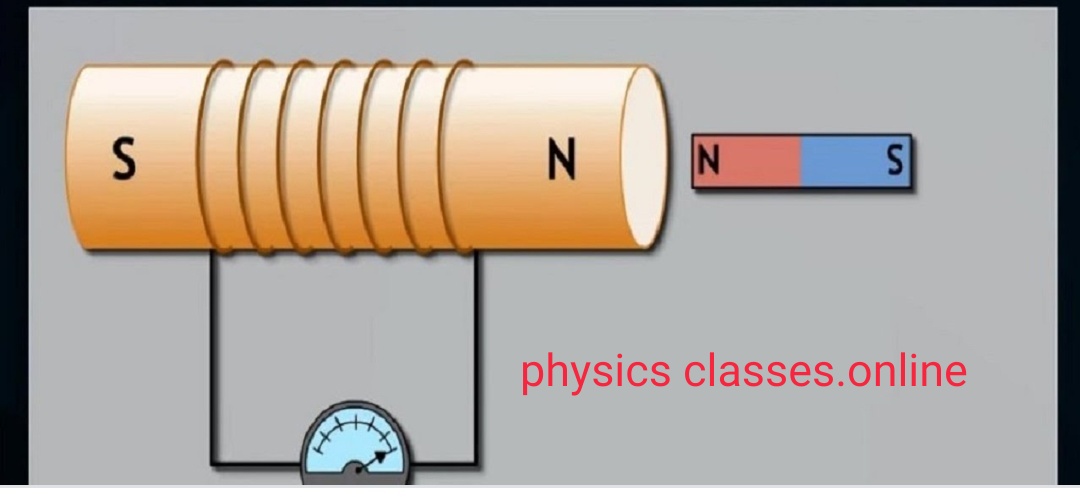
    this Assignment for short answer type questions of electromagnetic induction and alternating current contain all short type questions which is important for board examination of class 12th

    SHORT ANSWER TYPE QUESTIONS.

    Q1. In a series LCR circuit, obtain the conditions under which (i)the impedance of the circuit is minimum and  (ii)wattles current flows in the circuit.

    Q2. what is the power dissipated by an ideal inductor in AC circuit? Explain.

    Q3. When an AC source is connected to an ideal capacitor, show that the average power supplied by the source over a complete cycle is zero.

    Q4. Prove that the power dissipated in an ideal resistor connected to an AC source is Veff 2   / R.

    Q5. State the principle of working of a transformer. Can a transformer be used to step up or step down a d.c. voltage ? Justify your answer.

    Q6. State the underlying principle of a transformer. How is the large scale transmission of electric energy over long distances done with the use of transformers?

    Q7. Define power factor. State the conditions under which it is  (i)maximum (ii) minimum.

    Q8. Show that the current leads the voltage in phase by n/2 in an AC circuit containing an ideal capacitor.

    Q9. State Lenz’s law.

    A metallic rod held horizontally along east- west direction, is allowed to fall under gravity. Will there be an emf induced at its ends? Justify your answer.

    Q10. show that Lenz’s law is in accordance with the law of conservation of energy.

    Q11. In an experimental arrangement of two coils C1 and C2 placed coaxially parallel to each other, find out the expression for the emf induced in the coil C1 (of N1 turns) corresponding to the change of current I2 in the coil C2 (of N2 turns).

    Q12. (a)How does the mutual inductance of a pair of coils change when

    (i)distance between the coils increased and

    (ii)number of  turns in the coil increased

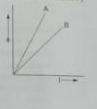
    (b) A plot of magnetic flux (ɸ) versus current (I), is shown in the figure for two inductors A and B. which one the two has large value of self inductance?

    EMI PIC

    (c)How is the mutual inductance of a pair of coils effected when

    (i)separation between the coils increased

    (ii)the number of turns in each coil is increased

    (iii)a thin iron sheet is placed between the two coils, other factors remaining the same ?

    Q13. Define self-inductance of a coil . show that magnetic energy required to build up the current I in a coil of a self inductance L. is given by½ LI2. .

    OR

    Define the term self- inductance of a solenoid. Obtain the expression for the magnetic energy stored in an inductor of self- inductance L. to build up a current I through it.

    TO DOWNLOAD/READ LONG ANSWER TYPE QUESTIONS CLICK HERE


  • Assignment of electromagnetic induction and alternating current

    Assignment of electromagnetic induction and alternating current

    This assignment of electromagnetic induction and alternating current contain long answer type questions ( derivation and reasoning type questions. )

    electromagnetic induction
    electromagnetic induction

    LONG ANSWER TYPE QUESTIONS OF ELECTROMAGNETIC INDUCTION AND ALTERNATING CURRENT

    Q1. Explain with the help of a labelled diagram, the principle and working of an ac generator. Write the expression for the emf generated in the coil in terms of speed and rotation. Can the current produced by an ac generator be measured with a moving coil galvanometer ?

    OR

    Describe briefly , with the help of a labelled diagram, the basic elements of an ac generator. State its underlying principle. Show diagrammatically how an alternating emf is generated by a loop of wire rotating in a magnetic field. Write the expression for the instantaneous value of the emf induced in the rotating loop.

    OR

    State the working of ac generator with the help of a labelled diagram . the coil of an ac generator having N turns, each of area A, is rotated with a constant angular velocity ω. Deduce the expression for the alternating emf generated in the coil. What is the source of energy generation in this device?

    Q2. derive an expression for impedance of an a.c. circuit consisting of an inductor and a resistor.

    Q3. (a)State the condition for resonance to occur in series LCR a.c. circuit  and derive an expression for resonant frequency.

    (b) Draw a plot showing the variation of the peak current (im)with frequency of the a.c. source used. Define the quality factor Q of the circuit.

    Q4. Define the term capacitive reactance. Show graphically the variation of capacitive reactance with frequency of applied alternating voltage.

    An ac voltage  V=V0 sin ωt is applied across a pure capacitor of capacitance C. Find an expression for current flowing through it. Show mathematically the current flowing through it leads the applied voltage by angle π/2.

    Q5. Explain the term inductive reactance. Show graphically the variation of inductive reactance with frequency of the applied alternating voltage.

    An ac voltage  V=V0 sin ωt is applied across a pure inductor of inductance L. Find an expression for current i, flowing in the circuit . Show mathematically the current flowing through it lags behind the applied voltage by phase angle π/2. Also draw (i) phasor diagram  (ii) graphs of V an I versus ωt for the circuit.

    Q6. Derive an expression for (i)induced current when a conductor of length l is moved with a uniform velocity v. normal to a uniform magnetic field B. Assume the resistance of conductor to be R.

    Q7. (a)What is induced emf ? write Faraday’s law of electromagnetic induction. Express it Mathematically.

    (b) A conducting rod of length l with one end pivoted, is rotated with a uniform angular speed ω in a vertical plane, normal to a uniform magnetic field B. deduce an expression for the emf induced in this rod.

    If resistance of rod is R, what is the current induced in it.

    Q8. A coil of number of turns N, Area A is rotated at a constant angular speed ω in a uniform magnetic field B and conducted to a resistor R. Deduce the expression for

    (i)Maximum emf induced in the coil.

    (ii) Power dissipation in the coil .

    Q9. (a)Describe briefly, with the help of a labeled diagram, the working of a step up transformer.

    (b) Write any two source of energy loss in a transformer.

    (c) A set up Transformer converts a low voltage into high voltage. Does it not violate the principle of conservation of energy? Explain.

    OR

    Draw a schematic Diagram of a set up transformer. Explain its working principle . Deduce the expression for the secondary to primary voltage in turms of number of turns in the two coils. In an ideal transformer, how is this ratio related to the current in the two coils?

    How is the transformer used in large scale transmission and distribution of electrical energy over long distances?


    Q10. An ac source of voltage V=Vm sin ωt is connected one by one, to three circuit elements X,Y and Z. It is observed that the current flowing in them.

    (a) is in the phase with applied voltage for element X.

    (b) lags the applied voltage, in phase, by angle π/2 for element Y.

    (c) leads the applied voltage in phase by angle π/2.

    Identify the three circuit elements.

    Find an expression for for the current flowing in the circuit, when the same ac source is connected across a series combination of the elements X,Y and Z.

    If the frequency of the applied voltage is varied, set up the condition of the frequency when the current amplitude in the circuit is maximum. Write expression for this current amplitude.

    Q11. (a)What is impedance?

    (b) A series LCR circuit is connected to an ac source having voltage V=V0 sin ωt. Derive an expression for the impedance, instantaneous current and its phase relationship to the applied voltage. Find the expression for the resonant frequency

    OR

    (a) ac source having voltage V=V0 sin ωt is connected to a series combination of L, C and R. Use the phasor diagram to obtain expression for impedance of the circuit and phase angle between voltage and current. Find the condition when the current will be in phase with the voltage. What is the circuit in this condition called?

    (b)In a series LR circuit XL = R and power factor of the circuit is P1. When capacitor with capacitance C such that XL=XC is put in series, the power factor becomes P2 calculate P1/P2 .

    Q12. Derive Expression for self inductance of a long air- cored solenoid of length l, cross- sectional area A and having number of turns N.

    Q13. What do mean by mutual inductance of two nearby coils ? Find an expression for mutual inductance of two co-axial solenoid.

    OR

    (a)Define mutual inductance and write its SI units.

    (b)Derive an expression for the mutual inductance of two long co – axial solenoid of same length wound one over the other.

    (c)In an experiment, two coils C1 an C2 are placed   close to each other. Find out the expression for the emf induced in the coil C1 due to change in the current through coil C2.

    To download short and very short answer type questions click here – short  answers type questions ELECTROMAGNETIC INDUCTION AND ALTERNATING CURRENT


  • IMPORTANT QUESTIONS OF CURRENT ELECTRICITY

    IMPORTANT QUESTIONS OF CURRENT ELECTRICITY

    CURRENT ELECTRICITYCURRENT ELECTRICITY

    IMPORTANT QUESTION OF CURRENT ELECTRICITY

    THIS ASSIGNMENT PROVIDE  ALL IMPORTANT QUESTIONS OF CURRENT ELECTRICITY CHAPTER .

    This question paper is designed for quick revision for the students of class 12th appearing in the class test or board examination , if students have to practice the question of current electricity in broad level click on  complete assignment of electric current 

    1 (i)State the working principle of a potentiometer. With the help of the circuit diagram, explain how a potentiometer is used to compare the emf’s of two primary cells. Obtain the required expression used for comparing the emf’s.

    (ii) write two possible causes for one sided deflection in a potentiometer experiment.

    (iii)Which material is used for potentiometer wire and why?

    (iv)how can the sensitivity of a potentiometer be increased?

    2. Answer the following

    (i) Why are the connections between the resistor in a meter bridge made of thick copper strips?

    (ii)Why is it generally preferred to obtain the balance point in the middle of the meter bridge wire?

    (iii)which material is used for the meter bridge wire and why?

    3. (i)State with the help of a circuit diagram, the working principle of a meter bridge. Obtain the expression used for determining the unknown resistance.

    (ii) what happens if the galvanometer and cell are interchanged at the balance point of the bridge?

    (iii) why is it considered important to obtain the balance point near the mid- point of the wire?

    4. (a) A cell of emf E and internal resistance r is connected across a variable resistor R. Plot a graph showing the variation of terminal potential V with resistance R.

    (b) Plot a graph showing the variation of terminal potential difference across a cell of emf E and internal resistance r with current drawn from it. Using this graph how does one determine the emf of the cell?

    5. Two conducting wires X and Y of same diameter but different materials are joined in series across a battery. If the number of density of electrons in X is twice than that in Y, then find the ratio of drift velocity of electrons in the two wires.

     If students wants to quick revision in short time practice these question-  IMPORTANT QUESTIONS OF ELECTRIC CURRENT-


  • IMPORTANT QUESTIONS OF ELECTROSTATIC POTENTIAL AND CAPACITANCE

    IMPORTANT QUESTIONS OF ELECTROSTATIC POTENTIAL AND CAPACITANCE

    ELECTROSTATIC POTENTIAL AND CAPACITANCE

    ELECTROSTATIC POTENTIAL AND CAPACITANCE
    ELECTROSTATIC POTENTIAL AND CAPACITANCE

    THIS QUESTION PAPER CONTAINS THE IMPORTANT QUESTIONS OF ELECTROSTATIC POTENTIAL AND CAPACITANCE IT IS IMPORTANT FOR THE BOARD EXAMINATION FOR CLASS 12TH

    1. What do you mean by the term equipotential surface ? Draw the equipotential surface for (i) a point charge, (ii) an electric dipole , (iii) two positive charges of equal magnitude separated by some distance (iv) two uniformly large parallel thin plates having charge density +σ and -σ separated d distance apart. Can two equipotential surface intersect each other ? give reason. Why there is no work done in moving a charge fro one point to other on an equipotential surface? TO DOWNLOAD COMPLETE QUESTIONS PAPER CLICK HERE –ELECTROSTATIC POTENTIAL AND CAPACITANCE
  • Very important questions of ELECTRIC CHARGES AND FIELDS

    Very important questions of ELECTRIC CHARGES AND FIELDS

    ELECTRIC CHARGES AND FIELDS
    ELECTRIC CHARGES AND FIELDS

    ELECTRIC CHARGES AND FIELDS

    This assignment contains very important questions of ELECTRIC CHARGES AND FIELDS

    1. Explain the following terms –(a) Quantisation of charge . (b) Additivity of charge and (c) conservation of charge.
    2. What is electric field lines ? Draw the field lines for (a) A positive charge (b) A negative charge (c) An electric dipole (d) Two positive charge having equal magnitude separated by some distance, (e)  ) Two positive charge having different magnitude separated  by some distance, and (f) A plane positively charged sheet (g) A positive point charge  (+q) is kept in the vicinity of an uncharged conduction plate. Sketch the electric field lines originated from the point on to the surface of the plate. Also explain why ( I ) Field lines never intersect each other? (ii) Why field lines always comes out normally to the surface ?
    3. What do you mean by the term electric dipole and dipole moment? Is it scaler or vector quantity? Find the electric at a point the (i) axial  and  (ii) equatorial point , also find the relation between them . Also deduce an expression for the torque acting on a dipole and energy stored in the dipole when it is placed in the uniform electric field E .What will happen to the dipole when it is placed in non – uniform electric field?
    4. State and prove Gauss theorem . Using Gauss’s theorem find the magnetic field at a point due to (i) straight charged wire , (ii) plane charged sheet , show that it is independent of distance of the point from the sheet , and (iii) charged spherical shell also plot the graph between electric field and separation of point from the centre of the shell. Using Gauss’s law also derive  an expression for the electric field between two uniformly charged  parallel sheets of charge density σ and -σ respectively
    5. (i)Define electric flux  , write its SI unit . (ii)The electric field components due to a charge inside the cube of side 0.1m are shown below      Ex=αx   ,  where α =500N/C-m EY=0,EZ=0Calculate (a) The flux through the cube (b)the charge inside the cube CLICK HERE TO DOWNLOAD-Very important questions for ELECTRIC CHARGES AND FIELD 


  • OBJECTIVE QUESTIONS OF ELECTROSTATICS

    OBJECTIVE QUESTIONS OF ELECTROSTATICS

    ELECTROSTATICS

    OBJECTIVE TYPE QUESTIONS OF ELECTROSTATICS FOR THE STUDENTS PREPARING FOR JEE/ NEET/AIIMS.

    OBJECTIVE TYPE QUESTIONS OF ELECTROSTATICS questions will help the students to practice the entire chapter of ELECTROSTATICS …..Having solved these question students will be able to solve all questions in all competitive examinations based on this chapter . Section A is for NEET and XII(board), section B is for JEE students.


    ELECTROSTATICS


    TO DOWNLOAD ENTIRE QUESTION PAPER


    OBJECTIVE TYPE QUESTIONS -1-electrostatics

    Here is another set of important objective questions for class 12th which contain all important questions of electric field and potential only, it will help the students to practice this chapter well , for board examination  point of view .

    To dawnload important objective questions for class 12th-click here -Electric Field and Potential.objective 2


  • assignment  electric current class 12

    assignment electric current class 12

    this assignment deals with chapter electric current. this assignment will help the students to practice well and score good marks in board examinations.

  • Electrostate Assignment-1 for the class 12

    Electrostate Assignment-1 for the class 12

    These questions are based on the 12th Board examination. This first set of questions cover the chapters of Electrostatic in Physics where we deal with charge in rest and what properties it shows. Check the questions below of electrostate Assignment-1 for the class 12 .

    Short answer type Questions

    Q1. Can a charged body attract an uncharged body?

    Q2. A small test charge is released at rest at a point in an electrostatic field. Will it travel along the field line passing through that point?

    Q3. In an electric field an electron is kept freely. If the electron is replaced by proton, what will be the relationship between the forces experienced by them?

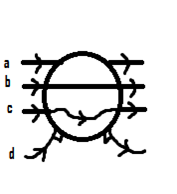
    Q4. A metallic sphere is placed in uniform electric field as shown in the figure. Which path is followed by electric field lines and why?

    Download the Electrostate Full Question Here

    Q5. find the value of electric field that would exactly balance the weight of electron.

    Q6. if the Coulomb’s law involved 1/r3 dependence (instead of 1/r3), where r is distance between two point changes would Gauss’s law still be true?

    Q7. A glass rod is rubbed with silk. Will its mass increase or decrease ?

    Q8 . An electrostatic field line cannot be discontinuous, why?

    Q9. Which orientation of an electric dipole in a uniform electric field would correspond to stable equilibrium ?

    Q10. The distance of the point on equatorial plane of a small electric dipole is halved. By what factor will the electric field due to dipole at the point changes?

    Q11. When two electrically charged particles having charges of different magnitude are placed at a distance d from each other, they experience a force of attraction F. these two particles are put in contact and again placed at the same distance from each other. What is the nature of new forces between them ?

    Guidence : This is the researched Electrostate Assignment of Physics Classes by Nayan Jha. Please read the questions carefully before attempting.

    Q12. What is the line of symmetry of a dipole field?

    Check for 12th Class Notes -Click Here


    Q13. Repulsion is the sure test of electric charge. Explain

    Q14. An electric dipole moment P is placed in a uniform electrostatic field E. for what angle between P and E will the potential energy of the electric dipole be half of its maximum value?

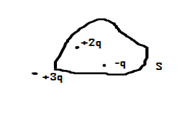
    Q15. Figure shows three point charges +2q , -q and +3q. two charges +2q and –q are enclosed within a surface S. what is the electric fix due to this configuration through the surface S?


    Download the 12th class Test paper of Electrostate