Author: Nayan Jha

  • Very important numericals physics( term-2)

    Important numericals physics term-2 (CBSE)

    1. What is apparent position of the object below a rectangular block of glass 6cm thick , if a layer of water 4cm thick is on the top of the glass ? Refractive index of glass and water with respect to air is 3/2 and 4/3 respectively.
    2. A screen is placed 100cm from an object  . The image of the object on the screen is formed by a convex lens at two different locations , separated by distance 20cm . calculate the focal length of the lens used.
    3. You are given three lenses  L1 , L2,L3 each of focal length 10cm . an object is kept at 15cm in front of L1  ,  as shown in fig. the final image is formed at the focus of L3 find the separation between the lenses.
    • 4. A convex lens made up of glass of refractive index 1.5 is  dipped  , in turn ,in (a) a medium of refractive index 1.65 (b)   ) a medium of refractive index 1.33.Will it behave like converging or diverging lens in two cases, explain how focal length changes in two cases .
    • 5.Three rays  red  , green and blue are incident on a right angled prism ABC at face AB the refractive indices of the material  of the prism for red, green ,and blue are 1.39,1.44, and 1.47 respectively . Out of the three which colour of ray emerge out of face AC. Trace the path of the three rays after passing through AB.
    • 6. State the conditions under which total internal reflection occurs . one face of a prism with a refracting angle of 30 , is coated with silver . A ray incident on  another face at an angle of 45 is refracted and reflected from the silver coated face and retrace its path. Find the refractive index of the material of the prism.
    • 7. Find the position of the image formed by the lens combination given in figure   
    • 8. A diverging lens of focal length f cut into two identical parts ,each forming a plano- convex lens what is the focal length of each part. How the focal length of the lens changes if it bisected axially?
    • 9. The image of a needle placed 45cm from a lens is formed on a screen placed 90 cm on the other side of lens. Find displacement of image if object is moved 5cm away from lens.
    • 10. A small bulb is placed at  the bottom of a tank containing water to a depth of 80 cm . what is the area of the surface of water through which light of the bulb can emerge out ?Refractive index of water is 1.33 consider the bulb to be a point source.
    •  11. Yellow light of wavelength λ= 6000 A illuminate a single slit of width 1 x 10⁻⁴ m calculate (i) the distance between two dark lines on either side of the central maximum when the diffraction pattern is on screen kept 1.5 m away from the slits , (ii) the angular spread of the first diffraction minima .

       Ans- 1.8 cm , 6x 10⁻³ rad . 12. Two wavelength of sodium light 590 nm are used in turn , to study the diffraction taking place at the single slit of aperture  2x 10⁻⁴ m . The distance between the slits and the screen is 1.5 m . Calculate the separation between the position of first maxima of the diffraction pattern obtained in the two cases .

      Ans-6.75×10⁻⁵m . 13. (a) In a single slit diffraction , a slit of width d is illuminated by red light of wavelength 650 nm . For what value of  d will (i) the first minimum fall at an angle of diffraction of 300 , and   (ii) the first maximum fall at an angle of diffraction of 300 ? 

      (b) Why does the intensity of secondary maximum becomes less as compared to the central maximum .

         Ans- 1.3 x10⁻⁶ m , 1.95×10 ‑6‑ m 14. A monochromatic light of wavelength 500 nm is incident normally on a single slit of width 0.2 mm to produce a diffraction pattern . Find the angular width of the central maximum obtained on the screen . Also estimate the number of fringes obtained in YDSE with fringe width 0.5 mm , which can be accommodate within the region of total angular spread of the central maximum due to single slit .            Ans- ϴ=0 to 2.5×10⁻³ ; n=D/2 ;D+1 15.A beam of light consisting of two wavelength 800nm and 600 nm is used to obtain the interference pattern in YDSE on a screen placed 1.4 m away . If the two slits are separated by 0.28mm , calculate the least distance from the central bright maximum where the bright fringes of the two wavelengths coincide . Ans- n=3 ; 1.2 cm . 16. In YDSE using monochromatic light of wavelength λ, the intensity of light at a point on the screen where path difference is λ is K units . Find out the intensity of light of light at a point where path- difference is λ/3 . 17. The ratio of the intensity at minima to the maxima in YDSE is 9:25 , find the ratio of the width of the two slits , also find the ratio of amplitude .   Ans- 16:1 . 18. Two wavelength of sodium light of 590 nm and 596 nm are used in turn to study the diffraction taking place at a single slit of aperture 2×10⁻⁶ m . The distance between the slit and the screen is 1.5 m . Calculate separation between the position of first maxima and of the diffraction pattern obtained in the two cases .

     Ans- 6.75 nm .

    19. The electron in a given Bohr orbit has a total energy of -1.5Ev. calculate its(i) kinetic energy(ii)potential energy (iii) wavelength of the radiation emitted , when this electron makes a transition to the ground state.

    20. The energy of an electron in the ground state of hydrogen atom is -13.6 Ev. (i) what does the negative sign signify ? (ii)how much energy is required to take an electron in this atom from the ground state to the first exited state?

    21. The ground state energy of hydrogen atom is  -13.6 eV.  ( I ) What is the potential energy of an electron in the third exited state? (ii) what will be the maximum and minimum wavelength of the emitted  radiation of Lyman series of hydrogen spectrum.

    22. The energy level diagram  of an element is given below . identify using necessary calculations , which transition corresponds to the emission of the spectral line of wavelength 102.7 nm . which transition corresponds to the emission of radiation of maximum wavelength?  

    .

    23.The first line of Lyman series in hydrogen spectrum has a wavelength of 1220 Å. Calculate the wavelength of the second member of the series.

    24. A nucleus at rest splits up into two parts with velocity ratio 2 : 1 calculate the ratio of their radii of the ratio the two nuclear fragments.

    25.The ground state energy of electron in hydrogen atom is – 13.6 eV. Find the kinetic energy and potential energy of the electron in (i) ground state (ii) first excited state.
  • Physics Sample paper class12th(term-2)

    Sample paper -1

                                                            Class 12th

                                                        Physics (Theory)   Term-2


    M.M: 35                                                                                                             TIME-2Hrs

     Here Physics classes by Nayan jha providing CBSE Term-2 Physics sample paper .

    There are 12 questions in all and all questions are compulsory.

     This question paper consists of three section A,B and C.

    SECTION A has three questions of two marks each , 

    SECFTION- B there are eight questions carrying three marks each and

    SECTION- C is case study based questions of five marks.

    There is no overall choice . However , an internal choice has been provided.

    Uses of calculator is not allowed.

    SECTION-A

    1. Find the ratio of energies of photons produced due to transition of electron of hydrogen atom from its (i) Second permitted energy level to the first level and, (ii) the highest permitted energy level .

    Or,

    The ground state energy of hydrogen atom is -13.6eV. What is the kinetic and potential energy of electron in this orbit.

    2. Draw the circuit diagram showing the biasing of an LED . State the factor which controls (i) Wavelength of light (ii) intensity of light emitted by the diode.

    3. Write the photoelectric equations of Einstein . Write two basic features of photon picture of electromagnetic radiation on which Einstein’s photoelectric equation is based.

    SECTION-B

    4. Draw V-I characteristics of p-n junction diode (i) When diode is reversed bias and (ii) when diode is forward biased . Explain why the current under reverse bias is almost independent of the applied voltage up to the critical voltage?

    5.State the necessary conditions for producing total internal reflection of light. Draw the diagram to show how specially designed prism make use of T.I.R to obtained inverted image of the object by deviating rays (i) through 900 and (ii) Through 1800.

    Or,

    Three rays of light red , green and blue is fall normally on one of the equal side of an isosceles right angled prism . The refractive index of these rays are 1.39,1.44,1.47 respectively . Find which of these rays get internally reflected from diagonal side . Trace the path of rays . Justify your answer with necessary conditions.

    6. Using Bohr postulates for hydrogen atom , show that the total energy of the electron in the stationary states can be expressed as the sum of kinetic energy(K) and potential energy (U)  , where K=-2U. hence , deduce the expression for the total energy in the nth energy level of hydrogen atom .

    Or,

     Draw a labelled diagram of alpha particle scattering experiment. Give Rutherford observations and  discuss the significance of this experiment .

    7. How the size of nuclei is experimentally determined ? write the relation between the radius and mass number of the nucleus . show that the density of the nucleus is independent of its mass number. Two nuclei of mass number in the ratio 27:125. What is the ratio of their nuclear radius and , ratio of their densities.

    Or,

    Draw the binding energy per nucleon curve . using the curve state clearly how the release in energy in the process of nuclear fission and nuclear fusion can be explained.

    8. An electron of mass m  and charge q is accelerated from rest through a potential difference V  , obtain the expression for the de-Broglie  wavelength  associated with it . if electron and proton are moving with the same K.E. , which one of them will have a large De-Broglie wavelength associated with it ? give reason .

    9. I n a single slit diffraction experiment , deduce the conditions for the central maximum and secondary maxima/minima observed in diffraction pattern . Also explain why the secondary maxima go on becoming weaker in intensity as the order increases. Haw does the width of the slit affected the size of the central bright fringe?

    10. Using Young’s double slit experiment obtain the conditions for gating bright and dark fringes  also derive the expression for the fringe width.  Also write the effect on fringe width when(I)Distance between slits increases/decreases (II) Distance between slits and the screen increases/decreases(III) Monochromatic light replaced  by white light,(IV) One of slit is closed and (V) entire experimental apparatus is immersed in a liquid.

    11.  (i) Which segment of electromagnetic waves has highest frequency? How are these waves produced? Give one use of these waves.

    (ii) Which EM waves lie near the high frequency end of visible part of EM spectrum? Give its one use. In what way this component of light has harmful effects on humans?

                Section-C

    12.

     Power of a lens-

    Power (P) of a lens is given as the reciprocal of focal length (P=1/f)where f should be in meter and P is in Diopter . for convex power is positive and concave power is –ve. When two or more lenses are kept in contact then power of the combined lens is given as P= P1 + P2+P3 …….

    (I) A convex and a concave lens is separated by distance d are then put in contact then the focal length of the combination  (a) becomes 0 (b) remain the same (iii) decreases (iv)increases.

    (ii)The two lenses of power +1.5D and +1.0D are placed in contact then the effective power of the combination will be (a)2.5D (b)1.5 D (c) 0.5D (d)3.25D .

    (iii) If the power of the lens is 5D then what is the focal length of the lens?(a)10cm (b) 20cm (c)15cm (d) 5cm

    (iv)Two thin lens of focal length +10cm and -5cm are kept in contact , the power of the combination is ? (a)-10D (b)-20D (c)10D (d)15D .

    (v)A convex lens of focal length 25cm is placed coaxially in contact with a concave lens of focal length 20cm the system will be ; (a) converging in nature (ii) diverging in nature (c) can be converging or diverging (d) None of the above.

  • Case study based questions on Photoelectric effect

    Photoelectric effect

    Photoelectric effect is the phenomenon of emission of electrons from a metal surface , when radiation of suitable frequency fall on them . The emitted electrons are called photoelectrons and the current so produced is called photoelectric current.

    i. With the increase of intensity of incident radiation on photoelectrons emitted by a photo tube , the number of photoelectrons emitted pre unit time is (a) increases (b) decreases (c) remain the same  (d) none of these .

    ii. It is Observed that photoelectrons emission stops at a certain time t after the light source is switched on . The stopping potential can be represented as (a) 2(K.E.)max/e (b) (K.E.)max/e  (c) (K.E.)max/3e (c) (K.E.)max/2e .

    iii. A point source of light of power 3.2×10⁻³ W mono energetic photons of energy 5.0eV and work function 3.0eV . The efficiency of photoelectrons emission is 1 for every 106 incident photons . Assume that the photoelectrons are instantaneously swept away after emission . The max kinetic energy of photon is (a) 4eV (b) 5eV (c) 2eV (d) Zero .

    iv. Which of the following is the application of photoelectric effect ?   (a)L.E.D  (b)Diode (c) Photocell     (d) Transistor .

    v. If the frequency of incident light falling on the photosensitive metal is doubled , the kinetic energy of the emitted photoelectrons is (a) Unchanged (b) halved (c) doubled (d) more than twice its initial value.

    To solve the test based on the chapter Dual nature of matter . Atoms and nuclei, and Semiconductor devices click here-

    Test Dual nature, Atoms Nuclei and semiconductor

  • Test Dual nature, Atoms Nuclei and semiconductor

    Here physics classes by Nayan jha providing the test paper based on the chapter Dual nature, Atoms nuclei and semiconductor devices , After solving this question paper students can notice his preparation for class 12th CBSE (Board examination ).

    To get the question paper related to this topic click here-

    PHYSICS CLASSES BY NAYAN JHA
    Test class 12th
    ( Dual nature, Atoms and Nuclei and Semiconductor)
    Sec-A ( each questions carry 2 marks)
    1.Define the term threshold frequency and stopping potential in relation to the
    phenomenon of photoelectric effect . how is photoelectric current affected on increasing
    the (I) frequency (II) intensity of the incident radiations and why?

    1. Draw the graph showing the variation of potential energy between a pair of nucleons as a
      function of their separation. Indicate the regions in which the nuclear forces is (i) attractive,
      (ii) repulsive. Write two important conclusions which you can draw regarding the nature of
      the nuclear forces.
    2. Distinguish between conductors, insulator and semiconductors on the basis of their
      energy bands.
      Or,
      State the reasons, why GaAs is most commonly used in making a solar cell.
      Sec-B (each questions carry 3 marks )
    3. An electron of mass m and charge q is accelerated from rest through a potential
      difference V , obtain the expression for the de-Broglie wavelength associated with it . if electron and proton are moving with the same K.E. , which one of them will have a large De-Broglie wavelength associated with it ? give reason .
    4. State any two postulates of Bohr theory of hydrogen atom . what is the maximum
      possible no. of spectral lines observed when the hydrogen atom is in its second exited state? justify your answer . calculate the ratio of the max. and min. wavelength of the radiation
      emitted in this process.
    5. Using Bohr postulates for hydrogen atom , show that the total energy of the electron in
      the stationary states can be expressed as the sum of kinetic energy(K) and potential energy
      (U) , where K=-2U. hence , deduce the expression for the total energy in the nth energy level
      of hydrogen atom .
    6. Draw the binding energy per nucleon curve . using the curve state clearly how the release
      in energy in the process of nuclear fission and nuclear fusion can be explained.
    7. The energy level diagram of an element is given below . identify using necessary
      calculations , which transition corresponds to the emission of the spectral line of
      wavelength 102.7 nm . which transition corresponds to the emission of radiation of
      maximum wavelength?
      .
    8. (i)Define the activity of the radioactive material and write its SI unit. plot a graph showing
      the variation of activity with respect to time of a given radioactive sample.(ii) what is meant
      by half life time of a radioactive element ? the half life of a radioactive sample is 30s
      calculate (a) the decay constant and (b)time taken for the sample to decay by 3/4thof the initial value .
    9. Explain, with the help of a circuit diagrams, the working of a photo-diode. Write briefly
      how it is used to detect the optical signals.
      Or
      a) How is photodiode fabricated
      b) Briefly explain its working. Draw its V-I characteristic for two different intensities of
      illumination.
      Sec –c ( case study based questions)
    10. Line spectra of the hydrogen atom –The spectral series of hydrogen atom were accounted for
      by the Bohr using the relation 1/ʎ = R(1/n1-1/n2). Where R is the Rydberg constant . Lyman series is obtained when an electron jumps to first orbit from any subsequent orbit . Similarly Balmer
      series is obtained when an electron is jumps to 2nd orbit from any subsequent orbit . , Paschen series is obtained when an electron is jumps to 3rd orbit from any subsequent orbit. Whereas
      Lyman series is lies in U.V. region , Balmer series in visible region and Paschen in infrared region.
      Series limit is obtained when n2=infinity.
      1.The wavelength of first spectral line of Lyman series is.(a) 1215.4 A (b)1215.3cm (c)1215.4m
      (d)1215.4mm.
      (ii)The wavelength limit of Lyman series is (a)1215.4 A (b)511.9A (c)951.6A (d)911.6A
      (iii) The frequency of spectral line of Balmer series is (a) 1.097 x 10⁷ Hz (b) 4.57x10¹⁴A (c) 4.57 x
      1015Hz (d)4.567 x 10¹⁶Hz
      (iv)Which of the following transition in hydrogen atoms emits photons of highest frequency (a)
      n=1 to n=2 (b) n=2 to n=6 (c) n=6 to n=2 (d)n=2 to n=1 .
      (v) The ratio of minimum to max wavelength in Balmer series is (a) 5:9 (b) 5:36 (c) 1:4 (d)3:4 .
  • Hots questions based on semiconductor

    Hots questions based on Semi conductors.

    These questions are important for class 12th board Examination.

    Q. 1. What are different types of compound semiconductors? Give two examples of each.

    Ans- The compound semiconductors are of following types

    • Inorganic semiconductors: Cds, GaAs, CdSe
    • Organic semiconductors: Anthracene, pthalocynines
    • Organic polymers: Polyparrole, polyaniline, polythiophene.

    Q. 2. Which characteristic of a semiconductors make them useful in fabrication of electronic devices?

    Ans- The number of charge carriers and their direction of flow can be controlled within the solid semiconductor.

    Q. 3. Give three advantages of semiconductor devices over conventional vacuum tube devices.

    Ans- 1. The charge carriers can be manipulated within the semiconductor unlike the vacuum tubes where the electrons were manipulated in vacuum.

    2. The size of semiconductors devices is very small because they do not require vacuum for manipulation of the charge carriers.

    3. The semiconductor devices consume lesser energy because unlike vacuum tube, they do not require heating for electron emission.

    Q. 4. What are the characteristics to be taken care of while doping a semiconductor? Justify your answer.

    Ans-(i) The number of dopant atoms should be small and restricted to just a few parts per million (ppm) of the pure semiconductor atoms.

    (ii) The size of the dopant atom used should be nearly equal to that of the semiconductor atom.

    The above characteristics are essential so that the doping process does not cause any major distortion in the original pure semiconductor lattice. The dopant atom just substitute some of the semiconductor atoms in their lattice.

    Q. 5. Give example of the dopants used to make

           (i) n-type semiconductor                       (ii) p-type semiconductor.

    Ans- n-type semiconductor are formed by using pentavalent impurity e.g. Arsenic (As);  Antimony (Sb), Phosphorous (P) p-type semiconductors are formed by adding trivalent impurity to pure semiconductor e.g., Indium (In), Boron (B), Aluminium (Al).

    Q. 6. What is the energy required to make electrons free for conduction in pure (i) germanium (ii) silicon? How does the energy value change in a doped semiconductor?

    Ans- In a pure semiconductor, the energy required to make electrons available for conduction is large. It is about 0.72 eV for germanium and about 1.1 eV for silicon. In doped germanium, the energy required becomes nearly 0.01 eV and in doped silicon it is about 0.05 eV.

    Q. 7. What is the net charge on a p-type extrinsic semiconductor? Justify.

    Ans- Zero, the crystal maintains its overall neutrality because the charge on additional charge carriers is just equal and opposite to that of the ionised cores in the lattice.

    Q.8. What should be the value of the reverse breakdown voltage of the diode used in a half-wave rectifier and why?

    Ans- The reverse breakdown voltage of the pn-junction diode used in half-wave rectifier should be higher than the peak voltage of the a.c. voltage at the secondary of the transformer. The condition is necessary to protect the pn-junction diode from reverse breakdown.

    Q.9. How is a sample of n-type semiconductor electrically neutral though it has an excess of negative charge carriers?

    Ans- n-type semiconductors are fabricated by adding group 15 impurity atom which are neutral and having one extra proton for every conduction electron. So the sample in neutral.

    Q.10. A student has to study the forward and reverse characteristics of a pn-junction. What kind of circuit arrangement should he use?

    Draw the typical shape of input and output characteristic curves likely to be obtained.

    Mark the knee voltage and reverse breakdown voltage on the curve. How can the static and the dynamic resistance be determined from the curves?

    In which of the regions does the pn-junction remain when used as (i) full-wave rectifier (ii) stabiliser?

    Q.11. What do you mean by host atoms in semiconductors?

    Ans- In impure semiconductors, the semiconductors atom (e.g. Ge or Si) are called host atoms.

    Q.12. What are optoelectronic devices? Give any two example of such devices.

    Ans- The semiconductor junction diodes in which the charge carriers are generated by photons are called photoelectronic devices. The examples of such devices are

    • Photodiodes
    • Light emitting diodes
    • Photovoltaic or solar cells.

    Q.13. Two semiconductor pieces X and Y of same length and equal area or cross-section are provided. One of the materials is pure semiconductor and the other is doped.

    (i) How will you identify the impure semiconductor from the two give pieces X and Y?

    (ii) For a given rise in temperature what will be the relative charge in the behaviour of the two materials?

    Ans- (i) Measure the electrical resistance offered by X and Y. The piece offering lower resistance will be impure semiconductor.

    (ii) Both X and Y will have negative temperature coefficient of resistance. However, the resistance of pure semiconductor will decrease sharply with rise in temperature as compared to the impure semiconductor.

    Q.14. A photodiode is operated is reverse bias region only although the forward current is known to be more than the current in reverse bias. Give reason.

    Ans- A photodiode is sensitive to light and is used to measure/detect intensity of light incident on it. In a pn-junction, photodiode; consider n-type region. The electrons in this region are majority carriers and the holes are minority charge carriers

    ؞                              ne >> nh.

    When the pn-junction is illuminated the bonds between same atoms breaks up due to photo-excitation leading to increase in ne and nh say by ∆ne and ∆nh

    We have                       ∆ne = ∆nh

    ؞                                    ∆nh/nh >>  ∆ne/ne

    i.e. The fractional increase in minority charge carriers is very large as compared to that in minority charge carriers.

    The current through pn-junction in reverse bias is due to drift of the minority charge carriers. The number density of minority carriers being sensitive to light intensity; the reverse current show a rapid change with intensity of incident light.

    So a photodiode is always operated in reverse bias.

    Q.15. What is the minimum frequency that can be detected by a photodiode?

    Ans- The minimum frequency (vm) that can be detected by a photodiode depends on the energy gap Eg of the semiconductor and is given by

                                H vm = Eg

        ؞                         vm = Eg/h.

    Q.16.What are the factors taken into consideration while selecting material suitable for fabrication of solar cell?

    Ans-The following factors are taken into consideration while fabricating solar cell:

    • Band gap is 1.0 eV to 1.8 eV
    • High optical absorption
    • Reasonable electrical conductivity
    • Availability of raw material
    • Cost.

  • Test paper of Dual nature of matter and atoms and nuclei

    This test paper d contain the questions of chapter, Dual nature and atoms and nuclei . Having completed these chapter students must try to solve this question paper. Provided by Nayan jha.

            Physics classes by Nayan jha                       

                        Test class 12th

                       (   Dual nature , Atoms and nuclei )

    1. Draw a suitable graph to show the variation of photoelectric current with collector plate potential for (i) a fixed frequency but different intensities , I1>I2 > I3 of radiation .(ii) a fixed intensity but different frequencies v1 > v2 > v3 of radiations.         [2marks]                                                                            2. Using De- Broglie hypothesis explain with the help of suitable diagram , Bohr’s second postulates of quantization of energy in hydrogen atom ..                               [2-marks]                                                                                                                                                  3. Show that the density of nucleus over a wide range of nuclei is constant independent of mass number A.                                                                                                                                         [2marks]                                                                                  4. An electron of mass m  and charge q is accelerated from rest through a potential difference V  , obtain the expression for the de-Broglie  wavelength  associated with it . if electron and proton are moving with the same K.E. , which one of them will have a large De-Broglie wavelength associated with it ? give reason .                                                                 [3-marks]                                                                                                                                                            5. Using Bohr postulates for hydrogen atom , show that the total energy of the electron in the stationary states can be expressed as the sum of kinetic energy(K) and potential energy (U)  , where K=-2U. hence , deduce the expression for the total energy in the nth energy level of hydrogen atom   .                                                            [3-marks]                                                                                                            6. . The energy of an electron in the ground state of hydrogen atom is -13.6 Ev. (i) what does the negative sign signify ? (ii)how much energy is required to take an electron in this atom from the ground state to the first exited state?                                                                             [3-marks]                                                                                                                                                                                                                                       5.( Case  study based question)  Photoelectric effect is the phenomenon of emission of electrons from a metal surface , when radiation of suitable frequency fall on them . The emitted electrons are called photoelectrons and the current so produced is called photoelectric current.                [5-marks]                                                                                                              i. With the increase of intensity of incident radiation on photoelectrons emitted by a photo tube , the number of photoelectrons emitted pre unit time is (a) increases (b) decreases (c) remain the same  (d) none of these   ii. It is Observed that photoelectrons emission stops at a certain time t after the light source is switched on . The stopping potential can be represented as (a) 2(K.E.)max/e (b) (K.E.)max/e  (c) (K.E.)max/3e (c) (K.E.)max/2e .                                   

      iii. A point source of light of power 3.2×10⁻³ W mono energetic photons of energy 5.0eV and work function 3.0eV . The efficiency of photoelectrons emission is 1 for every 106 incident photons . Assume that the photoelectrons are instantaneously swept away after emission . The max kinetic energy of photon is (a) 4eV (b) 5eV (c) 2eV (d) Zero .                                                                                                               

     iv. Which of the following is the application of photoelectric effect ?   (a)L.E.D  (b)Diode (c) Photocell     (d) Transistor .                                                                                                               

       v. If the frequency of incident light falling on the photosensitive metal is doubled , the kinetic energy of the emitted photoelectrons is (a) Unchanged (b) halved (c) doubled (d) more than twice its initial value.

  • Important questions of physics (Term-2)

    Important questions of class 11th [physics (Term-2)]

    This assignment contain the questions of following chapters [ 1- Solids ( elasticity), 2- Fluids , 3- Thermal properties of matter, 4- Thermodynamics,5-Oscillations ,6-Waves ]

    1 .What are the basic assumptions of kinetic theory of gases? on their basis, derive an expression for the pressure exerted by an ideal gas.

    2. What is meant by degrees of freedom? State the law of equipartition of energy. Hence calculate the values of molar specific heats at constant volume and pressure for monoatomic, diatomic and triatomic gases.

    3. Calculate the kinetic energy of one mole of argon at 127⁰C. given that N =6.02×10²³ mol and k=1.381 x10⁻²³ mol-1K-1

    4.Calculate the number of degrees of freedom for one mole of diatomic gas at N.T.P

     5.Calculate the number of degrees of freedom of 1 cm3 of helium gas at N.T.P.

     6.A vessel contains argon gas at 127⁰C. find the average kinetic energy of argon molecule, if      Boltzmann’s constant, k=1.38 x 10⁻²³ j mol -1 K-1 .

    7.Calculate the total kinetic energy of 1g of helium at 27⁰C Given that R =8.31 mole -1 K-1.

    8.At what temperature is the r.m.s velocity of a hydrogen molecule equal to that of a oxygen molecule at 47⁰C ?

    9.Give the kinetic interpretation of temperature and define absolute temperature.

    10.If three molecules have velocities 0.5,1 and 2km s-1 respectively, calculate the relation between the root mean square speed and average speed.

    11. Calculate the temperature at which the r.m.s velocity of a hydrogen will be equal to 8km/hr. given that R =8.31 j mole -1.

    12. Calculate the r.m.s velocity of CO2 molecules at N.T.P. given, R=8.31 j mol -1 K-1 .

    13. Calculate the r.m.s velocity of hydrogen at N.T.P. given that density of the gas is 9×10⁻⁵ g cm -3.

    14.Find the temperature at which the root mean square velocity of a gas is double than that its value at 0 ⁰C , pressure remaining constant.

    15. The molar gas volume at S.T.P. is 22.4 litre and Avogadro number is 6.023×10²³. (a) calculate the number of gas molecules per unit volume,

    16. Draw a graph to show the variation of V2 rms  with absolute temperature .

    17. When an ideal gas undergoes an isothermal expansion, the pressure of the gas in the encloser falls. Why?

    18. Two identical cylinders contains helium at 2.5 atmosphere and organ at 1 atmosphere. Find pressure if both the gases are filled in one of the cylinders?

    19. The temperature of argon, kept in vessel, is raised by 1⁰C at constant volume. The total heat supplied to the gas is a combination of translational energies. Find their respective shares.

    20. A gas mixture consist of 2moles of oxygen and 4 moles of argon at temperature T. find total internal energy of the system, when vibrational modes are rejected.

    21.During an adiabatic process, the pressure of a gas is found to be proportional to cube of its absolute temperature what is the ratio of Cp/Cv ?

    To download the complete assignment click on DOWNLOAD

  • Beats

    BEATS
    If two tuning fork whose frequency is slightly different are sounded together , the sound we hear periodically fluctuates in intensity , i.e intensity increases and decreases suddenly . This periodic variations in intensity of sound are called beats.

    So we can define “ Beats are periodic vibration in the intensity of sound when two sound wave of nearly same frequency travel in the same direction. One loud sound followed by a faint sound from one beat and the number of beats formed per second is called beat frequency”.

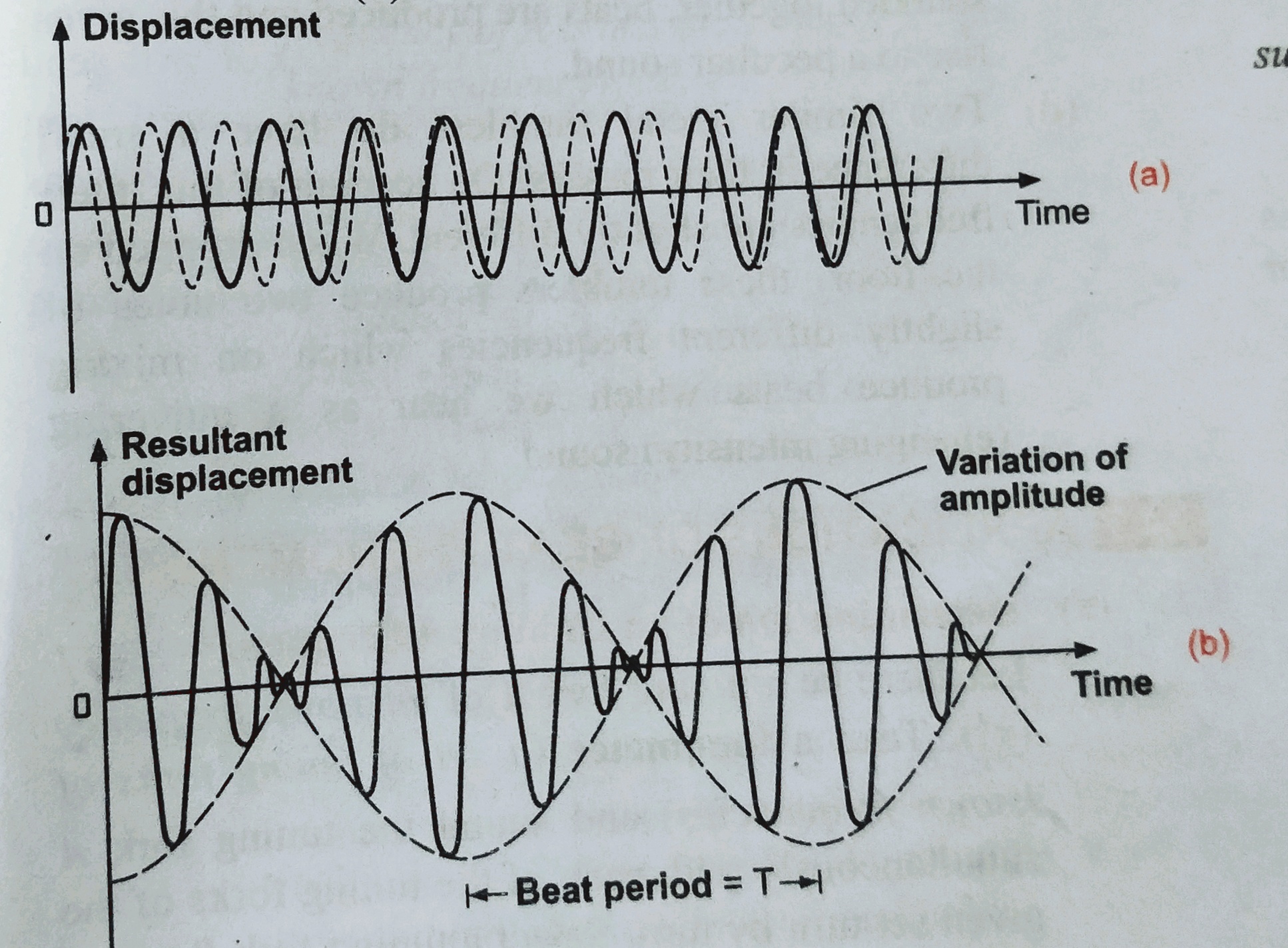
    Graphical method for the formation of beats-

    As shown in fig (a) Two waves ( One in dotted and other in dark line). When they superimpose then due to the superposition principle , at T=0 the intensity becomes max and at T= T/2 Intensity becomes minimum which is ‘0’ . This process happening again and again.

    And number of beats per second or beats frequency is equal to difference in frequency between these two waves.

    Suppose the beat period is T and that during this time one wave of frequency n1 , makes one cycle more than the other wave of frequency n2 . The number of cycle of frequency n1 in time T = n1T. And number of cycle of frequency n2 in time T = n2T.

    According to the given condition, n1T-n2T = 1

    Or   

    n1-n2 = 1/T = n0 (resultant frequency).

    Analysis of graph shown in figure-

    (1)The resultant wave oscillates with the average of the frequencies of the individual waves .

    (2) The resultant amplitude oscillates with a beat frequency that is equal to the difference between the two frequencies.

    Application of beat phenomenon

    (i) Determination of unknown frequency

    (ii) By loading tuning fork with wax.

    (iii) By loading the tuning fork

    (iv) Tuning musical instrument

    (v) In electronics.

  • Syllabus class12th physics (Term-2) (2021-2022)

    Important questions of ray optics

    Physics classes by Nayan jha providing the syllabus for term -2 CBSE (physics)Examination ; guided by CBSE( Distribution of marks may change in some circumstances)

    CBSE Class 12 Physics Syllabus Term – 2 (2021-22)

    Time: 2hrs 

    Max Marks: 35

    SI. No.Chapter Namemarks
    Unit–VElectromagnetic Waves2-3
    Chapter–8: Electromagnetic Waves
    Unit–VIOptics14-15
    Chapter–9: Ray Optics and Optical Instruments
    Chapter–10: Wave Optics 
    Unit–VIIDual Nature of Radiation and Matter4-5
    Chapter–11: Dual Nature of Radiation and Matter 
    Unit–VIIIAtoms and Nuclei6-7
    Chapter–12: Atoms
    Chapter–13: Nuclei
    Unit–IXElectronic Devices7
    Chapter–14: Semiconductor -Electronics: Materials, Devices and Simple Circuits
    Total35

     Unit (i – iv is provided for term-1 examination)

    Unit V: Electromagnetic waves   

    Chapter–8: Electromagnetic Waves 

    Electromagnetic waves, their characteristics, their Transverse nature (qualitative ideas only). Electromagnetic spectrum (radio waves, microwaves, infrared, visible, ultraviolet, X-rays, gamma rays) including elementary facts about their uses. 

    Unit VI: Optics   

    Chapter–9: Ray Optics and Optical Instruments 

    Ray Optics: Refraction of light, total internal reflection and its applications, optical fibers, refraction at spherical surfaces, lenses, thin lens formula, lensmaker’s formula, magnification, power of a lens, combination of thin lenses in contact, refraction of light through a prism. 

    Optical instruments: Microscopes and astronomical telescopes (reflecting and refracting) and their magnifying powers. 

    Chapter–10: Wave Optics 

    Wave optics: Wavefront and Huygens principle, reflection and refraction of plane waves at a plane surface using wave fronts. Proof of laws of reflection and refraction using Huygens principle. Interference, Young’s double slit experiment and expression for fringe width, coherent sources and sustained interference of light, diffraction due to a single slit, width of central maximum. 

    Unit VII: Dual Nature of Radiation and Matter  

    Chapter–11: Dual Nature of Radiation and Matter 

    Dual nature of radiation, Photoelectric effect, Hertz and Lenard’s observations; Einstein’s photoelectric equation-particle nature of light. Experimental study of photoelectric effect Matter waves-wave nature of particles, de-Broglie relation 

    Unit VIII: Atoms and Nuclei           

    Chapter–12: Atoms 

    Alpha-particle scattering experiment; Rutherford’s model of atom; Bohr model, energy levels, hydrogen spectrum. 

    Chapter–13: Nuclei 

    Composition and size of nucleus Nuclear force Mass-energy relation, mass defect, nuclear fission, nuclear fusion. 

    Unit IX: Electronic Devices  

    Chapter–14: Semiconductor Electronics: Materials, Devices and Simple Circuits 

    Energy bands in conductors, semiconductors and insulators (qualitative ideas only) Semiconductor diode – I-V characteristics in forward and reverse bias, diode as a rectifier; Special purpose p-n junction diodes: LED, photodiode, solar cell. 

  • Important questions of oscillations

    Important questions of oscillations-

    1. What is meant by periodic and oscillatory motion? Distinguish between them.

    2. What is meant by SHM . Find the expressions for displacement , velocity and acceleration. Also find the phase difference between them.

    3. Find the potential energy and kinetic energy of a SHM and hence show that total energy is conserved . In what position of the oscillation is the energy wholly kinetic and wholly potential?

    4. Prove that for an harmonic motion time period T = 1/2π(spring factor/inertial factor)1/2.

    5. What is simple pendulum? Derive expression for the time period or frequency of the oscillating simple pendulum. Also explain the second pendulum and find the length of the second pendulum on the surface of earth.

    TO GET THE IMPORTANT QUESTIONS OF MECHANICAL PROPERTIES OF FLUID CLICK HERE-

    6. Show that vibration of the liquid in the U-Tube is simple harmonic and also find the expression for the time period and frequency .

    7. Explain the term (i) Free vibration (ii) Forced vibration (c) Resonant vibration (d) Damped oscillation.

    8. A cylinder floating in water is temporarily pushed down . Derive an expression for its frequency.

    9. Obtain an expression for the time period of a loaded and massless spring (i) Oscillating horizontally (ii) oscillating vertically . Show that is the same as the simple pendulum of length equal to the extension of the spring?

    Numericals-

    1. A body describe S.H.M. with am amplitude of 5cm . and a period of 0.2sec . Find the acceleration and velocity  of the body when the displacement is (a) 5cm (b)3cm (c)0cm.

    2.  Simple pendulum of length l and having a bob of mass m is suspended in a car . The car is moving on a circular path of radius R with a uniform speed v . If the pendulum makes small oscillation in a redial direction about its equilibrium position . What will be its time period?  

    3. A spring balance has a scale that reads from 0 to 50 kg . the length of the scale is 20cm. A body suspended from this balance when displaced and released , oscillation with a period of 0.60 sec. What is the weight of the body?                                            Ans-219N

    4. The acceleration due to gravity on the surface of the moon is 1.7m/s2. What is the time period of the simple pendulum on the moon if its time period on the surface of the earth is 3.5sec?     Ans-8.4 sec

    5. A spring with spring constant 1200N /m is mounted on the horizontal frictionless table , a mass of three kg it attached to the free end of the spring . The mass is then pulled sideway to a distance of 2cm and released . Determine (a) the frequency of oscillation (b)the maximum acceleration of the mass (c) The maximum speed of the mass.          Ans- 3.2 ; 8.1 ; 0.4

    To get the very important questions of Thermodynamics click here-