Author: Nayan Jha

  • Thermal expansion

    Thermal expansion

    Most of the material expand when their temperature increases. Then the phenomenon of expansion of material when it is heated is known as thermal expansion.

    1. Linear expansion– When a rod heated then the temperature of the body increases due to which length of the rod increases , this phenomenon is known as the linear expansion .

    Suppose a rod is of length l0 at the initial temperature T0, when its temperature is rises by temperatureT , then the length changes by l. Then the change in length is proportional to original length and rise in temperature,

    i.e.   l α T……………(i)

    And l α l0 ……………..(ii)

    From eq. (i) and (ii)

    l α l0T,

    Or, l = α l0T , where α is the coefficient of linear expansion its unit is K-1 or  ( C0)-1.

    Then the final length l = l0+ l  

    Or, l = l0 + α l0T

    L = l0 ( 1+ α T)………….(iii)

    Area expansion or superficial expansion – When a surface heated then the temperature of the body increases due to which area of the rod increases , this phenomenon is known as the Area expansion .

    Suppose a rod is of length A0 at the initial temperature T0, when its temperature is rises by temperatureT , then the length changes by A. Then the change in area is proportional to original area and rise in temperature,

    i.e.   A α T……………(i)

    And A α l0 ……………..(ii)

    From eq. (i) and (ii)

    A α A0T,

    Or, A = β A0T , where β is the coefficient of Superficial expansion its unit is K-1 or  ( C0)-1.

    Then the final area A = A0+ A  

    Or, A = A0 + β A0T

    A = A0 ( 1+ β T)………….(iii)

    Volume expansion-  When a rod heated then the temperature of the body increases due to which volume of the rod increases , this phenomenon is known as the volume expansion .

    Suppose a rod is of length V0 at the initial temperature T0, when its temperature is rises by temperatureT , then the length changes by V. Then the change in length is proportional to original length and rise in temperature,

    i.e.   V α T……………(i)

    And V α V0 ……………..(ii)

    From eq. (i) and (ii)

    V α V0T,

    Or, V = Ÿ V0T , where Ÿ is the coefficient of linear expansion its unit is K-1 or  ( C0)-1.

    Then the final length V = V0+ V  

    Or, V = V0 + Ÿ V0T

    V = V0 ( 1+ Ÿ T)………….(iii)

    Relation between linear, area and volume expansion (α,β and Ÿ )

    2α=β; and 3α=Ÿ

    Or , α = β/2=Ÿ/3 .

    To solve the important questions based on this topic CLICK HERE-

    To solve the important questions based on the topic Temperature and thermometers CLICK HERE-
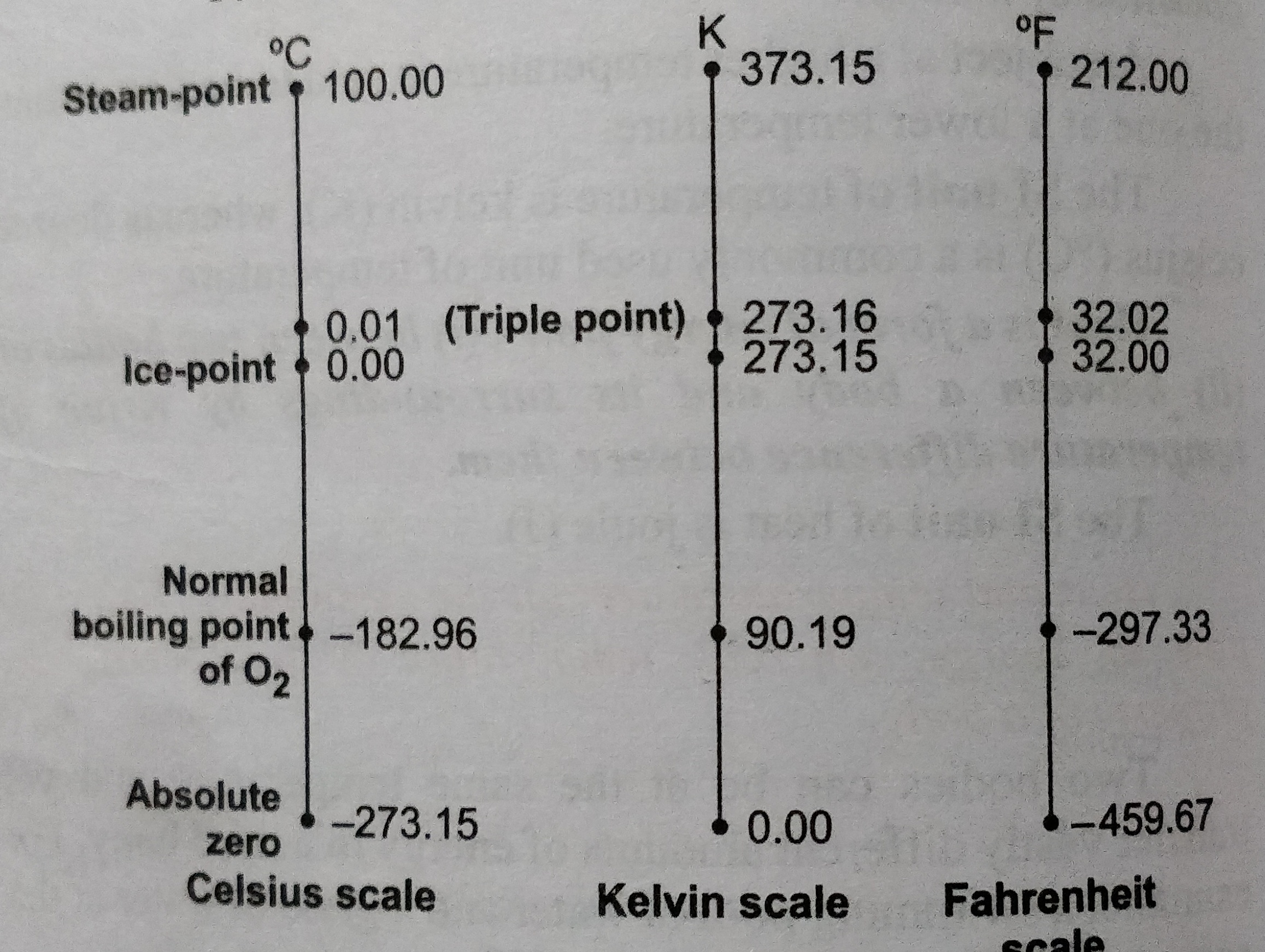
  • Important numericals on temperature and thermometer (Temperature scale)

    Temperature is a relative measure of hotness or coldness of a body. An object at a higher temperature is said to be hotter than the one at a lower temperature. The S.I. unit of temperature is Kelvin(K).

    (We must keep it in our mind that , Heat and temperature are not the same thing , heat is the flow of energy , whereas temperature is a microscopic property of body.)

    Important numericals on Thermal properties of matter.

    A- Numericals based on temperature and( temperature scale)

    Formula used in the following questions-

        [ ( Tc-0)/100 = (tF-32)/180 = (tK-273)/100 = (tr-F.P.)/(B.P. –F.P.) ]

    temperature scales

    1. An object has a temperature of 500F. What is the temperature in degrees Celsius and in Kelvin?

     [Ans- 100C, 283.15K]

    2. A pan of water is heated from 250C to 800C. What is the change in the temperature in Kelvin scale and on the Fahrenheit scale?   [Ans- 55K,990F]

    3. A faulty thermometers reads 50C in melting ice and 990C in steam .Find the correct temperature in 0F when this faulty thermometer reads 520C.    [Ans-1220F]

    4. At what temperature is the Fahrenheit scale reading equal to half that on the Celsius scale?             [Ans-0.6670F]

    5. At what temperature the reading on both Celsius and Fahrenheit scale remain the same? [Ans—400C]

    6. The triple points of neon and carbon dioxide are 24.57K and 216.55K respectively. Express temperatures on the Celsius and Fahrenheit scale. [Ans—248.580C, -56.60C, -415.440F,-69.880F].

    After solving these questions students have to learn- Thermal expansion, CLICK HERE-

    To solve the questions based on the thermal expansion-CLICK HERE

  • Magnus effect and dynamic lift

    Magnus effect and dynamic lift-

    The upward force experience by a body when it moves through a fluid is called dynamic lift . Such a lift is felt by airfoil , aircraft win etc. Couse behind it can be explained by Bernoulli’s theorem . It also explain why a spinning ball is deviated from its parabolic path .This deviation is usually observed in many games like cricket, football golf, tennis etc.

    As a ball moves through air without spinning , it divides the streamline  above and below it symmetrically . Thus there is no pressure difference on the two sides of the ball.

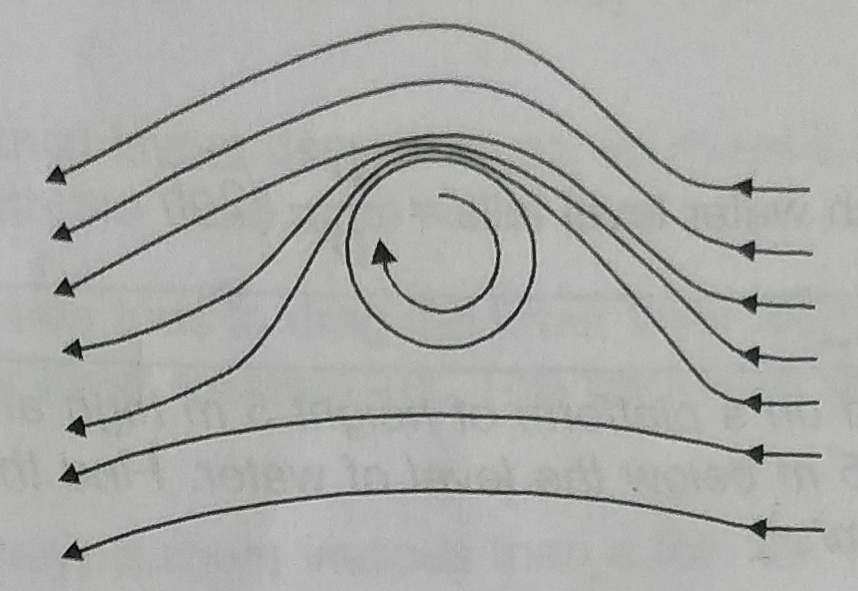
    But when a ball spins as it moves through air , it drags along a layer of air with itself. When the ball moves forward , the air ahead of the ball rushes backward to fill the space left vacant by the ball. Thus the streamlines of air around this ball is shown in the fig. given below.

    The velocity of air above the ball opposite to the direction of spin and it is in the direction below the ball. Thus the relative velocity of air  with respect to the ball is larger at the upper part than that is in the region below  the ball . The streamline thus gets crowded above and rarified below .This cause the pressure above the to be smaller and that below it to be greater . This pressure difference causes an upward force on the ball. Hence the ball experiences a dynamic lift and is deviated from its path . This effect arising due to spinning of the ball is called ‘Magnus effect’.

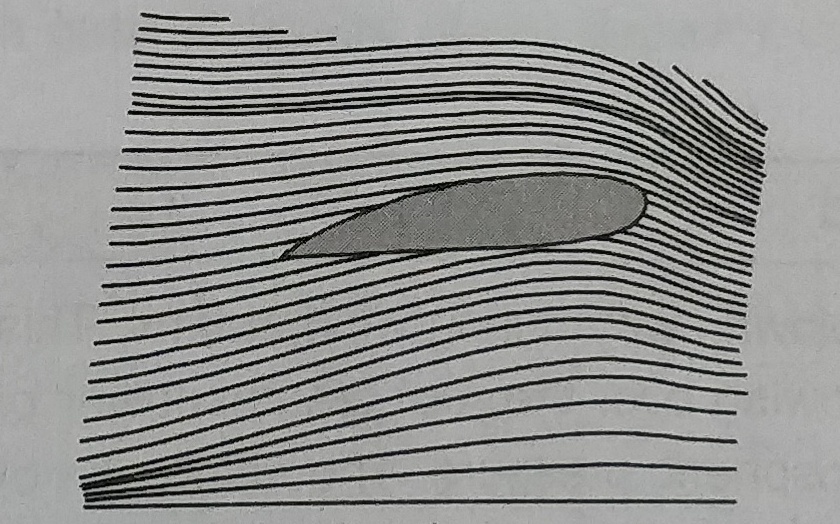
    Airfoil and lift on aircraft wing:-  An airfoil is streamlined shaped , Solid body that is capable of generating a dynamic lift as it moves through a fluid .  streamline shape is special shape given to bodies moving in fluids, So as to produce minimum drag .

    The cross-section of air wings is also shaped like that  .Its upper portion is more curved then the lower surface .Its front edge is broader and the rear edge is narrow . When the airfoil moves through air , streamlines of air moves backward . The air above the foil has to travel a longer distance then that  below in the same time . Thus the flow speed on top becomes greater then that below it . The higher speed on reduces air pressure there. This pressure difference causes to lift the foil. Such dynamic lift also acts on the wings of an air craft and balances the weight of the plane.     

  • Optical fibres

    In this topic we will discuss what is optical fibre , what is its working and its important application.

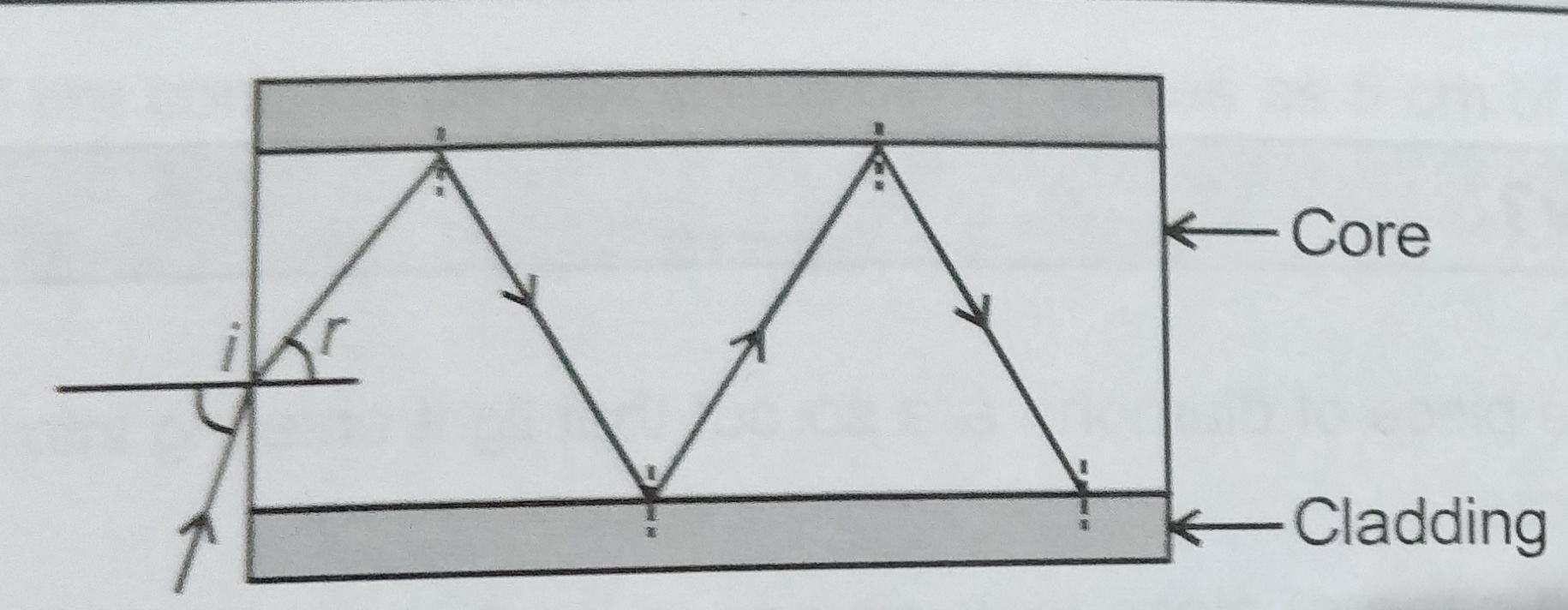
    Optical fibres – It is a device based on Total internal reflection by which signal may be transmitted from one location to another. It is a thin fibre of plastic specially coated glass , in which light enters at one end leaves it at other end suffering a number of total internal reflection with little loss of energy . it works even it is bent or twisted.

     The structure of The structure of optical fibre consists of a core surrounded by cladding . Core ( very high quality glass/silica/plastic) is denser medium of refractive index µ1 and cladding ( glass/plastic) is relatively rarer medium of refractive index µ2  such that µ1 > µ2 .When light incident at one end of the core gets reflected and will be incident on the interface between the core and cladding at an angle greater then the critical angle and light continues reflecting in the core. After several reflection light comes out to the other side i.e.  at the destination.   

     Application of optical fibre –

     ( I ) It is used to transmit light without loss of intensity over a long distance of several kilometers .

    (ii) It is used in the in the manufacture of medical instruments, called endoscope for visual examination of stomach and intestines etc. of patients.

    (iii) It used for telecommunication, i.e., in transmitting audio and video signals to long distance.

    (iv) It is used to measure the blood flow to the heart in the form of photometric sensor.

    (v) It is used to measure refractive indices of the liquid.

  • Application of Total internal reflection

    Application of total internal reflection ( T.I.R) – 

    T.I.R in nature and its technological application-

    Brilliance of diamond-   The brilliance of diamond is due to the total internal reflection of light. Refractive index for diamond is very large which is near about 2.42 , so that critical angle for diamond air is 24.40. The diamond is cut suitably so that light entering the diamond from any face falls at an angle greater than 24.40. Therefore , it suffers multiple T.I R. at various faces , and remains within the diamond , falling to come out . Hence the diamond sparkles.

    Mirage–   Mirage is an optical illusion of water observed generally in desert in hot summer day. An inverted image of an object such as tree is observed along with the object as if the tree were on the bank of a pound of water.

    Optical fibres – It is a device based on Total internal reflection by which signal may be transmitted from one location to another. It is a thin fibre of plastic specially coated glass , in which light enters at one end leaves it at other end suffering a number of total internal reflection with little loss of energy . it works even it is bent or twisted.

     The structure of The structure of optical fibre consists of a core surrounded by cladding . Core ( very high quality glass/silica/plastic) is denser medium of refractive index µ1 and cladding ( glass/plastic) is relatively rarer medium of refractive index µ2  such that µ1 > µ2 .When light incident at one end of the core gets reflected and will be incident on the interface between the core and cladding at an angle greater then the critical angle and light continues reflecting in the core. After several reflection light comes out to the other side i.e.  at the destination.   

     Application of optical fibre –

     ( I ) It is used to transmit light without loss of intensity over a long distance of several kilometers .

    (ii) It is used in the in the manufacture of medical instruments, called endoscope for visual examination of stomach and intestines etc. of patients.

    (iii) It used for telecommunication, i.e., in transmitting audio and video signals to long distance.

    (iv) It is used to measure the blood flow to the heart in the form of photometric sensor.

    (v) It is used to measure refractive indices of the liquid.

    Totally reflected glass prism – Prism designed to bend light by 900, or 1800 the phenomenon of total internal reflection , such prisms are used to invert images without changing their sizes.

  • Real depth and apparent depth

    Real depth and apparent depth.

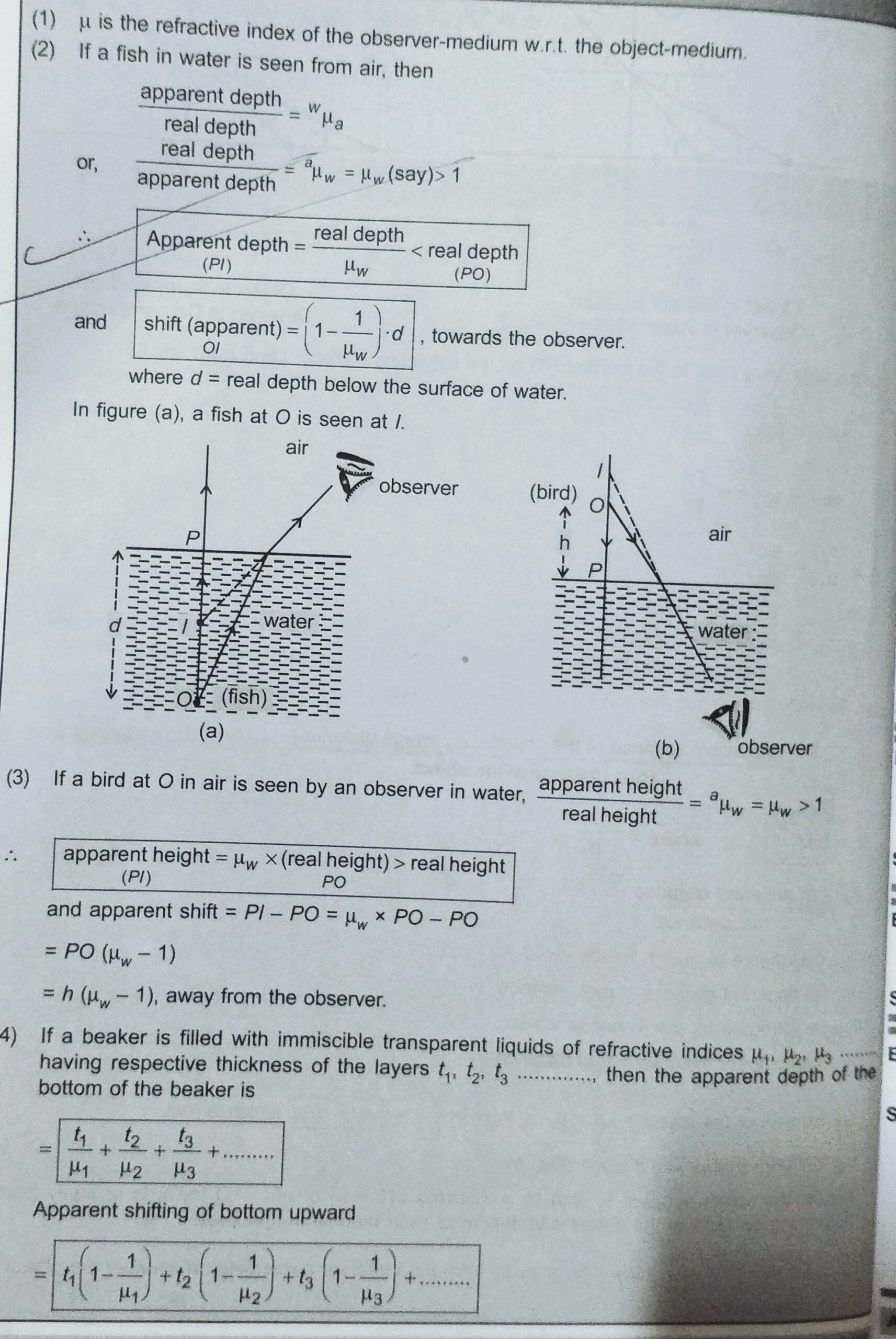
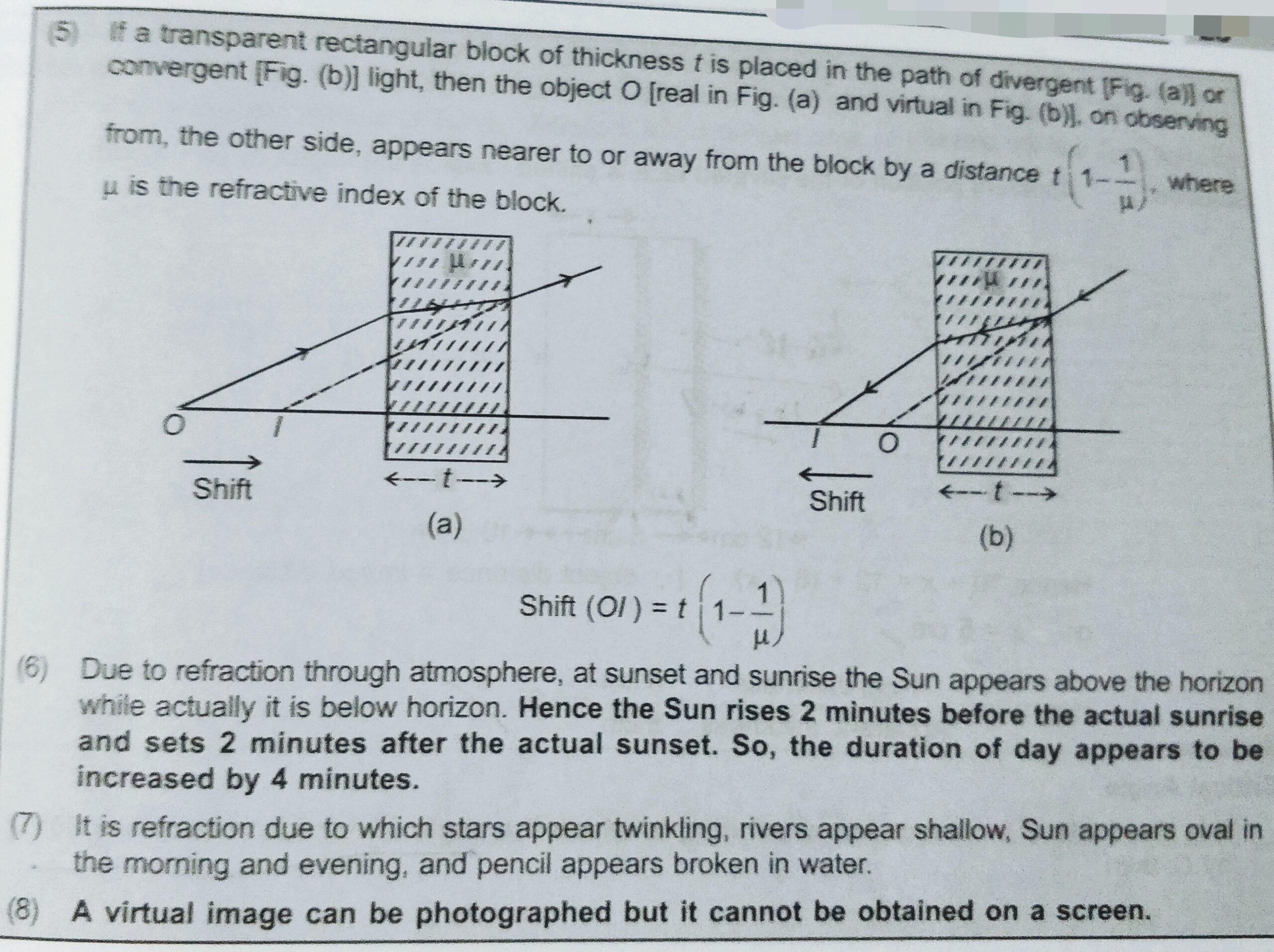
    A water tank appears shallower i.e. less deep then what actually is. When we observe an object which is inside the water or any transparent liquid it appear higher then its actual position . This is because when light travels from denser to rarer it bended away from the normal . And we can understand the inverse of this process that when a fish observe an object which is placed above the water level then it appears higher then its actual height from the surface of water this is because when light travels from rarer to denser medium light banded towards the normal.

    To watch the video of this topic click on the link given below-

    The relation between real depth and apparent with the refractive index is given in   point 2 and point 3 below.

    After this topic students have to learn Total internal reflection click here to learn- Total internal reflection

  • Total internal reflection

    In this topic we will discuss , what do you mean by the term Total internal reflection, critical angle . And we will practice some questions based on these topics.

    before to know this topic students must know Real depth and apparent depth. To know this topic click here-

    Total internal reflection and critical angle.

    Before to know about the total internal reflection we must know critical angle

    Critical angle –  It is the value of angle of incidence for which angle of refraction becomes 900, when light enters from denser to rarer medium .

    As we know ,

    1µ2 = sin i /sin r

    Since light is moving from denser medium to rarer medium

    So,  1µ2 = sin r /sin I;

    i.e. µ = sin 900 / sin c  [ here r= 900 then I is written by C (critical angle).

    So, sin C = 1/µ

    Then critical angle C = sin -1(1/µ).

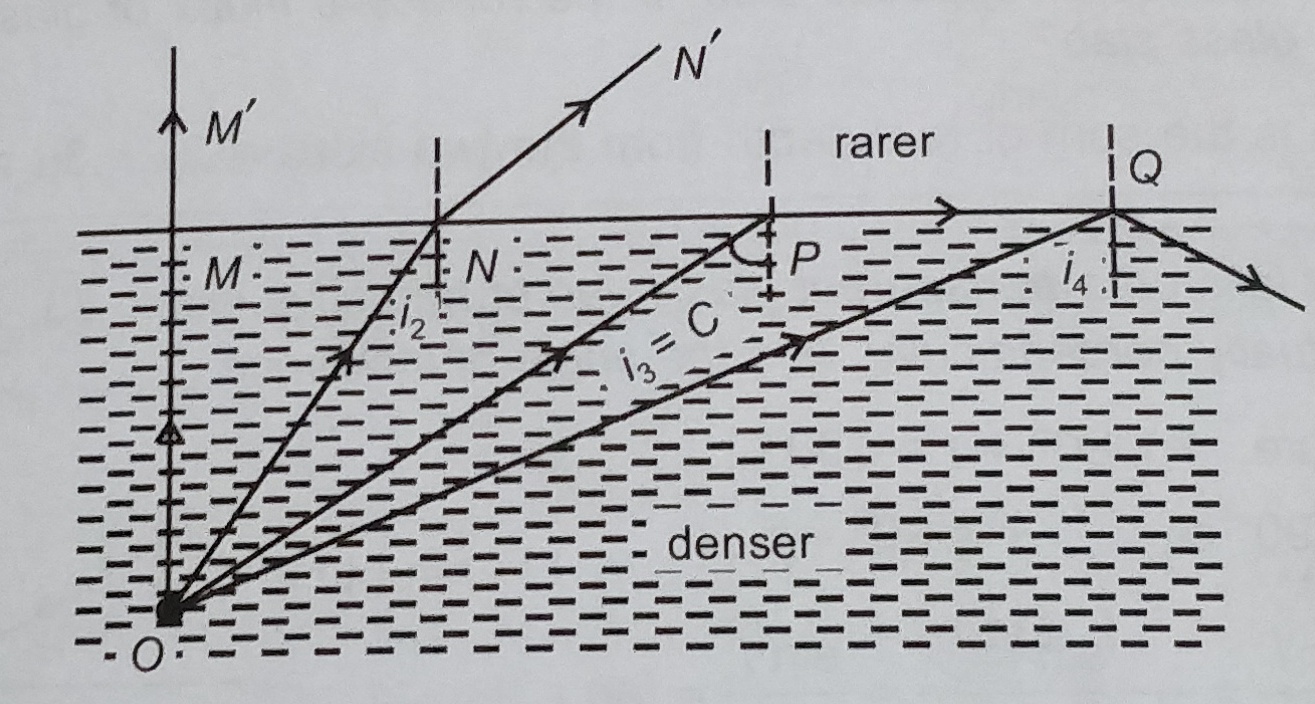
    Total internal reflection-   (TIR) When the light in the denser medium strikes an interface separating the denser medium and a rarer medium at an angle of incidence greater then critical angle total light is reflected without any refraction through the rarer medium . This phenomenon is called “total internal reflection”.

    As shown in fig.

    I2< C ( critical angle) in this case refraction of light occurs .

    I1> C  in this condition T.I.R. occurs.

    Essential conditions for T.I.R is

    (i) Light must move from denser to rarer and (ii) angle of incidence should be greater then critical angle.

    Questions based on refraction of light ( apparent depth and real depth, total internal reflection and  

    Q1. A ray of light is incident on a glass plate as an angle of 600. What would be the refractive index of glass , if reflected and refracted rays are perpendicular to each other? (a)√3 . (b)3/2 (c) √3/2 (d) ½ . ans-a

    Q2. A glass of thickness 12mm is placed on a table . The lower surface of the slab has a black spot .At what depth from the upper surface will the sport appear when viewed from above ? (µg=1.50) . (a) 2mm (b) 4mm (c) 6mm (d) 8mm. ans-d

    Q3. Light enters at an angle of incidence in a transparent rod of refractive index of the material of the rod the light once entered into it will not leave it through its lateral surface whatsoever be the value of angle of incidence? (a) µ>√2 (b) µ = 1 (c) µ=1.1 (d) µ=1.3. ans-a

    Q4. A transparent cube contains a small air bubble . Its apparent distance is 2cm when seen through one face and 5cm when seen through other face . If the refractive index of the of the material of the cube is 1.5 the real length of the edge of the cube must be (a) 7cm (b) 7.5 cm (c) 10.5 cm (d) 14/3 cm. ans-c

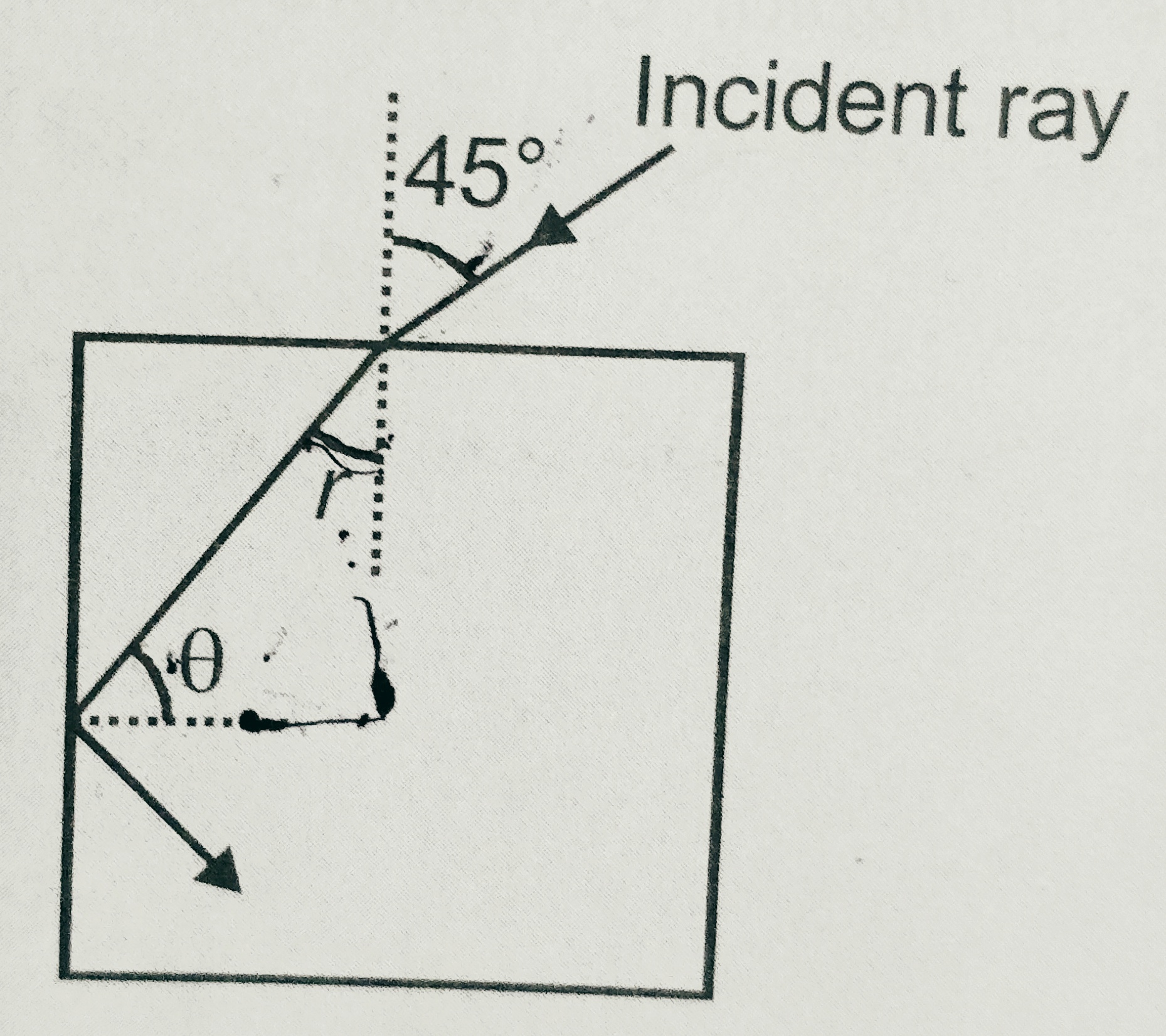
    Q5. For the given incident ray as shown in figure , The condition of T.I.R of the ray will be satisfied , if the refractive index of the block will be  ,

    (a) (√3+1)/2      (b)(√2+1)/2     (c)√3/√2     (d)√7/√6. ans-c

    Q6. A ray of light travels from optical denser medium to rarer medium. The critical angle for the two media is C . The maximum possible deviation of the ray will be (a)2C (b) π/2 – C (c) π-C  (d) π-2C . ans-b

    Q7. The apparent depth of water in the cylindrical water tank of diameter 2R cm is reducing at the rate of x cm/min. when water is being drained out at a constant rate . The amount of water drained in cc/minute is : (µ1 refractive index of air and µ2 refractive index of water) (a) xπR2µ1/µ2  (b) xπR2µ2/µ1          (c)  2πRµ1/µ2  (d) xπR2. ans-b

    Q8. Refractive index of glass with respect to medium is 4/3  .If the difference between the velocities of light in medium and glass is 6.25 x 10⁷m/sec , then velocity of light in medium is (a)2.5 x 10⁸m/s  (b) 0.125 x10⁸m/s (c) 1.5 x 10⁷m/s (d) 3 x 10⁷m/s . ans-a

  • Important points on refraction of light.

    In this note we will discuss about the very important points on the refraction of light , every students must keep it in the mind . It is use ful for objective point of view.

    Keep in your mind-

    Some important thing for refraction of light.

    1. Refractive index  µ=c/v where c is the velocity of light in air or vacuum and v is the velocity of light in given medium.

    2. The speed of light in air slightly less than the speed of light in vacuum.

    3.  The medium having greater refractive index is called denser and the other is rarer.

    4. While going from a denser medium to rarer medium , the refracted ray bends away from the normal and vice-versa.

    5. Snell’s low states that  µ = sin I /sin r { µ>1 if light moves from rarer to denser and µ<1 if light moves from denser to rarer.}.

    6. As we know 1µ2= v1/v2 ,

    Therefore , 1µ2 x  2µ1=[v1/v2 x v2/v1]=1

    Or ,

     1µ2=1/ 2µ1 .

    Similarly, 1µ2 x 2µ3x  3µ4 x…………..=1.

    7. Laws of refraction is valid for all types of surface separating for two media i.e. the separating may be plane or curved.

    8. The angle of deviation on refraction is given as ‘ angle of deviation’ =|i-r|.

    9. If incident ray is normal, refraction takes place without bending. In this case I = r = 00.

    To get the Very Important questions of ray optics click here

    10. On refraction both the velocity as well as the wavelength of light changes but frequency and the phase doesn’t change.

    11. rareµdenser >1 and  denserµrare< 1.

    12. The value of refractive index depends on’

    (a) the nature of two media (b) the colour or wavelength of the light (c)the temperature of the media.

    13.As we know the value of refractive index is given as µ= sin I /sin r. but it doesn’t depend on the value of I, for a given pair of media.

    To get the important numericals of ray optics click on the link given http://physicsclasses.online/important-numerical-of-ray-optics/–

    14. Refractive index has no dimension or unit.

    15. Optical path is the distance travelled by light in vacuum in the same time travel in which it has travelled a distance x in a medium of refractive index µ . i.e. optical path = ct =cx/v=µx.

    16 According to Cauchy’s formula, refractive index µ= A+ B/(wavelength)2.

    Having saw this result we can say that, as wavelength increases refractive index decreases and vice-versa.

    To solve the objective questions of this chapter ray optics click here-

  • Important numericals of surface tension

    This assignment contains Important numericals of surface tension which is solved . solution is given just below the questions.

    1.The surface tension of the soap solution is 30 x 10-3N/m .How much work is done to increase the radius of the soap bubble from 1.5 cm to 3 cm .     Ans- 5.091 x 10⁻⁴ j.

    solution-

    2. A square glass plate of length 10cm and thickness 0.4cm, weighs 40 g in air . It is held vertically such that its lower edge rests on water surface. What is the apparent weight of glass plate now? (S.T. of water is 0.073 N/m).                                                     Ans-0.407N.

    3. The radii of two air bubbles are in the ratio 4:5 .Find the ratio of excess pressure inside them . Also compare the works done in Blowing these bubbles.             Ans-5/4  ; 16/25 .

    .

    4. A circular plate of radius 4cm and weight W is made to rest on the surface of water if a minimum pull of   W+F is required to clear the plate off the water surface then find F , given surface tension of water is 0.072N/M.                       Ans-0.018N .

    5. Water rises up in a glass capillary upto a height of 10cm , while mercury falls down by 3.5 cm in the same tube. If the angle of contact for water – glass and mercury-glass are is taken as 00 and 1350 respectively . compare the surface tension of water and mercury. [ density of water and mercury are 103 and 13.6×10³kg/m3.].

    6. A canister has a small hole at its bottom .What penetrates into the canister when its base is at a depth of 40cm from the surface of water. If surface tension of water is 73.5 dyne/cm, find the radius of the hole .     Ans- 0.0375mm.

    To get the Important objective questions based on this topic click here–

  • Questions based on surface tension

    This assignment contains some important questions based on the surface tension, in which there are some objective and some numericals based questions.

    these questions are for the practice of the topic surface tension and surface energy, excess pressure inside the liquid drop, soap bubble , ascent formula etc.

    Question based on surface tension and surface energy

    Multiple choice questions. (Only one option is correct)

    1. The angle of contact doesn’t depend upon,     (a)  Temperature         (b)Surface impurity      (c) Cohesive force      (d) The inclination of surface in contact.   Ans -d

    2. When a capillary tube is immersed in a liquid , then the liquid of mass m rises in the capillary tube .If capillary tube of double radius is taken then the mass f same liquid rising in the tube is , ,     (a)   M/2        (b)   2M   (c) M/4     (d) 4M .                                                      Ans- b

    3. What will be the work done to increasing the radius of the soap bubble from r/2 to 2r . If surface tension of soap solution is T ? ,     (a) 3πr2T   (b) 30πr2T    (c)    9πr2T   (d) 12πr2T   . Ans-b

    4. pressure inside soap bubble are 1.02 atm and 1.05 atm respectively . then the ratio of their surface area is (a) 125/8 (b) 25/4  (c)5/2   (d)2/5.   Ans-b

    Dou you want to know the harmful effect of Online classes click here–

    5.The property utilized in the manufacture of lead shots is (a)specific gravity of lead   (b)specific weight of the liquid lead  (c) compressibility of the liquid lead  (d) surface tension of the liquid lead. Ans-d

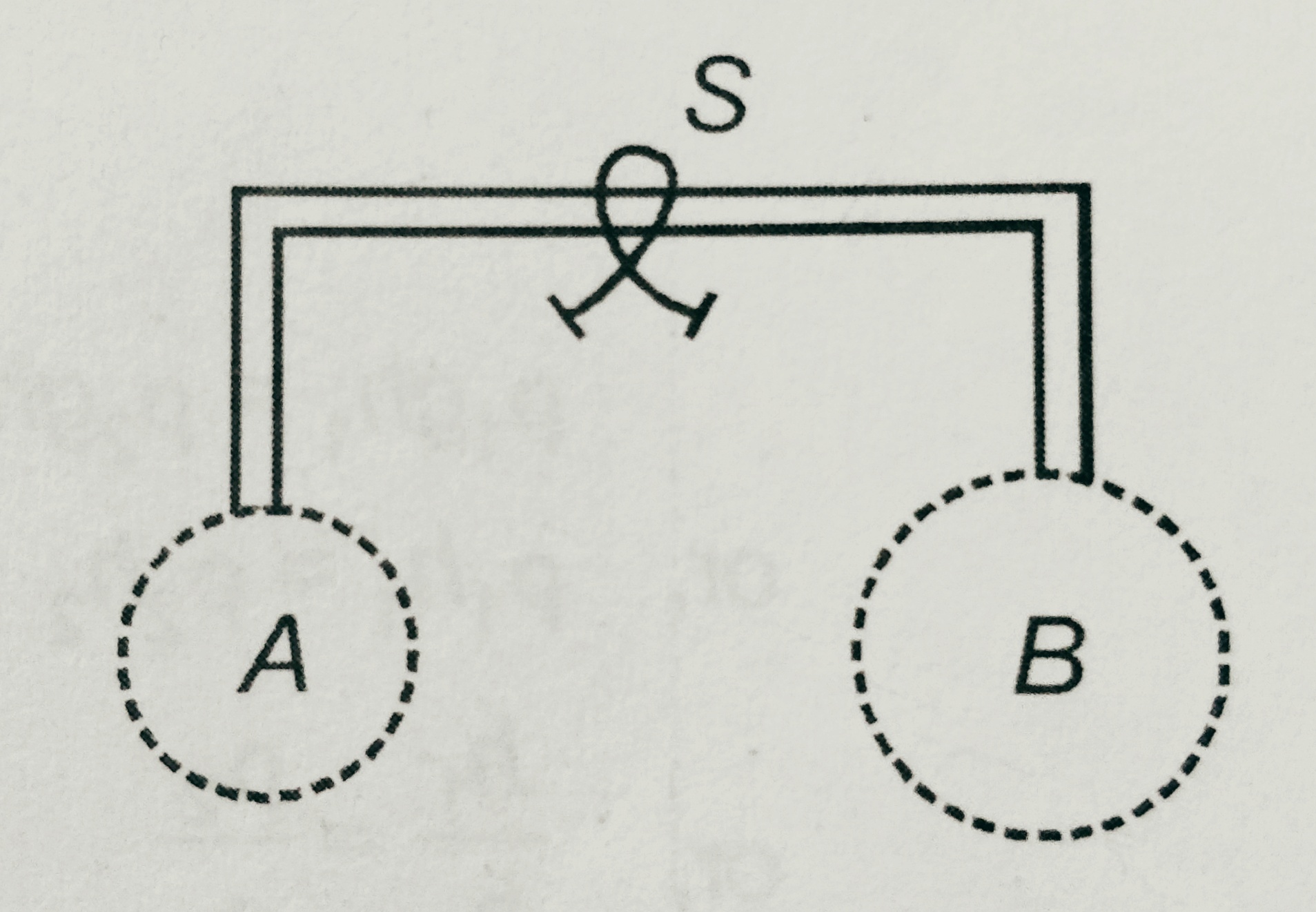
    6. Two soap bubbles are connected by a tube as shown in figure , what happens when stopper s is removed ?

    (a)size of A increase   (b) size of B is decreased   (c) both takes the same size (d) size of bubble A decreases and size of bubble B increases.                     Ans-d

    7. Two soap bubble of radii 2cm and 4 cm are join to form a double bubble in air , then the radius of curvature of the interface is , (a)2√5 cm  (b)2cm  (c)4  cm (d)  2√3cm  .  Ans-c

    8. A square wire frame of  side l is floating on the surface of the liquid of surface tension T . The force required to pull out the frame from the liquid is  (a) Tl  (b) 2Tl  (c) 4Tl  (d) 8Tl . Ans-d

    9. Two drops of liquid coalesce to form a single drop . In this process energy is (a) Absorbed  (b) Evolved  (c) Either absorbed or evolved    (d) Neither absorbed nor evolved.  Ans-b

    10. Surface tension of a liquid , at critical temperature is (a)Maximum   (b)Unchanged  (c)  Zero (d) none of these.                                                                                                           Ans-c

    Important numericals based on this topic –

    TO WATCH THE VERY IMPORTANT TOPIC OF SURFACE TENSION WHICH IS EXCESS PRESUURE INSIDE THE SOAP BUBBLE AND LIQUD DROP CLICK ON THE VIDEO LINK GIVEN BELOW-

    1.The surface tension of the soap solution is 30 x 10-3N/m .How much work is done to increase the radius of the soap bubble from 1.5 cm to 3 cm .     Ans- 5.091 x 10⁻⁴ j.

    2. A square glass plate of length 10cm and thickness 0.4cm, weighs 40 g in air . It is held vertically such that its lower edge rests on water surface. What is the apparent weight of glass plate now? (S.T. of water is 0.073 N/m).                                                     Ans-0.407N.

    3. The radii of two air bubbles are in the ratio 4:5 .Find the ratio of excess pressure inside them . Also compare the works done in Blowing these bubbles.             Ans-5/4  ; 16/25 . .

    4. A circular plate of radius 4cm and weight W is made to rest on the surface of water if a minimum pull of   W+F is required to clear the plate off the water surface then find F , given surface tension of water is 0.072N/M.                       Ans-0.018N .

    5. Water rises up in a glass capillary upto a height of 10cm , while mercury falls down by 3.5 cm in the same tube. If the angle of contact for water – glass and mercury-glass are is taken as 00 and 1350 respectively . compare the surface tension of water and mercury. [ density of water and mercury are 103 and 13.6×10³kg/m3.].

    6. A canister has a small hole at its bottom .What penetrates into the canister when its base is at a depth of 40cm from the surface of water. If surface tension of water is 73.5 dyne/cm, find the radius of the hole .     Ans- 0.0375mm.

    To get the solution of all numerical questions given above click here–

    Are you looking to prepare JEE/NEET and looking for the best coaching center , then you must watch this video how to select coaching centre for JEE/NEET.