In this topic we will discuss about Electric flux and area vector .
question may be asked as what is electric flux ? write its unit and dimension.
Area vector and electric flux –
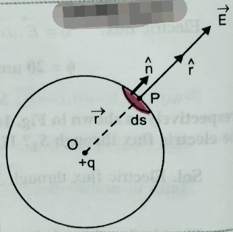
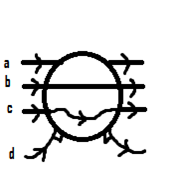
As we know area is a scaler quantity , but in some cases or in case of some problems area is taken as vector quantity . the direction of area is taken as the normal of the surface at a given point . The vector associated with every area element of a closed surface is taken to be in the direction of the outward drawn normal .
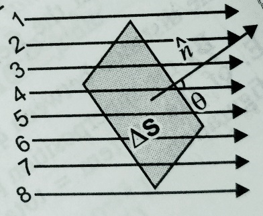
Electric flux – Electric flux over an area in an electric field is the total number of field line passes through that area normally . It is denoted by ɸ its unit is Nm2C-1 . And its dimension is [M1L3T-3A-1]. Electric flux is a scaler quantity.
The number of electric field lines crossing this area is proportional to field intensity E . Let electric field lines makes an angle ϴ with the area vector dS , and E is the electric field intensity , then we can write dɸ = E. (dS cosϴ ) [ since dScosϴ is the component of area vector normal to the surface ].
Equipotential surface and Relation between electrostatic field and potential
In this topic we will discuss about Equipotential surface and relation between electrostatic field and potential also, we will know about equipotential surface for different-different conditions .
Equipotential surface- It is the surface inside the electrostatic field, the electric potential at every point on that surface are same. For any charge configuration, equipotential surface through a point is normal to the electric field at that point.
Equipotential surfaces of a single point charge are concentric spherical surfaces centred at the charge .
Electrostatic potential energy and electrostatic potential
In this topic we will discuss about Electrostatic potential energy and electrostatic potential also with potential difference , potential due to multiple charges and potential at a point due to electric dipole .
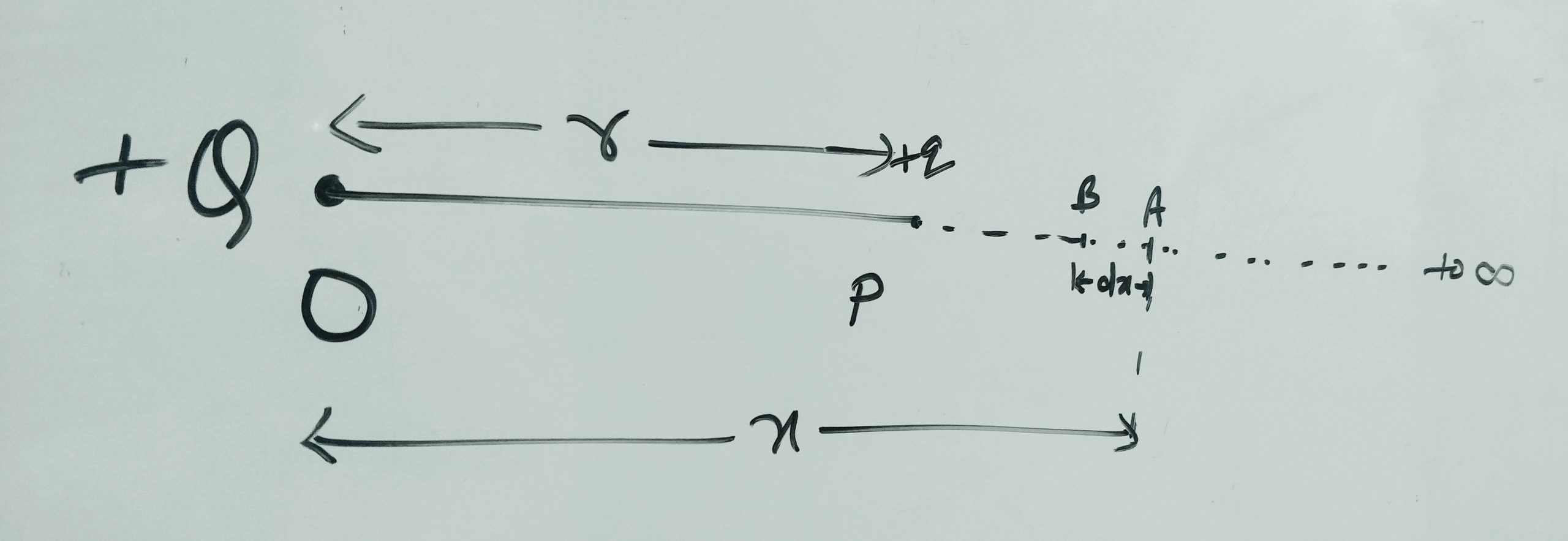
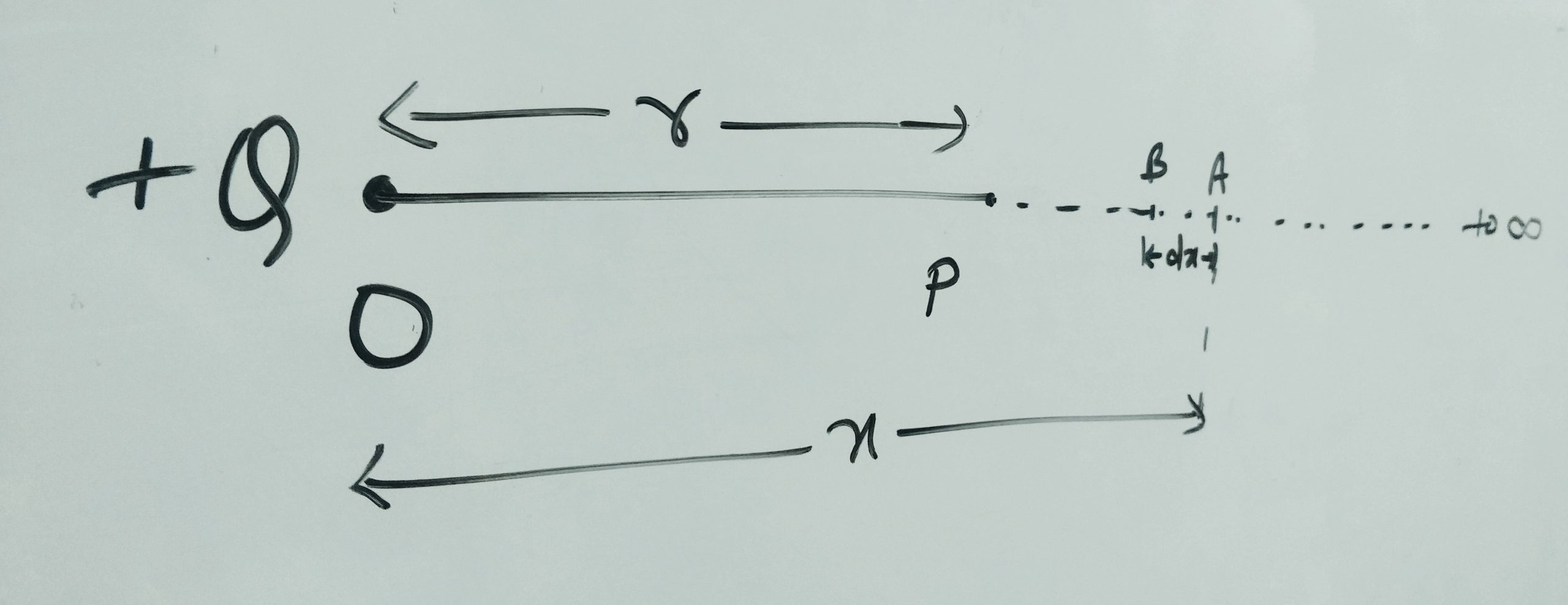
Electrostatic potential energy – Electrostatic potential energy of a charge in an electrostatic field is the amount of work done required to bring that charged body from infinity to that point . Its unit is joule
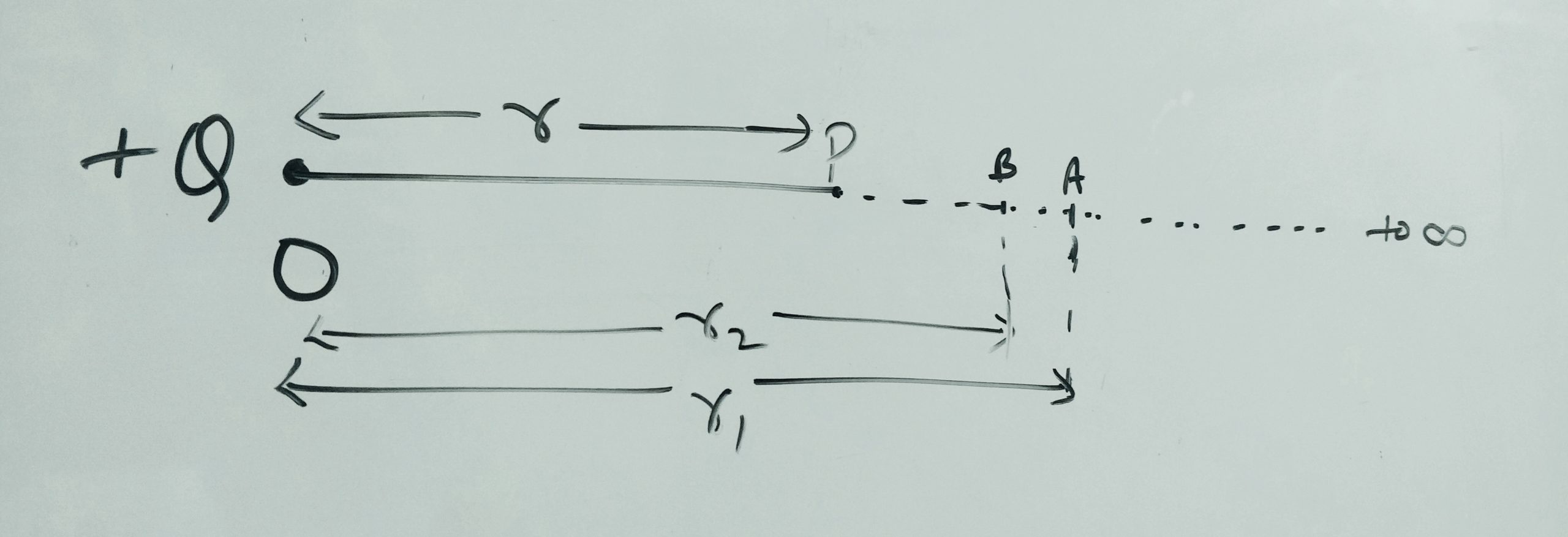
Let a charge Q is placed at point O as shown in figure , we have to find the potential energy at point ‘p’ which is ‘r’ distance away from the point ‘O’ . ( derivation of this topic , link is given below)
To see the video for electrostatic potential energy and electrostatic potential click on the link given below-
Electrostatic potential – electrostatic potential at any point in a region of electrostatic field is the minimum work done required to carry a unit positive charge from infinity to that point .
We can write electrostatic potential V = U/q i.e. electrostatic potential is equal to potential energy per unit charge . Its unit is J/C . or JC-1 or NmC-1 and its dimension is [M1L2T-3A-1]
( derivation of this topic , link is given Above/below)
Electrostatic potential difference – Electrostatic potential difference between two points is the amount of work done required to bring the unit positive charge from one point to another point .
( derivation of this topic , link is given Above/below)
To view the video related to the topic potential difference and potential at a point due to multiple charges visit on the link given below-
Electrostatic potential at a point due to dipole- ( derivation of this topic , link is given below) . Before to know about this topic students must have to know about electric dipole , to read about electric dipole click here-
To view the video related to the topic electrostatic potential at a point due to a dipole visit to the link given below-
Electrostatic forces are conservative are conservative in nature i.e. electrostatic force is independent of path followed , it only depends on initial and final position of the charge particle in an electric field .
Expression for the electric field intensity at a point on the axis of the charged ring –
Question may be asked as ; A charge is distributed uniformly over a ring of radius ‘a’ . Obtain an expression for the electric field intensity E at a point on the axis of the ring. Hence show that for points at large distance from the ring behaves like a point charge.
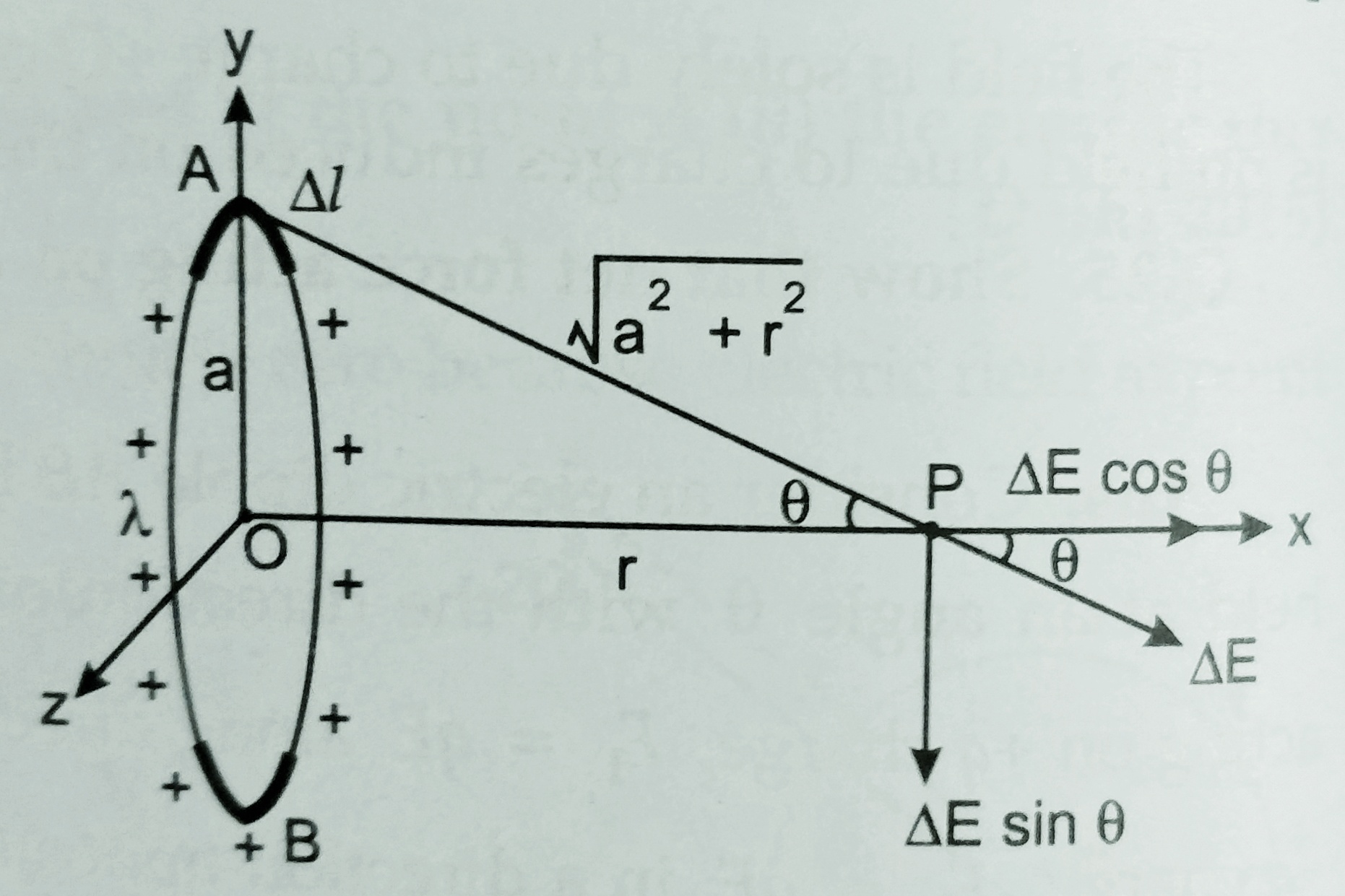
Suppose a uniform circular ring of radius ‘a’ charged uniformly ‘Q’ which is distributed uniformly over the ring.
Suppose a small element ‘dl’ on the ring then, charge on the element is given by – dQ = (Q/2∏a) dl
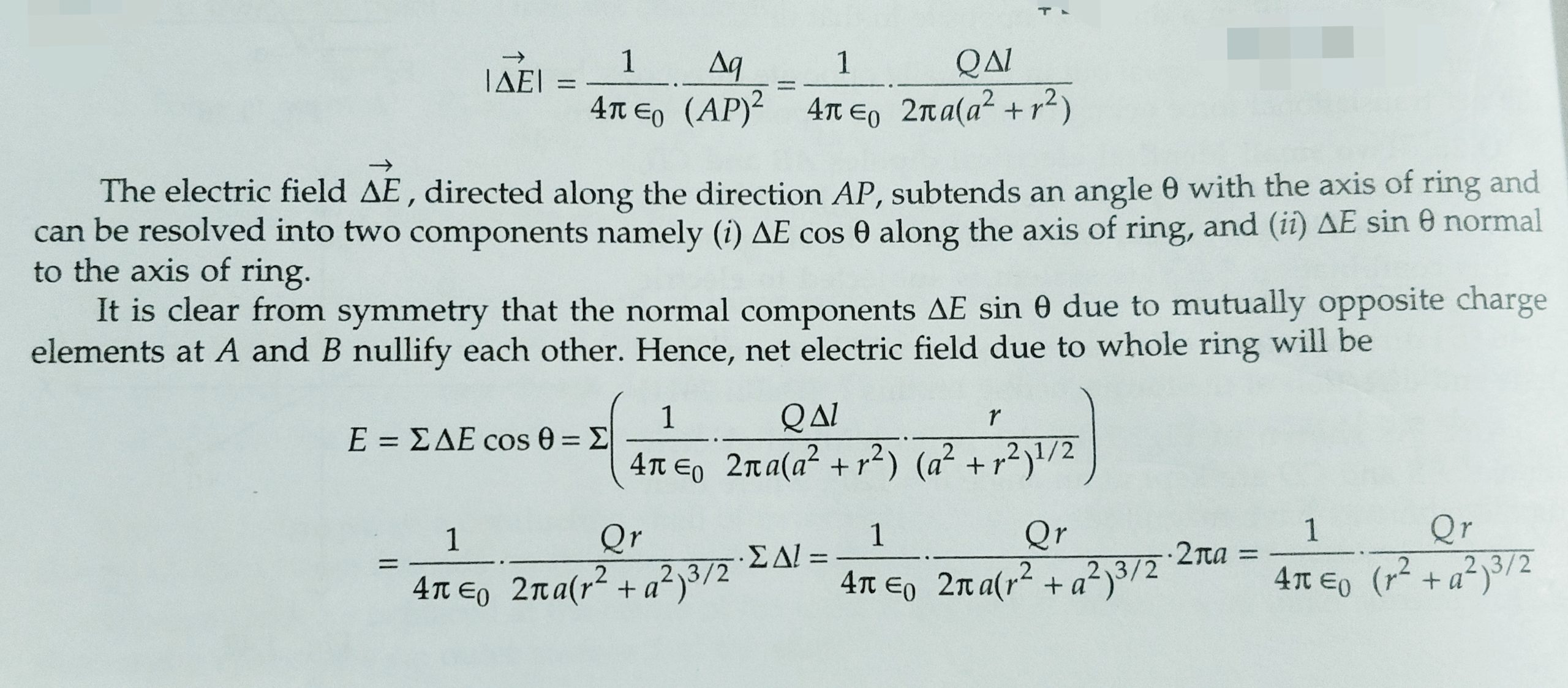
The electric field at point p due to this element is given by –
*****At the place of ∑ students can use integration with limit 0 to 2∏a ( in both case answer will be same ) *****
The field E is directed along the axis OP of the charged ring .
If r >> a , then the above expression may be written as ‘
E = (Q/4∏ϵ0 r2 ) . This shows that for far points at long distance from the ring , it behaves like a point charge .
To view the video of this topic electric field at a pint on the axis of uniformly charged circular link click on the link given below-
In this topic we will discuss about the , Expression for torque and potential energy stored in dipole placed in uniform electric field . and what will be Expression for torque and potential energy stored in dipole placed in non-uniform electric field ?
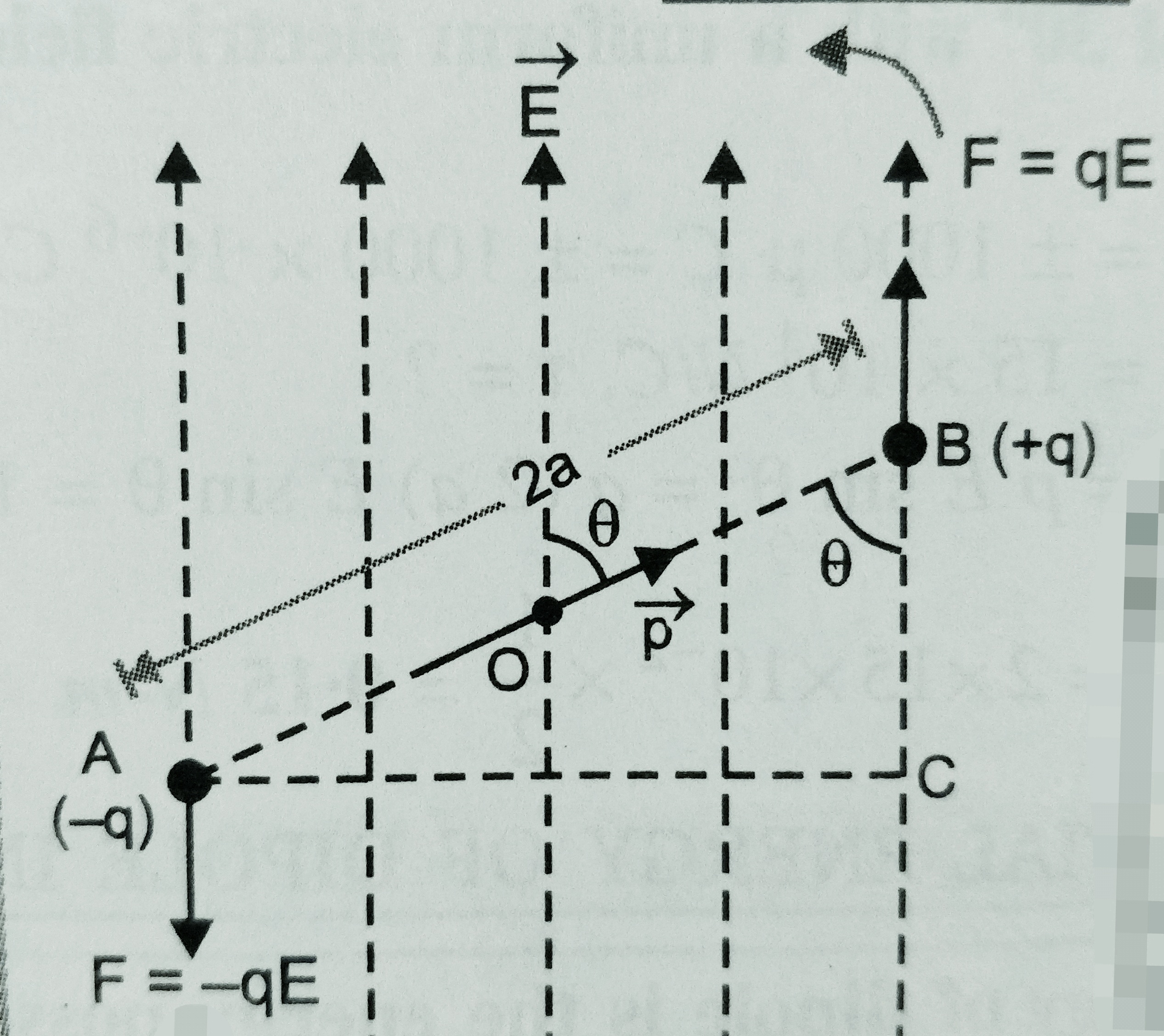
Suppose an electric dipole AB having charges -q and +q are placed at distance 2a , and dipole moment ‘p’ is placed in an uniform electric field ‘E’ .
Then Electrostatic force experienced on both the charges are F = q E , but the direction of forces on each charges are opposite to each other . since the electric field E is constant then net force on the dipole will be zero ( since forces are in opposite directions ) .
Since the forces are equal , unlike and parallel acting at different points so , they form a couple . The couple tends to align the dipole axis along the direction of field ‘E’ .
Let’s draw AC perpendicular on electric field ‘E’ .
But Questions may be asked by the students that ,what will happen if electric field is not uniform ?
then its answer will be that the net force on the dipole will not be zero (0) . It means there will be translational and rotational motion in the dipole . And net force will be equal to F1-F2 .
To view the video based on this topic torque and potential energy on the dipole placed in uniform electric field go to the link given below-
This topic contain numerical for the practice of the chapter electric field
Before to solve the numerical based on electric field students has to study ( learn ) , and all the notes based on electric field , electric dipole ( axial and equatorial point)
Two point charges +16μc and -9μc are placed 8cm apart in air . Determine the position of the point at which the resultant electric field is zero . [ Ans- 24 cm]
A particle of mass m and charge q is thrown at speed u against a uniform electric field E . How much distance will it travel before coming to momentary rest . ? [Ans- mu2/2qE]
A particle of mass m and charge q is released from rest in uniform electric field of intensity E . Calculate the kinetic energy it attains after moving a distance a distance x between the plates . [Ans- qEx]
Eight identical point charges of q coulomb each are placed at the corners of a cube of each side 0.1 m . calculate the electric field at the centre of the cube . calculate the field at the centre when one of the corner charge is removed . [Ans – 0 ; 1.2 x 10¹² .]
Two charges + 30μc and -30μc are placed 1cm apart . calculate electric field at a point on the the axial and equatorial line at a distance of 20 cm from the centre of the dipole . [ Ans- 6.25 x 10⁵ N/C and 3,25 x 10⁵‑ N/C .]
Four particles each of charge q are be placed on the vertices A ,B, C, D of a regular pentagon ABCDE . the distance of each corner from the centre is ‘a’ . Calculate the electric field at the centre of the pentagon . [ Ans- q/4∏ϵ0 a2 along OE .]
A small sphere of mass 1g carries a charge of +6μc . The sphere is suspended by a string in an electric field of 400N/C acting downwards. Calculate the tension in the string . What will be the tension if the charge on the sphere be -6μc . [Ans- 1.22x 10⁻² N . ; 74 x 10-4 N .]
An electron falls through a distance of 1.5 cm in uniform electric field of value 2 x10⁴N/C . when the direction of electric field is reversed , a proton falls through the same distance . compare the time of fall in each case .
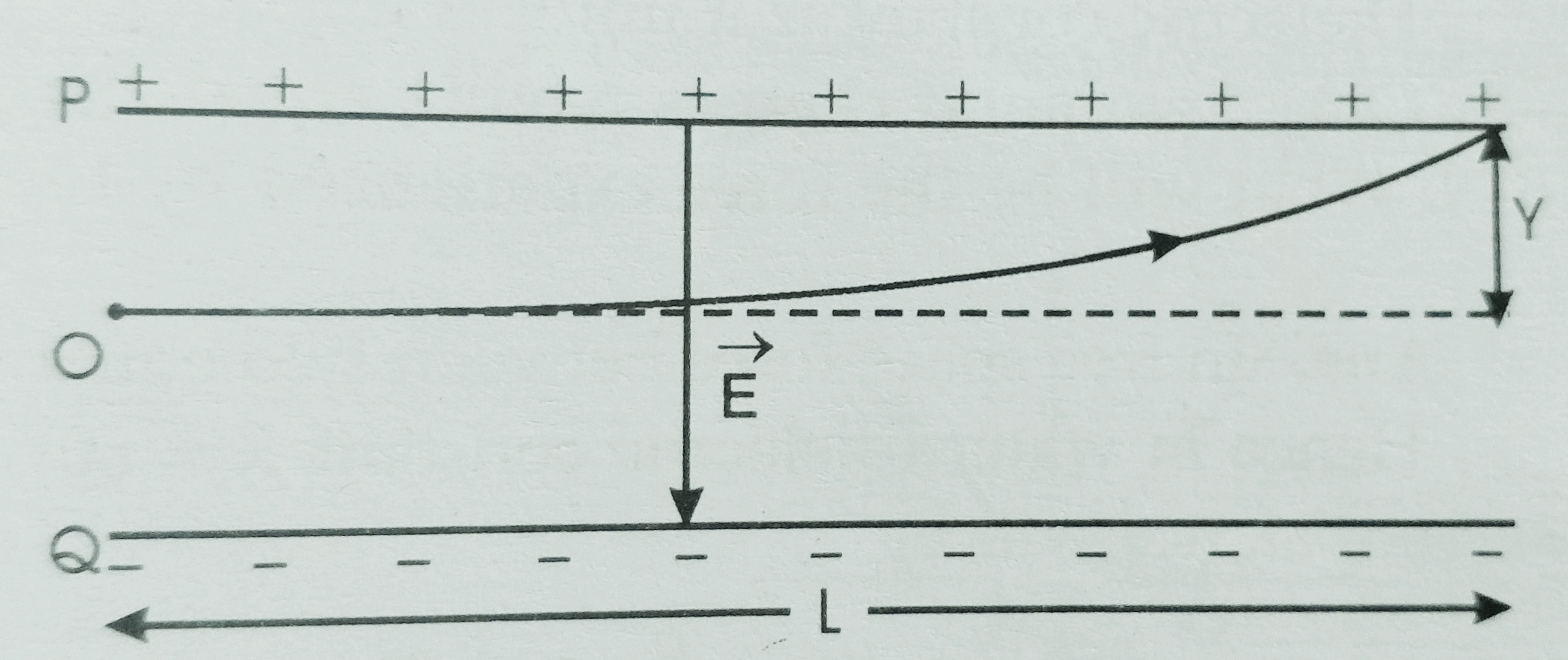
A particle of mass ‘m’ and charge -q enters the region between two charged plates initially moving along x-axis with speed vx ( as shown in the fig) . The length of the plate is L and an uniform electric field E is maintained between the plates . Show that the vertical deflection of the particle at the far edge of the plate is QelL2 / (2m vx2) .
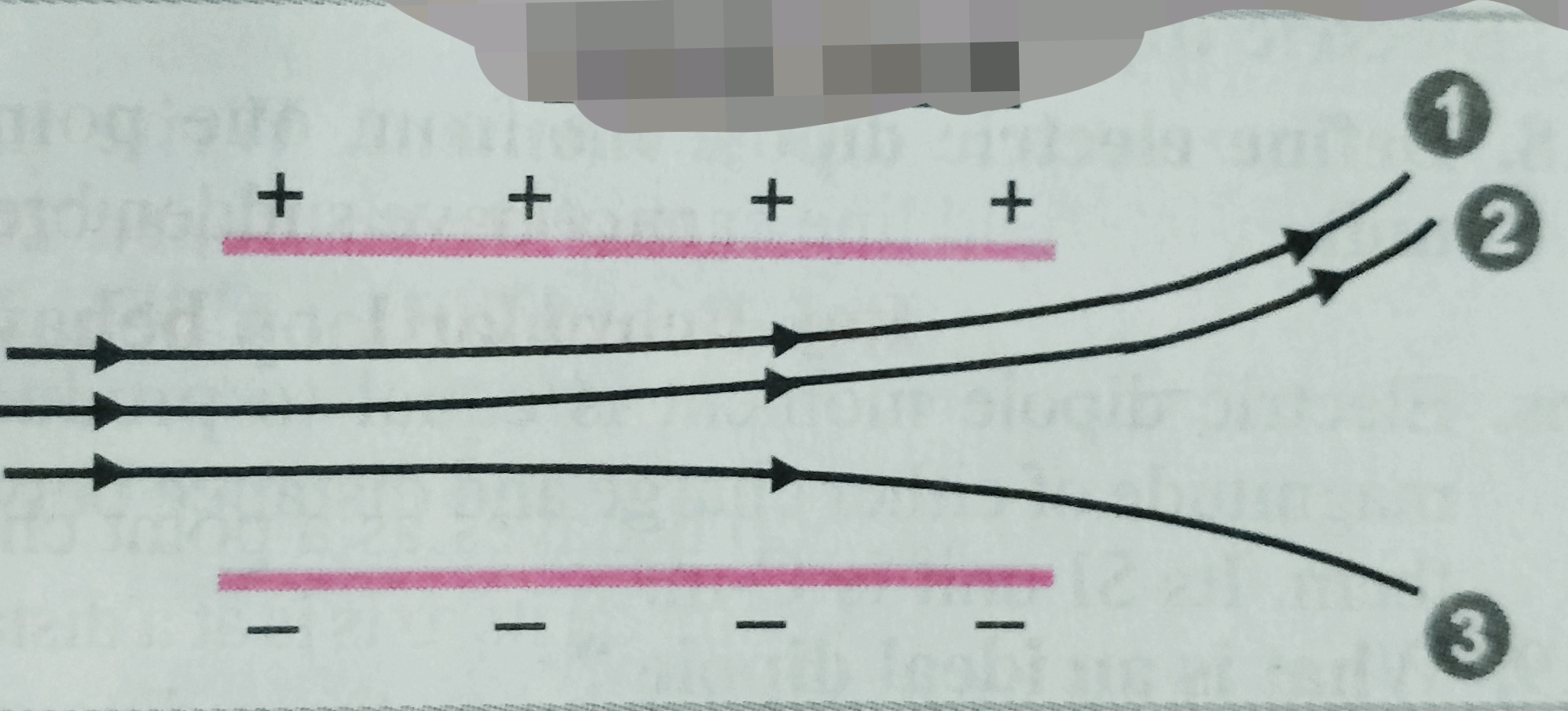
As shown in the figure three charged particles in a uniform electrostatic field . Give the sign of three charges . Which particle has the highest charge to mass ratio .
Electric dipole – An electric dipole consist of a pair of equal and opposite point charges separated by small distance .
Let two charges of equal magnitude but opposite sign( q and -q) are separated by distance 2a , then the arrangement is known as electric dipole .
Dipole moment (p) – Dipole moment of an electric dipole is the measurement of the strength of the electric dipole its magnitude is the product of magnitude of either charge and separation between them .
i.e. Magnetic moment p = q ( 2a )
Direction of magnetic field is given as negative to positive charge i.e. -q to +q ;
Its SI unit is C-m ( coulomb meter ) and dimension is [M0 L1 T1 A1 ] :
** Dipole field – It is the space around the dipole in which electric effect of the dipole can be experienced . For electric dipole electric field E α 1/r3 but for a point charge E α 1/r2
In the link given below , students can find the notes related to electric field at a point on axial and equatorial line due to a dipole.
To see the video of electric field at axial point due to a dipole click on the link given below
To view the video related to the topic electric field at equatorial point of a dipole click on link given below
Electric field intensity at any point due to a short electric dipole , it explain the electric field due to a dipole at any point and using this derivation we can find the electric field at axial and equatorial point of a dipole .
In this topic we will discuss about what is electric field and electric field lines , also electric field intensity at a point due to a point charge .
Electric field – Due to given electric charge it is the space around a charge particle in which electrostatic force can be experienced .
Electric field intensity – Electric field intensity at a point is the force experienced at unit charge placed at that point , it is strength of electric field at that point .
Electric field = F/q0
Electric field intensity due to a point charge – Suppose a charge Q is placed at point O , we have to find the electric field intensity at point p which is r distance away from charge Q .
Suppose a test charge q is placed at point p , then force acting at charge q due to Q is given as F = KQq/r2 ,
therefore electric field E = F/q
so, E =( kQq/r2 )/q
E = kQ/r2
If we have to find the electric field at a point due to group of charges then we can write
Net electric field, E = E1 + E2+E3 ..………..
Electric field lines – It is the imaginary line the tangent at any point on this lines gives the direction of force at that point .
To watch the video on electric field and electric field lines visit on given link below-
Properties of Electric field lines –
Electric field lines are continuous curve . They start from positive charge and end into negative charge . this is why electric field lines not form a closed loop . If there is a single charge then field lines start from the charge and goes into infinity .
2. Tangent to the electric field lines at any point gives the direction of electric field intensity at that point .
3. No two field lines intersect each other . This is because at the point of intersection , there will be two direction of force at the same point which is not possible .
4. The electric field lines are always normal to the surface of a conductor .
5. Where field lines are denser the electric filed intensity is more and vice- versa .
To watch the video of properties of electric field lines click on given link below-
***So in the form of electric field lines electric field intensity is equal to the number of field lines crossing normally a unit area around that point .
In this topic we will discuss about the Coulomb’s law of electrostatic force between two charged particle separated by some distance .
Coulomb’s law –
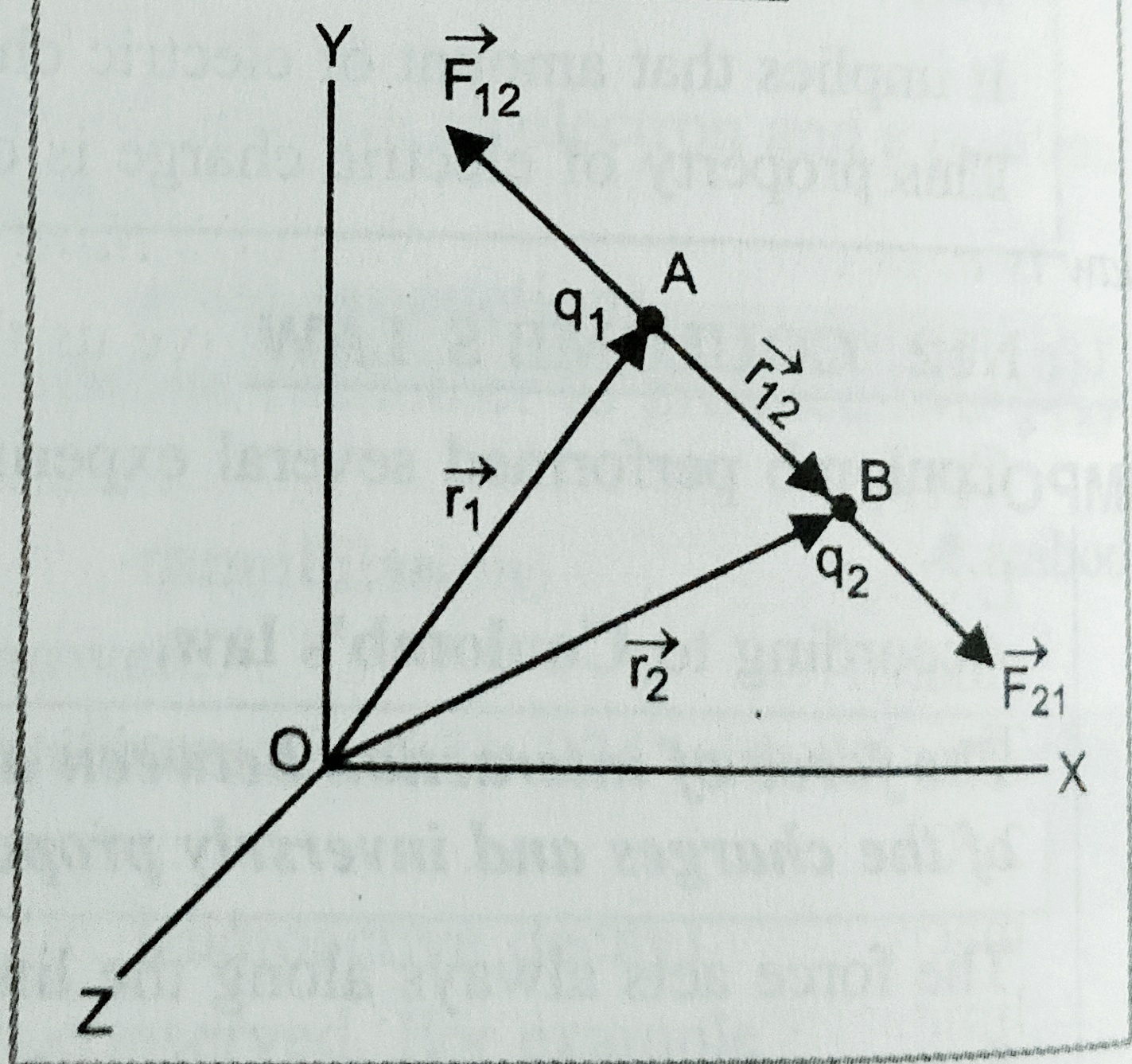
According to Coulomb’s law , the force of attraction or repulsion between two charged body is directly proportional to product of magnitude of their charges and inversely proportional to square of distance between them .
If Q1 and Q2 are two charges placed at distance ‘r’ from each other , then magnitude of force will be given as,
F α Q1.Q2 ………. (I) and
F α 1/ r2 …………(ii)
After combining these two we get
F α Q1.Q2/r2
Or F = K Q1.Q2/r2 where K is a constant given as
K= 1/4∏ϵ0 = 9 x 10⁹ here ϵ0 is called permittivity in vacuum or air .
ϵ0 =8.85 x 10⁻¹² C2‑N-1m-2
Electric permittivity of a medium is a measure of how the molecules of substance align or polarize under an electric field . The substance which has higher electric permittivity then its molecules polarization is maximum , and the more that substance resist the external electric field . It is denoted by ϵ . its unit is C2‑N-1m-2
Dielectric constant or relative permittivity – Dielectric constant of a given medium is the ratio of permittivity of the medium to the permittivity of free space (vacuum /air )
Or
Dielectric constant of a given medium is the ratio of force of interaction between two charges separated by a certain distance in vacuum/air to the force of interaction between two given charges at the same distance in that medium .
Dielectric constant K ( ϵr ) = ϵm / ϵo = F0 /Fm where ;
F0 = force of interaction between two charges separated by a certain distance in vacuum/air
F0 = force of interaction between two charges separated by a certain distance in the given medium
*Dielectric constant is unit less .
To watch the video of relative permittivity and charge density click on the link given below –