Tag: Electrostatics

  • What is electric charge? And what are the properties of charge ?

    What is electric charge? And what are the properties of charge ?

    What is electric charge ? And what are the properties of charge ?

    in this topic we will discuss that, What is electric charge ? And what are the properties of charge ? We will also discuss that what are the processes of charging of an objects ?

    This topic will help the students of class 12th and 10th to understand the topic, What is electric charge and what are the properties of charge ?

    What is electric charge  ? how can we charge a body? And what are the properties of charges ?  


    Electric charges – Charge is the intrinsic  property of the body which is possessed by the body itself , due to which electrostatic force comes into play .

    There are two types of charge positive (+ve ) i.e. proton  and negative (-ve ) i.e. electron  which is given by the Benjamin Franklin .


     Processes to charge a body –

    1. Rubbing –
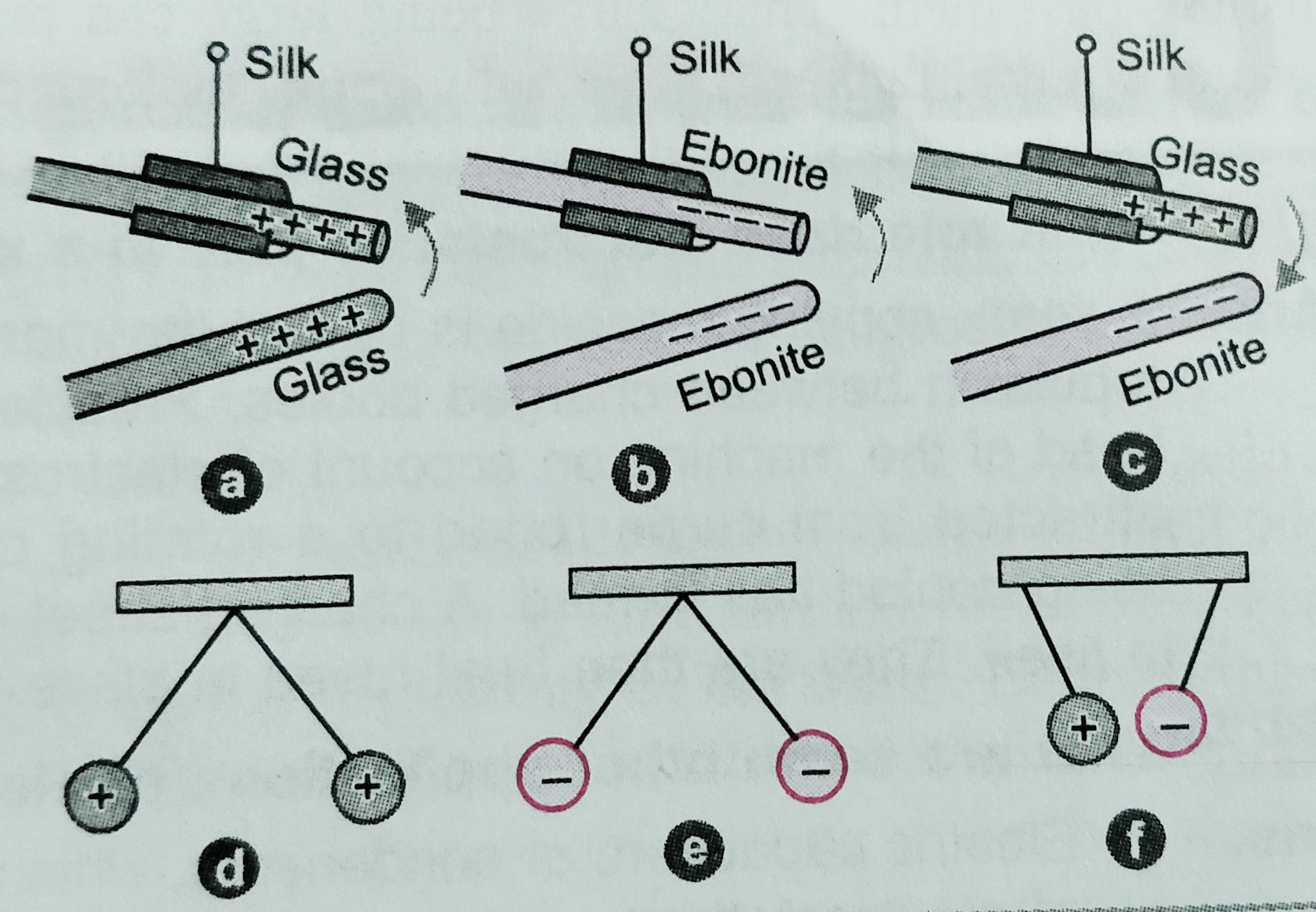
    2. i) – A glass rod rubbed by a piece of silk brought closer to another glass rod rubbed by the silk cloth repel each other . But these glass rods attract the silk cloth with which it was rubbed . In this case the glass rods gets positive charge and silk cloths gets negative charge .

    ii)-   When an Ebonite / Amber rods are rubbed with a fur then  Ebonite rod gets negative charge and fur gets positive charge.

    1. Direct contact ( conduction)

    iii)- When a pith ball is kept in contact with the rubbed glass or rubbed Ebonite rod pith balls get same kind of charge with which it is connected .

    It can be understand with the help of following figure-
    charging of bodies


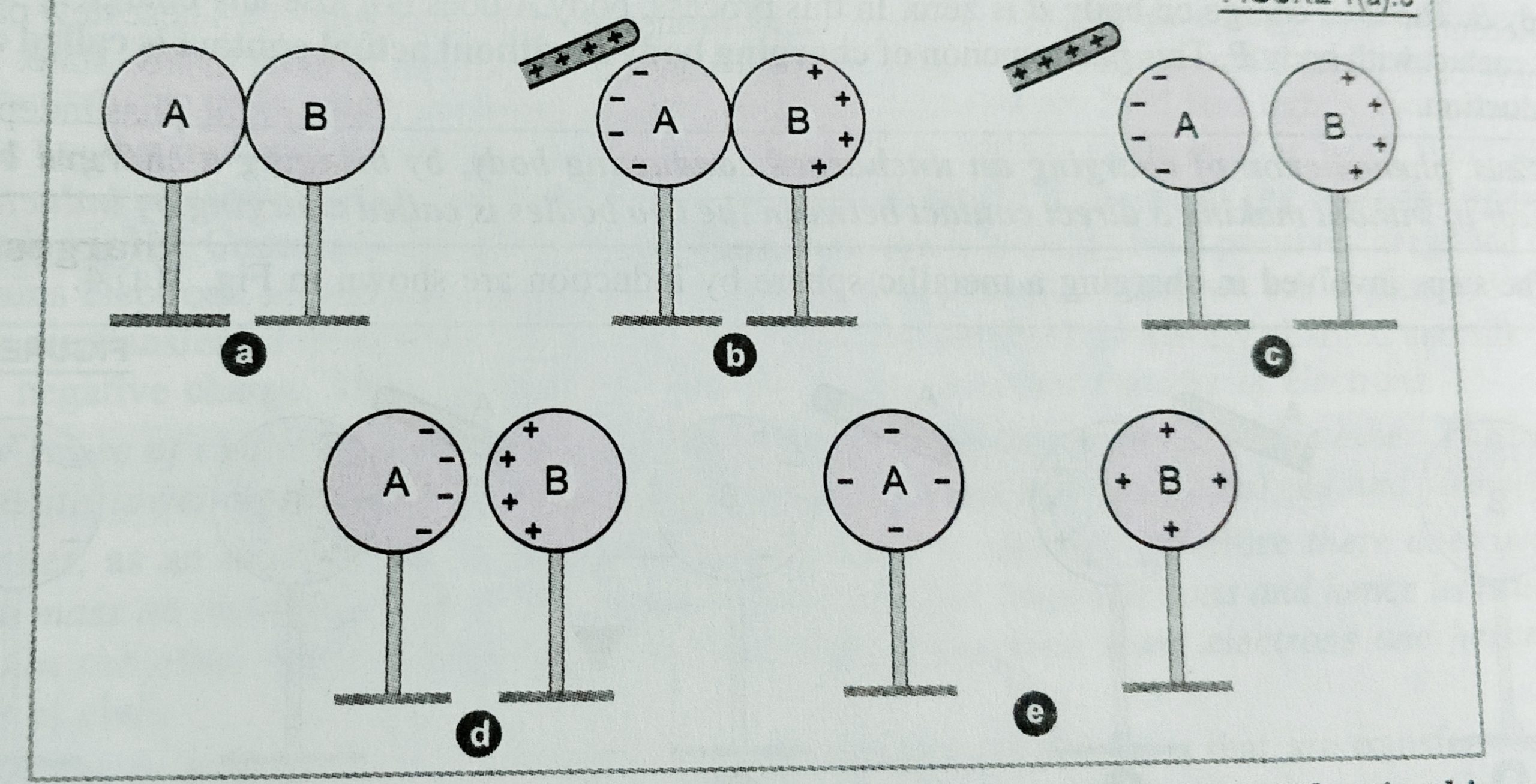
    1. Induction – when a charge body ‘A’  is kept near an uncharged body ‘B’ then some charge of opposite sign appears on the near face of body ‘B’ , and equal charge of opposite sign is appear on the another face of body B . so we can say the process of charging of a body without actual contact is called induction .

    Let us understand how can we charge a body by induction ; Suppose a positively charged glass rod is kept near an uncharged body ‘B’ , then free electrons of B comes on the surface  near the body A but positive charge appear on the opposite face ( because sphere on whole remain neutral ) as shown in fig. again when the sphere B is grounded then electrons move  from ground towards the sphere which neutralise the positive charge on the other side of the sphere . The negative charge at the near end remain on the sphere , and when rod A is removed the negative charge appears on the complete sphere . And finally body B gets negatively charged .

    charging a body due to induction

    Similarly we can see in fig. how can we charge two spheres by induction .
    To view its video click  on the video link given below –

    Properties of charges –

      When we see the several experiments carefully we will come to know that the following properties shown by the charged bodies –

    (A) Like charges repel and unlike charges attracts , which is finally explained by the Coulomb . According to  Coulomb’s  The force of repulsion or attraction between charged body is directly proportional to the  products of magnitude of charges and inversely proportional the square of the distance  between the charged body .

    (B) Quantisation of charge –  It is the property of the charged particle  due to which , the charge on a body is integral multiple of basic unit of charge i.e. electron (-e) or proton (+e) . It is given that charge on a body Q = n. e : where n is the integer . and e= 1.6 x 10⁻¹⁹ C .

    ( C ) Additivity of charge – It is the property of charge by virtue of which total charge of a system is obtained simply by adding algebraically all the charges present in  the system   .  If q1 , q­2 , q3 …… are the charges on the particle of the system then total charge on the system q=  q1 + q­2 + q3………. We should use proper sign of the charge during the addition of charges .

    (D) Conservation of charge – According to this property total charge of the isolated system always remain constant . i.e.  charge neither be created nor be destroyed but it can transfer from one body to another . When we rub a body then equal number of charges of opposite sign appear on the surfaces of these  bodies .

    To view its video click on video link given below –

     For practice of the questions based on charges and properties of charges with the Coulomb’s law click here-

     To get the important question of  electrostatics charges and fields click here


  • Objective questions of capacitance

    Objective questions of capacitance

    Objective questions of capacitance

    This assignment contains all important  objective questions of capacitance, it will be beneficial for the students preparing for class 12th board examination or preparing for JEE/NEET.

    Before to solve this assignment student must solve the assignment of its previous chapter electric field and potential, to download the assignment of objective questions of electric field and potential click here.

    Capacitance

    1. There are 27 drops of a conducting fluid. Each has a radius r and they are charged to a potential V0. These are combined to from a bigger drop. Its potential will be:
    • (a)V0      (b) 3V0    (c) 9V0          (d) 27V0
    1. 1000 small water drops each of radius r and charge q coalesce together to from one spherical drop. The potential of the bigger drop is larger than that of the smaller one by a factor:
    • (a)1000        (b) 100         (c) 10          (d) 1
    1. The capacitance of a parallel plate condenser does not depend upon:
    • (a)area of the plates
    • (b)medium between the plates
    • (c)distance between the plates
    • (d)metal of the plates
    1. The force between the plates of a parallel plate capacitor of capacitance C and distance of separation of the plates d with a potential difference V between the plates is:
    • (a)CV2/2d (b) C2V2/2d2    (c) C2V2/d2      (d) V2d/C
    1. A parallel plate capacitor is made by stacking n equally spaced plates connected alternately. If the capacitance between any two plates is C, then the resulting capacitance is:
    • (a)C    (b) nC         (c) (n-1)C        (d) (n+1)C
    1. Two parallel metal plates carry charge +Q and -Q respectively. A test charge q0 placed between them experiences a force F. Now the separation between the plates is doubled, then the force on the test charge will be:
    • (a)F         (b) 2F             (c) F/2              (d) F/4
    1. A 2μF capacitor is charged to a potential of 200 V and then isolated. When it is connected in parallel with a second capacitor which is uncharged, the common potential becomes 40 V. The capacitance of the second capacitor is:
    • (a)2μF        (b) 4μF        (c) 8μF       (d) none of these
    1. Three capacitors of capacitance 12μF each are available. The minimum and maximum capacitance which may be obtained from these are:
    • (a)12μF, 36μF (b) 4μF, 12μF    (c) 4μF, 36μF   (d) 0μF, ꚙμF

    To download entire assignment of objective questions of electric field click here -objective questions of Capacitance


    To solve the assignment of important objective  questions of electric current click here.

    electric- current
    electric- current


  • IMPORTANT QUESTIONS OF ELECTROSTATIC POTENTIAL AND CAPACITANCE

    IMPORTANT QUESTIONS OF ELECTROSTATIC POTENTIAL AND CAPACITANCE

    ELECTROSTATIC POTENTIAL AND CAPACITANCE

    ELECTROSTATIC POTENTIAL AND CAPACITANCE
    ELECTROSTATIC POTENTIAL AND CAPACITANCE

    THIS QUESTION PAPER CONTAINS THE IMPORTANT QUESTIONS OF ELECTROSTATIC POTENTIAL AND CAPACITANCE IT IS IMPORTANT FOR THE BOARD EXAMINATION FOR CLASS 12TH

    1. What do you mean by the term equipotential surface ? Draw the equipotential surface for (i) a point charge, (ii) an electric dipole , (iii) two positive charges of equal magnitude separated by some distance (iv) two uniformly large parallel thin plates having charge density +σ and -σ separated d distance apart. Can two equipotential surface intersect each other ? give reason. Why there is no work done in moving a charge fro one point to other on an equipotential surface? TO DOWNLOAD COMPLETE QUESTIONS PAPER CLICK HERE –ELECTROSTATIC POTENTIAL AND CAPACITANCE
  • Very important questions of ELECTRIC CHARGES AND FIELDS

    Very important questions of ELECTRIC CHARGES AND FIELDS

    ELECTRIC CHARGES AND FIELDS
    ELECTRIC CHARGES AND FIELDS

    ELECTRIC CHARGES AND FIELDS

    This assignment contains very important questions of ELECTRIC CHARGES AND FIELDS

    1. Explain the following terms –(a) Quantisation of charge . (b) Additivity of charge and (c) conservation of charge.
    2. What is electric field lines ? Draw the field lines for (a) A positive charge (b) A negative charge (c) An electric dipole (d) Two positive charge having equal magnitude separated by some distance, (e)  ) Two positive charge having different magnitude separated  by some distance, and (f) A plane positively charged sheet (g) A positive point charge  (+q) is kept in the vicinity of an uncharged conduction plate. Sketch the electric field lines originated from the point on to the surface of the plate. Also explain why ( I ) Field lines never intersect each other? (ii) Why field lines always comes out normally to the surface ?
    3. What do you mean by the term electric dipole and dipole moment? Is it scaler or vector quantity? Find the electric at a point the (i) axial  and  (ii) equatorial point , also find the relation between them . Also deduce an expression for the torque acting on a dipole and energy stored in the dipole when it is placed in the uniform electric field E .What will happen to the dipole when it is placed in non – uniform electric field?
    4. State and prove Gauss theorem . Using Gauss’s theorem find the magnetic field at a point due to (i) straight charged wire , (ii) plane charged sheet , show that it is independent of distance of the point from the sheet , and (iii) charged spherical shell also plot the graph between electric field and separation of point from the centre of the shell. Using Gauss’s law also derive  an expression for the electric field between two uniformly charged  parallel sheets of charge density σ and -σ respectively
    5. (i)Define electric flux  , write its SI unit . (ii)The electric field components due to a charge inside the cube of side 0.1m are shown below      Ex=αx   ,  where α =500N/C-m EY=0,EZ=0Calculate (a) The flux through the cube (b)the charge inside the cube CLICK HERE TO DOWNLOAD-Very important questions for ELECTRIC CHARGES AND FIELD 


  • Electrostate Assignment-1 for the class 12

    Electrostate Assignment-1 for the class 12

    These questions are based on the 12th Board examination. This first set of questions cover the chapters of Electrostatic in Physics where we deal with charge in rest and what properties it shows. Check the questions below of electrostate Assignment-1 for the class 12 .

    Short answer type Questions

    Q1. Can a charged body attract an uncharged body?

    Q2. A small test charge is released at rest at a point in an electrostatic field. Will it travel along the field line passing through that point?

    Q3. In an electric field an electron is kept freely. If the electron is replaced by proton, what will be the relationship between the forces experienced by them?

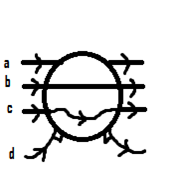
    Q4. A metallic sphere is placed in uniform electric field as shown in the figure. Which path is followed by electric field lines and why?

    Download the Electrostate Full Question Here

    Q5. find the value of electric field that would exactly balance the weight of electron.

    Q6. if the Coulomb’s law involved 1/r3 dependence (instead of 1/r3), where r is distance between two point changes would Gauss’s law still be true?

    Q7. A glass rod is rubbed with silk. Will its mass increase or decrease ?

    Q8 . An electrostatic field line cannot be discontinuous, why?

    Q9. Which orientation of an electric dipole in a uniform electric field would correspond to stable equilibrium ?

    Q10. The distance of the point on equatorial plane of a small electric dipole is halved. By what factor will the electric field due to dipole at the point changes?

    Q11. When two electrically charged particles having charges of different magnitude are placed at a distance d from each other, they experience a force of attraction F. these two particles are put in contact and again placed at the same distance from each other. What is the nature of new forces between them ?

    Guidence : This is the researched Electrostate Assignment of Physics Classes by Nayan Jha. Please read the questions carefully before attempting.

    Q12. What is the line of symmetry of a dipole field?

    Check for 12th Class Notes -Click Here


    Q13. Repulsion is the sure test of electric charge. Explain

    Q14. An electric dipole moment P is placed in a uniform electrostatic field E. for what angle between P and E will the potential energy of the electric dipole be half of its maximum value?

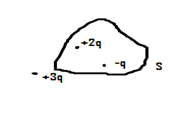
    Q15. Figure shows three point charges +2q , -q and +3q. two charges +2q and –q are enclosed within a surface S. what is the electric fix due to this configuration through the surface S?


    Download the 12th class Test paper of Electrostate