This assignment (Objective questions of alternating current),provide the important objective questions of the chapter alternating current ,which is important for the students preparing for class-12th board examination or , other competitive examinations (JEE/NEET)
A direct current of 5 amp is superimposed on an alternating current I = 10sin ɷt flowing through a wire. The effective value of the resulting current will be:
(a)(15/2) amp (b) 5√3 amp (c) 5√5 amp (d) 15 amp
In an AC circuit, a resistance of R ohm is connected in series with an inductance L. If phase angle between voltage and current is 45°, the value of inductive reactance will be:
(a)R/4
(b)R/2
(c)R
(d)cannot be found with the given data
Resonance frequency of L – C circuit is:
(a)1/2π √LC (b) 1/2πLC (c) 1/2π √L/C (d) 1/2π √LC
In L-C-R series AC circuit, the phase angle between current and voltage is:
(a)any angle between 0 and ± π/2
(b)π/2
(c)π
(d)any angle between 0 and π
In an L-C-R circuit, the capacitance is made one-fourth, when in resonance, so that the circuit remains in resonance?
(a)4 times (b) (1/4) times (c) 8 times (d) 2 times
This assignment contains Objective questions of electromagnetic induction, which will help the students to prepare for class 12th board examination and other competitive exams like JEE/NEET.
This assignment contains all type objective questions of magnetism and matter. it will be helpful for the students preparing for class 12th board examination or other competitive examinations like JEE/ NEET .
Magnetism and matter
With the tangent galvanometer it is desirable to have a deflection near 45°; then the percentage error:
(a)is less in the reading of deflection
(b)is negligible in the reading of deflection
(c)is less in the measurement of current
(d)is large in the measurement of current
The sensitivity of a moving coil galvanometer depends on:
(a)the angle of deflection
(b)the earth’s magnetic field
(c)torsional constant of the spring
(d)the moment of inertia of the coil
An ammeter can be converted into a voltmeter by connecting:
(a)a high resistance in series
(b)a low resistance in parallel
(c)a low resistance in series
(d)a high resistance in parallel
In a moving coil galvanometer the deflection of the coil θ is related to the electric current I by the relation:
(a)I ꭀ tan θ (b) I ꭀ θ (c) I ꭀ θ2 (d) I ꭀ √θ
A voltmeter of range 2V and resistance 300 Ω cannot be converted into ammeter of range:
(a)1 A (b) 1 mA (c) 100 mA (d) 10 mA
The effect due to uniform magnetic field on a freely suspended magnetic needle is as follows:
(a)both torque and net force are present
(b)torque is present but no net force
(c)both torque and net force are absent
(d)net force is present but not torque
A voltmeter has a resistance of G ohm and range V volt. The value of resistance used in series to convert it into voltmeter of range nV volt is:
(a)nG (b) (n – 1)G (c) G/n (d) G/(n – 1)
An ammeter has a resistance of G ohm and a range of I The value of resistance used in parallel to convert it into an ammeter of range nI amp is:
(a)nG (b) (n – 1)G (c) G/n (d) G/(n – 1)
To reduce the range of a voltmeter, its resistance need to be reduced. Which of the following resistance when connected in parallel will convert it into a voltmeter of range (V/n)?
(a)nR0 (b) (n + 1)R0 (c) (n – 1)R0 (d) None of these
this assignment contains all important objective type questions of magnetic effect of current . Students preparing for 12th board examination or other competitive examination like JEE/NEET.
The force acting on a charge q moving with a velocity ʋ in a magnetic field of induction B is given by:
(a) q/(ʋ ₓ B) (b) (ʋ ₓ B)/q (c) q/(ʋ ₓ B) (d) (ʋ . B)q
Two free parallel wire carrying currents in the opposite directions:
(a)attract each other
(b)repel each other
(c)do not affect each other
(d)get rotated to be perpendicular to each other
Two parallel wires carrying currents in the same direction attract each other because of:
(a)potential difference between them
(b)mutual inductance between them
(c)electric forces between them
(d)magnetic force between them
A free charged particle moves through a magnetic field. The particle may undergo a change in:
(a)speed (b)energy (c) direction of motion (d) none these
An electron and a proton travel with equal speeds and in the same direction, at 90° to a uniform magnetic field. They experience forces which are initially:
(a)in opposite direction and differing by a factor of about 1840
(b)in the same direction and differing by a factor of about 1840
This topic provide important objective questions for electric current it will be very important for the students preparing for class 12th board examination or JEE/NEET
For which of the following dependence of drift velocity ʋ on electric field E is ohm’s law obeyed?
This assignment contain all important objective questions of atoms and nuclei , which is important for the students preparing for board examination and other competitive examinations .
Atomic Structure
According to Bohr’s atomic model:
(a)an atom has heavy, positively charged nucleus
(b)the electron radiates energy only when it jumps to another orbit
(c)the electron can move only in particular orbits
(d)all the above statements are correct
In an atom, two electrons move around the nucleus in circular orbit of radii R and 4R. The ratio of the time taken by them to complete one revolution is:
(a)1/4 (b) 4/1 (c) 8/1 (d) 1/8
According to Bohr’s quantum condition, an electron can revolve only in those orbits in which:
(a) its energy is an integral multiple of h/2π
(b) its linear momentum is an integral multiple of h/2π
(c) its angular momentum is an integral multiple of h/2π
(d) its angular momentum vector is perpendicular to magnetic dipole moment vector
According Bohr’s theory the radius of the electron in an orbit described by principal quantum number n and atomic number Z is proportional to:
(a)Z2n2 (b) Z2 /n2
(c) Z2 /n
(d) n2 /Z
When the electron jumps from a level n = 4 to n = 1, the momentum of the recoiled hydrogen atom will be:
(a)5 ₓ 10-27 kg – ms-1
(b) 13.6 ₓ 10-19 kg – ms-1 (c)75 ₓ 10-19 kg – ms-1
(d) zero
The radius of Bohr’s fast orbit is a0. The electron in nth orbit has a radius:
(a)na0
(b) a0/n
(c) n2a0
(d) a0/n2
The angular momentum of an electron in the nth orbit is given by:
(a)nh
(b) h/2πn
(c) nh/2π
(d) n2h/2π
When a hydrogen atom is raised from the ground state to fifth state:
(a)both KE and PE increase
(b) PE increases and KE decreases
(c)both KE and PE decrease
(d) PE decreases and KE increases
As the electron in Bohr orbit of hydrogen atom passes from state n = 2 to n = 1, the KE (K) and PE (U) change as: (a)K two-fold, U also two-fold
(c) K four-fold, U two-fold
(b)K four-fold, U also four-fold
(d) K two-fold U four-fold
An electron jumps from the 4th orbit to the 2nd orbit of a hydrogen atom. Given the Rydberg constant R = 105 cm-1, the frequency in Hz of the emitted radiation will be:
(a)3/16 ₓ 105
(b) 3/16 ₓ 1015
(c) 9/16 ₓ 1015
(d) 3/4 ₓ 1015
Nitrogen gas, cynogen gas and compounds of carbon give band spectra because:
(a)these are excited in molecular state
(b)these are in atomic state
(c)these are inorganic compounds
(d)these are in gaseous state
The hydrogen atom can give spectral lines in the series, Lyman, Balmer and Paschen. Which of the following statements is correct?
(a)Lyman series is in the infrared region
(b)Balmer series is in the visible region (partly)
(c)Balmer series is solely in the ultraviolet region
(d)Paschen series is in the visible region
.Which of the following statements is true regarding Bohr’s model of hydrogen atom?
(a)Orbiting speed of electron decreases as it falls to discrete orbits away from the nucleus.
(b)Radii of allowed orbits of electrons are proportional to the principal quantum number.
(c)Frequency with which electrons orbits around the nucleus in discrete orbits is inversely proportional the principal quantum number.
Binding force with which the electron is bound to the nucleus increases as it shifts to outer orbits.
(A)a and c
(B) b and d
(C) a, b and c
(D) b, c and d
An electron in the hydrogen atom jumps from excited state n to the ground state. The wavelength so emitted illuminates a photosensitive material having work function 2.75 eV. If the stopping potential of the photo-electron is 10 V, then the value of n is: (a)2 (b) 3 (c) 4 (d) 5
In Bohr’s model, the atomic radius of the fast orbit is r0;then the radius of the third orbit is: (a)r0/9 (b) r0 (c) 9r0 (d) 3r0
The ground state energy of H-atom is 13.6 eV. The energy needed to ionise H-atom from its second excited state is: (a)51 eV (b) 3.4 eV (c) 13.6 eV (d) 12.1 eV
Hydrogen atoms are excited from ground state to the state of principal quantum number 4. Then, the number of spectral lines observed will be:
(a) 3 (b) 6 (c) 5 (d) 2
If an electron in n = 3 orbit of hydrogen atom jumps down to n = 2 orbits, the amount of energy released and the wavelength of radiation emitted are: (a)85 eV, 6566 Å (b) 1.89eV, 1240 Å (c) 1.89 eV, 6566 Å (d) 1.5 eV,6566 Å
The longest wavelength that a single ionised helium atom in its ground state will absorb is:
(a)912 Å (b) 304 Å (c) 606 Å (d) 1216 Å
If the ionisation potential of hydrogen atom is 13.6 eV, the energy required to remove the electron from the third orbit of hydrogen atom is:
(a)5 V (b) 1.5 eV (c) 4.5 eV (d) 3.4 V
The ratio of the areas within the electron orbits for the first excited state the ground state for the ground state for the hydrogen atom is:(a)2 : 1 (b) 4 : 1 (c) 8 : 1 (d) 16 : 1
The first excitation potential of the hydrogen atom in the ground state is: (a)6 volt (b) 10.2 volt (c) 3.4 volt (d) 1.89 volt
The minimum energy in electron volt required to strip a ten times ionized sodium atom ( i.e., Z = 11) of its last electron is:
(a)6 eV (b) 13.6/11 eV (c) 13.6 ₓ 11 eV (d) 13.6 ₓ (11)2 eV
Of the following transitions in hydrogen atom, the one which gives emission line of minimum frequency is:(a)n = 1 to n = 2 (b) n = 3 to n = 10 (c) n = 10 to n = 3 (d) n = 2 to n = 1
The energy of an electron in the nth orbit of positronium is: (a) -13.6/n2 eV (b) -13.6 ₓ 2/n2 eV (c) -13.6 ₓ 4/n2 eV (d) -13.6/2n2 eV
The ratio (in SI units) of magnetic dipole moment to that of the angular momentum of electron of mass m kg and charge e coulomb in Bohr’s orbit of hydrogen atom is:
(a) e/2m (b) e/m (c) 2e/m (d) none of these
The Bohr model of atoms:
(a)assumes that the angular momentum of the electrons is quantized
(b)uses Einstein’s photoelectric equation
(c)predicts continuous emission spectra for atoms
(d)predicts the same emission spectra for all types of atoms
The angular momentum of an electron in a hydrogen atom is proportional to:
(a)1/√r (b) 1/r (c) √r (d) r2
What will be the angular momentum in fourth orbit, if L is the angular momentum of the electron in the second orbit of hydrogen atom?
(a)2 L (b) 3/2 L (c) 2/3 L (d) L/2
The required energy to detach one electron from Balmer series of hydrogen spectrum is:
(a)6 eV (b) 10.2 eV (c) 3.4 eV (d) -1.5 eV
Which of the following is quantised according to Bohr’s theory of hydrogen atom? (a)Linear momentum of electron
(b)Angular momentum of electron
(c)Angular velocity of electron
(d)Linear velocity of electron
The energy levels of a certain atom for 1st ,2nd and 3rd levels are E, 4E/3 and 2E respectively. A photon of wavelength λ is emitted for a transition 3 →1.What will be the wavelength of emission for transition 2 → 1?
(a) λ/3 (b) 4λ/3 (c) 3λ/4 (d) 3λ
The ratio of the frequencies of the long wavelength limits of the Lyman and Balmer series of hydrogen is:
(a)27 : 5 (b) 5 : 27 (c) 4 : 1 (d) 1 : 4
If electron in a hydrogen atom has moved from n = 1 to n = 10 orbit, the potential energy of the system has:
(a)Increased (b)Decreased (c) remains unchanged (d) become zero
The energy of hydrogen atom in nth orbit is En , then the energy in nth orbit of singly ionised helium atom will be:
(a)4En (b) En/4 (c) 2En (d) En/2
The energy of hydrogen atom is -13.6 eV in the first orbit, then calculate the energy of He atom in the same orbit:
(a)6 eV (b) -27.2 eV (c) -54.4 eV (d) +54.4 eV
In hydrogen spectrum, the shortest wavelength in Balmer series is λ. The shortest wavelength in Brackett series will be:(a)2λ (b) 4λ (c) 9λ (d) 16λ
The ratio of the largest to shortest wavelength in Lyman series of hydrogen spectra is:
(a) 25/9 (b) 17/6 (c) 9/5 (d) 4/3
The minimum orbital angular momentum of the electron in hydrogen atom is:
(a) h (b) h/π (c) h/2π (d) h/2
The total energy of an electron in the first excited state of hydrogen atom is about – 3.4 eV. Its KE in this state is:
(a)4 eV (b) 6.8 eV (c) -3.4 eV (d)-6.8 eV
The ground state energy of hydrogen atom is -13.6 eV. What is the potential energy of the electron in this state?
(a)0 eV (b) -27.2 eV (c) 1 eV (d) 2 eV
If λ1 and λ2 are the wavelengths of the first member of the Lyman and Paschen series respectively, then λ1 : λ2 is:
(a)1 : 3 (b) 1 : 30 (c) 7 : 50 (d) 7 : 108
Student’s as we know from this year , in CBSE 12th board examination ( physics ) there will be 20 , 1- mark questions . therefore we just posted some objective questions of wave optics , so that students can practice well all kind of objective questions of wave optics in short time .
Objective questions of wave optics
Newton has postulated his corpuscular theory on the basis of , (a) Newton’s ring (b) color due to thin film (c) dispersing of light (d) rectilinear propagation of light.
The wavefront is a surface in which ; (a) all points are on the same phase(b) there are pair of points in opposite phase (c) there are pairs of points with phase difference 900 (d)there are no relation between the phase.
The concepts of secondary wavelets from all points on a wave front was proposed by ; (a) Newton (b) Huygen (c) Faraday (d) Raman.
Huygen’s concepts of secondary waves ; (a) allow us to find the focal length of thin lens (b) gives the magnifying power of thin lens (c) is a geometrical method to find the wavelength (d)is used to find the velocity of light.
For constructive interference to take place between two monochromatic light waves of wavelength λ , the path difference should be ; (a) (2n-1)λ/4 (b) (2n-1)λ/2 (c) nλ (d)(2n+1)λ/2
Two light sources are coherent when ; (a) their amplitudes are equal (b) their frequency are equal (c) their wavelengths are equal (d)their frequencies are equal and their phase difference is constant.
Ratio of intensity of two waves is given by 4:1 , the ratio of amplitudes of their waves is ; (a) 2:1 (b)1:2 (c) 4:1 (d)1:4
If the ratio of intensities of two waves causing interference be 9:4 then the ratio of the resultant maximum and minimum intensity will be : ; (a) 9:4(b) 3:2 (c) 25:1 (d)5:1 .
In young’s double slit experiment , if monochromatic light used is replaced by white light , then ; (a) no fringes are observed (b) all bright fringes becomes white (c) all fringes have colour between violet and red (d)only central fringes is white and all other fringes are coloured .
Two coherent monochromatic light beams of intensity I and 4I are superposed , the max and min. possible intensities in the resulting beam are ; (a) 5I and I (b) 5I and 3I (c) 9I and I (d) 9I and 3I
If two waves , each of intensities I0 , having the same frequency but differing by constant phase angle of 600 , superpose at a certain point in space , then the intensity of resultant wave is ; (a) 2I0 (b) √3 I0 (c) 3I0 (d) 4I0
Two monochromatic waves each of intensity I , have constant phase difference of ɸ , if these waves superpose , then the intensity of resulting wave is ; (a) 4I (b) 4Icosɸ (c) 4Icos2ɸ (d) 4I cos2 (ɸ/2)
Two monochromatic waves of same amplitude ‘a’ ,have random phase difference between them . when these wave superpose , then the amplitude of resulting wave is given by ; (a) √2a (b) 2a (c) 4a (d)zero .
The contrast in the fringes in any interference pattern depends on ; (a) fringe width (b)wavelength (c) intensity ratio of the sources (d) distance between the sources
In young’s double slit experiment if the distance between the slits is made 3-folds, the fringe width becomes ; (a) 1/3 folds (b) 3 folds (c) 1/9 folds (d) 9 folds .
In Young’s double slit experiments the separation between the is halved and separation between the slits and screen is doubled , the fringe width is ; ; (a) unchanged (b) halved (c) doubled (d) quadrupled .
Yellow light emitted by sodium lamp in Young’s double slit experiment is replaced by blue light of the same intensity ; (a) fringe width will decrease (b) fringe width will increase (c) fringe width will remain unchanged (d) fringe will become less intense .
Two light waves are coherent if they are obtained from a single monochromatic source by ; ; (a) division of amplitude only (b) division of wavefront only (c) both of the above (d) none of the above.
In an interference experiment monochromatic light is replaced by white light , we will see , ; (a) uniform illumination on the screen (b) uniform darkness in the screen (c) equally spaced white and dark bands (d) a few coloured bands and then uniform illumination .
In Young’s double slit experiment the fringe width is found to be 0.4 mm . if the whole apparatus is immersed in water of refractive index 4/3 without disturbing the original geometric arrangement , then new fringe width will be ; (a) 0.3mm (b)0.40mm (c) 0.53mm (d )450 microns .
Two waves are said to be coherent if they have ; (a) same wave length (b) same amplitude (c) same amplitude and save wavelength (d) same wavelength and constant phase difference .
In a young’s double slit experiment fringe width is equal to 1mm , then the distance of the nearest bright fringe from the central fringe will be ; (a) 1mm (b) 0.5mm (c) 2mm (d) insufficient data ,
In young’s double slit experiment . if width of the slit s is increased keeping other parameters constant , then the interference fringes will be ; (a) remain unchanged (b) form closer (c) form further away (d) gradually disappear.
Interference of light waves from two coherent sources is possible for ; (a) unpolarised light waves only (b) polarised light waves only if their polarisation is in the same direction (c) both of the above (d) none of the above.
Two waves coming from two coherent sources , having different intensity interfere , their ratio of maximum intensity is 25 , then the intensities of the sources are in the ratio ; (a) 25:1 (b) 25:16 (c) 9:4 (d) 5:1 .
When petrol drop from a vehicle fall over rain water on the road , colors are seen because of ; (a) dispersion of light (b) scattering of light (c) interference of light (d) absorption of light.
In one of the two slits of young’s double slit experiment is painted over so that it transmits half the light intensity of the other , then ; (a) the fringe system will disappear (b) the bright fringe will be more bright (c) the dark fringe will be brighter and vice -versa (d) none of the above .
The phenomena of diffraction can be exhibited by ; (a) polarised wave only (b) unpolarised wave only (c) longitudinal wave only (d)all kind of wave
Diffraction effects are easily observed for ; (a) microwave (b) sound wave (c) radio waves (d) all of the these .
In case of diffraction at single slit if the wavelength of light becomes equal to the aperture of slit , on the screen we shall observe : ; (a) image of slit (b) diffraction band (c)uniform illumination (d) non-uniform illumination.
Light of wavelength 2 x 10⁻³ m falls on a slit of width 4 x 10⁻³ m . the angular dispersion of the central max will be ; (a) 300 (b) 600 (c) 900 (d) 1800 .
The width of the diffraction band varies as (a) inversely as the wavelength (b) directly as the width of the slit (c) directly as the distance between slit and the screen (d) inversely as the size of source from which the slit is illuminated .
The polarisation of light prove the ; (a) corpuscular nature of light (b) quantum nature of light (c) transverse wave nature of light (d) longitudinal wave nature of light .
A beam of light strikes a piece of glass at an angle of incidence of 600 and reflected beam is completely plane polarized , then the refractive index of glass is ; (a) 1.5 (b) √3 (c) √2 (d) 2/3.
A ray of light incident on the surface of a glass plate at an angle of incidence equal to Brewster’s angle ɸ. If µ is the refractive index of the glass then the angle between reflected and refracted rays is ; (a) (90+ɸ) (b) sin-1 (µ cosɸ) (c) 900 (d) sin-1( sinɸ/µ).
A Nicol prism is based on the principle of ; (a) refraction (b) scattering (c) dichroism (d) double refraction .
Which of these wave can be polarised ? (a)sound wave (b) longitudinal wave on a string (c) transverse wave on a string (d) light wave
Two Nicol prism are first crossed and ten one of them is rotated through 600 , the percentage of incident light transmitted is ; (a) 1.25 (b)25 (c)37.5 (d)50 .
Two polaroids are placed cross to each other , now one of them is rotated through an angle of 450 the percentage of incident light now transmitted through the system is (a)15% (b)25% (c) 50% (d) 60% ( e) 75%.
Waves can’t be polarised is ; (a) light wave (b) electromagnetic wave (c) transverse wave (d) longitudinal wave .
Young’s double slit experiment is made in a liquid . The tenth bright fringe in the liquid lies where the 6th bright fringe lies in the vacuum . The refractive index of the liquid is approximately ; (a) 1.8 (b) 1.54 (c) 1.67 (d) 2 .
If light is polarised by reflection , then the angle between reflected and refracted light is ; (a) Π (b) Π/2 (c) Π/3 (d) Π/4
A beam of light strikes a piece of glass at an angle of incidence of 600 and the reflected ray is completely polarised . Then the refractive index of the glass is ; (a) 1.5 (b) √3 (c) √2 (d)3/2
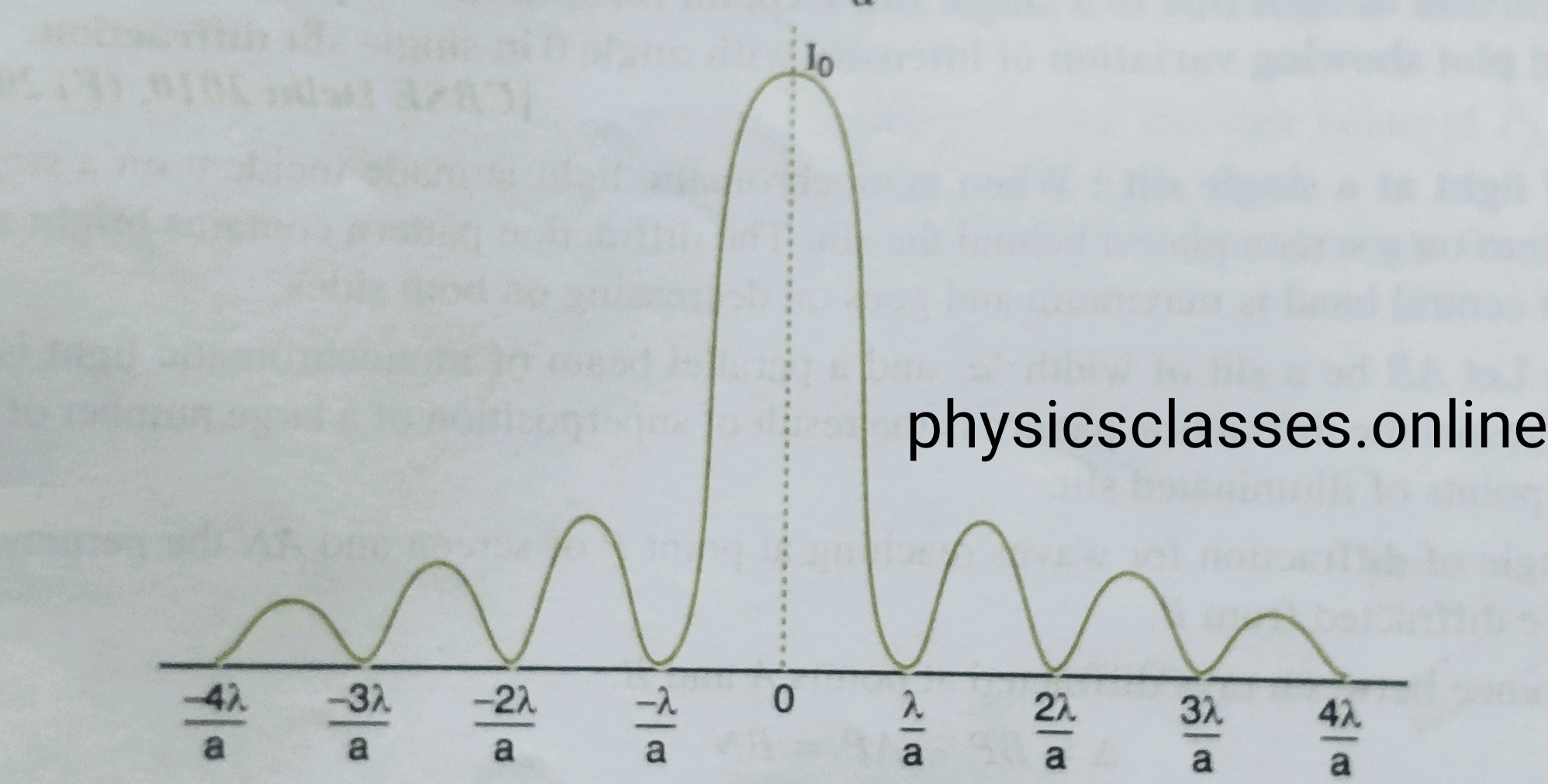
What is diffraction of light ? conditions for maximum and minimum using single slit experiment, and intensity curve .
Diffraction of light –
When a beam of monochromatic light passes through an aperture or an obstacle comes into the way of light then light is bent at the corners of the aperture or obstacle , this phenomena of light is called diffraction of light
Diffraction of light at a single slit – when a beam of monochromatic light is made incident on single slit , then we get diffraction pattern on the screen , which contain bright (maximum) and dark (minimum) band .
diffraction single slit
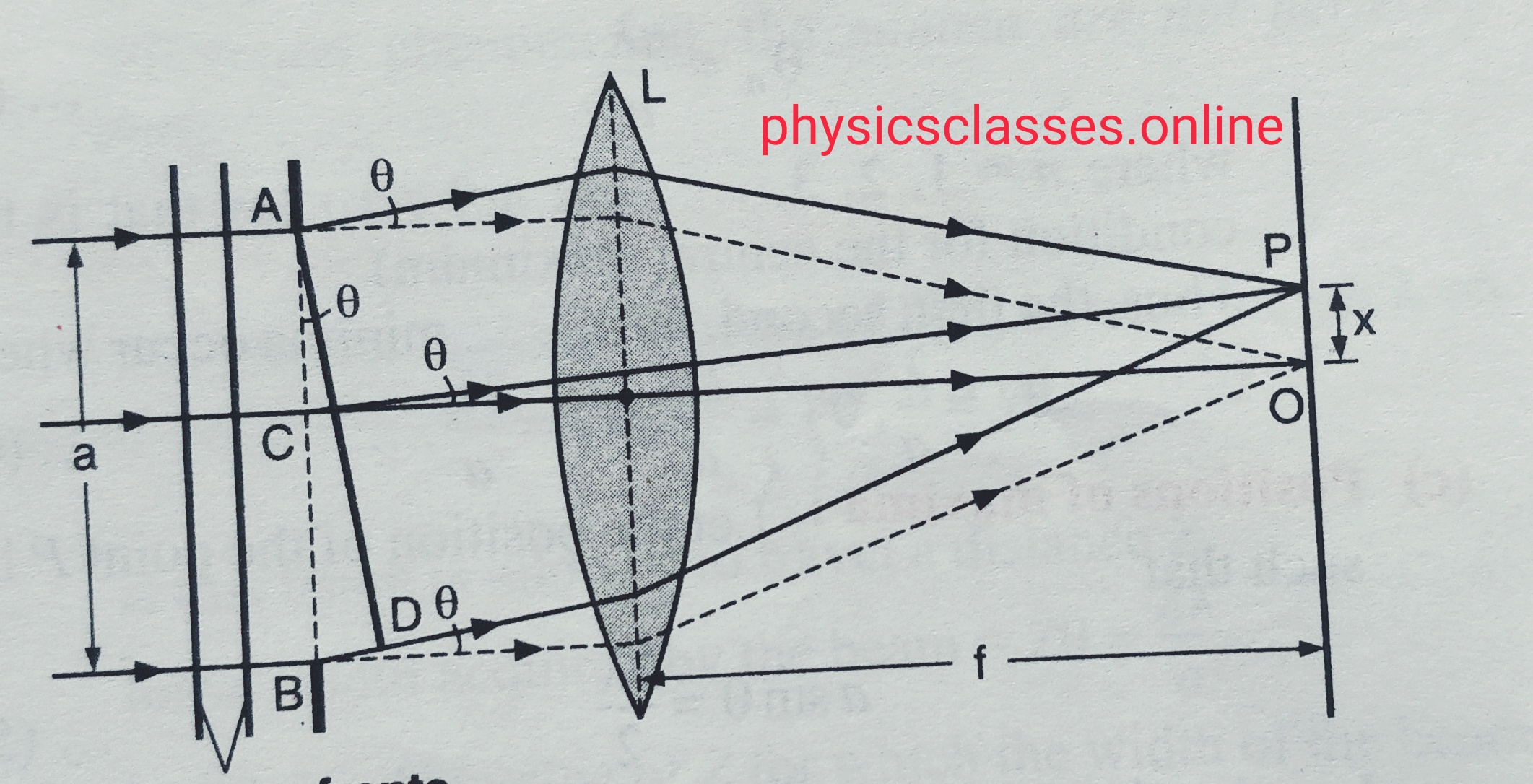
Let, AB be a slit of width ‘a’ and parallel beam of a monochromatic light incident on it . All the primary ray incident converges at the center and form a bright fringe, and all the secondary wave gets superimposed and form secondary dark and bright fringes on the screen .
Let θ be the angle of diffraction for waves reaching at point P of screen , and AD is the perpendicular drown from ‘A’
The path difference between the rays AP and BP
So path difference , p = BP – AP = BD
But from geometry <ANB = θ
Sinθ= BD/AB ,
Or, BD = AB sinθ
width of the slit AB = a
Hence path difference ; p = a sinθ ……………………………(i)
Position of central maximum – the wavelets fall on the lens L along parallel direction of the axis reaches at o in the same phase and form central maximum .
Position of secondary minimum – if we imagine the slits is divided in two equal halves AC and CB then every point on the upper half the path difference is λ/2 and same as in lower half . they will reach at the point p in opposite phase and form destructive interference cause of minimum or dark band , for dark band a sinθ = nλ , where n= 1,2,3,4………..
, if θ is very small then , aθ = nλ
So , θ = nλ/a .
Position of secondary maximum – we imagine slits is divided in three equal parts so the path difference between these two upper parts will be λ/2 , which will cancelled each other effect , so only third part will be the cause of the diffraction pattern obtained on the screen .
So , a sinθ = ( 2n+1) λ/2
If θ is very small then , a θ = ( 2n+1) λ/2
So , θ =( 2n+1) λ/2 / a
Intensity- position curve for diffraction of light
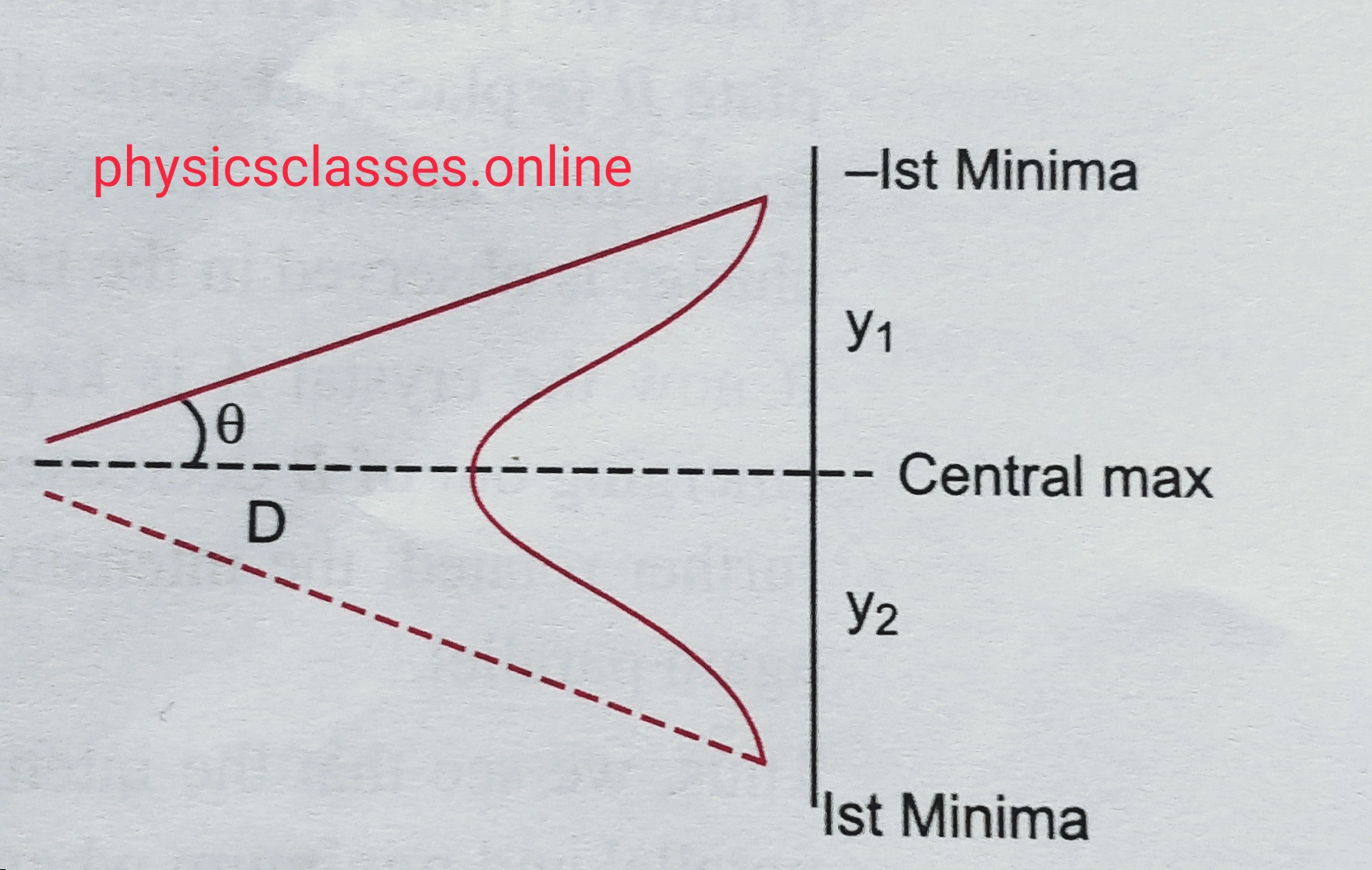
Central maximum is twice the width of any other secondary maximum –
diffraction central maximum
For first minimum , from the relation of secondary minimum θ = nλ/a
Here value of n=1 ( for first minimum ) , so, θ = 1λ/a .
But , according to the geometry θ = y1 / D ( where D is the separation between the slit and screen ) .
Angular width of the central maximum 2θ = y1 + y2 /D ,
Or, 2λ/a = y1+ y2 /D,
Or , Y1 + y2 = 2λD/a
Therefore , width of the slits = 2( λD/a) = 2 x (width of other secondary maximum).
Questions based on diffraction of light – What do you mean by the term diffraction of light ? using single slit show the conditions of central maximum, secondary minimum, secondary maximum and hence draw the intensity curve with position ‘x’ . Using single slit experiment show that (i) the intensity of diffraction fringes increases as order (n) increases .(ii) angular width of the central maximum is twice of first order secondary maximum .
For important questions based on the chapter wave optics– click here
Important questions of system of particles and rotational motion
In this assignment we are providing for the students, Important questions of system of particles and rotational motion . Students who is already completed the theory and derivation of entire chapter should solve all the questions given in this assignment ” Important questions of system of particles and rotational motion”. Since numbers of questions in this assignment is very less, so it can be revised or solved in very short time .
System of particle and rotational motion
assignment
Is it possible to open a pen cap with one finger? Why?
When a sphere, ring, disc and spherical shell are coming down on an inclined plane, rolling without slipping, which will reach the ground first?
How will you distinguish between a hard-boiled egg and a raw egg by spinning each on a table top?
Find the torque of a force 7î-3jˆ-5kˆ about the origin which acts on a particle whose position vector is iˆ+jˆ-kˆ.
What is torque? Write its formula in vector form. Handle, to open the door, is always provided at the free edge of a door. Why?
Establish the relation between angular momentum and rotational kinetic energy?
If earth were to shrink suddenly, what would happen to the length of the day?
Derive the relations
L = I ω (ii) Ʈ = Iα
If angular momentum is covered in a system whose moment of inertia is decreased, will its rotational kinetic energy to be also conserved? Explain.
Can a body in translatory motion have angular momentum? Explain.
A ring, a dice and a sphere all of the same radius and same mass roll down on an inclined plane from the same height h. Which of the three reaches the bottom
(i)earliest (ii) latest ?
Write an expression for the moment of inertia of a circular disc of a mass M and radius R
(i)about an axis passing through its center, and a perpendicular to its plane.
(ii) about its diameter.
(iii)about a tangent to its own plane.
(iv) about a tangent perpendicular to the plane of the disc.
How much fraction of the K.E. of rolling is purely (i) translational (ii) rotational ?
Obtain an expression for position vector of center of mass of a two particle system.
What is the difference between rotational kinetic energy and rolling kinetic energy?
Show that rolling kinetic energy of a rolling body is given by 1/2mv2(( K2/r2)+1) , where r is the radius of the body and K is the radius of gyration of the body.
(i) Define moment of inertia. Write the parallel and perpendicular axis theorem.
Derive an expression for moment of inertia of a disc of radius r, mass m
Prove that the rate of a change of the angular momentum of particle is equal the torque of acting on it.
Define moment inertia. Write any two factors which it depends. When the diver leaves the diving board, why does he bring his hand and feet closer together in order to make a some result ?
Derive an expression for moment of inertia of a thin circular ring passing through the centerrotational motionr and perpendicular to the plane of the ring.
(I)Define moment of inertia .write the parallel and perpendicular axis theorem .(II)derive an expression for moment of inertia of a disc of radius r , mass m about the axis along its diameter.
A rope of negligible mass is wound round a hollow cylinder of mass 3kg and radius 40cm . what is the angular acceleration of the cylinder if the rope is pulled by a force of 30N?what is the linear acceleration of the rope?
From a uniform circular disc of diameter d , a circular hole of diameter d/6 and having its center at a distance of d/4 from the center of the disc is scooped out , find the center of mass of the remaining portion .
A uniform ring of mass 10kg and diameter 0.40m rotate with the uniform speed of 2100 rpm, find the moment of inertia and angular momentum of the ring about its geometric axis
A cylinder of mass 5kg and radius 30cm and free to rotate about its axis , receive an angular impulse of 3kg m2/s followed by a similar impulse after every 4 sec . what is the angular speed of the cylinder 30 sec. after the initial impulse ? the cylinder is at rest initially.
Two particles of mass 2kg and 1kg are moving along the same line with speeds 2m/s and 5m/s respectively . what is the speed of the center of mass of the system if both the particles are moving (a) in the same direction (b) in opposite direction ?
Important questions of dual nature of radiation and matter
Dual nature
In this assignment, important questions of dual nature of radiation and matter , i am trying to provide some important questions based on the chapter dual nature of radiation and matter, student preparing for 12th board exam must solve all the questions , this chapter is little bit easier than other previous chapter of physics class 12th.Numerical based on this chapter is bit easier than other chapters, so prepare this chapter nicely , and solve all the questions , i am sure that students will get benefit from this assignment of important questions of dual nature of radiation and matter.
Dual nature of matter and radiation
List important observations made by Lenard which lead to quantum theory of radiations .
State De-Broglie hypothesis . Derive an expression for the De-Broglie wavelength associated with an electron accelerated through a potential V . draw the schematic diagram of a localized-wave describe the wave nature of the moving electron .
Define the term threshold frequency and stopping potential in relation to the phenomenon of photoelectric effect . how is photoelectric current affected on increasing the (I) frequency (II) intensity of the incident radiations and why?
Sketch the graphs showing the variation of stopping potential with frequency of incident radiations for two photosensitive radiations for two photosensitive materials A and B having threshold frequencies ѵ0 > ѵ0’ respectively . (I) which of the two metals ,A and B has higher work function ? (II) what information do you get from the slope of the graphs ? (III) what does the value of the intercept of graph A on the potential axis represent ? FOR IMPORTANT QUESTIONS OF RAY OPTICS -CLICK HERE
Draw the graphs showing the variation of photoelectric current with anode potential of a photocell for (I) the same frequencies but different intensities I1 >I2 > I3 incident radiation, (II) the same intensities but different frequencies ѵ1> ѵ2 >ѵ3 of incident radiation . Explain why the saturation current is independent of the anode potential.
What is the photoelectric current ? Write Einstein’s photoelectric equation and use it to explain (I) independence of photoelectrons from intensity , of incident light , (II) Existence of threshold frequency for emission of photoelectrons. FOR IMPORTANT QUESTIONS OF WAVE OPTICS AND OPTICAL INSTRUMENT CLICK HERE
An electron of mass m and charge q is accelerated from rest through a potential difference V , obtain the expression for the de-Broglie wavelength associated with it . if electron and proton are moving with the same K.E. , which one of them will have a large De-Broglie wavelength associated with it ? give reason .
State the dependence of the work function on the K.E. of electrons emitted in a photocell . (a) if the intensity of the incident radiation increases to double of its initial intensity what change occur in the (I) stopping potential and (II)photoelectric current.(b) if the frequency of the incident radiation is doubled what change occur in the (I) stopping potential (II)photoelectric current(III) K.E. of the photo electron emitted
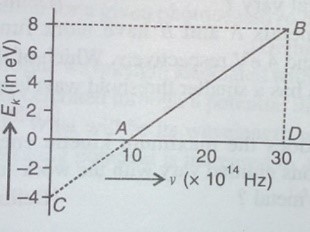
Given below in the graph between frequency of the incident light and maximum kinetic energy of the emitted photoelectron find the value of (I) threshold frequency and (II) work function from the graph.
dual pic-1
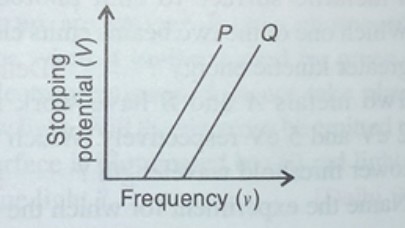
In a photoelectric effect experiment , the graph between the stopping potential V and frequency v of the incident radiation on two different metal plate P and Q in the fig. (I) which of the two metal plates , P and Q has greater value of work function ?(II)what does the slope of the lines depict ?
dual pic-2
Ultraviolet light of wavelength 2271 A from a 100W mercury source is incident on a photocell made of molybdenum metal , if the stopping potential is 1.3 V , estimate the work function of the metal.