Author: Nayan Jha

  • Newton’s second law of motion and Impulse

    Newton’s second law of motion and Impulse

    Newton’s second law of motion and Impulse

    In this topic Newton’s second law of motion and Impulse  , we will explain Newton’s second law of motion , expression for force, Impulse and application of concept of impulse . The reasoning questions of this topic and numericals ( specially based on Impulse) is very important for class examination and also for other competitive examination like JEE/NEET .

    But before to know this topic, it is necessary the students must  have the concept of Newtons first law of motion and inertia .                                                                                                    For  the notes on Newton’s first law and inertia click here- 

    Newtons second law of motion and impulse –

    As we know from Newton’s first law of motion ‘every body remain in its position of rest or of uniform motion in a straight line , till no external force acts on it’ . Just think what will happen when external force acts on the body . This effect of  acting a force on the body is described by Newton’s second law of motion .

    To watch the video on Newton’s second law – click on the link given below-


    Newtons second law of motion ( Force law)-

    Newton’s second law of motion states that , when an external force applied on a body , then rate in change in momentum is directly proportional to the applied force , and change takes place in the direction of applied force . this law is also known as the law of force.

    We have to take care of its two parts (i) rate of change of momentum is directly proportional to the applied force and , (ii) change in momentum occurs in the direction of applied force .

    Expression of force from newtons second law of motion –

    Let a body of mass ‘m’ moving with velocity ‘v’ .

    Then , its linear momentum will be  p = mv ;

    As newton’s second law states  force F α dp/dt   ;  or  F= k dp/dt  ……………..(i)

    But here ,  p=mv .

    So putting this value of p in equation (i) we get

    F=k d(mv)/dt =k m (dv/dt) = k ma; [where dv/dt=a( acceleration) ],

    Experimentally it is found k=1

    So we can say,  F =ma ;

    Unit of force is  kg-m/s2  or kg-ms-2 OR Newton (N)

    Its dimension is  [ M L T-2] ;


    IMPULSE-

    To know the impulse we must know . What is impulsive force?

    Impulsive force – It a large force acts on a body for short time which is the cause of change in momentum . example-  Blow a hammer on a nail, force exerted by a bat when it hits a ball, etc.

    Impulse – When a large force acts on a body for short time which is the cause of change in momentum, then the product of force and time for which it acts on the body is called impulse or Impulse of force which is equal to the change in linear momentum of the body.

    So we can write impulse I = Fav. x  t   = Pf – Pi = Δp

    Proof–   From Newton’s second law we know ;

    Force F = dp /dt  ;

    But momentum P = mv ( m- mass of the body and v is its velocity);

    So we can write  F dt = dp ;

    Integrating both sides with appropriate limits we get ,

    ∫ Fdt =∫dp = p2-p1 

    Or ,  Fav.t = p2-p1  = I

    So we can say if the force varying with time ( or force is the function of time ) then we can write

    Impulse I = ∫F dt .

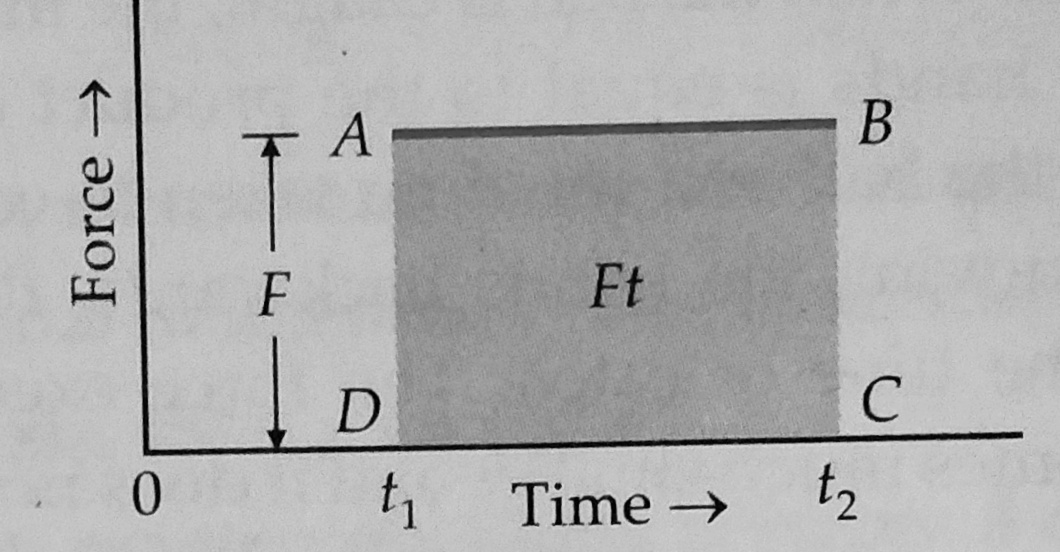
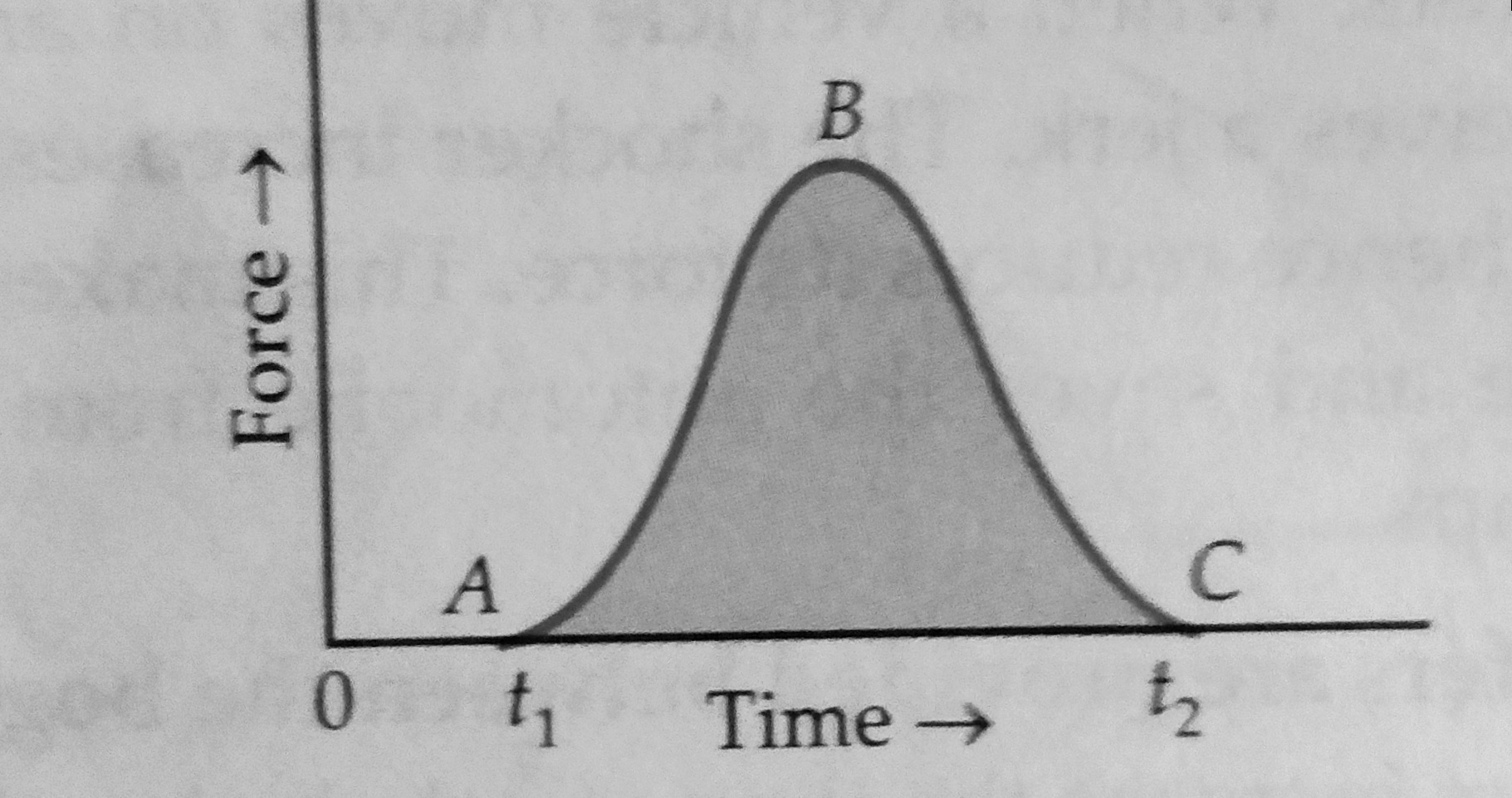
    If we plot the force v/s time curve , then the area under the curve gives the impulse .

    A. When a constant force acts on a body then force v/s time graph is given below . the area under the line AB gives the impulse .
    B. When a variable force acts on a body then force v/s time graph is given below . the area under the line ABC gives the impulse ;
    The unit and dimension of the impulse is same as linear momentum .

    Application of concept of impulse – ( It also work as reasoning questions in your class examinations)

    (a) Automobiles are provided with shockers.

    (b) China wares are packed under straw paper.

    (c) A cricket players lower his hand while catching a ball.

    (d) A person falling from a certain height gets more injuries when he falls on a cemented or tough floor than when he falls from a heap of sand.

    If we goes to the reason of all the points mentioned above then answers of all the questions will be same .

    As we know,  impulse = F x t = change in momentum

    For the same impulse force F = impulse / time . i.e. F α 1/t

    when time of impact increases due to some processes then force acts on the body decreases .

    To watch of the video of this topic click here-

  • Units and measurement

    Units and measurement

    Units and measurement

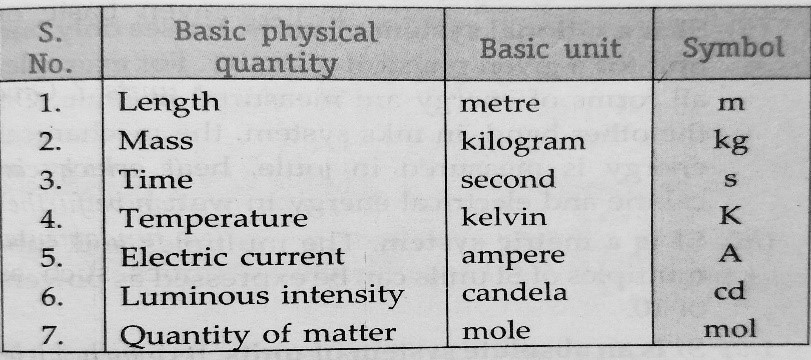
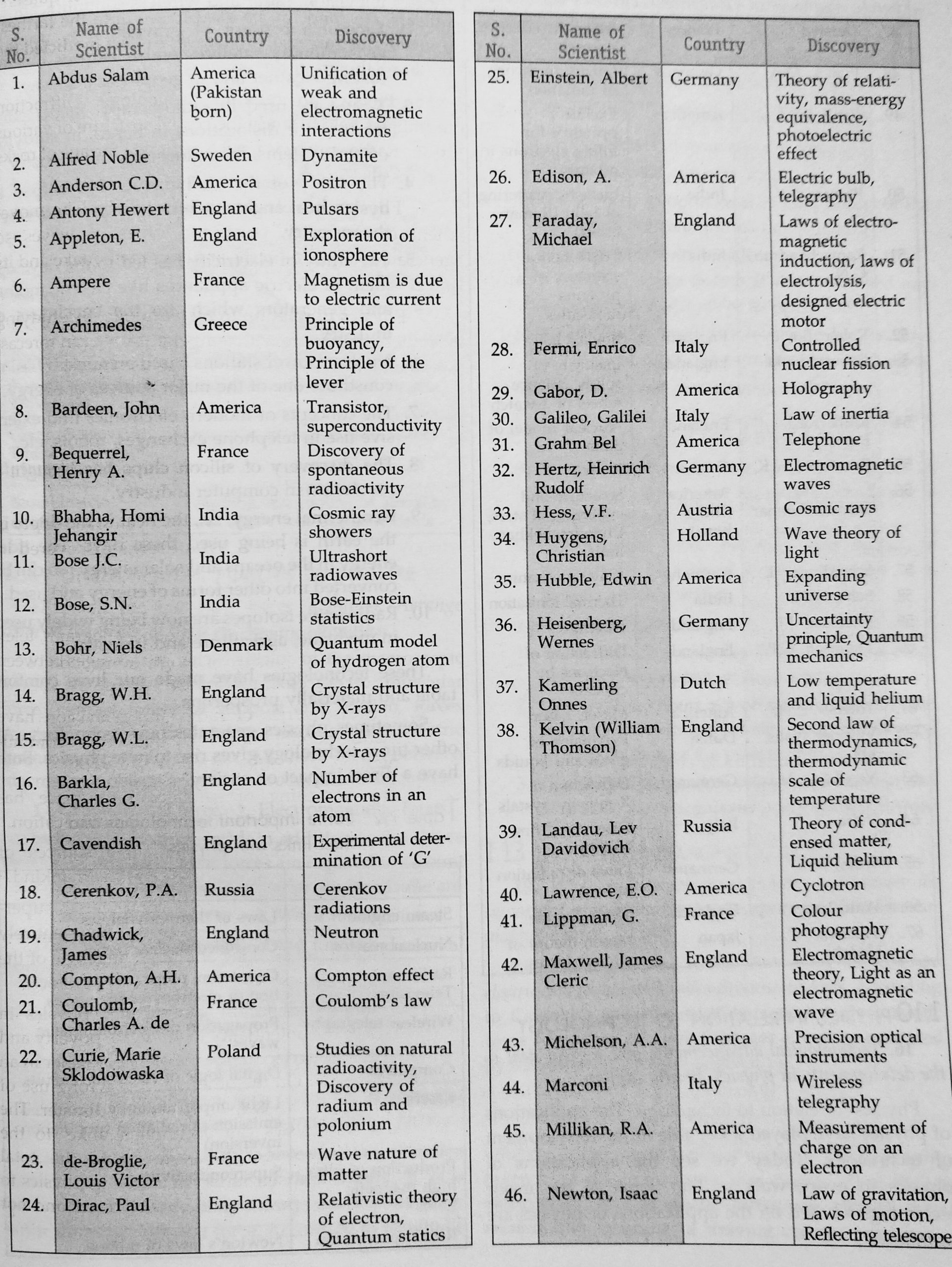
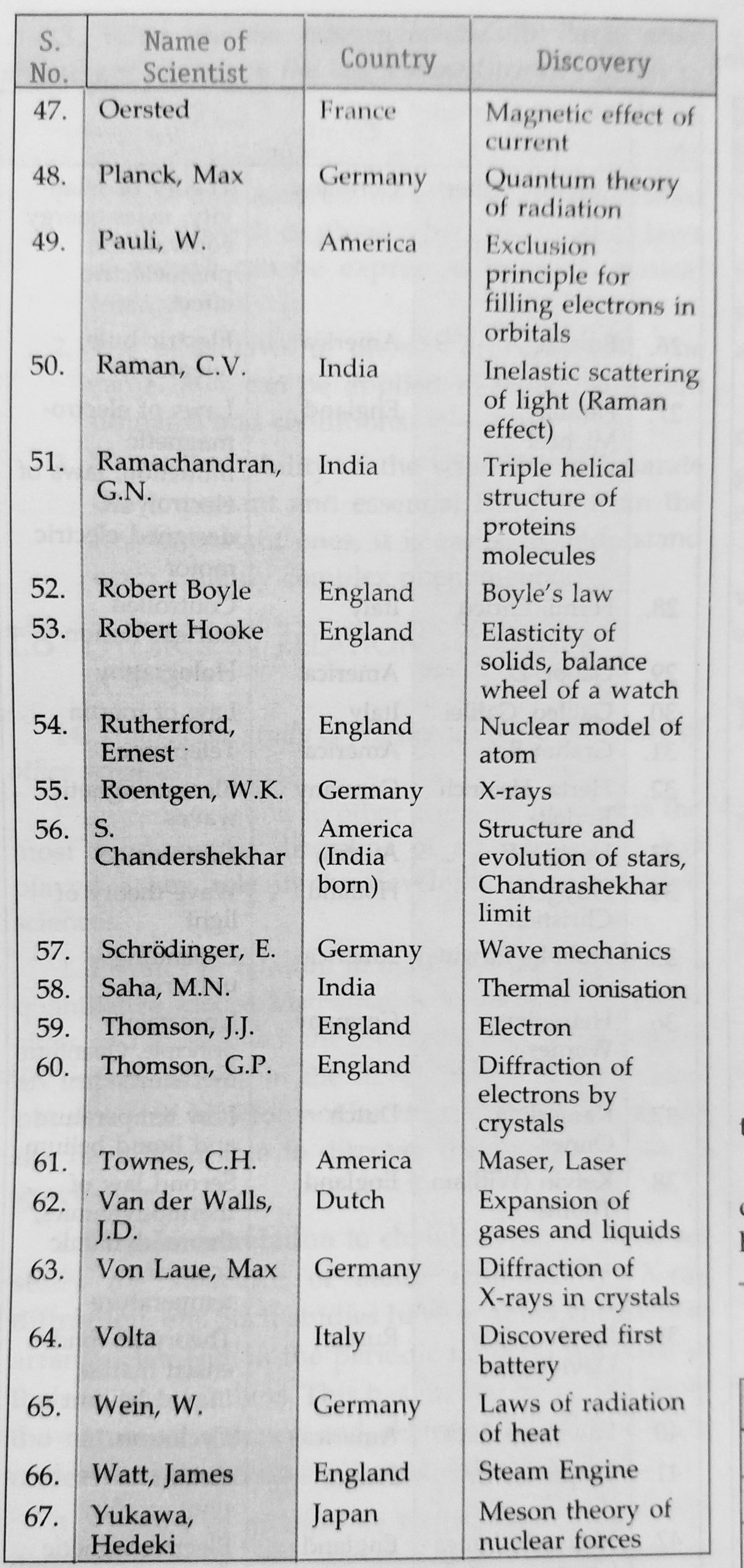
    In this topic we will discuss about, type of units, system of units ,  name and define of all fundamental units . Also the abbreviations in power of tens. one of the important thing given is chart of physicist and their discoveries.

    Units and measurement

    Physical quantity-

    All those quantities which can be measured in terms of which the laws of physics can be expressed are called physical quantity. Example- mass , speed, force , power etc.

    Physical quantities are of two types- fundamental and derived

    1. Fundamental quantities–

    The physical quantities which is independent of other physical quantities and are not usually defined in terms of other physical quantities are called fundamental quantities. These are  , mass, length, time, electric current, temperature ,luminous intensity and amount of substance.

    1. Derived quantities-

    The physical quantities which can obtained using other physical quantities are called derived units. Example – velocity, force , power etc. or we can say all the physical quantities other than seven fundamental quantities are derived units.

    UNITS-

    The standard amount of a physical quantity chosen to measure the physical quantity of the same kind are called physical unit.

    To represent a physical quantity we need numeric value and its units .i.e.

    Physical quantity  Q = n U ( where n represent numeric value and U is the unit) . So we can define unit is the thing used to identify and measure a physical quantity .

    There are two types of unit .Fundamental and derived units .


    Fundamental units–

    The physical unit which neither be derived from one another and it can not be resolved into more simpler units called fundamental units. There are seven fundamental units which are the units of These are  , mass, length, time, electric current, temperature ,luminous intensity and amount of substance .


    Derived units –  All the units can be expressed using fundamental units is called derived units .

    Example unit of speed = distance/time =m/s …etc .


    System of units – A complete set of units which is used to measure all kind of fundamental and derived quantities is called system of units.

    (i) cgs system- It is based on centimetre, gram and second as the fundamental unit of length, mass and time respectively.

    (ii) MKS system – – It is based on metre, kilogram and second as the fundamental unit of length, mass and time respectively.

    (iii) FPS system – – It is based on foot, pound and second as the fundamental unit of length, mass and time respectively.

    (iv)SI ( the international system of units) system .


    Definition of basics units –

    1. Meter (m) – It is the SI unit of length, One meter is defined as the path travelled by light in vacuum in 1/ 299,792,458 seconds ,
    2. kilogram (kg) – It is the SI unit of mass .- It is the mass of prototype cylinder of platinum-iridium alloy .
    3. Second(s)- It is the SI unit of time . On e second is the duration of 9,192,631,770 period of the radiation between two levels of the ground state of the Cesium-133 atom.
    4. Ampere (A) – It is the unit of electric current. It is the force 2 x 10⁻⁷ Newton between two parallel current carrying wire placed 1m away is of unit length . To know more on Ampere click here-
    5. Kelvin (K) – It is the SI unit of temperature. One kelvin is the fraction 1/273 of the thermodynamic temperature of the triple point of water.
    6. Candela(cd)- It is the SI unit of luminous intensity. It is the intensity of a source that emits monochromatic radiation of frequency 540 x 1012 Hz , and that has the radiant intensity 1/683 watt per steradian in that direction.
    7. Mole (mol)- It is the unit of amount of substance . .It is the amount of substance which contain as many elementary entities as there are atom in 0.012 kg of C-12 isotopes.

    Supplementary SI units –

    (a). Radian (rad)-  It is the plane angle subtended at the centre of a circle by an arc equal in length to the radius of the circle . ϴ= arc/radius .

    (b). Steradian (sr)- It is defined as the solid angle subtended at the centre of the sphere by a surface of the sphere equal in area to that of a square , having each side equal to the radius of the sphere . sr= surface area / radius2 .


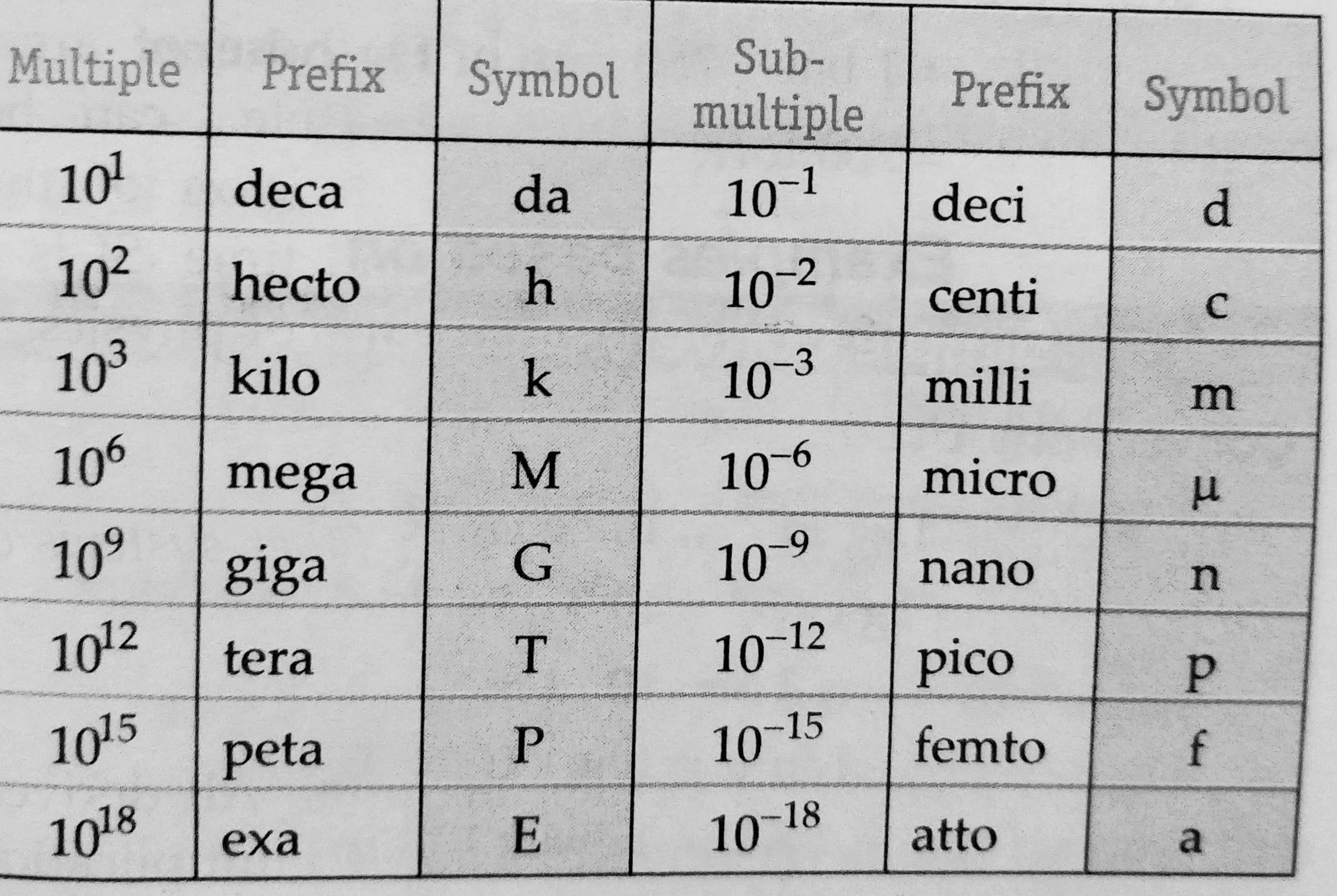
    Some important thing ( multiple , prefix and symbol) in the power of ten.

    Some great physicist and their discoveries ( This topic is important for objective point of view)-

    Next topic after this topic units and measurement students have to learn DIMENSIONS AND USES OF DIMENSIONS


  • Solenoid and Toroid

    Solenoid and Toroid

    Solenoid and Toroid

    Before to know Solenoid and Toroid  , students must know Ampere’s circuital law , proof of Ampere’s circuital law and its application.        To know all these thing click here-

    In this topic we will discuss about  one of the application of Ampere’s circuital law . We will define solenoid and Toroid , we will find the magnetic field due to Solenoid and Toroid .

    Solenoid –

    It is the closely wound coil in the form of helix . its length is very large as compared to its diameter.


    Magnetic field due to a solenoid –

    Let current I is flowing through the coil , each turn of solenoid regarded as a circular loop carrying current which produces a magnetic field . Total magnetic field is vector sum of magnetic field due to current through all the turns in the coil .

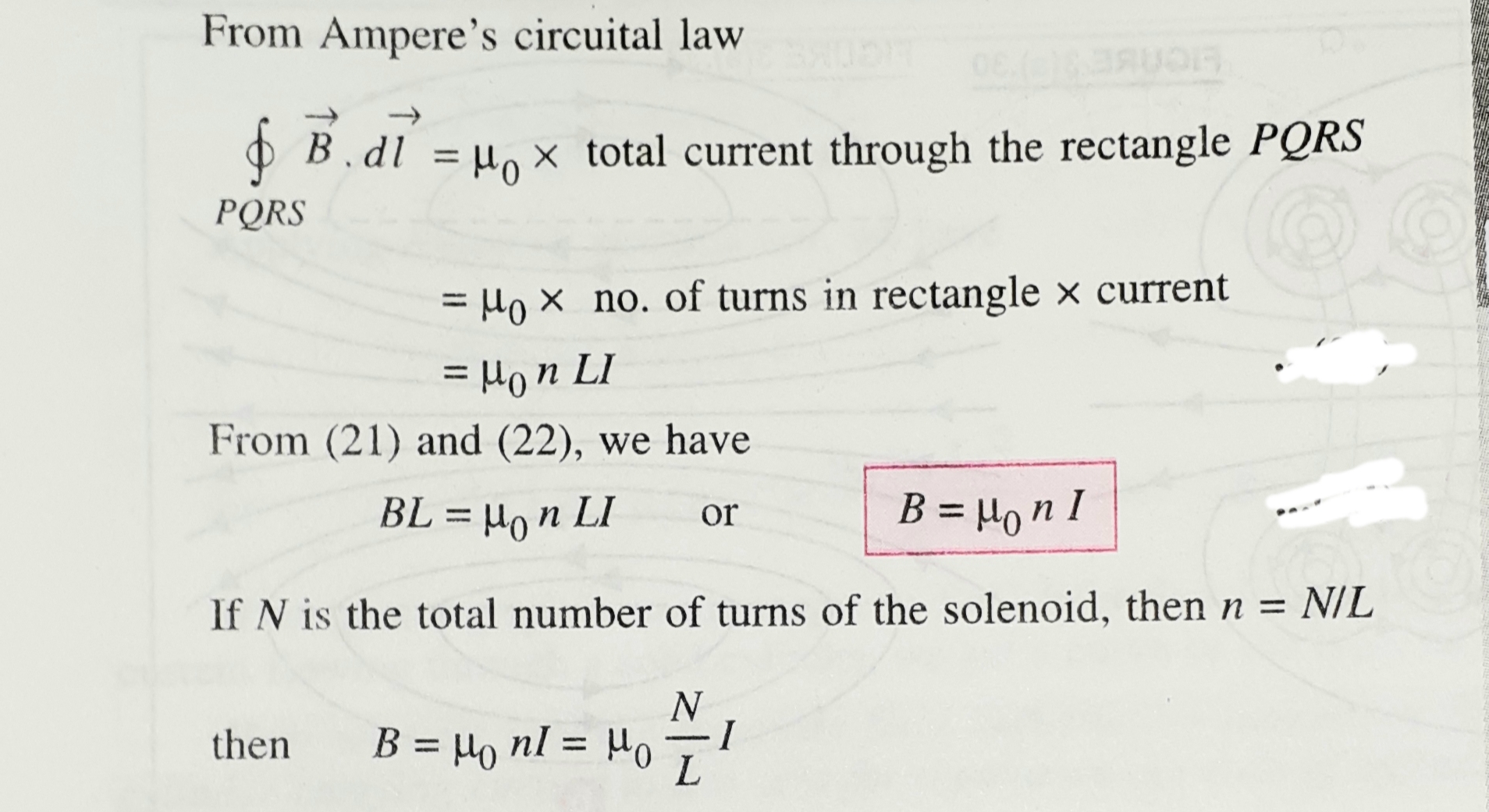
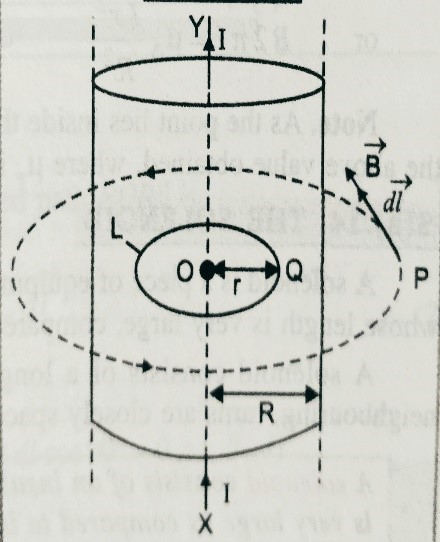
    Let n be the number of turns per unit length of the solenoid . Consider a rectangular loop PQRS  near the middle of the solenoid as shown in figure.

    PQ=L . hence total numbers of turn in length L = nL .

    The line integral of magnetic field over the closed path PQRS is ,

    At a point near the end of the solenoid magnetic field B = μ0nI/2 .

    If the solenoid is filled by material of permeability μ in side then magnetic field B = μnI = μ NI/L.

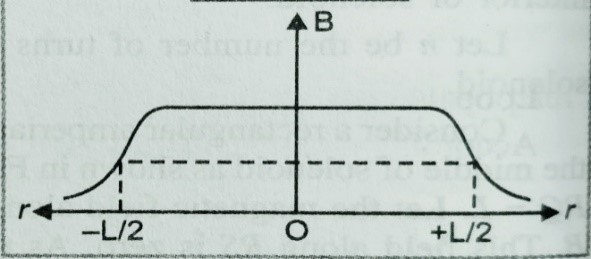
    If we draw a plot magnetic field B vs r (distance) from the centre of the solenoid we get the following curve.


    Toroid –

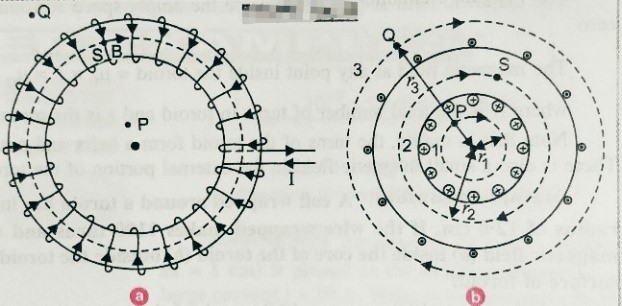
    Toroid is the endless solenoid in the form of ring . or we can define ‘The toroid is the hollow circular ring on which a large number of insulated turns of a metallic wire are closely wound’. As shown in figure below.

    Magnetic field due to current in a toroid–  Let n be the number of turns per unit length of the toroid , I be the current flowing through the toroid . When current passes through the solenoid magnetic field of constant magnitude setup in side the turn of toroid in the form of circular magnetic field . We draw three circle having radii r1,r2 and r3 as shown in fig (b). Let B1 is the magnetic field along loop 1  then using Ampere’s law –

    The magnetic field at any point inside the empty space surrounded by toroid or outside the toroid magnetic field is zero .

  • Ampere’s circuital law

    Ampere’s circuital law

    Ampere’s circuital law

    In this topic we will discuss about Ampere’s circuital law and proof of Ampere’s circuital law ( using Biot- Savart’s law).We will also discuss the  applications of  Ampere’s circuital law (Magnetic field due to infinite long straight wire carrying current,magnetic field due to current through very long circular cylinder or thick wire, solenoid and Toroid)

    Ampere’s circuital law –

    According to this law the line integral of the magnetic field around any closed path in free space is equal to μ0 times the total current passing through the surface enclosed by the closed path .

    – To download the complete notes (pdf) of Ampere’s law and proof of Ampere’s law click here–Ampere.law and its proof

    To watch the video of Ampere’s circuital law click on the link given below-

    Applications of Ampere circuital law –

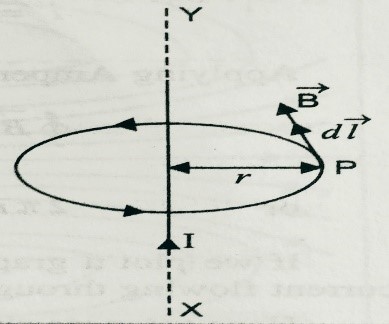
    Application(i) Magnetic field due to infinite long straight wire carrying current – To down load the notes(pdf) on this topic click on the link given here- magnetic field due to long wire

    Application (ii). Magnetic field due to long current carrying cylinder or thick wire. To download the notes(pdf) click here -Magnetic field due to long current carrying cylinder or thick wire

    Application(iii). Solenoid and Toroid-To get the notes on solenoid and toroid click here-


  • Newton’s first law of motion and inertia

    Newton’s first law of motion and inertia

    Newton’s first law of motion and inertia

    In this topic we will discuss about Newton’s first law of motion and inertia .  Force , linear momentum and some example of inertia (all type).

    Newton’s first law of motion  ( law of inertia )-

    Before to know the Newton’s first law of motion and inertia we must know –

    FORCE– Force is a physical quantity which when applied on a body it actually changes or try to change , shape, size and, position of rest or motion.

    INERTIA –  It is the property of a body by virtue of which it can’t change itself its state of rest or uniform motion in a straight line . Or we can say ‘inertia is the resistance of change’. this term inertia is first used by Galileo .

    Different types of inertia –

    1. Inertia of rest – It is the tendency of a body to remain in its position of rest .

    Example- A person standing in a bus fall backward when the bus suddenly start moving forward. Dust is removed from a hanging carpet by beating it with a stick,  etc.

    1. Inertia of motion– It is the tendency of a body to remain in its state of uniform motion in a straight line .

    Example-When a running bus stop suddenly the passengers in the bus fall in forward direction. It is dangerous to jump out from a running bus, etc.

    1. Inertia of direction– It is the property of the body to restrict the change of direction of motion.

    Example- When a bus takes a sharp turn the person sitting in the bus experiences a force acting away from the centre of the curved path .

    Linear momentum (momentum) –  momentum of a body is the quantity of motion possessed by the body . Mathematically it is equal to the product of mass and velocity of the body .

    If ‘m’ is the mass of the body and its velocity is’v’ then it is given momentum P = m v .

    It is a vector quantity .

    Its unit is kg m/s or Ns.

    And its dimension is [M L T-1] .


    Newton’s  first law of motion   – It is also known as law of inertia. According to Newton’s first law of motion ‘every body remain in its position of rest or of uniform motion in a straight line , till no external force acts on it’ .

    This law consist of three parts ;

    (i) firs part say  a body is in rest continues in the states of rest( inertia of rest).

    (ii) second part say that body is in motion continue moves in the same path with same speed (inertia of motion)

    (iii)third part say that if a body moving with wit uniform velocity in a st. line then it cant change its direction of motion it self ( inertia of direction ) .

    From the above three parts given above explain that how Newton’s first law  explain the law of inertia.

    Illustration of Newton’s first law of motion –

    1. Based on inertia of rest-

    (i) When we shake a branch of tree its fruit and dry leaves fall down – It is because when we shake the tree its branches comes in motion but due to inertia of rest fruit or leaves wants to be in rest due to which it separated from the branches of tree and fall down.

    (ii) When a horse suddenly start running then the riders on it fall back -It is because initially the rider and horse are in rest , when horse starts running suddenly the  part of the rider in contact with the horse comes into the motion but upper part of the body due to inertia in rest remain in rest and the rider falls back.

    (iii) A person standing in a bus fall backward when the bus suddenly start moving suddenly forward- -It is because initially the person and bus are in rest , when bus starts moving suddenly the  part of the person in contact with the bus comes into the motion but upper part of the body due to inertia in rest remain in rest and the person falls back.

    (iv) Dust is removed from a hanging carpet by beating it with a stick- it is because when we hit the carpet it comes in motion but due to inertia of rest dust wants to be in rest due to which it separated from the carpet and fall down.

    2.Based on inertia of motion–

    (i) When a running bus stop suddenly the passengers in the bus fall in forward direction.- It is because when the bus is in motion then the passenger on it also is in motion , but when bus stop suddenly then the portion of the passenger is in contact with the bus also comes in rest but due to inertia of motion upper part of the passenger remain in motion and hence passengers fall in forward direction or in the direction of the moving bus .

    (ii) It is dangerous to jump out from a running bus – .- It is because when the bus is in motion then the passenger on it also is in motion , but when the person jumps out then the lower part of the body comes in contact with the ground and it comes in rest but due to inertia of motion upper portion of the body remain in motion and person fall down in the direction of motion of bus and it becomes the cause of accident.

    NEXT TOPIC -Newton’s second law of motion and Impulse.            To get the notes on Newton’s second law of motion and Impulse click here-


  • Magnetic field at a point on the axis of a circular coil carrying current

    Magnetic field at a point on the axis of a circular coil carrying current

    Magnetic field at a point on the axis of a circular coil carrying current

    Before to learn about this topic students must know about Biot-Savart law. To learn about this topic click here-
    In this topic we will discuss about Magnetic field at a point on the axis of a circular coil carrying current , and using its derivation we can find the magnetic field and we will also discuss about magnetic moment due current carrying coil.

    To get the notes on magnetic field at the center of a circular current carrying coil, click here-

    Magnetic field at a point on the axis of a circular coil carrying current –

    Suppose a circular coil of radius ‘a’ with center ‘O’ . Let current I is flowing through the coil we have to find the magnetic field at point ‘P’ , which is x distance away from the center .

    Suppose two small element ‘dl’ of the coil C and D which is diametrically opposite points as shown in figure.

    Here PC =PD = √(a2+x2), and we consider <COP = ɸ = <DPO .

    As shown in figure dBcosɸ is cancelled  by each other , then the net magnetic field dB sinɸ  will be in the same side .

    Here magnetic field due to small current carrying element  dB = (µ0/4Π) I dl sinθ/r2  ; here r=√(a2+x2),

    So we can write  , dB=(µ0/4Π) Idl sinθ/(a2+x2) ,

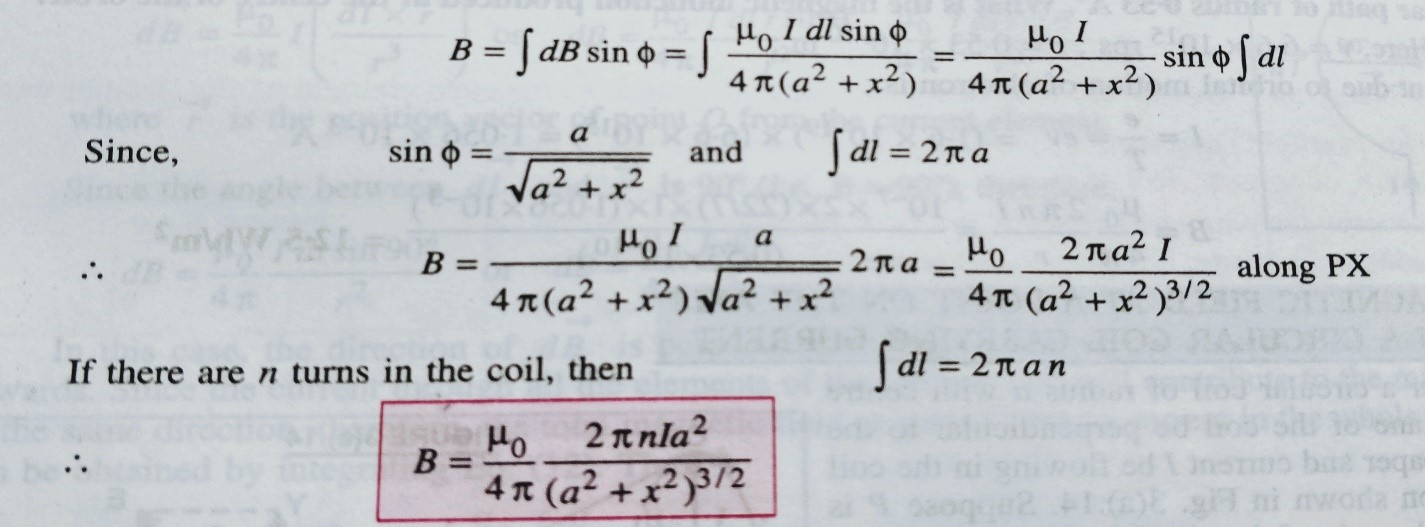
    So magnetic field at point p due to the circular loop


    Special case  1- when point P lies at the center of the circular coil then , x = 0

    Then B= (µ0/4Π)  2∏nI/a = µ0nI/2a ,

    Case 2 – When point P is far away from the center then a2+x2=x2

    Then B= (µ0/4Π)  2nIA/x3 [ since ∏a2 = A (area)]

    Here nIA= M (magnetic moment)

    So we can write , B= (µ0/4Π)  2M/x3

    So we can define the magnetic moment due to current carrying coil is given as the product of ampere turns and area of current loop . SI unit of magnetic moment is A-m2 .

    To watch the video related to this topic, Magnetic field at a point on the axis of a circular coil carrying current ( By Nayan jha sir) go to the link given below-


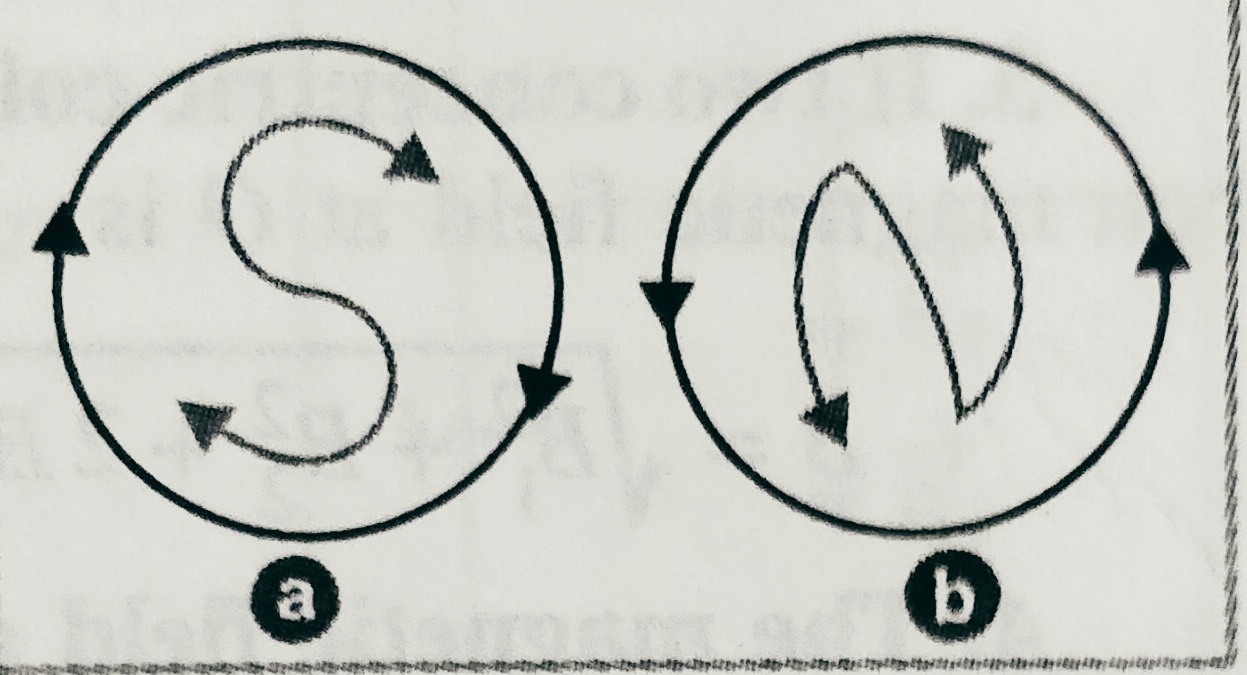
    The polarity of magnetic dipole due to the current loop is decided as , if the current from one side is clock wise direction it gives south pole and on another face direction of current is anti-clock wise it gives  north pole , as shown in figure-

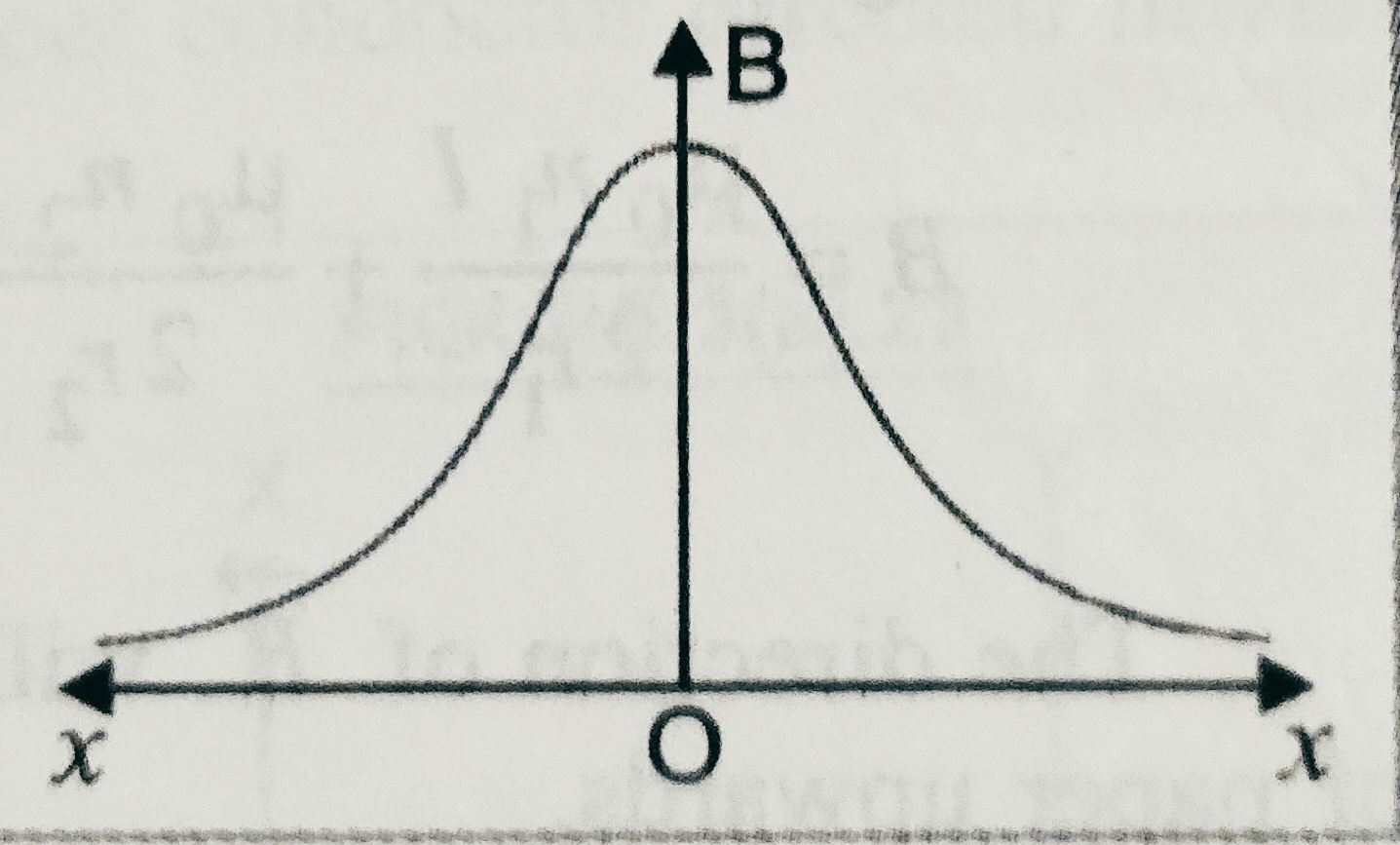
    Case 3- The variation of magnetic field induction with distance of a point on the axis of coil carrying current is given as –

    class 12th physics syllabus removed . How it is beneficial for the students , see the video given below-

  • Magnetic field at the center of a circular current carrying coil

    Magnetic field at the center of a circular current carrying coil

    Magnetic field at the center of a circular current carrying coil

    Before to know about this topic students must know Biot-Savart’s law.

    To get the notes on Biot-Savart’s law click here-

    Magnetic field at the center of a circular current carrying coil is the one of the application of Biot-Savart’s law . here we will derive the expression for Magnetic field at the center of a circular current carrying coil .

    syllabus class 12th physics (2020-2021)

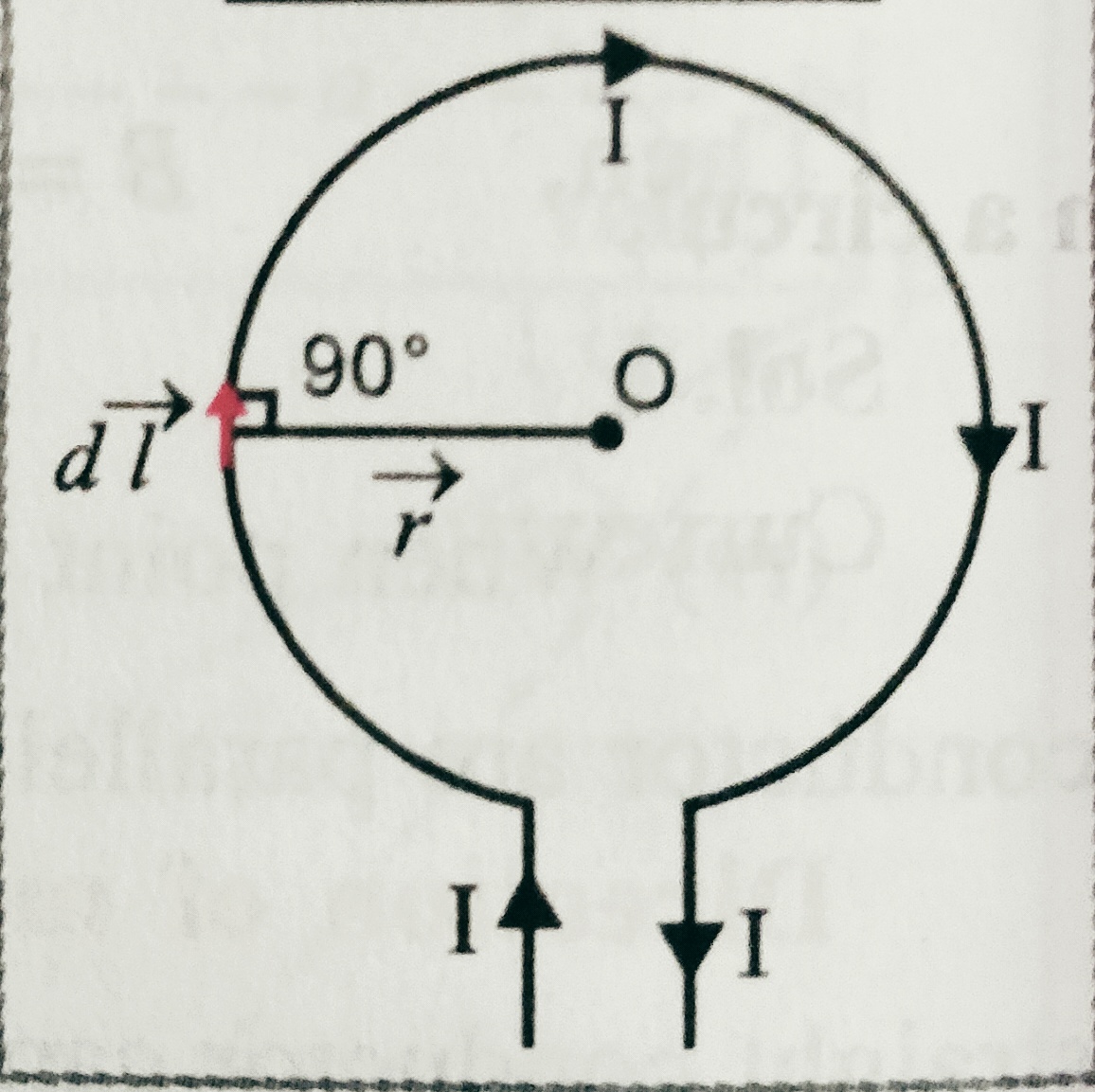
    Magnetic field at the center of a circular  current carrying coil – Consider a circular coil of radius ‘r’ having center ‘O’. suppose I be the current flowing through the coil , and we have to find the magnetic field at the center .

    Suppose a small element ‘dl’ which is the part of coil create a magnetic field dB at the center.

    According to Biot-savart’s law dB = (µ0/4Π) I dl sinθ/r2 . but ϴ=900,

    So we can write dB = (µ0/4Π) I dl sin900/r2 = dB = (µ0/4Π) I dl /r2 .

    Then magnetic field at the center due to complete coil

    B=∫ (µ0/4Π) I dl sinθ/r2 ( Taking limit 0 to 2∏)

    We get B= dB = (µ0/4Π) I 2∏r/r2  =  µ0 I /2r

    For an arc which is making angle ϴ at the center will be given as

    B= (µ0 I /4∏r)(Angle at the center )

    Or , B= (µ0 Iϴ /4∏r) ;

    The direction of magnetic field due to current carrying coil may be give by right hand rule , according to it if curled finger shows the direction of current then stretched thumb gives the direction of magnetic field .

    To watch the video of related topic click here-
    For next topic  magnetic field at a point on the axis of a circular current carrying coil . click here-

  • Force on a moving charge in a Magnetic field

    Force on a moving charge in a Magnetic field

    Force on a moving charge in a Magnetic field 

    In this topic Force on a moving charge in a Magnetic field , define the magnetic field and units and dimension of magnetic field .We will also know about Fleming’s left hand rule.

    Before to know about this topic Force on a moving charge in a Magnetic field we must learn about Oersted’s experiment and Ampere’s swimming rule. To know about this topic click here – 

    Force on a moving charge in a Magnetic field –

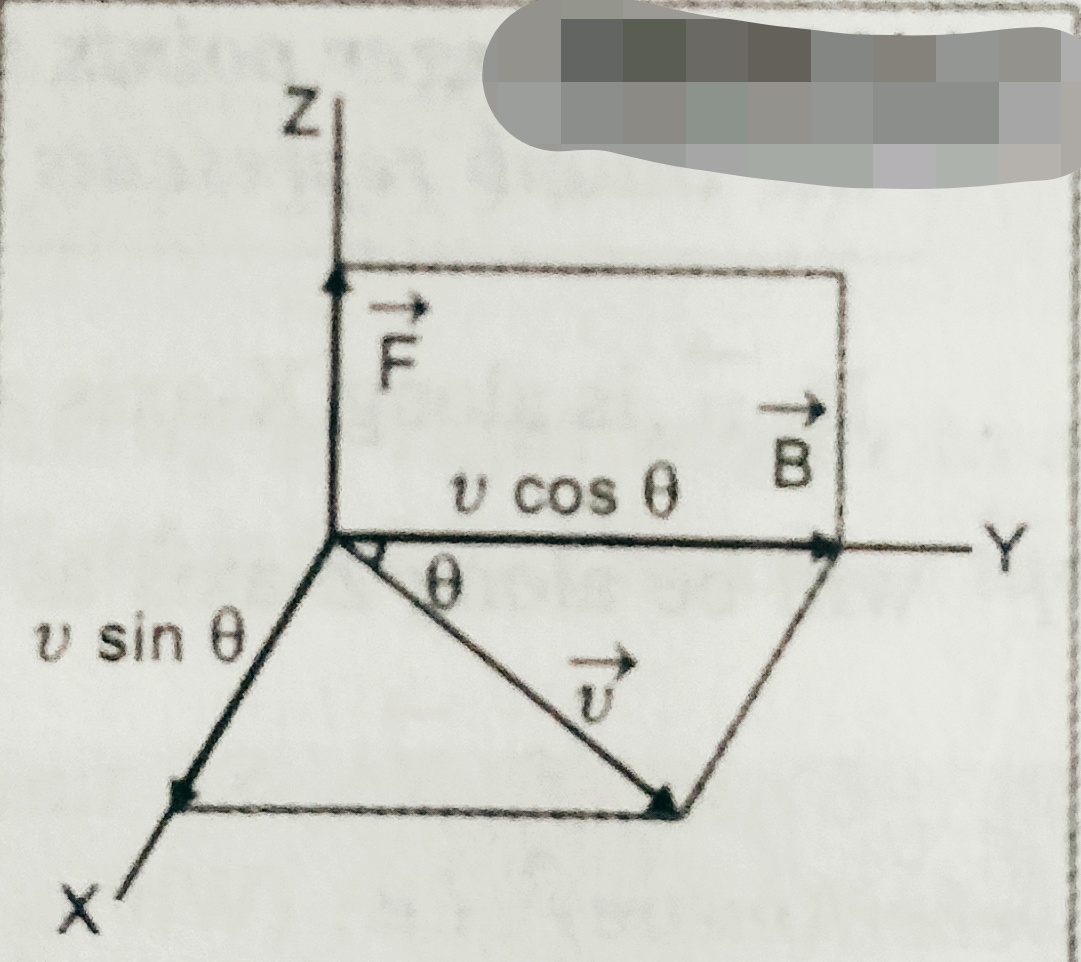
    Suppose a positive charge ‘q’ is moving with velocity ‘v’ at an angle ‘ϴ’ with magnetic field ‘B’. Then experimentally it is found that   force ‘F’ experienced depends on

    F α q ………(i)

    F α B……………….(ii)

    F α v sinϴ …………(iii)

    On combining these three equations we get ,

    F α q B v sinϴ

    Or, F =k q B v sinϴ ; where k is constant of proportionality k=1

    Then we can write F = q B v sinϴ or, F = q( x  )

    Here the direction of force is given by Fleming’s left hand rule or right hand screw rule .

    Fleming’s left hand rule –

     According to this rule when we stretch our left hand’s fore finger, middle finger and thumb such that they are perpendicular to each other , if fore finger shows the direction of field, middle finger shows the direction of current( +ve charge) then thumbs gives the direction of force .

     Definition of B (magnetic field intensity) –  

    As we have seen in the equation F = q B v sinϴ ;

    If  q= 1C , v=1m/s ϴ=900 i.e. sinϴ = 1 then   B= F ;

    So we can define magnetic field intensity at a point is equal to the force experienced by a unit charge moving with a unit velocity perpendicular to the direction of magnetic field at that point .

    Unit of  magnetic field ‘B’ –

    From the equation F = q B v sinϴ ,

    B = F/qv sinϴ ; then unit of B is NA-1m-1 = Tesla  (T) ,

    And dimension of B is [M A-1 T-2]


  • Magnetic effect of current,Oersted experiment and Amperes swimming rule

    Magnetic effect of current,Oersted experiment and Amperes swimming rule

    Magnetic effect of current, Oersted experiment and Amperes swimming rule –

    In this topic we will discuss about magnetic effect of current,Oersted experiment and Ampere’s swimming rule.

    Magnetic effect of current–

    When electric current passes through a conductor (conducting wire) then magnetic field developed around the conductor.

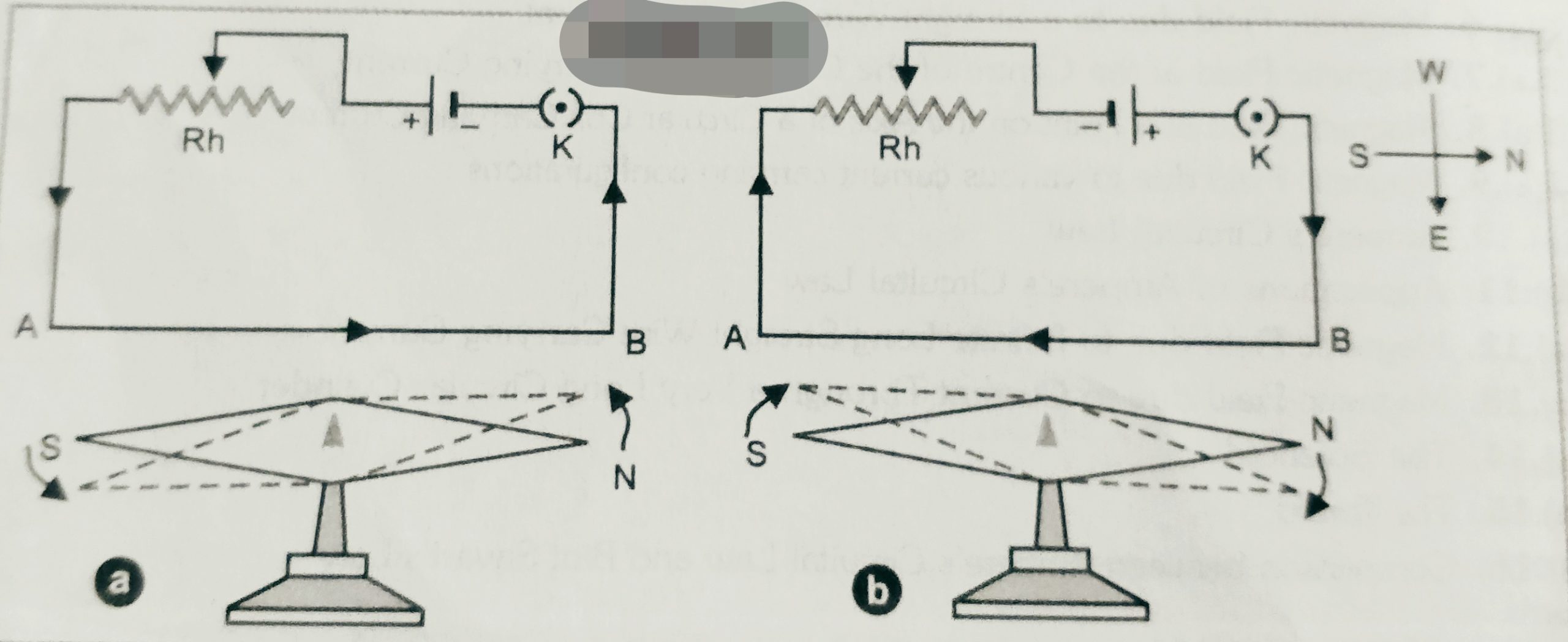
    The intimate relationship between electricity and magnetism was discovered 200 years ago , Oersted discovered in the year 1820 that a straight wire carrying current cause a deflection in a nearby magnetic compass needle.


    Oersted’s experiment and Ampere’s swimming rule-

    According to Oersted’s experiment , we take a needle NS which is free to rotate . We place the needle above a current carrying wire AB . If current flows through the wire in the direction A to B   and from B to A then deflection in the needle shown in the figure . Since magnetic needle can deflect only in the interaction of the another magnetic field . so it is confirmed that due to flow of current in a conductor magnetic field setup across around the wire.

    The direction of deflection in the magnetic needle due to current in the wire is given by Ampere swimming rule . According to this rule ‘ If a man swimming along the wire in the direction of current with his face turned always towards the needle , so that the current  enters through his feet and leaves in his had , then north pole of the magnetic needle will be deflected towards his left hand’ .


  • Circular motion

    Circular motion

    Circular motion

    In this topic we will discuss about what is circular motion, angular displacement,angular velocity, angular acceleration, relation between angular velocity- linear velocity ,and angular acceleration-linear acceleration . Also we will discuss about centripetal acceleration.

      Circular motion-

    When during the motion body moves on a circular path then the such kind of motion of the body is called circular motion .

    Some important topics of circular motion:-

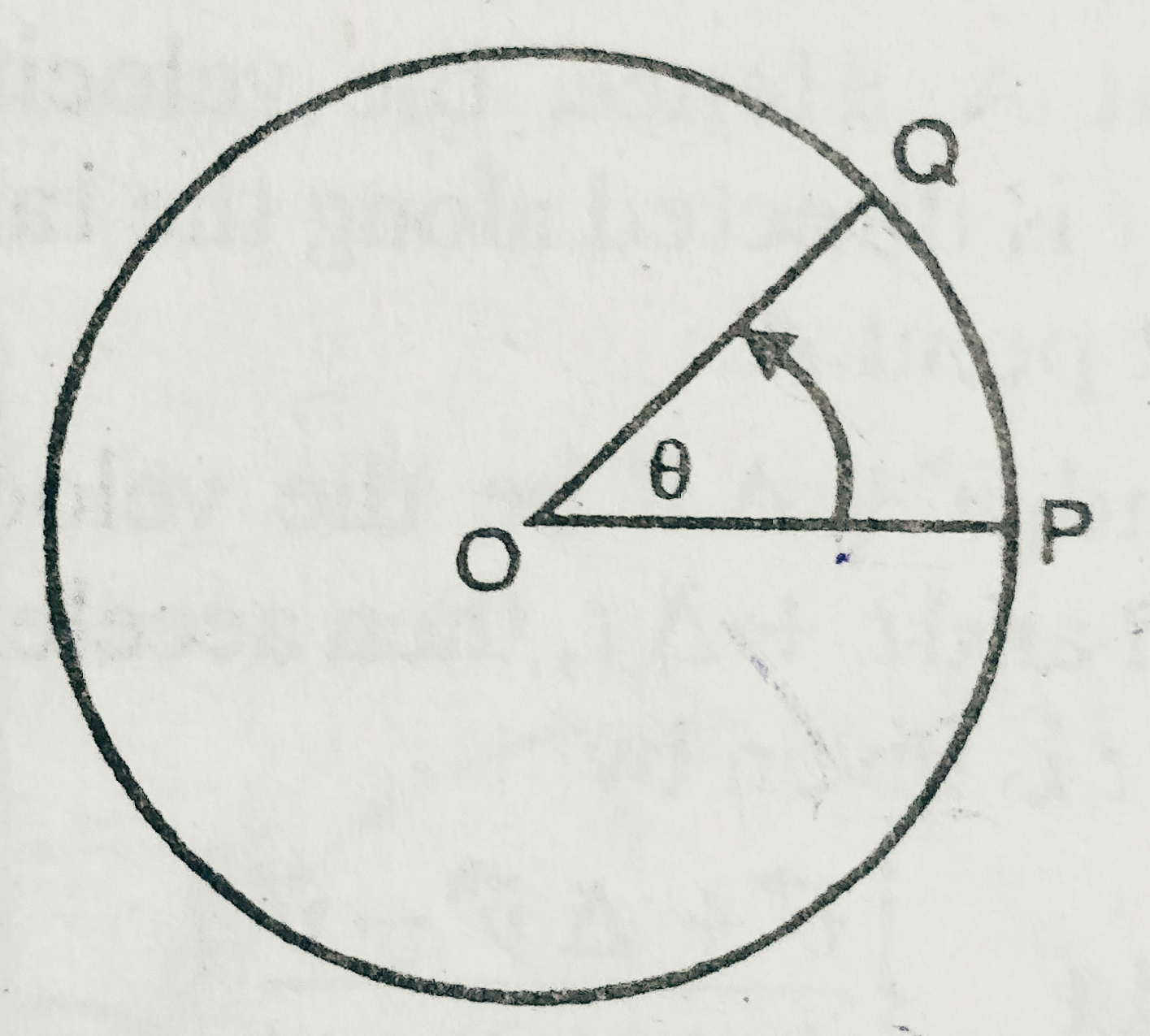
    1. Angular displacement –  When a body moves on a circular path then the angle traced out by the radius vector at the axis of the circular path in a given time is called angular displacement .

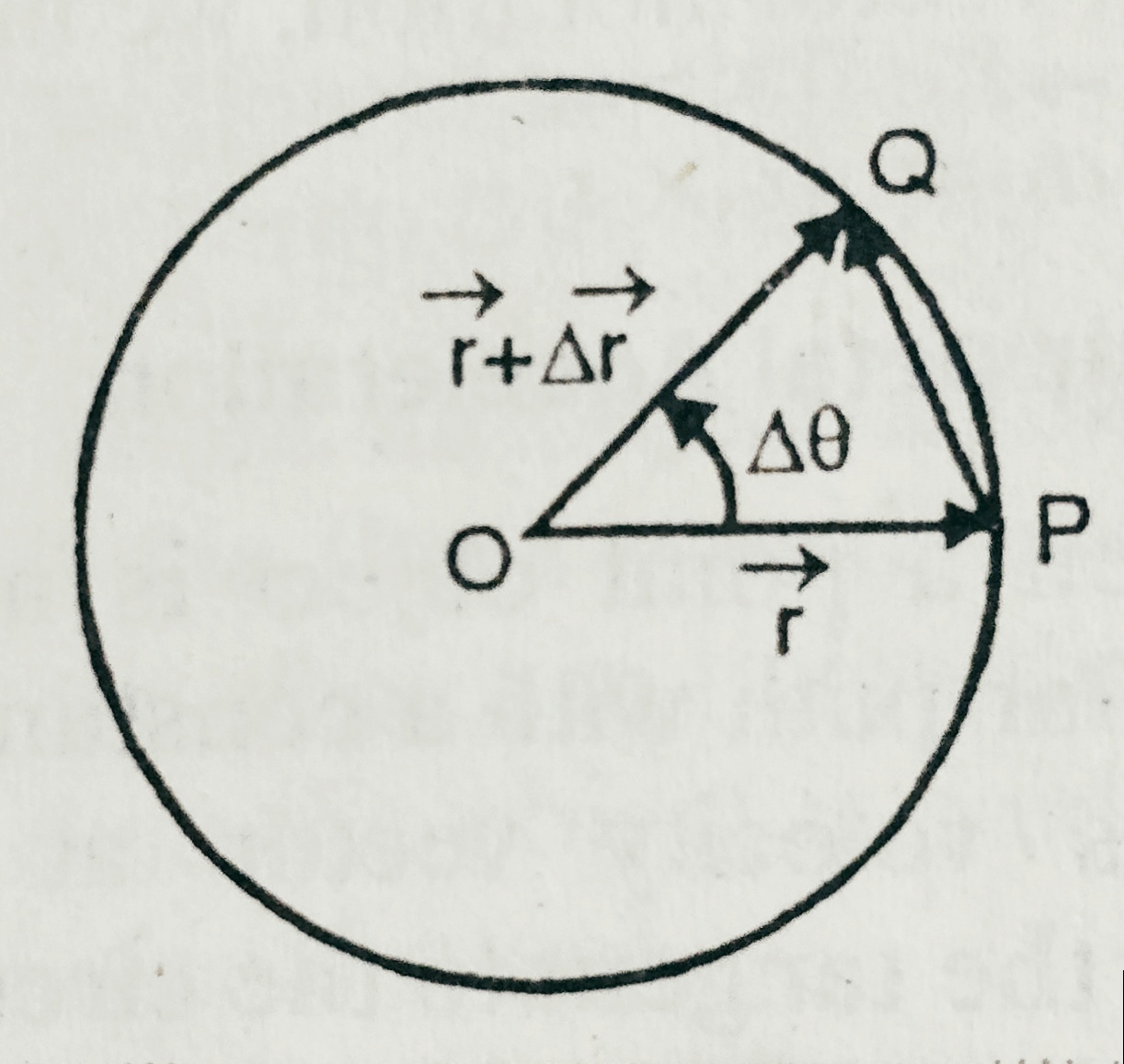
    Suppose a body is moving on a circular path of radius ‘r’ , in anticlockwise direction in the plane of paper , with center ‘O’ . let the position of the object changes from P to Q in time t . let <POQ = ϴ  , as shown in figure .

    Since,  angle = arc/radius

    So we can write   ϴ=PQ/r .

    Angular displacement is a vector quantity . Its unit is radian and it has no dimension.

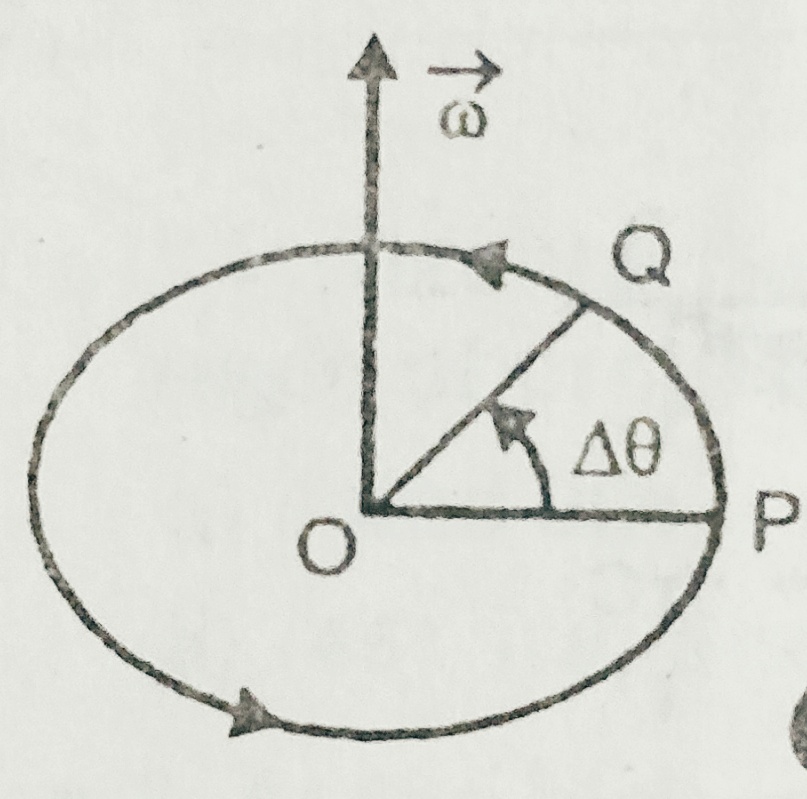
    1. Angular velocity – When a body moves on a circular path then angular velocity is defined as the rate of change of its angular displacement . it is denoted by ‘ω’ (omega) .

    Its unit is radian/second , and its dimension is [M0L0T-1]. It is a vector quantity.

    Suppose a point object moving along a circular path of radius r and centre O . let object moves from P to Q in time dt . and <POQ = dϴ .

    Then angular velocity  ω= dϴ/dt .

    Relation between linear velocity and angular velocity –

    Suppose an object is moving with uniform angular velocity ω and linear velocity v  on a circular path of radius r with centre O .


    Object is at P at time t and after time Δt it reaches at Q . <AOP=Δϴ The length of PQ=Δl

    Therefore v= Δl/Δt   or, Δl=vΔt

    But , angular velocity ω=Δϴ/Δt  or, Δϴ=ωΔt ,

    As we know angle = arc/redius

    So, Δϴ=Δl/r  or ωΔt=vΔt/r or  v=ωr ;


    Angular acceleration –

     In a circular motion angular acceleration is defined as the time rate of change of its angular velocity .

    it is denoted by α . Its unit is rad. S-2 . And its dimension is [M0 L0 T-2].

    Relation between linear velocity and angular acceleration – as we know v=ωr

    So  angular acceleration α= dω/dt =d(v/r)/dt = dv/rdt= a/r ( a= angular acceleration a= dv/dt)

    So , a= αr ;

    Centripetal acceleration –

    In a uniform circular motion , the velocity vector of the object is changing with time . it indicates that the uniform circular motion is the example of circular motion.

    Acceleration acting on the object undergoing uniform circular motion is called centripetal acceleration . It always acts along the radius and towards the center.

    Suppose a particle of mass m moving with a constant speed v and uniform angular velocity ω around a circular path of radius r .

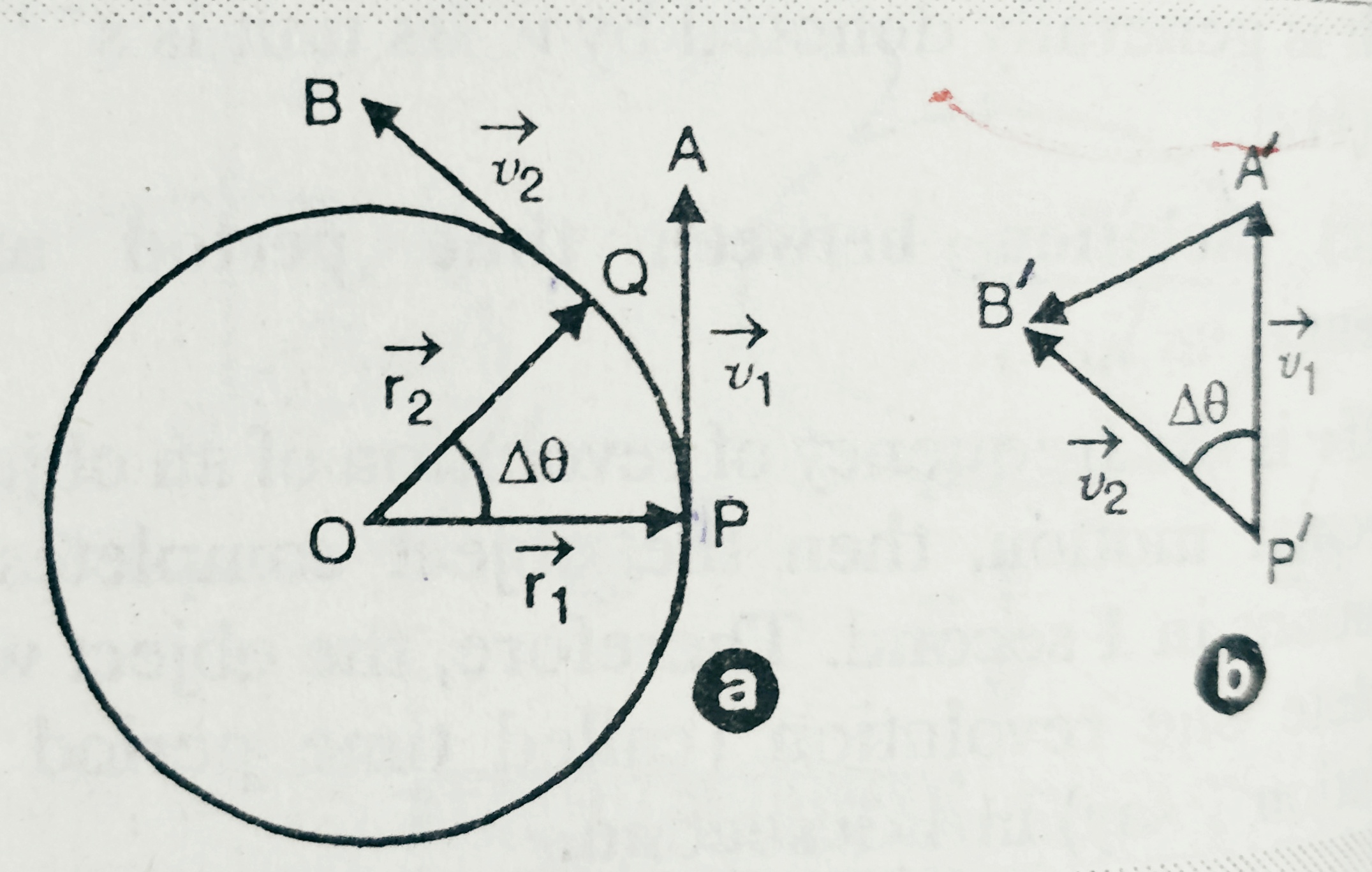
    Let at time t the point is at p and after time Δt it reaches at Q .

    Here OP=r1 and OQ = r2 and , <POQ = Δϴ

    Here, angular velocity  ω=Δϴ/Δt ;

    Let v1 and v2 are the velocity at position P and Q respectively . as shown in figure (a) .

    Here magnitude of PA and QB are equal which is equal to v.

    To find the change in velocity in time interval Δt . we draw p’A’ and P’B’ respectively the velocity vector v1 and v2 as shown in above  figure (b) .

    Here A’B’ = Δv ,

    From figure (b)

    Δϴ=A’B’/P’A’ = Δv/v

    ω Δt= Δv/v ;

    ω v = Δv/Δt ;

    (v/r)v = ac

    ac = v2/r =ω2r