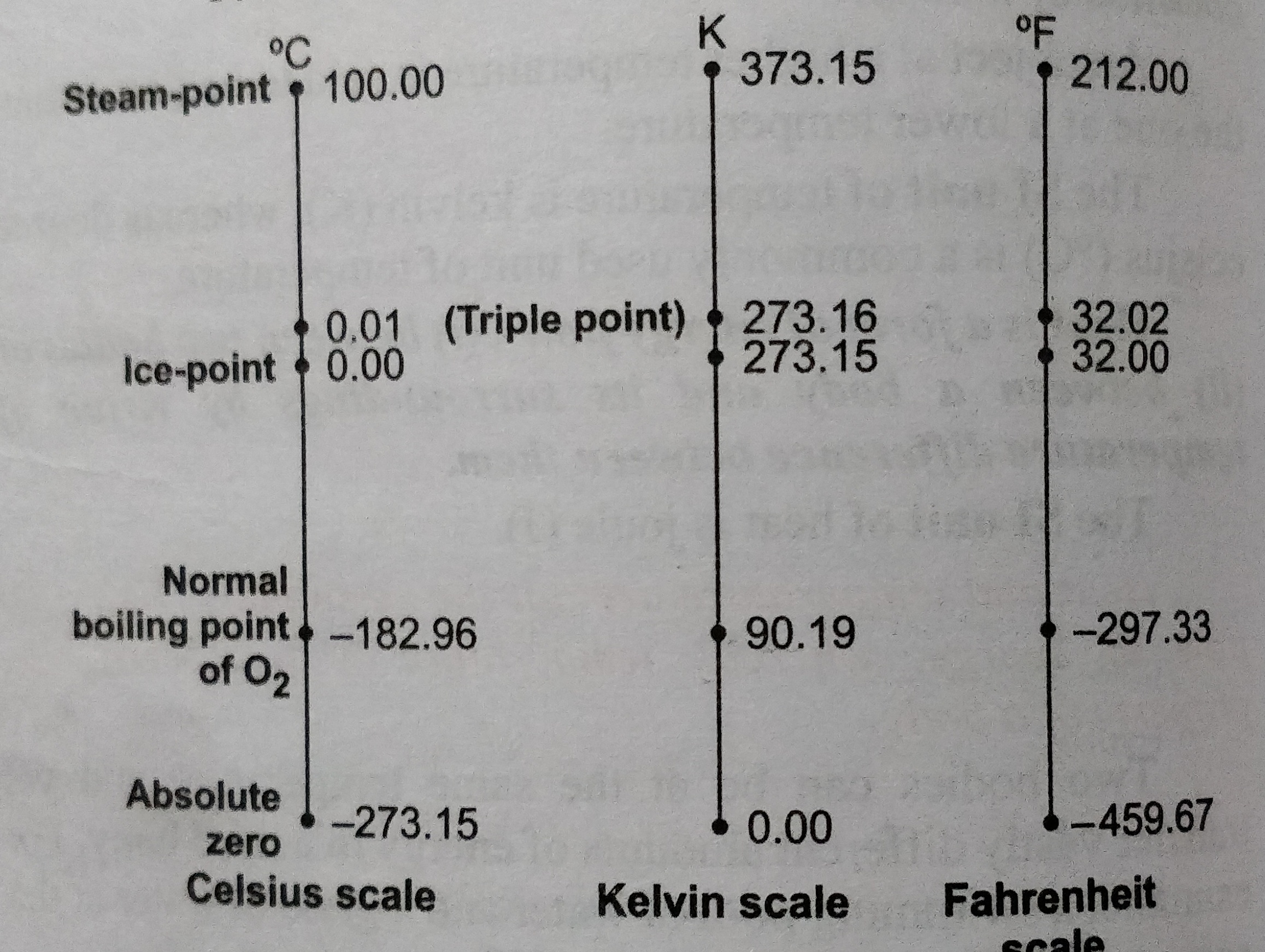
Temperature is a relative measure of hotness or coldness of a body. An object at a higher temperature is said to be hotter than the one at a lower temperature. The S.I. unit of temperature is Kelvin(K).
(We must keep it in our mind that , Heat and temperature are not the same thing , heat is the flow of energy , whereas temperature is a microscopic property of body.)
Important numericals on Thermal properties of matter.
A- Numericals based on temperature and( temperature scale)
1. An object has a temperature of 500F. What is the temperature in degrees Celsius and in Kelvin?
[Ans- 100C, 283.15K]
2. A pan of water is heated from 250C to 800C. What is the change in the temperature in Kelvin scale and on the Fahrenheit scale? [Ans- 55K,990F]
3. A faulty thermometers reads 50C in melting ice and 990C in steam .Find the correct temperature in 0F when this faulty thermometer reads 520C. [Ans-1220F]
4. At what temperature is the Fahrenheit scale reading equal to half that on the Celsius scale? [Ans-0.6670F]
5. At what temperature the reading on both Celsius and Fahrenheit scale remain the same? [Ans—400C]
6. The triple points of neon and carbon dioxide are 24.57K and 216.55K respectively. Express temperatures on the Celsius and Fahrenheit scale. [Ans—248.580C, -56.60C, -415.440F,-69.880F].
This assignment contains Important numericals of surface tension which is solved . solution is given just below the questions.
1.The surface tension of the soap solution is 30 x 10-3N/m .How much work is done to increase the radius of the soap bubble from 1.5 cm to 3 cm . Ans- 5.091 x 10⁻⁴ j.
solution-
2. A square glass plate of length 10cm and thickness 0.4cm, weighs 40 g in air . It is held vertically such that its lower edge rests on water surface. What is the apparent weight of glass plate now? (S.T. of water is 0.073 N/m). Ans-0.407N.
3. The radii of two air bubbles are in the ratio 4:5 .Find the ratio of excess pressure inside them . Also compare the works done in Blowing these bubbles. Ans-5/4 ; 16/25 .
.
4. A circular plate of radius 4cm and weight W is made to rest on the surface of water if a minimum pull of W+F is required to clear the plate off the water surface then find F , given surface tension of water is 0.072N/M. Ans-0.018N .
5. Water rises up in a glass capillary upto a height of 10cm , while mercury falls down by 3.5 cm in the same tube. If the angle of contact for water – glass and mercury-glass are is taken as 00 and 1350 respectively . compare the surface tension of water and mercury. [ density of water and mercury are 103 and 13.6×10³kg/m3.].
6. A canister has a small hole at its bottom .What penetrates into the canister when its base is at a depth of 40cm from the surface of water. If surface tension of water is 73.5 dyne/cm, find the radius of the hole . Ans- 0.0375mm.
To get the Important objective questions based on this topic click here–
This assignment contains some important questions based on the surface tension, in which there are some objective and some numericals based questions.
these questions are for the practice of the topic surface tension and surface energy, excess pressure inside the liquid drop, soap bubble , ascent formula etc.
Multiple choice questions. (Only one option is correct)
1. The angle of contact doesn’t depend upon, (a) Temperature (b)Surface impurity (c) Cohesive force (d) The inclination of surface in contact. Ans -d
2. When a capillary tube is immersed in a liquid , then the liquid of mass m rises in the capillary tube .If capillary tube of double radius is taken then the mass f same liquid rising in the tube is , , (a) M/2 (b) 2M (c) M/4 (d) 4M . Ans- b
3. What will be the work done to increasing the radius of the soap bubble from r/2 to 2r . If surface tension of soap solution is T ? , (a) 3πr2T (b) 30πr2T (c) 9πr2T (d) 12πr2T . Ans-b
4. pressure inside soap bubble are 1.02 atm and 1.05 atm respectively . then the ratio of their surface area is (a) 125/8 (b) 25/4 (c)5/2 (d)2/5. Ans-b
Dou you want to know the harmful effect of Online classes click here–
5.The property utilized in the manufacture of lead shots is (a)specific gravity of lead (b)specific weight of the liquid lead (c) compressibility of the liquid lead (d) surface tension of the liquid lead. Ans-d
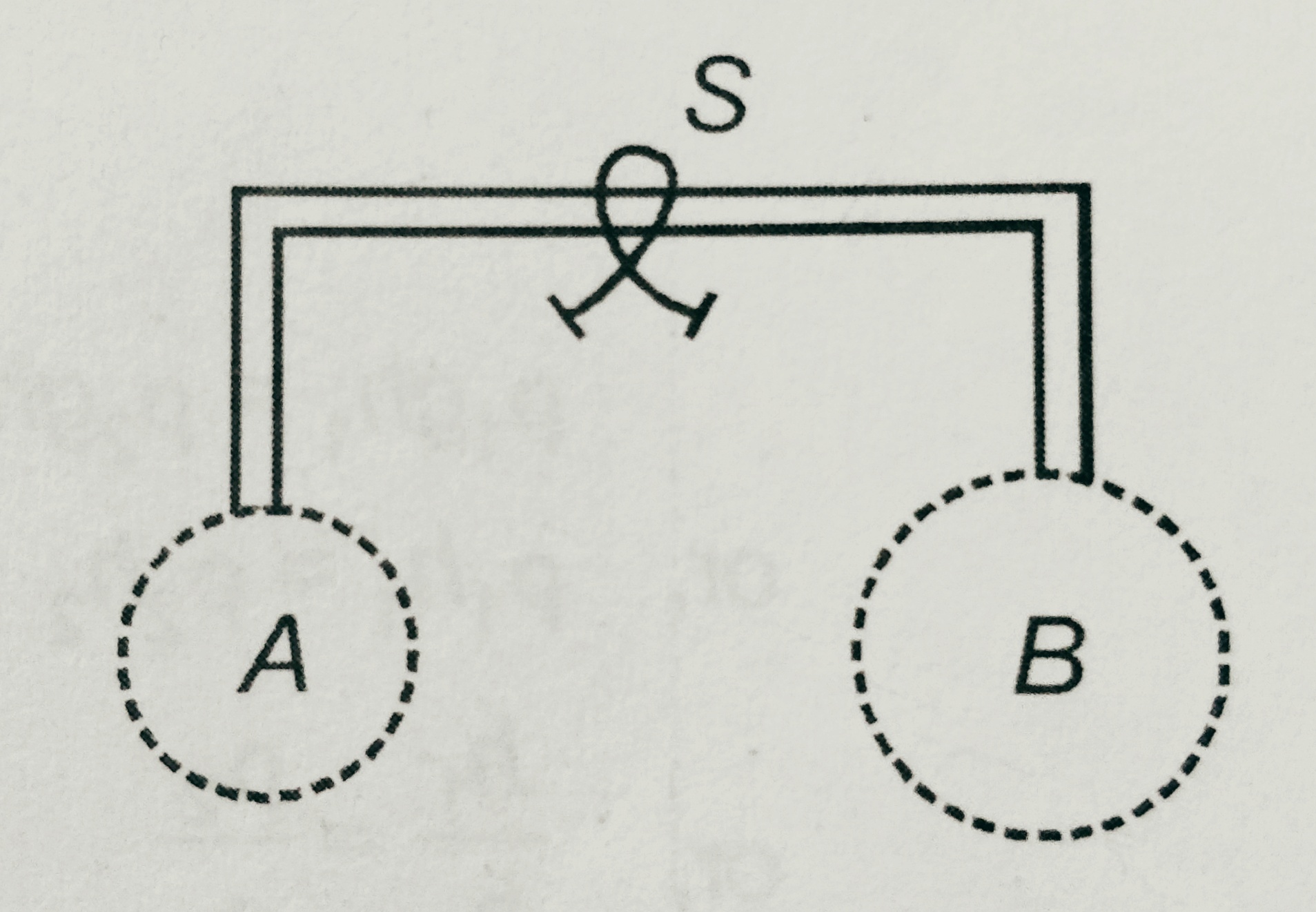
6. Two soap bubbles are connected by a tube as shown in figure , what happens when stopper s is removed ?
(a)size of A increase (b) size of B is decreased (c) both takes the same size (d) size of bubble A decreases and size of bubble B increases. Ans-d
7. Two soap bubble of radii 2cm and 4 cm are join to form a double bubble in air , then the radius of curvature of the interface is , (a)2√5 cm (b)2cm (c)4 cm (d) 2√3cm . Ans-c
8. A square wire frame of side l is floating on the surface of the liquid of surface tension T . The force required to pull out the frame from the liquid is (a) Tl (b) 2Tl (c) 4Tl (d) 8Tl . Ans-d
9. Two drops of liquid coalesce to form a single drop . In this process energy is (a) Absorbed (b) Evolved (c) Either absorbed or evolved (d) Neither absorbed nor evolved. Ans-b
10. Surface tension of a liquid , at critical temperature is (a)Maximum (b)Unchanged (c) Zero (d) none of these. Ans-c
Important numericals based on this topic –
TO WATCH THE VERY IMPORTANT TOPIC OF SURFACE TENSION WHICH IS EXCESS PRESUURE INSIDE THE SOAP BUBBLE AND LIQUD DROP CLICK ON THE VIDEO LINK GIVEN BELOW-
1.The surface tension of the soap solution is 30 x 10-3N/m .How much work is done to increase the radius of the soap bubble from 1.5 cm to 3 cm . Ans- 5.091 x 10⁻⁴ j.
2. A square glass plate of length 10cm and thickness 0.4cm, weighs 40 g in air . It is held vertically such that its lower edge rests on water surface. What is the apparent weight of glass plate now? (S.T. of water is 0.073 N/m). Ans-0.407N.
3. The radii of two air bubbles are in the ratio 4:5 .Find the ratio of excess pressure inside them . Also compare the works done in Blowing these bubbles. Ans-5/4 ; 16/25 . .
4. A circular plate of radius 4cm and weight W is made to rest on the surface of water if a minimum pull of W+F is required to clear the plate off the water surface then find F , given surface tension of water is 0.072N/M. Ans-0.018N .
5. Water rises up in a glass capillary upto a height of 10cm , while mercury falls down by 3.5 cm in the same tube. If the angle of contact for water – glass and mercury-glass are is taken as 00 and 1350 respectively . compare the surface tension of water and mercury. [ density of water and mercury are 103 and 13.6×10³kg/m3.].
6. A canister has a small hole at its bottom .What penetrates into the canister when its base is at a depth of 40cm from the surface of water. If surface tension of water is 73.5 dyne/cm, find the radius of the hole . Ans- 0.0375mm.
To get the solution of all numerical questions given above click here–
Are you looking to prepare JEE/NEET and looking for the best coaching center , then you must watch this video how to select coaching centre for JEE/NEET.
This assignment contains Important objective questions of mechanical properties of fluid , based on pressure atmospheric pressure , Pascal’s law , buoyancy etc.
It will be beneficial for the students preparing for 11th , NEET / JEE and other examination.
Mechanical properties of fluids
Questions based on fluid pressure , atmospheric pressure, Pascal’s law
1 . Dimension formula of pressure head is – (a) [M0 L0 T0 ] (b) [M L-1 T-2 ] (c) [M0 L1 T-2 ] (d) [M0 L1 T0 ].
Ans-d
2.The two thigh bones each of cross-sectional area 10cm2 supports the upper part of the person of a mass 50 kg . The average pressure sustained by the bones is , (a) 2.5 x 10⁵ N/m2 (b) 4 x 10⁵ N/m2 (c) 5 x 10⁵N/m2 (d) 106 N/m2 .
Ans-a
3.What is the pressure on the swimmer 20m below the surface of water? (a)1atm (b) 2atm (c) 3 atm (d) 4 atm .
Ans-c
4. Water is filled to a height H behind the dame of width w . The resultant force on the dame is ( if d is the density of water), (a) dgwH2 (b) 1/2 dgwH2 (c)2 dgwH2 (d)4 dgwH2.
Ans-b
5. A tank is filled by density d of liquid upto height H . The average pressure on the wall of the container is (a) dgH (b) ½ dgH (c) ¼ dgH (d) 1/8 dgH .
Ans-b
6. Increase in pressure at one point of the enclosed liquid in equilibrium of rest is transmitted equally to all other point of the liquid . This is as per (a) Buoyancy (b) Pascals law (c) conservation of momentum (d) Impulse .
Ans-b
7. By sucking through a straw , a boy can reduce the pressure in his lungs to 750mm of Hg ( density of Hg is 13.6 g/cm3). Using a straw he can drink water from a maximum depth of (a) 13.6 cm (b) 1.36 cm (d) 0.136 cm (d) 10 cm .
Ans-a
8. An open U-tube contains mercury , when 13.6 cm of water is poured into one of the arms of the tube , then the mercury rise in the other arm from its initial level is (a) 1cm (b) 0.5 cm (c) 10cm (d) 5 cm .
Ans-2
9. A cylinder of radius R full of liquid of density d Is rotated about its axis at w rad/sec. The increase in pressure at the centre of the cylinder will be (a) d w2 R2 /2 (b) d w2 R /2 (c) d2 w R /2 (d) d2 w2 R2 /2 .
Ans-a
10. A barometer kept in an elevator reads 76 cm when the accelerator is accelerating upward . The most likely pressure inside the elevator is ( in cm of Hg ) (a) 74 (b) 75 (c) 76 (d) 77 . Ans-d
Questions based on Archimedes principle , Buoyancy (up-thrust )
11. A body floating in water has 1/5th of its volume immersed in water . What fraction of its volume will be immersed , if it floats in liquid of specific gravity 1.2 ? ans- 1/6
12. A cylinder of height 30 cm and radius 7cm is immersed completely in a fluid of density 1.3 x 10³ kg/m3 . What is the buoyant force acting on it? G =10m/s2 . ans-60N.
13. A metallic spheres weighs 35g in air and 28.5 g in water. Find its relative density and also find its weight in a liquid of relative density 0.9 . ans- r.d – 5.4 and app-wt-29.15g .
14. A piece of gold weighs 50 g in air and 45g in water. If there is cavity inside the piece of gold , then find its volume ( density of gold is – 19.3 gm/cc) Ans-2.4
15.An alloy of Zn and Cu weighs 16.8 g in air and 14.7 g in water. If relative density of Cu and Zn are 8.9 and 7.1 respectively then determine the amount of Zn and Cu in alloy. Ans- Cu-9.34 Zn-7.45g.
16.An object of mass m is floating in a liquid of density x . if the object is made up of density y , then the apparent weight of the object in the liquid is (a) mg (b) mg(1-x/y) (c) mg (1-y/x) (d) zero. Ans-d
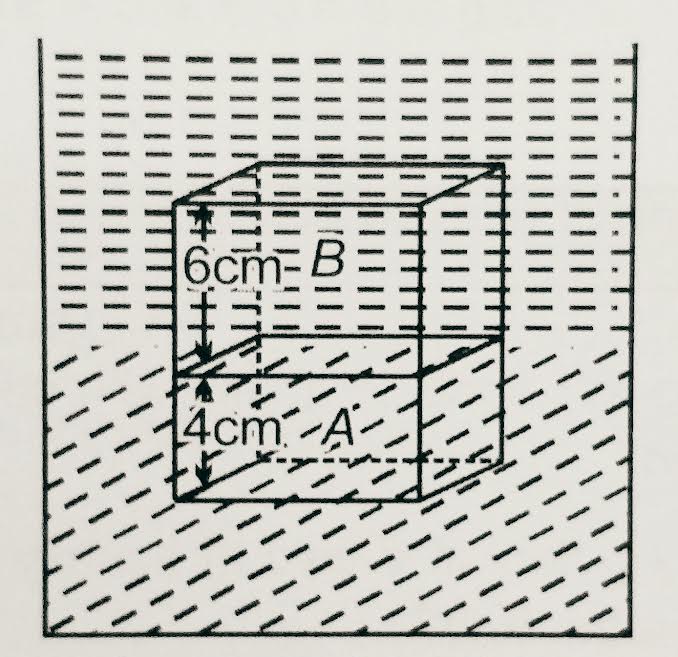
17. A cube of edge length 10 cm is just balanced at the interface of two liquids A and B as shown in fig. if A and B has specific gravity of 0.6 and 0.4 respectively then the mass of the cube is .
(a) 240g (b) 360g (c) 480g (d) 540g . ans-c
18.A boat having some iron pieces is floating in the pond , if iron pieces are thrown in the pond then level of the liquid (a) increases (b) Decreases (c) may increase or decrease (d) remain the same. Ans-b
19.When two liquid of same mass and different densities d1 and d2 mixed together, then the density of the mixture is (a) d1 +d2 (b) d1 +d2 /2 (c) 2d1 d2 / d1 +d2 (d) 2d1 +2d2 . Ans-c
20. When two liquid of same volume and different densities d1 and d2 mixed together, then the density of the mixture is (a) d1 +d2 (b) d1 +d2 /2 (c) 2 d1 d2 / d1 +d2 (d) 2d1 +2d2 . Ans-a
21. if there were no gravity, then which of the following will not be there for the fluid ? (a) viscosity (b)surface tension (c) pressure (d) upward thrust . ans-d
22. An ice cube contains a large air bubble . The cube is floating on the horizontal surface of water contained in a trough. What will happen to the water level when the cube is melts? (a) remain unchanged (b) it will fall (c) it will rise ( d) first it will fall and then rise . ans-a
23. The density of ice is 0.9gm/cm3.What percentage by volume by volume of the block of ice will float outside the water. (a) 10% (b)45% (c)75% (d)90% . ans-a
24. The reading of a spring balance when it is suspended in the air is 6oN . This reading is changed to 40N when it is submersed in water. The specific gravity of the block must be (a) 3 (b) 2 (c) 6 (d)1.5. ans-a
25. The weight of a body in water is one third of its weight in air. The density of the body in gm/cm3 is (a) 0.5 (b) 1.5 (c) 2.5 (d) 3.5 . ans-b
This is the assignment for the practice of objective questions of mechanical properties of solids. Students can consider it as a test paper of the chapter mechanical properties of solids.
1. Breaking stress depends on (a) length of wire (b) Area of cross-section of wire (c) both a and b (d) independent of length and area of cross-section.
2.Which of the following is perfectly plastic? (a) plasticine (b) Quartz fibre (c) steel (d) Rubber.
3. the length of an elastic string is X meter when the tension is 8N and Y m when tension is 10N , what will be the length when tension is 18N . (a) 4X-5Y (b) 5Y-4X (c) 9X-4Y (d) 4Y-9X.
4. When a load of 10kg is hung in the wire, then extension of 2m is produced. Then work done by the restoring force is (a)200J (b) 100J (c) 50J (d) 25J .
5.Substance which can be elastically stretched to large value of strain is called (a) isomers (b) isodiapheres (c) Plastomers (d) Elastomers .
6. A force F doubles the length of the wire of cross-section a . Then the Young’s modulus of the wire is (a) F/a (b) F/3a (c) F/2a (d) F/4a .
7. Breaking stress of a material is 2×10⁸ N/m2, what maximum length of the wire of this material can be taken so that the wire doesn’t break by own weight? ( density of material is 5×10³kg/m3) (a) 1km (b)2km (c) 3km (d) 4km.
8.Young modulus of elasticity for a gas is (a) 1 (b) infinity (c) zero (d) none of these .
9. If we added an impurity in the material then its elasticity (a) may change (b) never change (c) remain the same (d) change by a factor of 5 .
10. A structural steel rod has a radius r = 10mm when a force 100 kN is applied . it stretches along its length Y for steel is 2x 10¹¹ N/m2 . aswer the following questions-
(i) what is the stress produced ?
(ii)what is the elongation produced ?
(iii) what is the elastic energy density of the steel rod ?
(iv) elastic potential energy stored in the rod is what?
11.Elasticity of a rigid body is ………..
12. If Young’s modulus is three times of modulus of rigidity. Then the Poisson’s ratio is equal to …………
13. In case of bending of a beam , depression depends on the Young’s modulus Y as proportional to …….
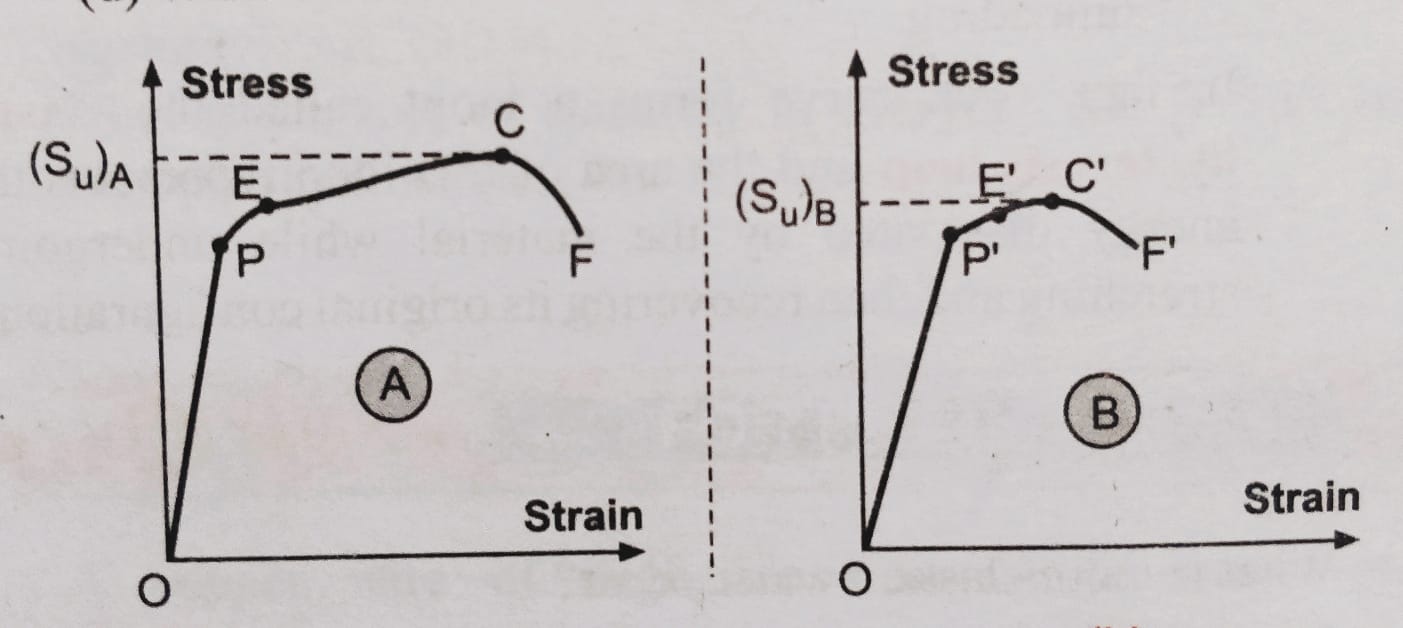
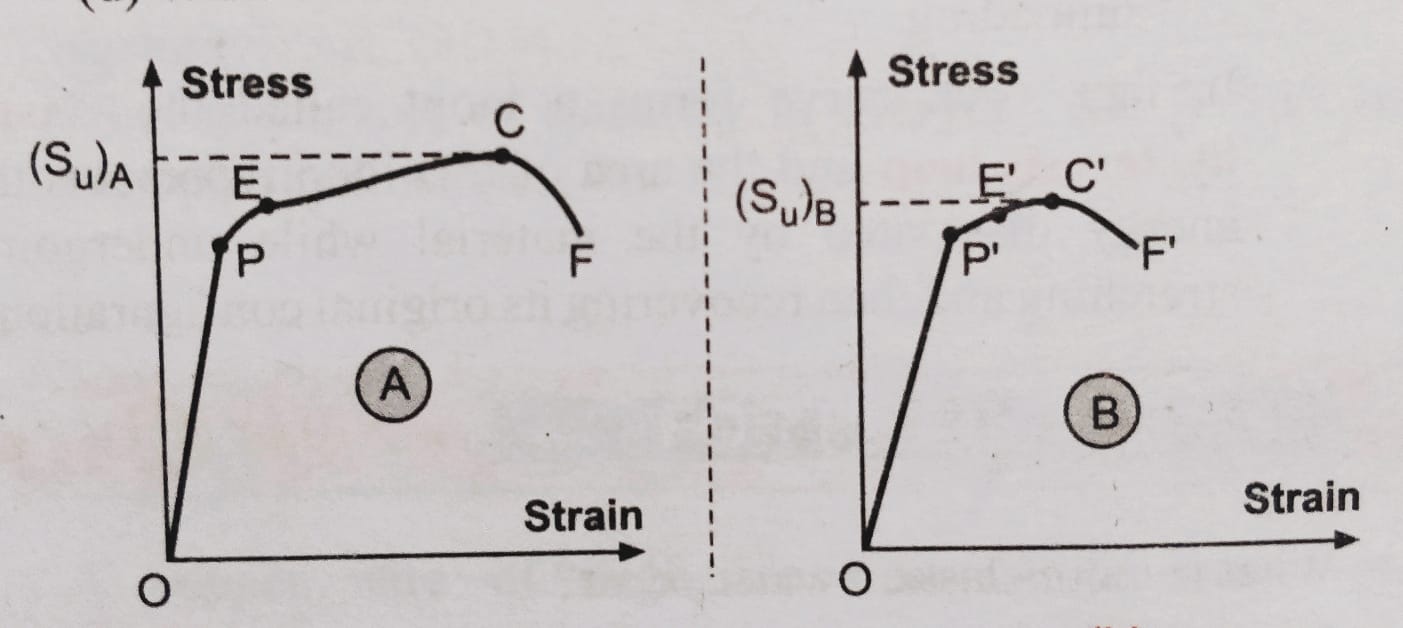
14.The stress strain graph for two materials A and B are shown in fig. (a) Which one has greater Young’s modulus ?(b) which one is strongest material?(c) which is more ductile?(d) which is more brittle?
This assignment contain Important questions of elasticity
( Mechanical properties of solids)
1. what is more elastic water or air?
2. Write copper,steel,rubber and glass in the increasing order of their elasticity.
3.How do modulus of elasticity of a material changes with temperature?
4. The breaking force for a wire is F, what will be the breaking force (i) two parallel wire of same size? (ii) for a single wire of double of thickness? Ans- 2F and 4F
5.What is the modulus of rigidity of a fluid ? Ans-0
6.Define Young’s modulus and modulus of rigidity. Give their expression and units.
7. What is the meant by elastic limit and angle of share?
8. Define Poisson’s ratio, what is its value for perfectly incompressible substance? Ans-0.5
9. Derive an expression for the elastic potential energy of a wire under stress.
10. What is the role of elasticity in everyday life? Give two example.
11. A 4m long aluminium wire whose diameter is 3 mm is used to support a mass of 50 kg. What will be the elongation of the wire? Y for aluminium is 7 x 10¹¹N/m2 ans-3.9mm
12-Calculate the percentage increase in the length of a wire of diameter 2.5mm stretched by a force of 100kg-wt Young’s modulus of the wire is 12.5 x 10¹⁰ N/m2.ans-0.16
13.Acable is replaced by anther cable of same length and material but twice the diameter (a) How will this effect the elongation under given load? (b)How does this effect the maximum load it can support without exceeding the elastic limit? Ans-1/4th and D 2 .
14. A material has poisson’s ratio 0.5. If a uniform rod of it suffers a longitudinal strain of 2 x 10⁻³ . What is the percentage increase in its volume? Ans-0%
15.Two wires of different materials are suspended from a rigid support. They have the same length and diameter carrying the same load at their free ends . (a) Will the stress and strain in each wire be the same? (b) will the extension in both wire will be same? Ans- (a) stress same strain different (b) different.
16.The stress strain graph for two materials A and B are shown in fig.
(a) Which one has greater Young’s modulus ?(b) which one is strongest material?(c) which is more ductile?(d) which is more brittle?
17. A wire stretches a certain amount under a load. If the load and diameter are both increased to three times, find the stretch cause in the wire.
Ans. [3/4l]
18.A metal bar of length L and area of the cross-section A is rigidly clamped between two walls. The young’s modulus of its material is Y and the coefficient of linear expansion is. α. The bar is heated so that its temperature is increased by C. find the force exerted at the ends of. the bar.
Ans. [YA α]
19.A metallic wire is suspended by attaching some weight to it. If is the longitudinal strain and Y is young’s modulus, find the ratio between elastic potential energy and the energy density.
Ans. [volume]
20.A spherical ball contracts in volume by 0.01 when subjected to a normal pressure of 100 atmospheres. What is the bulk modulus of its material in cgs units?
This assignment contains all important questions for class 11th physics.It will help the students to revise all questions in a short period of time .
If (p+ a/V2) (V-b)=RT where the symbols has their usual meanings, then what is the dimension of a/b .
If F= a/ b+√d , where f=force ,d= density , then find the dimension of a and b.
The factors effecting the time period (T) of the simple pendulum depends on mass , length and acceleration due to gravity . Deduce the relation for time period of the simple pendulum.
To determine acceleration due to gravity ,the time of 20 oscillations of a simple pendulum of length 100 cm was observed to be 40 s . calculate the value of ‘g’ and maximum percentage error in the measured value of ‘g’ .
If power P=a-x2/b where x represents displacement find the dimension of a and b.
A physical quantity Qis given by Q= A2.B3/2/C4D1/2 percentage error in A,B,C,D are 1%, 2%,4%,2% respectively . Find the percentage error in Q.
Write the expression for distance covered in nth second by uniformly accelerated body.
A ball is thrown vertically upwards. Draw its:
Velocity-time curve
Acceleration-time curve.
Draw velocity -time graph of uniformly accelerated motion in one dimension .From the velocity time graph of uniform Accelerated motion ,deduce the equation of motion in distance and time.
The displacement (in metre) of a particle moving along x-axis is given by
x=18 t + 5 t2.Calculate :
The instantaneous velocity at t=2s,
Average velocity between t=2s and t=3s, and
Instantaneous acceleration.
Derive an equation for the distance covered by a uniformly accelerated body in nth second of its motion. A body travels half its total path in the last second of its fall from rest . Calculate the time of its fall.
12.A body moving with a uniform acceleration describes 12 m in 3rd second of its motion and 20 m in the 5th second . find the velocity after 10 seconds.
A car travels first half of a length S with velocity u1. The second half is covered with velocities u2 and u3 for equal time intervals .Find the average velocity of the motion.
A body start from rest and accelerates uniformly .find the ratio of the displacement in, (1)one, two and three seconds, (2) first ,seconds and third second.
This assignment contains all important questions of the chapter kinetic theory of gases
KINETIC THEORY OF GASES
What are the basic assumptions of kinetic theory of gases ? on their basis, derive an expression for the pressure exerted by an ideal gas.
What is meant by degrees of freedom? State the law of equipartition of energy. Hence calculate the values of molar specific heats at constant volume and pressure for monoatomic , diatomic and triatomic gases.
Calculate the kinetic energy of one mole of argon at 127⁰ given that N =6.02×10²³ mol and k=1.381 x10⁻²³ mol-1K-1
Calculate the number of degrees of freedom for one mole of diatomic gas at N.T.P
Calculate the number of degrees of freedom of 1 cm3 of helium gas at N.T.P.
A vessel contains argon gas at 127⁰ find the average kinetic energy of argon molecule, if Boltzmann’s constant, k=1.38 x 10⁻²³ j mol -1 K-1
Calculate the total kinetic energy of 1g of helium at 27⁰C Given that R =8.31 mole -1 K-1.
At what temperature is the r.m.s velocity of a hydrogen molecule equal to that of a oxygen molecule at 47⁰C ?
Give the kinetic interpretation of temperature and define absolute temperature.
10. If three molecules have velocities 0.5,1 and 2km s-1 respectively, calculate the relation between the root mean square speed and average speed.
11. Calculate the temperature at which the r.m.s velocity of a hydrogen will be equal to 8km/hr. given that R =8.31 j mole -1.
12.Calculate the r.m.s velocity of CO2 molecules at N.T.P. given, R=8.31 j mol -1 K-1 .
13. Calculate the r.m.s velocity of hydrogen at N.T.P. given that density of the gas is 9×10⁻⁵ g cm -3.
14. Find the temperature at which the root mean square velocity of a gas is double than that its value at 0 ⁰C , pressure remaining constant.
15. The molar gas volume at S.T.P. is 22.4 litre and Avogadro number is 6.023×10²³. (a) calculate the number of gas molecules per unit volume,
16. Draw a graph to show the variation of V2rms with absolute temperature .
17. When an ideal gas undergoes an isothermal expansion, the pressure of the gas in the encloser falls. Why?
18. Two identical cylinders contains helium at 2.5 atmosphere and organ at 1 atmosphere. Find pressure if both the gases are filled in one of the cylinders?
19. The temperature of argon, kept in vessel, is raised by 1⁰C at constant volume. The total heat supplied to the gas is a combination of translational energies. Find their respective shares.
20. A gas mixture consist of 2 moles of oxygen and 4 moles of argon at temperature T. find total internal energy of the system, when vibrational modes are rejected.
This assignment contains all important questions of oscillations and waves , it will help the students preparing for the final class examination and prepare entire chapters in short time .
What do you mean by SHM ? Find expression for its displacement, velocity and acceleration , also write their phase difference .
What is meant by symmetric & Doppler effect?
How does the frequency of a tuning fork change, when the temperature is increase?
Tube a has both ends open, whole tube B has one end closed otherwise the two tubes are identical. what is the ratio of fundamental frequency of the tubes A and B?
When we start an empty bucket with water, the pitch of the sound produced foes on changing. Why?
A sine wave is travelling in a medium. What is the minimum distance between two particles always have same speed?
Two waves of the same frequency and amplitude superpose to produce a resultant disturbance of the same frequency. What is the phase difference between the waves?
A spring balance has a scale that reads from 0 to 50 kg. the length of the scale is 20cm. a body suspended from this spring, when displaced and released, oscillates with a period of 0.60 s. what is the weight of the body?
A spring of mass 2.50 kg is under a tension of 200 N. the length of the stretched string is 20.0 m. if a transverse jerk is struck at one end of the string, how long does the disturbance take to reach the other end.
A policeman on duty detects a drop of 15in the pitch of the horn of a motor car as it crosses him, if the velocity of sound is 330m/s, calculate the speed of the car.
This assignment contains all important questions of thermodynamics. It will help the students of class 11th to practice the entire chapter of thermodynamics for the final examination of class 11th , in cbse/icsc and all state board examinations.
IMPORTANT QUESTIONS OF THERMODYNAMICS
During an adiabatic process, the pressure of a gas is found to be proportional to cube of its absolute temperature what is the ratio of Cp/Cv ?
Can a room be cooled by opening the door of a refrigerator in a closed room?
Which molecules ice at 0⁰C or water at 0⁰C have greater potential energy and why?
(a) can the temperature of system be increases without heating it? (b) can heat be added to a system without increasing its temperature?
A refrigerator, whose coefficient of performance β is 5 extract heat from the cooling compartment at the rate of 250 j per cycle.
(a)How much work per cycle is required to operate the refrigerator cycle? (b) how much heat per cycle is discharged to the room which acts as high temperature reservoir?
A piston divides a closed gas cylinder gas into two parts. Initially the piston is kept pressed such that one part has a pressure p and volume 5V and the other part has pressure 8p and volume v; the piston is now left free. Find the new pressure and volume for the isothermal and adiabatic prosses.
Two car not engine A and B ate operated in series. The first one A receive heat at 800k and rejects to a reservoir at TK. The second engine B receives the heat rejected by the first engine and in turn
A mass of diatomic gas (=1.4) at a pressure of 2 atmosphere is compressed adiabatically, so that its temperature rises from 27⁰C to 927⁰. What is the pressure of the gas in the final state.
State and explain the isothermal process, derive the expression for work done in isothermal process.
State and explain the adiabatic process, derive the expression for work done in adiabatic process.