Category: 11th assignment

  • Top 20 questions for class 11th first term examination

    Top 20 most important questions for class 11th first term examination.

    This assignment contain 22 most important questions for class 11th first term examination, from unit-1 to unit- 7 (gravitation) . this assignment contain the questions based on derivation only (for important numerical you have to see another assignment).

    1. What is dimensions? What are the uses of dimensions on the basis of their uses answer the following questions.

    (a) If (p+ a/V2) (V-b)=RT where the symbols has their usual meanings, then what is the dimension of a/b . (b)  If   F= a/ b+√d , where f=force ,d= density  , then find the dimension of a and b.(c ) The factors effecting the time period (T) of the  simple pendulum depends on mass , length and acceleration due to gravity . Deduce the relation for time period of the simple pendulum.

    2.  (i) Draw velocity -time graph of uniformly accelerated motion in one dimension .From the velocity time graph of uniform Accelerated motion ,deduce the equations of motion in using this graph (or using calculus method). (ii) A ball is thrown vertically upwards. Draw its:  (i) Velocity-time curve (ii) Acceleration-time curve, If T is the time of flight. Using calculus method also find the distance covered in nth second.

        3.  Define average velocity and relative velocity. A car travels first half of a length S with velocity u1. The second half is covered with velocities u2   and u3 for equal time intervals .Find the average velocity of the motion. Also answers the following questions (a)  A body start from rest and accelerates uniformly .find the ratio of the displacement in, (1)one, two and three seconds, (2) first ,seconds and third second. (b). A body covers 12 m in 2nd seconds and 20 m in 4th seconds .find what distance the body will cover in 4 second after 5th second.

    4.State the triangle law and parallelogram law of vector addition, derive the expression for the magnitude and direction of the resultant of two vector. (**Also solve some numericals based on this derivation).also write the answers of the following questions

     (a) If a man can swim with speed s in still water , if a river flowing with speed v from east to west , find the(1) velocity of swimmer with respect to river ,(2) in which direction should he swim to reach the opposite direction (3) what is the minimum time taken by the swimmer to reach on opposite bank if width of the river is ‘d’.

     (b)   Rain is falling vertically downward  with speed Vr , and a man is running on the horizontal road with speed Vm , in which direction should he hold his umbrella to protect him from rain.

    5. A projectile is fired at an angle θ with the horizontal . (a) show that its trajectory is parabolic, (b) Obtain the expression for , time of flight ,horizontal range and vertical height. A body is projected horizontally from the top of a building  of height H , if velocity of projection is  ‘u’ find (a) time it will take to reach the ground (b)horizontal distance from the foot of the building where it will strike the ground, and (c) velocity with which body strikes the ground. Also answer the following questions (i)at what value of  θ  the range will be maximum, ((ii)) prove that for a given velocity of projection the horizontal range is same for θ and 90- θ .

    6. Define centripetal acceleration and centripetal force find the expression for it if a body of mass m moving with a uniform speed u in a circular path of radius r (derivation of centripetal acceleration).

    7. Answer the following questions (a)  State, Newton’s second law of motion. show that second law is the real law of motion .(b) If a man of mass m is in a lift find the apparent weight of the man when (i) lift is accelerating upward with acceleration ‘a’, (ii)lift is accelerating downward with acceleration ‘a’ , (iii) lift is moving upward with constant velocity v ,(d) lift is falling freely under gravity.(c)Explain, Why pull is easy as compared to push a rolling body ?

    8. Distinguish between static friction , limiting friction and kinetic friction,  haw do they vary with the applied force , explain with the help of a diagram. . (b)write the laws of limiting friction (c)Why are ball bearings used in machinery? (d) What is the need of banking of road. (e) State two advantage and disadvantages of  friction.(d) Explain why (i) a cyclist slow dawn his speed while taking turn. (ii) a cyclist bend himself towards the centre at the turn . (iii) it is necessary of banking of road ?

    9. Define impulse .(a) A cricket ball of mass m moving with speed of v m/s, calculate the impulse received by the ball (b) a ball moving by a momentum of strike against a wall at an angle of  θ with the normal and is reflected at the same angle and with the same speed . find the change in momentum of the ball.

    10. Define conservative and non- conservative force.  How will you find variable force ? what is the significance of F-x graph.?  Explain conservation of energy ,draw a graph showing the variation of potential and kinetic energy with respect to the height of a  free fall under gravity.

    11. Define elastic and inelastic collision . discuss elastic collision in one dimension . obtain expression for velocities of two bodies after such a collision .Also show that for perfactaly elastic collision coefficient of restitution is 1.  

    12. State and explain work energy theorem.Also Find the relation between kinetic energy and linear momentum . using this relation answer the given questions, (a) two bodies of masses M  and m (M>m)having same momentum , which has more kinetic energy? (b)  ) two bodies of masses M  and m (M>m)having same kinetic energy, which has more momentum? (c)the linear momentum of a body is increased by 10% what is the % change in kinetic energy? (d) the kinetic energy of  a body is increased by 10% what is the % change in linear momentum?

    13 . Find  the expression for the potential energy stored in a  stretched spring of spring constant    K  and it is stretched by distance X. Also plot the graph which shows the variation in kinetic energy and potential energy  with respect to X if spring is free to oscillate.

    14.State Newtons law of gravitation in vector form .(I)Haw can you find the mass of earth ,starting from the law of gravitation?)II) What are the factors affecting the value of G  ? (III)If mass of two bodies are doubled and distance is halved , how will the gravitational force change ? Write the differences between (I) Inertial ang gravitational mass,(II) G and g (III)escape velocity and orbital velocity on earth.

    15. Define gravitational acceleration , find the expression for it, also find its value on the surface of earth .Haw the value of g changes (I) With altitude (II)with the depth .A planet reduces its radius by 1% with its mass remaining same , haw acceleration due to gravity changes ? Find the relation between height h above the earth surface with the depth from the earth surface where the value of g will be same.

    16. what is geostationary satellite  ? calculate the height of the  orbit above the surface of the earth in which a satellite is placed , will appear stationary, and also write the conditions for the launching of  geo stationary satellite .Also, define the term orbital velocity , find the expression for (a) orbital velocity(b) time period and(c) total energy of the satellite . Obtain the relation for orbital speed and escape velocity of the satellite from earth surface.

     17. Answer the following questions-(a) what is the percentage increase in velocity for moon to escape from the gravitational pull of the earth ?( b) If the earth supposed to be a uniform sphere , suddenly contract and its radius becomes half of its original value , what will be the duration of day (or what will be time of rotation of earth on its own axis/ what will be the %change in duration of day)?( c)Why space craft usually launched from west to east ? why is it more advantageous to launch rockets in the equatorial plane?(d) What is escape velocity ? obtain the expression for the escape velocity on earth . why there is no atmosphere on moon? Explain. Also state and prove Kepler’s laws of planetary motion.

    18. Answer the following questions, (a)Is it possible to open a pen cap with one finger? Why? (b)When a sphere, ring, disc and spherical shell are coming down on an inclined plane, rolling without slipping, which will reach the ground first?( c)How will you distinguish between a hard-boiled egg and a raw egg by spinning each on a table top?(d)What is torque? Write its formula in vector form. Handle, to open the door, is always provided at the free edge of a door. Why? ( e)If earth were to shrink suddenly, what would happen to the length of the day?

    19. Answer the following questions                                                                                                                                                                  (a)Derive the relations (i)L = I ω    (ii) Ʈ =  Iα (b)If angular momentum is covered in a system whose moment of inertia is decreased, will its rotational kinetic energy to be also conserved? Explain.                      ( c)Can a body in translatory  motion have angular momentum? ( d)Explain.Write an expression for the moment of inertia of a circular disc of a mass M and radius R(i)about an axis passing through its centre, and a perpendicular to its plane.(ii) about its diameter.(iii)about a tangent to its own plane.(iv) about a tangent perpendicular to the plane of the disc.

          20. Obtain an expression for position vector of centre of mass of a two particle system. From a     uniform circular disc of diameter d , a circular hole of diameter d/6 and having its centre at a distance of d/4  from the centre of the disc is scooped out , find the centre of mass of the remaining portion .

    21. What is the difference between rotational kinetic energy and rolling kinetic energy?Show that rolling kinetic energy of a rolling body is given by 1/2mv2(( K2/r2)+1) , where r is the radius of the body and K is the radius of gyration of the body. How much fraction of the K.E. of rolling is purely (i) translational (ii) rotational ?

    22.(i) Define moment of inertia and radius of gyration also write the parallel and perpendicular axis      theorem.(ii)Derive an expression for moment of inertia of a disc of radius r, mass m(iii)Derive an expression for moment of inertia of a thin circular ring passing through the centre and perpendicular to the plane of the ring.

    To download the complete question paper click here-

  • Test NEET /JEE Chapter 1 -4 (class 11th)

    ( chapter 1 -4 class 11th)

    There are 20 questions in this question paper. Students have to solve it in 25 minutes only .

    Test NEET/JEE (ch-1,2,3,4)

    1. A  new system of units is proposed in which unit of mass is A kg . unit of length is B kg and unit of time is C s , What will be the value of 5 j in new system?

    (a) 5AB2C-2 (b) 5A-1B-2C2 (c) 5 A-2 B-1 C-2 (d) 5 A-1 B-1 C2

    2. If linear momentum P , area A and  time t is taken as fundamental units then the dimensional formula of  energy is (a) P1 A-1 t-1  (b) P2 A1 t1   (c) P1 A-1/2 t1   (d) P1 A1/2 t-1.

    3.  If E , m,L  and G denotes energy , mass , length and gravitational constant then the ( EL2 /m5G2) has the dimension of   (a) mass (b) length (c) time (d) angle.

    4. The period of oscillation of time period T is 2π(l/g)1/2 measured value of l is 10 cm is known as 1mm accuracy ant time for 100 0scillations of the pendulum is found to be 50 s using a wrist watch of 1s resolution . What is the accuracy in the measurement of g ?

    (a)2% (b) 3% (c) 4% (d) 5% .

    5. Two resistors of resistance R1=100+-3 Ohm R2=200+-4 Ohm then the equivalent resistance of parallel combination is (a) 66.7 +-1.8  (b) 66.7+- 4  (c) 66.7+-3  (d)66.7+-7 Ohm.

    6. A cube has a side of length 1.2 x 10⁻² its volume upto correct significant figure is (a) 1.7×10 -6 (b) 1.73×10 -6 (c) 1.78×10 -6(d) 1.732×10 -6.

    7. T he position of the object moving along x-axis is given by x= a+bt2, where a=8.5 b=2.5 and t is measured in seconds. The average velocity of the object between t=2s to t=4 s  in m/s  is (a) 5 (b) 10 (c) 15 (d) 20 .

    8. A player throw a ball vertically upwards with velocity u at highest pint , (a) both velocity and acceleration are zero (b) The velocity of the ball is u and acceleration is zero (c)The velocity of the ball is 0 but acceleration is g (d) the velocity of the ball is u and acceleration is g .

    9. If a lift is moving upward with velocity 5m/s a girl throw a ball upward with speed 50m/s the ball will returns on her hand in time (a)5s (b)10s (c) 15s (d) 20s.

    10. A boy sliding on the smooth inclined plane requires 4 s to reach on the ground starting from rest from the top . How much time will it take to cover one fourth the distance starting from rest at the top?

    (a) 1s (b) 4s (c)2s (d)16s .

    11. A particle is released from rest from a tower of height 3h . the ratio of the intervals of time to cover three equal heights h is (a) t1:t2: t3 = 3:2:1 (b) t1:t2: t3 =1: (√2-1)(:√3-2) (c) t1:t2: t3 =√3:√2:1 (d) t1:t2: t3 = 1:√2-1): (√3-√2).

    12. A ball A is thrown upward  with velocity u  at the same time another ball B is released from rest at height H,  at time t the speed of A relative to B is (a) u (b) u-2gt (c) (u2-2gh)1/2 (d)u-gt.

    13. A vehicle travel half the distance L with speed V1 and other half with speed V2 then its average speed is , (a) (V1 + V2)/2 (B) (2V1+V2)/V1+ V2 (C) 2V1V2/V1+V2 (D) L(V1+ V2)/V1V2 .

    14. Two vectors    and A+B = C then A and B are (a) parallel (b) perpendicular (c) anti-parallel (d) null vector.

    15. If resultant of two equal vectors is equal to the either forces Then the angle between these two vectors is ,(a) 900 (b) 1200 (c) 600 (d) 300

    16. if dot product  of two vectors   is null vector then the angle between these two vectors is   (a) 0 (b) 1200 (c) 900 (d) 450 .

    17. If  then  then which of the following statement is  correct ( a) vector A is perpendicular to  vector B (b) vector A is parallel to vector C (c) vector b is parallel to vector C (D) vector A is perpendicular to vector C .

    18.Two vectors  magnitude of A,B and C are 3,5,4 respectively then  (a)the angle between A and B is 900 . angle between A and C is 900. (c) angle between B and C is 900(d) angle between A and B is 00.

    19. If unit vector of a vector is represented as 0.5  – 0. 8  +c  then the value of c is (a) √0.01  (b) √0.11  (c) √0.39 (d)  1.

    20. The component of a vector A is along X-axis will have maximum value if (a)vector A is along positive Y axis   (b)vector A along positive x-axis  (c) vector A makes angle 450 with the x-axis  (d) A is along negative X aixis.

  • Test solid, liquid and gases incluting thermal properties of matter

     Solids, liquid and thermal properties of matter.

    1. The maximum load a wire can withstand without breaking, when its length is reduced to half of its length, will (i) be doubled (ii) be half (iii) be four times (iv) remain same .                                                           2. If length of a wire is doubled and area is halved then its young modulus will be (i) same (ii) halved (iii) four times (iv) ¼ times.                                                                                                                                                            3.The two ends of the wire maintained at temp. 100 and 1100c the rate of flow of heat is 4j/s . if the temp. of the ends are 200 and 2100c then the rate of flow of heat will be (i) 16.8 (ii)8.0 (iii)4.0 (iv) 44.8 j/s.                                                                                                                                                                                                      4. An ideal liquid flows through a tube having diameters 2.5 and 3.75 cm then the ratio of velocity of liquid through these cross-section is (i)9:4 (ii)3:2 (iii) (3/2)1/2.(iv) (2/3)1/2                                                                              5. If volume of a system is doubled without changing its temp then volume will be (i) doubled (ii) same (iv) four times (iv) halved.                                                                                                                                                              6. Two moles of helium gas undergo a cyclic process as shown in fig. assuming the gas to be ideal calculate the following quantities in the prosses (a) the net work done (b) the net change in internal energy (c) the net change heat energy. (R=8.32j/mole)

    To download complete question paper click here–

  • Test paper Class-11 (Physics)

    This is the first test paper provided for the students of class-11th ( Physics) . in the end of the paper answer is given . Students having solved the question paper , may check its answers.

    This question paper is taken by the other books, if students get any errors , then sorry for this.

  • Important questions of physics (Term-2)

    Important questions of class 11th [physics (Term-2)]

    This assignment contain the questions of following chapters [ 1- Solids ( elasticity), 2- Fluids , 3- Thermal properties of matter, 4- Thermodynamics,5-Oscillations ,6-Waves ]

    1 .What are the basic assumptions of kinetic theory of gases? on their basis, derive an expression for the pressure exerted by an ideal gas.

    2. What is meant by degrees of freedom? State the law of equipartition of energy. Hence calculate the values of molar specific heats at constant volume and pressure for monoatomic, diatomic and triatomic gases.

    3. Calculate the kinetic energy of one mole of argon at 127⁰C. given that N =6.02×10²³ mol and k=1.381 x10⁻²³ mol-1K-1

    4.Calculate the number of degrees of freedom for one mole of diatomic gas at N.T.P

     5.Calculate the number of degrees of freedom of 1 cm3 of helium gas at N.T.P.

     6.A vessel contains argon gas at 127⁰C. find the average kinetic energy of argon molecule, if      Boltzmann’s constant, k=1.38 x 10⁻²³ j mol -1 K-1 .

    7.Calculate the total kinetic energy of 1g of helium at 27⁰C Given that R =8.31 mole -1 K-1.

    8.At what temperature is the r.m.s velocity of a hydrogen molecule equal to that of a oxygen molecule at 47⁰C ?

    9.Give the kinetic interpretation of temperature and define absolute temperature.

    10.If three molecules have velocities 0.5,1 and 2km s-1 respectively, calculate the relation between the root mean square speed and average speed.

    11. Calculate the temperature at which the r.m.s velocity of a hydrogen will be equal to 8km/hr. given that R =8.31 j mole -1.

    12. Calculate the r.m.s velocity of CO2 molecules at N.T.P. given, R=8.31 j mol -1 K-1 .

    13. Calculate the r.m.s velocity of hydrogen at N.T.P. given that density of the gas is 9×10⁻⁵ g cm -3.

    14.Find the temperature at which the root mean square velocity of a gas is double than that its value at 0 ⁰C , pressure remaining constant.

    15. The molar gas volume at S.T.P. is 22.4 litre and Avogadro number is 6.023×10²³. (a) calculate the number of gas molecules per unit volume,

    16. Draw a graph to show the variation of V2 rms  with absolute temperature .

    17. When an ideal gas undergoes an isothermal expansion, the pressure of the gas in the encloser falls. Why?

    18. Two identical cylinders contains helium at 2.5 atmosphere and organ at 1 atmosphere. Find pressure if both the gases are filled in one of the cylinders?

    19. The temperature of argon, kept in vessel, is raised by 1⁰C at constant volume. The total heat supplied to the gas is a combination of translational energies. Find their respective shares.

    20. A gas mixture consist of 2moles of oxygen and 4 moles of argon at temperature T. find total internal energy of the system, when vibrational modes are rejected.

    21.During an adiabatic process, the pressure of a gas is found to be proportional to cube of its absolute temperature what is the ratio of Cp/Cv ?

    To download the complete assignment click on DOWNLOAD

  • Important questions of oscillations

    Important questions of oscillations-

    1. What is meant by periodic and oscillatory motion? Distinguish between them.

    2. What is meant by SHM . Find the expressions for displacement , velocity and acceleration. Also find the phase difference between them.

    3. Find the potential energy and kinetic energy of a SHM and hence show that total energy is conserved . In what position of the oscillation is the energy wholly kinetic and wholly potential?

    4. Prove that for an harmonic motion time period T = 1/2π(spring factor/inertial factor)1/2.

    5. What is simple pendulum? Derive expression for the time period or frequency of the oscillating simple pendulum. Also explain the second pendulum and find the length of the second pendulum on the surface of earth.

    TO GET THE IMPORTANT QUESTIONS OF MECHANICAL PROPERTIES OF FLUID CLICK HERE-

    6. Show that vibration of the liquid in the U-Tube is simple harmonic and also find the expression for the time period and frequency .

    7. Explain the term (i) Free vibration (ii) Forced vibration (c) Resonant vibration (d) Damped oscillation.

    8. A cylinder floating in water is temporarily pushed down . Derive an expression for its frequency.

    9. Obtain an expression for the time period of a loaded and massless spring (i) Oscillating horizontally (ii) oscillating vertically . Show that is the same as the simple pendulum of length equal to the extension of the spring?

    Numericals-

    1. A body describe S.H.M. with am amplitude of 5cm . and a period of 0.2sec . Find the acceleration and velocity  of the body when the displacement is (a) 5cm (b)3cm (c)0cm.

    2.  Simple pendulum of length l and having a bob of mass m is suspended in a car . The car is moving on a circular path of radius R with a uniform speed v . If the pendulum makes small oscillation in a redial direction about its equilibrium position . What will be its time period?  

    3. A spring balance has a scale that reads from 0 to 50 kg . the length of the scale is 20cm. A body suspended from this balance when displaced and released , oscillation with a period of 0.60 sec. What is the weight of the body?                                            Ans-219N

    4. The acceleration due to gravity on the surface of the moon is 1.7m/s2. What is the time period of the simple pendulum on the moon if its time period on the surface of the earth is 3.5sec?     Ans-8.4 sec

    5. A spring with spring constant 1200N /m is mounted on the horizontal frictionless table , a mass of three kg it attached to the free end of the spring . The mass is then pulled sideway to a distance of 2cm and released . Determine (a) the frequency of oscillation (b)the maximum acceleration of the mass (c) The maximum speed of the mass.          Ans- 3.2 ; 8.1 ; 0.4

    To get the very important questions of Thermodynamics click here-

  • Important questions of mechanical properties of fluid in rest

    Important questions of mechanical properties of fluid in rest (Hydrostatics);

    This assignment contain all important questions based on the topic , liquid pressure, Pascal’s law, surface tension etc. It will help the students to prepare for the schools examination for class 11th.

    1. Define thrust  and derive an expression for the pressure at depth in a liquid at rest under gravity.

    2. State and prove Pascal’s law . Describe the principle and working of hydraulic press, or hydraulic lift.

    3. What do you mean by up-thrust force? explain.  Obtain the conditions for floating and equilibrium of a floating body.

    4. Describe briefly Torricelli’s experiment. What do you understand by the statement that the atmospheric pressure in 76cm of Hg column.

    5. Define surface tension and surface energy show that surface energy is equivalent to surface tension.

    6. Define angle of contact . How can it be determined  in case of mercury and glass?

    7. Derive an expression for the excess pressure inside (i) a liquid drop and (ii) a soap bubble (iii) an air bubble in liquid .

    To watch the video on the topic excess pressure inside liquid drop and soap bubble click here-

    8. What is capillarity? Explain the capillary rise in liquid , deduce an expression for the rise .

    9. Explain why

    (a) The angle of contact of mercury with glass is obtuse , while that of water with glass is acute.

    (b) Water on a clean glass surface tends to spread out while mercury on the same surface tends to form drops .

    (c) Surface tension of a liquid is independent of the area of the surface .

    (d)Water with detergent is dissolved in it should have small angles of contact .

    (e) A drop of liquid under no external force is always spherical in shape .

    (f) To keep a piece of paper horizontal. You should blow over not under it.

    (g)A spinning cricket ball in air doesn’t follow a parabolic trajectory.

    Numericals-

    1. A 50 kg girls wearing high heel shoes balance on a single heel . The heel is circular with a diameter 1.0cm . What is the pressure exerted by the heel on the horizontal floor?    Ans-6.2x 10⁶N/m2.

    2. What is the pressure inside the drop of mercury of radius 3mm at room temperature? T for mercury is 4.56×10⁻¹n/m also give the excess pressure inside the drop. Ans-310pa,1,01×105N/m2.

    3. A U-shaped wire is dipped in the soap solution, and removed . The thin soap film formed between the wire and the light slider support a weight of 1.5×10⁻²N . The length of the slider is 30cm. What is the surface tension of the film?     Ans-2.5×10⁻²N/m.

  • Very important questions of thermodynamics

    Important questions of thermodynamics-

    1. What is the zeroth law of thermodynamics ? How does it lead us to the concept of temperature?

    2. Define isothermal and adiabatic process . What are the conditions necessary for such process to occur?

    3. State and explain the first law of thermodynamics. Also write its limitations.

    4. Define two principle specific heat of gas . Why is Cp greater then Cv ?

    5. Define two specific heat of a gas and show that the difference between them is constant . (or, Derive Mayer’s formula).

    6. Describe melting and boiling process on the basis of first law of thermodynamics.

    7. Show that for an adiabatic change in a perfect gas PVƳ=constant, where P is pressure and V is the volume and Ƴ is the ratio of two specific heat of the gas.

    8. Define isothermal change . Calculate the amount of work done when perfect gas expand isothermally.

    9. Define adiabatic change . Calculate the amount of work done when perfect expands adiabatically.

    10.  Derive a relation between the slopes of an isothermal and adiabatic curve.

    11. State second law of thermodynamics in the two usual forms. Show that both these forms are equivalent to each other. Also write the limitations of second law of thermodynamics.

    12. What is the heat engine ? Explain the basic principle with the help of a flow diagram. Also explain its efficiency .

    13. What is a Carnot cycle? Find its efficiency. Does this efficiency depends on the working fluid ?Does any actual engine reach to the efficiency of Carnot engine ? Give reason  .

    Numericals-

    1. A cylinder with a movable piston contains 3 mole of hydrogen at standard temperature and pressure. The wall of the cylinder is made of insulating . By what factor does the pressure of the gas increase if the gas is compressed to half of its initial value?    Ans-21.4

    2. In changing the states of a gas adiabatically from an equilibrium states A to another Equilibrium state B , an amount of work equal to 22.3J is done on the system . If the gas is taken from state A to B via process in which the net heat absorbed by the system is 9.35 cal, how much is the net work done by the system in latter case ?               Ans-16.9 J

    3. A steam engine delivers 5.4×10⁸J of work per minute. What is the efficiency of the engine ? How much heat is wasted per minute?                        Ans- 15%, 3.06x10J .

    4. An electric heater supplies heat to a system at a rate of 100W . The system prefer work at the rate of 75J/sec. At what rate the internal energy increasing?                  Ans-25 watt.

    5. A thermodynamic system is taken from an original states D to an intermediate state E by the liner process shown in fig,

    Its volume is then reduced to the original value From E to F by an isobaric process . Calculate the total work done by the gas from D to E to F.

  • Important questions of thermal properties of matter

    Important questions of thermal properties of matter

    This assignment provides all important questions of this chapter , which will be important for examinations point of view.

    1. Briefly describe the various scale of temperature and give the relation between them.

    2.Define coefficient of linear ,area and volume expansion , also find the relation between them.

    3.Show with the help of potential energy diagram that thermal expansion in solid is due to increase in interatomic distance.

    4. What do you mean by the term thermal stress? Derive an expression for the same in case of a road fixed at both ends.

    5. Define heat capacity, molar heat capacity and specific heat capacity also give their units and dimensions.

    6. What do you mean by the term latent heat of fusion and latent heat of vaporization ?

    7.Using P-T diagram of water , discuss the behavior of water when both pressure and temperature are (i) above the triple point (ii) at triple point (iii)below the triple point.

    8. What is thermal conduction ? Discuss the variable and steady state of a rod being heated at one of its ends.

    9. Define the coefficient of thermal conductivity and explain the formula used . Why do metals have higher conductivity then insulator?

    10. Write the expression for the rate of flow of heat energy through a conductor maintained at different temperature at its two ends . Explain the symbols used . Given that heat is measured in joule , derive the units of thermal conductivity.

    11.What is Newton’s law of cooling / how can it be experimentally verified? Plot the graph of log (T-T0) V/S time ‘t’.

    12.Discuss energy distribution in the spectrum of perfectly black body. What conclusion do you derive from this distribution? Also explain the Wine’s displacement law of radiation.

    13. State and explain Stefan’s law . How will you deduce  Newton’s law of cooling from this law?

    14. State and prove Kirchhoff’s law of heat radiation . Explain how Kirchhoff’s law leads to the conclusion that good absorber are good emitters.

    Numericals-

    1. A surveyor uses a steel measuring tape that is exactly 50m long at a temperature of 200C . What is the length on the hot summer day when the temperature is 350C?                                                              coefficient of linear expansion is  1.2 x 10⁻⁵K-1. .   [ans-50.009m]

    2. A glass flask with volume 200cm3 is filled to the brim with mercury at 200C . How much mercury overflows when temperature of the system is raised to 1000C ?[α for glass is 0.40x 10⁻⁵K-1.and cubical exp. For mercury is 1.2x 10⁻⁵K] . Ans-2.7cm3].

    3. A pendulum clock consist of an iron rod connected to a small heavy bob. If it is designed to keep correct time at 200C, how fast or slow will it go in 24 hours at 400C. ( α for iron is 1.2×10⁻⁵K-1).                Ans-10.4 sec

    4.At what temperature is the Fahrenheit scale reading equal to(I) half that on the Celsius scale (II)Equal to the reading on Celsius scale?

    5.A faulty thermometer reads 50C in melting ice and 990C in steam . Find the correct temperature in 0F when this faulty thermometer reads 520C.

    6.

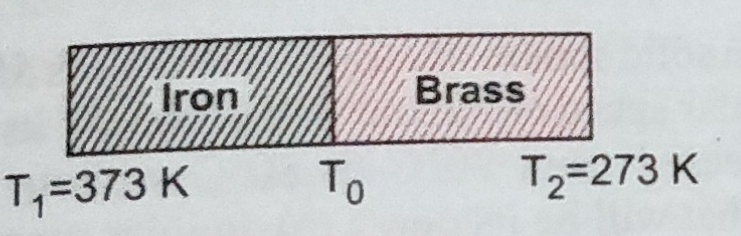
    An iron bar of length l1=0.1m, A1=0.02m2, k1= 79w/mK and a brass bar of length l2=0.1m area 0.02m2 and K2=109 W/mK are soldered end to end as shown in fig. the free ends of the iron ball and brass bar maintained at 373K and 273K respectively . Obtain expression for and hence compute (a) the temperature of the junction(b) the equivalent thermal conductivity of the compound bar and (c)the heat current through the compound bar.   Ans-315K ,91.6W/mK, 916W.

    7. A body cools from 700c to 500C in 6 minutes and to 400C in 12 minutes . Find the temperature of the surroundings if cooling occur according to Newton’s law of cooling.        Ans-300C.

    8. A pan filled with hot food cools from 940C to 860C in 2 minutes when the room temperature is 200C . How long will it take to cool from 710C to 690c .    Ans- 42sec.

    9. The energy emitted per second by a black body at 12270C is E . If the temperature of the black body is increased to 27270C , calculate the energy emitted per second in terms of E in the second case. Ans-16E

    10. Calculate the temperature in kelvin scale at which a perfectly black body radiates at the rate of 5.67 W/cm2. Given σ=5.67×10⁻⁸W/m2K4.                                  Ans-1000K.

  • Numericals based on expansion of matter

    Before to solve these questions students must studied the topic Thermal expansion of matter , to watch the complete notes on this topic click here 

    Important numericals based on expansion of matter-

    1. A surveyor uses a steel measuring tape that is exactly 50m long at a temperature of 200C . What is the length on the hot summer day when the temperature is 350C?                                                              coefficient of linear expansion is  1.2 x 10⁻⁵K-1. .   [ans-50.009m]

    2. A glass flask with volume 200cm3 is filled to the brim with mercury at 200C . How much mercury overflows when temperature of the system is raised to 1000C ?[α for glass is 0.40x 10⁻⁵K-1.and cubical exp. For mercury is 1.2x 10⁻⁵K] . Ans-2.7cm3].

    3. A pendulum clock consist of an iron rod connected to a small heavy bob. If it is designed to keep correct time at 200C, how fast or slow will it go in 24 hours at 400C. ( α for iron is 1.2×10⁻⁵K-1).                Ans-10.4 sec

    4. When a strip made of iron (α1) and copper (α2)(α2>α1)is heated then (a)Its length doesn’t change (b)It gets twisted (c)It bends with iron on concave side (d) it bends with iron on convex side.   Ans-c

    5. The volume coefficient of expansion of a liquid is 7 times the volume coefficient of expansion of the vessel. The ratio of absolute and apparent expansion of the liquid is (a) 1/7 (b)7/6 (c)6/7(d)1/6.ans-b

    6. The coefficient of areal expansion of a solid is 2x 10⁻⁵ 0C-1. Calculate the coefficient of linear expansion.

    7. A bar of iron is 10cm at 200C. At 190Cit will be ( α=11 x10 -5/0C). (a) 11 x10 -6cm longer (b) 11 x10 -6cm shorter (c) 11 x10 -5cm shorter (d) 11 x10 -5cm longer. Ans-c

    8. Coefficient  of volume expansion of mercury is 0.18×10⁻³/0C. If the density of mercury is 13.6 gm/cc . Then its density at 2000C is (a) 13.11g/cc (b)52.11g/cc (c)16.11g/cc (d) 26.11g/cc. Ans-a

    9. A meter rod of silver at 00C is heated to 1000C Its length is increased by 0.19 cm then the coefficient of volume expansion of the rod is (a) 5.7 x10 -5 /C (b) 0.63 x10 -5/C   (c) 1.9 x 10⁻⁵/C (d) 16.1 x10 -5/C . Ans-a

    10. Ratio among coefficient of  linear exp. , area and volume exp. Is (a)1:2:3 (b)3:2:1(c)4:3:2 (d) all of these . Ans-a

    11. A solid ball of metal has a concentric spherical cavity within it . If the ball is heated , the volume of the cavity will (a( increase (b) decrease (c) remain same(d) all are possible. Ans-a

    12. Solid expands on heating because (a) Kinetic energy of the atom increases(b)potential energy of the atom increases (c) total energy of atom increases (d) The potential energy curve is assymetric about the equilibrium distance between neighbouring atoms. Ans-d