In this topic we will discuss about Electric flux and area vector .
question may be asked as what is electric flux ? write its unit and dimension.
Area vector and electric flux –
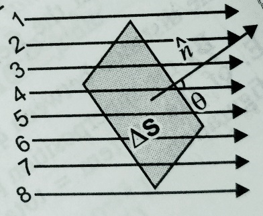
As we know area is a scaler quantity , but in some cases or in case of some problems area is taken as vector quantity . the direction of area is taken as the normal of the surface at a given point . The vector associated with every area element of a closed surface is taken to be in the direction of the outward drawn normal .
Electric flux – Electric flux over an area in an electric field is the total number of field line passes through that area normally . It is denoted by ɸ its unit is Nm2C-1 . And its dimension is [M1L3T-3A-1]. Electric flux is a scaler quantity.
The number of electric field lines crossing this area is proportional to field intensity E . Let electric field lines makes an angle ϴ with the area vector dS , and E is the electric field intensity , then we can write dɸ = E. (dS cosϴ ) [ since dScosϴ is the component of area vector normal to the surface ].
Equipotential surface and Relation between electrostatic field and potential
In this topic we will discuss about Equipotential surface and relation between electrostatic field and potential also, we will know about equipotential surface for different-different conditions .
Equipotential surface- It is the surface inside the electrostatic field, the electric potential at every point on that surface are same. For any charge configuration, equipotential surface through a point is normal to the electric field at that point.
Equipotential surfaces of a single point charge are concentric spherical surfaces centred at the charge .
Numerical based on electric charge ,electric field .
Numerical based on electric dipole ( electric field at axial and equatorial point, torque and potential energy stored in dipole )-
Two charges + 30μc and -30μc are placed 1cm apart . calculate electric field at a point on the the axial and equatorial line at a distance of 20 cm from the centre of the dipole .
Ans- 6.25 x 10⁵ N/C and 3,25 x 10⁵‑ N/C .
An electric dipole of dipole moment 4 x 10⁻⁵ C-m is placed in uniform electric field of 103 N/C making an angle of 300 with the direction of field . Determine the torque exerted by the electric field on the dipole. Ans- 2 x 10⁻⁸Nm .
An electric dipole is placed at an angle of 600 with an electric field of magnitude 4 x 10⁵ N /C . It experience a torque of 8√3 Nm . If the length of the dipole is 2cm , determine the magnitude of either charge of the dipole . Ans – 2 x 10⁻³ C .
An electric dipole of length 10cm having charges of magnitude 6 x 10⁻³ C , placed at 300 with respect to a uniform electric field experience a torque of magnitude 6√3 N-m . Calculate (i) magnitude of the field and (ii) potential energy of the dipole . Ans- 2√3x 10⁴; -18J
An electric dipole consist of two opposite charges of magnitude q=1×10⁻⁶C separated by 2.0 cm . The dipole is placed in an external electric field of 1×10⁵ N/C . What maximum torque does the field exert on the dipole ? How much work must an external agent to do turn the dipole end for end , starting from position of alignment ( ϴ=00 ) . Ans- 2×10⁻³ N-m ; 4×10⁻³J .
(i)Two point charges 4Q and Q are separated by 1m in air at what point on the line joining the two charges the electric field intensity is zero. (ii) Two identical metallic sphere A and B having charges +4Q and -10Q are kept at a certain distance apart . A third identical uncharged sphere C is first placed in contact with sphere A and then with sphere B . Spheres A and B are then brought in contact and then separated . Find the charges on the sphere A and B .
7.Calculate the amount of work done in turning an electric dipole of dipole moment 3×10⁸ C-m from its position of unstable equilibrium to stable equilibrium, in a uniform electric field of intensity 103N/c.
8.The sum of two point charges is 7µc they repel each other with a force of 1N when kept 30 cm apart in free space , calculate the value of each charge.
Electrostatic potential energy and electrostatic potential
In this topic we will discuss about Electrostatic potential energy and electrostatic potential also with potential difference , potential due to multiple charges and potential at a point due to electric dipole .
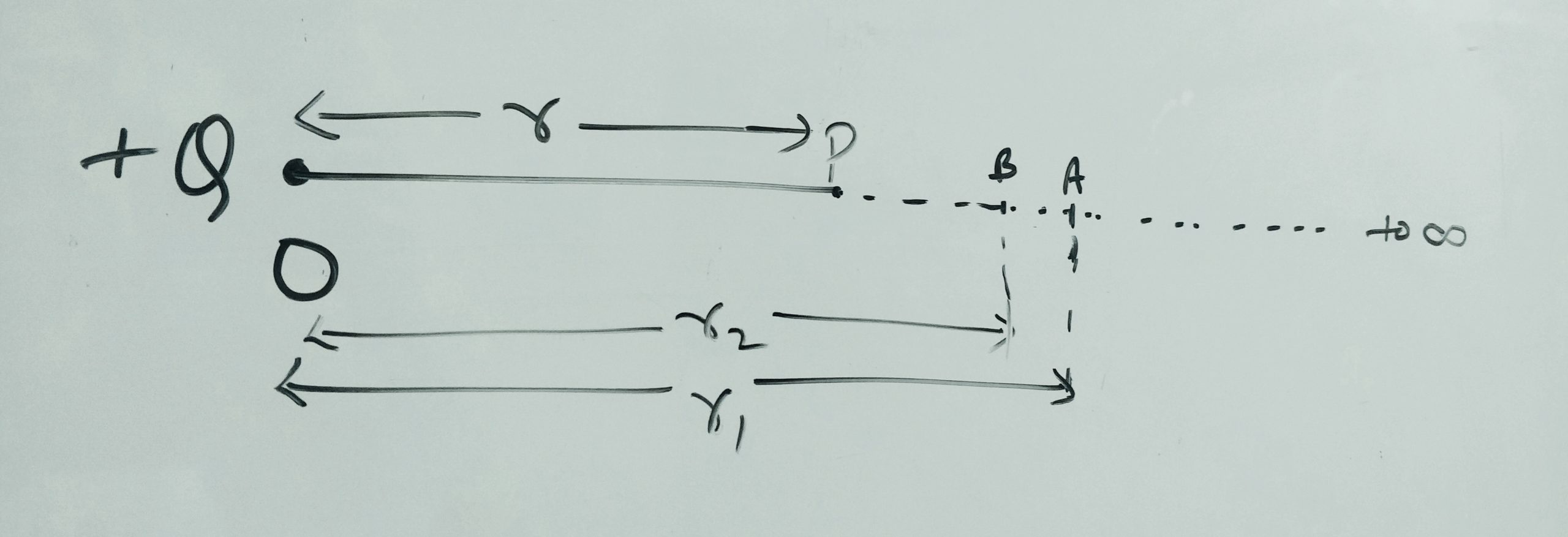
Electrostatic potential energy – Electrostatic potential energy of a charge in an electrostatic field is the amount of work done required to bring that charged body from infinity to that point . Its unit is joule
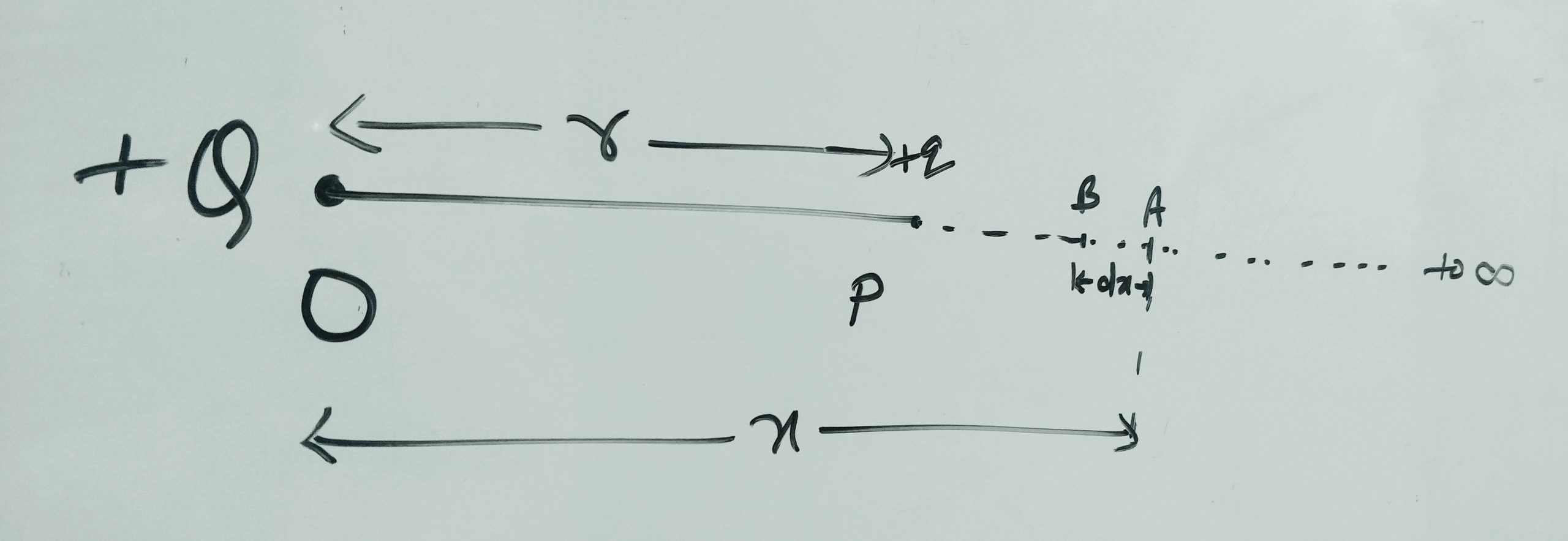
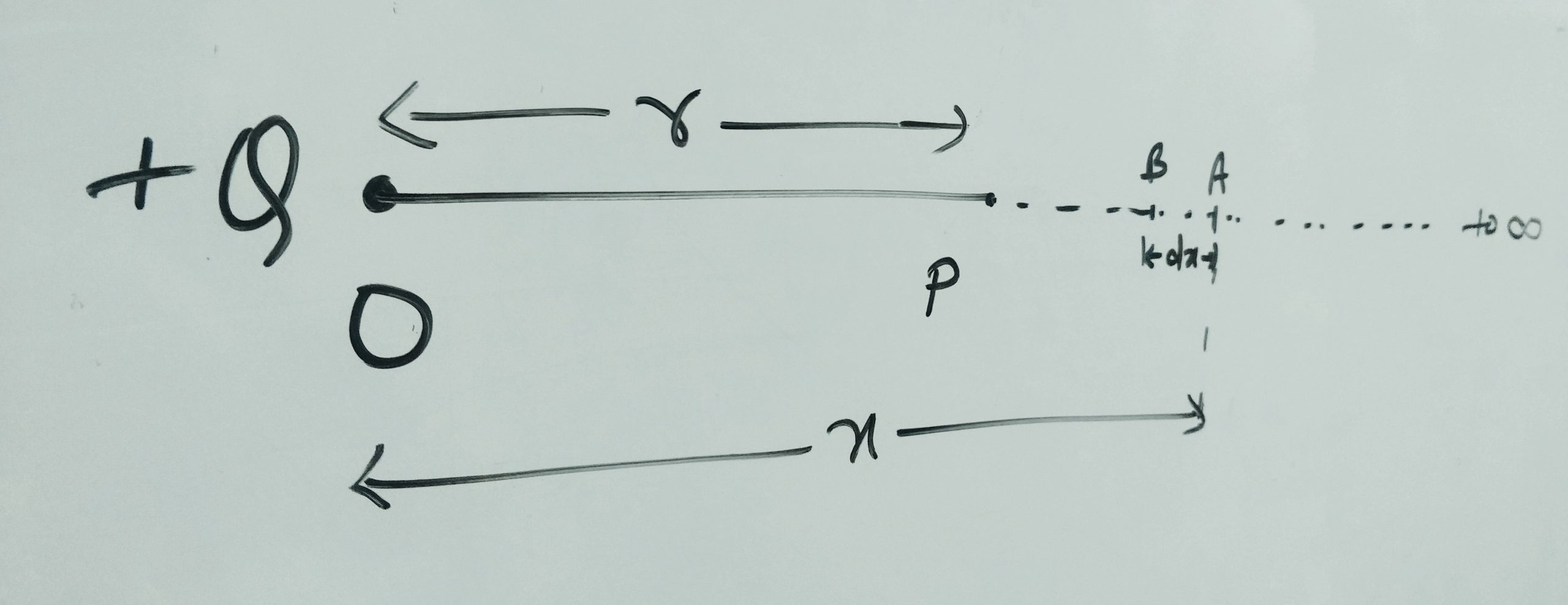
Let a charge Q is placed at point O as shown in figure , we have to find the potential energy at point ‘p’ which is ‘r’ distance away from the point ‘O’ . ( derivation of this topic , link is given below)
To see the video for electrostatic potential energy and electrostatic potential click on the link given below-
Electrostatic potential – electrostatic potential at any point in a region of electrostatic field is the minimum work done required to carry a unit positive charge from infinity to that point .
We can write electrostatic potential V = U/q i.e. electrostatic potential is equal to potential energy per unit charge . Its unit is J/C . or JC-1 or NmC-1 and its dimension is [M1L2T-3A-1]
( derivation of this topic , link is given Above/below)
Electrostatic potential difference – Electrostatic potential difference between two points is the amount of work done required to bring the unit positive charge from one point to another point .
( derivation of this topic , link is given Above/below)
To view the video related to the topic potential difference and potential at a point due to multiple charges visit on the link given below-
Electrostatic potential at a point due to dipole- ( derivation of this topic , link is given below) . Before to know about this topic students must have to know about electric dipole , to read about electric dipole click here-
To view the video related to the topic electrostatic potential at a point due to a dipole visit to the link given below-
Electrostatic forces are conservative are conservative in nature i.e. electrostatic force is independent of path followed , it only depends on initial and final position of the charge particle in an electric field .
Expression for the electric field intensity at a point on the axis of the charged ring –
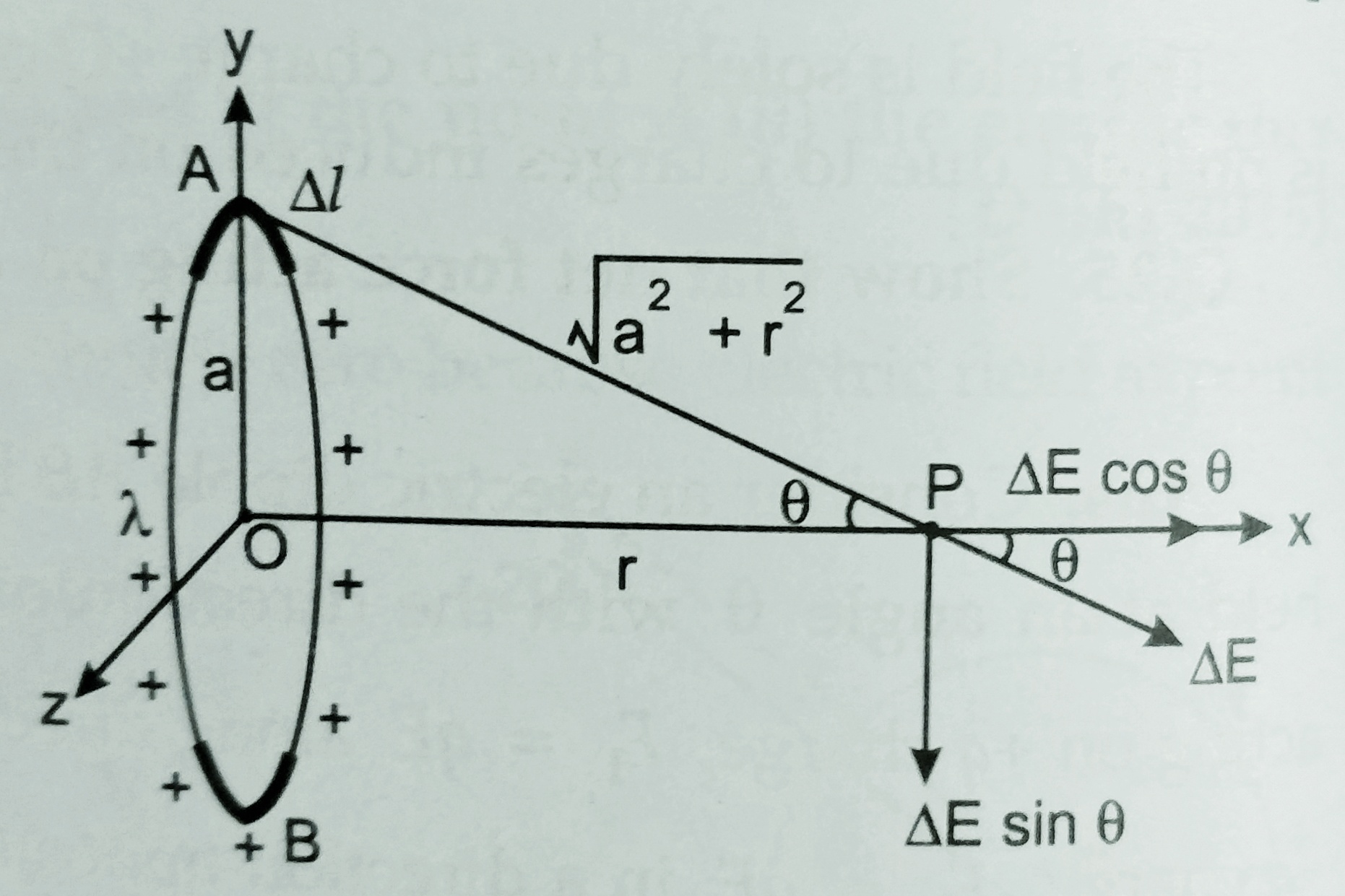
Question may be asked as ; A charge is distributed uniformly over a ring of radius ‘a’ . Obtain an expression for the electric field intensity E at a point on the axis of the ring. Hence show that for points at large distance from the ring behaves like a point charge.
Suppose a uniform circular ring of radius ‘a’ charged uniformly ‘Q’ which is distributed uniformly over the ring.
Suppose a small element ‘dl’ on the ring then, charge on the element is given by – dQ = (Q/2∏a) dl
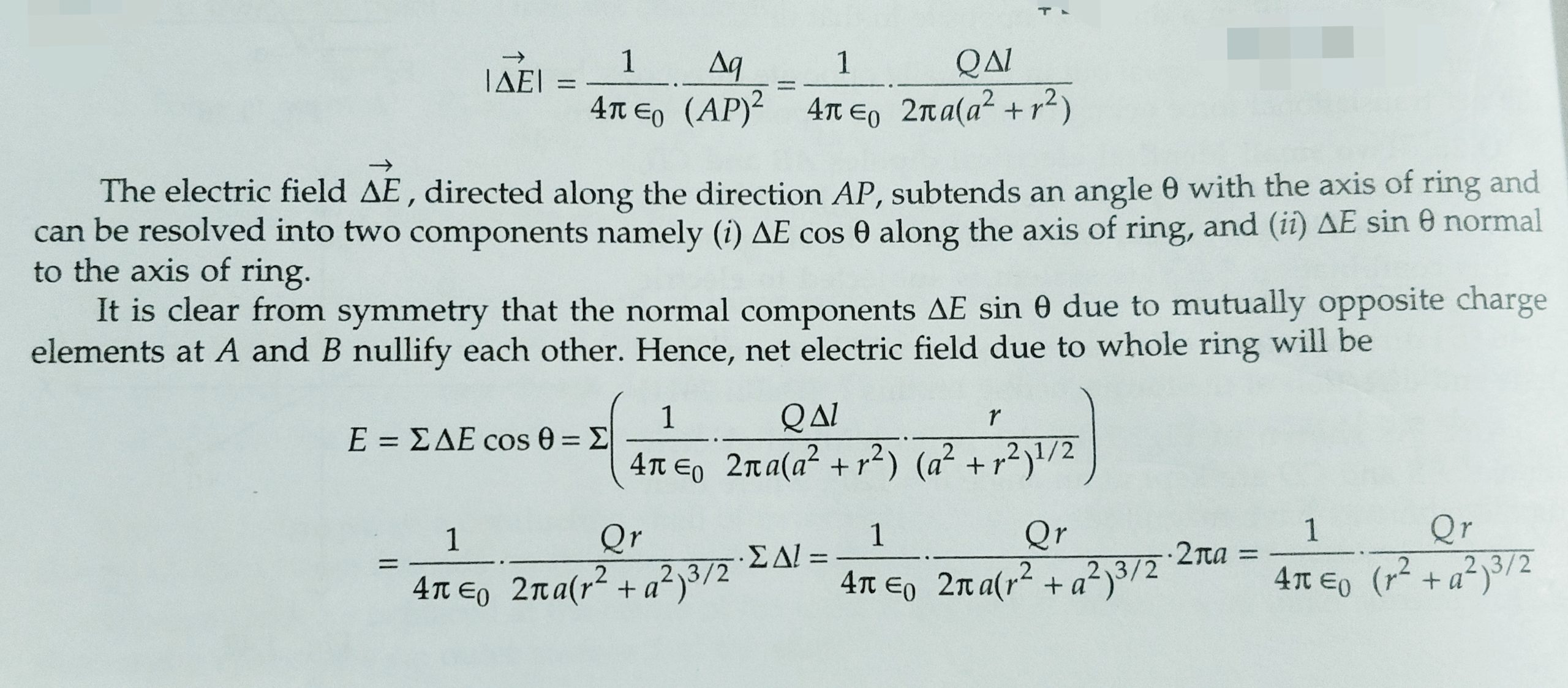
The electric field at point p due to this element is given by –
*****At the place of ∑ students can use integration with limit 0 to 2∏a ( in both case answer will be same ) *****
The field E is directed along the axis OP of the charged ring .
If r >> a , then the above expression may be written as ‘
E = (Q/4∏ϵ0 r2 ) . This shows that for far points at long distance from the ring , it behaves like a point charge .
To view the video of this topic electric field at a pint on the axis of uniformly charged circular link click on the link given below-
In this topic we will discuss about the , Expression for torque and potential energy stored in dipole placed in uniform electric field . and what will be Expression for torque and potential energy stored in dipole placed in non-uniform electric field ?
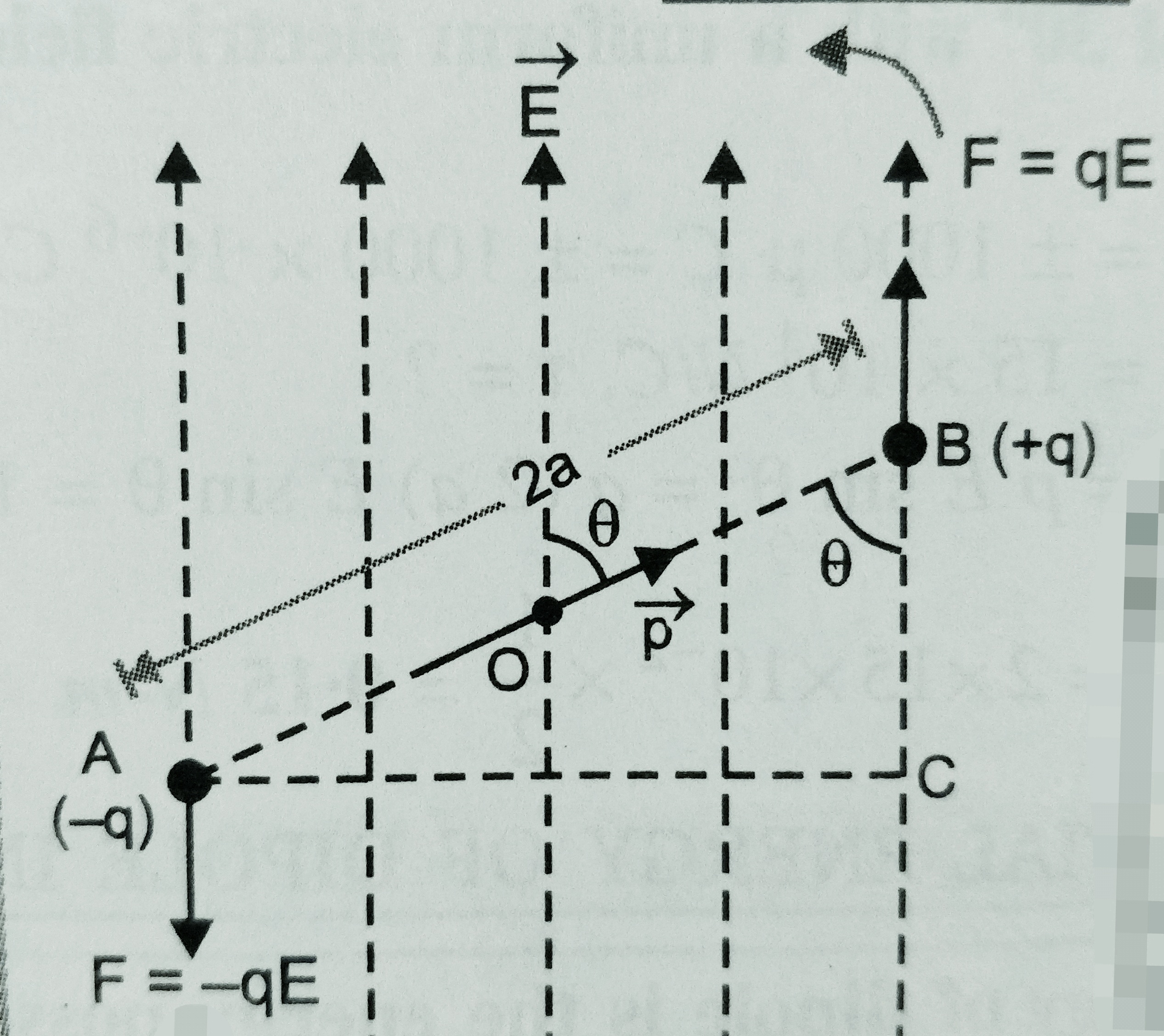
Suppose an electric dipole AB having charges -q and +q are placed at distance 2a , and dipole moment ‘p’ is placed in an uniform electric field ‘E’ .
Then Electrostatic force experienced on both the charges are F = q E , but the direction of forces on each charges are opposite to each other . since the electric field E is constant then net force on the dipole will be zero ( since forces are in opposite directions ) .
Since the forces are equal , unlike and parallel acting at different points so , they form a couple . The couple tends to align the dipole axis along the direction of field ‘E’ .
Let’s draw AC perpendicular on electric field ‘E’ .
But Questions may be asked by the students that ,what will happen if electric field is not uniform ?
then its answer will be that the net force on the dipole will not be zero (0) . It means there will be translational and rotational motion in the dipole . And net force will be equal to F1-F2 .
To view the video based on this topic torque and potential energy on the dipole placed in uniform electric field go to the link given below-
This topic contain numerical for the practice of the chapter electric field
Before to solve the numerical based on electric field students has to study ( learn ) , and all the notes based on electric field , electric dipole ( axial and equatorial point)
Two point charges +16μc and -9μc are placed 8cm apart in air . Determine the position of the point at which the resultant electric field is zero . [ Ans- 24 cm]
A particle of mass m and charge q is thrown at speed u against a uniform electric field E . How much distance will it travel before coming to momentary rest . ? [Ans- mu2/2qE]
A particle of mass m and charge q is released from rest in uniform electric field of intensity E . Calculate the kinetic energy it attains after moving a distance a distance x between the plates . [Ans- qEx]
Eight identical point charges of q coulomb each are placed at the corners of a cube of each side 0.1 m . calculate the electric field at the centre of the cube . calculate the field at the centre when one of the corner charge is removed . [Ans – 0 ; 1.2 x 10¹² .]
Two charges + 30μc and -30μc are placed 1cm apart . calculate electric field at a point on the the axial and equatorial line at a distance of 20 cm from the centre of the dipole . [ Ans- 6.25 x 10⁵ N/C and 3,25 x 10⁵‑ N/C .]
Four particles each of charge q are be placed on the vertices A ,B, C, D of a regular pentagon ABCDE . the distance of each corner from the centre is ‘a’ . Calculate the electric field at the centre of the pentagon . [ Ans- q/4∏ϵ0 a2 along OE .]
A small sphere of mass 1g carries a charge of +6μc . The sphere is suspended by a string in an electric field of 400N/C acting downwards. Calculate the tension in the string . What will be the tension if the charge on the sphere be -6μc . [Ans- 1.22x 10⁻² N . ; 74 x 10-4 N .]
An electron falls through a distance of 1.5 cm in uniform electric field of value 2 x10⁴N/C . when the direction of electric field is reversed , a proton falls through the same distance . compare the time of fall in each case .
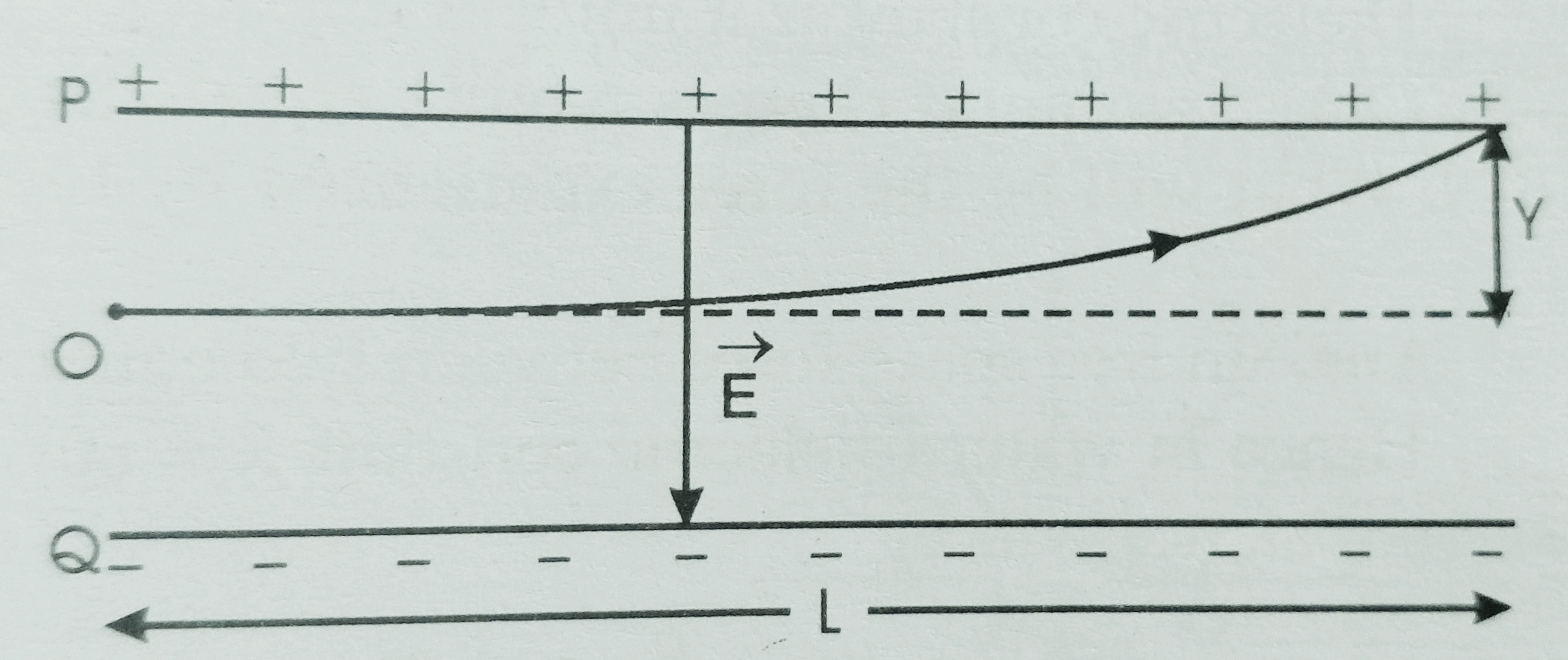
A particle of mass ‘m’ and charge -q enters the region between two charged plates initially moving along x-axis with speed vx ( as shown in the fig) . The length of the plate is L and an uniform electric field E is maintained between the plates . Show that the vertical deflection of the particle at the far edge of the plate is QelL2 / (2m vx2) .
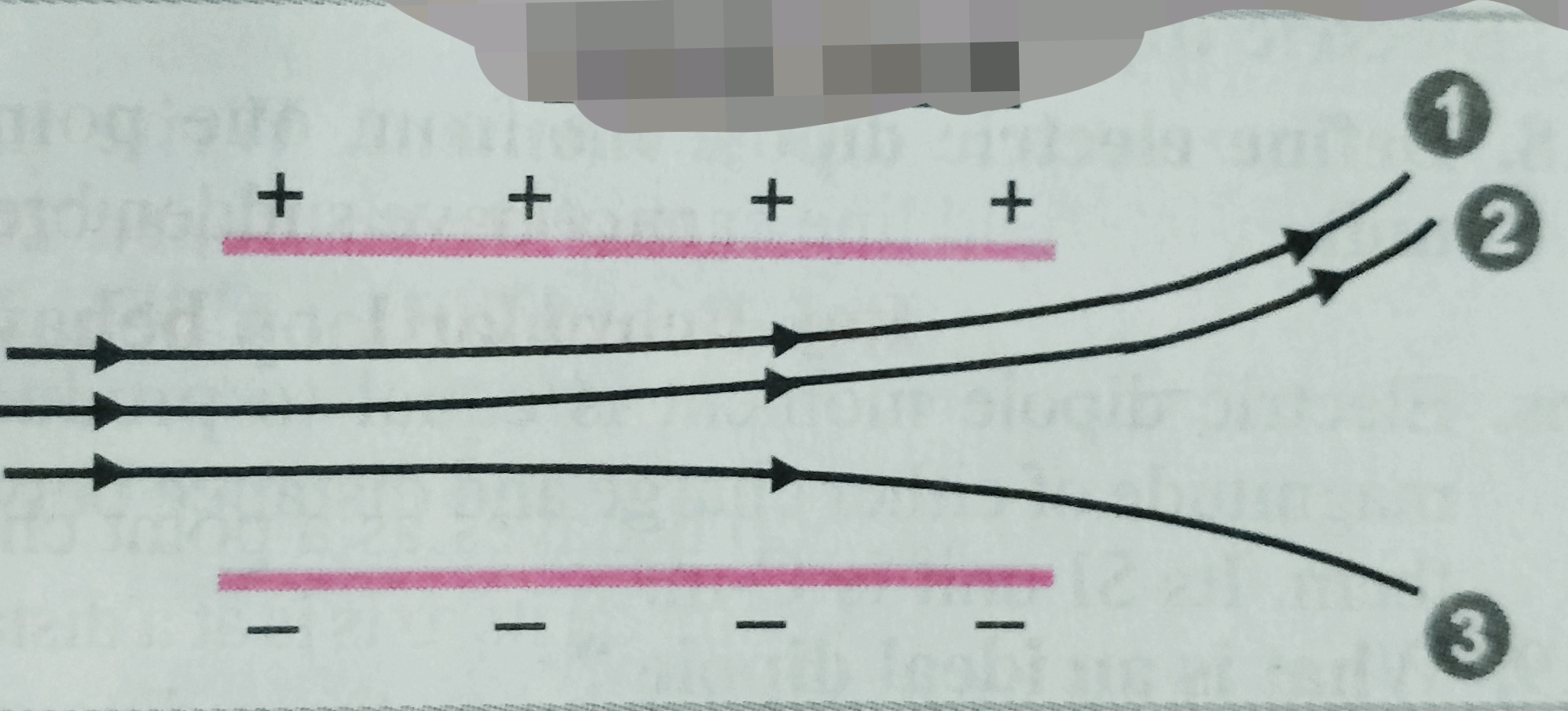
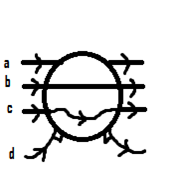
As shown in the figure three charged particles in a uniform electrostatic field . Give the sign of three charges . Which particle has the highest charge to mass ratio .
Electric dipole – An electric dipole consist of a pair of equal and opposite point charges separated by small distance .
Let two charges of equal magnitude but opposite sign( q and -q) are separated by distance 2a , then the arrangement is known as electric dipole .
Dipole moment (p) – Dipole moment of an electric dipole is the measurement of the strength of the electric dipole its magnitude is the product of magnitude of either charge and separation between them .
i.e. Magnetic moment p = q ( 2a )
Direction of magnetic field is given as negative to positive charge i.e. -q to +q ;
Its SI unit is C-m ( coulomb meter ) and dimension is [M0 L1 T1 A1 ] :
** Dipole field – It is the space around the dipole in which electric effect of the dipole can be experienced . For electric dipole electric field E α 1/r3 but for a point charge E α 1/r2
In the link given below , students can find the notes related to electric field at a point on axial and equatorial line due to a dipole.
To see the video of electric field at axial point due to a dipole click on the link given below
To view the video related to the topic electric field at equatorial point of a dipole click on link given below
Electric field intensity at any point due to a short electric dipole , it explain the electric field due to a dipole at any point and using this derivation we can find the electric field at axial and equatorial point of a dipole .
In this topic we will discuss about what is electric field and electric field lines , also electric field intensity at a point due to a point charge .
Electric field – Due to given electric charge it is the space around a charge particle in which electrostatic force can be experienced .
Electric field intensity – Electric field intensity at a point is the force experienced at unit charge placed at that point , it is strength of electric field at that point .
Electric field = F/q0
Electric field intensity due to a point charge – Suppose a charge Q is placed at point O , we have to find the electric field intensity at point p which is r distance away from charge Q .
Suppose a test charge q is placed at point p , then force acting at charge q due to Q is given as F = KQq/r2 ,
therefore electric field E = F/q
so, E =( kQq/r2 )/q
E = kQ/r2
If we have to find the electric field at a point due to group of charges then we can write
Net electric field, E = E1 + E2+E3 ..………..
Electric field lines – It is the imaginary line the tangent at any point on this lines gives the direction of force at that point .
To watch the video on electric field and electric field lines visit on given link below-
Properties of Electric field lines –
Electric field lines are continuous curve . They start from positive charge and end into negative charge . this is why electric field lines not form a closed loop . If there is a single charge then field lines start from the charge and goes into infinity .
2. Tangent to the electric field lines at any point gives the direction of electric field intensity at that point .
3. No two field lines intersect each other . This is because at the point of intersection , there will be two direction of force at the same point which is not possible .
4. The electric field lines are always normal to the surface of a conductor .
5. Where field lines are denser the electric filed intensity is more and vice- versa .
To watch the video of properties of electric field lines click on given link below-
***So in the form of electric field lines electric field intensity is equal to the number of field lines crossing normally a unit area around that point .
The Syllabus class 12 (physics) providing here is totally based on 2019-2020 pattern , if there will be any change in the syllabus , it will be improved and informed to the students through the website – www.physicsclasses.online , to get any improved information remain in contact with this site .
Topic removed from cbse class 12th physics. What are the benefits for the students or what are the drawbacks see in the video given below-
electrostatics –
Chapter 1: electric charges and fields –
Electric charges , properties of charges (Conservation of charge , quantisation of charge etc. ), coulombs law ( between two point charges and due to multiple charges also known as superposition of force due to multiple charges ) , permittivity of a medium , continuous charge distribution ( linear ,surface ,volume charge density) .
Electric field , electric field due to a point charge , electric field lines ( electric lines of force ) , electric dipole , electric field due to a dipole ( axial and equatorial) , torque on a dipole placed in uniform electric field . Electric flux , Gauss’s theorem and its applications (i.e. electric field at a point due to long straight charged conductor, charged infinite plane sheet , charged spherical shell) .
Chapter 2: Electrostatic potential and capacitance –
Electric potential and potential difference , electric potential due to a point charge and system of charges also due to electric dipole ( axial, equatorial and at any point) , equipotential surfaces , electric potential energy of a system of two point charges and of a dipole in an electric field . Conductors and insulators , electric polarization and dielectric constant ( relative permittivity ) , capacitor and its capacitance ; combination of capacitor ( series and parallel ) , capacitance of parallel plate capacitor with dielectric slab /conducting slab , energy stored in capacitor , common potential , lass in energy when two charged capacitors connected with each other .
current electricity-
Chapter 3: current electricity-
Electric current, drift velocity , mobility , relation between drift velocity and current , proof of Ohm’s law on the basis of drift velocity , current density , resistance , conductance , resistivity, conductivity , relation between current density and drift velocity, effect of temperature on resistance and resistivity , graph of resistance(resistivity) Vs temperature for conductors/alloy /semiconductors , Ohmic and non ohmic conductors ( graph) , carbon resister , combination of resistors ( series and parallel ) . Internal resistance (r) , terminal potential (V) and emf (E) of the cell and relation between them . also graph between ( V,E, r and R) . Combination of cells (series, parallel ,and mixed grouping) , Kirchhoff’s law (junction and loop rules) , wheat -stone bridge , meter bridge , potentiometer and its applications ( effects on null points on different -different conditions ). Electrical energy and power .
Magnetic effect of current and magnetism-
Chapter 4: Moving charges and magnetism-
Oersted’s experiment , concepts of magnetic field, Biot-Savart’s law and its application ( magnetic field at a point using Biot -savart’s law due to current carrying wire finite( only formulae ) and infinite , at the centre and on the axis of a circular current carrying coil . Ampere circuital law and its application to infinite long straight current carrying conducting wire ( thin and thick ) , magnetic field inside solenoid / toroid . Force on a moving charge in a magnetic field and direction of force . force on a current carrying wire placed in uniform magnetic field. Force between two parallel current carrying wire and definition of one Ampere . Torque acting on a current carrying coil , and expression for potential energy stored in the coil placed in uniform magnetic field . Moving coil galvanometer its current sensitivity and conversion of galvanometer into ammeter and voltmeter .
Chapter 5: Magnetism and matter-
Earth behaves like magnet , pole strength, magnetic dipole and magnetic moment . Expression for torque and potential energy when a magnetic dipole( short magnet) placed in uniform magnetic field . Current loop as magnetic dipole and its magnetic moment , current carrying solenoid behave as short bar magnet , magnetic field intensity at a point due to magnetic dipole (short bar magnet) at axial, equatorial and any point . Magnetic field lines and its properties . magnetic moment due to revolving electrons in an atom Bohr magneton . magnetic elements of earth and relation between them . Di- para-ferro magnetic substance ( with examples) and its properties . Electro magnet, permanent magnets and factor effecting its strength and material suitable for making them .
Electromagnetic induction and alternating current-
Chapter 6: Electromagnetic induction-
Electromagnetic induction, Faraday’s law , induced emf and current , Lenz’s law , Eddy current . self and mutual induction , expression for self- induction of current carrying solenoid , expression for mutual induction due to coaxial solenoids , units and dimensions of self and mutual induction . grouping of inductors (series and parallel ) .
Chapter 7: Alternating current-
Alternating current. Peak, mean and rms( root mean square ) current/emf . Phasor diagram . phase relation and its phasor diagram when an AC source connected to only resistance, only inductor, only capacitor, resistance and inductor connected in series, resistance and capacitor connected in series , and resistance , capacitor and inductor ( LCR) connected in series , also discussion of reactance and impedance . resonance circuit of LCR and discussion of Quality factor ( sharpness of resonance ) .power in AC circuits . power factor . Watt-less current . Ac generator and transformer .
Electromagnetic wave ( EMW)-
Chapter 8: Electromagnetic wave-
Production of Electromagnetic wave their characteristics their transverse nature ( qualitative idea only ) , displacement current, Maxwell’s improvement of Ampere’s law . Electromagnetic spectrum their production ,properties and uses ( elementary facts )
6.Optics-
Chapter 9: Ray optics and optical instruments –
Reflection of light , spherical mirror , mirror formula , refraction of light , total internal reflection and its application , optical fibres , refraction at spherical surface , lenses thin lens formula , lens maker’s formula , magnification , power of a lens , combination of lens , refraction and dispersion of light through the prism . Scattering of light . Optical instruments ( microscope , telescope ( refracting and reflecting)) and expression for magnifying power .
Chapter 10: Wave optics-
Wave-front , Huygen’s principle , reflection and refraction on the basis of wave theory using Huygen’s principle , interference of light , conditions of constructive and destructive interference using YDSE also expression for fringe width . Diffraction of light using single slit experiment . Width of the central maximum , difference between diffraction and interference. Resolving power of microscope and limit of resolution . polarization , plane polarized light, law of malus , Brewster’s law uses of plane polarised light and polaroids .
Dual nature of radiation and matter –
Chapter 11: Dual nature of radiation and matter –
Emission of electron , photoelectric effect, Hertz’s and Lenard’s observation , effect of intensity and frequency on photoelectric current, stopping potential and threshold frequency , Einstein’s photoelectric equation also the possible graph using these equation . Particle nature of light . Matter waves . Wave nature of particles . De-Broglie relation . Davisson- Germer experiment( only conclusion).
Atoms and nuclei –
Chapter 12: Atoms –
Alpha particle scattering experiment , Rutherford’s model of atom , Bohr’s model, expressions for radius , velocity , total energy and time period ( frequency ) , energy levels , hydrogen spectrum .
Chapter 13: Nuclei –
Atomic mass unit . Composition and size of nucleus , Radioactivity, alpha-beta and gamma emission and their properties . radioactive decay law . half life and mean life . Activity of a radioactive substance . mass defect , binding energy , binding energy per nucleon and its variation with mass number . nuclear fission and fusion .
Electronic devices –
Chapter 14: semiconductor devices and simple circuit-
Energy band in conductors, semiconductors and insulators . Semiconductor diode ( both p-type and n-type) . formation of deplation layer , potential barrier . biasing of diode . forward and reverse characteristics . Diode as rectifier ( full wave and half wave ) . application of diode ( Zener , photo,light emitting diode and solar cell )