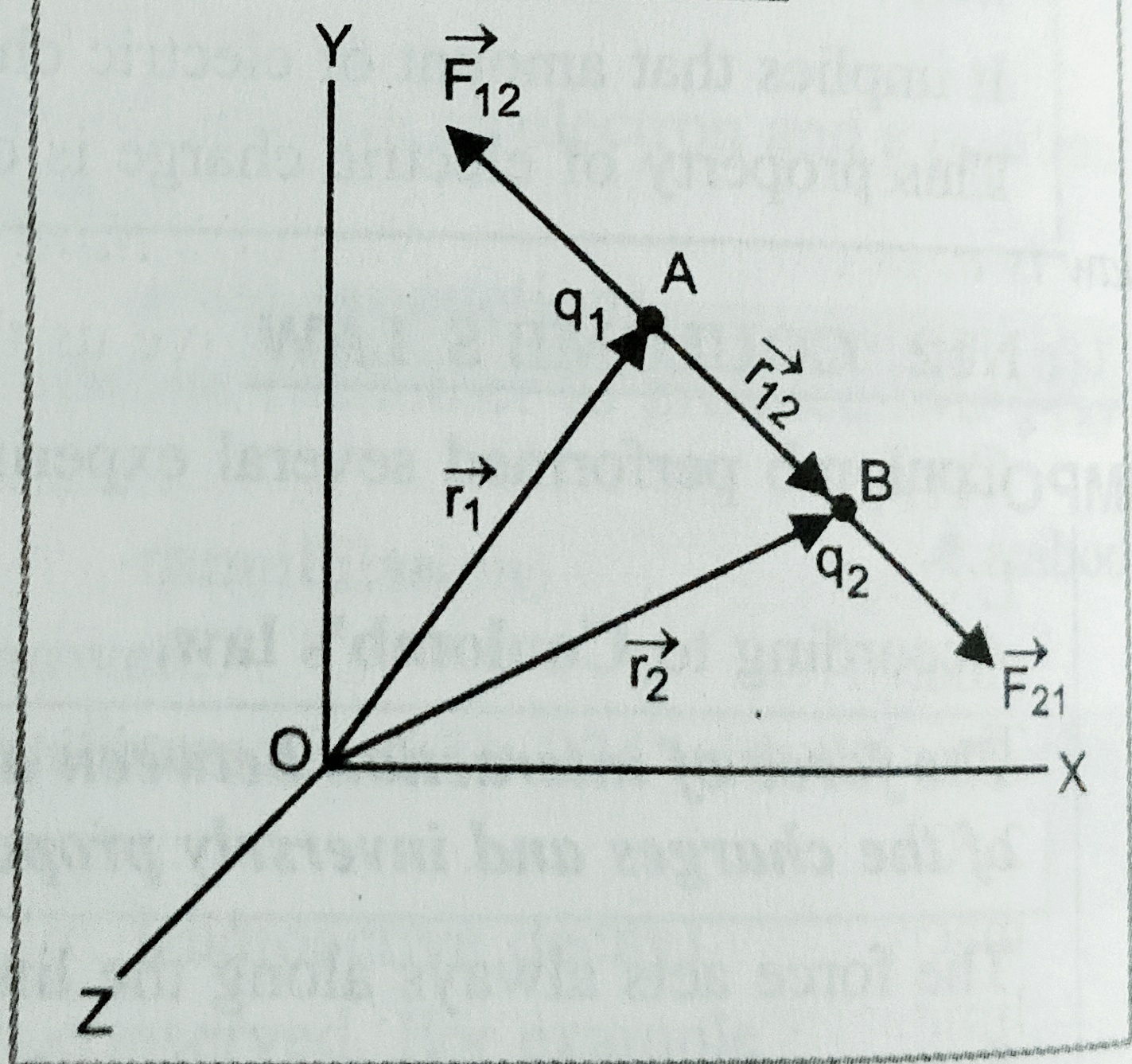
In this topic we will discuss about the Coulomb’s law of electrostatic force between two charged particle separated by some distance .
Coulomb’s law –
According to Coulomb’s law , the force of attraction or repulsion between two charged body is directly proportional to product of magnitude of their charges and inversely proportional to square of distance between them .
If Q1 and Q2 are two charges placed at distance ‘r’ from each other , then magnitude of force will be given as,
F α Q1.Q2 ………. (I) and
F α 1/ r2 …………(ii)
After combining these two we get
F α Q1.Q2/r2
Or F = K Q1.Q2/r2 where K is a constant given as
K= 1/4∏ϵ0 = 9 x 10⁹ here ϵ0 is called permittivity in vacuum or air .
ϵ0 =8.85 x 10⁻¹² C2‑N-1m-2
Electric permittivity of a medium is a measure of how the molecules of substance align or polarize under an electric field . The substance which has higher electric permittivity then its molecules polarization is maximum , and the more that substance resist the external electric field . It is denoted by ϵ . its unit is C2‑N-1m-2
Dielectric constant or relative permittivity – Dielectric constant of a given medium is the ratio of permittivity of the medium to the permittivity of free space (vacuum /air )
Or
Dielectric constant of a given medium is the ratio of force of interaction between two charges separated by a certain distance in vacuum/air to the force of interaction between two given charges at the same distance in that medium .
Dielectric constant K ( ϵr ) = ϵm / ϵo = F0 /Fm where ;
F0 = force of interaction between two charges separated by a certain distance in vacuum/air
F0 = force of interaction between two charges separated by a certain distance in the given medium
*Dielectric constant is unit less .
To watch the video of relative permittivity and charge density click on the link given below –
What is electric charge ? And what are the properties of charge ?
in this topic we will discuss that, What is electric charge ? And what are the properties of charge ? We will also discuss that what are the processes of charging of an objects ?
This topic will help the students of class 12th and 10th to understand the topic, What is electric charge and what are the properties of charge ?
What is electric charge ? how can we charge a body? And what are the properties of charges ?
Electric charges – Charge is the intrinsic property of the body which is possessed by the body itself , due to which electrostatic force comes into play .
There are two types of charge positive (+ve ) i.e. proton and negative (-ve ) i.e. electron which is given by the Benjamin Franklin .
Processes to charge a body –
Rubbing –
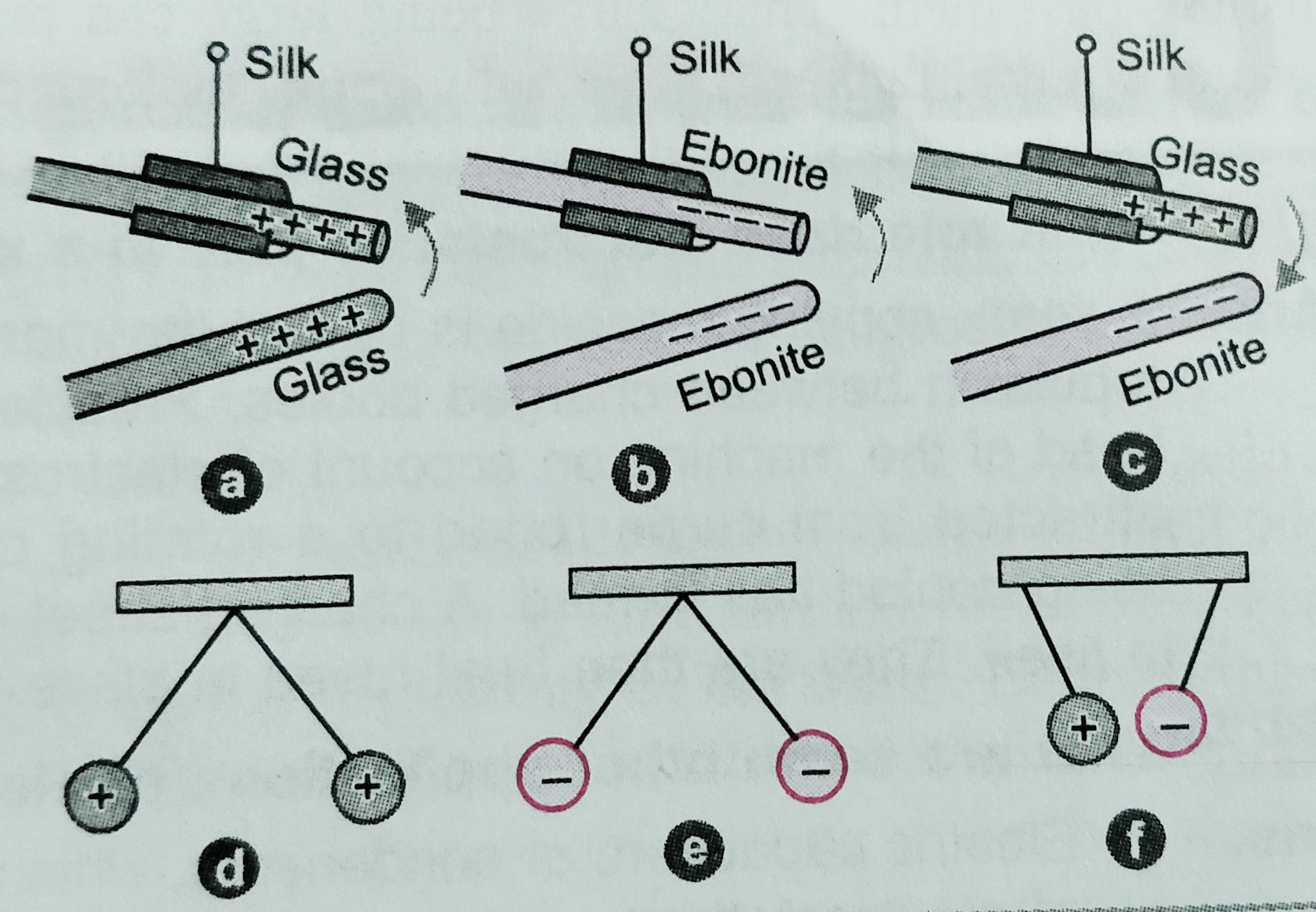
i) – A glass rod rubbed by a piece of silk brought closer to another glass rod rubbed by the silk cloth repel each other . But these glass rods attract the silk cloth with which it was rubbed . In this case the glass rods gets positive charge and silk cloths gets negative charge .
ii)- When an Ebonite / Amber rods are rubbed with a fur then Ebonite rod gets negative charge and fur gets positive charge.
Direct contact ( conduction)
iii)- When a pith ball is kept in contact with the rubbed glass or rubbed Ebonite rod pith balls get same kind of charge with which it is connected .
It can be understand with the help of following figure-
charging of bodies
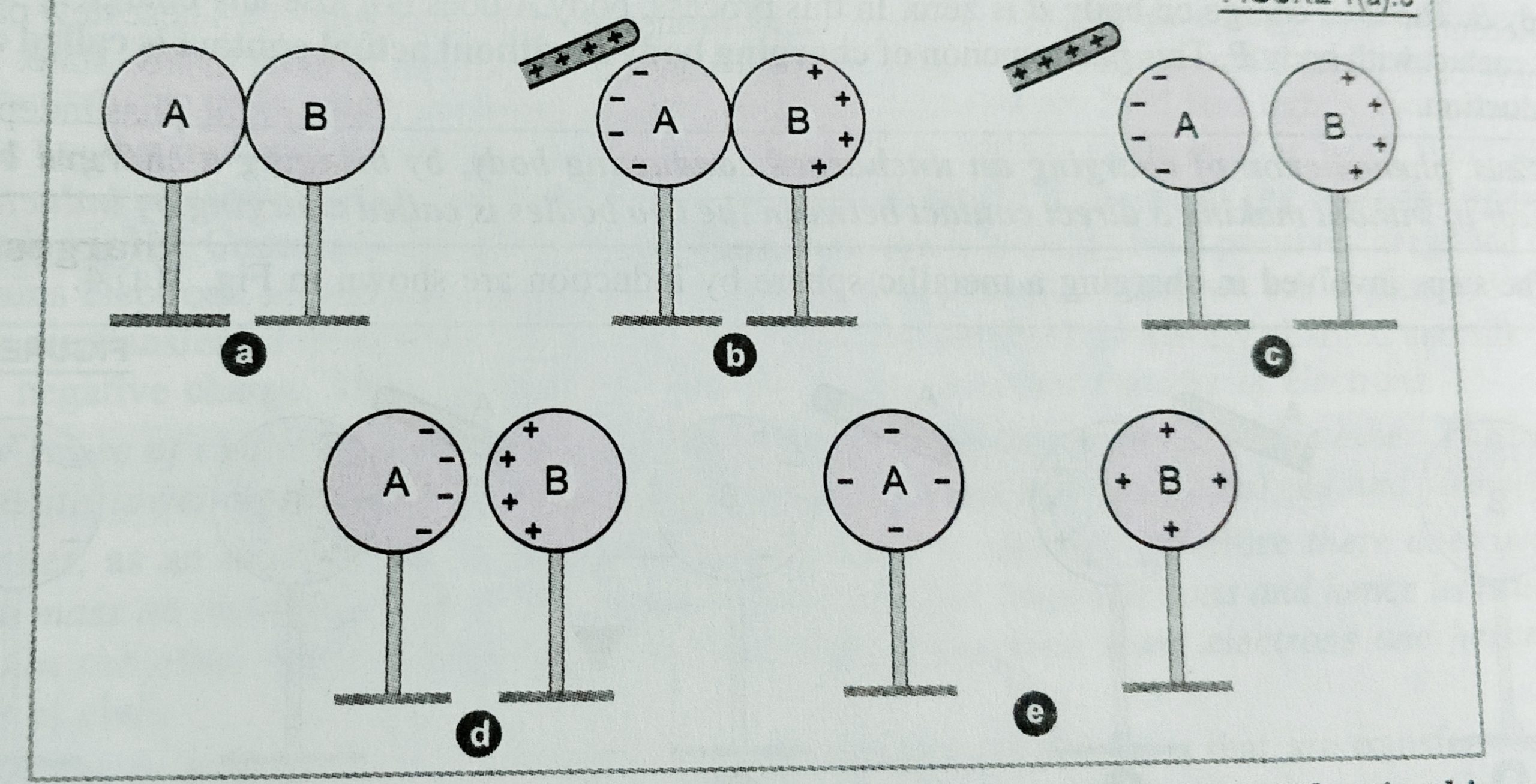
Induction – when a charge body ‘A’ is kept near an uncharged body ‘B’ then some charge of opposite sign appears on the near face of body ‘B’ , and equal charge of opposite sign is appear on the another face of body B . so we can say the process of charging of a body without actual contact is called induction .
Let us understand how can we charge a body by induction ; Suppose a positively charged glass rod is kept near an uncharged body ‘B’ , then free electrons of B comes on the surface near the body A but positive charge appear on the opposite face ( because sphere on whole remain neutral ) as shown in fig. again when the sphere B is grounded then electrons move from ground towards the sphere which neutralise the positive charge on the other side of the sphere . The negative charge at the near end remain on the sphere , and when rod A is removed the negative charge appears on the complete sphere . And finally body B gets negatively charged .
charging a body due to induction
Similarly we can see in fig. how can we charge two spheres by induction .
To view its video click on the video link given below –
Properties of charges –
When we see the several experiments carefully we will come to know that the following properties shown by the charged bodies –
(A) Like charges repel and unlike charges attracts , which is finally explained by the Coulomb . According to Coulomb’s The force of repulsion or attraction between charged body is directly proportional to the products of magnitude of charges and inversely proportional the square of the distance between the charged body .
(B) Quantisation of charge – It is the property of the charged particle due to which , the charge on a body is integral multiple of basic unit of charge i.e. electron (-e) or proton (+e) . It is given that charge on a body Q = n. e : where n is the integer . and e= 1.6 x 10⁻¹⁹ C .
( C ) Additivity of charge – It is the property of charge by virtue of which total charge of a system is obtained simply by adding algebraically all the charges present in the system . If q1 , q2 , q3 …… are the charges on the particle of the system then total charge on the system q= q1 + q2 + q3………. We should use proper sign of the charge during the addition of charges .
(D) Conservation of charge – According to this property total charge of the isolated system always remain constant . i.e. charge neither be created nor be destroyed but it can transfer from one body to another . When we rub a body then equal number of charges of opposite sign appear on the surfaces of these bodies .
To view its video click on video link given below –
This is the third sample paper physics class 12 published by physics classes by Nayan Jha . This question paper is totally based on new pattern (2020) applied by the CBSE , it will help the students to practice well before the examination . Physics classes by nayan jha already launched two sample paper previously .
Sample paper physics class12 (Third sample paper)-
1.If ɸ E.ds =0, a surface, that means:- (a)There is net charge present inside the surface (b)Uniform electric field inside the surface (c)Discontinuous field inside the surface (d)Charge present inside the surface
2.A parallel plate capacitor is charged by a battery. Once it is charged battery is removed now a dielectric material is inserted between the plates of the capacitor, which of the following does not change? (a)Electric field between the plats(b)Potential difference across the plates(c)Charge on the plates(d)Energy stored in the capacitor.
3.In a meter bridge experiment, resistance box(with R=2 Ω) is connected in the left gap and the unknown resistance S in the right gap. If balancing length be 40cm, calculate the value of S. (a)2 Ω (b)3 Ω (c)4 Ω (d)5 Ω
4.For a cell of emf 2V, a balance is obtained for 50cm of the potentiometer wire. If the cell is shunted by a 2 Ω resistor and the balance is obtained across 40cm of the wire, then the internal resistance of the cell is ; (a)1Ω (b)5 Ω (c)2 Ω (d)5 Ω
This assignment contains all important questions for class 11th physics.It will help the students to revise all questions in a short period of time .
If (p+ a/V2) (V-b)=RT where the symbols has their usual meanings, then what is the dimension of a/b .
If F= a/ b+√d , where f=force ,d= density , then find the dimension of a and b.
The factors effecting the time period (T) of the simple pendulum depends on mass , length and acceleration due to gravity . Deduce the relation for time period of the simple pendulum.
To determine acceleration due to gravity ,the time of 20 oscillations of a simple pendulum of length 100 cm was observed to be 40 s . calculate the value of ‘g’ and maximum percentage error in the measured value of ‘g’ .
If power P=a-x2/b where x represents displacement find the dimension of a and b.
A physical quantity Qis given by Q= A2.B3/2/C4D1/2 percentage error in A,B,C,D are 1%, 2%,4%,2% respectively . Find the percentage error in Q.
Write the expression for distance covered in nth second by uniformly accelerated body.
A ball is thrown vertically upwards. Draw its:
Velocity-time curve
Acceleration-time curve.
Draw velocity -time graph of uniformly accelerated motion in one dimension .From the velocity time graph of uniform Accelerated motion ,deduce the equation of motion in distance and time.
The displacement (in metre) of a particle moving along x-axis is given by
x=18 t + 5 t2.Calculate :
The instantaneous velocity at t=2s,
Average velocity between t=2s and t=3s, and
Instantaneous acceleration.
Derive an equation for the distance covered by a uniformly accelerated body in nth second of its motion. A body travels half its total path in the last second of its fall from rest . Calculate the time of its fall.
12.A body moving with a uniform acceleration describes 12 m in 3rd second of its motion and 20 m in the 5th second . find the velocity after 10 seconds.
A car travels first half of a length S with velocity u1. The second half is covered with velocities u2 and u3 for equal time intervals .Find the average velocity of the motion.
A body start from rest and accelerates uniformly .find the ratio of the displacement in, (1)one, two and three seconds, (2) first ,seconds and third second.
This assignment contains all important questions of the chapter kinetic theory of gases
KINETIC THEORY OF GASES
What are the basic assumptions of kinetic theory of gases ? on their basis, derive an expression for the pressure exerted by an ideal gas.
What is meant by degrees of freedom? State the law of equipartition of energy. Hence calculate the values of molar specific heats at constant volume and pressure for monoatomic , diatomic and triatomic gases.
Calculate the kinetic energy of one mole of argon at 127⁰ given that N =6.02×10²³ mol and k=1.381 x10⁻²³ mol-1K-1
Calculate the number of degrees of freedom for one mole of diatomic gas at N.T.P
Calculate the number of degrees of freedom of 1 cm3 of helium gas at N.T.P.
A vessel contains argon gas at 127⁰ find the average kinetic energy of argon molecule, if Boltzmann’s constant, k=1.38 x 10⁻²³ j mol -1 K-1
Calculate the total kinetic energy of 1g of helium at 27⁰C Given that R =8.31 mole -1 K-1.
At what temperature is the r.m.s velocity of a hydrogen molecule equal to that of a oxygen molecule at 47⁰C ?
Give the kinetic interpretation of temperature and define absolute temperature.
10. If three molecules have velocities 0.5,1 and 2km s-1 respectively, calculate the relation between the root mean square speed and average speed.
11. Calculate the temperature at which the r.m.s velocity of a hydrogen will be equal to 8km/hr. given that R =8.31 j mole -1.
12.Calculate the r.m.s velocity of CO2 molecules at N.T.P. given, R=8.31 j mol -1 K-1 .
13. Calculate the r.m.s velocity of hydrogen at N.T.P. given that density of the gas is 9×10⁻⁵ g cm -3.
14. Find the temperature at which the root mean square velocity of a gas is double than that its value at 0 ⁰C , pressure remaining constant.
15. The molar gas volume at S.T.P. is 22.4 litre and Avogadro number is 6.023×10²³. (a) calculate the number of gas molecules per unit volume,
16. Draw a graph to show the variation of V2rms with absolute temperature .
17. When an ideal gas undergoes an isothermal expansion, the pressure of the gas in the encloser falls. Why?
18. Two identical cylinders contains helium at 2.5 atmosphere and organ at 1 atmosphere. Find pressure if both the gases are filled in one of the cylinders?
19. The temperature of argon, kept in vessel, is raised by 1⁰C at constant volume. The total heat supplied to the gas is a combination of translational energies. Find their respective shares.
20. A gas mixture consist of 2 moles of oxygen and 4 moles of argon at temperature T. find total internal energy of the system, when vibrational modes are rejected.
Physics classes by Nayan Jha publishing the question paper of JEE (main) January 2020 asked in 9th of January second seating . the questions are memory based and it is taken from the any other different – different sites , and it posted after a correct view by the Nayan Jha ( director of physics classes by Nayan jha) . if there is iny wrong solution in the given paper then please message on the site , and give your feedback please , having saw your query ill try to correct my answer and i’ll try to provide most correct answer .
this year there are 25 questions in all sections ( physics/chem./ math ).
Having saw the standard of the question papers this year it is possible that cutoff Jee 2020 may be near about 75 marks (all together) . The standard of questions in physics was little bit tougher than average questions ( as it is asked previous years). The standard of questions was different for different day and different periods . students who solved questions more than 8 ( eight) is good for physics point of view , if such students will go for next examination ( April 2020) definitely will do batter with applying little bit more effort .
physics classes by nayan jha provides assignment for the objective questions of all chapters ( individually) , it will help the students preparing for JEE( main) / NEET and other board examinations. to download objective questions in all chapters visit – www.physicsclasses.online
This assignment contains all important questions of oscillations and waves , it will help the students preparing for the final class examination and prepare entire chapters in short time .
What do you mean by SHM ? Find expression for its displacement, velocity and acceleration , also write their phase difference .
What is meant by symmetric & Doppler effect?
How does the frequency of a tuning fork change, when the temperature is increase?
Tube a has both ends open, whole tube B has one end closed otherwise the two tubes are identical. what is the ratio of fundamental frequency of the tubes A and B?
When we start an empty bucket with water, the pitch of the sound produced foes on changing. Why?
A sine wave is travelling in a medium. What is the minimum distance between two particles always have same speed?
Two waves of the same frequency and amplitude superpose to produce a resultant disturbance of the same frequency. What is the phase difference between the waves?
A spring balance has a scale that reads from 0 to 50 kg. the length of the scale is 20cm. a body suspended from this spring, when displaced and released, oscillates with a period of 0.60 s. what is the weight of the body?
A spring of mass 2.50 kg is under a tension of 200 N. the length of the stretched string is 20.0 m. if a transverse jerk is struck at one end of the string, how long does the disturbance take to reach the other end.
A policeman on duty detects a drop of 15in the pitch of the horn of a motor car as it crosses him, if the velocity of sound is 330m/s, calculate the speed of the car.
This is the first sample paper designed on the basis of latest CBSE pattern , by physics classes by nayan jha. student may solve the entire question paper for the practice well before the examination. I also want to inform that such kind of question paper will be provided every week ( on sunday) student can download all question paper and test himself after solving all question papers.
Sample paper -1 .
Sec-A mark-1
Two charges 3×10⁻⁵ and 5×10⁴C are placed at a distance 10cm from each other. Find the value of electrostatic force acting between them. (a)5×10¹¹N(b)40×1011N(c)180×109N(d)5×10¹⁰N
When charge is supplied to a conductor, its potential depends upon (a)The amount of charge (b)Geometry and size of conductor (c)Both (a) & (b) (d)Only on (a)
Kirchhoff’s II law for the electric network is based on: (a)Law of conversation of charge (b)Low of conversation of energy (c)Low of conversation of angular momentum (d)Low of conversation of mass
In a whetstone’s bridge, all the four arms have equal resistance R. if resistance of the galvanometer arm is also R, then equivalent resistance of combination is (a)R(b)2R(c)R/2(d)R/4
In a certain reason of space, electric filled E vector and magnetic filled b vector are perpendicular to each other. An electron inters perpendicularly to both the fields and move undeflected. The velocity of electron is (a)E/B (b)B/E (c)E vector x B vector (d)E vector. B vector
How does the focal length of a convex lens changes if mono chromatic red light is used instead of violet light? (a)Focal length is increased when red light is used (b)Focal length is decreases when red light is used (c)Focal length is remain same when red light is used (d)Not depends on colour of light.
the phenomenon of polarization is exhibited by (a)longitudinal wave(b)matter wave(c)transverse wave(d)mechanical wave
which of the following is correct for” Malus Law” (a)I=I2v cos2 θ(b)I=Iv cos2 θ(c)I=I2v sin2 (d)I=Iv tan-1 θ
the theory on the basis of photoelectric effect can be explained: (a)Corpuscular theory(b)Wave theory(c)Electromagnetic theory(d)Quantum theory
10.When alpha particle are sent through a thin gold foil, most f beam go straight through the foil because (a)Alpha particles are positively charged(b)Alpha particles are is more than mass of electron(c)Most of the part of an atom is empty space(d)Alpha particles moves with high velocity
this assignment will provide the important Objective questions of ray optics for students preparing for class-12th board examination and for the students preparing for JEE/NEET and other competitive examinations.
Reflection and Refraction of Light at Plane Surface ( Objective questions of ray optics)
When light travels from glass to air, the incident angle is and the refraction angle is .the true relation is :(a)θ 1 =θ 2 (b) θ 1 >θ2 (c)θ1 <θ2 (d)Not predictable
Two mirrors are kept at 60 to each other and a body is placed in the middle.The total number of images formed is:(a)Three(b)Four (c)Five (d)Six
If an object is placed unsymmetrically between two plane mirrors inclined at an angle 72 ,then the total number of images formed is:(a)5 (b)4 (c)2 (d)infinite
If an object is placed symmetrically between two plane mirrors, inclined at an angle of 72 .than the total total number of images formed is:(a)5 (b)4 (c)2 (d)Infinite
5) A ray of light is incident on a plane mirror at an angle of incidence of 30⁰ ,the deviation
Produced by the mirror is :
(a) 30 ⁰ ( b) 60⁰
(c) 90⁰ (d) 120
6) when a ray of light enters a glass slab from air:
(a) its wavelength decreases
(b) its wavelength decreases
(c) its frequency increases
(d) neither wavelength nor frequency changes
7) When a light enters from air to water, then its:
(a) frequency increases and speed decreases
(b) frequency is the same but the wavelength is smaller in water then in air:
(c) frequency is same but wavelength in water is greater than in air
This assignment contains all important objective questions of capacitance, it will be beneficial for the students preparing for class 12th board examination or preparing for JEE/NEET.
There are 27 drops of a conducting fluid. Each has a radius r and they are charged to a potential V0. These are combined to from a bigger drop. Its potential will be:
(a)V0 (b) 3V0 (c) 9V0 (d) 27V0
1000 small water drops each of radius r and charge q coalesce together to from one spherical drop. The potential of the bigger drop is larger than that of the smaller one by a factor:
(a)1000 (b) 100 (c) 10 (d) 1
The capacitance of a parallel plate condenser does not depend upon:
(a)area of the plates
(b)medium between the plates
(c)distance between the plates
(d)metal of the plates
The force between the plates of a parallel plate capacitor of capacitance C and distance of separation of the plates d with a potential difference V between the plates is:
(a)CV2/2d (b) C2V2/2d2 (c) C2V2/d2 (d) V2d/C
A parallel plate capacitor is made by stacking n equally spaced plates connected alternately. If the capacitance between any two plates is C, then the resulting capacitance is:
(a)C (b) nC (c) (n-1)C (d) (n+1)C
Two parallel metal plates carry charge +Q and -Q respectively. A test charge q0 placed between them experiences a force F. Now the separation between the plates is doubled, then the force on the test charge will be:
(a)F (b) 2F (c) F/2 (d) F/4
A 2μF capacitor is charged to a potential of 200 V and then isolated. When it is connected in parallel with a second capacitor which is uncharged, the common potential becomes 40 V. The capacitance of the second capacitor is:
(a)2μF (b) 4μF (c) 8μF (d) none of these
Three capacitors of capacitance 12μF each are available. The minimum and maximum capacitance which may be obtained from these are: