Tag: kinematics

  • Projectile motion

    Projectile motion

    Projectile motion

    Projectile given horizontal projection and projectile given angular projection

    In this topic we will discuss about projectile given horizontal and projectile given angular projection. And we will derive the expressions for equation of trajectory, time of flight , vertical height , horizontal range and velocity of projectile at any time .

    Projectile motion-

    When a body has given some initial velocity , and body allowed to move in two dimensional motion under the action of gravitational force only ( i.e. there is no any external force acting on the body ) such kind of motion of the body is called projectile motion .

    • Important things to know about the projectile motion- projectile moves with constant horizontal velocity, there are no any external force it means there is no acceleration or retardation in horizontal motion.
    • The vertical velocity changes with time i.e. increases or decreases when moves downward or upward direction respectively under the gravitational acceleration.
    • There is no air resistance ( practically it is not possible in earth surrounding , but considered)
    • The magnitude of acceleration due to gravity remain constant at every point it doesn’t changes even at height or depth.
    • Projectile given horizontal projection-
    • HORIZONTAL PROJECTION
      HORIZONTAL PROJECTION

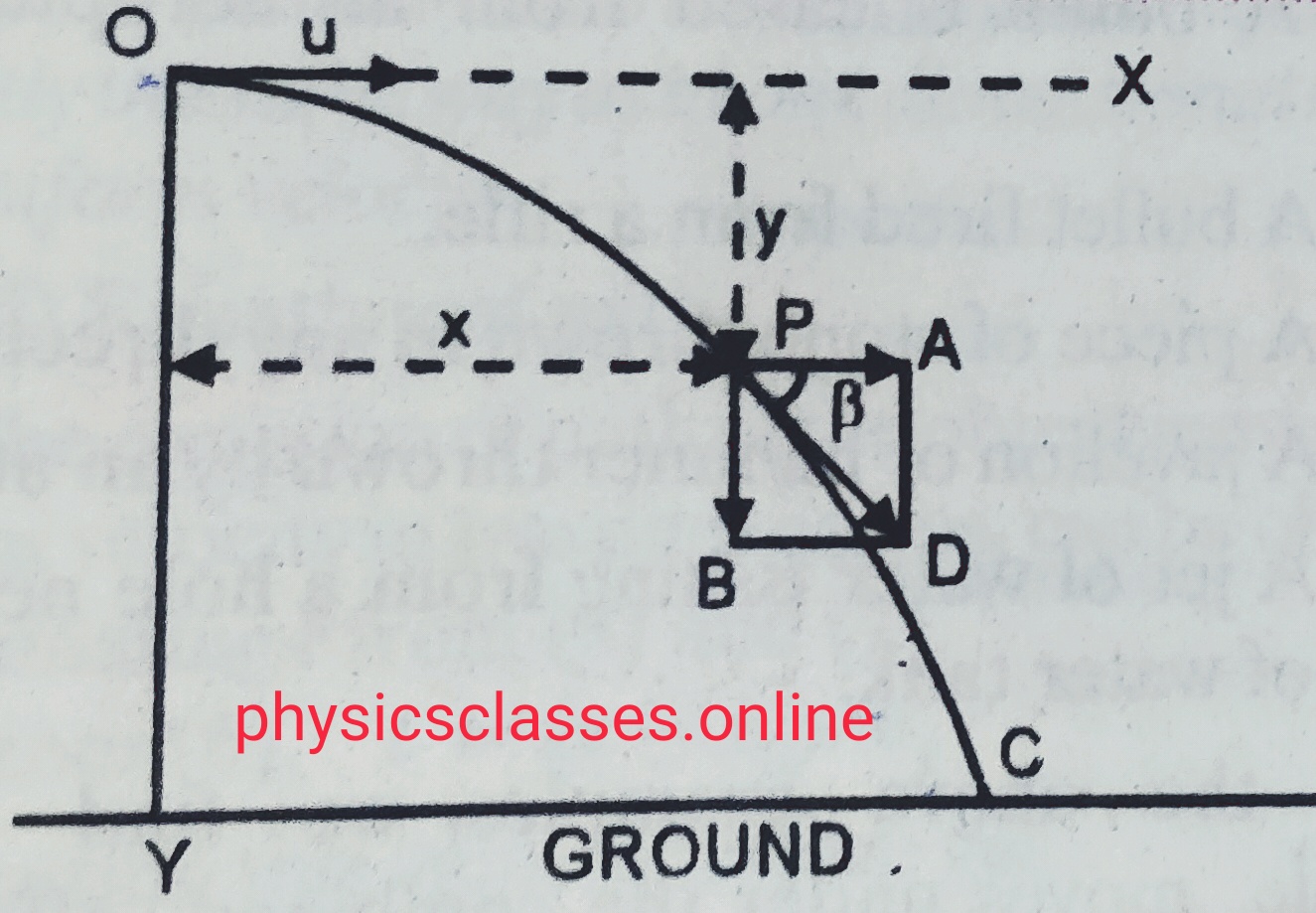
    Suppose OX a horizontal line is parallel to the ground and oy is vertical height. A body is projected with velocity  u in horizontal direction ,

    so, ux = u and uy = o

    Let t is the time taken by the body to reach from initial point O to final point C ( as shown in fig. ) then ,    horizontal distance X = ux x t  = u x t

    so  t= x /u

    Again for vertical motion  Y = uyt + ½ gt2 = 0 + ½ gt2

    y = ½ g (X/u)2

    or , Y = ½ g X2/u2……………………..(i) This the equation of trajectory which is equation of parabola , then we can say path followed the projectile is parabolic .


    Time of flight (T)  – It is the time taken by the projectile to reach from initial to final position , let T is the time of flight and H is the height ,

    Then,  from equation of motion  Y = uy + ½ gT2

    ( but uy =0)

    so, Y= ½ g T2

    or ,  T = √2H/g ………………(ii)

    Horizontal range (R)   – It is the horizontal distance covered by the projectile during its flight . Since there is no acceleration in horizontal direction.

    So , distance = speed x time

    X = R = u x T = u √2H/g .

    Velocity of the projectile at any time ‘t’ –  As shown in fig. at point p  , there are are two components of the velocity ,  vx and vy along horizontal and vertical direction respectively , then , v =  √(vx)2 + (vy)2

    Or , v = √ u2 +(gt)2 ( since , vx = u and vy = gt )

    Let v makes an angle β with the horizontal then , tanβ = vy/vx

    Or , tanβ = gt/u .

    Or , β = tan-1(gt/u) with the horizontal.

    TO SEE THE VIDEO ON PROJECTILE GIVEN HORIZONTAL PROJECTION CLICK HERE-

    Projectile given angular projection- 

    ANGULAR PROJECTION
    ANGULAR PROJECTION

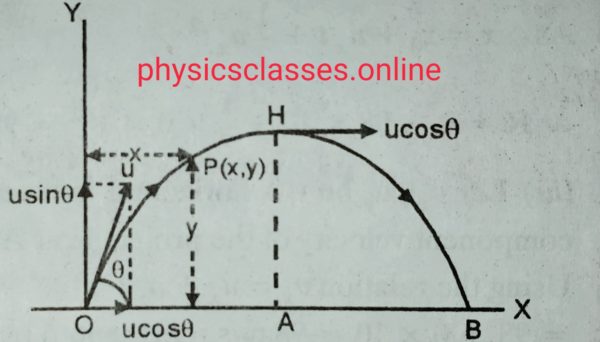
    Suppose a projectile is projected at an angle θ with horizontal , and velocity given to the projectile is ‘u’ . OX and OY are the horizontal and vertical axis respectively . Then the component of velocity along OX and OY are respectively u cosθ  and  u sinθ .


    Equation of trajectory-  let  ‘t’ is the time taken by the projectile to reach from point O to point B as shown in fig.

    Then horizontal distance X = u cosθ x t ,

    Or, t=x/ucosθ

    But for vertical motion ,  y= uyt + ½ g t2

    Putting the  value of time in the above equation we get ,

    Y = usinθ .( x/ucosθ)   + ½ g ( x2/ u2 cos2θ) .

    Or , y=  x tanθ + ½ g (x2/u2 cos2θ) …………………….this is the equation of trajectory , which is parabolic . Hence we can say path followed by the projectile is parabolic .


    Time of flight (T) –     It is the total time taken by the projectile to reach from initial position to the final position .   Total time of flight ( T) =  ta ( time of ascent) + td (time of descent ) .

    [       Time of ascent is the time taken by the projectile to reach to max. height by the projectile. And time of descent is the time taken by the projectile to reach from highest position to the point on the ground .]

    As we know , for ascending motion , v = uy – gta

    But at highest point v=0 , so , 0= u sinθ – g ta

    g ta = u sinθ

    ta = u sinθ/g ;

    Hence, Time of flight  , T = 2 ta = 2u sinθ/g ……………eq.


    maximum height(H) – It is the maximum vertical height attained by the projectile above the point of projection during its flight .

    from 3rd equation of motion v2 -u2 =2as ;

    0 – u2sin2θ = – 2gH

    H = u2sin2θ/2g ……………………eq.

    Horizontal range(H) –  It is the displacement of the projectile  between point of projection and point of hitting the ground .

    Since there is no acceleration in horizontal direction and hence

    X= R = u cosθ x T = u cosθ . 2u sinθ/g = u2 2sinθ cosθ/g  = u2 sin2θ /g ;

    Range R = u2 sin2θ /g ………………eq.

    TO SEE THE COMPLETE VIDEO ON PROJECTILE GIVEN HORIZONTAL PROJECTION CLICK HERE-

    Velocity of projectile at any time –

    VELOCITY OF PROJECTILE AT ANY INSTANT
    VELOCITY OF PROJECTILE AT ANY INSTANT

    At ant time the velocity has two components vx (velocity along x- axis) and vy (velocity along y-axis ). So at any time velocity v= √vx2 + vy2

                                                                                           v = √ [u2 cos2 θ + (u sinθ – gt)2 ].

    Or , v = √ (u2 + g2t2-2ugt sinθ ).

    Let β be the angle of resultant velocity with horizontal direction then ,

    Tanβ = (u sinθ-gt) / (ucosθ)

    [ ***** note- question based on the projectile may be asked to find the all equations but angle of projection is θ with the vertical instead of  horizontal in that case  , at the place of sinθ take cosθ and vice-versa .*******]
  • What do you mean by Relative velocity ?

    What do you mean by Relative velocity ?

    This topic will discuss about the velocity of an object with respect to another object. In this article you will learn Relative Velocity Analysis  in both forms text and video as well.

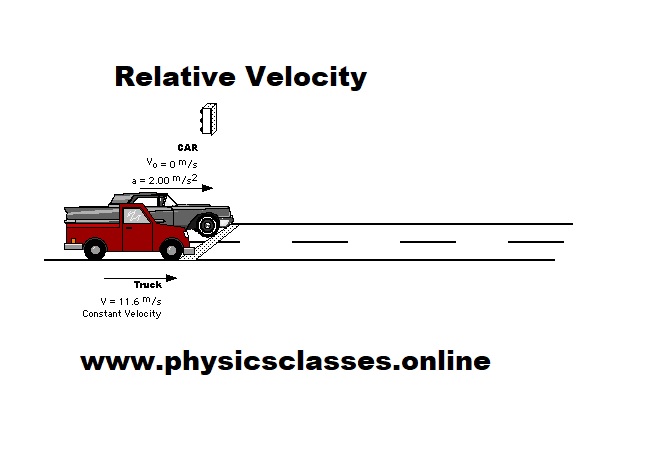
     Relative velocity of one object with respect to another is the velocity with which one object moves with respect to another object .When two objects A and B are moving with different velocities , then the velocity of one object A with respect to another object B is called relative velocity of object A with respect to object B , hence relative velocity is defined as the time rate of change of relative position of one object with respect to another.

    • Watch Relative Velocity Analysis Video :

    Expression for the relative velocities – Suppose two objects A and B moving with uniform velocities VA and VB respectively along parallel straight line path in the

    (i) Same direction (I.e. angle between them is 00)  ;

    Relative velocity of A with respect to B = VA -(VB ) = VA -VB


    (ii) Opposite direction (I.e. angle between them is 1800)

    Relative velocity of A with respect to B = VA – (-VB ) = VA + VB

    To read or download complete topic of Relative velocity click here-


    Download QA for various chapters of Physics 


  • MOTION

    MOTION

    MOTION

    MOTION , THERE DIFFERENT TYPES, AND EQUATIONS OF MOTION .

    MOTION OF AN OBJECT


    Motion –

    Rest and Motion -An object is said to be in rest , if body does not change its position with time , with respect to surroundings . An object is said to be in motion , if body  changes its position with time , with respect to surroundings .

    Motion of the body can be of following type –

    • Rectilinear / Translatory motion – In rectilinear motion a point mass body moves along a straight line . but in translator motion a body which is not a point mass moves in a straight line path.


    • Circular or rotatory motion – In circular motion a point mass object moves on a circular path. But in rotatory motion a body which is not a point mass moves on a circular path .


    • Oscillatory or vibratory motion– oscillatory motion is a type of motion in which a body moves to and fro or back and forth repeatedly about a fixed point. If in the oscillatory motion, amplitude is very small then the motion of the body is said to be in vibratory motion.


    Motion in one , two and three dimensions-

    • One dimensional motion– The motion of a body is said to be in one dimensional if only one co-ordinate specify the position of the object in the given time. In such a motion body moves along a straight line
    • Two dimensional motion– The motion of a body is said to be in two dimensional if any two coordinate specify the motion of the body.
    • Three dimensional motion – The motion of a body said to be in three dimensional if all three coordinates specify the motion of the body . in such kind of motion body may cover a specific motion or irregular motion.


    UNIFORM AND NON-UNIFORM MOTION- 

    Uniform motion – If a body covers equal distance in equal interval of time then it is said the motion of a body is uniform .

    Some important features of the uniform motion is following-

    (a) For a uniform motion  along a straight line in a given direction , the distance and magnitude of the displacement remain the same .

    (b) The velocity in uniform motion doesn’t depend upon the time interval .

    (c)There is no need of force for an object to be in uniform motion .

    (d) The velocity in uniform motion is in dependent of choice of origin.

    (e) The average and instantaneous velocities have value in uniform motion.


    If the motion of the object is uniform the following formula is used to find the

    different– different physical quantities .


    Distance = speed x time ;    speed = distance / time


    Displacement = velocity x time ;   Velocity = displacement / time ;

    Average speed = total distance covered / total time taken .


    Average velocity = total displacement covered / total time taken


    V =  X2-X1 / t2-t1 .


    Non-uniform motion- An object is said to be in non-uniform motion if it covers unequal distance in equal interval of time ,or equal distance in unequal interval of time. The velocity of a body changes with time it may increase ( accelerated ) or decrease (deaccelerate) with time .

    Following are the important equations of motion– for uniformly accelerated motion

    • 1st of motion ( it is also known as velocity – time relation)- v = u + at ( Where v=final velocity, u= initial velocity , a= acceleration, t = time taken .)
    • 2nd of motion (it also known as distance – time relation ) – S=ut+1/2 at2 (where s=displacement ;  u = initial velocity ; a= acceleration ; t = time taken .)
    • 3rd of motion (it is also known as the velocity- position relation) – V2-U2=2aS (where – S= displacement ; V= final velocity ; U= initial velocity ; a= acceleration .)

    TO SEE THE VIDEO FOR THE DERIVATION OF ALL THREE EQUATIONS OF MOTION CLICK HERE-

    • 4th of motion ( distance covered by the body in nth second ) Snth = u+ a(2n-1)/2 . (where Snth = distance covered in nth second ; a= acceleration ; n= given time ; u= initial velocity .)

    TO SEE THE VIDEO FOR THE DERIVATION OF 4th EQUATION OF MOTION CLICK HERE-


     To download  objective practice paper of motion in st line (akash)click here-

    the above assignment wiil be very helpful for the student preparing for NEET/ JEE and class 12-th board examination.