Tag: Oscillations and waves

  • Beats

    BEATS
    If two tuning fork whose frequency is slightly different are sounded together , the sound we hear periodically fluctuates in intensity , i.e intensity increases and decreases suddenly . This periodic variations in intensity of sound are called beats.

    So we can define “ Beats are periodic vibration in the intensity of sound when two sound wave of nearly same frequency travel in the same direction. One loud sound followed by a faint sound from one beat and the number of beats formed per second is called beat frequency”.

    Graphical method for the formation of beats-
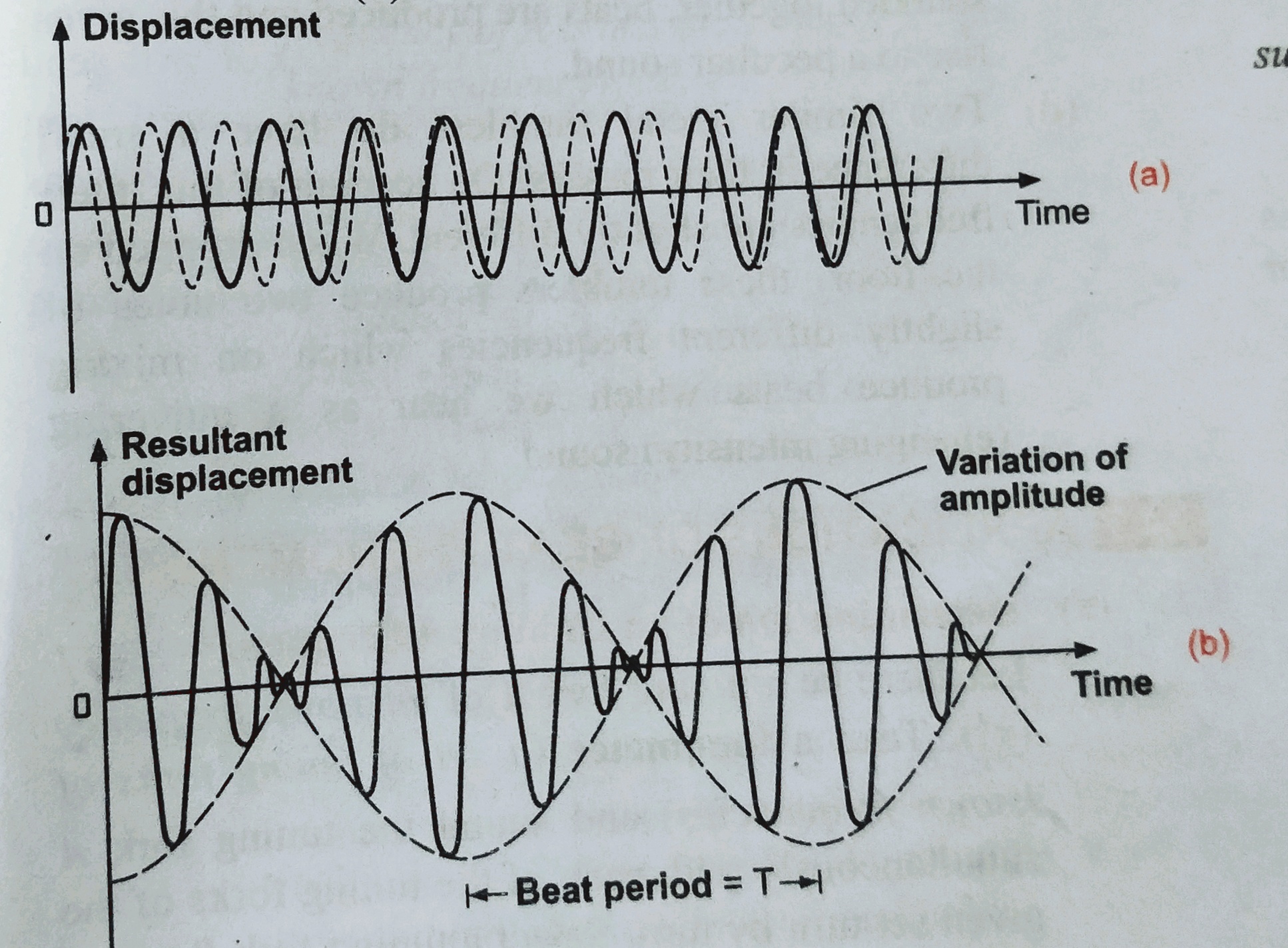
    As shown in fig (a) Two waves ( One in dotted and other in dark line). When they superimpose then due to the superposition principle , at T=0 the intensity becomes max and at T= T/2 Intensity becomes minimum which is ‘0’ . This process happening again and again.

    And number of beats per second or beats frequency is equal to difference in frequency between these two waves.

    Suppose the beat period is T and that during this time one wave of frequency n1 , makes one cycle more than the other wave of frequency n2 . The number of cycle of frequency n1 in time T = n1T. And number of cycle of frequency n2 in time T = n2T.

    According to the given condition, n1T-n2T = 1

    Or   

    n1-n2 = 1/T = n0 (resultant frequency).

    Analysis of graph shown in figure-

    (1)The resultant wave oscillates with the average of the frequencies of the individual waves .

    (2) The resultant amplitude oscillates with a beat frequency that is equal to the difference between the two frequencies.

    Application of beat phenomenon

    (i) Determination of unknown frequency

    (ii) By loading tuning fork with wax.

    (iii) By loading the tuning fork

    (iv) Tuning musical instrument

    (v) In electronics.

  • Important questions of oscillations

    Important questions of oscillations-

    1. What is meant by periodic and oscillatory motion? Distinguish between them.

    2. What is meant by SHM . Find the expressions for displacement , velocity and acceleration. Also find the phase difference between them.

    3. Find the potential energy and kinetic energy of a SHM and hence show that total energy is conserved . In what position of the oscillation is the energy wholly kinetic and wholly potential?

    4. Prove that for an harmonic motion time period T = 1/2π(spring factor/inertial factor)1/2.

    5. What is simple pendulum? Derive expression for the time period or frequency of the oscillating simple pendulum. Also explain the second pendulum and find the length of the second pendulum on the surface of earth.

    TO GET THE IMPORTANT QUESTIONS OF MECHANICAL PROPERTIES OF FLUID CLICK HERE-

    6. Show that vibration of the liquid in the U-Tube is simple harmonic and also find the expression for the time period and frequency .

    7. Explain the term (i) Free vibration (ii) Forced vibration (c) Resonant vibration (d) Damped oscillation.

    8. A cylinder floating in water is temporarily pushed down . Derive an expression for its frequency.

    9. Obtain an expression for the time period of a loaded and massless spring (i) Oscillating horizontally (ii) oscillating vertically . Show that is the same as the simple pendulum of length equal to the extension of the spring?

    Numericals-

    1. A body describe S.H.M. with am amplitude of 5cm . and a period of 0.2sec . Find the acceleration and velocity  of the body when the displacement is (a) 5cm (b)3cm (c)0cm.

    2.  Simple pendulum of length l and having a bob of mass m is suspended in a car . The car is moving on a circular path of radius R with a uniform speed v . If the pendulum makes small oscillation in a redial direction about its equilibrium position . What will be its time period?  

    3. A spring balance has a scale that reads from 0 to 50 kg . the length of the scale is 20cm. A body suspended from this balance when displaced and released , oscillation with a period of 0.60 sec. What is the weight of the body?                                            Ans-219N

    4. The acceleration due to gravity on the surface of the moon is 1.7m/s2. What is the time period of the simple pendulum on the moon if its time period on the surface of the earth is 3.5sec?     Ans-8.4 sec

    5. A spring with spring constant 1200N /m is mounted on the horizontal frictionless table , a mass of three kg it attached to the free end of the spring . The mass is then pulled sideway to a distance of 2cm and released . Determine (a) the frequency of oscillation (b)the maximum acceleration of the mass (c) The maximum speed of the mass.          Ans- 3.2 ; 8.1 ; 0.4

    To get the very important questions of Thermodynamics click here-

  • Important questions of oscillations and waves

    Important questions of oscillations and waves

    Important questions of oscillations and waves

    This assignment contains all important questions of oscillations and waves , it will help the students preparing for the final class examination and prepare entire chapters in short time .

    1. What do you mean by SHM ? Find expression for its displacement, velocity and acceleration , also write their phase difference .
    2. What is meant by symmetric & Doppler effect?
    3. How does the frequency of a tuning fork change, when the temperature is increase?
    4. Tube a has both ends open, whole tube B has one end closed otherwise the two tubes are identical. what is the ratio of fundamental frequency of the tubes A and B?
    5. When we start an empty bucket with water, the pitch of the sound produced foes on changing. Why?
    6. A sine wave is travelling in a medium. What is the minimum distance between two particles always have same speed?
    7. Two waves of the same frequency and amplitude superpose to produce a resultant disturbance of the same frequency. What is the phase difference between the waves?
    8. A spring balance has a scale that reads from 0 to 50 kg. the length of the scale is 20cm. a body suspended from this spring, when displaced and released, oscillates with a period of 0.60 s. what is the weight of the body?
    9. A spring of mass 2.50 kg is under a tension of 200 N. the length of the stretched string is 20.0 m. if a transverse jerk is struck at one end of the string, how long does the disturbance take to reach the other end.
    10. A policeman on duty detects a drop of 15in the pitch of the horn of a motor car as it crosses him, if the velocity of sound is 330m/s, calculate the speed of the car.
    11. The third overtone of a closed organ pipe is found to be in unison with the first overtone of an open pipe. Find the ratio of the length of the pipes.                                                                                                                                                                                                                    TO download OSCILLATIONS and WAVE important questions click here-.