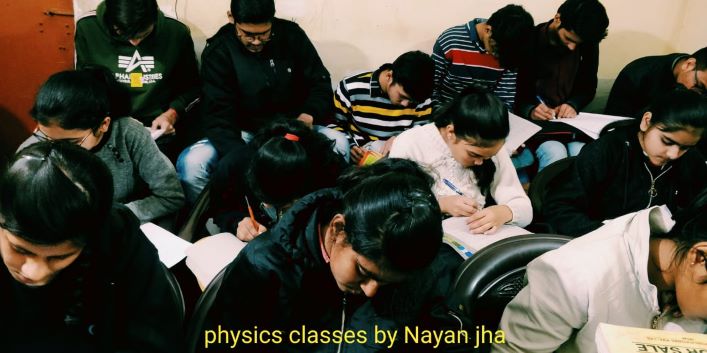
How to score better marks in physics class 12 physics
To download latest physics sample paper click here-
CBSE Class 12 Physics Board Exam: Smart Strategy to Score Better Marks in physics.
In this blog Physics by Nayan Jha going to tell you, about the smart strategy to score better in physics class 12th board examination.
Class 12th Physics Board Examination is not only about studying for long hours; it is about studying with the right strategy, proper revision and consistent practice. Many students understand the concepts but lose marks because of incomplete preparation, calculation mistakes, poor time management and lack of practice in objective-type questions.
With the right approach, Physics can become one of the scoring subjects in the CBSE Board Examination.
1. Make a Realistic Study Schedule
Students should focus on quality study hours rather than simply counting the number of hours.Try to study Physics for around 2–3 focused hours every day, depending on your overall timetable and preparation level.A simple daily routine can be:
– 45–60 minutes: Concept revision
– 45–60 minutes: Numerical and derivations
– 30–45 minutes: Objective questions
– 15–20 minutes: Quick revision of formulas
Consistency is more important than studying for 8–10 hours on one day and then taking a long break.
2. Give Special Attention to Objective Questions
To download the important objective class12th click here-
The pattern of board examinations has increasingly placed importance on conceptual and application-based questions. Therefore, students should not prepare Physics only by solving long-answer questions.
Practice regularly:
– MCQs
– Assertion-Reason questions
– Case Study-based questions
– Competency-based questions
– Numerical-based MCQs
– Statement-based questions
Physics by Nayan Jha Suggestion:
Don’t wait until the last few days to start objective preparation. Solve a small set of objective questions every day.
3. Understand the Concept Before Memorising the Formula
Physics is not a subject where memorising formulas alone is enough.
Before using a formula, understand:
What does the formula represent?
When can it be used?
What are the units of each quantity?
What happens when one variable changes?
This approach is particularly useful for MCQs, Assertion-Reason and application-based questions.
4. Make a Chapter-wise Formula Sheet
Prepare a separate formula sheet for every chapter.
For example, revise:
– Important formulas
– SI units
– Dimensions
– Graphs
– Important laws
– Important definitions
– Special cases
– Frequently used relations
Revise these sheets regularly instead of opening the entire textbook every time.
5. Don’t Ignore NCERT
For CBSE Board preparation, NCERT should remain one of the most important resources.
Students should thoroughly study:
– NCERT theory
– Important definitions
– Diagrams
– Examples
– Derivations
– Numerical problems
After completing NCERT, move towards sample papers and additional practice questions.
6. Practice Numericals Every Day
Many students understand the theory but lose marks in numerical questions because they do not practice enough.
While solving a numerical, follow this sequence:
Given → Formula → Substitution → Calculation → Final Answer with Unit
Also pay attention to:
– Sign conventions
– SI units
– Powers of 10
– Significant figures where applicable
– Direction of vectors
Regular numerical practice improves both speed and accuracy.
7. Prepare Important Derivations
Do not leave derivations for the last week.
Prepare the important derivations chapter-wise and practise writing them without looking at the book.
While writing a derivation:
1. Start with the relevant law or principle.
2. Write the required equation.
3. Show the mathematical steps clearly.
4. Draw the diagram wherever required.
5. Highlight the final result.
A neat and logically arranged answer makes your solution easier to evaluate.
8. Solve Sample Papers and Previous Questions
Once you have completed the syllabus, start solving full-length papers under examination conditions.
Try to complete the paper within the prescribed time.
After every paper, analyze :
– Which questions were wrong?
– Which concepts were weak?
– Where did you lose time?
– Were there calculation mistakes?
– Did you leave any question incomplete?